
Applying Learning Theory to Tutoring Stony Brook University
Applying Learning Theory to Tutoring Stony Brook University Academic Success and Tutoring Center
? Why should tutors understand use learning theory?

Learning theories can: Ø Inform our tutoring practice by providing us with insights into how students learn and develop Ø Provide a basis to determine relevant and effective approaches to use with students
Students experience many forms of development throughout their college experiences. The following chart depicts a few domains of this development…
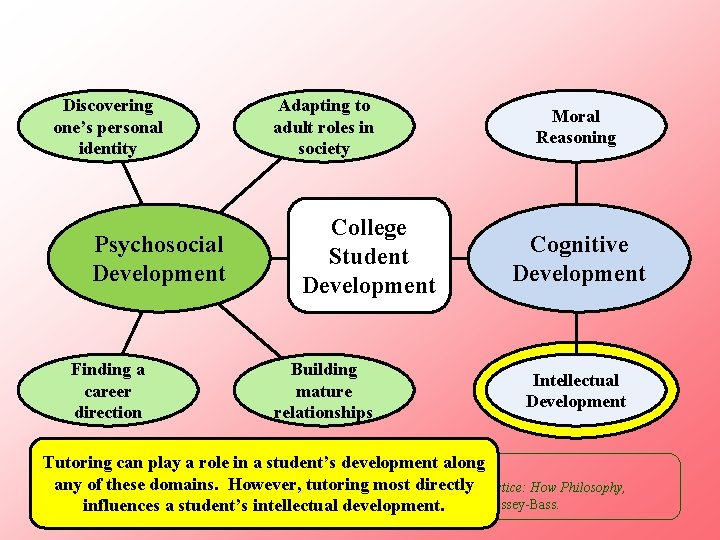
Discovering one’s personal identity Psychosocial Development Finding a career direction Adapting to adult roles in society College Student Development Building mature relationships Moral Reasoning Cognitive Development Intellectual Development Tutoring can play a role in a student’s development along Source: any of F. , these domains. However, tutoring most directly Hamrick, Evans, N. , & Schuh, J. (2002). Foundations of Student Affairs Practice: How Philosophy, Theory, and Research Outcomes. San Francisco, CA: Jossey-Bass. influences a Strengthen student’s. Educational intellectual development.
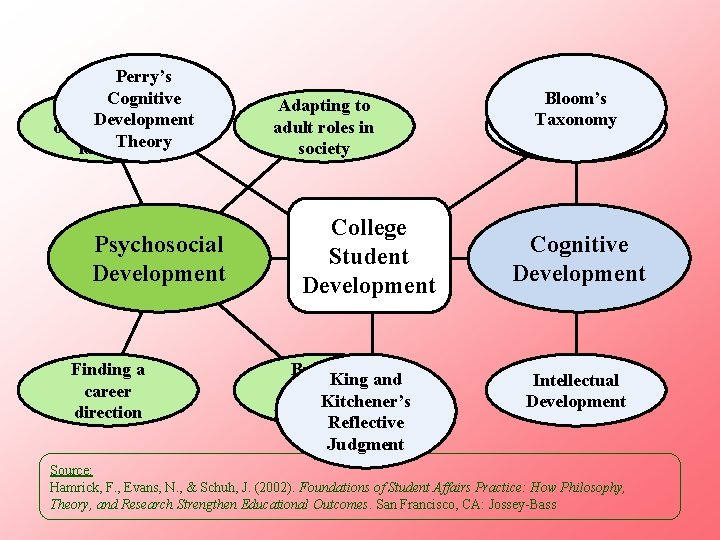
Perry’s Cognitive Discovering one’s Development personal Theory identity Psychosocial Development Finding a career direction Adapting to adult roles in society College Student Development Building King and mature Kitchener’s relationships Reflective Judgment Bloom’s Moral Taxonomy Reasoning Cognitive Development Intellectual Development Source: Hamrick, F. , Evans, N. , & Schuh, J. (2002). Foundations of Student Affairs Practice: How Philosophy, Theory, and Research Strengthen Educational Outcomes. San Francisco, CA: Jossey-Bass
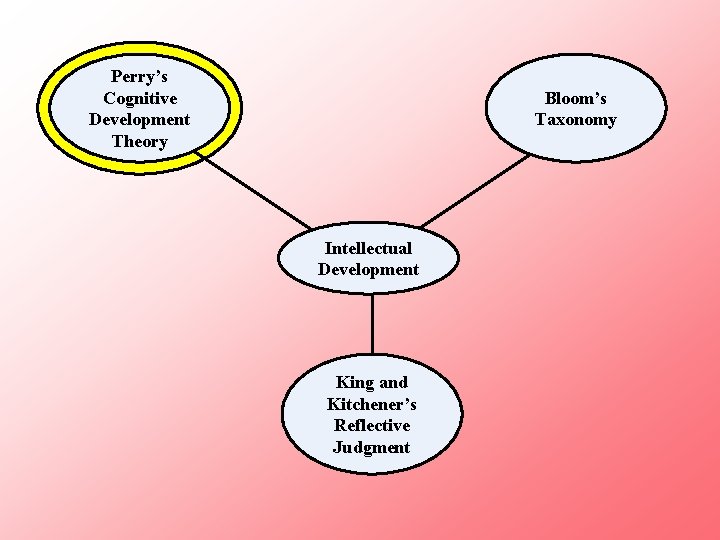
Perry’s Cognitive Development Theory Bloom’s Taxonomy Intellectual Development King and Kitchener’s Reflective Judgment
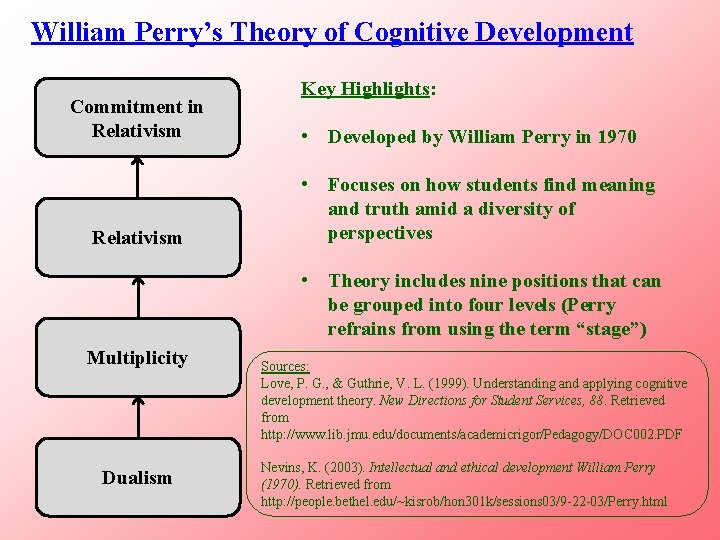
William Perry’s Theory of Cognitive Development Commitment in Relativism Key Highlights: • Developed by William Perry in 1970 • Focuses on how students find meaning and truth amid a diversity of perspectives • Theory includes nine positions that can be grouped into four levels (Perry refrains from using the term “stage”) Multiplicity Dualism Sources: Love, P. G. , & Guthrie, V. L. (1999). Understanding and applying cognitive development theory. New Directions for Student Services, 88. Retrieved from http: //www. lib. jmu. edu/documents/academicrigor/Pedagogy/DOC 002. PDF Nevins, K. (2003). Intellectual and ethical development William Perry (1970). Retrieved from http: //people. bethel. edu/~kisrob/hon 301 k/sessions 03/9 -22 -03/Perry. html
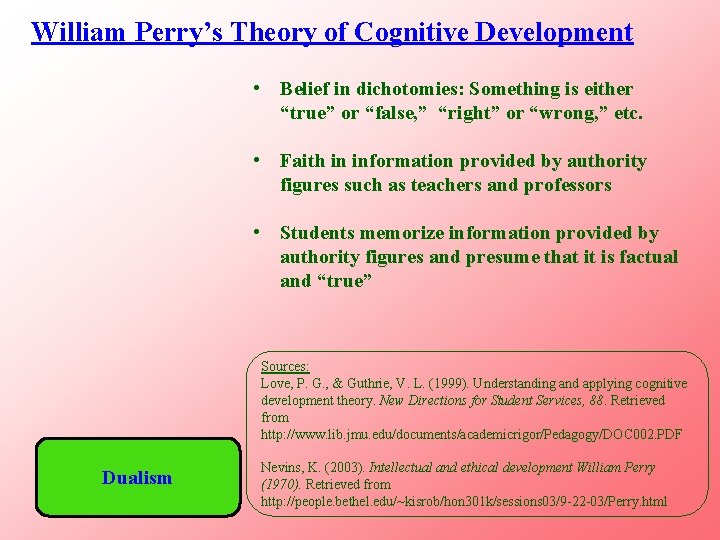
William Perry’s Theory of Cognitive Development • Belief in dichotomies: Something is either “true” or “false, ” “right” or “wrong, ” etc. • Faith in information provided by authority figures such as teachers and professors • Students memorize information provided by authority figures and presume that it is factual and “true” Sources: Love, P. G. , & Guthrie, V. L. (1999). Understanding and applying cognitive development theory. New Directions for Student Services, 88. Retrieved from http: //www. lib. jmu. edu/documents/academicrigor/Pedagogy/DOC 002. PDF Dualism Nevins, K. (2003). Intellectual and ethical development William Perry (1970). Retrieved from http: //people. bethel. edu/~kisrob/hon 301 k/sessions 03/9 -22 -03/Perry. html
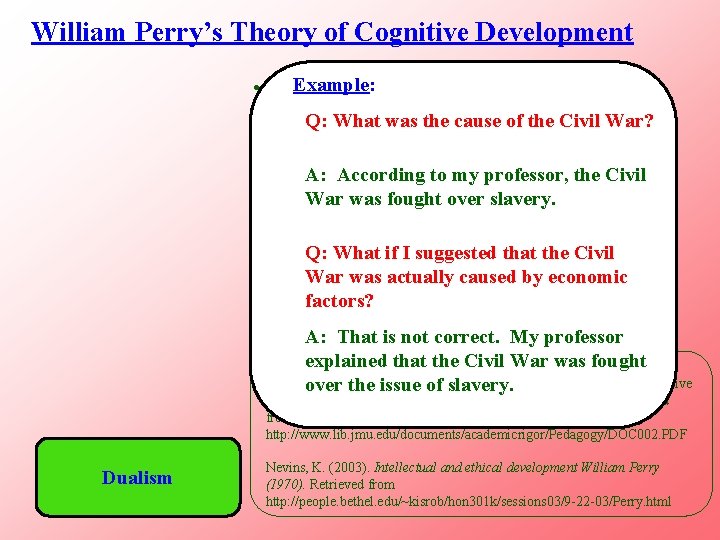
William Perry’s Theory of Cognitive Development Example: • Belief in dichotomies: Something is either “true” or “false, ” “right” “wrong, ” etc. Q: What was the cause or of the Civil War? • Faith in information provided by authority A: According to my professor, the Civil figures such as teachers and professors War was fought over slavery. • Students memorize information provided by Q: What if I suggested that the authority figures and presume that. Civil it is factual was actually caused by economic and. War “true” factors? A: That is not correct. My professor explained that the Civil War was fought Sources: Love, P. G. , & the Guthrie, V. L. of (1999). Understanding and applying cognitive over issue slavery. development theory. New Directions for Student Services, 88. Retrieved from http: //www. lib. jmu. edu/documents/academicrigor/Pedagogy/DOC 002. PDF Dualism Nevins, K. (2003). Intellectual and ethical development William Perry (1970). Retrieved from http: //people. bethel. edu/~kisrob/hon 301 k/sessions 03/9 -22 -03/Perry. html
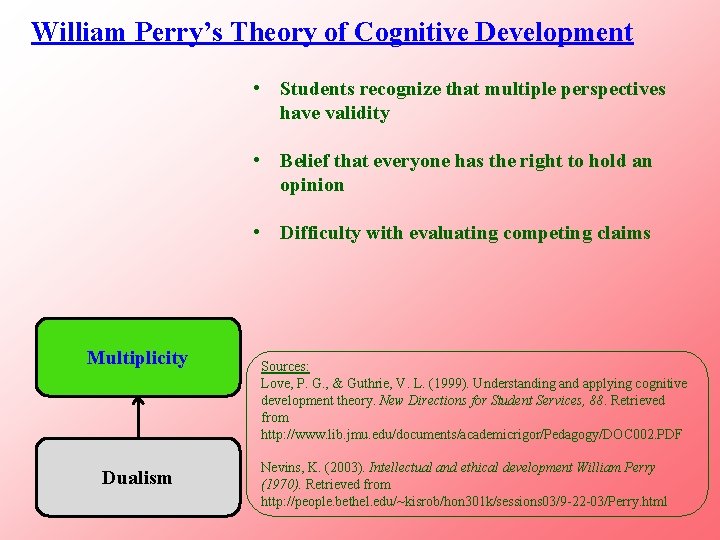
William Perry’s Theory of Cognitive Development • Students recognize that multiple perspectives have validity • Belief that everyone has the right to hold an opinion • Difficulty with evaluating competing claims Multiplicity Dualism Sources: Love, P. G. , & Guthrie, V. L. (1999). Understanding and applying cognitive development theory. New Directions for Student Services, 88. Retrieved from http: //www. lib. jmu. edu/documents/academicrigor/Pedagogy/DOC 002. PDF Nevins, K. (2003). Intellectual and ethical development William Perry (1970). Retrieved from http: //people. bethel. edu/~kisrob/hon 301 k/sessions 03/9 -22 -03/Perry. html
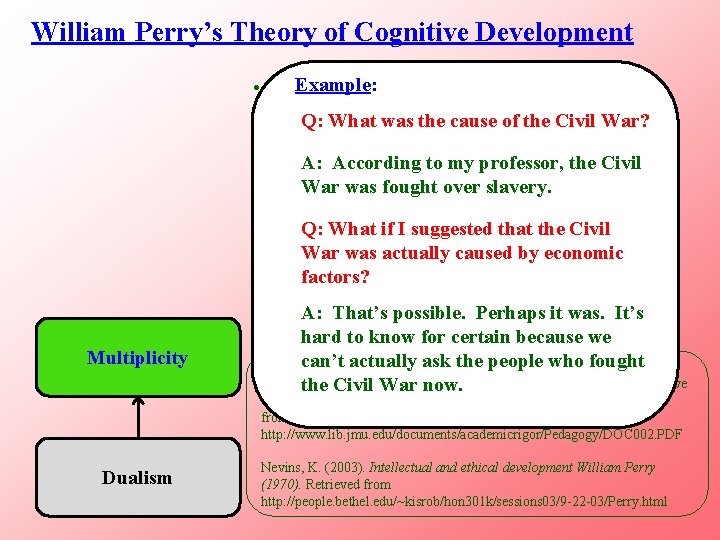
William Perry’s Theory of Cognitive Development Example: • Students recognize that multiple perspectives have Q: validity What was the cause of the Civil War? • Belief that everyone hasprofessor, the right to A: According to my thehold Civilan opinion War was fought over slavery. Q: Whatwith if I evaluating suggested that the Civil • Difficulty competing claims War was actually caused by economic factors? Multiplicity A: That’s possible. Perhaps it was. It’s hard to know for certain because we can’t actually ask the people who fought Sources: Love, P. G. , & Guthrie, V. L. now. (1999). Understanding and applying cognitive the Civil War development theory. New Directions for Student Services, 88. Retrieved from http: //www. lib. jmu. edu/documents/academicrigor/Pedagogy/DOC 002. PDF Dualism Nevins, K. (2003). Intellectual and ethical development William Perry (1970). Retrieved from http: //people. bethel. edu/~kisrob/hon 301 k/sessions 03/9 -22 -03/Perry. html
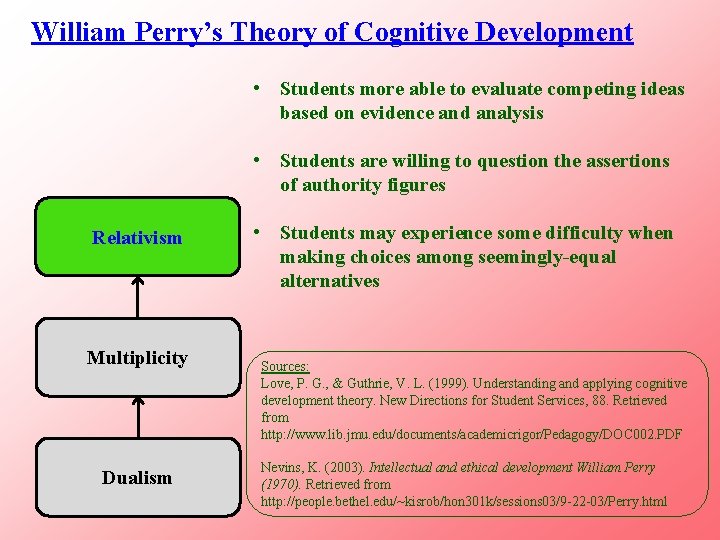
William Perry’s Theory of Cognitive Development • Students more able to evaluate competing ideas based on evidence and analysis • Students are willing to question the assertions of authority figures Relativism Multiplicity Dualism • Students may experience some difficulty when making choices among seemingly-equal alternatives Sources: Love, P. G. , & Guthrie, V. L. (1999). Understanding and applying cognitive development theory. New Directions for Student Services, 88. Retrieved from http: //www. lib. jmu. edu/documents/academicrigor/Pedagogy/DOC 002. PDF Nevins, K. (2003). Intellectual and ethical development William Perry (1970). Retrieved from http: //people. bethel. edu/~kisrob/hon 301 k/sessions 03/9 -22 -03/Perry. html
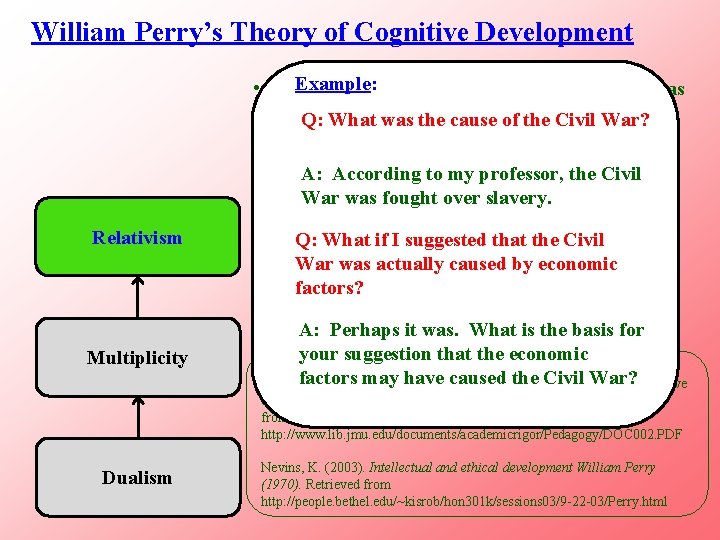
William Perry’s Theory of Cognitive Development Example: • Students more able to evaluate competing ideas based on evidence analysis Q: What was theand cause of the Civil War? • Students are willing to question the assertions A: According to my professor, the Civil of authority figures War was fought over slavery. Relativism Multiplicity • Students may somethe difficulty Q: What if I experience suggested that Civil when making choices among seemingly-equal War was actually caused by economic alternatives factors? A: Perhaps it was. What is the basis for your suggestion that the economic Sources: factors may. V. have caused the Civil War? cognitive Love, P. G. , & Guthrie, L. (1999). Understanding and applying development theory. New Directions for Student Services, 88. Retrieved from http: //www. lib. jmu. edu/documents/academicrigor/Pedagogy/DOC 002. PDF Dualism Nevins, K. (2003). Intellectual and ethical development William Perry (1970). Retrieved from http: //people. bethel. edu/~kisrob/hon 301 k/sessions 03/9 -22 -03/Perry. html
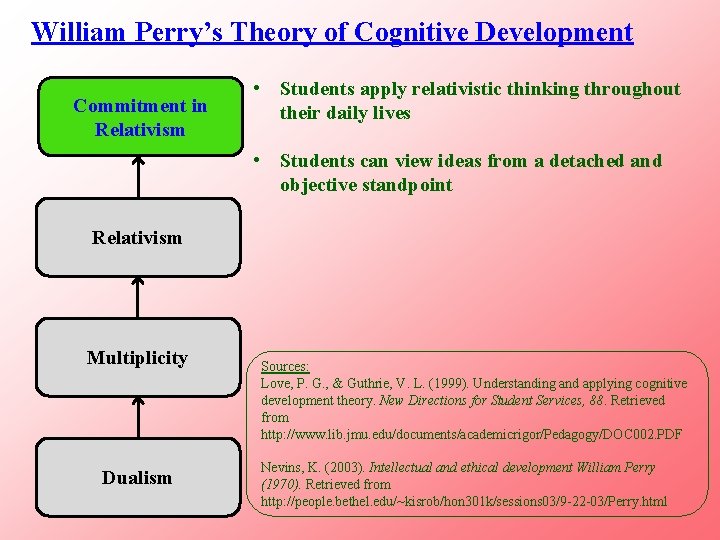
William Perry’s Theory of Cognitive Development Commitment in Relativism • Students apply relativistic thinking throughout their daily lives • Students can view ideas from a detached and objective standpoint Relativism Multiplicity Dualism Sources: Love, P. G. , & Guthrie, V. L. (1999). Understanding and applying cognitive development theory. New Directions for Student Services, 88. Retrieved from http: //www. lib. jmu. edu/documents/academicrigor/Pedagogy/DOC 002. PDF Nevins, K. (2003). Intellectual and ethical development William Perry (1970). Retrieved from http: //people. bethel. edu/~kisrob/hon 301 k/sessions 03/9 -22 -03/Perry. html
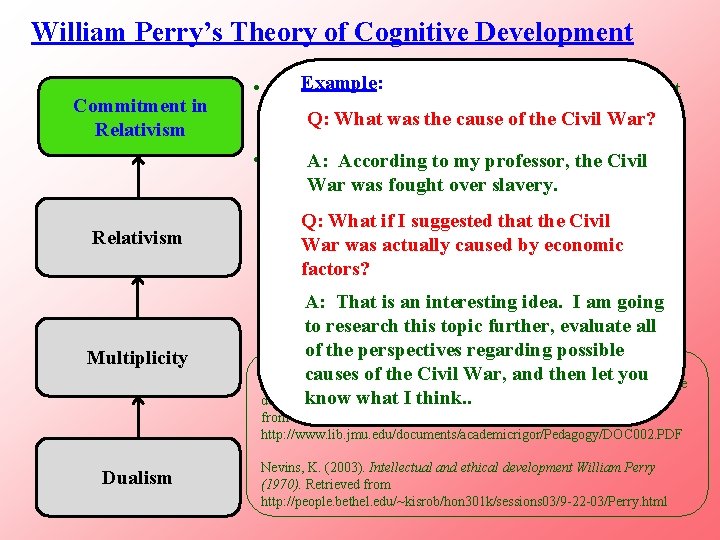
William Perry’s Theory of Cognitive Development Commitment in Relativism Example: • Students apply relativistic thinking throughout their Q: daily Whatlives was the cause of the Civil War? A: According my professor, the Civil • Students can viewto ideas from a detached and War was fought over slavery. objective standpoint Relativism Multiplicity Q: What if I suggested that the Civil War was actually caused by economic factors? A: That is an interesting idea. I am going to research this topic further, evaluate all of the perspectives regarding possible Sources: causes of the Civil War, and then let you Love, P. G. , & Guthrie, V. L. (1999). Understanding and applying cognitive know what think. . for Student Services, 88. Retrieved development theory. New. IDirections from http: //www. lib. jmu. edu/documents/academicrigor/Pedagogy/DOC 002. PDF Dualism Nevins, K. (2003). Intellectual and ethical development William Perry (1970). Retrieved from http: //people. bethel. edu/~kisrob/hon 301 k/sessions 03/9 -22 -03/Perry. html
? Why is it important to help students move beyond dualism to attain relativistic thinking?
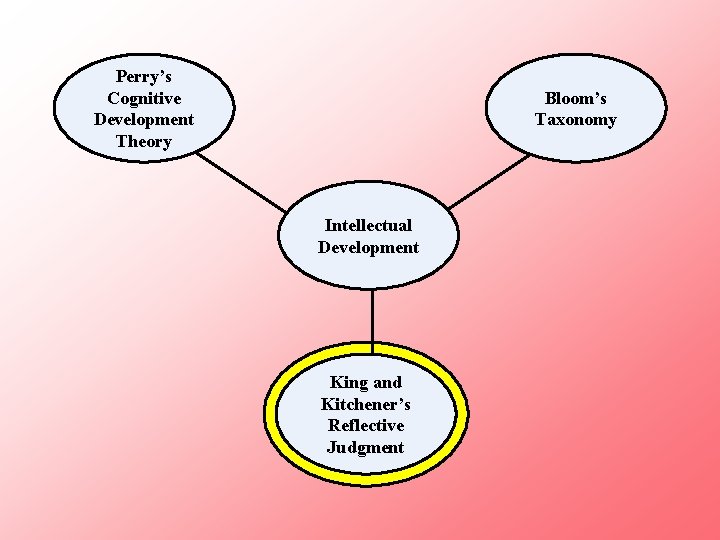
Perry’s Cognitive Development Theory Bloom’s Taxonomy Intellectual Development King and Kitchener’s Reflective Judgment
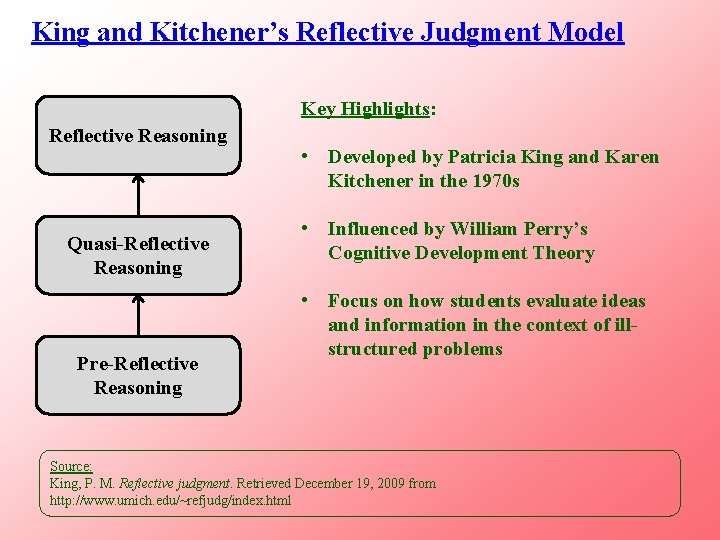
King and Kitchener’s Reflective Judgment Model Key Highlights: Reflective Reasoning Quasi-Reflective Reasoning Pre-Reflective Reasoning • Developed by Patricia King and Karen Kitchener in the 1970 s • Influenced by William Perry’s Cognitive Development Theory • Focus on how students evaluate ideas and information in the context of illstructured problems Source: King, P. M. Reflective judgment. Retrieved December 19, 2009 from http: //www. umich. edu/~refjudg/index. html
? What are ill-structured problems?
? Ill-structured problems involve questions for which there is no simple answer and for which arguments can be made from many different perspectives. What are ill-structured Examples: problems? • How should the government balance the need to make investments in public programs while also managing the public debt? • How can colleges and universities best maintain costly facilities, attract high-achieving students, ensure access for low-income students, offer sufficient financial aid, and provide adequate services while keeping tuition low?
King and Kitchener’s Reflective Judgment Model • Knowledge is assumed to be absolutely certain • Belief that “There is only one right answer” to every question • Faith in information from authority figures or first hand observation without further reflection Pre-Reflective Reasoning Source: King, P. M. Reflective judgment. Retrieved December 19, 2009 from http: //www. umich. edu/~refjudg/index. html
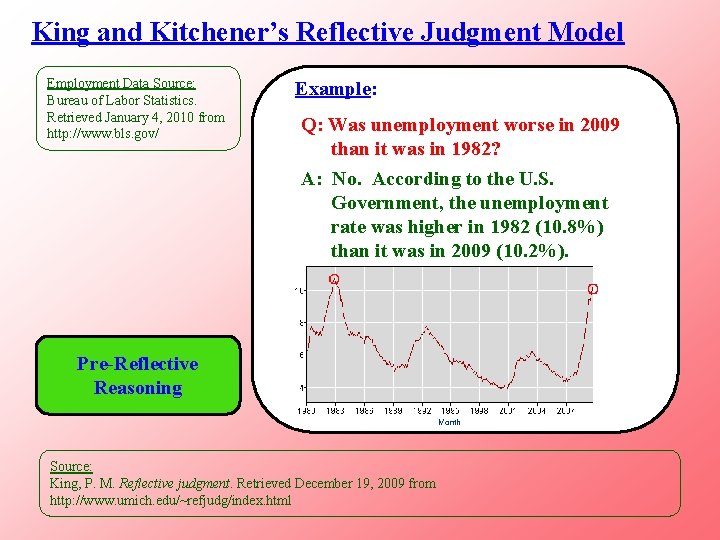
King and Kitchener’s Reflective Judgment Model Employment Data Source: Bureau of Labor Statistics. Retrieved January 4, 2010 from http: //www. bls. gov/ Example: Q: Was unemployment worse in 2009 than it was in 1982? A: No. According to the U. S. Government, the unemployment rate was higher in 1982 (10. 8%) than it was in 2009 (10. 2%). Pre-Reflective Reasoning Source: King, P. M. Reflective judgment. Retrieved December 19, 2009 from http: //www. umich. edu/~refjudg/index. html
King and Kitchener’s Reflective Judgment Model • Realization that knowledge contains some uncertainty • Recognition that an “answer” may be impacted by the method of inquiry used to find it Quasi-Reflective Reasoning Pre-Reflective Reasoning Source: King, P. M. Reflective judgment. Retrieved December 19, 2009 from http: //www. umich. edu/~refjudg/index. html
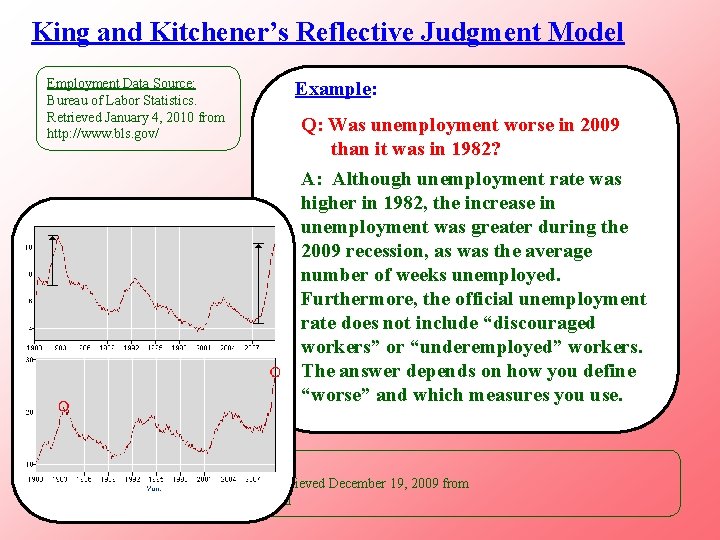
King and Kitchener’s Reflective Judgment Model Employment Data Source: Bureau of Labor Statistics. Retrieved January 4, 2010 from http: //www. bls. gov/ Quasi-Reflective Reasoning Pre-Reflective Reasoning Example: Q: Was unemployment worse in 2009 than it was in 1982? A: Although unemployment rate was higher in 1982, the increase in unemployment was greater during the 2009 recession, as was the average number of weeks unemployed. Furthermore, the official unemployment rate does not include “discouraged workers” or “underemployed” workers. The answer depends on how you define “worse” and which measures you use. Source: King, Patricia M. Reflective Judgment. Retrieved December 19, 2009 from http: //www. umich. edu/~refjudg/index. html
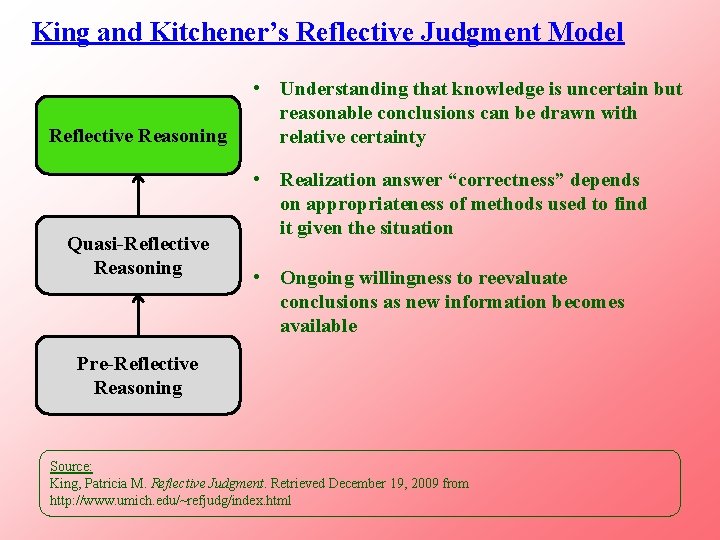
King and Kitchener’s Reflective Judgment Model Reflective Reasoning Quasi-Reflective Reasoning • Understanding that knowledge is uncertain but reasonable conclusions can be drawn with relative certainty • Realization answer “correctness” depends on appropriateness of methods used to find it given the situation • Ongoing willingness to reevaluate conclusions as new information becomes available Pre-Reflective Reasoning Source: King, Patricia M. Reflective Judgment. Retrieved December 19, 2009 from http: //www. umich. edu/~refjudg/index. html
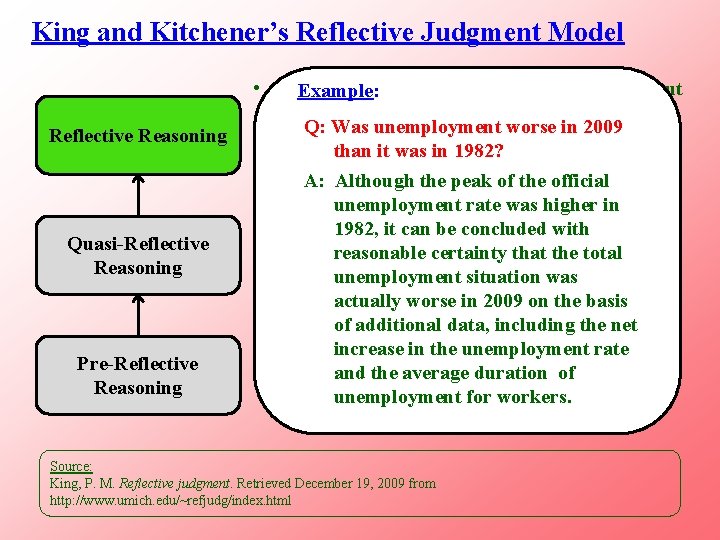
King and Kitchener’s Reflective Judgment Model Reflective Reasoning Quasi-Reflective Reasoning Pre-Reflective Reasoning • Understanding that knowledge is uncertain but Example: reasonable conclusions can be drawn with Q: Was unemployment worse in 2009 relative certainty than it was in 1982? • Realization answer depends A: Although the “correctness” peak of the official on appropriateness of rate methods used toinfind unemployment was higher it given 1982, the situation it can be concluded with reasonable certainty that the total unemployment was • Ongoing willingness tosituation reevaluate actually worse in 2009 on becomes the basis conclusions as new information of additional data, including the net available increase in the unemployment rate and the average duration of unemployment for workers. Source: King, P. M. Reflective judgment. Retrieved December 19, 2009 from http: //www. umich. edu/~refjudg/index. html
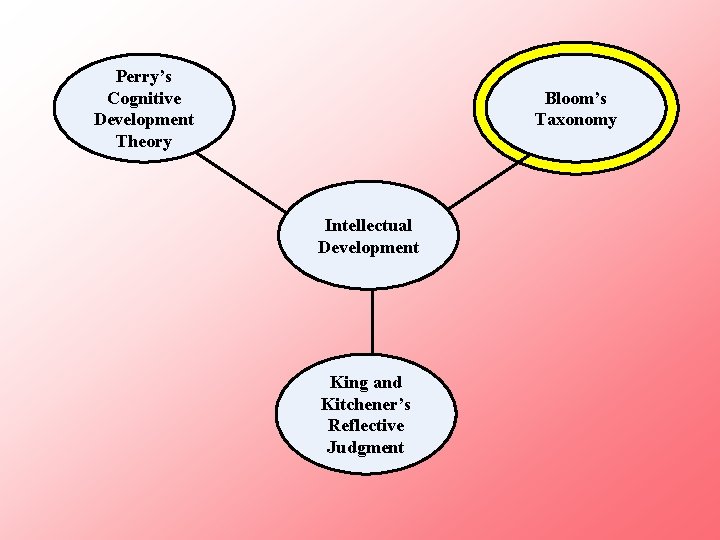
Perry’s Cognitive Development Theory Bloom’s Taxonomy Intellectual Development King and Kitchener’s Reflective Judgment
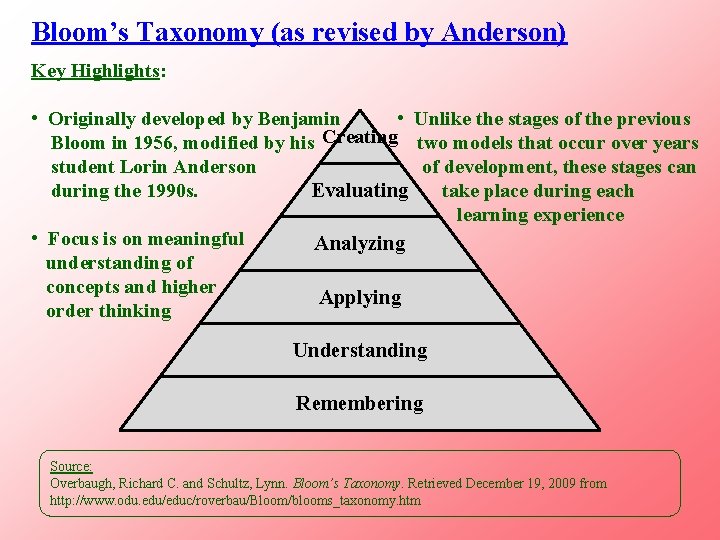
Bloom’s Taxonomy (as revised by Anderson) Key Highlights: • Unlike the stages of the previous • Originally developed by Benjamin Bloom in 1956, modified by his Creating two models that occur over years of development, these stages can student Lorin Anderson Evaluating take place during each during the 1990 s. learning experience • Focus is on meaningful Analyzing understanding of concepts and higher Applying order thinking Understanding Remembering Source: Overbaugh, Richard C. and Schultz, Lynn. Bloom’s Taxonomy. Retrieved December 19, 2009 from http: //www. odu. edu/educ/roverbau/Bloom/blooms_taxonomy. htm
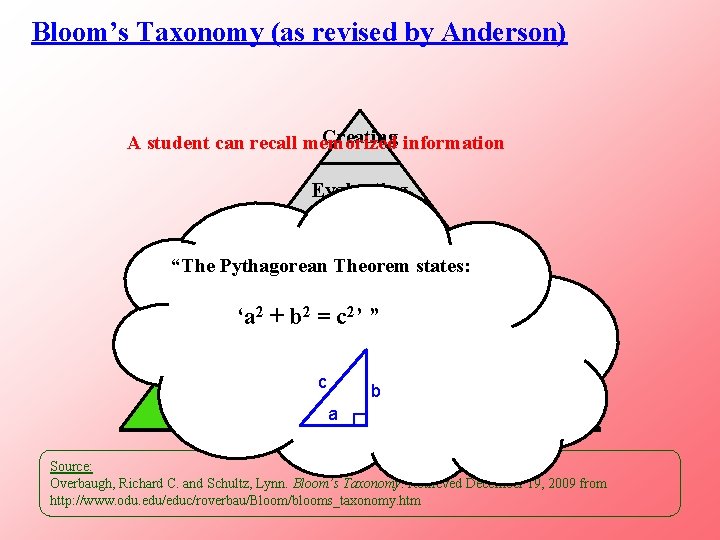
Bloom’s Taxonomy (as revised by Anderson) Creating information A student can recall memorized Evaluating Analyzing “The Pythagorean Theorem states: Applying ‘a 2 + b 2 = c 2’ ” Understanding c b Remembering a Source: Overbaugh, Richard C. and Schultz, Lynn. Bloom’s Taxonomy. Retrieved December 19, 2009 from http: //www. odu. edu/educ/roverbau/Bloom/blooms_taxonomy. htm
? What are the consequences when a student only memorizes information “for the test”?
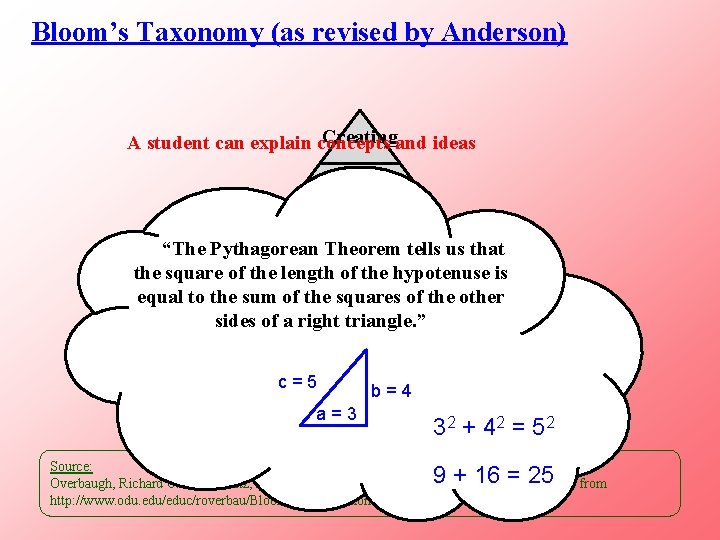
Bloom’s Taxonomy (as revised by Anderson) Creatingand ideas A student can explain concepts Evaluating “The Pythagorean. Analyzing Theorem tells us that the square of the length of the hypotenuse is equal to the sum of the squares of the other Applying sides of a right triangle. ” Understanding c=5 b=4 Remembering a=3 32 + 4 2 = 5 2 Source: Overbaugh, Richard C. and Schultz, Lynn. Bloom’s Taxonomy. Retrieved December 19, 2009 from http: //www. odu. edu/educ/roverbau/Bloom/blooms_taxonomy. htm 9 + 16 = 25
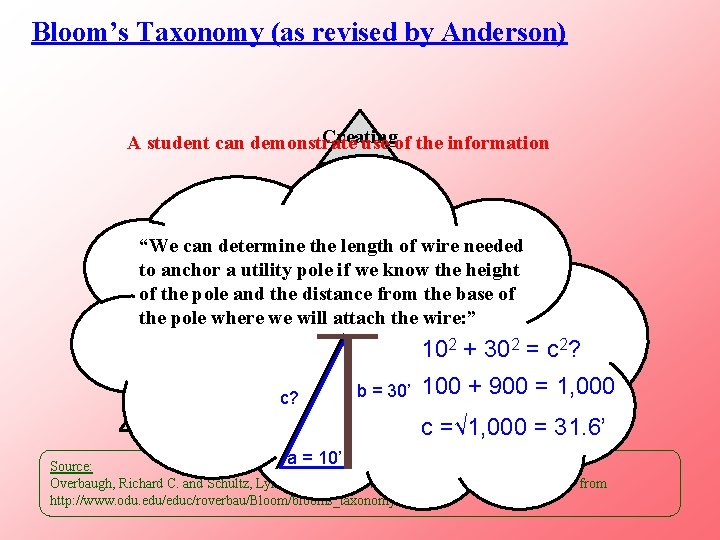
Bloom’s Taxonomy (as revised by Anderson) Creating A student can demonstrate use of the information Evaluating Analyzing “We can determine the length of wire needed to anchor a utility pole if we know the height of the pole and the distance from the base of Applying the pole where we will attach the wire: ” Understanding 102 + 302 = c 2? b = 30’ 100 c? Remembering + 900 = 1, 000 c =√ 1, 000 = 31. 6’ a = 10’ Source: Overbaugh, Richard C. and Schultz, Lynn. Bloom’s Taxonomy. Retrieved December 19, 2009 from http: //www. odu. edu/educ/roverbau/Bloom/blooms_taxonomy. htm
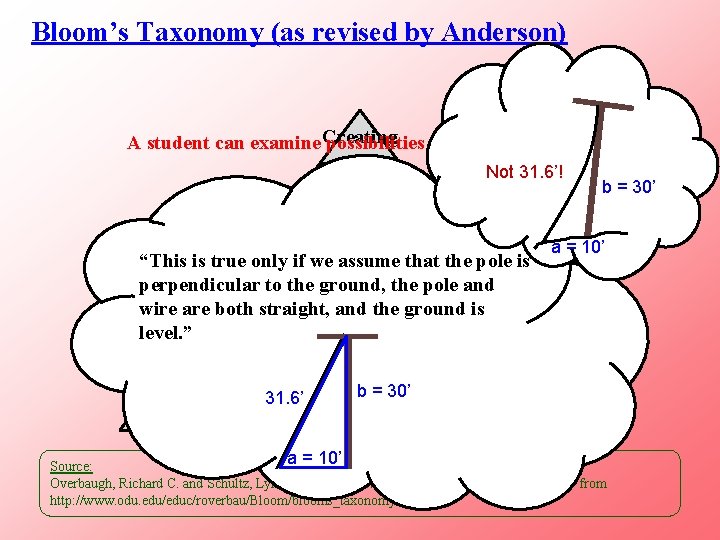
Bloom’s Taxonomy (as revised by Anderson) A student can examine Creating possibilities Evaluating Not 31. 6’! b = 30’ Analyzing a = 10’ “This is true only if we assume that the pole is perpendicular to the ground, the pole and Applying wire are both straight, and the ground is level. ” Understanding b = 30’ 31. 6’Remembering a = 10’ Source: Overbaugh, Richard C. and Schultz, Lynn. Bloom’s Taxonomy. Retrieved December 19, 2009 from http: //www. odu. edu/educ/roverbau/Bloom/blooms_taxonomy. htm
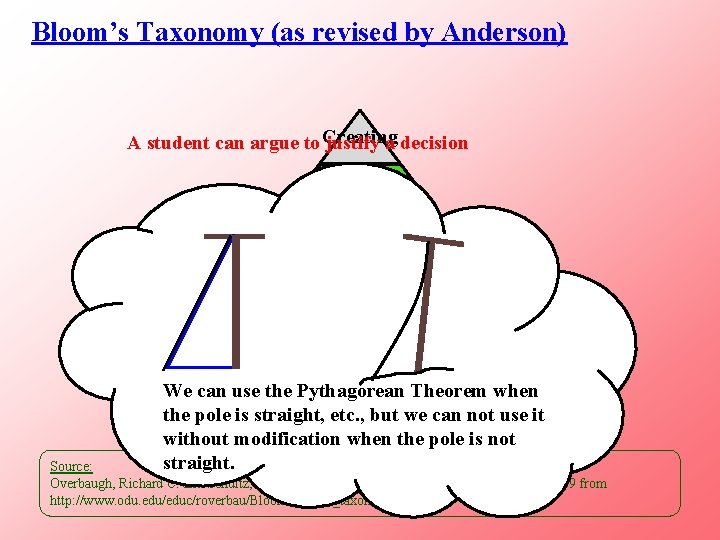
Bloom’s Taxonomy (as revised by Anderson) A student can argue to Creating justify a decision Evaluating Analyzing Applying Understanding We can use the Pythagorean Theorem when Remembering the pole is straight, etc. , but we can not use it without modification when the pole is not straight. Source: Overbaugh, Richard C. and Schultz, Lynn. Bloom’s Taxonomy. Retrieved December 19, 2009 from http: //www. odu. edu/educ/roverbau/Bloom/blooms_taxonomy. htm
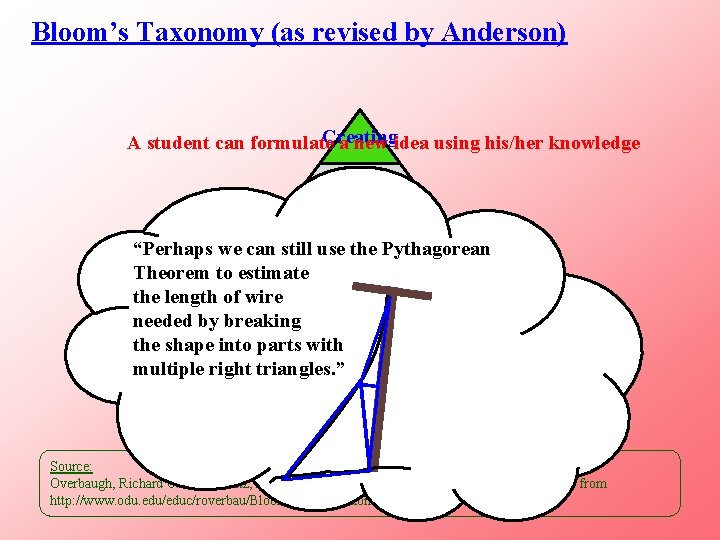
Bloom’s Taxonomy (as revised by Anderson) Creating A student can formulate a new idea using his/her knowledge Evaluating “Perhaps we can still Analyzing use the Pythagorean Theorem to estimate the length of wire Applying needed by breaking the shape into parts. Understanding with multiple right triangles. ” Remembering Source: Overbaugh, Richard C. and Schultz, Lynn. Bloom’s Taxonomy. Retrieved December 19, 2009 from http: //www. odu. edu/educ/roverbau/Bloom/blooms_taxonomy. htm

? How can you apply Bloom’s Taxonomy while tutoring?
Using Bloom’s Taxonomy in Tutoring Ask your students thought-provoking questions!
What questions could you ask a student to help him or her remember information? Example questions: Ø “Define…” Ø “What does this term mean? ” Ø “What…? ” “Where…? ” “Who…? ” Source: Indiana University-Perdue University Indianapolis Center for Teaching and Learning. (2002). Bloom’s taxonomy revised: Key words, model questions, & instructional strategies. Retrieved from http: //wed. siu. edu/faculty/JCalvin/bloomstax. pdf
What are some questions you can ask a student to help him or her understand what he or she has learned? Example question: Ø “Paraphrase this concept in your own words…” Source: Indiana University-Perdue University Indianapolis Center for Teaching and Learning. (2002). Bloom’s taxonomy revised: Key words, model questions, & instructional strategies. Retrieved from http: //wed. siu. edu/faculty/JCalvin/bloomstax. pdf
What are some questions you can ask a student to apply his or her knowledge? Example questions: Ø “Predict what would happen if…” Ø “Prepare a … to apply this idea” Ø “Describe a real-world example of this. ” Source: Indiana University-Perdue University Indianapolis Center for Teaching and Learning. (2002). Bloom’s taxonomy revised: Key words, model questions, & instructional strategies. Retrieved from http: //wed. siu. edu/faculty/JCalvin/bloomstax. pdf
What are some questions you can ask a student to help him or her analyze concepts? Ø Example questions: Ø “What assumptions did the author make when writing this? ” Ø “What ideas support this conclusion? ” Ø “What is the relationship between this and…? ” Source: Indiana University-Perdue University Indianapolis Center for Teaching and Learning. (2002). Bloom’s taxonomy revised: Key words, model questions, & instructional strategies. Retrieved from http: //wed. siu. edu/faculty/JCalvin/bloomstax. pdf
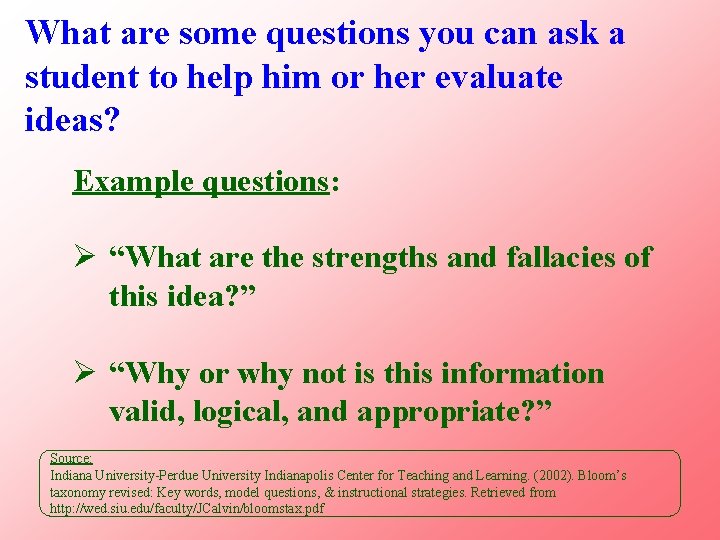
What are some questions you can ask a student to help him or her evaluate ideas? Example questions: Ø “What are the strengths and fallacies of this idea? ” Ø “Why or why not is this information valid, logical, and appropriate? ” Source: Indiana University-Perdue University Indianapolis Center for Teaching and Learning. (2002). Bloom’s taxonomy revised: Key words, model questions, & instructional strategies. Retrieved from http: //wed. siu. edu/faculty/JCalvin/bloomstax. pdf
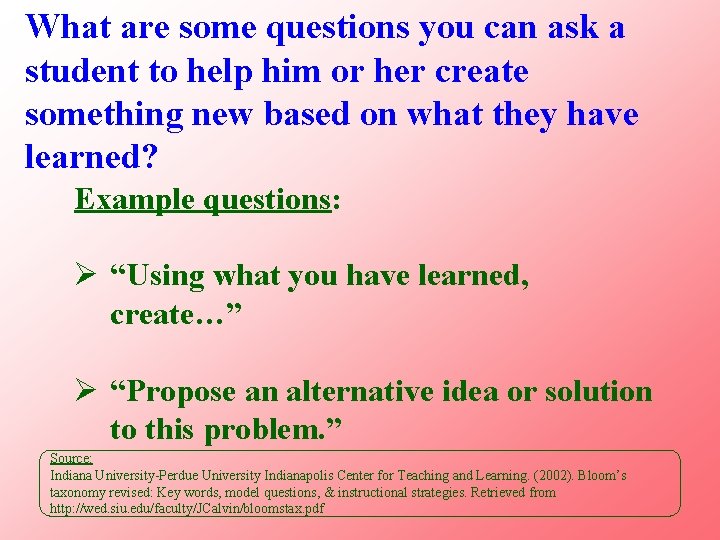
What are some questions you can ask a student to help him or her create something new based on what they have learned? Example questions: Ø “Using what you have learned, create…” Ø “Propose an alternative idea or solution to this problem. ” Source: Indiana University-Perdue University Indianapolis Center for Teaching and Learning. (2002). Bloom’s taxonomy revised: Key words, model questions, & instructional strategies. Retrieved from http: //wed. siu. edu/faculty/JCalvin/bloomstax. pdf
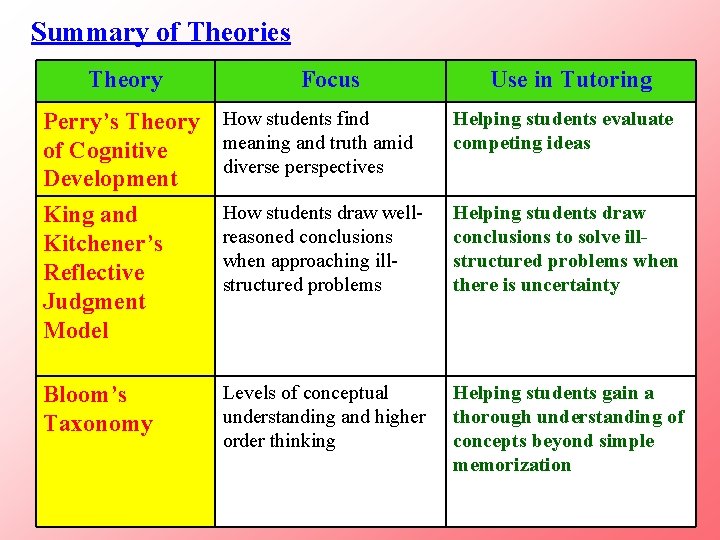
Summary of Theories Theory Focus Use in Tutoring Perry’s Theory of Cognitive Development King and Kitchener’s Reflective Judgment Model How students find meaning and truth amid diverse perspectives Helping students evaluate competing ideas How students draw wellreasoned conclusions when approaching illstructured problems Helping students draw conclusions to solve illstructured problems when there is uncertainty Bloom’s Taxonomy Levels of conceptual understanding and higher order thinking Helping students gain a thorough understanding of concepts beyond simple memorization
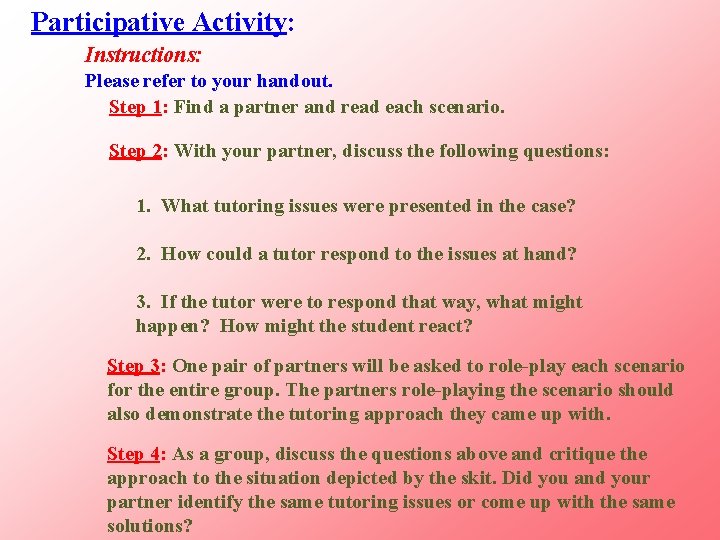
Participative Activity: Instructions: Please refer to your handout. Step 1: Find a partner and read each scenario. Step 2: With your partner, discuss the following questions: 1. What tutoring issues were presented in the case? 2. How could a tutor respond to the issues at hand? 3. If the tutor were to respond that way, what might happen? How might the student react? Step 3: One pair of partners will be asked to role-play each scenario for the entire group. The partners role-playing the scenario should also demonstrate the tutoring approach they came up with. Step 4: As a group, discuss the questions above and critique the approach to the situation depicted by the skit. Did you and your partner identify the same tutoring issues or come up with the same solutions?

Case Studies
Concluding Points to Remember: Understanding learning and development theories helps us tutor students more thoughtfully Help students consider and evaluate multiple perspectives (Perry’s Theory of Cognitive Development) Encourage students to assess the reasoning behind ideas, theories, and conclusions (King and Kitchener’s Reflective Reasoning Model) Ask students to understand, apply, analyze, and evaluate concepts as well as create new ideas of their own using what they have learned (Bloom’s Taxonomy)
References Hamrick, F. , Evans, N. , and Schuh, J. (2002). Foundations of student affairs practice: How philosophy, theory, and research strengthen educational outcomes. San Francisco, CA: Jossey-Bass. Indiana University-Perdue University Indianapolis Center for Teaching and Learning. (2002). Bloom’s taxonomy revised: Key words, model questions, & instructional strategies. Retrieved from http: //wed. siu. edu/faculty/JCalvin/bloomstax. pdf King, P. M. (2013). Reflective judgment. Retrieved from http: //www. umich. edu/~refjudg/index. html Love, P. G. , & Guthrie, V. L. (1999). Understanding and applying cognitive development theory. New Directions for Student Services, 88. Retrieved from http: //www. lib. jmu. edu/documents/academicrigor/Pedagogy/DOC 002. PDF Nevins, K. (2003). Intellectual and ethical development William Perry (1970). Retrieved from http: //people. bethel. edu/~kisrob/hon 301 k/sessions 03/9 -22 -03/Perry. html Overbaugh, R. C. & Schultz, L. . Bloom’s taxonomy. Retrieved from http: //ww 2. odu. edu/educ/roverbau/Bloom/blooms_taxonomy. htm Wright State University Boonshoft School of Medicine. (2010). Higher order thinking skills question templates. Retrieved from http: //www. med. wright. edu/aa/facdev/_Files/PDFfiles/Question. Templates. pdf
- Slides: 49