
Applying LearnerCentered Pedagogy in Library Instruction and Reference
Applying Learner-Centered Pedagogy in Library Instruction and Reference Services Calumet College of St. Joseph Dr. Qi Chen Library Director
Traditional Teacher-Centered Learning Teacher-centered pedagogy – traditional teaching methods Teachers prioritize related knowledge need to be learned as learning objectives Being the center of learning environment Teach in a method that teacher enjoys Teacher responsible for teaching and learning but lack of attention of the learning environment and topics of interest of learners.
Learner-Centered Approach Carl Rogers – Client-Centered Approach Psychotherapy Free from threat both physically and psychologically, a person feels receiving deeply understanding, accepting and unconditional genuine and positive regard. Person-centered education- counseling oriented educational psychology model that believes positive teacher-student relationships supports optimal, holistic learning
Student/Learner-Centered Approach Student centered/Learner centered teaching methods Establish a positive learning environment to support teacher and students relationship in the classroom, creating a space that students/learners feel trusting。 Learning is the center of the classroom, both teachers and students share responsibilities of creating a meaningful learning experience. Positive environment - a space students feel safe and trusting- supporting relationship in the classroom Treat students as partners in the learning process Empower students so that they become active Individualized instruction - content, instructional technology, and pace of learning are based upon the abilities and interest of each learner.
Why Learner-Centered Approach? Diverse students: different cultural, social and religious background with different learning styles. 。 Different cognitive levels Different emotional, environmental, physiological, and psychological and sociological levels Perceptual modalities (visual, auditory, tactual, kinesthetic, and combination Divergent learners process of creating many unique solutions in order to solve a problem, spontaneous and freeflowing Assimilator or Convergent Systematic and logical
Why Learner-Centered Approach? Students at risk Multicultural society – new immigrants and lower economical status Psychological problem – social or cultural background Affective or emotional attitudes towards learning At-risk students are always found having passive learning style Cognitive issue – learning disabilities
Why Learner-Centered Approach? Learning Disabilities: neurologically-based processing problems, interfering with learning basic skills, organization, time planning, abstract reasoning, long or short term memory and attention. Hidden diseases: 11. 3% Dyslexia 7. 5% Attention deficit Hyperactivity disorder ADHD: 11% https: //ldaamerica. org/types-of-learning-disabilities 50% more than in 2000.
Students with Learning Disabilities Challenged with: Getting information into the brain (input) Making sense of information (organization) ) Storing and later retrieving information (memory) Getting information out/ express (output) Students may have more than one difficulties in the learning process
Learner-Centered Approach Democratic and collaborative learning Pay attention classroom discussion but not giving answers to their questions. Consider students/learners’ preferences and opinions during learning process. Focus more on “how” and “why” to stimulate critical thinking. Bring students out of their passive learning role. Students/learners become more active with sense of autonomy.
Library Instruction Design Practical with realistic goals- do not overwhelm students with more knowledge than they can take Clear and specific learning objectives- well planned techniques List of goals with clear objectives Concept with a critical thinking elements Aiming at a higher cognitive level Cooperative learning model: learning as a continuous process of creation and discovery of the epistemology of their own learning.
Instruction Design: Cooperative learning Make students accountable for their search strategies Divide the class into small groups , giving each different topics to research Students work in group Which keywords best descried the topic How to best conduct the search How the search results should be evaluated for relevancy Present to the class with a summary search topic search methods problems or discoveries they encountered during searching process
Case Study: Argosy University Private for profit 私人牟利 Mission – Human Side learning and education 人为本的学习和教育 Online and ground– on campuses 网络和实际校园 National university with multiple campuses 而是 across the country全国各地的多个校园 Doctorate, graduate and undergraduate 博士,研究生和本科生 All cultural background with different levels of cognitive development and learning styles 不同文化 背景和认知发展水平及学习方式 All adult learners 成人学习者
Method Design: Approaches http: //thecampuscommon. com/library/auo/? n=097117102097099117108116121046097114103111 115121046101100117125541&g=yes Librarians as Liaison/representatives/experts to various colleges –experts in different subject areas Curriculum orientated and embedded approaches Learner-centered reference services – in depth interviews showing empathy Customized library instruction – in person and online Topics including development of research proposal, refine topics, establish inquiries and research questions within accepted theoretical and conceptual frameworks.
Case Study: Calumet College of St Joseph Whiting Indiana Economic- low middle class – United Standard Oil Population – 5500 Culture – racial mixed Isolated –
Case Study: Calumet College of St Joseph Mission – all equal and entitled to learn, to receive education and opportunities Open admission policy Student population – senior, international students, religious personals (nuns), students with disabilities, hidden disabilities – learning disabilities, etc. Faculty – local, adjuncts Library staff – administration turn over, lacking professional staff & professional development Barriers – old concept of library services, lacking 21 st centaury of information needs, etc.
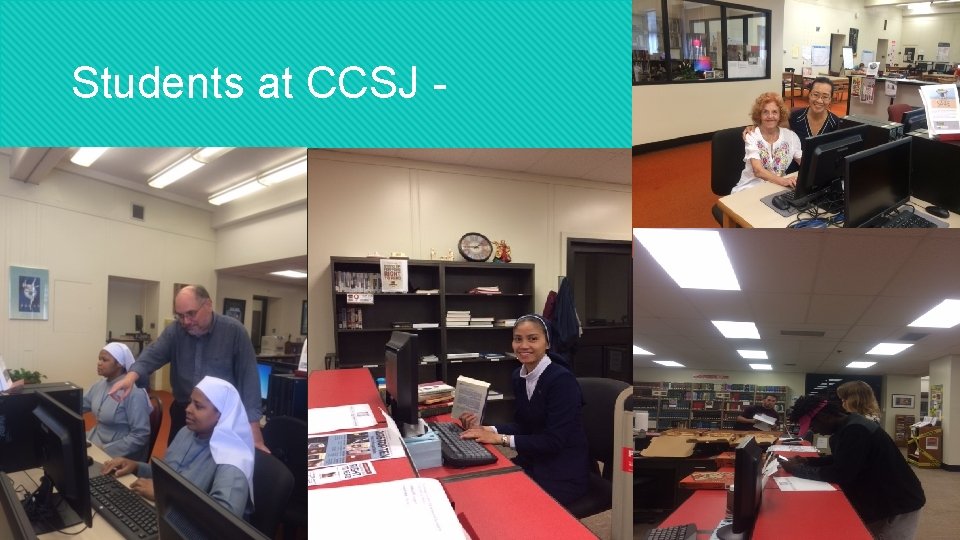
Students at CCSJ -
Method Design: Approaches Observations Visiting classes Talking to individual faculties Understanding the needs: faculty and students Curriculum related: Major assignments related Debate: philosophy, criminal justice, humanities Courses: American cinema, English,business management, general education & religious studies Presentations & argument Topic selection: being focused and find related information to support Presentation: how to use and include sources
Method Design: Approaches Focusing on how students learn best 。 How to better organize information they have learned 。 How to develop as effective learners during learning experience Applying different learning styles and theories in the classroom and reference services based on their learning styles and personality types. 。 Using active learning techniques like group discussions, questioning and short quizzes
Ways to better Support Students Learning o Information Access o Make library day everyday o Provide access to classes o Remember that the library belongs to the learning community o Provide an inviting climate o Program administration in the library o Ensure sufficient staffing o Collaborate with teachers o Provide atmosphere of a successful library o Beyond the library wall o Actively participate o Know the curriculum and students’ needs o Objectively assess
Summary/ Conclusion Learner-centered library service is effective in library instruction and reference services. Librarians are assimilators or convergent Able to adopt person-centered, learner-centered approaches in library instruction and reference services. Pay attention to verbal and non-verbal cues in the reference interview. Learner-centered approach can be used both in instruction and reference desk.
Reference Bertoldo, B. , & Golden, B. (2003). Recipe for a Dynamic, Learner-Centered Program. School Library Journal, 49(12), LQ 4 -LQ 5. Chodock, Ted, and Elizabeth Dolinger. 2009. "Applying Universal Design to Information Literacy: Teaching Students Who Learn Differently at Landmark College. " Reference & User Services Quarterly 49, no. 1: 24 -32. Academic Search Complete, EBSCOhost (accessed September 6, 2016). Dalrymple, C. (2002). Perceptions and practices of learning styles in library instruction. College & Research Libraries, 63(3), 261 -273. Dhawan, A. , & Chen, C. J. (2014). Library instruction for first-year students. Reference Services Review, 42(3), 414 -432 Dickinson, S. (2006). From Avery to INSPEC: A Collaborative Approach to Instruction Across Disciplines. Art Documentation: Bulletin Of The Art Libraries Society Of North America, 25(1), 43 -45. Gangster, L. A. , & Walsh, T. R. (2008). Enhancing Library Instruction to Undergraduates: Incorporating Online Tutorials into the Curriculum. College & Undergraduate Libraries, 15(3), 314 -333. doi: 10. 1080/10691310802258232 Mc. Carter, M. K. (2003). At-Risk Students and Cooperative Learning: Best Practices for Library Instruction Based on Students' Psychological, Cognitive, and Emotional Levels. Current Studies In Librarianship, 27(1/2), 51 -59. Moate, R. M. , & Cox, J. A. (2015). Learner-Centered Pedagogy: Considerations for Application in a Didactic Course. Professional Counselor, 5(3), 379 -389. Munro, K. (2006). Modified Problem-Based Library Instruction: A Simple, Reusable Instruction Design. College & Undergraduate Libraries, 13(3), 53 -61. doi: 10. 1300/J 106 v 13 n 03_04 Types of learning disabilities: https: //ldaamerica. org/types-of-learning-disabilities/
QUESTIONS? THANK YOU!
- Slides: 22