
Applying Best Practice Asthma Care in Schools A
Applying Best Practice Asthma Care in Schools: A Standardized Statewide Approach Asthma Intake Form Funded by: Kaiser Permanente
Learning Objectives At the end of this lesson, learners will be able to: §Use the Asthma Intake Form to determine how to prioritize care for students with asthma §Develop a teaching plan to address areas of need.
Asthma: A Daily Walk The American Lung Association has excellent resources for school nurses, staff, students, and parents. Their beginning page on Asthma states: Asthma is a lung disease that makes breathing difficult for millions of Americans. There is no cure for asthma, but the good news is it can be managed and treated so you can live a normal, healthy life. 3 http: //www. lung. org/lung-health-and-diseases/lung-disease-lookup/asthma/
How would you approach identifying students with asthma and completing the Asthma Intake Form?

Asthma Intake Form 5
At-Risk for Unnecessary Asthma Burden § At-risk factors indicating need for closer monitoring and intervention § Indicators of impairment during the last year § 2 or more urgent care/ED visits for asthma § Any hospitalization for asthma § 2 or more courses of prednisone or systemic corticosteroids for asthma § >5 missed school days due to asthma in the previous school year § Current uncontrolled asthma
Asthma Control § Asthma control criteria based on § Night time awakenings § Experience of symptoms § Use of quick relief inhaler for symptoms § Activity level
Uncontrolled Asthma § Cut points for uncontrolled asthma (having one or more of the following) § Nighttime asthma awakening >2 times per month § Daytime asthma symptoms >2 days per week § Quick relief medication >2 days per week § Limiting activity due to asthma ‘often’ or ‘all of the time’
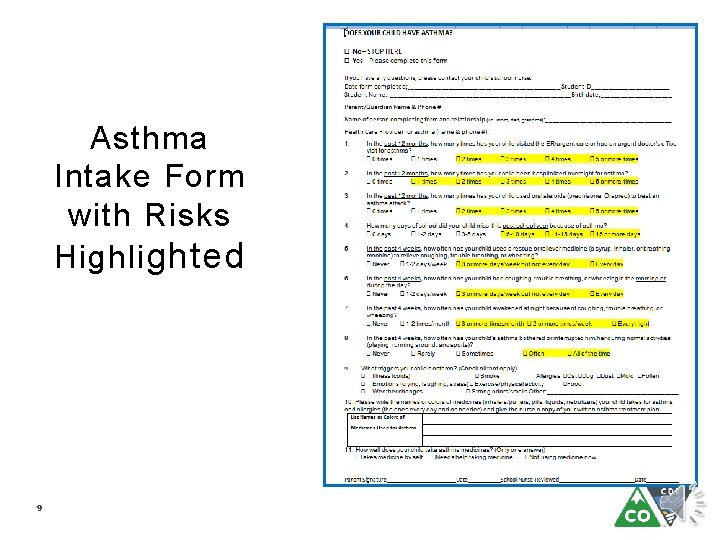
Asthma Intake Form with Risks Highli ghted 9
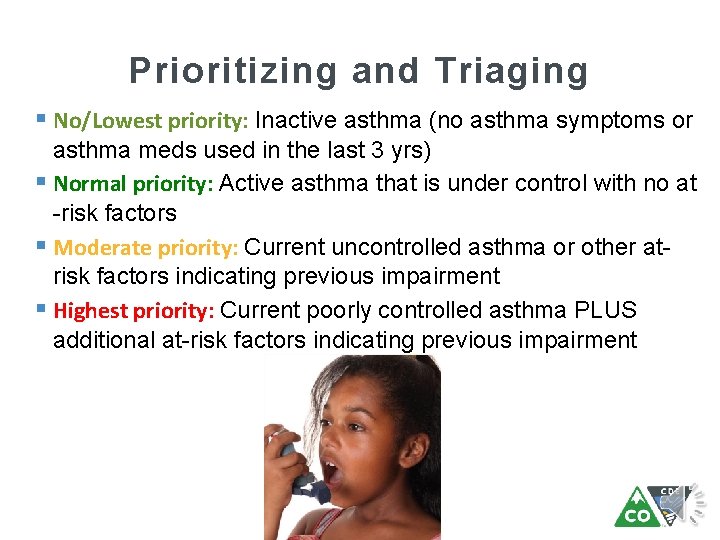
Prioritizing and Triaging § No/Lowest priority: Inactive asthma (no asthma symptoms or asthma meds used in the last 3 yrs) § Normal priority: Active asthma that is under control with no at -risk factors § Moderate priority: Current uncontrolled asthma or other atrisk factors indicating previous impairment § Highest priority: Current poorly controlled asthma PLUS additional at-risk factors indicating previous impairment

Applying Best Practice Asthma Care in Schools: A Standardized Statewide Approach Asthma Intake Form: Case Studies Funded by: Kaiser Permanente
Hands-on Exercise: Interpreting Asthma Intake Form § Case studies: § Find the four case studies § You can work alone, with another person, or in small groups § Review the completed Asthma Intake Forms to determine: § If asthma is well controlled or not § If student has above average risk for experiencing higher level of asthma burden § Priority level § Next steps

Applying Best Practice Asthma Care in Schools: A Standardized Statewide Approach Asthma Intake Form: Review Funded by: Kaiser Permanente
14
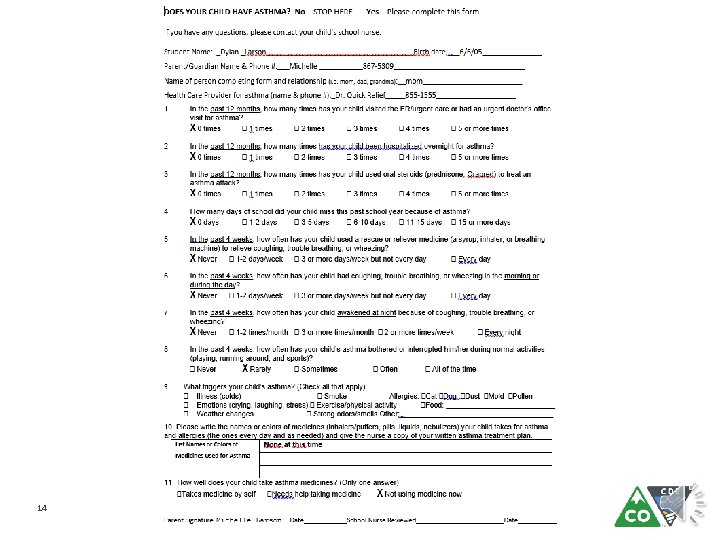
Asthma Intake Form Review § Dylan § Interpretation: Inactive asthma § Triage/Priority level: No/lowest priority level § Next steps: None § Asthma status can always change
16
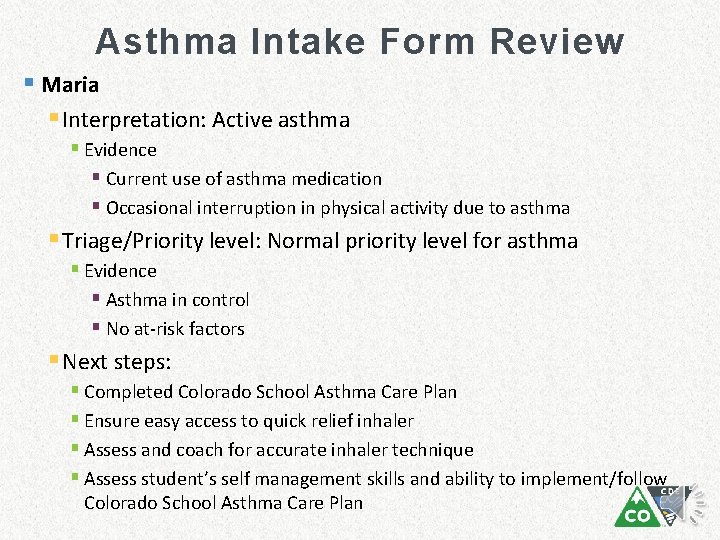
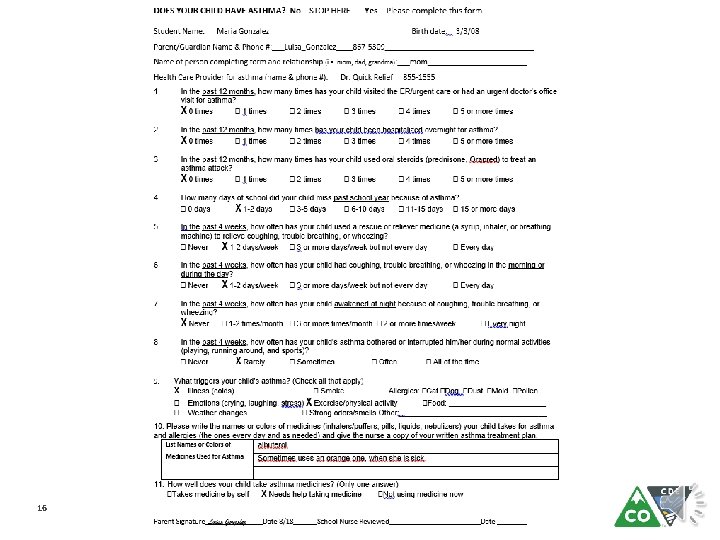
Asthma Intake Form Review § Maria § Interpretation: Active asthma § Evidence § Current use of asthma medication § Occasional interruption in physical activity due to asthma § Triage/Priority level: Normal priority level for asthma § Evidence § Asthma in control § No at-risk factors § Next steps: § Completed Colorado School Asthma Care Plan § Ensure easy access to quick relief inhaler § Assess and coach for accurate inhaler technique § Assess student’s self management skills and ability to implement/follow Colorado School Asthma Care Plan
18
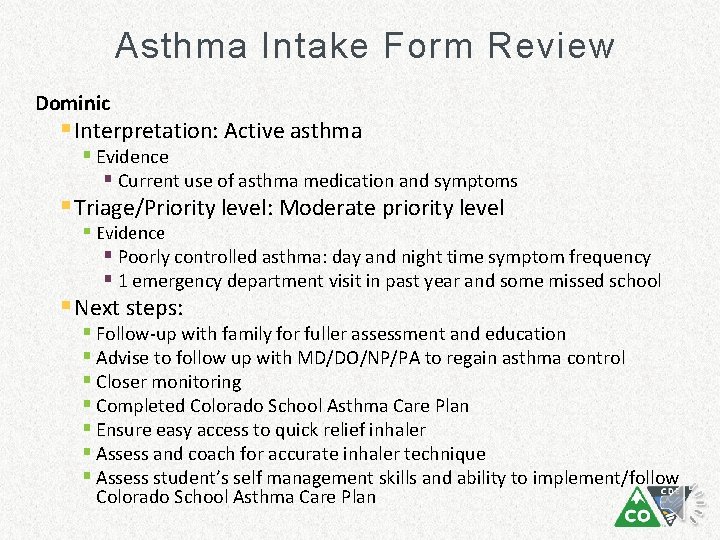
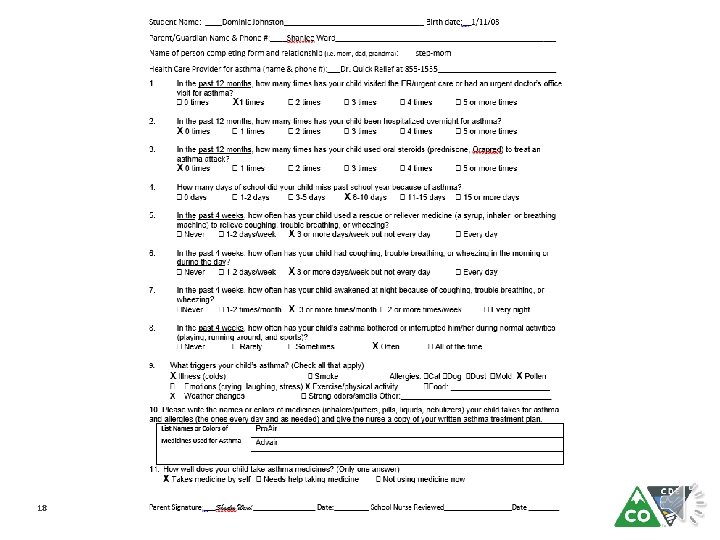
Asthma Intake Form Review Dominic § Interpretation: Active asthma § Evidence § Current use of asthma medication and symptoms § Triage/Priority level: Moderate priority level § Evidence § Poorly controlled asthma: day and night time symptom frequency § 1 emergency department visit in past year and some missed school § Next steps: § Follow-up with family for fuller assessment and education § Advise to follow up with MD/DO/NP/PA to regain asthma control § Closer monitoring § Completed Colorado School Asthma Care Plan § Ensure easy access to quick relief inhaler § Assess and coach for accurate inhaler technique § Assess student’s self management skills and ability to implement/follow Colorado School Asthma Care Plan
20
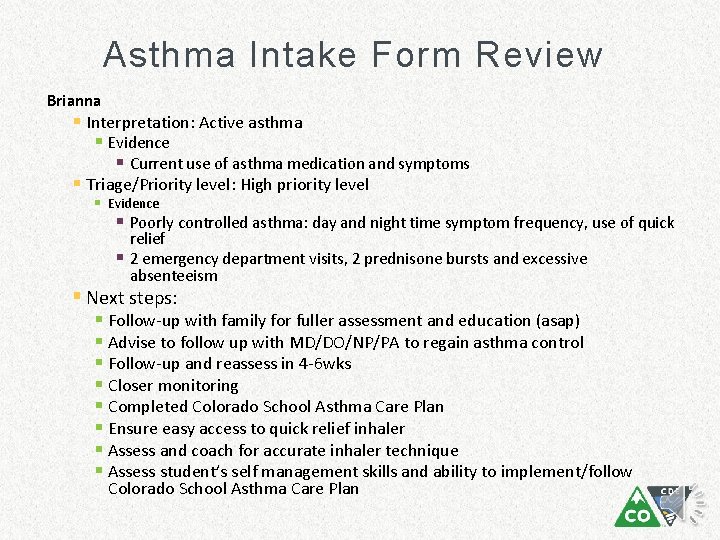
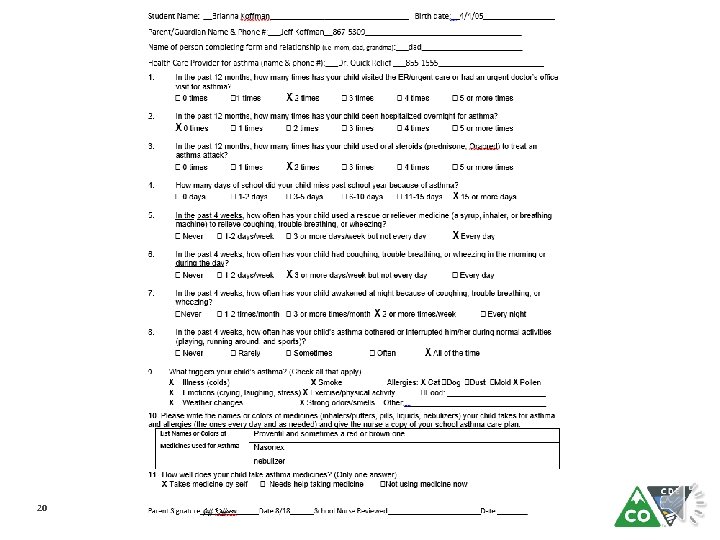
Asthma Intake Form Review Brianna § Interpretation: Active asthma § Evidence § Current use of asthma medication and symptoms § Triage/Priority level: High priority level § Evidence § Poorly controlled asthma: day and night time symptom frequency, use of quick relief § 2 emergency department visits, 2 prednisone bursts and excessive absenteeism § Next steps: § Follow-up with family for fuller assessment and education (asap) § Advise to follow up with MD/DO/NP/PA to regain asthma control § Follow-up and reassess in 4 -6 wks § Closer monitoring § Completed Colorado School Asthma Care Plan § Ensure easy access to quick relief inhaler § Assess and coach for accurate inhaler technique § Assess student’s self management skills and ability to implement/follow Colorado School Asthma Care Plan
How would you approach documentation for identifying students with asthma and results of the Asthma Intake Form?
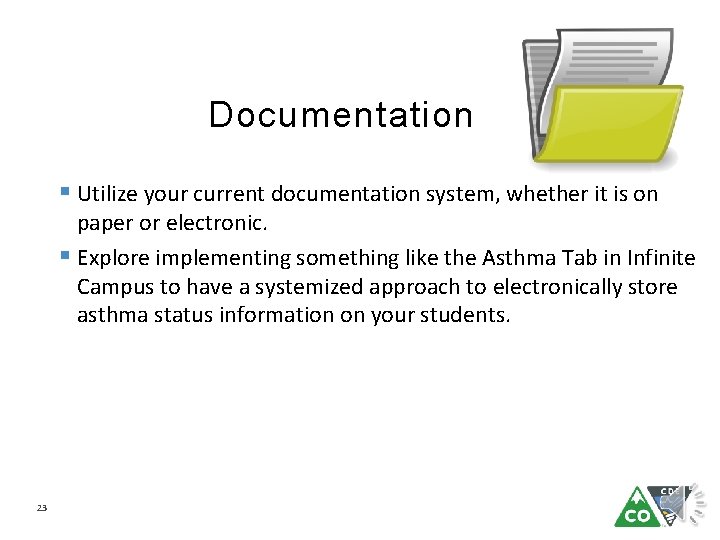
Documentation § Utilize your current documentation system, whether it is on paper or electronic. § Explore implementing something like the Asthma Tab in Infinite Campus to have a systemized approach to electronically store asthma status information on your students. 23
Summary Using the Asthma Intake Form helps the school nurse prioritize students with asthma who would most benefit from care coordination, plan care and identify teaching needs. 24

Check up time is next. Then you are ready to go to the following lessons which will provide more information to increase your competency and confidence. A special thanks to Kaiser Permanente for the grant to support training for all nurses in Colorado. 25
- Slides: 25