
Apply Risk Management Techniques Project Risk Processes Part
- Slides: 33
Apply Risk Management Techniques Project Risk Processes Part 2 Certificate IV in Project Management 17871 Qualification Code BSB 41507 Unit Code BSBPMG 407 A Apply Risk Management Techniques
Project Risk Management Processes PMBOK Project Risk Management Processes 11. 1 Plan Risk Management 11. 2 Identify Risks 11. 3 Perform Qualitative Risk Analysis 11. 4 Perform Quantitative Risk Analysis 11. 5 Plan Risk Responses 11. 6 Monitor and Control Risks Related processes from Project Integration Management – PMBOK 4 th Edition BSBPMG 407 A Apply Risk Management Techniques
Learning Objectives – Part 2 1. Understand qualitative and quantitative risk analysis 2. Describe standard tools that can be used for risk analysis 3. Understand the use of the Risk Register and how to manage and control high priority risks 4. Understand risk management processes and how to develop risk management strategies BSBPMG 407 A Apply Risk Management Techniques
Reading – Risk Processes Part 1 Please take some time to review – • PMBOK Chapters 11. 3, 11. 4, 11. 5, 11. 6 • Risk Management Standard – AS/NZS 31000: 2009 • Risk Management Companion- HB 327: 2010 This could take 60 to 90 minutes BSBPMG 407 A Apply Risk Management Techniques
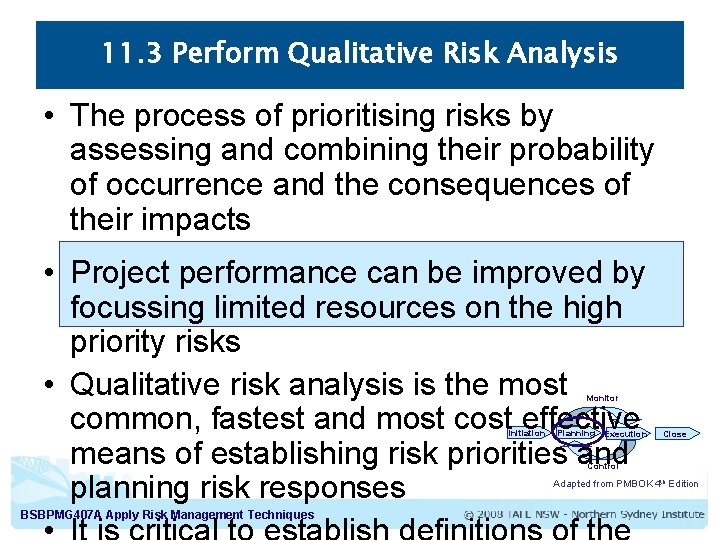
11. 3 Perform Qualitative Risk Analysis • The process of prioritising risks by assessing and combining their probability of occurrence and the consequences of their impacts • Project performance can be improved by focussing limited resources on the high priority risks • Qualitative risk analysis is the most common, fastest and most cost effective means of establishing risk priorities and planning risk responses Monitor Initiation Planning Execution Close Control Adapted from PMBOK 4 th Edition BSBPMG 407 A Apply Risk Management Techniques
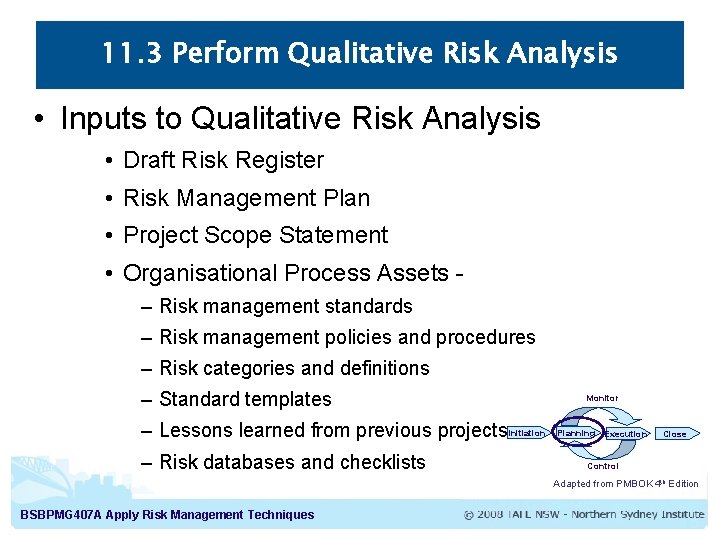
11. 3 Perform Qualitative Risk Analysis • Inputs to Qualitative Risk Analysis • Draft Risk Register • Risk Management Plan • Project Scope Statement • Organisational Process Assets – Risk management standards – Risk management policies and procedures – Risk categories and definitions – Standard templates – Lessons learned from previous projects. Initiation – Risk databases and checklists Monitor Planning Execution Close Control Adapted from PMBOK 4 th Edition BSBPMG 407 A Apply Risk Management Techniques
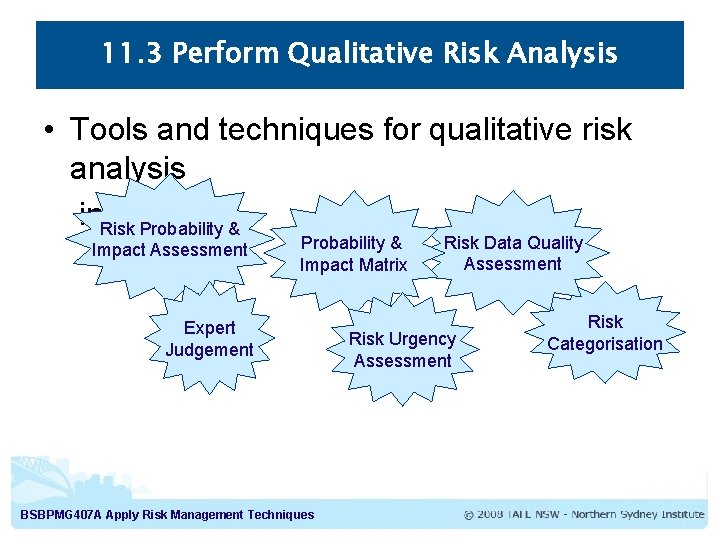
11. 3 Perform Qualitative Risk Analysis • Tools and techniques for qualitative risk analysis include Risk Probability & Impact Assessment Probability & Impact Matrix Expert Judgement BSBPMG 407 A Apply Risk Management Techniques Risk Data Quality Assessment Risk Urgency Assessment Risk Categorisation
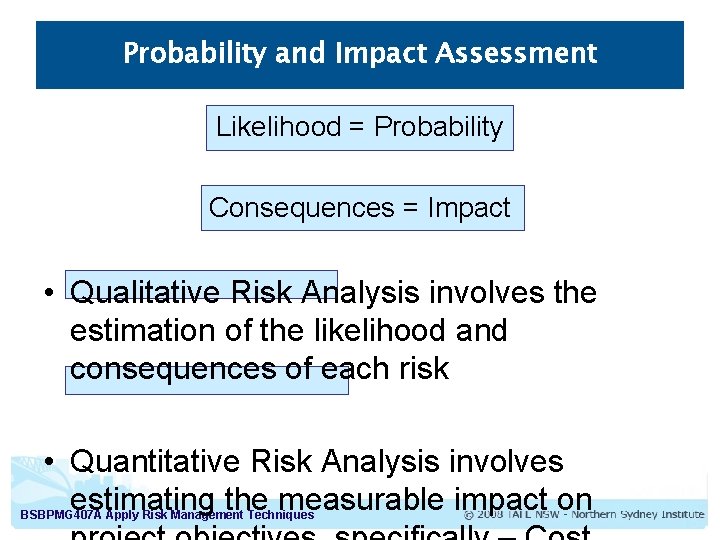
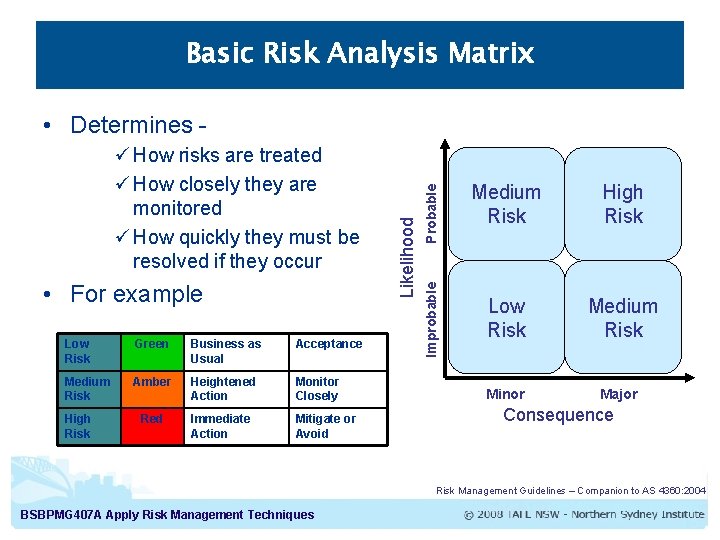
Probability and Impact Assessment Likelihood = Probability Consequences = Impact • Qualitative Risk Analysis involves the estimation of the likelihood and consequences of each risk • Quantitative Risk Analysis involves estimating the measurable impact on BSBPMG 407 A Apply Risk Management Techniques
Basic Risk Analysis Matrix • For example Low Risk Green Business as Usual Acceptance Medium Risk Amber Heightened Action Monitor Closely Red Immediate Action Mitigate or Avoid High Risk Probable Improbable ü How risks are treated ü How closely they are monitored ü How quickly they must be resolved if they occur Likelihood • Determines Medium Risk High Risk Low Risk Medium Risk Minor Major Consequence Risk Management Guidelines – Companion to AS 4360: 2004 BSBPMG 407 A Apply Risk Management Techniques
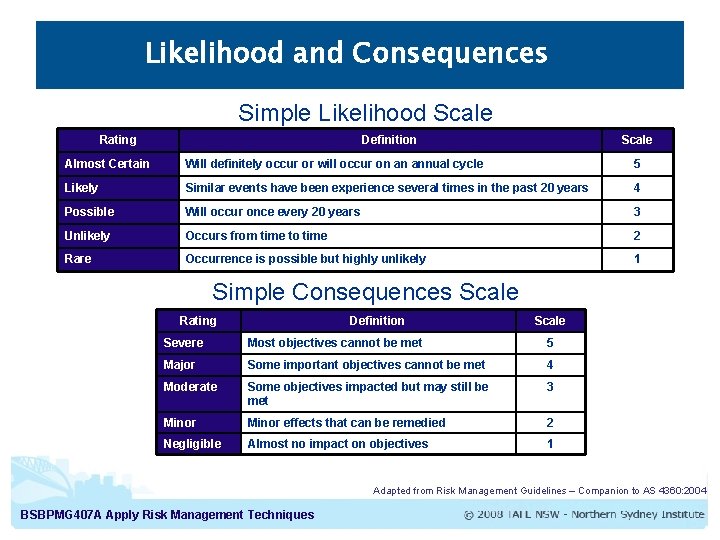
Likelihood and Consequences Simple Likelihood Scale Rating Definition Scale Almost Certain Will definitely occur or will occur on an annual cycle 5 Likely Similar events have been experience several times in the past 20 years 4 Possible Will occur once every 20 years 3 Unlikely Occurs from time to time 2 Rare Occurrence is possible but highly unlikely 1 Simple Consequences Scale Rating Definition Scale Severe Most objectives cannot be met 5 Major Some important objectives cannot be met 4 Moderate Some objectives impacted but may still be met 3 Minor effects that can be remedied 2 Negligible Almost no impact on objectives 1 Adapted from Risk Management Guidelines – Companion to AS 4360: 2004 BSBPMG 407 A Apply Risk Management Techniques
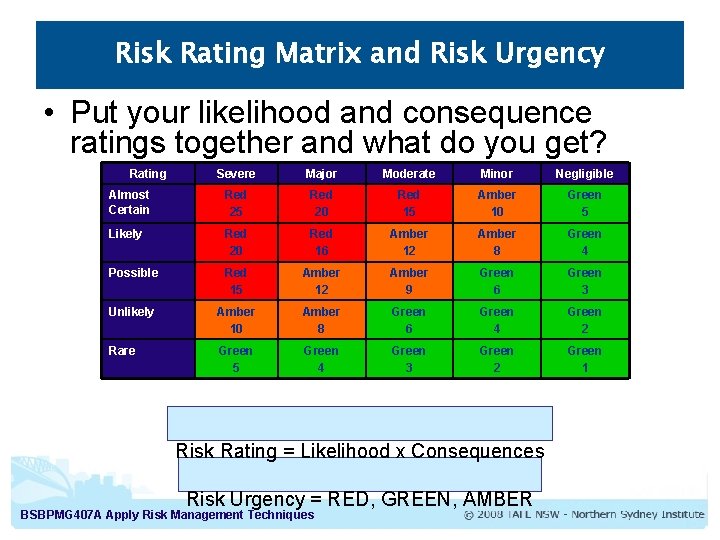
Risk Rating Matrix and Risk Urgency • Put your likelihood and consequence ratings together and what do you get? Rating Severe Major Moderate Minor Negligible Almost Certain Red 25 Red 20 Red 15 Amber 10 Green 5 Likely Red 20 Red 16 Amber 12 Amber 8 Green 4 Possible Red 15 Amber 12 Amber 9 Green 6 Green 3 Unlikely Amber 10 Amber 8 Green 6 Green 4 Green 2 Rare Green 5 Green 4 Green 3 Green 2 Green 1 Risk Rating = Likelihood x Consequences Risk Urgency = RED, GREEN, AMBER BSBPMG 407 A Apply Risk Management Techniques
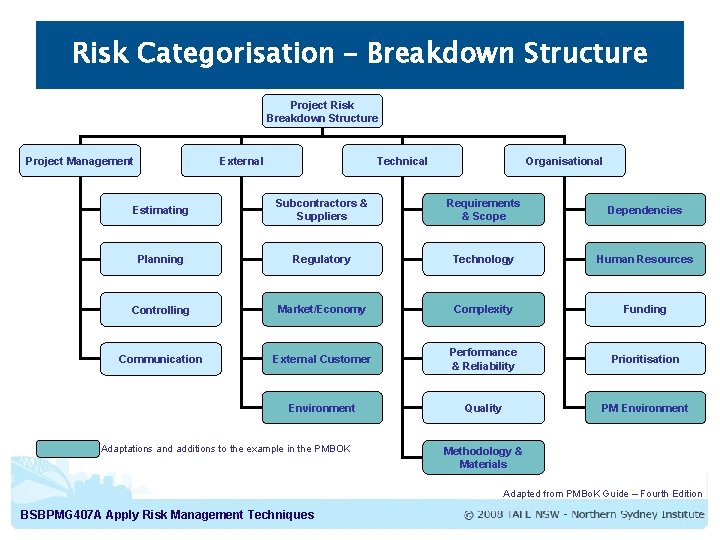
Risk Categorisation – Breakdown Structure Project Risk Breakdown Structure Project Management External Technical Organisational Estimating Subcontractors & Suppliers Requirements & Scope Dependencies Planning Regulatory Technology Human Resources Controlling Market/Economy Complexity Funding Communication External Customer Performance & Reliability Prioritisation Environment Quality PM Environment Adaptations and additions to the example in the PMBOK Methodology & Materials Adapted from PMBo. K Guide – Fourth Edition BSBPMG 407 A Apply Risk Management Techniques
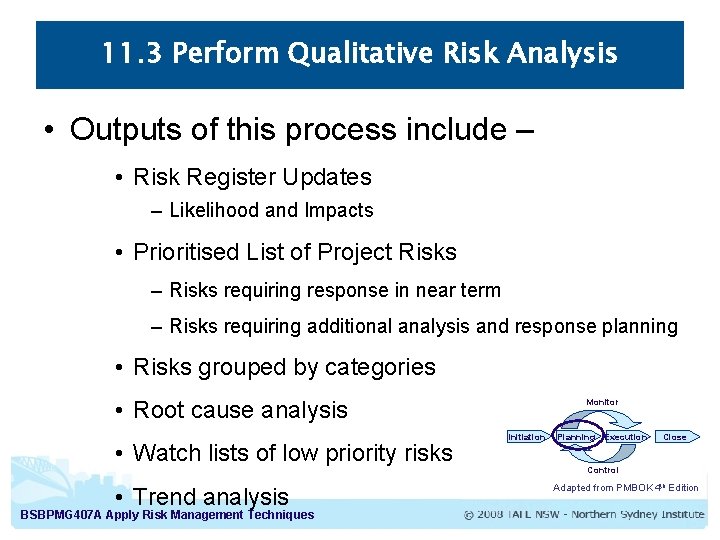
11. 3 Perform Qualitative Risk Analysis • Outputs of this process include – • Risk Register Updates – Likelihood and Impacts • Prioritised List of Project Risks – Risks requiring response in near term – Risks requiring additional analysis and response planning • Risks grouped by categories • Root cause analysis • Watch lists of low priority risks • Trend analysis BSBPMG 407 A Apply Risk Management Techniques Monitor Initiation Planning Execution Close Control Adapted from PMBOK 4 th Edition
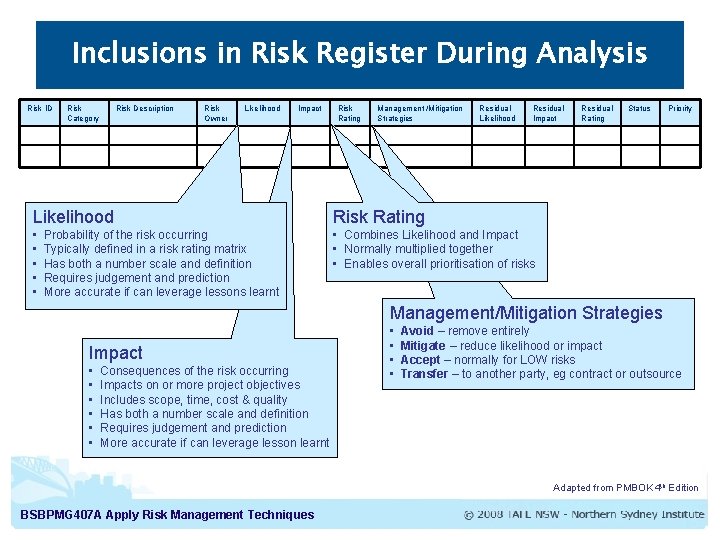
Inclusions in Risk Register During Analysis Risk ID Risk Category Risk Description Risk Owner Likelihood Impact Risk Rating Management /Mitigation Strategies Residual Likelihood Residual Impact Likelihood Risk Rating • • • Combines Likelihood and Impact • Normally multiplied together • Enables overall prioritisation of risks Probability of the risk occurring Typically defined in a risk rating matrix Has both a number scale and definition Requires judgement and prediction More accurate if can leverage lessons learnt Residual Rating Status Priority Management/Mitigation Strategies Impact • • • Consequences of the risk occurring Impacts on or more project objectives Includes scope, time, cost & quality Has both a number scale and definition Requires judgement and prediction More accurate if can leverage lesson learnt • • Avoid – remove entirely Mitigate – reduce likelihood or impact Accept – normally for LOW risks Transfer – to another party, eg contract or outsource Adapted from PMBOK 4 th Edition BSBPMG 407 A Apply Risk Management Techniques
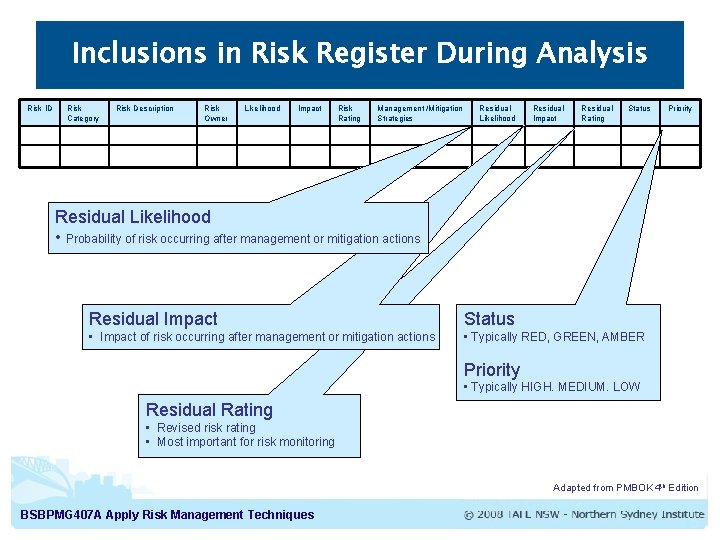
Inclusions in Risk Register During Analysis Risk ID Risk Category Risk Description Risk Owner Likelihood Impact Risk Rating Management /Mitigation Strategies Residual Likelihood Residual Impact Residual Rating Status Priority Residual Likelihood • Probability of risk occurring after management or mitigation actions Residual Impact Status • Impact of risk occurring after management or mitigation actions • Typically RED, GREEN, AMBER Priority • Typically HIGH. MEDIUM. LOW Residual Rating • Revised risk rating • Most important for risk monitoring Adapted from PMBOK 4 th Edition BSBPMG 407 A Apply Risk Management Techniques
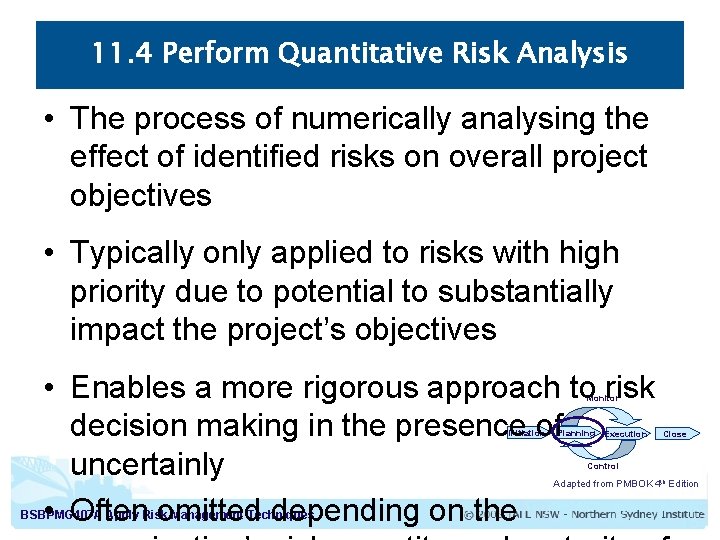
11. 4 Perform Quantitative Risk Analysis • The process of numerically analysing the effect of identified risks on overall project objectives • Typically only applied to risks with high priority due to potential to substantially impact the project’s objectives • Enables a more rigorous approach to risk decision making in the presence of uncertainly • Often omitted depending on the Monitor Initiation Planning Execution Close Control Adapted from PMBOK 4 th Edition BSBPMG 407 A Apply Risk Management Techniques
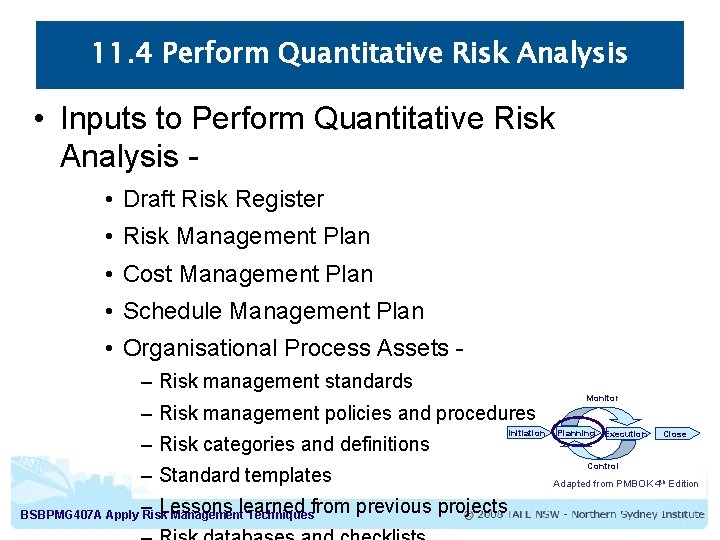
11. 4 Perform Quantitative Risk Analysis • Inputs to Perform Quantitative Risk Analysis • Draft Risk Register • Risk Management Plan • Cost Management Plan • Schedule Management Plan • Organisational Process Assets – Risk management standards – Risk management policies and procedures – Risk categories and definitions – Standard templates – Lessons learned from previous projects BSBPMG 407 A Apply Risk Management Techniques Initiation Monitor Planning Execution Close Control Adapted from PMBOK 4 th Edition
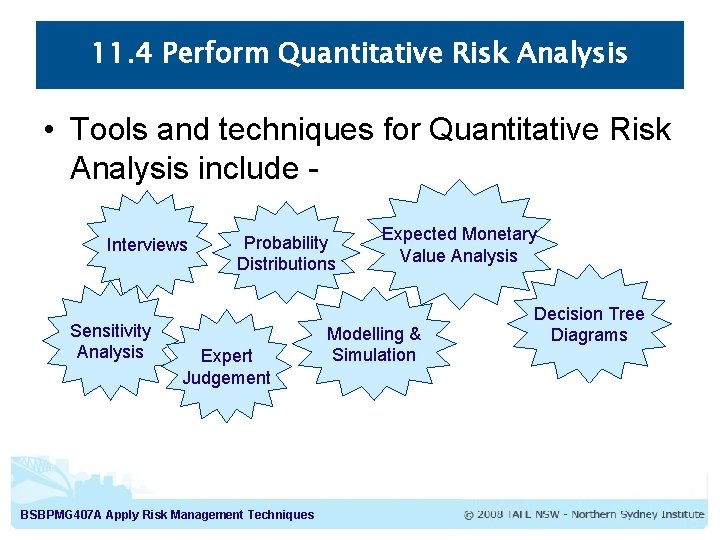
11. 4 Perform Quantitative Risk Analysis • Tools and techniques for Quantitative Risk Analysis include Interviews Sensitivity Analysis Probability Distributions Expert Judgement BSBPMG 407 A Apply Risk Management Techniques Expected Monetary Value Analysis Modelling & Simulation Decision Tree Diagrams
11. 4 Perform Quantitative Risk Analysis Interviews • Draw on experience of experts and historical data to quantify the probability and impacts of risks on project objectives. Often Three-point data is gathered on pessimistic, likely and optimistic outcomes. Probability Distributions – Advanced technique • Discrete distributions represent uncertain events such as risks. Requires high degree of statistical skill and statistical software. Sensitivity Analysis – Advanced technique • Helps to determine which risks have the most potential impact on project objectives. Prioritisation undertaken in Qualitative Analysis is often sufficient. BSBPMG 407 A Apply Risk Management Techniques
11. 4 Perform Quantitative Risk Analysis Modelling and Simulation – Advanced techniques • Uses a model to simulate the outcomes of the project, including the impact of uncertain events such as risks. Requires extensive data on past and similar projects, a high degree of statistical expertise and statistical software. Expected Monetary Value Analysis – Advanced technique • Extremely advanced technique. Rarely used except for Defence and Scientific projects such as space exploration. Specifically examines the impacts on cost of uncertain events. Decision Tree Diagrams • Can be use in conjunction with Modelling and Simulation and Expected Monetary Value Analysis, or can be prepared in a more informal manner. Enables analysis of different choices and paths. BSBPMG 407 A Apply Risk Management Techniques
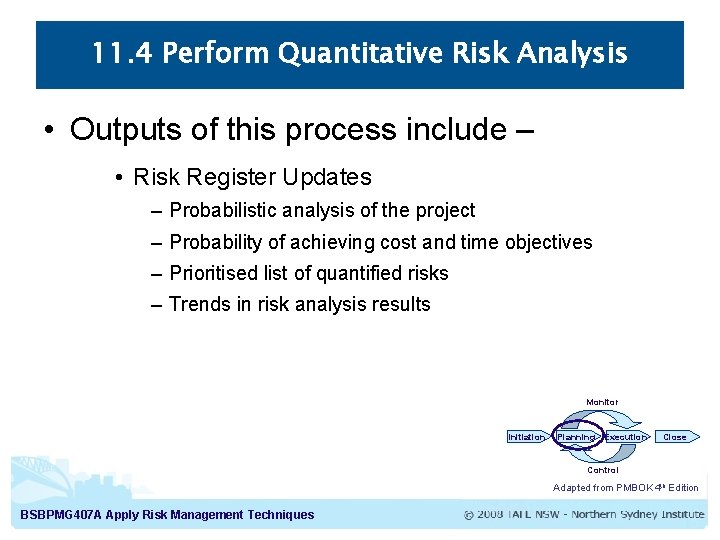
11. 4 Perform Quantitative Risk Analysis • Outputs of this process include – • Risk Register Updates – Probabilistic analysis of the project – Probability of achieving cost and time objectives – Prioritised list of quantified risks – Trends in risk analysis results Monitor Initiation Planning Execution Close Control Adapted from PMBOK 4 th Edition BSBPMG 407 A Apply Risk Management Techniques
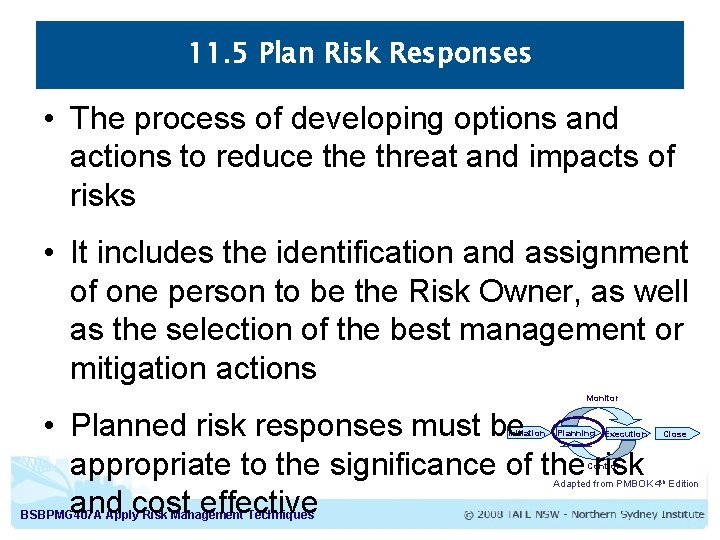
11. 5 Plan Risk Responses • The process of developing options and actions to reduce threat and impacts of risks • It includes the identification and assignment of one person to be the Risk Owner, as well as the selection of the best management or mitigation actions Monitor • Planned risk responses must be appropriate to the significance of the risk and cost effective Initiation Planning Execution Close Control Adapted from PMBOK 4 th Edition BSBPMG 407 A Apply Risk Management Techniques
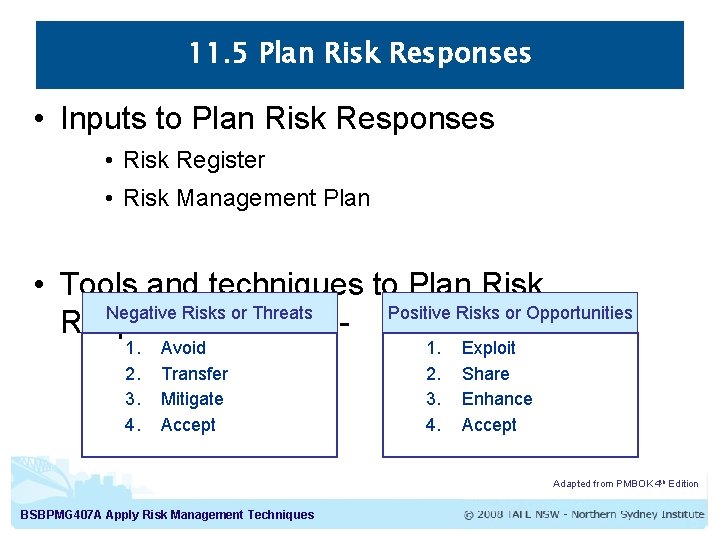
11. 5 Plan Risk Responses • Inputs to Plan Risk Responses • Risk Register • Risk Management Plan • Tools and techniques to Plan Risk Negative Risks or Threats Positive Risks or Opportunities Responses include 1. 2. 3. 4. Avoid Transfer Mitigate Accept 1. 2. 3. 4. Exploit Share Enhance Accept Adapted from PMBOK 4 th Edition BSBPMG 407 A Apply Risk Management Techniques
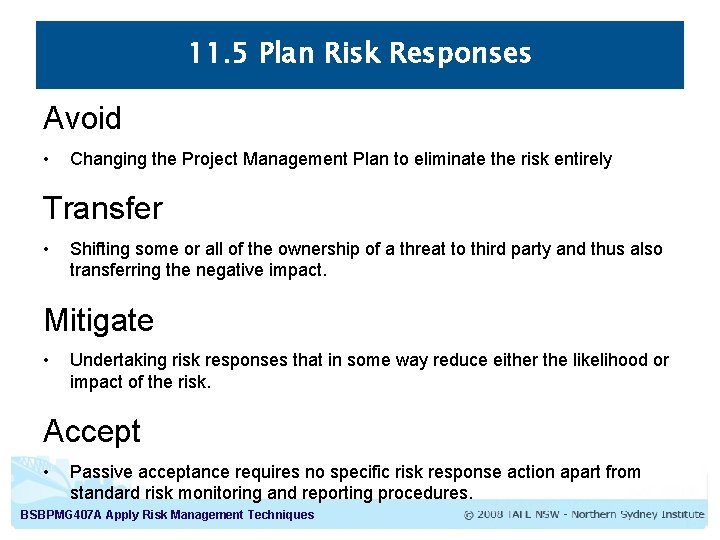
11. 5 Plan Risk Responses Avoid • Changing the Project Management Plan to eliminate the risk entirely Transfer • Shifting some or all of the ownership of a threat to third party and thus also transferring the negative impact. Mitigate • Undertaking risk responses that in some way reduce either the likelihood or impact of the risk. Accept • Passive acceptance requires no specific risk response action apart from standard risk monitoring and reporting procedures. BSBPMG 407 A Apply Risk Management Techniques
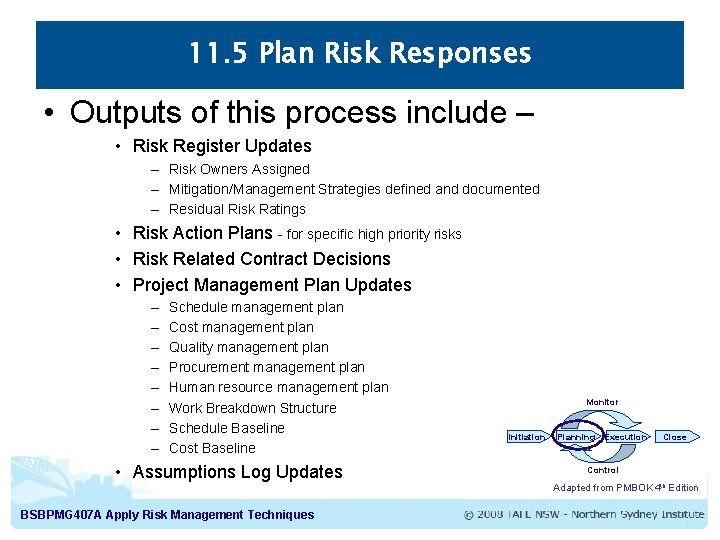
11. 5 Plan Risk Responses • Outputs of this process include – • Risk Register Updates – Risk Owners Assigned – Mitigation/Management Strategies defined and documented – Residual Risk Ratings • Risk Action Plans - for specific high priority risks • Risk Related Contract Decisions • Project Management Plan Updates – – – – Schedule management plan Cost management plan Quality management plan Procurement management plan Human resource management plan Work Breakdown Structure Schedule Baseline Cost Baseline • Assumptions Log Updates BSBPMG 407 A Apply Risk Management Techniques Monitor Initiation Planning Execution Close Control Adapted from PMBOK 4 th Edition
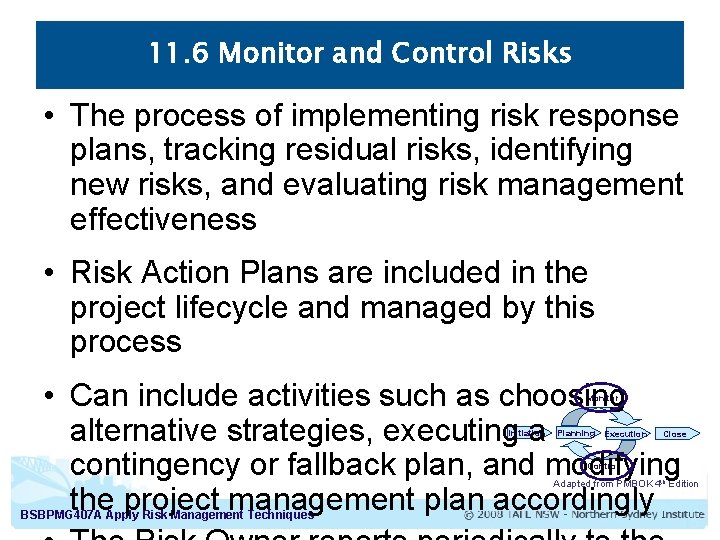
11. 6 Monitor and Control Risks • The process of implementing risk response plans, tracking residual risks, identifying new risks, and evaluating risk management effectiveness • Risk Action Plans are included in the project lifecycle and managed by this process • Can include activities such as choosing alternative strategies, executing a contingency or fallback plan, and modifying the project management plan accordingly Monitor Initiation Planning Execution Close Control Adapted from PMBOK 4 th Edition BSBPMG 407 A Apply Risk Management Techniques
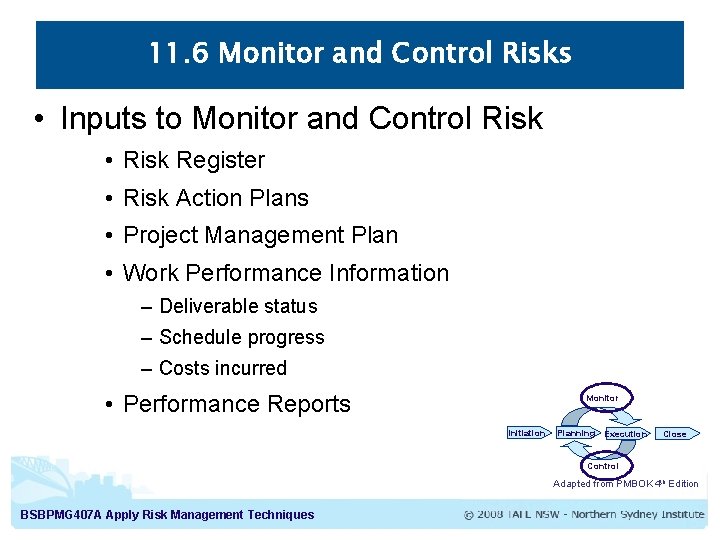
11. 6 Monitor and Control Risks • Inputs to Monitor and Control Risk • Risk Register • Risk Action Plans • Project Management Plan • Work Performance Information – Deliverable status – Schedule progress – Costs incurred • Performance Reports Monitor Initiation Planning Execution Close Control Adapted from PMBOK 4 th Edition BSBPMG 407 A Apply Risk Management Techniques
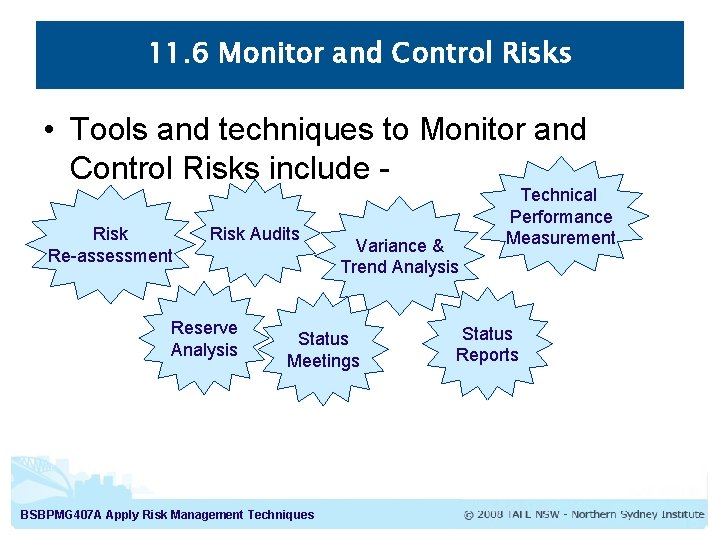
11. 6 Monitor and Control Risks • Tools and techniques to Monitor and Control Risks include Risk Re-assessment Risk Audits Reserve Analysis Variance & Trend Analysis Status Meetings BSBPMG 407 A Apply Risk Management Techniques Technical Performance Measurement Status Reports
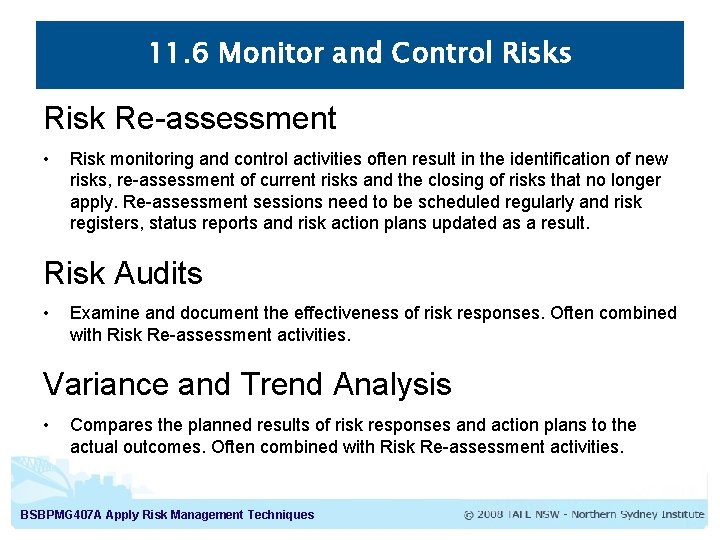
11. 6 Monitor and Control Risks Risk Re-assessment • Risk monitoring and control activities often result in the identification of new risks, re-assessment of current risks and the closing of risks that no longer apply. Re-assessment sessions need to be scheduled regularly and risk registers, status reports and risk action plans updated as a result. Risk Audits • Examine and document the effectiveness of risk responses. Often combined with Risk Re-assessment activities. Variance and Trend Analysis • Compares the planned results of risk responses and action plans to the actual outcomes. Often combined with Risk Re-assessment activities. BSBPMG 407 A Apply Risk Management Techniques
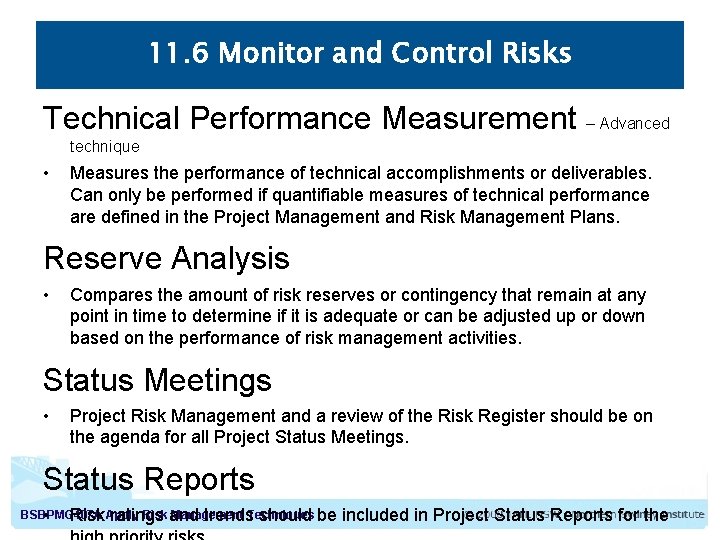
11. 6 Monitor and Control Risks Technical Performance Measurement – Advanced technique • Measures the performance of technical accomplishments or deliverables. Can only be performed if quantifiable measures of technical performance are defined in the Project Management and Risk Management Plans. Reserve Analysis • Compares the amount of risk reserves or contingency that remain at any point in time to determine if it is adequate or can be adjusted up or down based on the performance of risk management activities. Status Meetings • Project Risk Management and a review of the Risk Register should be on the agenda for all Project Status Meetings. Status Reports BSBPMG 407 A Risk and Management • Risk Apply ratings trends. Techniques should be included in Project Status Reports for the
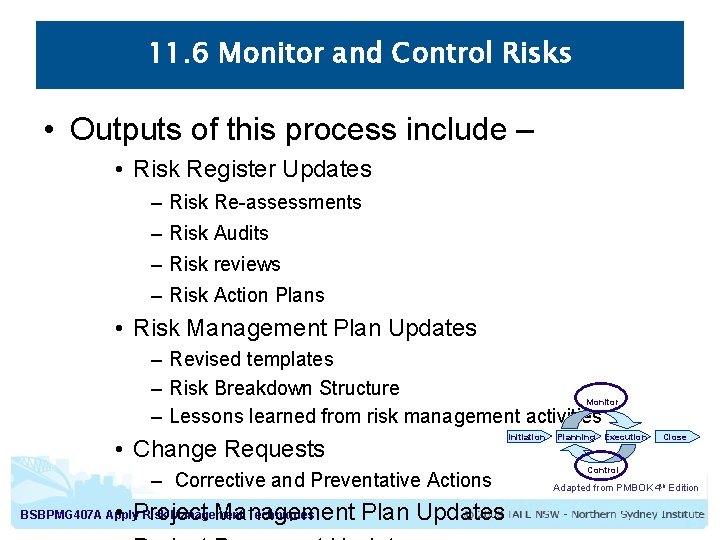
11. 6 Monitor and Control Risks • Outputs of this process include – • Risk Register Updates – Risk Re-assessments – Risk Audits – Risk reviews – Risk Action Plans • Risk Management Plan Updates – Revised templates – Risk Breakdown Structure Monitor – Lessons learned from risk management activities • Change Requests – Corrective and Preventative Actions • Project Management Plan Updates BSBPMG 407 A Apply Risk Management Techniques Initiation Planning Execution Close Control Adapted from PMBOK 4 th Edition
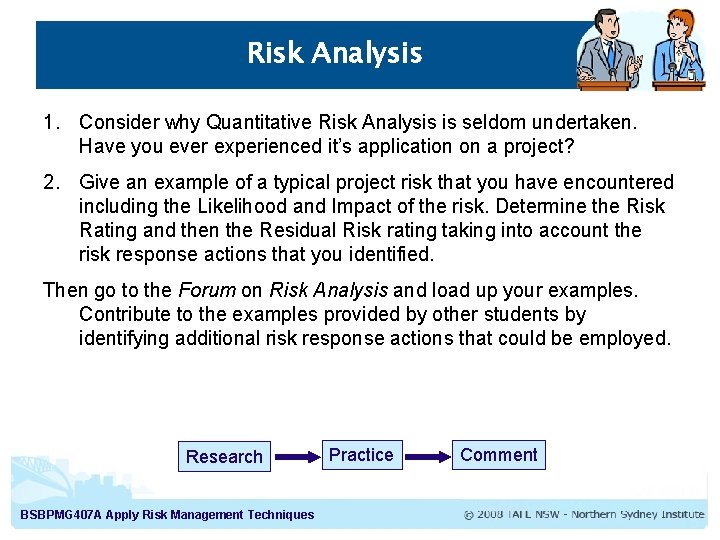
Risk Analysis 1. Consider why Quantitative Risk Analysis is seldom undertaken. Have you ever experienced it’s application on a project? 2. Give an example of a typical project risk that you have encountered including the Likelihood and Impact of the risk. Determine the Risk Rating and then the Residual Risk rating taking into account the risk response actions that you identified. Then go to the Forum on Risk Analysis and load up your examples. Contribute to the examples provided by other students by identifying additional risk response actions that could be employed. Research BSBPMG 407 A Apply Risk Management Techniques Practice Comment
Next Steps Please proceed to Tests & Tasks and take the Project Risk Quiz. Be sure that you have participated in the Forums. Best of Luck! These are all due at the end of Week 10 in the Course Delivery Schedule BSBPMG 407 A Apply Risk Management Techniques