
apply innovation Renishaw touchtrigger probing technology Rugged and
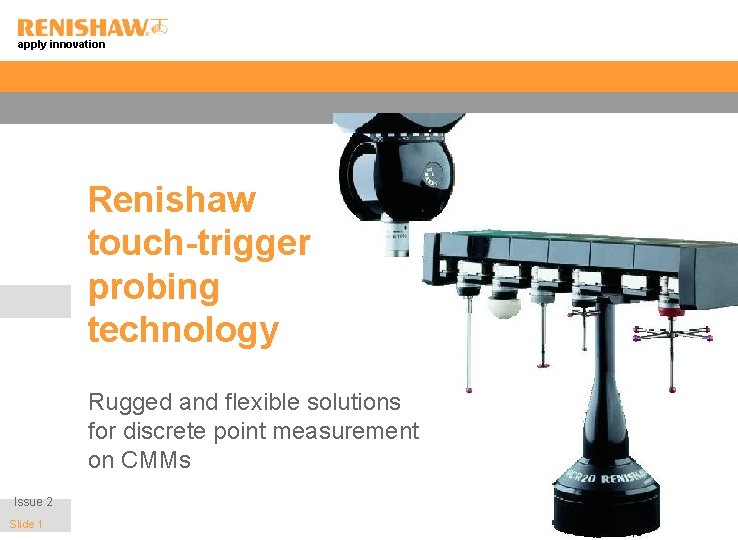
apply innovation Renishaw touch-trigger probing technology Rugged and flexible solutions for discrete point measurement on CMMs Issue 2 Slide 1
apply innovation Questions to ask your metrology system supplier • Are my measurement applications best inspected with discrete points? – if so, should I use a scanning probe or a touch-trigger probe? • Will I benefit from the flexibility of an articulating head – access to the component – sensor and stylus changing • What are the lifetime costs? – purchase price Slide 2 – what are the likely failure modes and what protection is provided? – repair / replacement costs and speed of service

apply innovation Renishaw touch-trigger probing - our objectives • robustness – compact and rugged – crash protection – extended operating life • flexibility – probe changing – stylus changing – articulation • cost effectiveness Slide 3 – innovative hardware – simple programming for lower running costs – robust designs and responsive service for lower lifetime costs
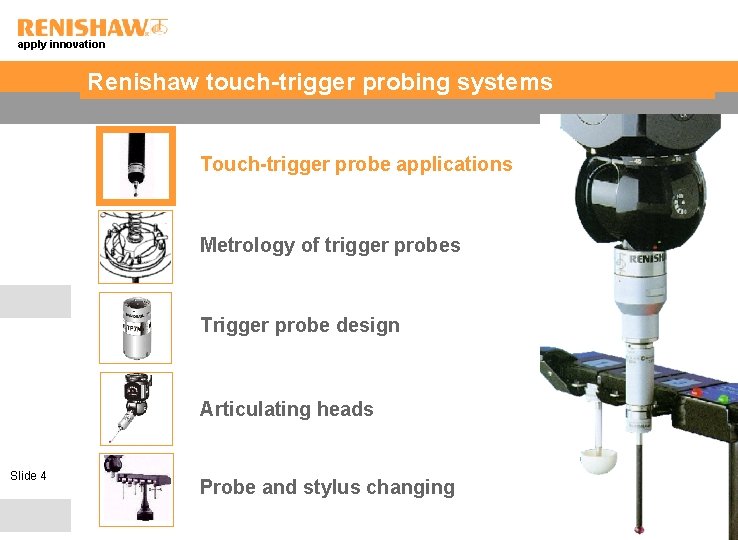
apply innovation Renishaw touch-trigger probing systems Touch-trigger probe applications Metrology of trigger probes Trigger probe design Articulating heads Slide 4 Probe and stylus changing

apply innovation Probing applications - factors Manufacturers need a range of measurement solutions. Why? · machining processes have different levels of stability: - stable form : - therefore control size and position Þ discrete point measurement - form variation significant : - therefore form must be measured and controlled Þ scanning Slide 5
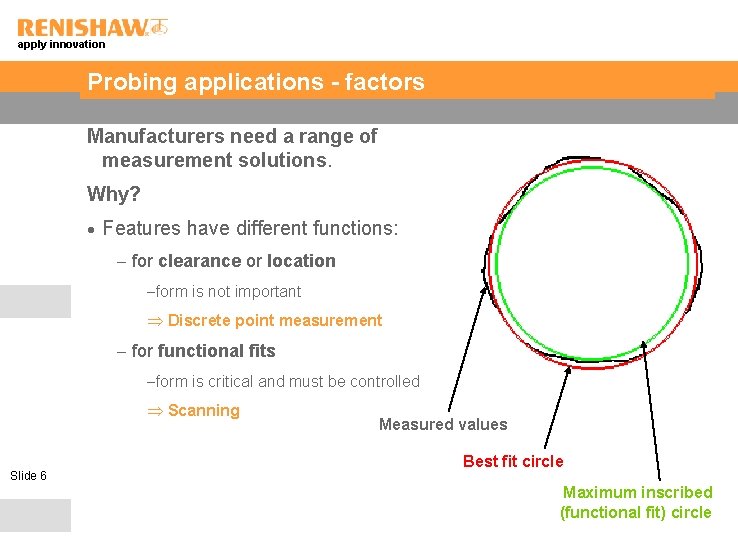
apply innovation Probing applications - factors Manufacturers need a range of measurement solutions. Why? · Features have different functions: - for clearance or location -form is not important Þ Discrete point measurement - for functional fits -form is critical and must be controlled Þ Scanning Slide 6 Measured values Best fit circle Maximum inscribed (functional fit) circle
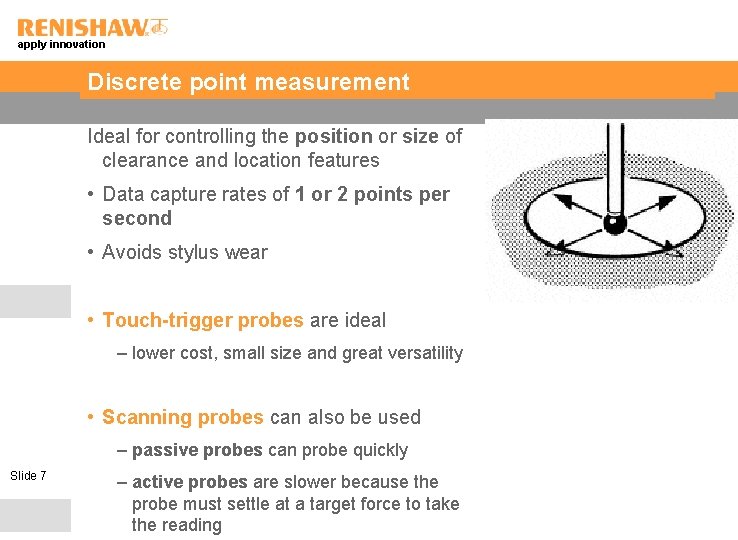
apply innovation Discrete point measurement Ideal for controlling the position or size of clearance and location features • Data capture rates of 1 or 2 points per second • Avoids stylus wear • Touch-trigger probes are ideal – lower cost, small size and great versatility • Scanning probes can also be used – passive probes can probe quickly Slide 7 – active probes are slower because the probe must settle at a target force to take the reading

apply innovation Discrete point measurement Speed comparison Slide 8 Touch-trigger probes are ideal for high speed discrete point measurement Scanning probes can also measure discrete points quickly, and provide higher data capture rates when scanning

apply innovation Touch-trigger probing operation Trigger probes measure discrete points. . . • a trigger probe is in one of two states: – seated when the stylus is not in contact with the part – unseated when the stylus is touching the part • a trigger signal is generated when the probe changes from seated to unseated • the trigger signal latches the machine position to record the location of the surface Slide 9 • feature geometry is computed from a best fit of discrete surface points
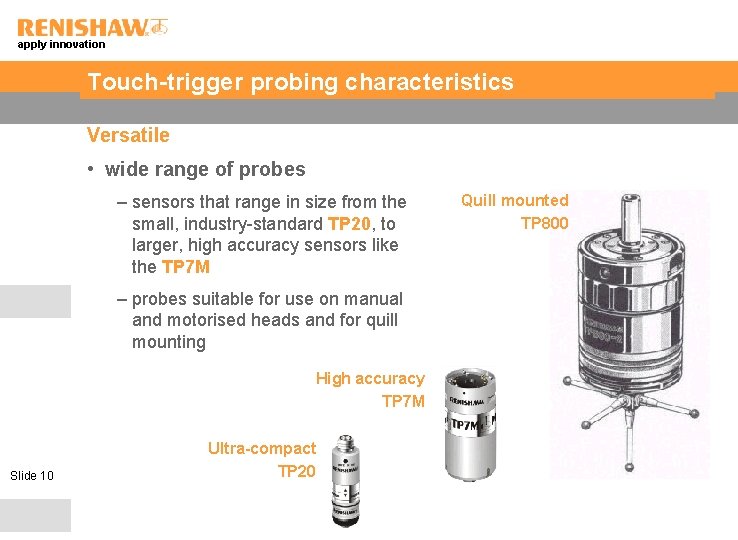
apply innovation Touch-trigger probing characteristics Versatile • wide range of probes – sensors that range in size from the small, industry-standard TP 20, to larger, high accuracy sensors like the TP 7 M – probes suitable for use on manual and motorised heads and for quill mounting High accuracy TP 7 M Slide 10 Ultra-compact TP 20 Quill mounted TP 800
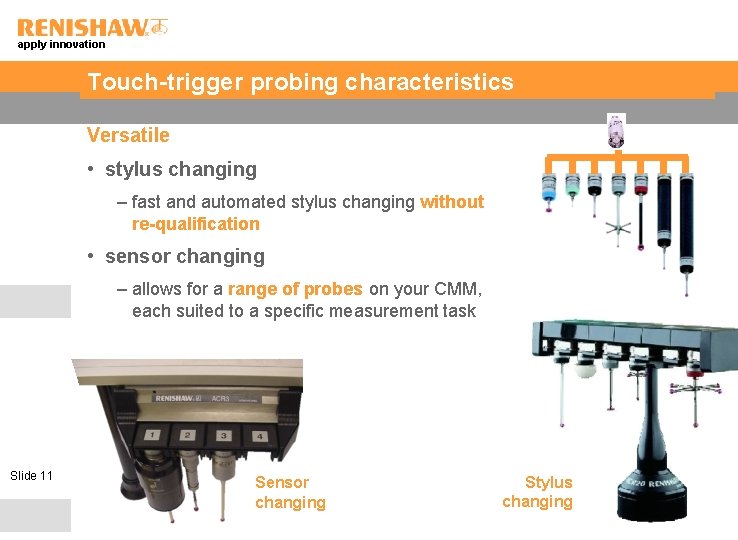
apply innovation Touch-trigger probing characteristics Versatile • stylus changing – fast and automated stylus changing without re-qualification • sensor changing – allows for a range of probes on your CMM, each suited to a specific measurement task Slide 11 Sensor changing Stylus changing
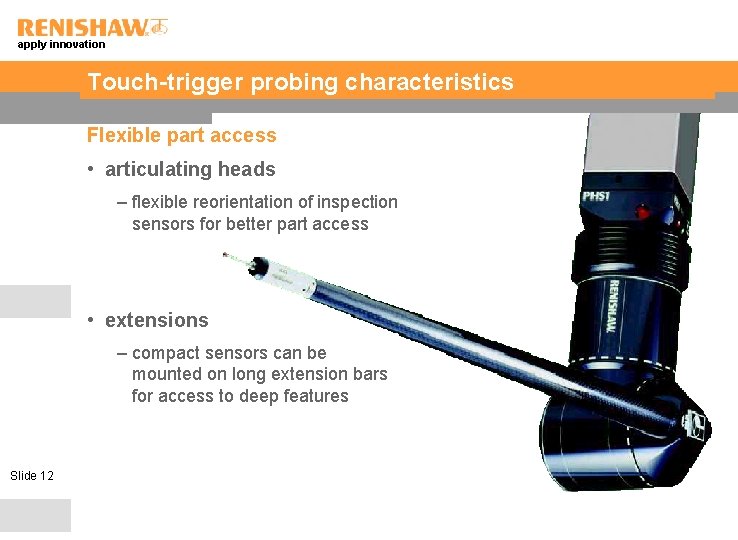
apply innovation Touch-trigger probing characteristics Flexible part access • articulating heads – flexible reorientation of inspection sensors for better part access • extensions – compact sensors can be mounted on long extension bars for access to deep features Slide 12
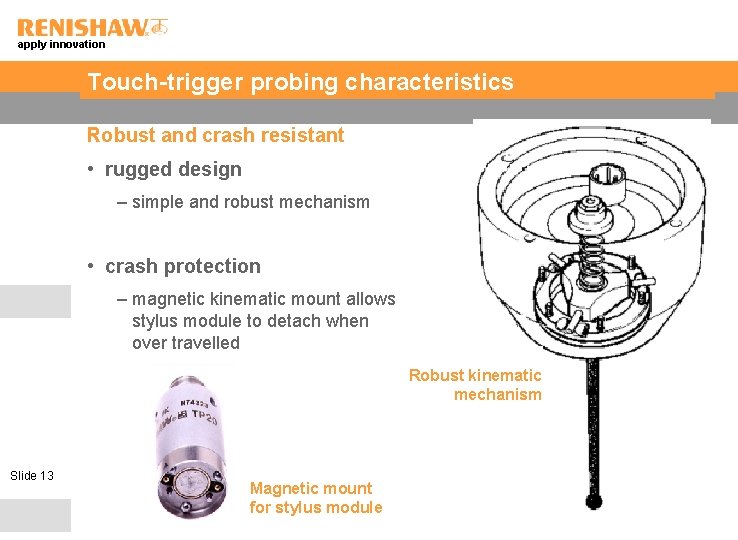
apply innovation Touch-trigger probing characteristics Robust and crash resistant • rugged design – simple and robust mechanism • crash protection – magnetic kinematic mount allows stylus module to detach when over travelled Robust kinematic mechanism Slide 13 Magnetic mount for stylus module
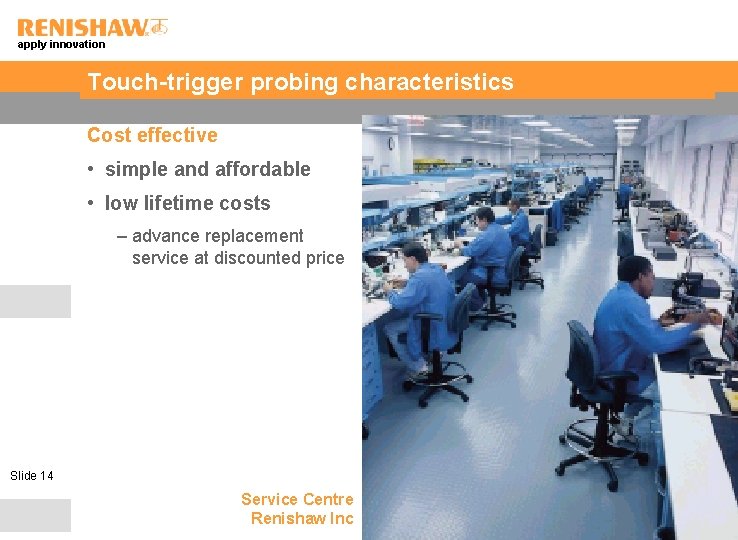
apply innovation Touch-trigger probing characteristics Cost effective • simple and affordable • low lifetime costs – advance replacement service at discounted price Slide 14 Service Centre Renishaw Inc
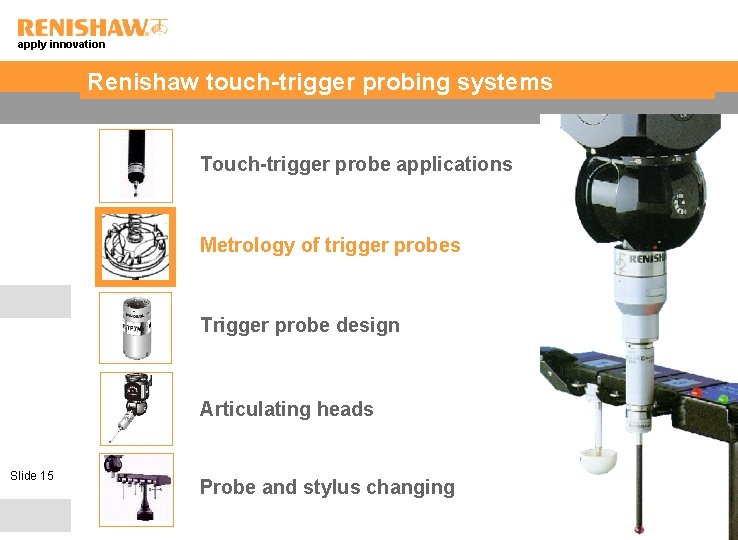
apply innovation Renishaw touch-trigger probing systems Touch-trigger probe applications Metrology of trigger probes Trigger probe design Articulating heads Slide 15 Probe and stylus changing
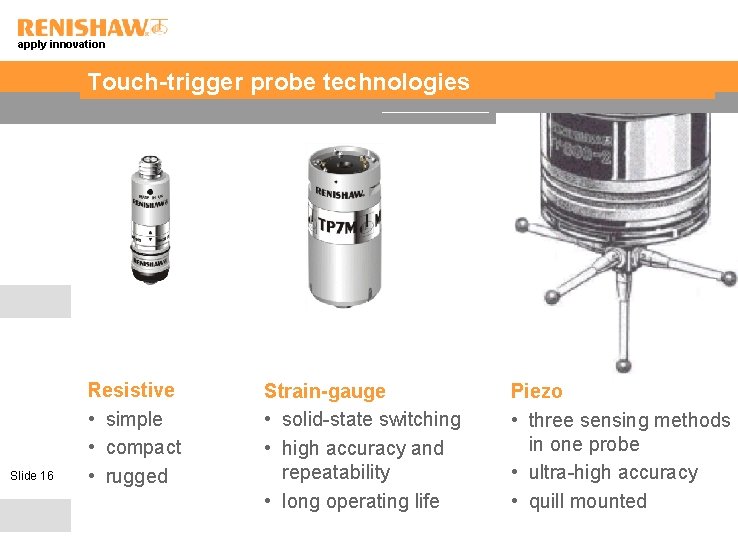
apply innovation Touch-trigger probe technologies Slide 16 Resistive • simple • compact • rugged Strain-gauge • solid-state switching • high accuracy and repeatability • long operating life Piezo • three sensing methods in one probe • ultra-high accuracy • quill mounted
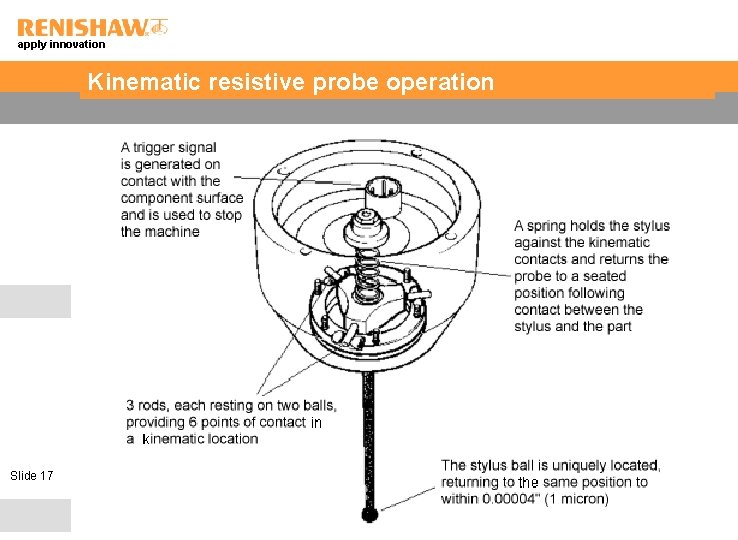
apply innovation Kinematic resistive probe operation Slide 17
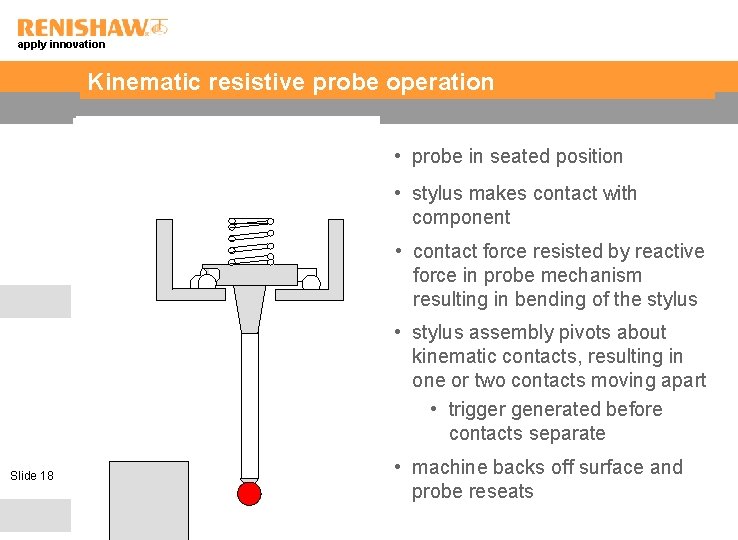
apply innovation Kinematic resistive probe operation All kinematics Pivots about Contacts in contact these Reactive separate contacts force • probe in seated position • stylus makes contact with component • contact force resisted by reactive force in probe mechanism resulting in bending of the stylus • stylus assembly pivots about kinematic contacts, resulting in one or two contacts moving apart • trigger generated before contacts separate Motion of machine Slide 18 Contact force • machine backs off surface and probe reseats
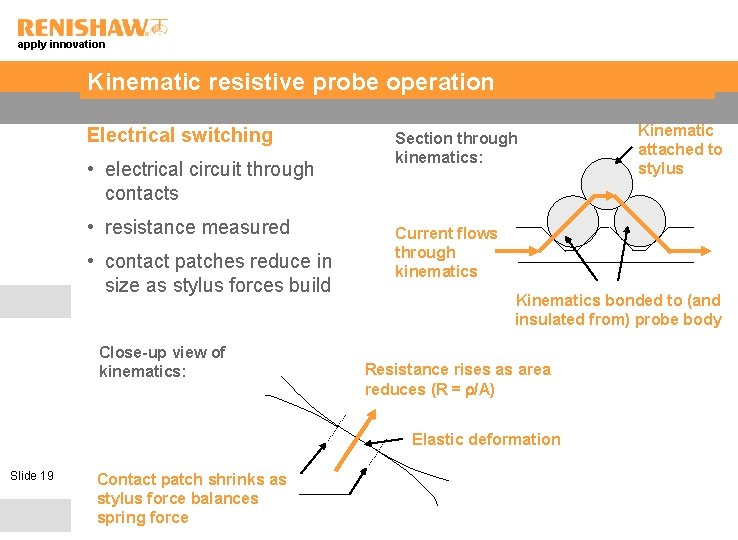
apply innovation Kinematic resistive probe operation Electrical switching • electrical circuit through contacts • resistance measured • contact patches reduce in size as stylus forces build Close-up view of kinematics: Section through kinematics: Current flows through kinematics Kinematics bonded to (and insulated from) probe body Resistance rises as area reduces (R = /A) Elastic deformation Slide 19 Contact patch shrinks as stylus force balances spring force Kinematic attached to stylus
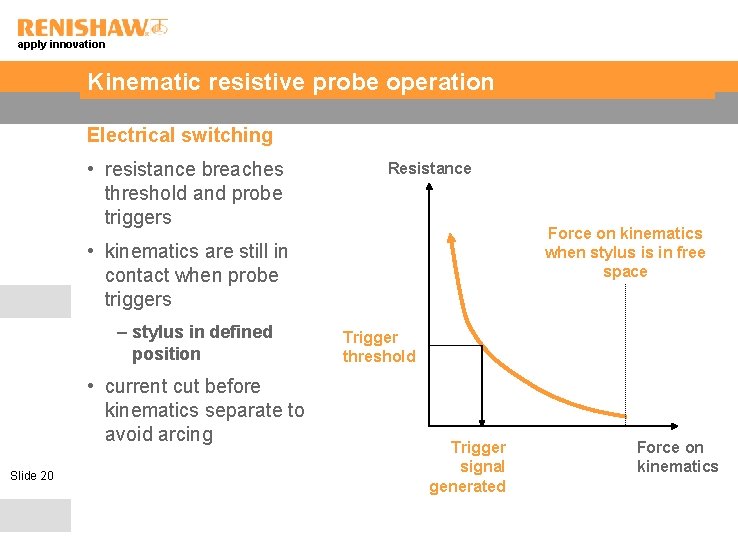
apply innovation Kinematic resistive probe operation Electrical switching • resistance breaches threshold and probe triggers Resistance Force on kinematics when stylus is in free space • kinematics are still in contact when probe triggers – stylus in defined position • current cut before kinematics separate to avoid arcing Slide 20 Trigger threshold Trigger signal generated Force on kinematics
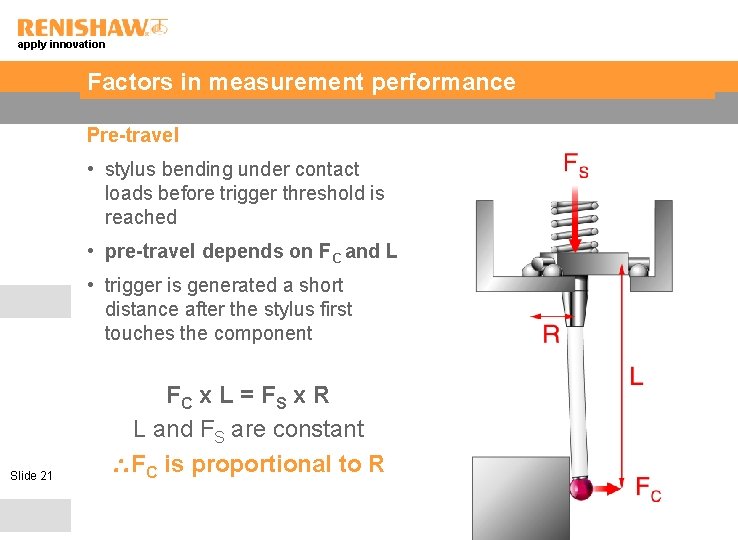
apply innovation Factors in measurement performance Pre-travel • stylus bending under contact loads before trigger threshold is reached • pre-travel depends on FC and L • trigger is generated a short distance after the stylus first touches the component Slide 21 FC x L = F S x R L and FS are constant FC is proportional to R
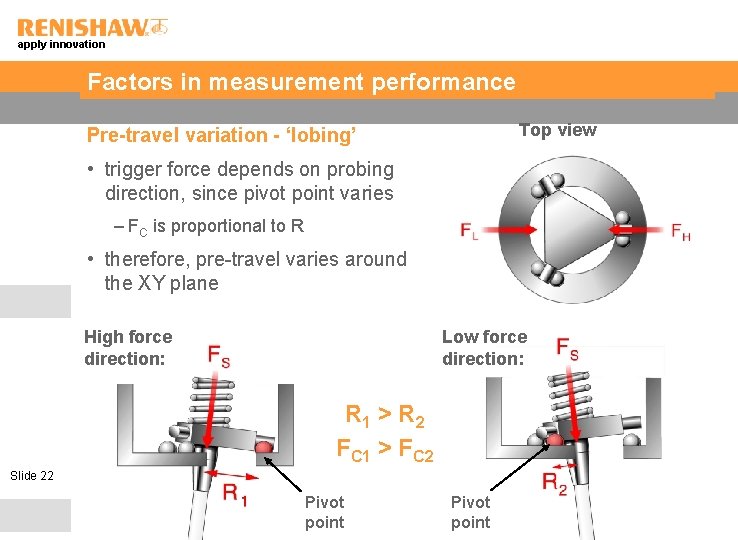
apply innovation Factors in measurement performance Top view Pre-travel variation - ‘lobing’ • trigger force depends on probing direction, since pivot point varies – FC is proportional to R • therefore, pre-travel varies around the XY plane High force direction: Low force direction: R 1 > R 2 FC 1 > FC 2 Slide 22 Pivot point
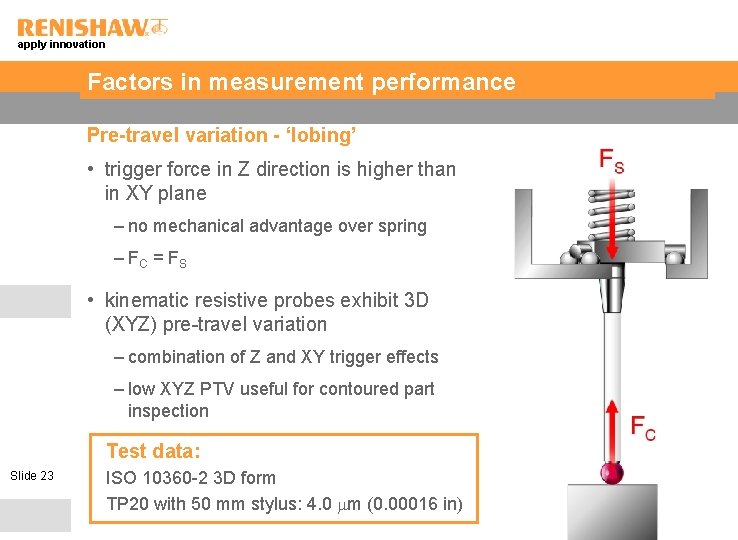
apply innovation Factors in measurement performance Pre-travel variation - ‘lobing’ • trigger force in Z direction is higher than in XY plane – no mechanical advantage over spring – FC = F S • kinematic resistive probes exhibit 3 D (XYZ) pre-travel variation – combination of Z and XY trigger effects – low XYZ PTV useful for contoured part inspection Test data: Slide 23 ISO 10360 -2 3 D form TP 20 with 50 mm stylus: 4. 0 m (0. 00016 in)
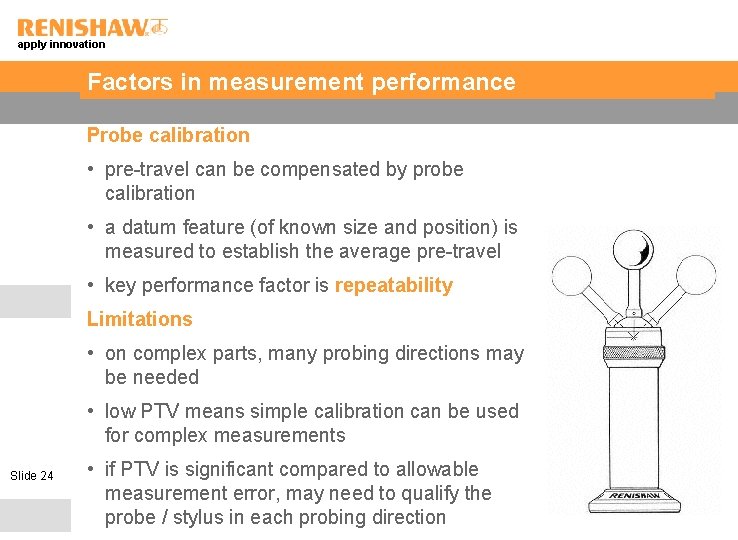
apply innovation Factors in measurement performance Probe calibration • pre-travel can be compensated by probe calibration • a datum feature (of known size and position) is measured to establish the average pre-travel • key performance factor is repeatability Limitations • on complex parts, many probing directions may be needed • low PTV means simple calibration can be used for complex measurements Slide 24 • if PTV is significant compared to allowable measurement error, may need to qualify the probe / stylus in each probing direction
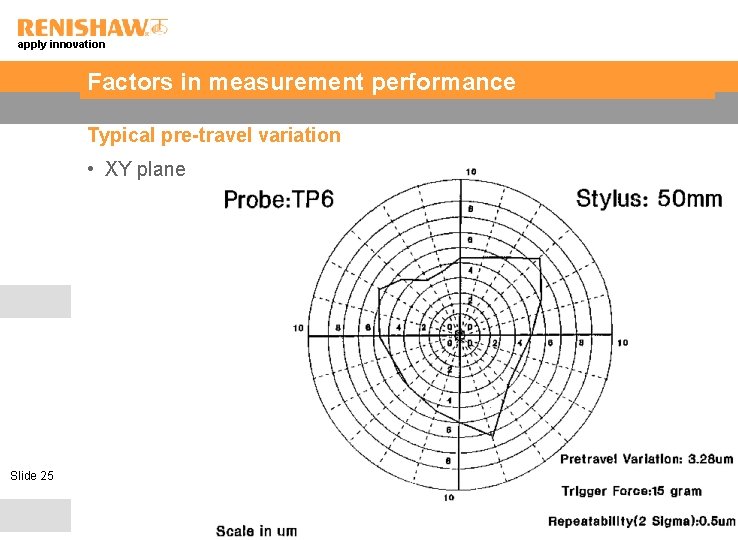
apply innovation Factors in measurement performance Typical pre-travel variation • XY plane Slide 25
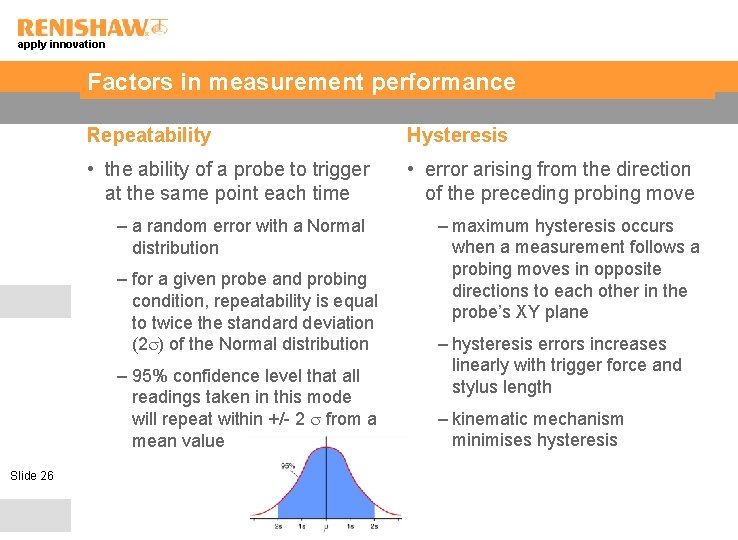
apply innovation Factors in measurement performance Repeatability Hysteresis • the ability of a probe to trigger at the same point each time • error arising from the direction of the preceding probing move – a random error with a Normal distribution – maximum hysteresis occurs when a measurement follows a probing moves in opposite directions to each other in the probe’s XY plane – for a given probe and probing condition, repeatability is equal to twice the standard deviation (2 ) of the Normal distribution – 95% confidence level that all readings taken in this mode will repeat within +/- 2 from a mean value Slide 26 – hysteresis errors increases linearly with trigger force and stylus length – kinematic mechanism minimises hysteresis
apply innovation Factors in measurement performance Ranked in terms of importance • repeatability – key requirement of any trigger probe – fundamental limit on system measurement performance – hysteresis contributes to measurement repeatability • pre-travel variation – can be calibrated, provided all probing directions are known – measurement accuracy will be reduced if probe used in un-qualified direction and PTV is high – increases rapidly with stylus length • hysteresis Slide 27 – small error factor for probes with kinematic mechanisms
apply innovation Renishaw touch-trigger probing systems Touch-trigger probe applications Metrology of trigger probes Trigger probe design Articulating heads Slide 28 Probe and stylus changing
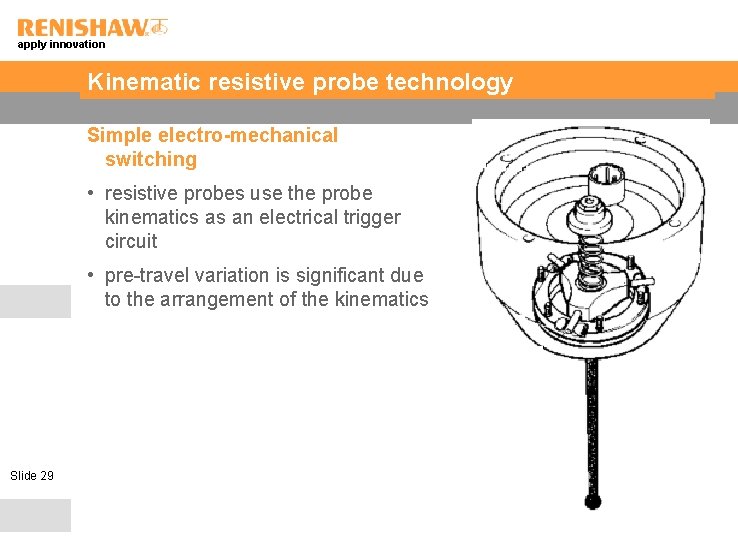
apply innovation Kinematic resistive probe technology Simple electro-mechanical switching • resistive probes use the probe kinematics as an electrical trigger circuit • pre-travel variation is significant due to the arrangement of the kinematics Slide 29
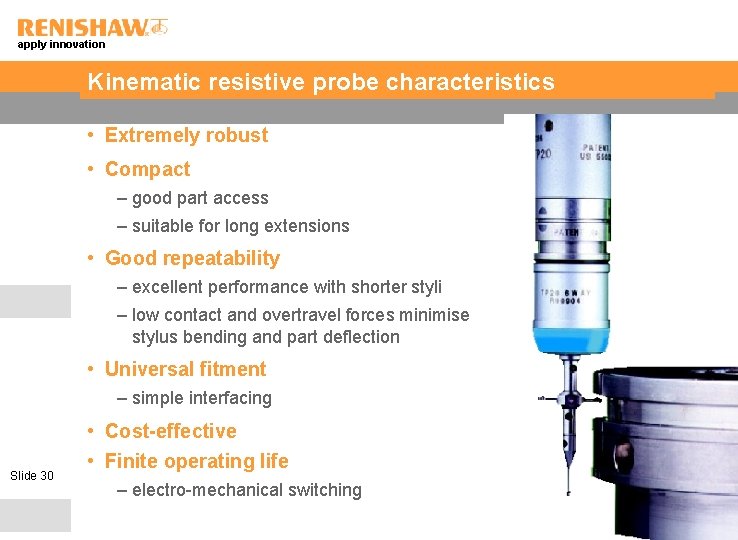
apply innovation Kinematic resistive probe characteristics • Extremely robust • Compact – good part access – suitable for long extensions • Good repeatability – excellent performance with shorter styli – low contact and overtravel forces minimise stylus bending and part deflection • Universal fitment – simple interfacing Slide 30 • Cost-effective • Finite operating life – electro-mechanical switching
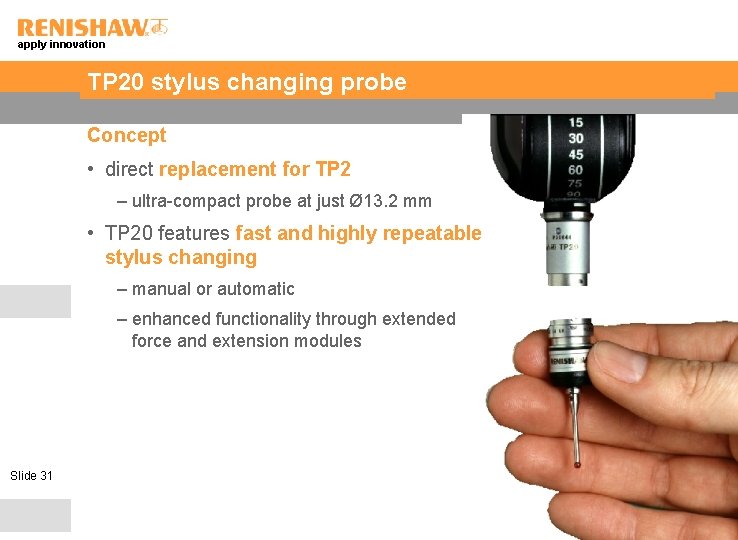
apply innovation TP 20 stylus changing probe Concept • direct replacement for TP 2 – ultra-compact probe at just Ø 13. 2 mm • TP 20 features fast and highly repeatable stylus changing – manual or automatic – enhanced functionality through extended force and extension modules Slide 31
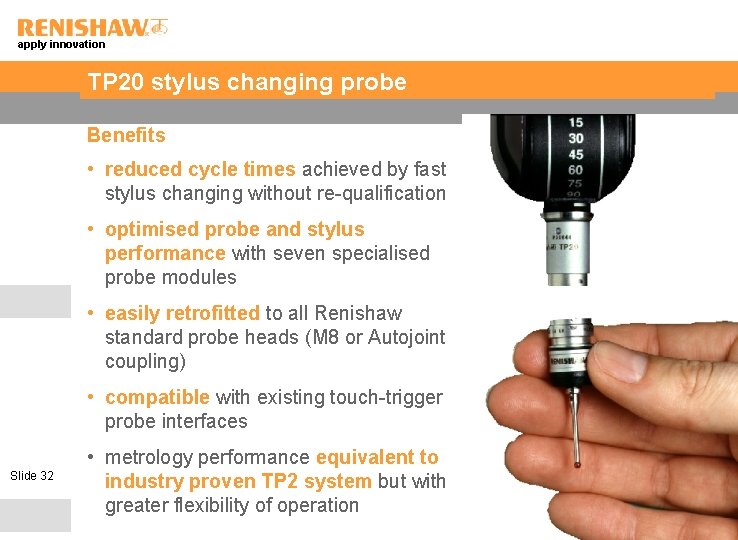
apply innovation TP 20 stylus changing probe Benefits • reduced cycle times achieved by fast stylus changing without re-qualification • optimised probe and stylus performance with seven specialised probe modules • easily retrofitted to all Renishaw standard probe heads (M 8 or Autojoint coupling) • compatible with existing touch-trigger probe interfaces Slide 32 • metrology performance equivalent to industry proven TP 2 system but with greater flexibility of operation
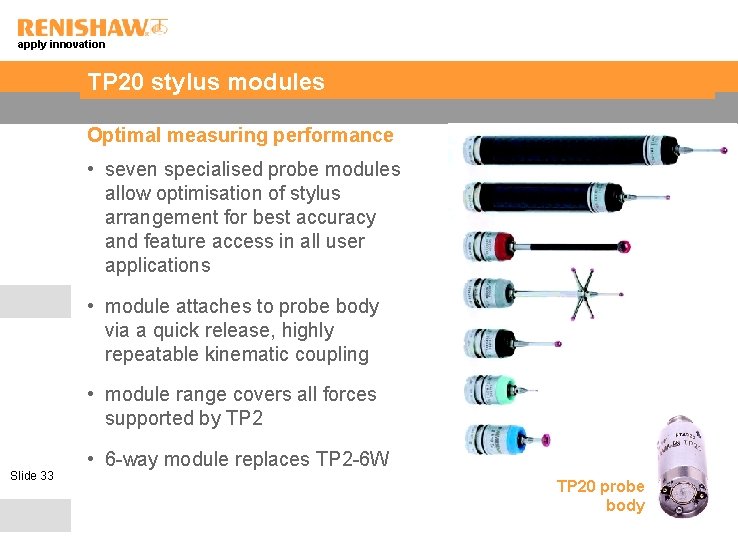
apply innovation TP 20 stylus modules Optimal measuring performance • seven specialised probe modules allow optimisation of stylus arrangement for best accuracy and feature access in all user applications • module attaches to probe body via a quick release, highly repeatable kinematic coupling • module range covers all forces supported by TP 2 Slide 33 • 6 -way module replaces TP 2 -6 W TP 20 probe body
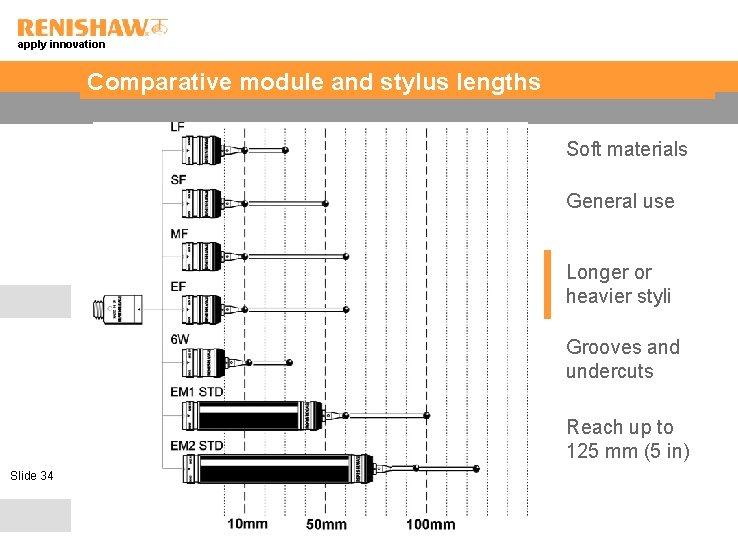
apply innovation Comparative module and stylus lengths Soft materials General use Longer or heavier styli Grooves and undercuts Reach up to 125 mm (5 in) Slide 34
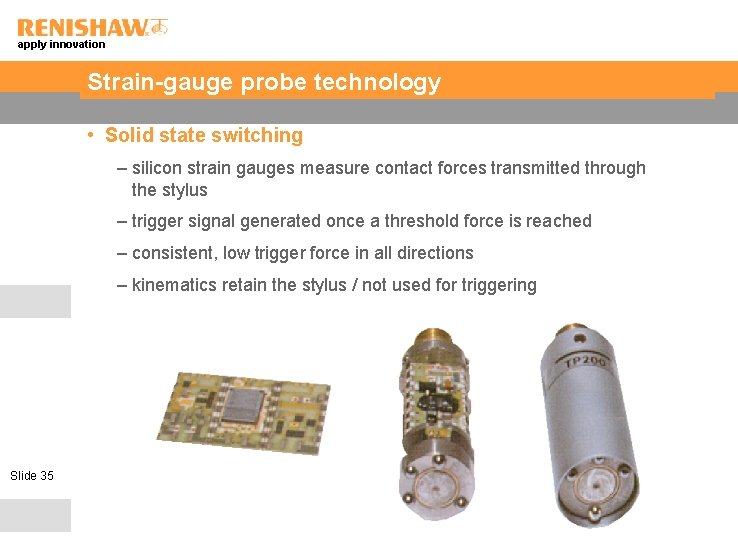
apply innovation Strain-gauge probe technology • Solid state switching – silicon strain gauges measure contact forces transmitted through the stylus – trigger signal generated once a threshold force is reached – consistent, low trigger force in all directions – kinematics retain the stylus / not used for triggering Slide 35
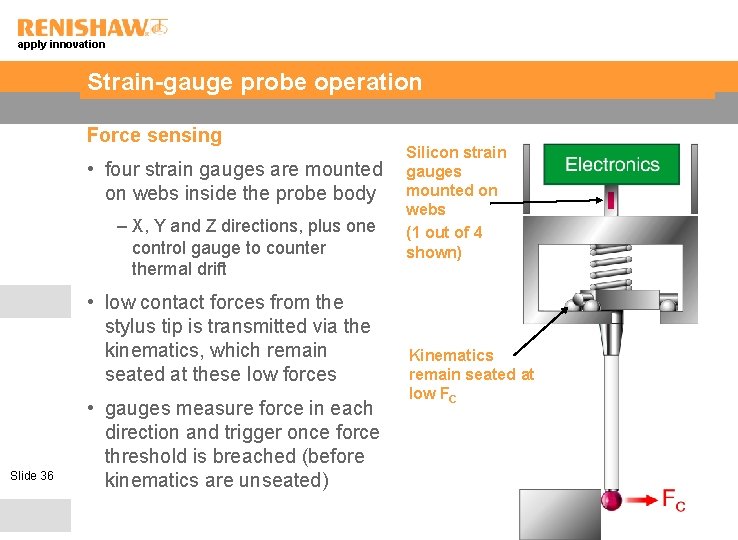
apply innovation Strain-gauge probe operation Force sensing • four strain gauges are mounted on webs inside the probe body – X, Y and Z directions, plus one control gauge to counter thermal drift • low contact forces from the stylus tip is transmitted via the kinematics, which remain seated at these low forces Slide 36 • gauges measure force in each direction and trigger once force threshold is breached (before kinematics are unseated) Silicon strain gauges mounted on webs (1 out of 4 shown) Kinematics remain seated at low FC
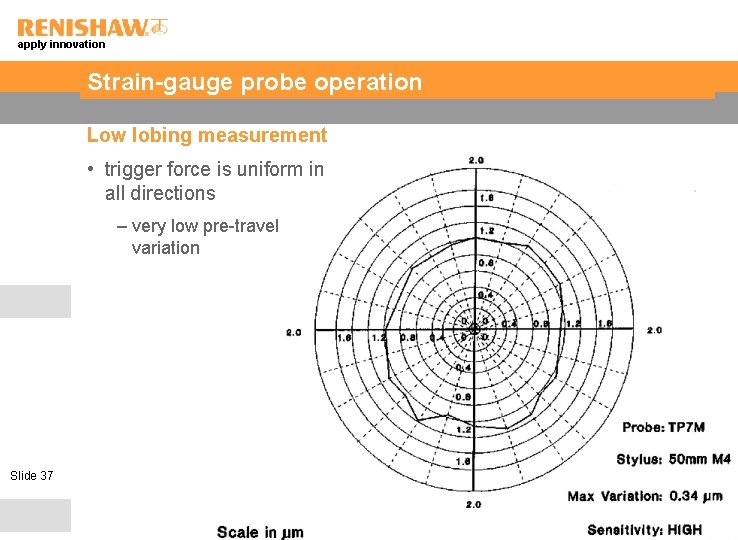
apply innovation Strain-gauge probe operation Low lobing measurement • trigger force is uniform in all directions – very low pre-travel variation Slide 37
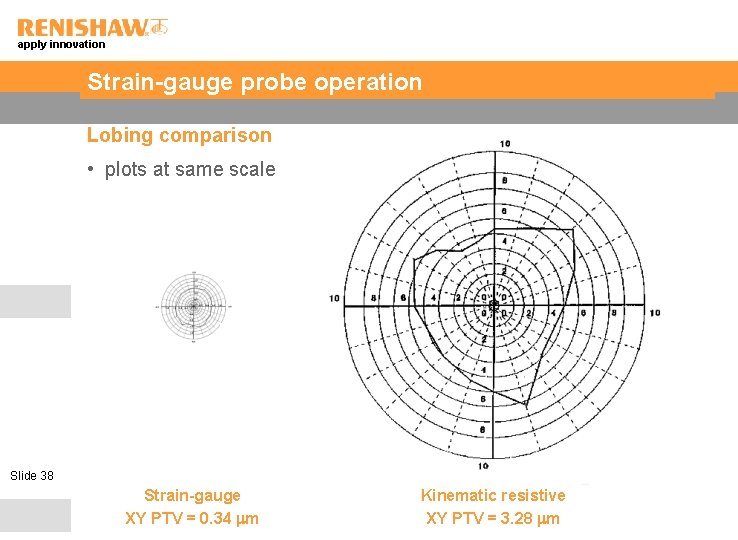
apply innovation Strain-gauge probe operation Lobing comparison • plots at same scale Slide 38 Strain-gauge XY PTV = 0. 34 m Kinematic resistive XY PTV = 3. 28 m
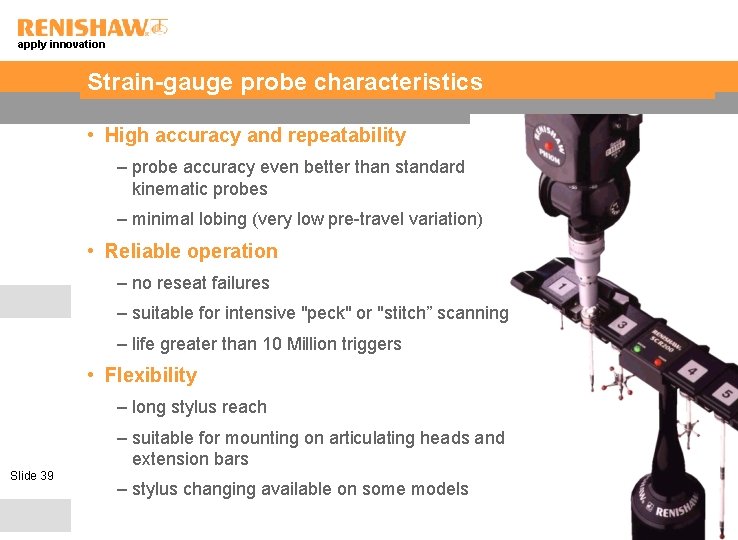
apply innovation Strain-gauge probe characteristics • High accuracy and repeatability – probe accuracy even better than standard kinematic probes – minimal lobing (very low pre-travel variation) • Reliable operation – no reseat failures – suitable for intensive "peck" or "stitch” scanning – life greater than 10 Million triggers • Flexibility – long stylus reach Slide 39 – suitable for mounting on articulating heads and extension bars – stylus changing available on some models
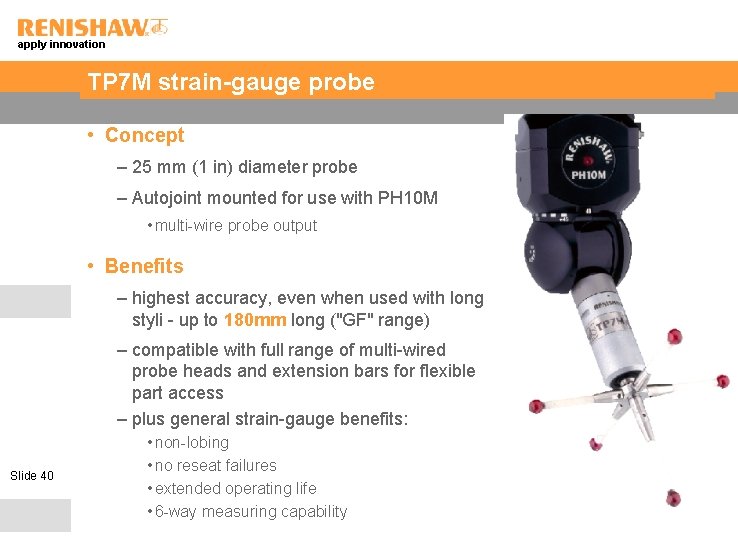
apply innovation TP 7 M strain-gauge probe • Concept – 25 mm (1 in) diameter probe – Autojoint mounted for use with PH 10 M • multi-wire probe output • Benefits – highest accuracy, even when used with long styli - up to 180 mm long ("GF" range) – compatible with full range of multi-wired probe heads and extension bars for flexible part access – plus general strain-gauge benefits: Slide 40 • non-lobing • no reseat failures • extended operating life • 6 -way measuring capability
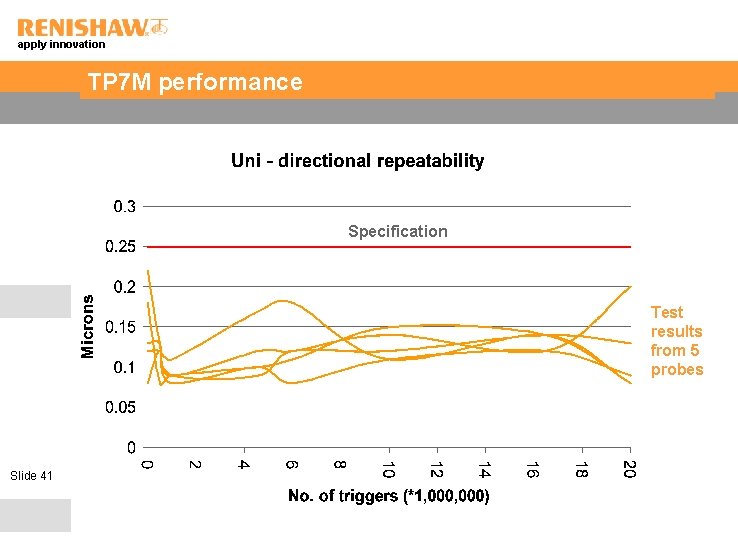
apply innovation TP 7 M performance Specification Test results from 5 probes Slide 41
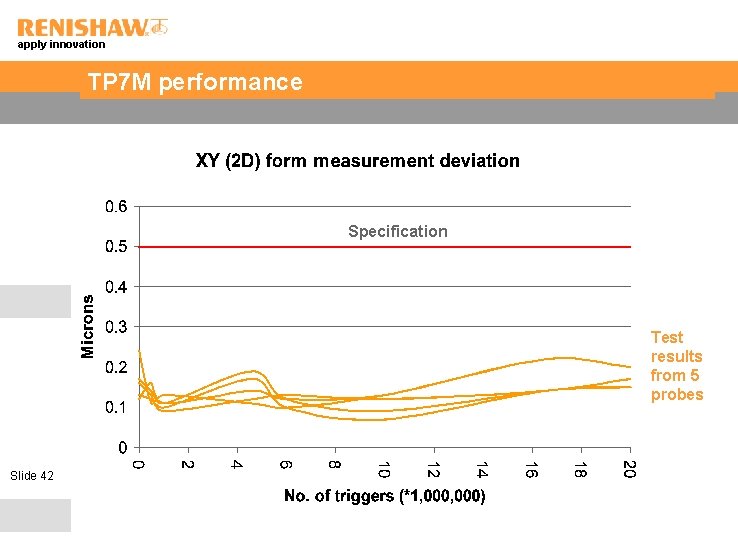
apply innovation TP 7 M performance Specification Test results from 5 probes Slide 42
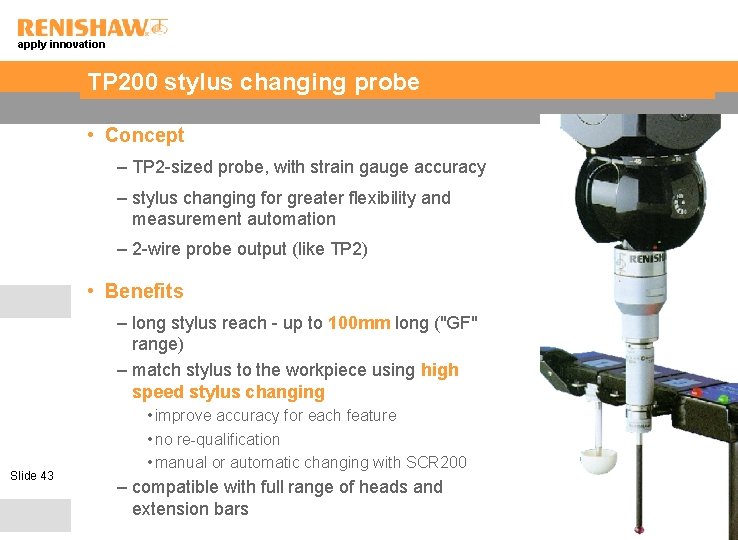
apply innovation TP 200 stylus changing probe • Concept – TP 2 -sized probe, with strain gauge accuracy – stylus changing for greater flexibility and measurement automation – 2 -wire probe output (like TP 2) • Benefits – long stylus reach - up to 100 mm long ("GF" range) – match stylus to the workpiece using high speed stylus changing Slide 43 • improve accuracy for each feature • no re-qualification • manual or automatic changing with SCR 200 – compatible with full range of heads and extension bars
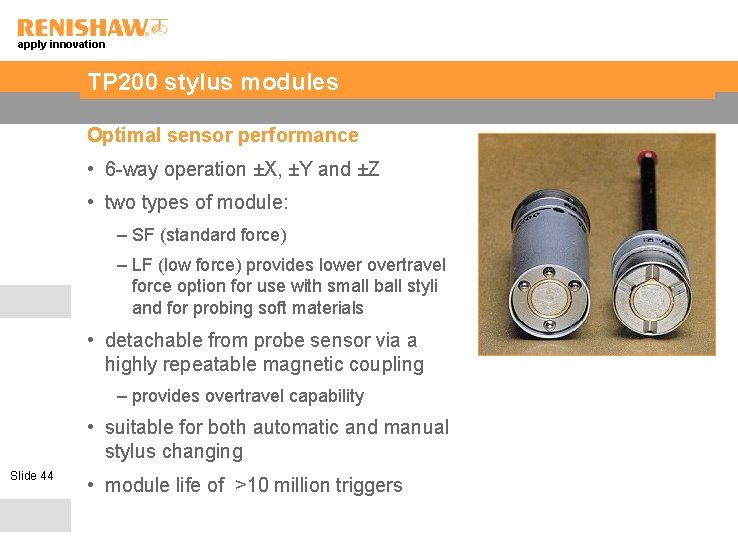
apply innovation TP 200 stylus modules Optimal sensor performance • 6 -way operation ±X, ±Y and ±Z • two types of module: – SF (standard force) – LF (low force) provides lower overtravel force option for use with small ball styli and for probing soft materials • detachable from probe sensor via a highly repeatable magnetic coupling – provides overtravel capability • suitable for both automatic and manual stylus changing Slide 44 • module life of >10 million triggers
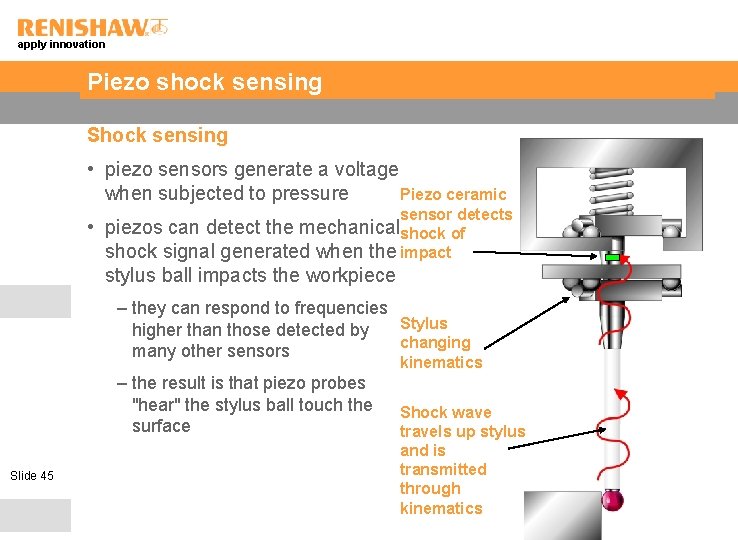
apply innovation Piezo shock sensing Shock sensing • piezo sensors generate a voltage when subjected to pressure Piezo ceramic • sensor detects piezos can detect the mechanicalshock of shock signal generated when the impact stylus ball impacts the workpiece – they can respond to frequencies Stylus higher than those detected by changing many other sensors kinematics – the result is that piezo probes "hear" the stylus ball touch the surface Slide 45 Shock wave travels up stylus and is transmitted through kinematics
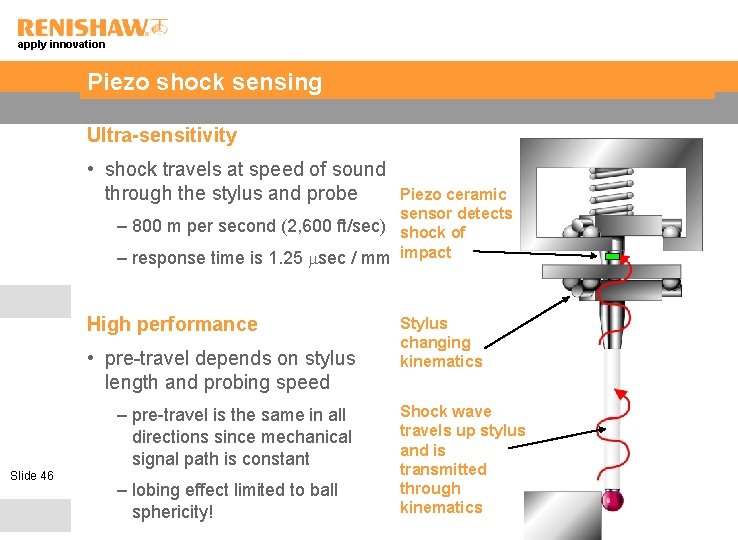
apply innovation Piezo shock sensing Ultra-sensitivity • shock travels at speed of sound through the stylus and probe Piezo ceramic sensor detects – 800 m per second (2, 600 ft/sec) shock of – response time is 1. 25 sec / mm impact High performance • pre-travel depends on stylus length and probing speed – pre-travel is the same in all directions since mechanical signal path is constant Slide 46 – lobing effect limited to ball sphericity! Stylus changing kinematics Shock wave travels up stylus and is transmitted through kinematics
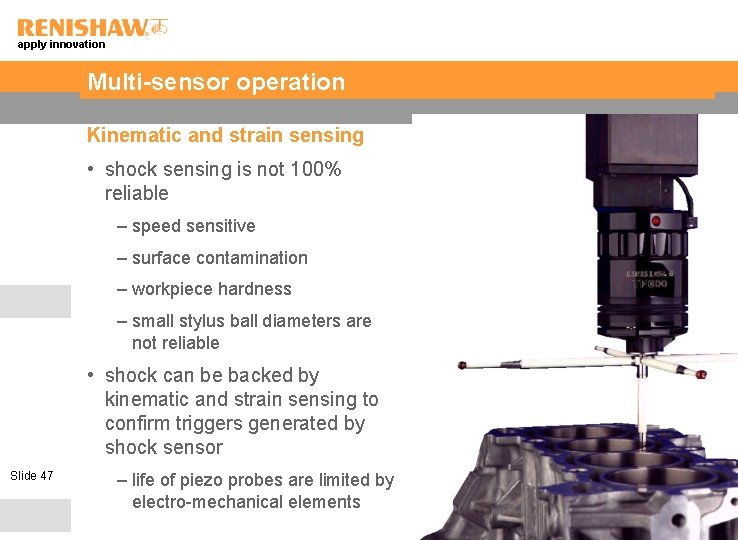
apply innovation Multi-sensor operation Kinematic and strain sensing • shock sensing is not 100% reliable – speed sensitive – surface contamination – workpiece hardness – small stylus ball diameters are not reliable • shock can be backed by kinematic and strain sensing to confirm triggers generated by shock sensor Slide 47 – life of piezo probes are limited by electro-mechanical elements
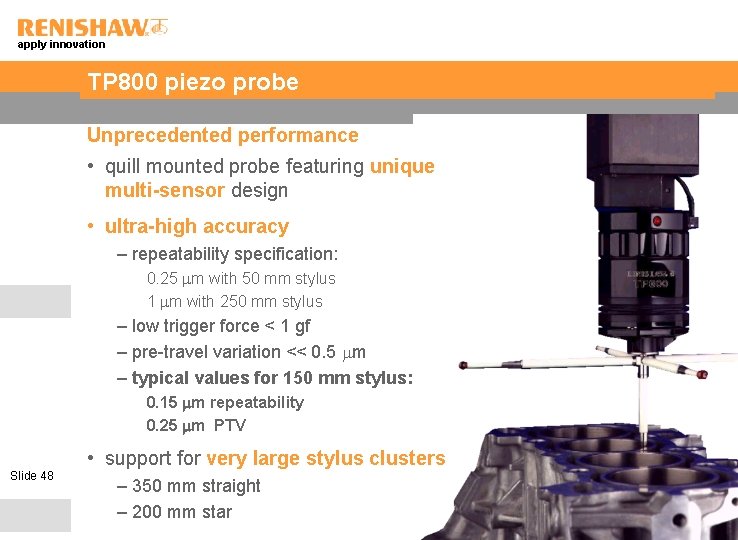
apply innovation TP 800 piezo probe Unprecedented performance • quill mounted probe featuring unique multi-sensor design • ultra-high accuracy – repeatability specification: 0. 25 m with 50 mm stylus 1 m with 250 mm stylus – low trigger force < 1 gf – pre-travel variation << 0. 5 m – typical values for 150 mm stylus: 0. 15 m repeatability 0. 25 m PTV Slide 48 • support for very large stylus clusters – 350 mm straight – 200 mm star
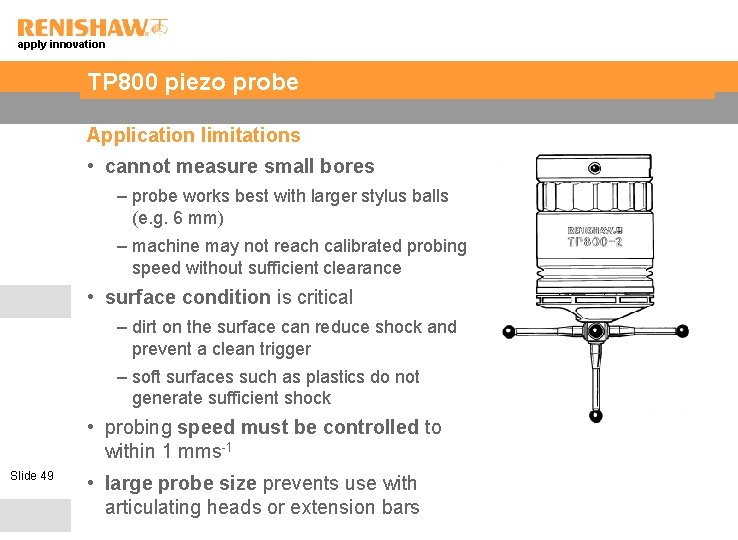
apply innovation TP 800 piezo probe Application limitations • cannot measure small bores – probe works best with larger stylus balls (e. g. 6 mm) – machine may not reach calibrated probing speed without sufficient clearance • surface condition is critical – dirt on the surface can reduce shock and prevent a clean trigger – soft surfaces such as plastics do not generate sufficient shock • probing speed must be controlled to within 1 mms-1 Slide 49 • large probe size prevents use with articulating heads or extension bars
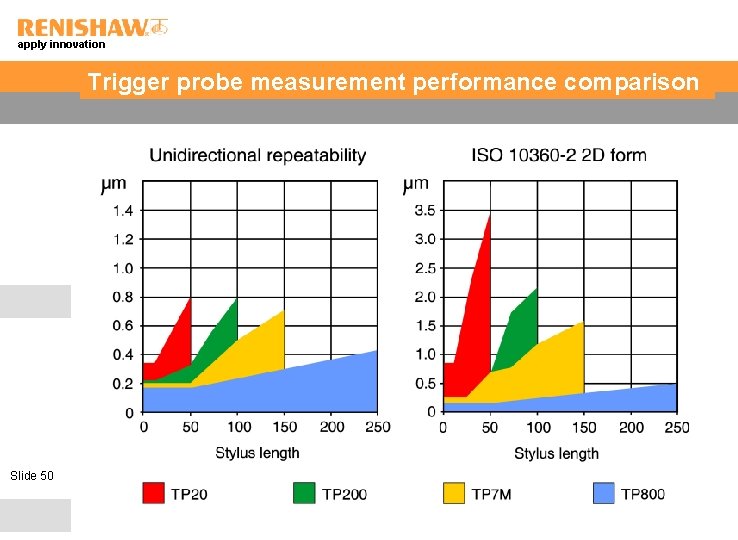
apply innovation Trigger probe measurement performance comparison Slide 50
apply innovation Renishaw touch-trigger probing systems Touch-trigger probe applications Metrology of trigger probes Trigger probe design Articulating heads Slide 51 Probe and stylus changing
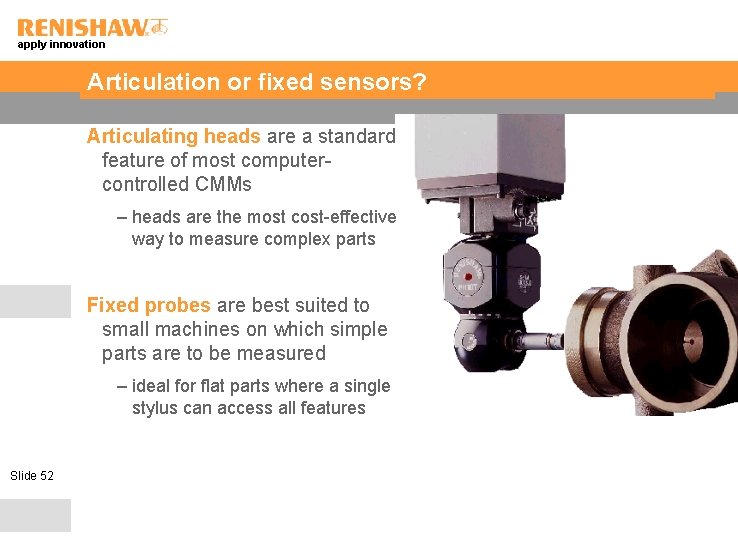
apply innovation Articulation or fixed sensors? Articulating heads are a standard feature of most computercontrolled CMMs – heads are the most cost-effective way to measure complex parts Fixed probes are best suited to small machines on which simple parts are to be measured – ideal for flat parts where a single stylus can access all features Slide 52
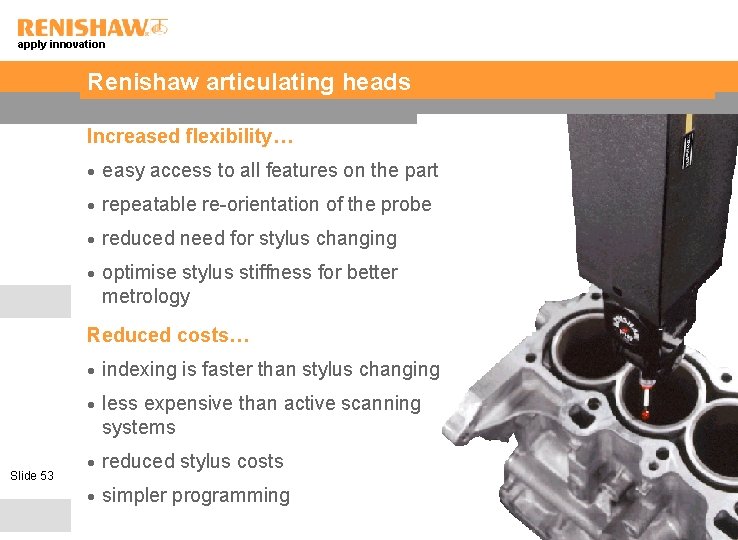
apply innovation Renishaw articulating heads Increased flexibility… · easy access to all features on the part · repeatable re-orientation of the probe · reduced need for stylus changing · optimise stylus stiffness for better metrology Reduced costs… Slide 53 · indexing is faster than stylus changing · less expensive than active scanning systems · reduced stylus costs · simpler programming
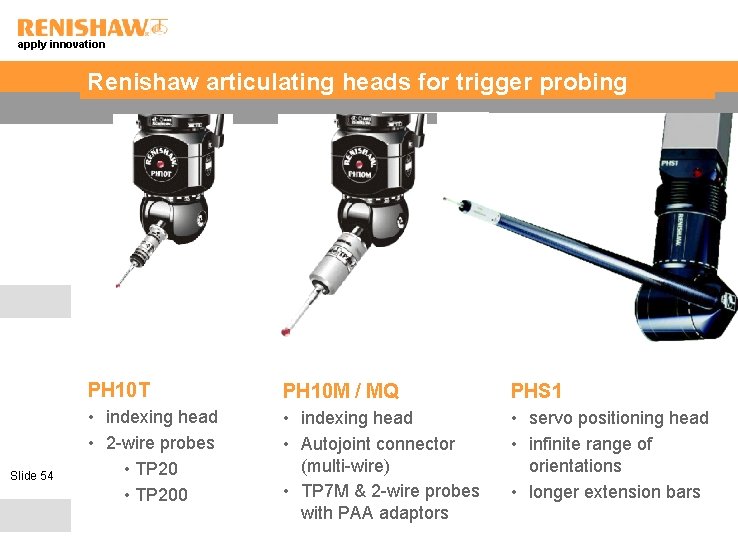
apply innovation Renishaw articulating heads for trigger probing Slide 54 PH 10 T PH 10 M / MQ PHS 1 • indexing head • 2 -wire probes • TP 200 • indexing head • Autojoint connector (multi-wire) • TP 7 M & 2 -wire probes with PAA adaptors • servo positioning head • infinite range of orientations • longer extension bars
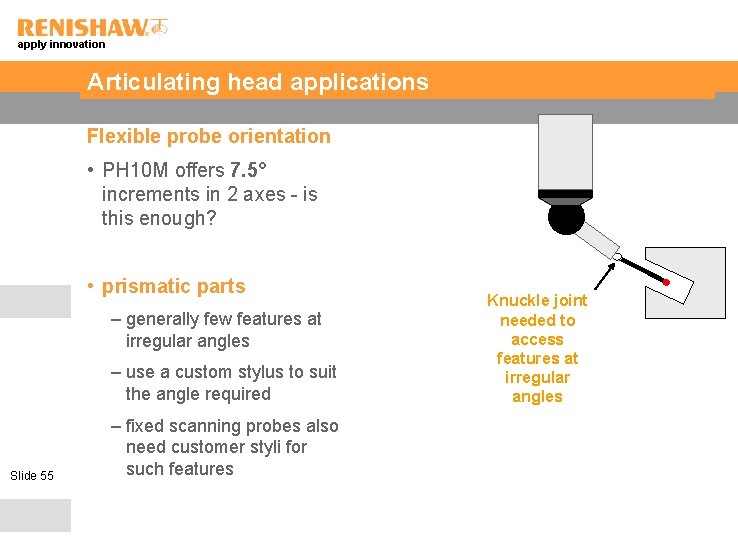
apply innovation Articulating head applications Flexible probe orientation • PH 10 M offers 7. 5° increments in 2 axes - is this enough? • prismatic parts – generally few features at irregular angles – use a custom stylus to suit the angle required Slide 55 – fixed scanning probes also need customer styli for such features Knuckle joint needed to access features at irregular angles
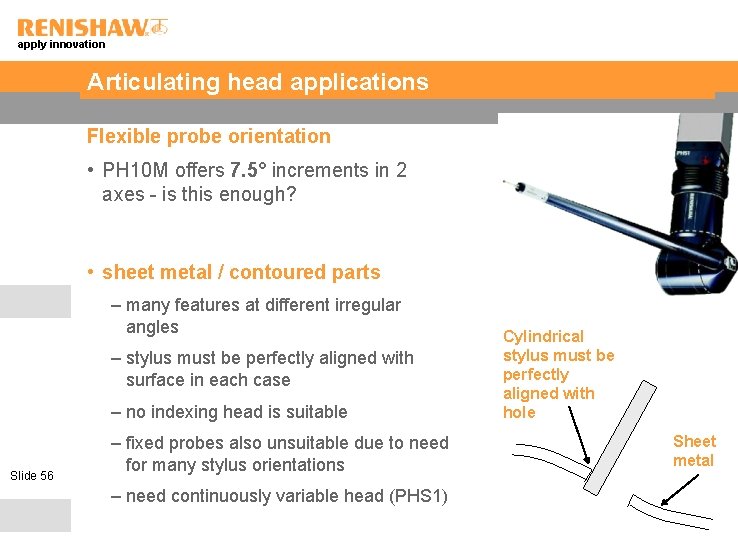
apply innovation Articulating head applications Flexible probe orientation • PH 10 M offers 7. 5° increments in 2 axes - is this enough? • sheet metal / contoured parts – many features at different irregular angles – stylus must be perfectly aligned with surface in each case – no indexing head is suitable Slide 56 – fixed probes also unsuitable due to need for many stylus orientations – need continuously variable head (PHS 1) Cylindrical stylus must be perfectly aligned with hole Sheet metal
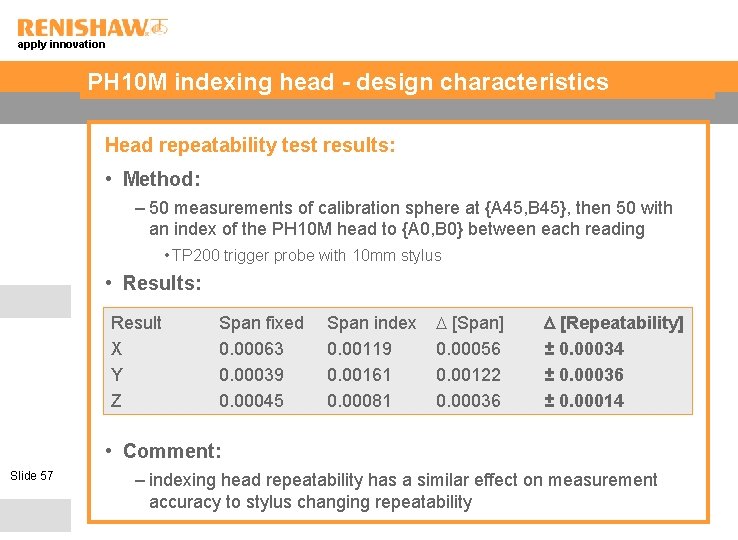
apply innovation PH 10 M indexing head - design characteristics Head repeatability test results: • Method: – 50 measurements of calibration sphere at {A 45, B 45}, then 50 with an index of the PH 10 M head to {A 0, B 0} between each reading • TP 200 trigger probe with 10 mm stylus • Results: Result X Y Z Span fixed 0. 00063 0. 00039 0. 00045 Span index 0. 00119 0. 00161 0. 00081 [Span] 0. 00056 0. 00122 0. 00036 [Repeatability] ± 0. 00034 ± 0. 00036 ± 0. 00014 • Comment: Slide 57 – indexing head repeatability has a similar effect on measurement accuracy to stylus changing repeatability
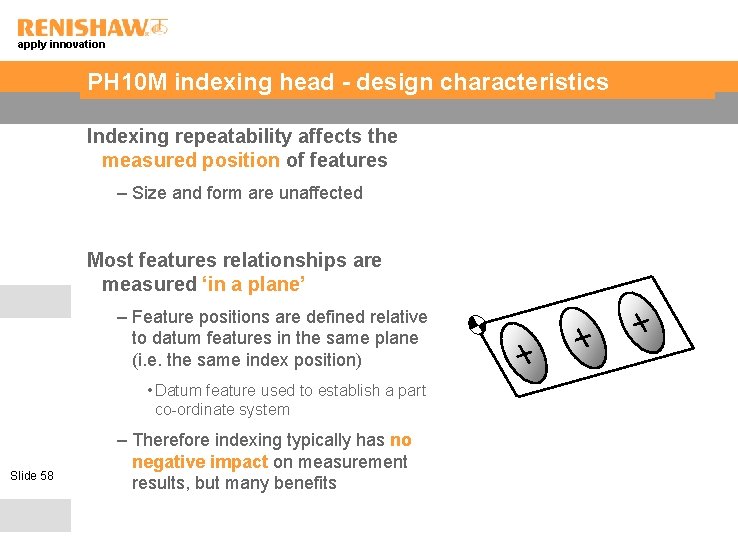
apply innovation PH 10 M indexing head - design characteristics Indexing repeatability affects the measured position of features – Size and form are unaffected Most features relationships are measured ‘in a plane’ – Feature positions are defined relative to datum features in the same plane (i. e. the same index position) • Datum feature used to establish a part co-ordinate system Slide 58 – Therefore indexing typically has no negative impact on measurement results, but many benefits
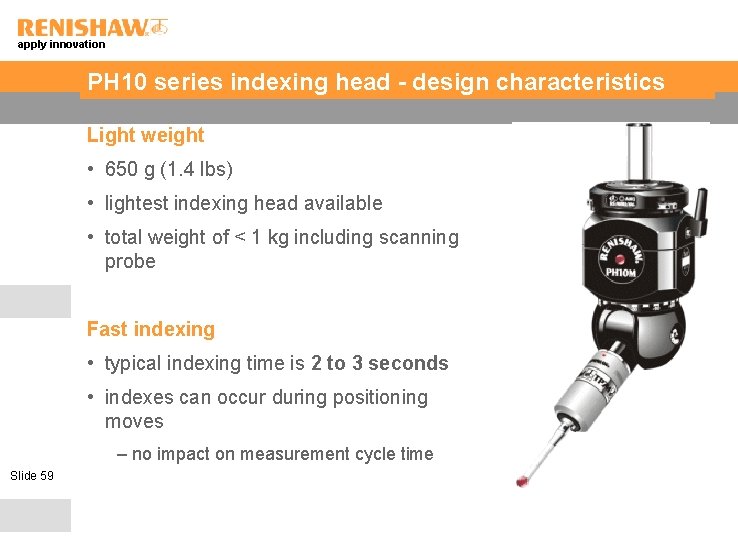
apply innovation PH 10 series indexing head - design characteristics Light weight • 650 g (1. 4 lbs) • lightest indexing head available • total weight of < 1 kg including scanning probe Fast indexing • typical indexing time is 2 to 3 seconds • indexes can occur during positioning moves – no impact on measurement cycle time Slide 59
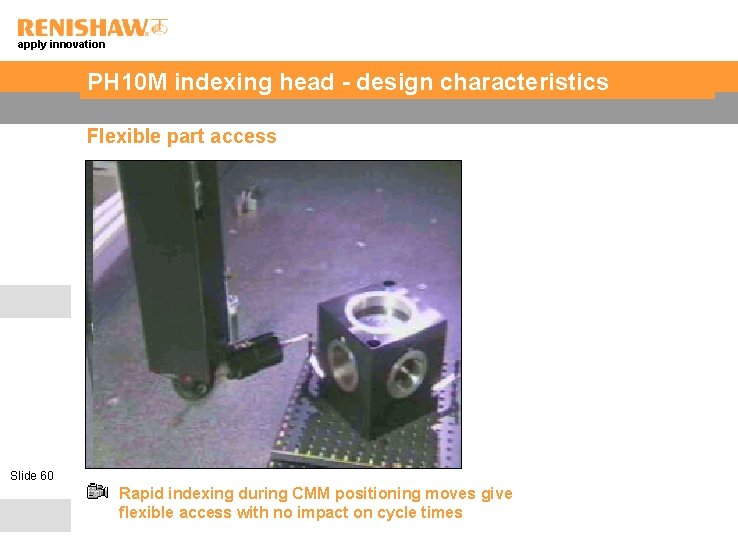
apply innovation PH 10 M indexing head - design characteristics Flexible part access Slide 60 Rapid indexing during CMM positioning moves give flexible access with no impact on cycle times
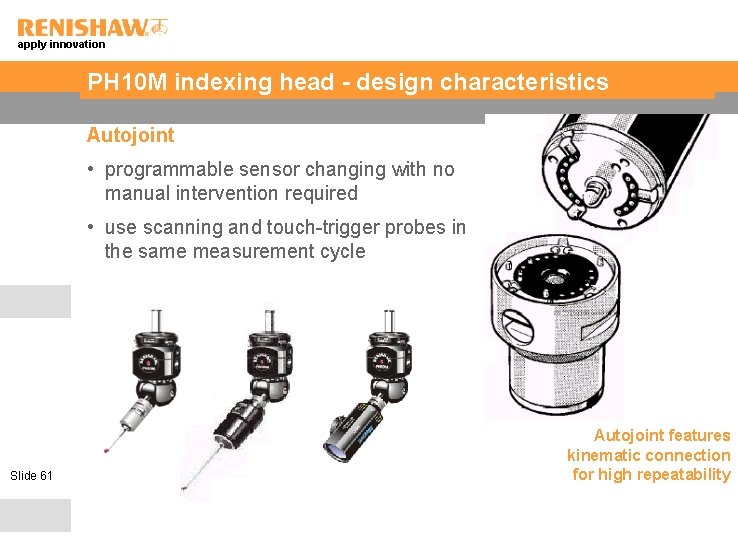
apply innovation PH 10 M indexing head - design characteristics Autojoint • programmable sensor changing with no manual intervention required • use scanning and touch-trigger probes in the same measurement cycle Slide 61 Autojoint features kinematic connection for high repeatability
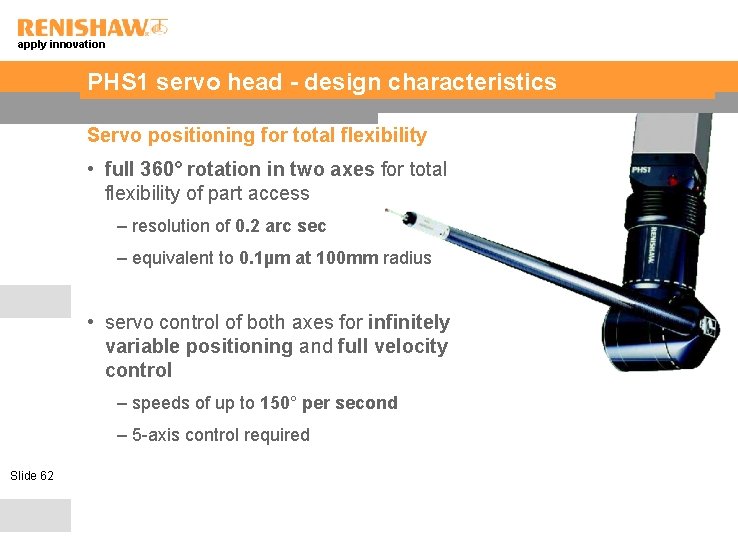
apply innovation PHS 1 servo head - design characteristics Servo positioning for total flexibility • full 360° rotation in two axes for total flexibility of part access – resolution of 0. 2 arc sec – equivalent to 0. 1µm at 100 mm radius • servo control of both axes for infinitely variable positioning and full velocity control – speeds of up to 150° per second – 5 -axis control required Slide 62
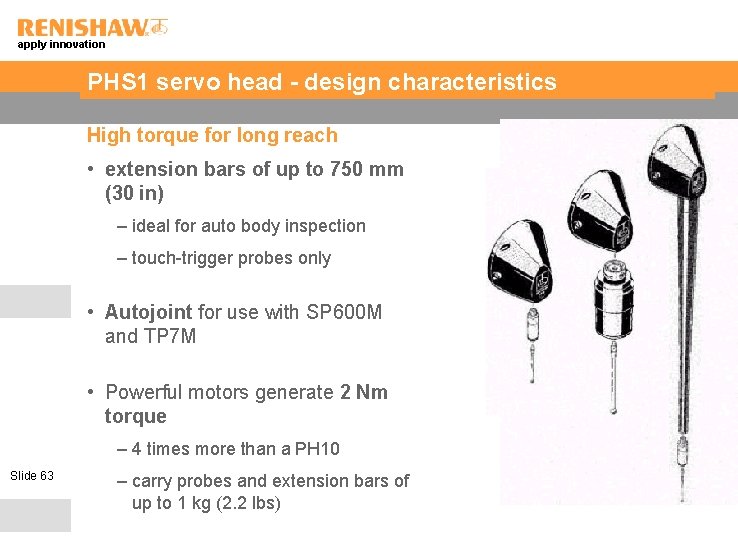
apply innovation PHS 1 servo head - design characteristics High torque for long reach • extension bars of up to 750 mm (30 in) – ideal for auto body inspection – touch-trigger probes only • Autojoint for use with SP 600 M and TP 7 M • Powerful motors generate 2 Nm torque – 4 times more than a PH 10 Slide 63 – carry probes and extension bars of up to 1 kg (2. 2 lbs)
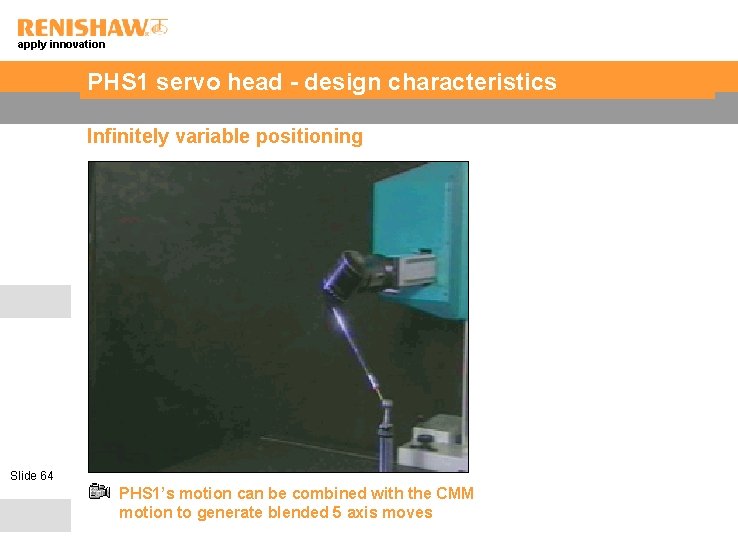
apply innovation PHS 1 servo head - design characteristics Infinitely variable positioning Slide 64 PHS 1’s motion can be combined with the CMM motion to generate blended 5 axis moves
apply innovation Renishaw touch-trigger probing systems Touch-trigger probe applications Metrology of trigger probes Trigger probe design Articulating heads Slide 65 Probe and stylus changing
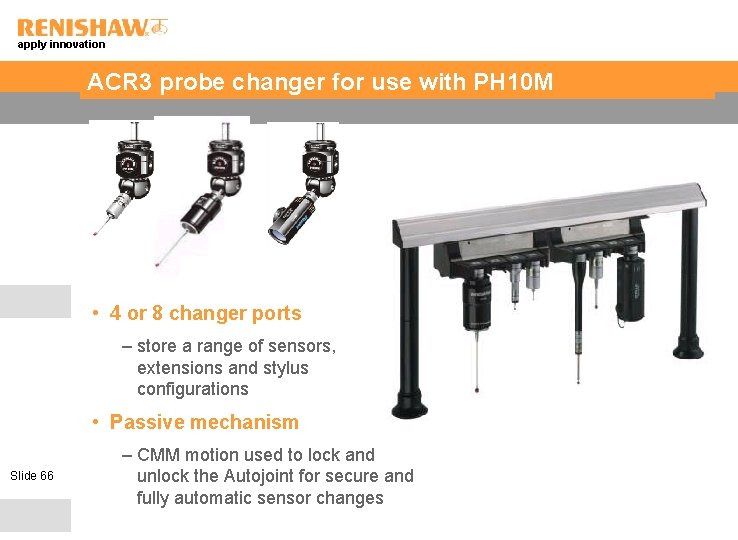
apply innovation ACR 3 probe changer for use with PH 10 M • 4 or 8 changer ports – store a range of sensors, extensions and stylus configurations • Passive mechanism Slide 66 – CMM motion used to lock and unlock the Autojoint for secure and fully automatic sensor changes
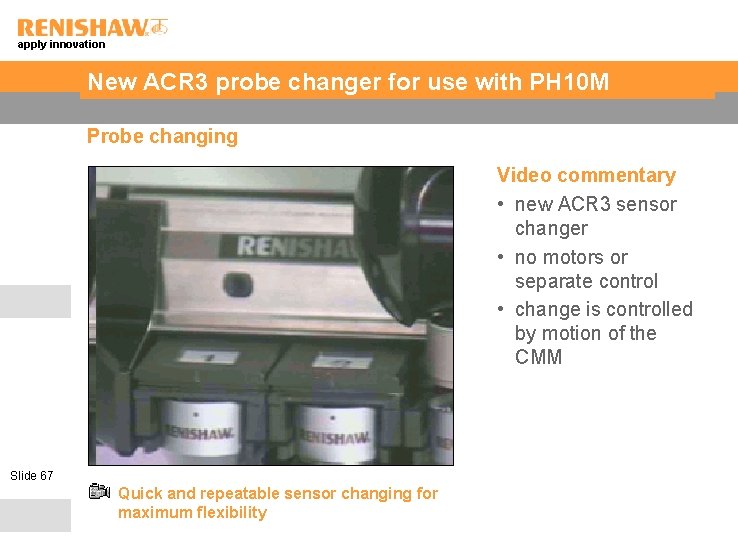
apply innovation New ACR 3 probe changer for use with PH 10 M Probe changing Video commentary • new ACR 3 sensor changer • no motors or separate control • change is controlled by motion of the CMM Slide 67 Quick and repeatable sensor changing for maximum flexibility
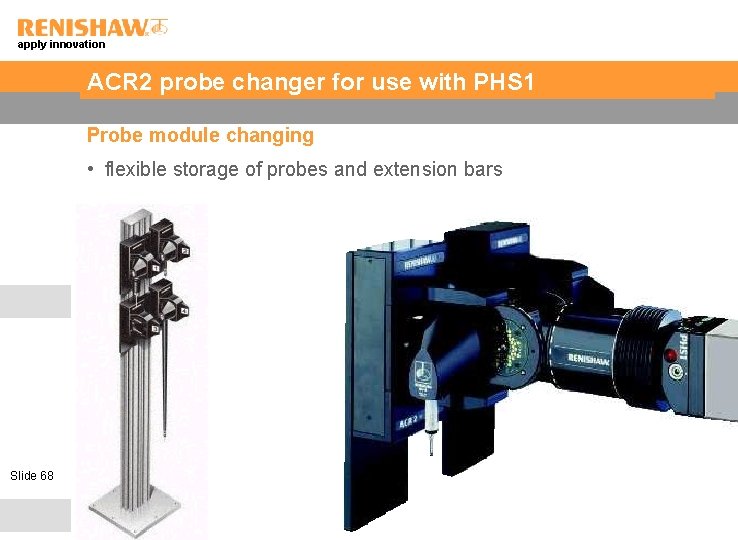
apply innovation ACR 2 probe changer for use with PHS 1 Probe module changing • flexible storage of probes and extension bars Slide 68
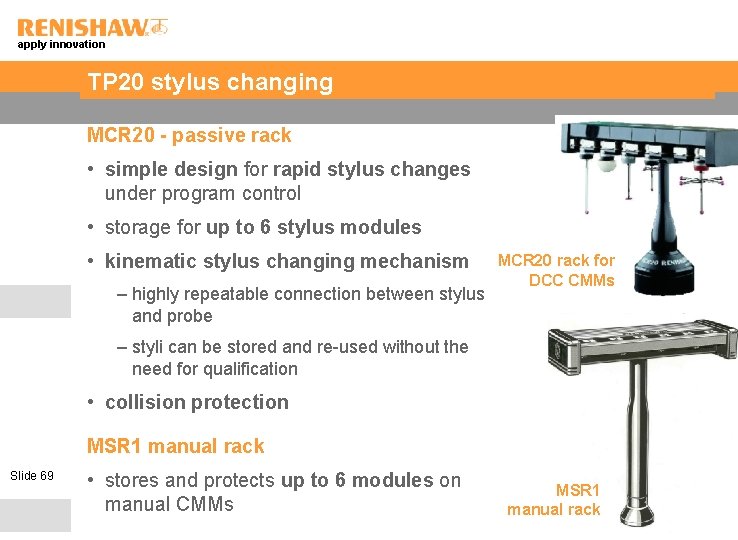
apply innovation TP 20 stylus changing MCR 20 - passive rack • simple design for rapid stylus changes under program control • storage for up to 6 stylus modules • kinematic stylus changing mechanism – highly repeatable connection between stylus and probe MCR 20 rack for DCC CMMs – styli can be stored and re-used without the need for qualification • collision protection MSR 1 manual rack Slide 69 • stores and protects up to 6 modules on manual CMMs MSR 1 manual rack
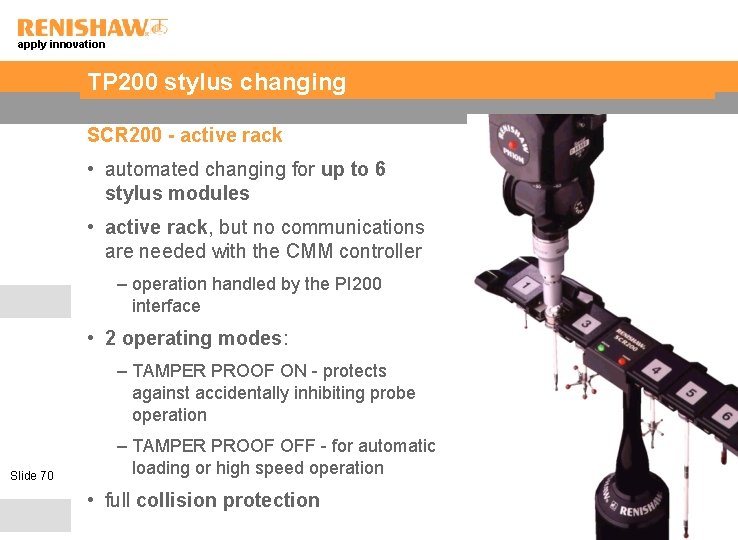
apply innovation TP 200 stylus changing SCR 200 - active rack • automated changing for up to 6 stylus modules • active rack, but no communications are needed with the CMM controller – operation handled by the PI 200 interface • 2 operating modes: – TAMPER PROOF ON - protects against accidentally inhibiting probe operation Slide 70 – TAMPER PROOF OFF - for automatic loading or high speed operation • full collision protection
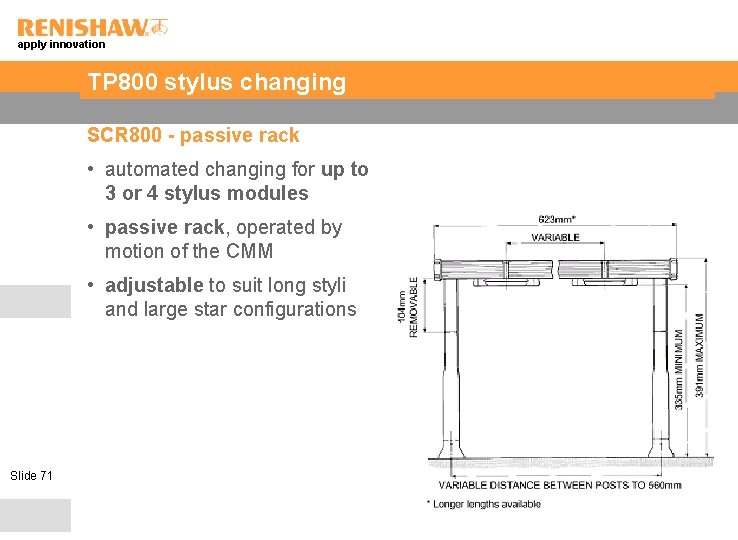
apply innovation TP 800 stylus changing SCR 800 - passive rack • automated changing for up to 3 or 4 stylus modules • passive rack, operated by motion of the CMM • adjustable to suit long styli and large star configurations Slide 71
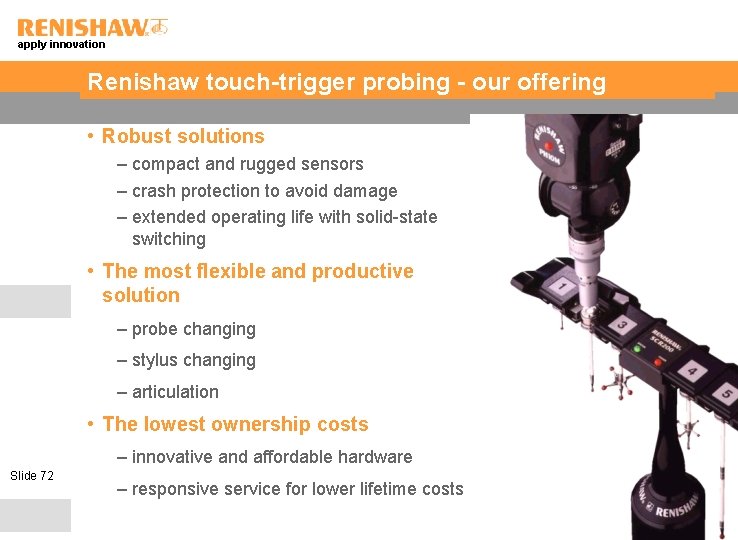
apply innovation Renishaw touch-trigger probing - our offering • Robust solutions – compact and rugged sensors – crash protection to avoid damage – extended operating life with solid-state switching • The most flexible and productive solution – probe changing – stylus changing – articulation • The lowest ownership costs – innovative and affordable hardware Slide 72 – responsive service for lower lifetime costs

apply innovation Responsive service and expert support • Application and product support wherever you are • Renishaw has offices in over 20 countries • responsive service to keep you running • optional advance RBE (repair by exchange) service on many products • we ship a replacement on the day you call • trouble-shooting and FAQs on www. renishaw. com/support Service facility at Renishaw Inc, USA Slide 73

apply innovation Questions? Slide 74
- Slides: 74