Applied Victimology Welcome to Week 3 Theories of

![Positivism: Oxford Dictionary of Sociology (1998) “[In] its commitment to the practical application of](https://slidetodoc.com/presentation_image_h/9817106ca1760f123a4fdf0806a9c80a/image-6.jpg "Positivism: Oxford Dictionary of Sociology (1998) “[In] its commitment to the practical application of")

- Slides: 35
Applied Victimology Welcome to Week 3 Theories of Victimology: 1 h. clarke@derby. ac. uk
Dates for Seminars l Seminar 1 l l l (A) Monday 13 th October (week 4) (B) Monday 20 th October (week 5) Seminar 2 l l (A) Monday 27 th October (week 6) (B) Monday 3 rd November (week 7)
Lecture Outline l l l Positivist victimology Mendelsohn von Hentig Wolfgang Criticisms of positivist victimology
What does it mean to be a victim? l Being a victim is not an objective phenomenon l How we understand define victimisation is dependent on who we are & our previous experiences l Can victimhood ever be a personality trait? ?
Positivism l What is positivism?
Positivism: Oxford Dictionary of Sociology (1998) “[In] its commitment to the practical application of its theory and research, it claims scientific status for its quantificationoriented methodology and is characterised by a search for the determinative causes of crime and misbehaviour which are held up to be discoverable in the physical, genetic, psychological or moral make-up of those predisposed to such acts”
Positivist Victimology l Tries to base itself upon recorded criminal statistics l Focuses attention on: l victim proneness l victim precipitation l victim lifestyle
Positivism l Goodey (2005): Victimology has prospered the most under positivism l Crime surveys allowed positivist research the chance to unmask the ‘dark figure’ of crime l Sought to identify victimisation proneness through identification of victim typologies
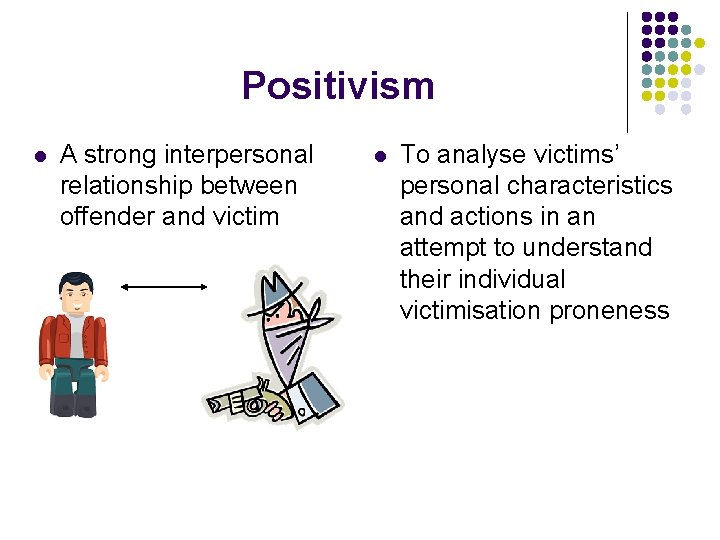
Positivism l A strong interpersonal relationship between offender and victim l To analyse victims’ personal characteristics and actions in an attempt to understand their individual victimisation proneness
Benjamin Mendelsohn (1963) l A theory of victimisation l He developed a typology of victims and their contribution to the criminal act
Mendelsohn's Typology of Victims l The completely innocent victim l The victim with minor guilt l The victim who is as guilty as the offender l The victim more guilty than the offender l The most guilty victim l The imaginary victim
Von Hentig l 1948, The Criminal and His Victim l Explored the relationship between the "doer" or criminal and the "sufferer" or victim l Established a typology of victims based on psychological, social, and biological factors l His classification identified victims by examining various risk factors.
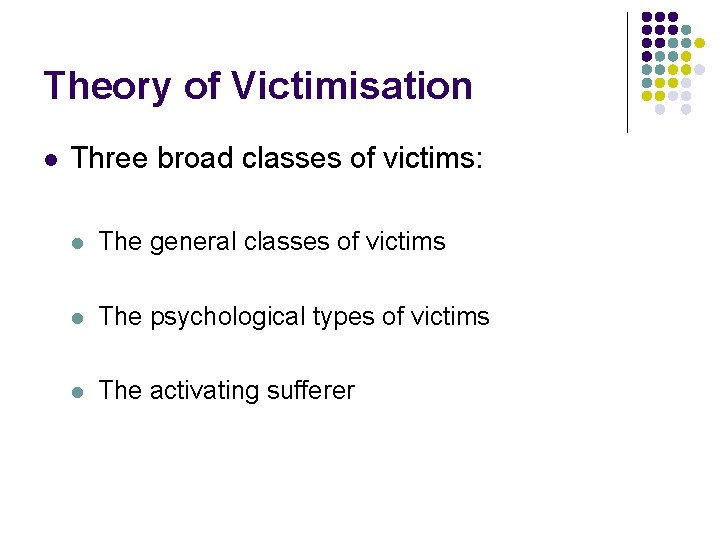
Theory of Victimisation l Three broad classes of victims: l The general classes of victims l The psychological types of victims l The activating sufferer
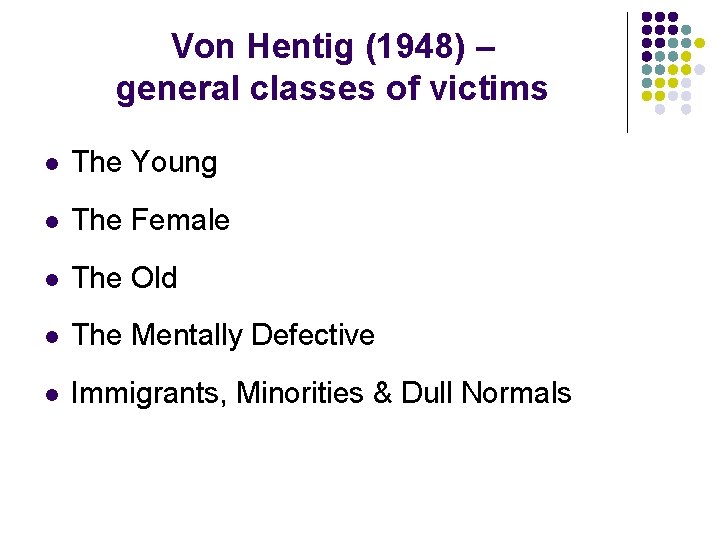
Von Hentig (1948) – general classes of victims l The Young l The Female l The Old l The Mentally Defective l Immigrants, Minorities & Dull Normals
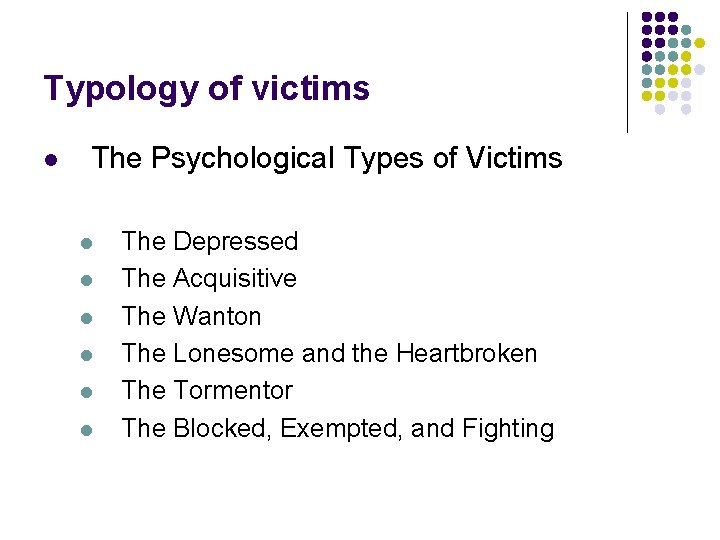
Typology of victims l The Psychological Types of Victims l l l The Depressed The Acquisitive The Wanton The Lonesome and the Heartbroken The Tormentor The Blocked, Exempted, and Fighting
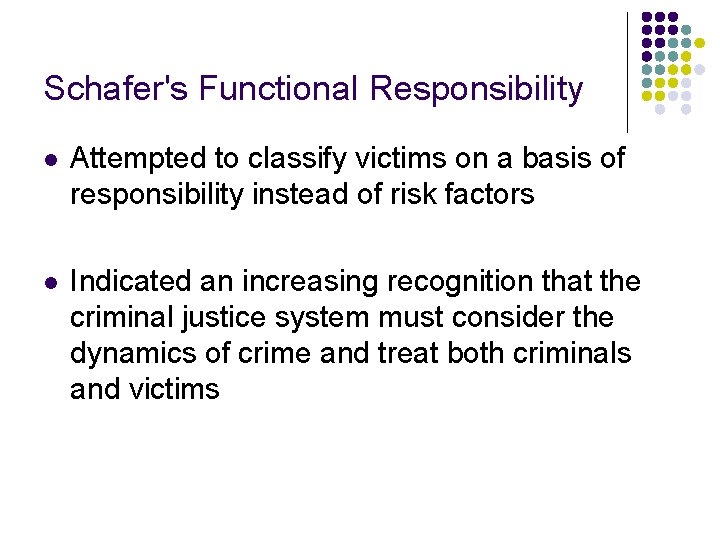
Schafer's Functional Responsibility l Attempted to classify victims on a basis of responsibility instead of risk factors l Indicated an increasing recognition that the criminal justice system must consider the dynamics of crime and treat both criminals and victims
Schafer The need to recognise the role and responsibility of the victim, who is not simply the cause of, and reason for, the criminal procedure, but has a major part to play in the search for an objective criminal justice system and a functional solution to the crime problem
Functional Responsibility l The functional role of a victim is to do nothing to provoke others from attempting to injure him and at the same time to actively prevent such attempts l This is the victim's functional responsibility
Wolfgang (1948 – 1952) l Developed a theory measuring victim culpability l The victim & the offender are both separate entities and ‘mutual participants’ l Lees (1997): these ideas are still used within the CJS in attempts to prove defendants innocent
Wolfgang's Study of Homicide l Conducted the first major study of victim precipitation from 1948 -1952 l Evaluated 588 homicides and found that 26 percent (150) of all the homicides studied in Philadelphia involved situations in which the victim was a direct positive precipitator in the crime—the first to use force during the acts leading to the homicide
Victim Blaming? l Mendelsohn, von Hentig, Schafer and Wolfgang all classified victims as having some form of causation in the commission of the crime l Also by Amir in one of the first studies of rape (1971) - Patterns in Forcible Rape
Legacy of Positivist Approach l Ensured the development and refinement of quantitative measures of victimisation l Clearly influenced the way the state, criminal justice agencies, and various voluntary institutions and organisations respond to victims of crime and victimisation
Criticisms of Positivism l Individualised the problem of crime l Concentrated on specifics of individual crimes and the link between the victim and offender l Ignored political considerations and social realities
Criticisms of Positivism l Early crime surveys focused mainly on street crime & did not uncover victimisation in the private domain l Second-wave feminism linked academic research with campaigns for social change & the politicisation of victimology
Break After the break: Victim Blaming?
Victim Myths l Stereotypes of ideal (deserving) victims form the foundations of victim myths l Many of these myths are seen as rape myths l Victims, therefore, must be: l l Weak compared to the unrelated offender Identified as having put in reasonable energy to defend herself (himself)
The Ideal & Not-So-Ideal Offender l Ideal victims need ideal offenders l The offender who is, in reality, a suffering victim l l Cycle of abuse Cycle of victimhood
Understanding Victimhood l Sally, 19, is a lone parent living in a socially deprived area. She has found it hard to get a full time job since leaving school. “I take about £ 100 worth of stuff a week. How else am I to provide for my son? I only take from big stores and they’re insured for it. I see it as a victimless crime”.
Group Work l Can the victim be more socially / culturally guilty than the offender? Please provide examples. l What is an ideal and non-ideal victim? – please provide examples
Summary l Positivist victimology focuses attention on victim proneness, victim precipitation and victim lifestyle l Through these processes, victims (and offenders) are labelled ideal or non-ideal l This forms the foundation of many rape myths l Next week: feminism theories of victimology
Break After the break: applying positivism to the assessment question!
Group Work l Please think of an example of an ideal and not-so-ideal offender l What is it about their situation that makes them ‘ideal’ offenders (and correspondingly ‘ideal’ victims) ?
Group Work l What is victim ‘precipitation’ and ‘proneness’? l Please provide examples 123 -
Finally l l Any questions? See you all next week!
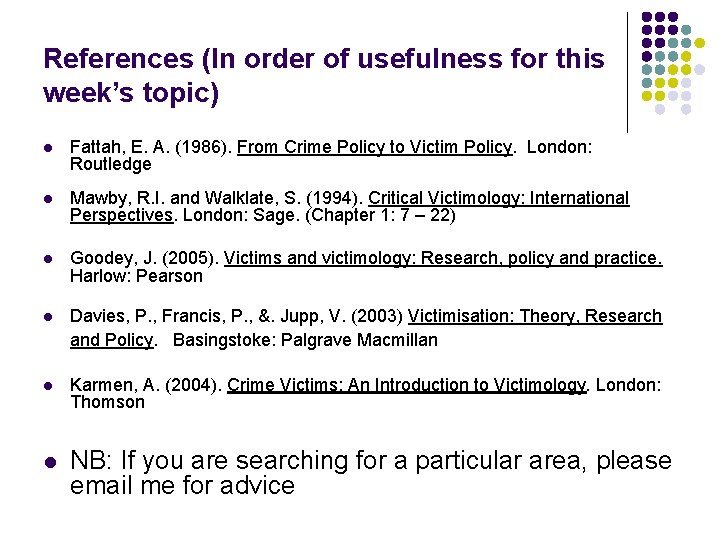
References (In order of usefulness for this week’s topic) l Fattah, E. A. (1986). From Crime Policy to Victim Policy. London: Routledge l Mawby, R. I. and Walklate, S. (1994). Critical Victimology: International Perspectives. London: Sage. (Chapter 1: 7 – 22) l Goodey, J. (2005). Victims and victimology: Research, policy and practice. Harlow: Pearson l Davies, P. , Francis, P. , &. Jupp, V. (2003) Victimisation: Theory, Research and Policy. Basingstoke: Palgrave Macmillan l Karmen, A. (2004). Crime Victims: An Introduction to Victimology. London: Thomson l NB: If you are searching for a particular area, please email me for advice