
Applied tax gap analysis in the United Kingdom


- Slides: 17
Applied tax gap analysis in the United Kingdom - Its use in tax administration, and future research Mick Thackray Knowledge, Analysis & Intelligence Enforcement and Compliance HM Revenue & Customs June 2012
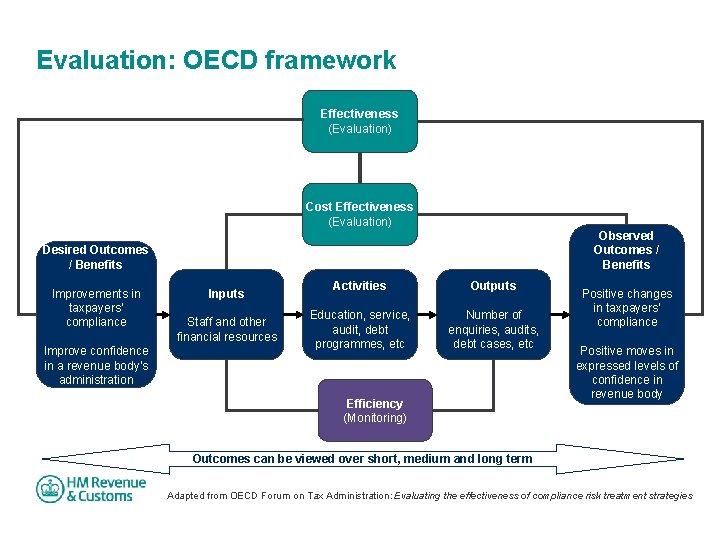
How does HMRC use their tax gaps? 1. Annual publication 2. HMRC Vision & Strategic Objective 1 3. Performance Management 4. Strategic resource allocation 5. Evaluation 6. Future work
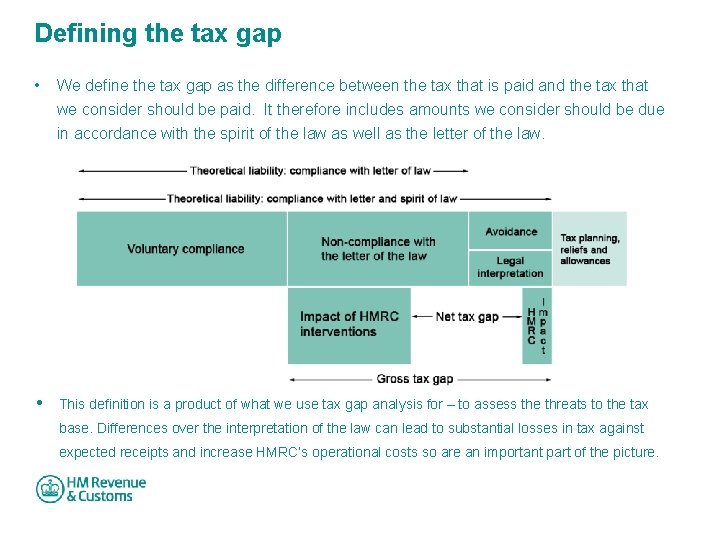
Defining the tax gap • We define the tax gap as the difference between the tax that is paid and the tax that we consider should be paid. It therefore includes amounts we consider should be due in accordance with the spirit of the law as well as the letter of the law. • This definition is a product of what we use tax gap analysis for – to assess the threats to the tax base. Differences over the interpretation of the law can lead to substantial losses in tax against expected receipts and increase HMRC’s operational costs so are an important part of the picture.
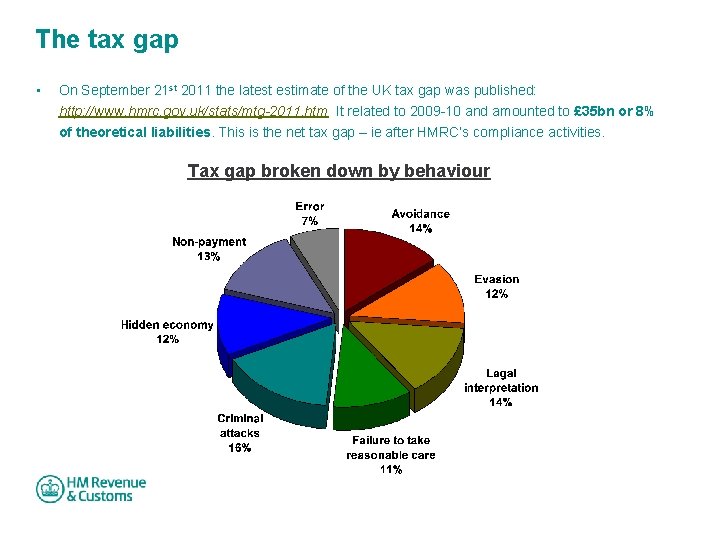
The tax gap • On September 21 st 2011 the latest estimate of the UK tax gap was published: http: //www. hmrc. gov. uk/stats/mtg-2011. htm It related to 2009 -10 and amounted to £ 35 bn or 8% of theoretical liabilities. This is the net tax gap – ie after HMRC’s compliance activities. Tax gap broken down by behaviour
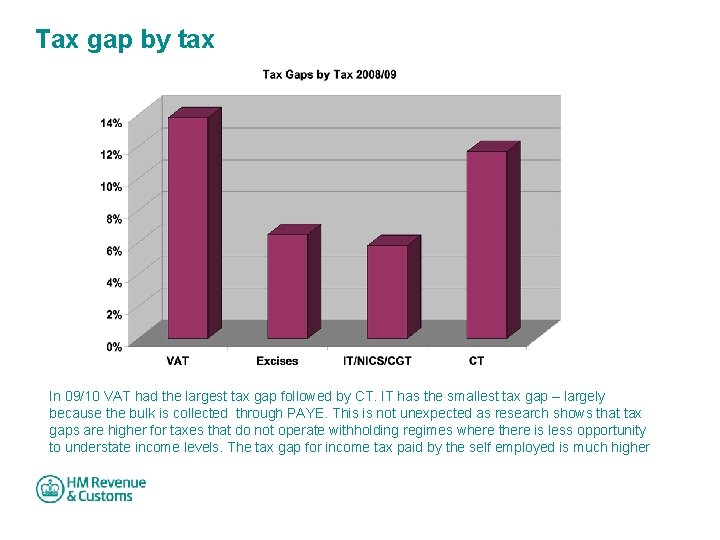
Tax gap by tax In 09/10 VAT had the largest tax gap followed by CT. IT has the smallest tax gap – largely because the bulk is collected through PAYE. This is not unexpected as research shows that tax gaps are higher for taxes that do not operate withholding regimes where there is less opportunity to understate income levels. The tax gap for income tax paid by the self employed is much higher
Publication • Published in full in September each year • Genuine area of public interest • Allows external analysts to understand - and challenge - methodology • Official Statistics covered by the UK Statistics & Registration Service Act • Current administration’s transparency agenda: • Allows public, and parliament, to monitor HMRC’s performance • Informs public debate on taxation (fiscal deficit and austerity regime) • Counters special interest claims http: //www. hmrc. gov. uk/stats/mtg-2011. pdf http: //www. hmrc. gov. uk/stats/mtg-annex 2011. pdf http: //www. hmrc. gov. uk/stats/vat-gap. pdf http: //www. hmrc. gov. uk/research/taxgap-workingpaper. pdf
HMRC Vision and Strategic Objective 1 HMRC Vision We will close the tax gap, our customers will feel that the tax system is simple for them and even-handed, and we will be seen as a highly professional and efficient organisation Strategic Objective 1 Maximise revenue to close the tax gap Our objective is to provide the money for public services by maximising revenue to close the tax gap and improving the extent to which individuals and businesses receive the credits and payments to which they are entitled
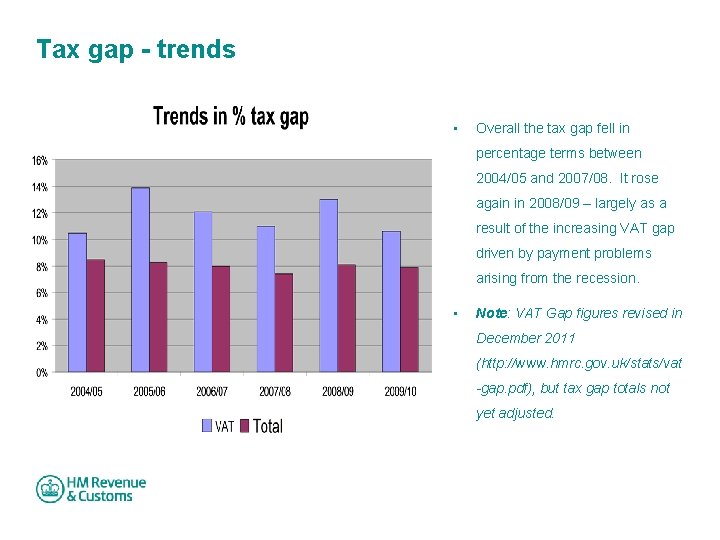
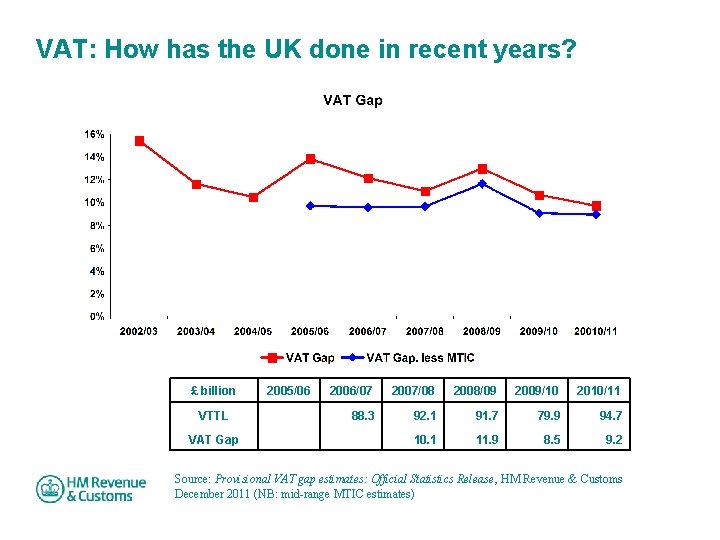
Tax gap - trends • Overall the tax gap fell in percentage terms between 2004/05 and 2007/08. It rose again in 2008/09 – largely as a result of the increasing VAT gap driven by payment problems arising from the recession. • Note: VAT Gap figures revised in December 2011 (http: //www. hmrc. gov. uk/stats/vat -gap. pdf), but tax gap totals not yet adjusted.
Performance management Performance Management Framework • Reporting framework for HMRC senior management • Performance against Strategic Objective 1 reported in tax gap currency: • Direct effects of interventions – ‘cash to bank’ • Indirect effects (Future Revenue Benefit): deterrence and prevention effects • Revenue protection: maintenance of tax gaps, eg repayments refused, loopholes closed • Tax gaps themselves are not a target or performance measure Tax Compliance Risk Overview • Comprehensive assessment of compliance risks and issues for HMRC and HM Treasury senior managers • Financial dimension of risk score based on tax gap estimates • Link to HM Treasury’s fiscal risk management
VAT: How has the UK done in recent years? £ billion 2005/06 2006/07 2007/08 2008/09 2009/10 2010/11 VTTL 84. 7 88. 3 92. 1 91. 7 79. 9 94. 7 VAT Gap 11. 7 10. 1 11. 9 8. 5 9. 2 Source: Provisional VAT gap estimates: Official Statistics Release, HM Revenue & Customs December 2011 (NB: mid-range MTIC estimates)
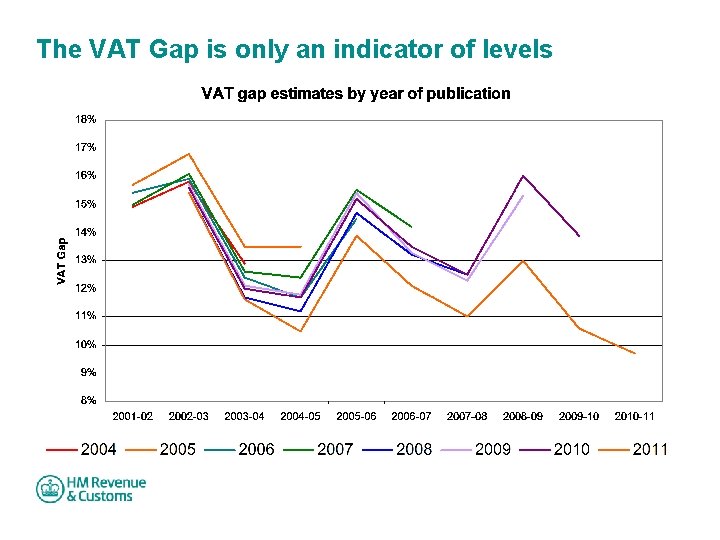
The VAT Gap is only an indicator of levels
Compliance Resource Allocation Management (CRAM) • Main purpose is to inform compliance strategy and resource allocation decisions in Local Compliance, and (under development) Special Investigations & Risk Intelligence Services • Optimal resource allocation decisions require understanding of full impact of resource changes on compliance behaviour, expressed in tax gap currency • Attitudinal segmentation of taxpayers, with conceptual and theoretical models of compliance behaviour, enable us to use a numerical model • Principal uses: PROTECT • HMRC Strategy March 2010 • Spending Review September 2010 (£ 917 m investment) • Ongoing forecasts of Change benefits
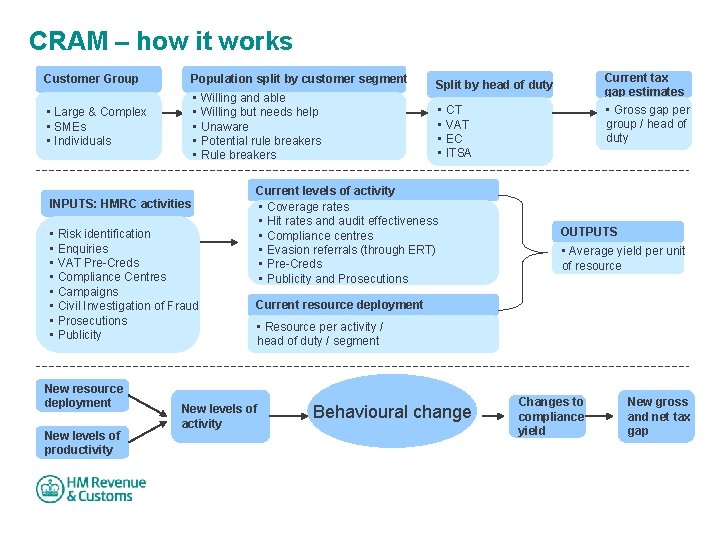
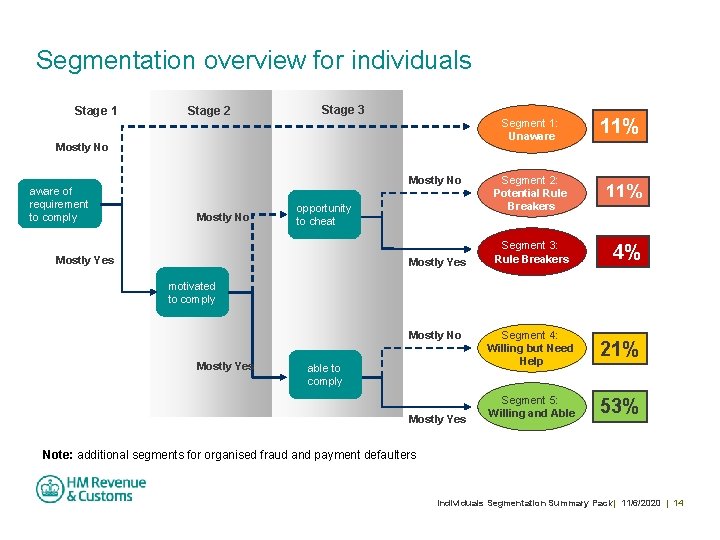
CRAM – how it works Customer Group Population split by customer segment • Large & Complex • SMEs • Individuals • Willing and able • Willing but needs help • Unaware • Potential rule breakers • Rule breakers INPUTS: HMRC activities • Risk identification • Enquiries • VAT Pre-Creds • Compliance Centres • Campaigns • Civil Investigation of Fraud • Prosecutions • Publicity New resource deployment New levels of productivity Current tax gap estimates • Gross gap per group / head of duty Split by head of duty • CT • VAT • EC • ITSA Current levels of activity • Coverage rates • Hit rates and audit effectiveness • Compliance centres • Evasion referrals (through ERT) • Pre-Creds • Publicity and Prosecutions OUTPUTS • Average yield per unit of resource Current resource deployment • Resource per activity / head of duty / segment New levels of activity Behavioural change Changes to compliance yield New gross and net tax gap
Segmentation overview for individuals Stage 1 Stage 2 Stage 3 Segment 1: Unaware Mostly No aware of requirement to comply Mostly No opportunity to cheat Mostly Yes 11% Segment 2: Potential Rule Breakers 11% Segment 3: Rule Breakers 4% motivated to comply Mostly No Mostly Yes able to comply Mostly Yes Segment 4: Willing but Need Help 21% Segment 5: Willing and Able 53% Note: additional segments for organised fraud and payment defaulters Individuals Segmentation Summary Pack| 11/6/2020 | 14
Evaluation: OECD framework Effectiveness (Evaluation) Cost Effectiveness (Evaluation) Observed Outcomes / Benefits Desired Outcomes / Benefits Improvements in taxpayers’ compliance Improve confidence in a revenue body’s administration Inputs Staff and other financial resources Activities Outputs Education, service, audit, debt programmes, etc Number of enquiries, audits, debt cases, etc Efficiency (Monitoring) Positive changes in taxpayers’ compliance Positive moves in expressed levels of confidence in revenue body Outcomes can be viewed over short, medium and long term Adapted from OECD Forum on Tax Administration: Evaluating the effectiveness of compliance risk treatment strategies
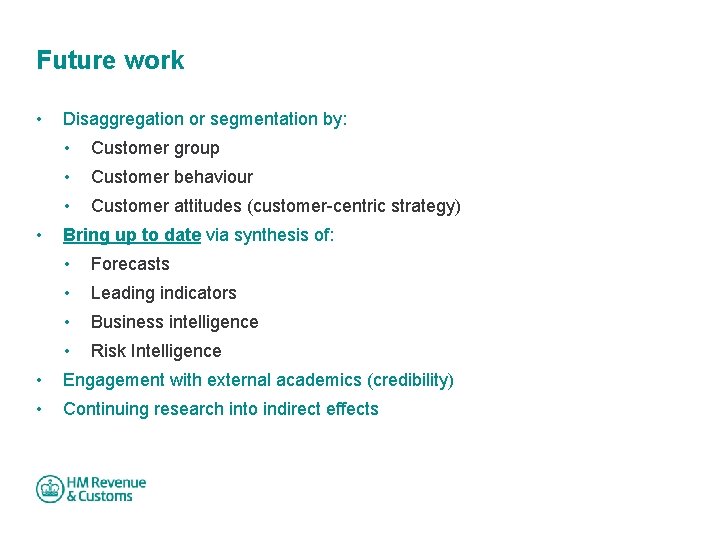
Future work • • Disaggregation or segmentation by: • Customer group • Customer behaviour • Customer attitudes (customer-centric strategy) Bring up to date via synthesis of: • Forecasts • Leading indicators • Business intelligence • Risk Intelligence • Engagement with external academics (credibility) • Continuing research into indirect effects
Thank you!