
Applied Statistics and Probability for Engineers Sixth Edition
Applied Statistics and Probability for Engineers Sixth Edition Douglas C. Montgomery George C. Runger Chapter 5 Joint Probability Distributions Copyright © 2014 John Wiley & Sons, Inc. All rights reserved.

5 Joint Probability Distributions CHAPTER OUTLINE 5 -1 Two or More Random Variables 5 -1. 1 Joint Probability Distributions 5 -1. 2 Marginal Probability Distributions 5 -1. 3 Conditional Probability Distributions 5 -1. 4 Independence 5 -1. 5 More Than Two Random Variables 5 -5 General Functions of Random Variables 5 -6 Moment Generating Functions 5 -2 Covariance and Correlation 5 -3 Common Joint Distributions 5 -3. 1 Multinomial Probability Distribution 5 -3. 2 Bivariate Normal Distribution 5 -4 Linear Functions of Random Variables Chapter 5 Title and Outline 2 Copyright © 2014 John Wiley & Sons, Inc. All rights reserved.
Learning Objectives for Chapter 5 After careful study of this chapter, you should be able to do the following: 1. 2. 3. 4. 5. 6. 7. 8. Use joint probability mass functions and joint probability density functions to calculate probabilities. Calculate marginal and conditional probability distributions from joint probability distributions. Interpret and calculate covariances and correlations between random variables. Use the multinomial distribution to determine probabilities. Properties of a bivariate normal distribution and to draw contour plots for the probability density function. Calculate means and variances for linear combinations of random variables, and calculate probabilities for linear combinations of normally distributed random variables. Determine the distribution of a general function of a random variable. Calculate moment generating functions and use them to determine moments and distributions Chapter 5 Learning Objectives 3 Copyright © 2014 John Wiley & Sons, Inc. All rights reserved.

Joint Probability Mass Function Sec 5 -1. 1 Joint Probability Distributions Copyright © 2014 John Wiley & Sons, Inc. All rights reserved. 4

Joint Probability Density Function The joint probability density function for the continuous random variables X and Y, denotes as f. XY(x, y), satisfies the following properties: Figure 5 -2 Joint probability density function for the random variables X and Y. Probability that (X, Y) is in the region R is determined by the volume of f. XY(x, y) over the region R. Sec 5 -1. 1 Joint Probability Distributions Copyright © 2014 John Wiley & Sons, Inc. All rights reserved. 5
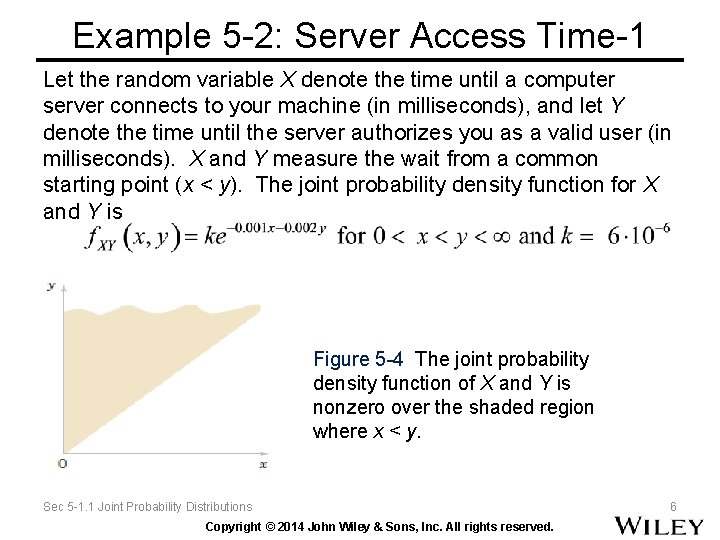
Example 5 -2: Server Access Time-1 Let the random variable X denote the time until a computer server connects to your machine (in milliseconds), and let Y denote the time until the server authorizes you as a valid user (in milliseconds). X and Y measure the wait from a common starting point (x < y). The joint probability density function for X and Y is Figure 5 -4 The joint probability density function of X and Y is nonzero over the shaded region where x < y. Sec 5 -1. 1 Joint Probability Distributions Copyright © 2014 John Wiley & Sons, Inc. All rights reserved. 6
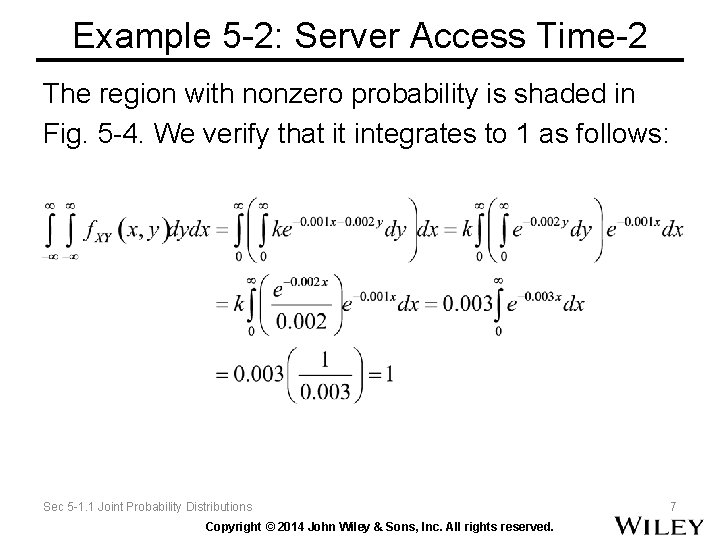
Example 5 -2: Server Access Time-2 The region with nonzero probability is shaded in Fig. 5 -4. We verify that it integrates to 1 as follows: Sec 5 -1. 1 Joint Probability Distributions Copyright © 2014 John Wiley & Sons, Inc. All rights reserved. 7
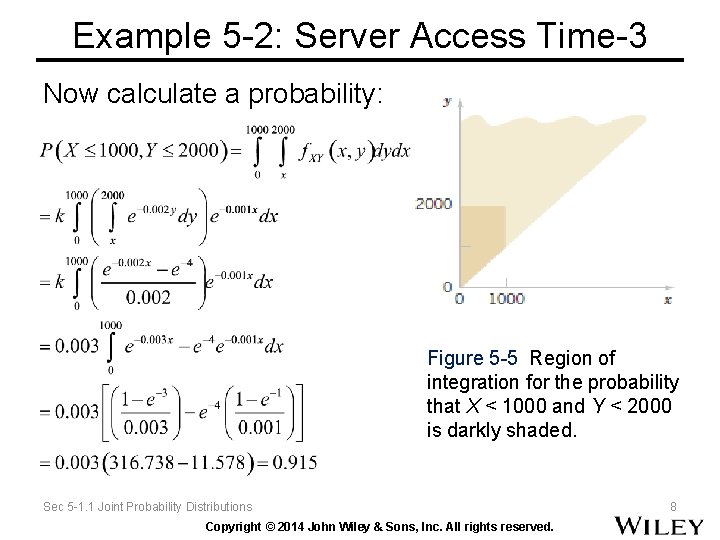
Example 5 -2: Server Access Time-3 Now calculate a probability: Figure 5 -5 Region of integration for the probability that X < 1000 and Y < 2000 is darkly shaded. Sec 5 -1. 1 Joint Probability Distributions Copyright © 2014 John Wiley & Sons, Inc. All rights reserved. 8

Marginal Probability Distributions (discrete) The marginal probability distribution for X is found by summing the probabilities in each column whereas the marginal probability distribution for Y is found by summing the probabilities in each row. Marginal probability distributions of X and Y Sec 5 -1. 2 Marginal Probability Distributions Copyright © 2014 John Wiley & Sons, Inc. All rights reserved. 9

Marginal Probability Density Function (continuous) If the joint probability density function of random variables X and Y is f. XY(x, y), the marginal probability density functions of X and Y are: Sec 5 -1. 2 Marginal Probability Distributions Copyright © 2014 John Wiley & Sons, Inc. All rights reserved. 10
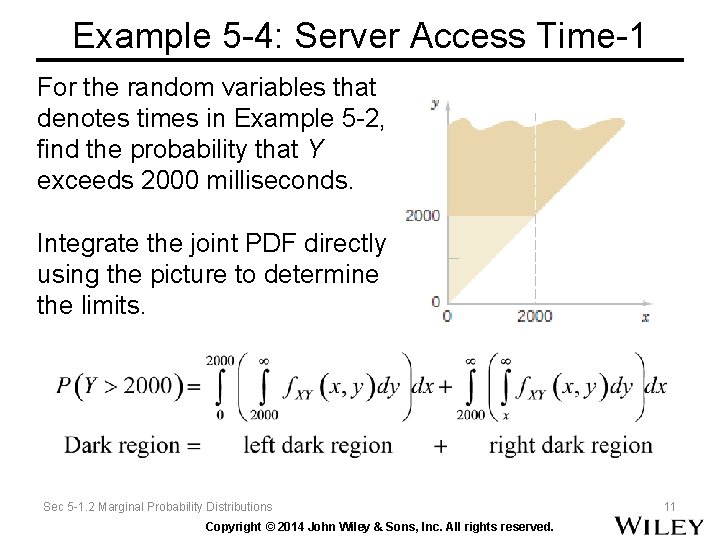
Example 5 -4: Server Access Time-1 For the random variables that denotes times in Example 5 -2, find the probability that Y exceeds 2000 milliseconds. Integrate the joint PDF directly using the picture to determine the limits. Sec 5 -1. 2 Marginal Probability Distributions Copyright © 2014 John Wiley & Sons, Inc. All rights reserved. 11
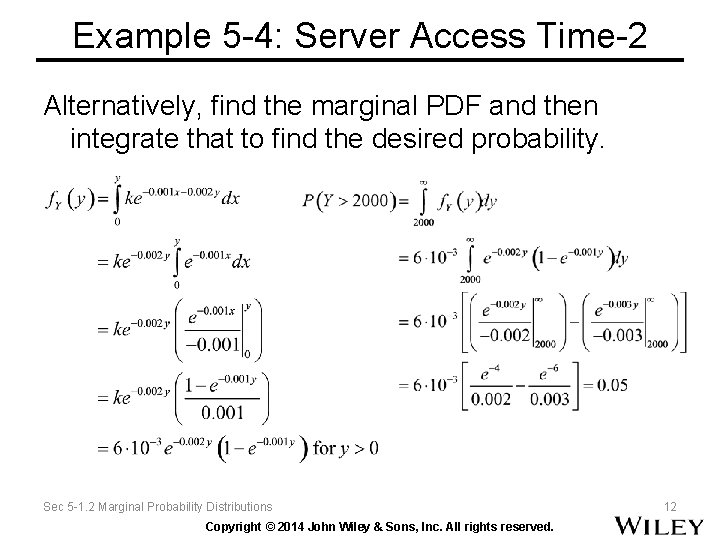
Example 5 -4: Server Access Time-2 Alternatively, find the marginal PDF and then integrate that to find the desired probability. Sec 5 -1. 2 Marginal Probability Distributions Copyright © 2014 John Wiley & Sons, Inc. All rights reserved. 12

Mean & Variance of a Marginal Distribution E(X) and V(X) can be obtained by first calculating the marginal probability distribution of X and then determining E(X) and V(X) by the usual method. Sec 5 -1. 2 Marginal Probability Distributions Copyright © 2014 John Wiley & Sons, Inc. All rights reserved. 13
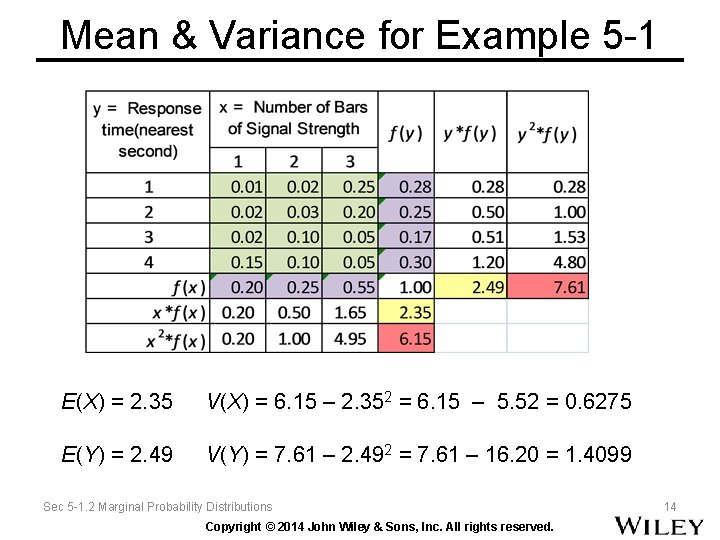
Mean & Variance for Example 5 -1 E(X) = 2. 35 V(X) = 6. 15 – 2. 352 = 6. 15 – 5. 52 = 0. 6275 E(Y) = 2. 49 V(Y) = 7. 61 – 2. 492 = 7. 61 – 16. 20 = 1. 4099 Sec 5 -1. 2 Marginal Probability Distributions Copyright © 2014 John Wiley & Sons, Inc. All rights reserved. 14
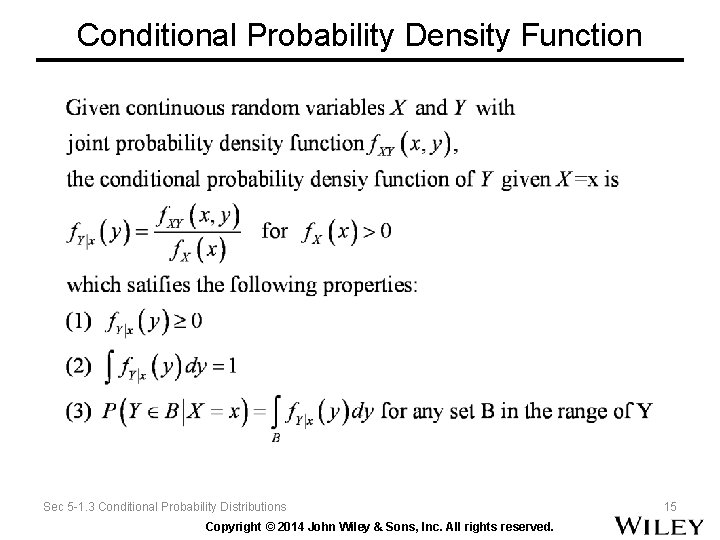
Conditional Probability Density Function Sec 5 -1. 3 Conditional Probability Distributions Copyright © 2014 John Wiley & Sons, Inc. All rights reserved. 15

Example 5 -6: Conditional Probability-1 From Example 5 -2, determine the conditional PDF for Y given X=x. Sec 5 -1. 3 Conditional Probability Distributions Copyright © 2014 John Wiley & Sons, Inc. All rights reserved. 16
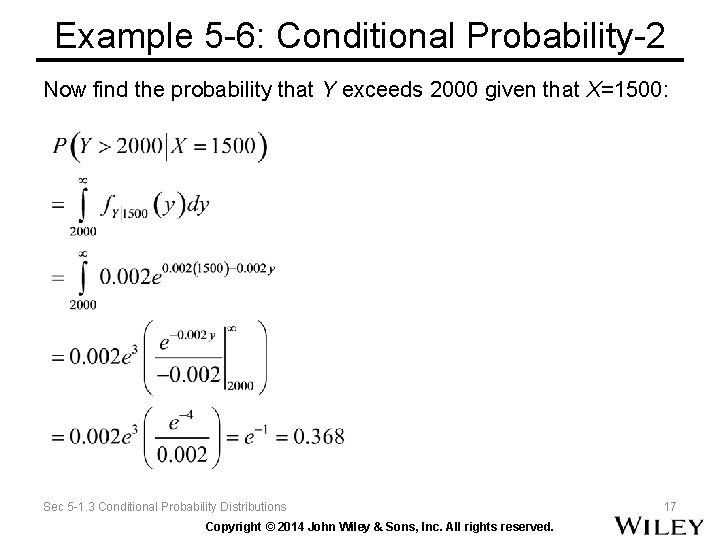
Example 5 -6: Conditional Probability-2 Now find the probability that Y exceeds 2000 given that X=1500: Sec 5 -1. 3 Conditional Probability Distributions Copyright © 2014 John Wiley & Sons, Inc. All rights reserved. 17
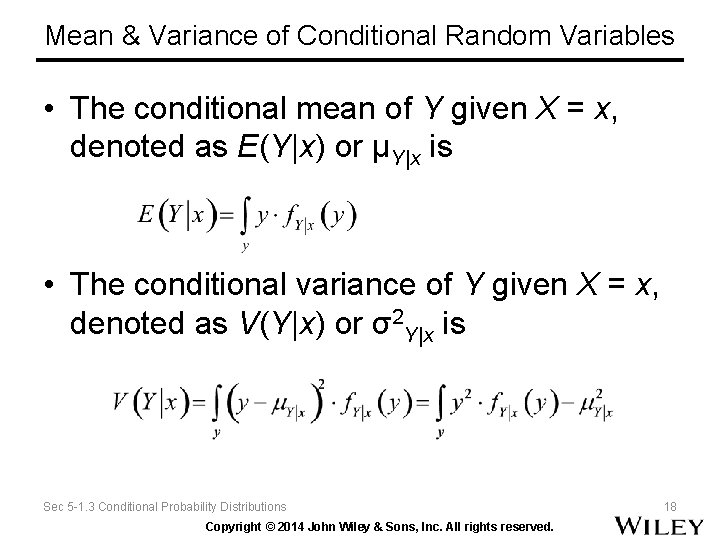
Mean & Variance of Conditional Random Variables • The conditional mean of Y given X = x, denoted as E(Y|x) or μY|x is • The conditional variance of Y given X = x, denoted as V(Y|x) or σ2 Y|x is Sec 5 -1. 3 Conditional Probability Distributions Copyright © 2014 John Wiley & Sons, Inc. All rights reserved. 18
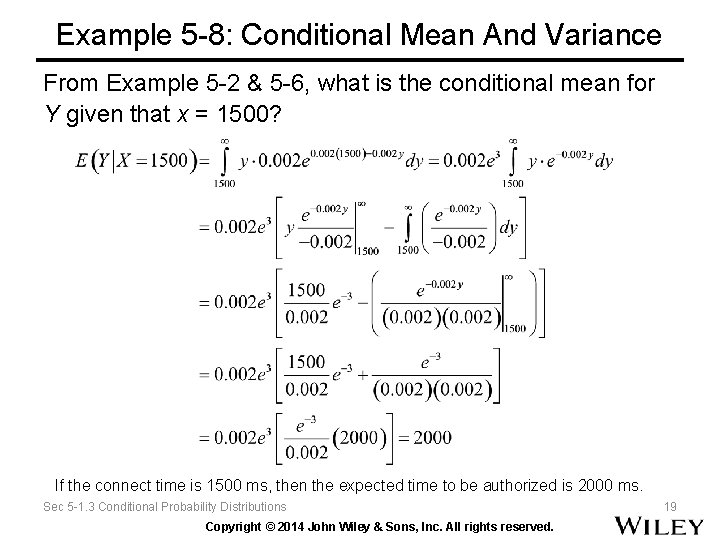
Example 5 -8: Conditional Mean And Variance From Example 5 -2 & 5 -6, what is the conditional mean for Y given that x = 1500? If the connect time is 1500 ms, then the expected time to be authorized is 2000 ms. Sec 5 -1. 3 Conditional Probability Distributions Copyright © 2014 John Wiley & Sons, Inc. All rights reserved. 19

Example 5 -9 For the discrete random variables in Exercise 5 -1, what is the conditional mean of Y given X=1? The mean number of attempts given one bar is 3. 55 with variance of 0. 7475. Sec 5 -1. 3 Conditional Probability Distributions Copyright © 2014 John Wiley & Sons, Inc. All rights reserved. 20
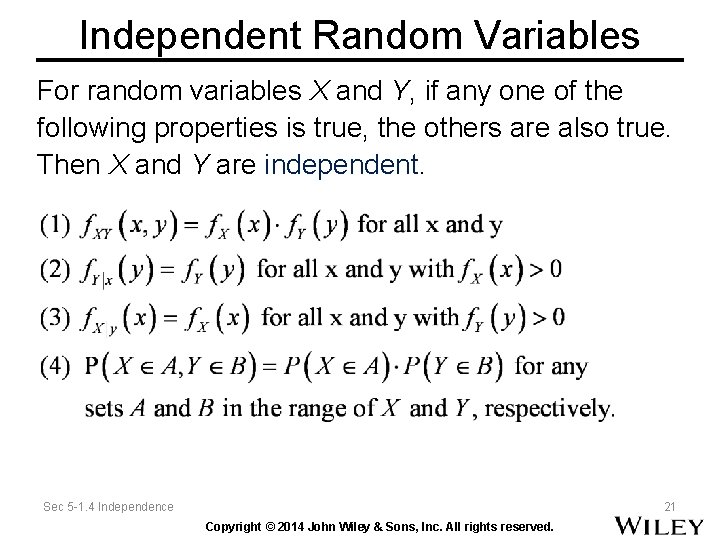
Independent Random Variables For random variables X and Y, if any one of the following properties is true, the others are also true. Then X and Y are independent. Sec 5 -1. 4 Independence 21 Copyright © 2014 John Wiley & Sons, Inc. All rights reserved.

Example 5 -11: Independent Random Variables • Suppose the Example 5 -2 is modified such that the joint PDF is: • Are X and Y independent? • Find the probability Sec 5 -1. 4 Independence 22 Copyright © 2014 John Wiley & Sons, Inc. All rights reserved.
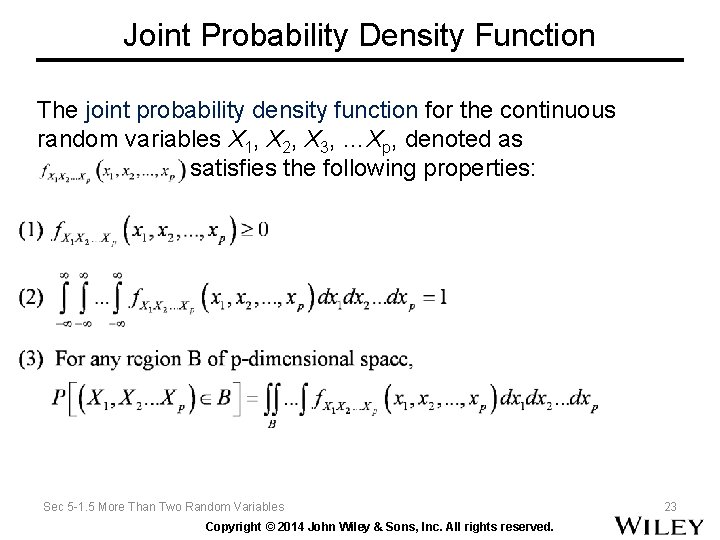
Joint Probability Density Function The joint probability density function for the continuous random variables X 1, X 2, X 3, …Xp, denoted as satisfies the following properties: Sec 5 -1. 5 More Than Two Random Variables Copyright © 2014 John Wiley & Sons, Inc. All rights reserved. 23

Example 5 -14: Component Lifetimes In an electronic assembly, let X 1, X 2, X 3, X 4 denote the lifetimes of 4 components in hours. The joint PDF is: What is the probability that the device operates more than 1000 hours? The joint PDF is a product of exponential PDFs. P(X 1 > 1000, X 2 > 1000, X 3 > 1000, X 4 > 1000) = e-1 -2 -1. 5 -3 = e-7. 5 = 0. 00055 Sec 5 -1. 5 More Than Two Random Variables Copyright © 2014 John Wiley & Sons, Inc. All rights reserved. 24
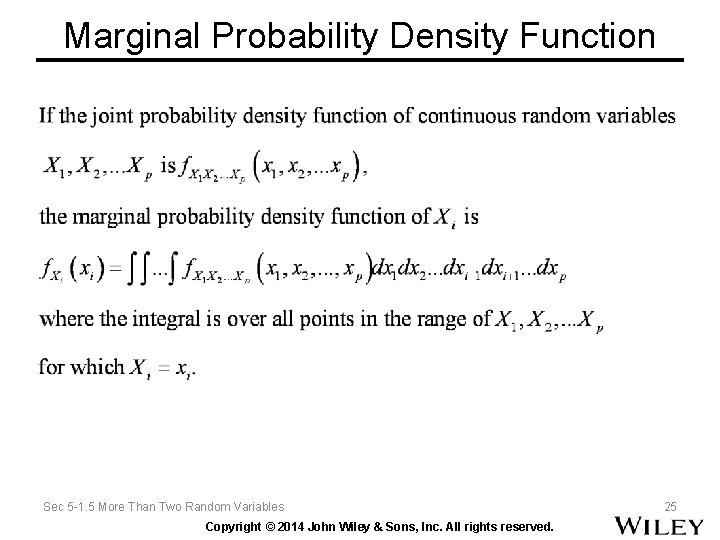
Marginal Probability Density Function Sec 5 -1. 5 More Than Two Random Variables Copyright © 2014 John Wiley & Sons, Inc. All rights reserved. 25
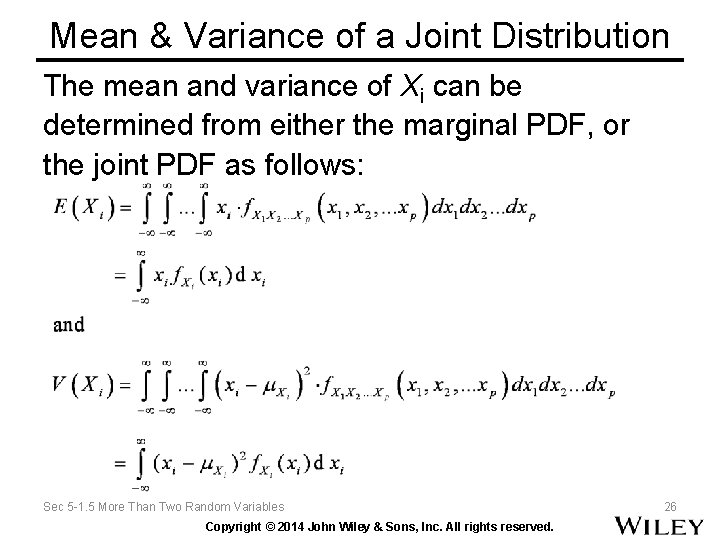
Mean & Variance of a Joint Distribution The mean and variance of Xi can be determined from either the marginal PDF, or the joint PDF as follows: Sec 5 -1. 5 More Than Two Random Variables Copyright © 2014 John Wiley & Sons, Inc. All rights reserved. 26
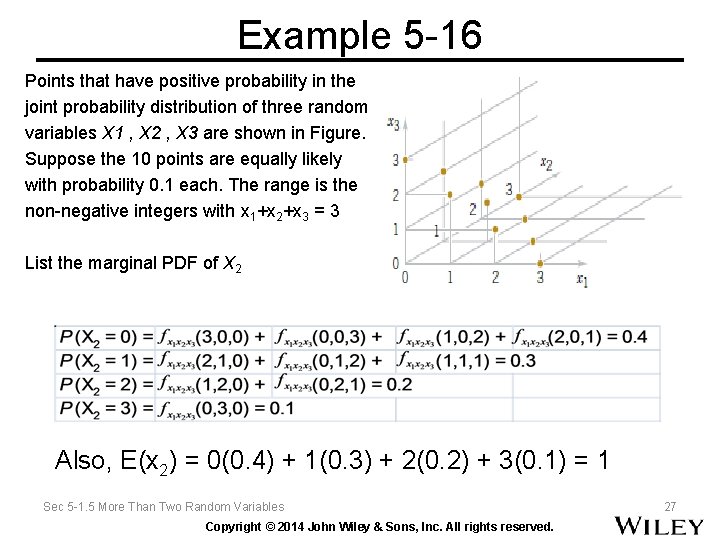
Example 5 -16 Points that have positive probability in the joint probability distribution of three random variables X 1 , X 2 , X 3 are shown in Figure. Suppose the 10 points are equally likely with probability 0. 1 each. The range is the non-negative integers with x 1+x 2+x 3 = 3 List the marginal PDF of X 2 Also, E(x 2) = 0(0. 4) + 1(0. 3) + 2(0. 2) + 3(0. 1) = 1 Sec 5 -1. 5 More Than Two Random Variables Copyright © 2014 John Wiley & Sons, Inc. All rights reserved. 27
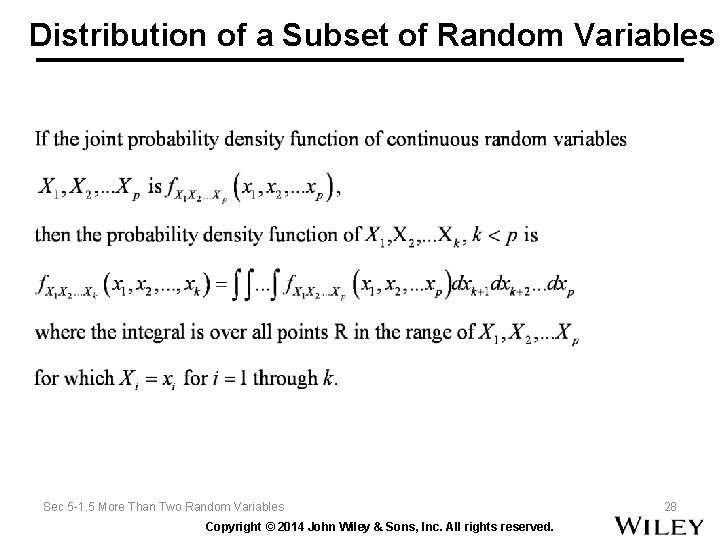
Distribution of a Subset of Random Variables Sec 5 -1. 5 More Than Two Random Variables Copyright © 2014 John Wiley & Sons, Inc. All rights reserved. 28
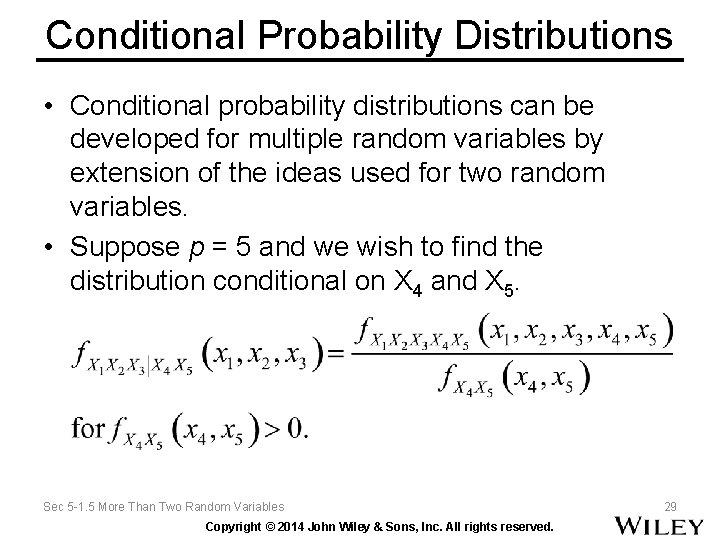
Conditional Probability Distributions • Conditional probability distributions can be developed for multiple random variables by extension of the ideas used for two random variables. • Suppose p = 5 and we wish to find the distribution conditional on X 4 and X 5. Sec 5 -1. 5 More Than Two Random Variables Copyright © 2014 John Wiley & Sons, Inc. All rights reserved. 29
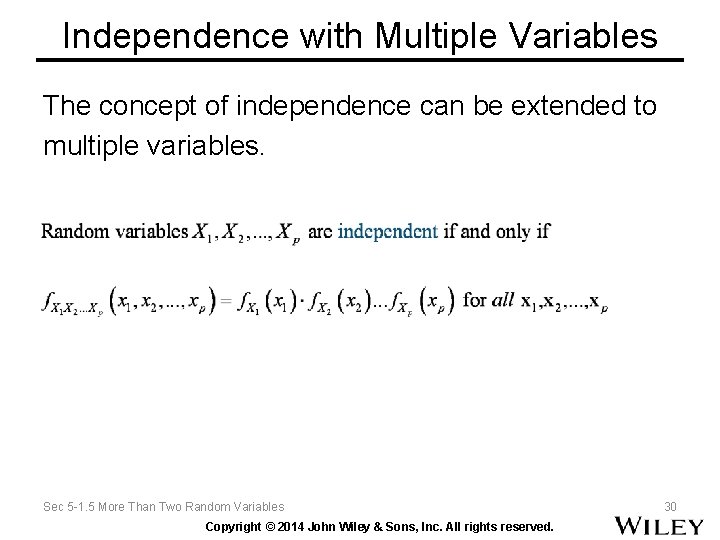
Independence with Multiple Variables The concept of independence can be extended to multiple variables. Sec 5 -1. 5 More Than Two Random Variables Copyright © 2014 John Wiley & Sons, Inc. All rights reserved. 30
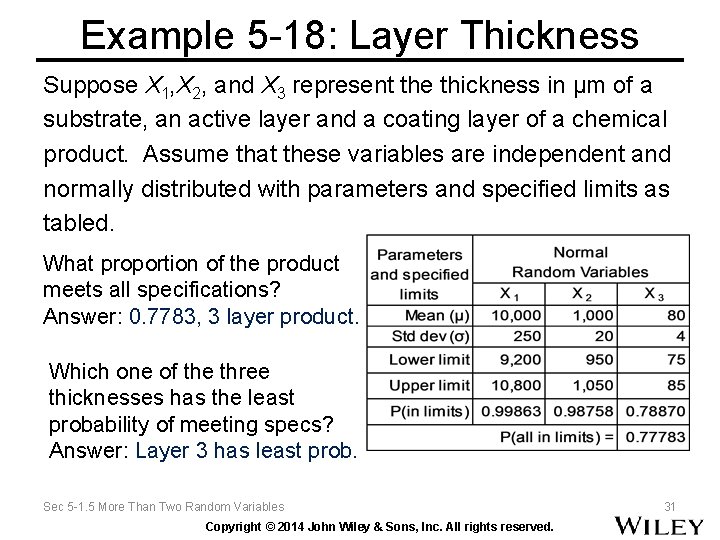
Example 5 -18: Layer Thickness Suppose X 1, X 2, and X 3 represent the thickness in μm of a substrate, an active layer and a coating layer of a chemical product. Assume that these variables are independent and normally distributed with parameters and specified limits as tabled. What proportion of the product meets all specifications? Answer: 0. 7783, 3 layer product. Which one of the three thicknesses has the least probability of meeting specs? Answer: Layer 3 has least prob. Sec 5 -1. 5 More Than Two Random Variables Copyright © 2014 John Wiley & Sons, Inc. All rights reserved. 31
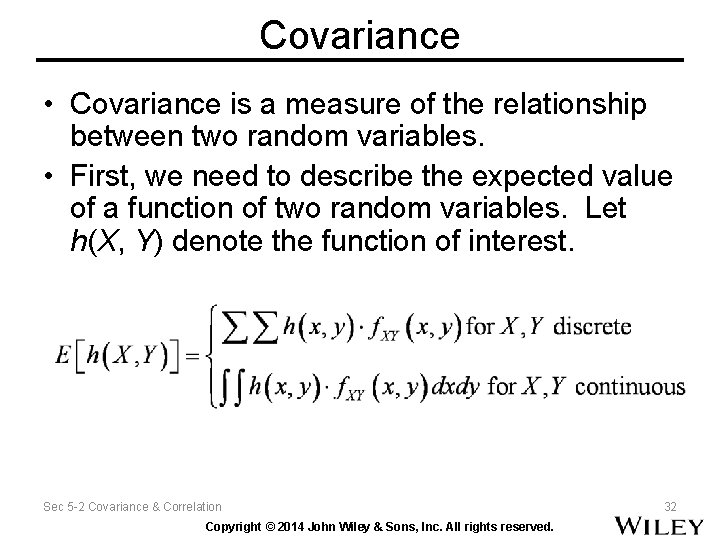
Covariance • Covariance is a measure of the relationship between two random variables. • First, we need to describe the expected value of a function of two random variables. Let h(X, Y) denote the function of interest. Sec 5 -2 Covariance & Correlation Copyright © 2014 John Wiley & Sons, Inc. All rights reserved. 32
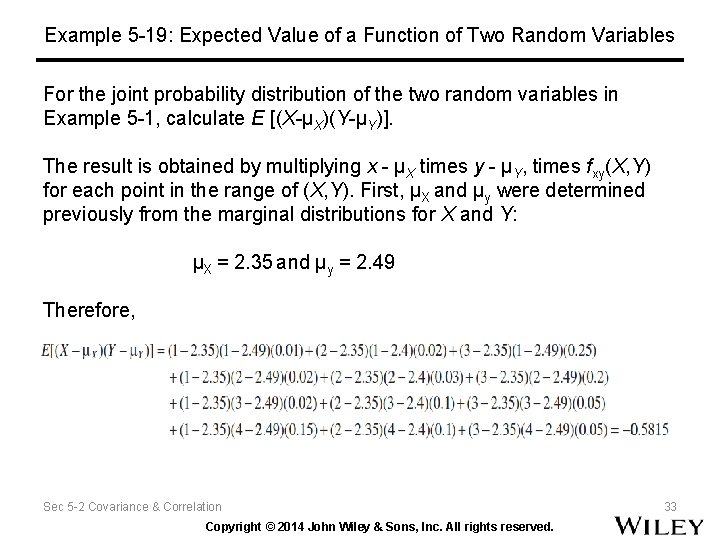
Example 5 -19: Expected Value of a Function of Two Random Variables For the joint probability distribution of the two random variables in Example 5 -1, calculate E [(X-μX)(Y-μY)]. The result is obtained by multiplying x - μX times y - μY, times fxy(X, Y) for each point in the range of (X, Y). First, μX and μy were determined previously from the marginal distributions for X and Y: μX = 2. 35 and μy = 2. 49 Therefore, Sec 5 -2 Covariance & Correlation Copyright © 2014 John Wiley & Sons, Inc. All rights reserved. 33

Covariance Defined Sec 5 -2 Covariance & Correlation Copyright © 2014 John Wiley & Sons, Inc. All rights reserved. 34
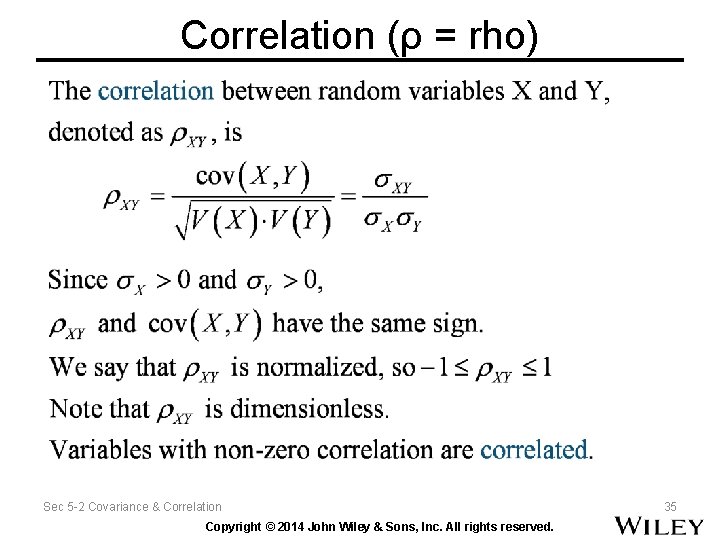
Correlation (ρ = rho) Sec 5 -2 Covariance & Correlation Copyright © 2014 John Wiley & Sons, Inc. All rights reserved. 35
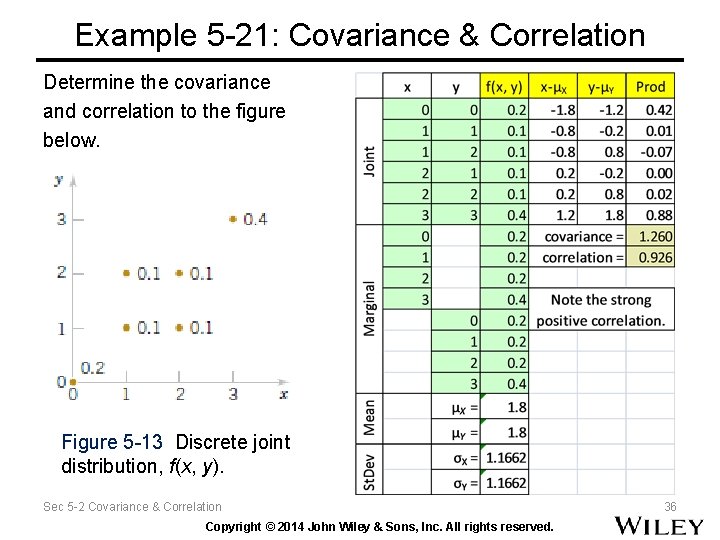
Example 5 -21: Covariance & Correlation Determine the covariance and correlation to the figure below. Figure 5 -13 Discrete joint distribution, f(x, y). Sec 5 -2 Covariance & Correlation Copyright © 2014 John Wiley & Sons, Inc. All rights reserved. 36
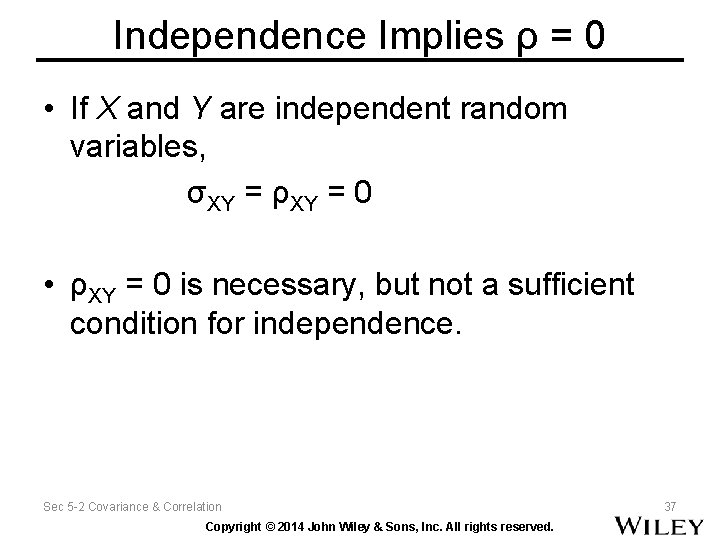
Independence Implies ρ = 0 • If X and Y are independent random variables, σXY = ρXY = 0 • ρXY = 0 is necessary, but not a sufficient condition for independence. Sec 5 -2 Covariance & Correlation Copyright © 2014 John Wiley & Sons, Inc. All rights reserved. 37
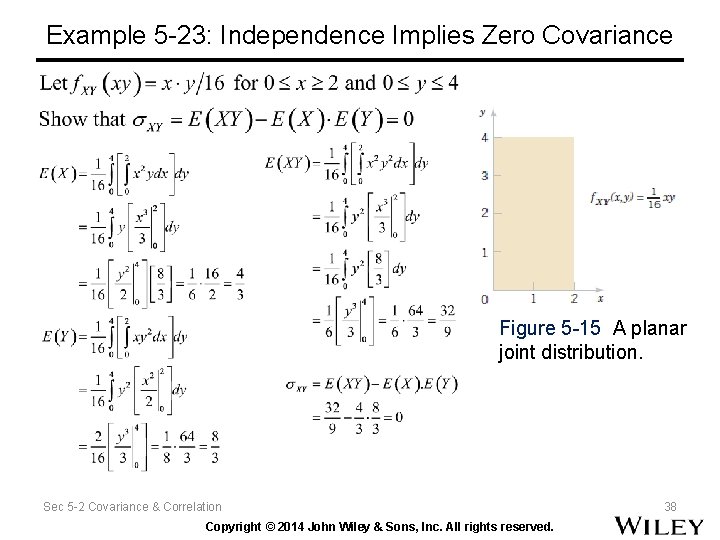
Example 5 -23: Independence Implies Zero Covariance Figure 5 -15 A planar joint distribution. Sec 5 -2 Covariance & Correlation Copyright © 2014 John Wiley & Sons, Inc. All rights reserved. 38
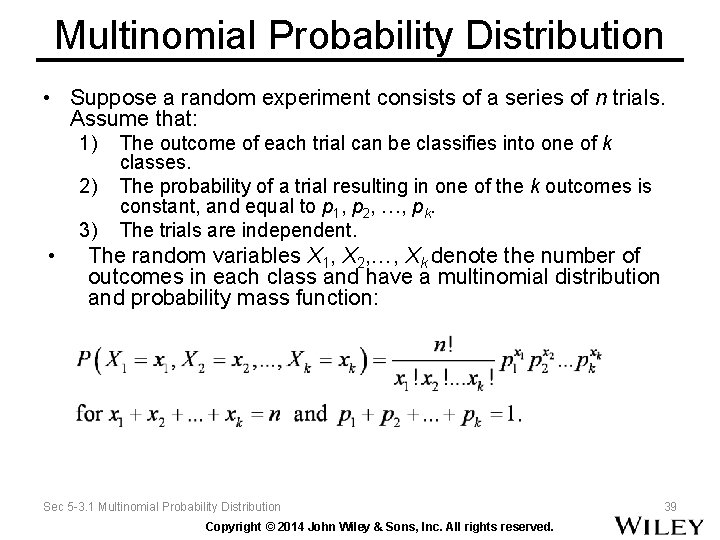
Multinomial Probability Distribution • Suppose a random experiment consists of a series of n trials. Assume that: 1) 2) 3) • The outcome of each trial can be classifies into one of k classes. The probability of a trial resulting in one of the k outcomes is constant, and equal to p 1, p 2, …, pk. The trials are independent. The random variables X 1, X 2, …, Xk denote the number of outcomes in each class and have a multinomial distribution and probability mass function: Sec 5 -3. 1 Multinomial Probability Distribution Copyright © 2014 John Wiley & Sons, Inc. All rights reserved. 39
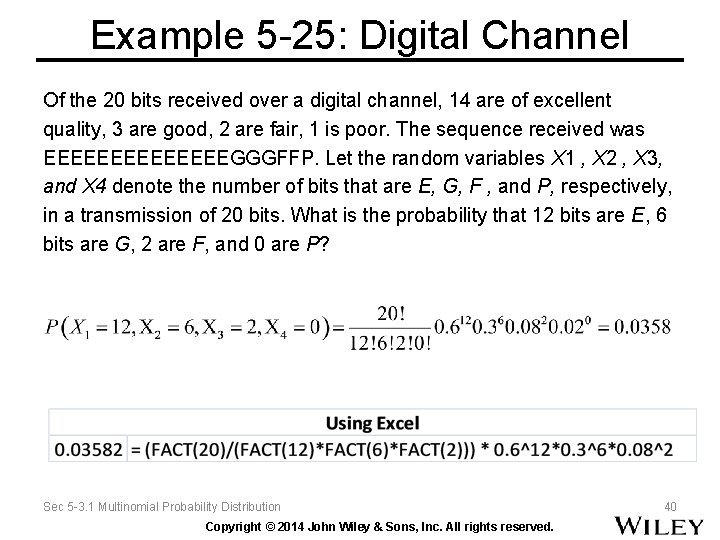
Example 5 -25: Digital Channel Of the 20 bits received over a digital channel, 14 are of excellent quality, 3 are good, 2 are fair, 1 is poor. The sequence received was EEEEEEEGGGFFP. Let the random variables X 1 , X 2 , X 3, and X 4 denote the number of bits that are E, G, F , and P, respectively, in a transmission of 20 bits. What is the probability that 12 bits are E, 6 bits are G, 2 are F, and 0 are P? Sec 5 -3. 1 Multinomial Probability Distribution Copyright © 2014 John Wiley & Sons, Inc. All rights reserved. 40

Multinomial Mean and Variance The marginal distributions of the multinomial are binomial. If X 1, X 2, …, Xk have a multinomial distribution, the marginal probability distributions of Xi is binomial with: E(Xi) = npi and V(Xi) = npi(1 -pi) Sec 5 -3. 1 Multinomial Probability Distribution Copyright © 2014 John Wiley & Sons, Inc. All rights reserved. 41
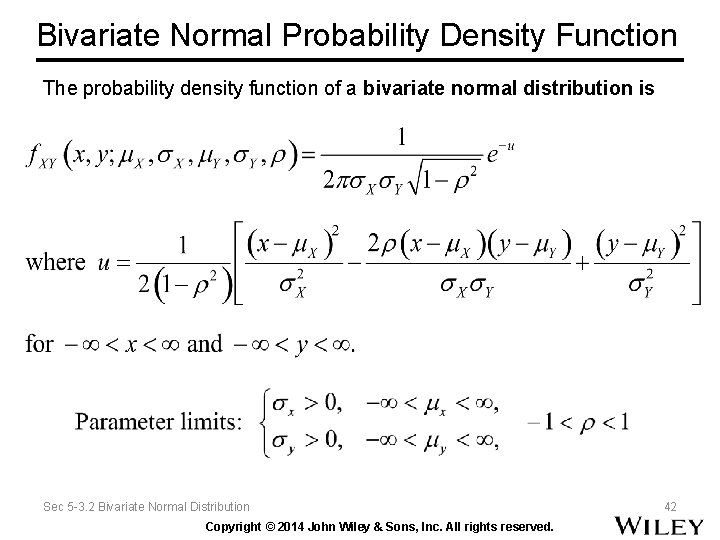
Bivariate Normal Probability Density Function The probability density function of a bivariate normal distribution is Sec 5 -3. 2 Bivariate Normal Distribution Copyright © 2014 John Wiley & Sons, Inc. All rights reserved. 42
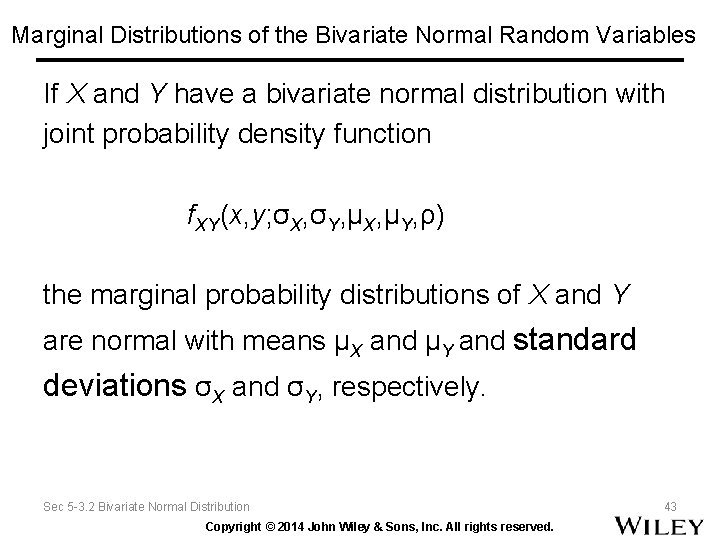
Marginal Distributions of the Bivariate Normal Random Variables If X and Y have a bivariate normal distribution with joint probability density function f. XY(x, y; σX, σY, μX, μY, ρ) the marginal probability distributions of X and Y are normal with means μX and μY and standard deviations σX and σY, respectively. Sec 5 -3. 2 Bivariate Normal Distribution Copyright © 2014 John Wiley & Sons, Inc. All rights reserved. 43
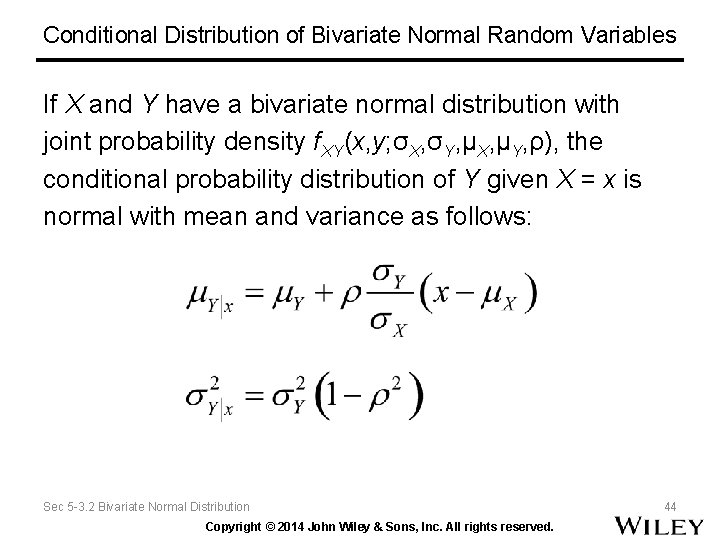
Conditional Distribution of Bivariate Normal Random Variables If X and Y have a bivariate normal distribution with joint probability density f. XY(x, y; σX, σY, μX, μY, ρ), the conditional probability distribution of Y given X = x is normal with mean and variance as follows: Sec 5 -3. 2 Bivariate Normal Distribution Copyright © 2014 John Wiley & Sons, Inc. All rights reserved. 44
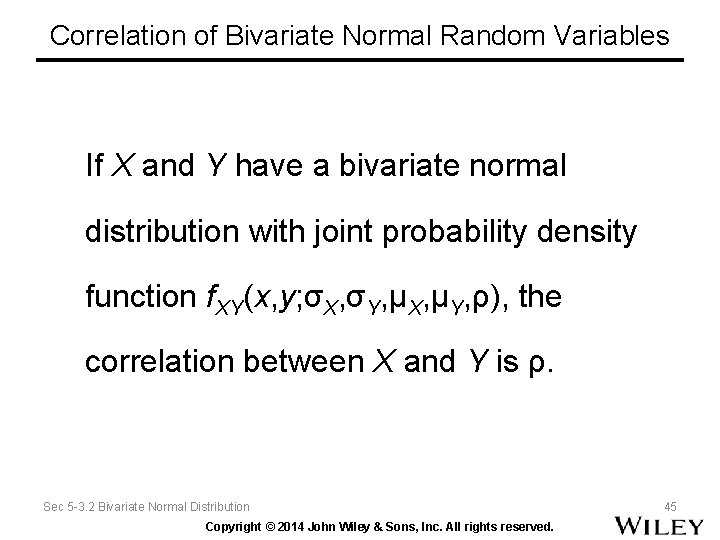
Correlation of Bivariate Normal Random Variables If X and Y have a bivariate normal distribution with joint probability density function f. XY(x, y; σX, σY, μX, μY, ρ), the correlation between X and Y is ρ. Sec 5 -3. 2 Bivariate Normal Distribution Copyright © 2014 John Wiley & Sons, Inc. All rights reserved. 45
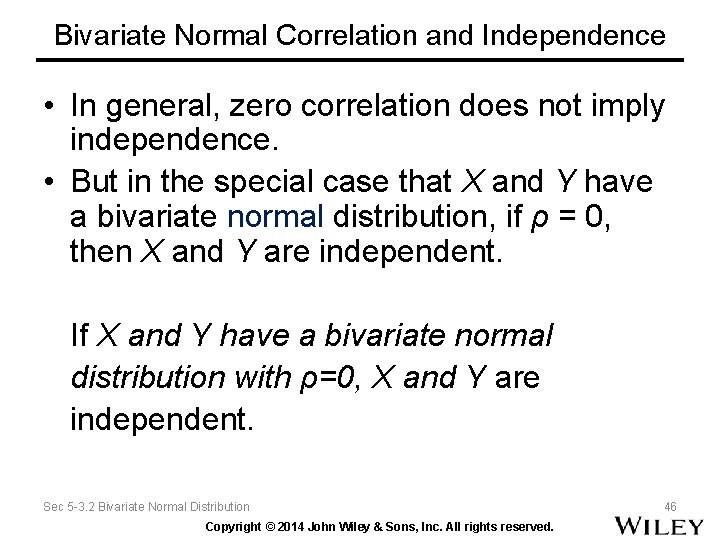
Bivariate Normal Correlation and Independence • In general, zero correlation does not imply independence. • But in the special case that X and Y have a bivariate normal distribution, if ρ = 0, then X and Y are independent. If X and Y have a bivariate normal distribution with ρ=0, X and Y are independent. Sec 5 -3. 2 Bivariate Normal Distribution Copyright © 2014 John Wiley & Sons, Inc. All rights reserved. 46

Linear Functions of Random Variables • A function of random variables is itself a random variable. • A function of random variables can be formed by either linear or nonlinear relationships. We limit our discussion here to linear functions. • Given random variables X 1, X 2, …, Xp and constants c 1, c 2, …, cp Y= c 1 X 1 + c 2 X 2 + … + cp. Xp is a linear combination of X 1, X 2, …, Xp. Sec 5 -4 Linear Functions of Random Variables Copyright © 2014 John Wiley & Sons, Inc. All rights reserved. 47
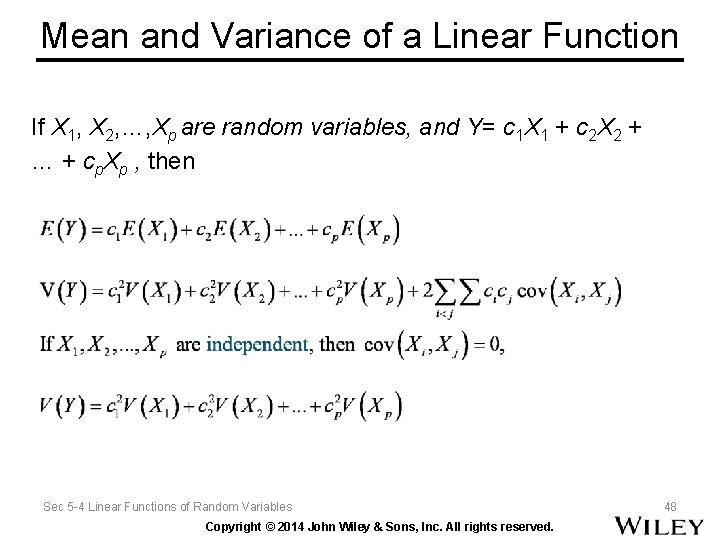
Mean and Variance of a Linear Function If X 1, X 2, …, Xp are random variables, and Y= c 1 X 1 + c 2 X 2 + … + cp. Xp , then Sec 5 -4 Linear Functions of Random Variables Copyright © 2014 John Wiley & Sons, Inc. All rights reserved. 48
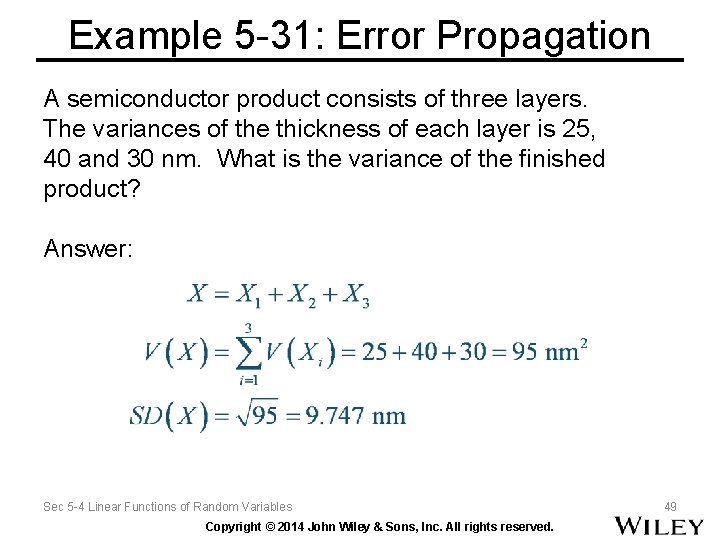
Example 5 -31: Error Propagation A semiconductor product consists of three layers. The variances of the thickness of each layer is 25, 40 and 30 nm. What is the variance of the finished product? Answer: Sec 5 -4 Linear Functions of Random Variables Copyright © 2014 John Wiley & Sons, Inc. All rights reserved. 49
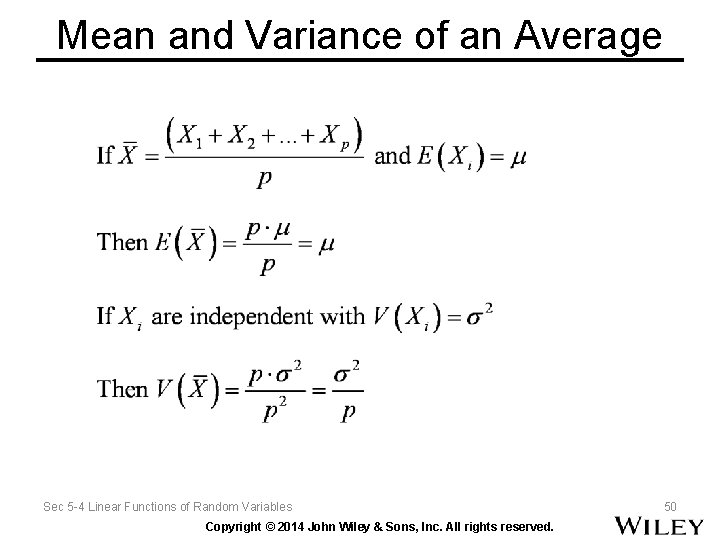
Mean and Variance of an Average Sec 5 -4 Linear Functions of Random Variables Copyright © 2014 John Wiley & Sons, Inc. All rights reserved. 50
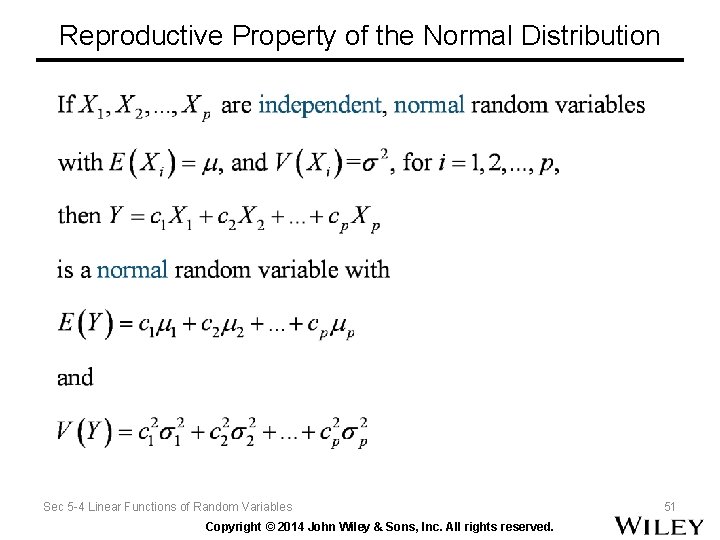
Reproductive Property of the Normal Distribution Sec 5 -4 Linear Functions of Random Variables Copyright © 2014 John Wiley & Sons, Inc. All rights reserved. 51
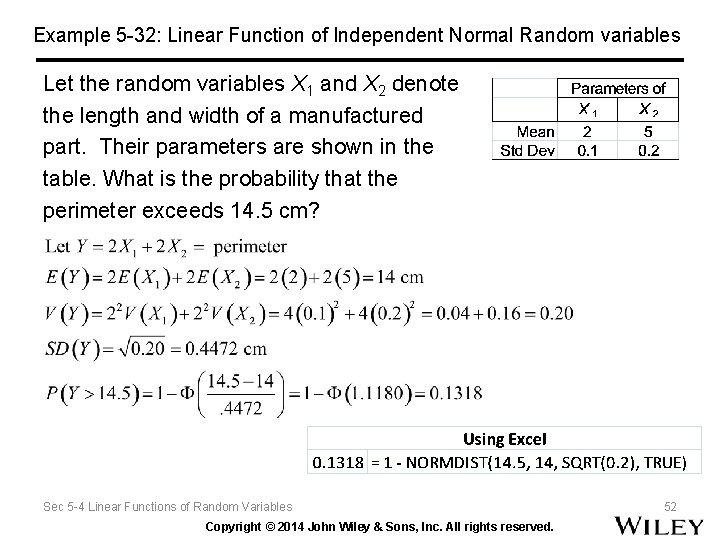
Example 5 -32: Linear Function of Independent Normal Random variables Let the random variables X 1 and X 2 denote the length and width of a manufactured part. Their parameters are shown in the table. What is the probability that the perimeter exceeds 14. 5 cm? Sec 5 -4 Linear Functions of Random Variables Copyright © 2014 John Wiley & Sons, Inc. All rights reserved. 52
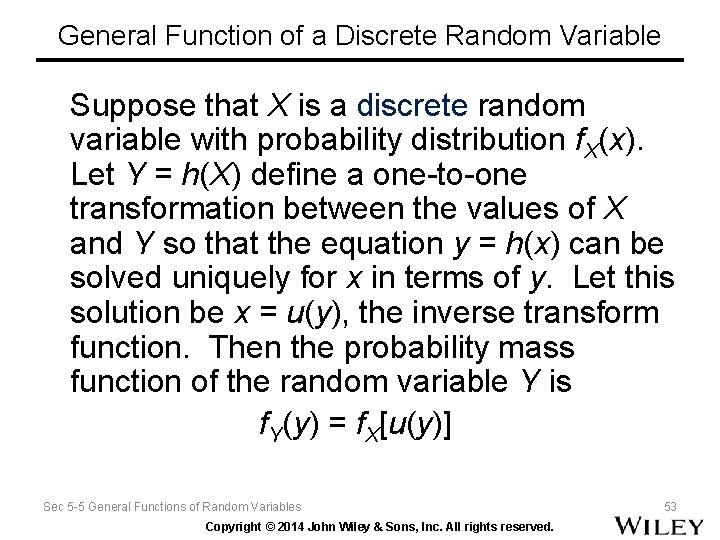
General Function of a Discrete Random Variable Suppose that X is a discrete random variable with probability distribution f. X(x). Let Y = h(X) define a one-to-one transformation between the values of X and Y so that the equation y = h(x) can be solved uniquely for x in terms of y. Let this solution be x = u(y), the inverse transform function. Then the probability mass function of the random variable Y is f. Y(y) = f. X[u(y)] Sec 5 -5 General Functions of Random Variables Copyright © 2014 John Wiley & Sons, Inc. All rights reserved. 53
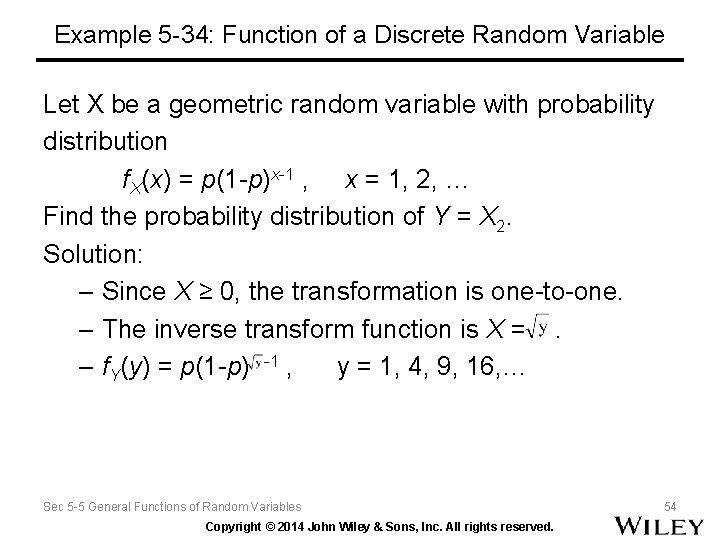
Example 5 -34: Function of a Discrete Random Variable Let X be a geometric random variable with probability distribution f. X(x) = p(1 -p)x-1 , x = 1, 2, … Find the probability distribution of Y = X 2. Solution: – Since X ≥ 0, the transformation is one-to-one. – The inverse transform function is X =. – f. Y(y) = p(1 -p) -1 , y = 1, 4, 9, 16, … Sec 5 -5 General Functions of Random Variables Copyright © 2014 John Wiley & Sons, Inc. All rights reserved. 54
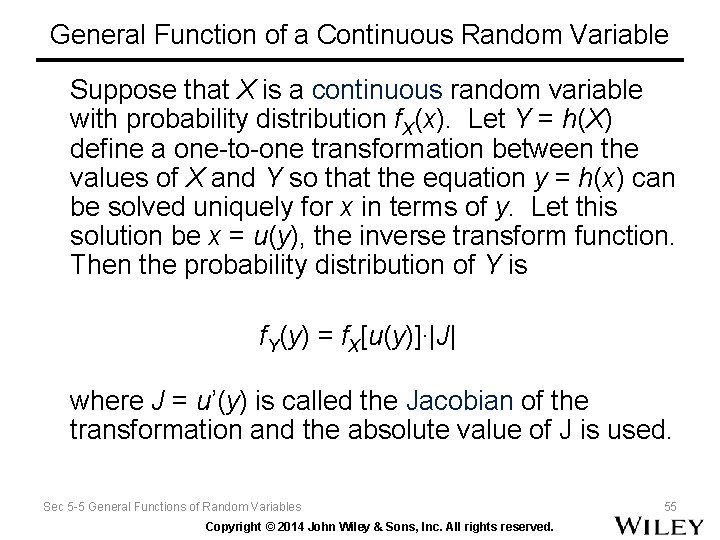
General Function of a Continuous Random Variable Suppose that X is a continuous random variable with probability distribution f. X(x). Let Y = h(X) define a one-to-one transformation between the values of X and Y so that the equation y = h(x) can be solved uniquely for x in terms of y. Let this solution be x = u(y), the inverse transform function. Then the probability distribution of Y is f. Y(y) = f. X[u(y)]∙|J| where J = u’(y) is called the Jacobian of the transformation and the absolute value of J is used. Sec 5 -5 General Functions of Random Variables Copyright © 2014 John Wiley & Sons, Inc. All rights reserved. 55
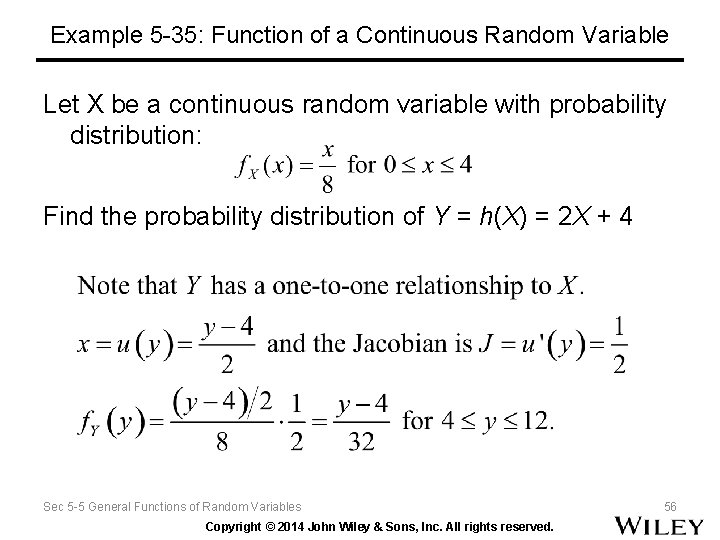
Example 5 -35: Function of a Continuous Random Variable Let X be a continuous random variable with probability distribution: Find the probability distribution of Y = h(X) = 2 X + 4 Sec 5 -5 General Functions of Random Variables Copyright © 2014 John Wiley & Sons, Inc. All rights reserved. 56
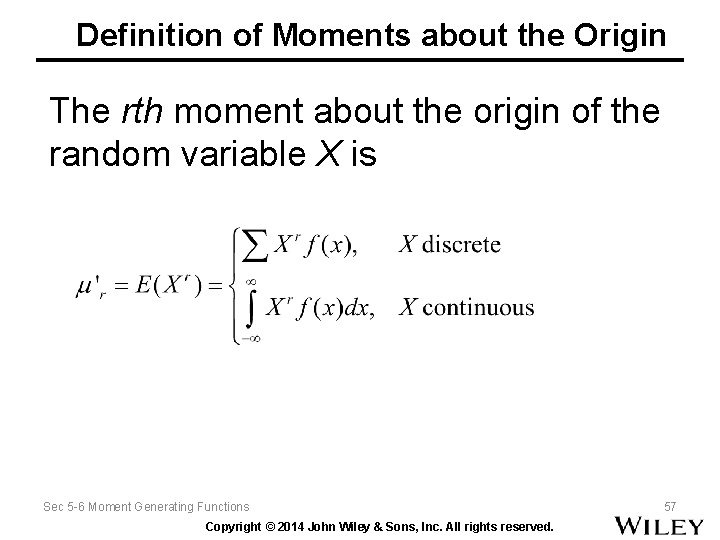
Definition of Moments about the Origin The rth moment about the origin of the random variable X is Sec 5 -6 Moment Generating Functions Copyright © 2014 John Wiley & Sons, Inc. All rights reserved. 57
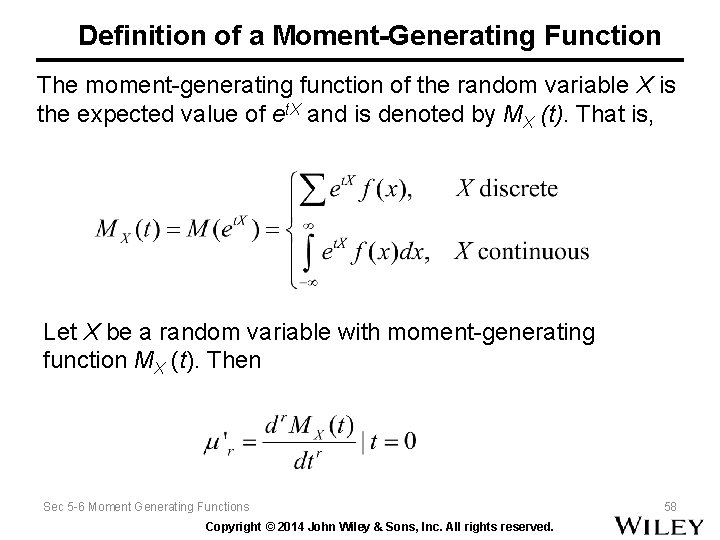
Definition of a Moment-Generating Function The moment-generating function of the random variable X is the expected value of et. X and is denoted by MX (t). That is, Let X be a random variable with moment-generating function MX (t). Then Sec 5 -6 Moment Generating Functions Copyright © 2014 John Wiley & Sons, Inc. All rights reserved. 58

Example 5 -36 Moment-Generating Function for a Binomial Random Variable-1 Let X follows a binomial distribution, that is Determine the moment generating function and use it to verify that the mean and variance of the binomial random variable are μ=np and σ2=np(1 -p). The moment-generating function is which is the binomial expansion of Now the first and second order derivatives will be Sec 5 -6 Moment Generating Functions Copyright © 2014 John Wiley & Sons, Inc. All rights reserved. 59
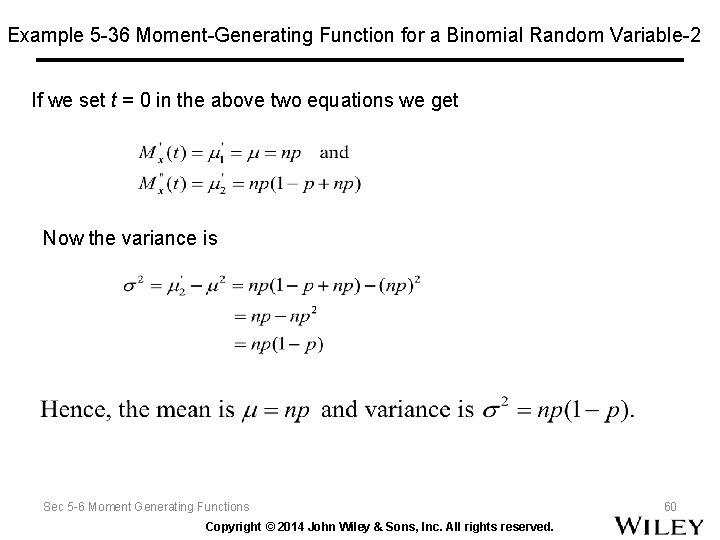
Example 5 -36 Moment-Generating Function for a Binomial Random Variable-2 If we set t = 0 in the above two equations we get Now the variance is Sec 5 -6 Moment Generating Functions Copyright © 2014 John Wiley & Sons, Inc. All rights reserved. 60

Properties of Moment-Generating Function Sec 5 -6 Moment Generating Functions Copyright © 2014 John Wiley & Sons, Inc. All rights reserved. 61
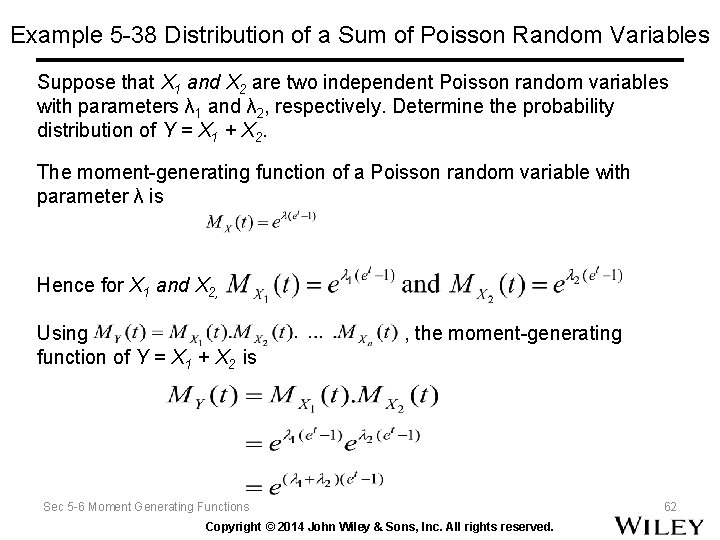
Example 5 -38 Distribution of a Sum of Poisson Random Variables Suppose that X 1 and X 2 are two independent Poisson random variables with parameters λ 1 and λ 2, respectively. Determine the probability distribution of Y = X 1 + X 2. The moment-generating function of a Poisson random variable with parameter λ is Hence for X 1 and X 2, Using function of Y = X 1 + X 2 is , the moment-generating Sec 5 -6 Moment Generating Functions Copyright © 2014 John Wiley & Sons, Inc. All rights reserved. 62
Important Terms & Concepts for Chapter 5 Bivariate distribution Bivariate normal distribution Conditional mean Conditional probability density function Conditional probability mass function Conditional variance Contour plots Correlation Covariance Error propagation General functions of random variables Independence Joint probability density function Joint probability mass function Linear functions of random variables Marginal probability distribution Multinomial distribution Reproductive property of the normal distribution Chapter 5 Summary 63 Copyright © 2014 John Wiley & Sons, Inc. All rights reserved.
- Slides: 63