
Applied Quantitative Methods Lecture 11 Instrumental Variables December
Applied Quantitative Methods Lecture 11. Instrumental Variables December 8 th , 2010

Organizational Issues § Term paper project discussion Monday (Dec. 13 th, 5: 45 pm) - Check the web page for the room number § Intermediate deadline December 16 th-17 th - Sign up list on the door of the office NB 339 from till Dec 9 th, 9 am - Put only your group number!!! - All consultation will be in CERGE-EI (Politickych veznu 7, office 446) § Final exam - January 14 th, 2011, 9: 30 am Lectures review, January 11 th , 2011
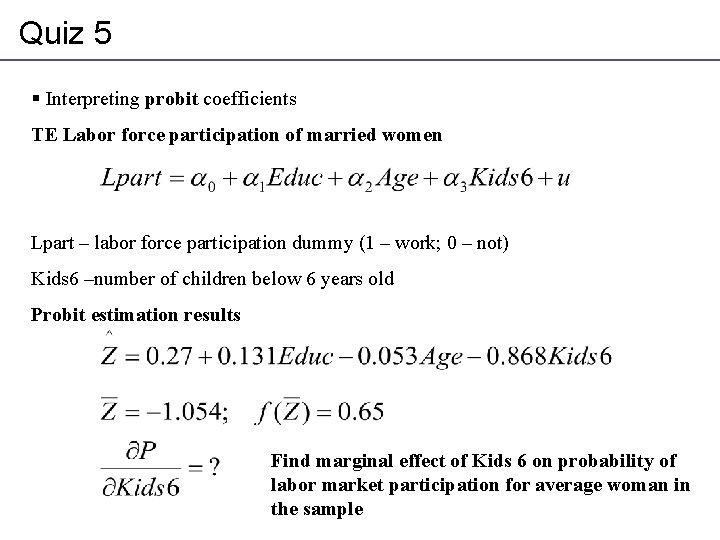
Quiz 5 § Interpreting probit coefficients TE Labor force participation of married women Lpart – labor force participation dummy (1 – work; 0 – not) Kids 6 –number of children below 6 years old Probit estimation results Find marginal effect of Kids 6 on probability of labor market participation for average woman in the sample
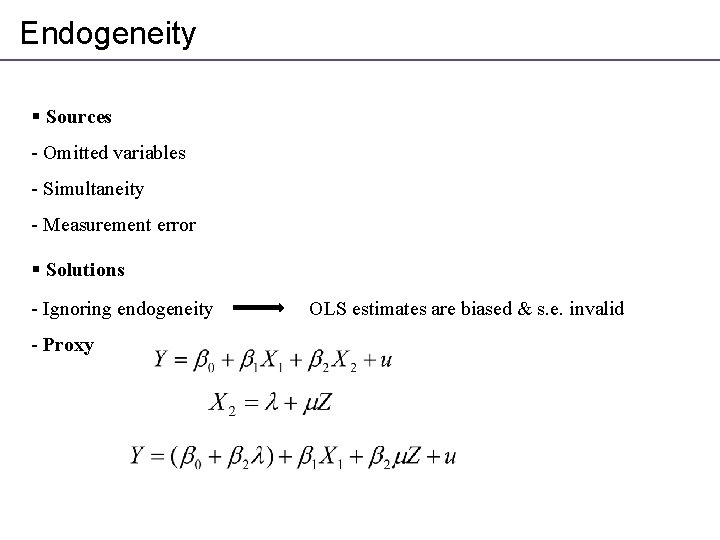
Endogeneity § Sources - Omitted variables - Simultaneity - Measurement error § Solutions - Ignoring endogeneity - Proxy OLS estimates are biased & s. e. invalid
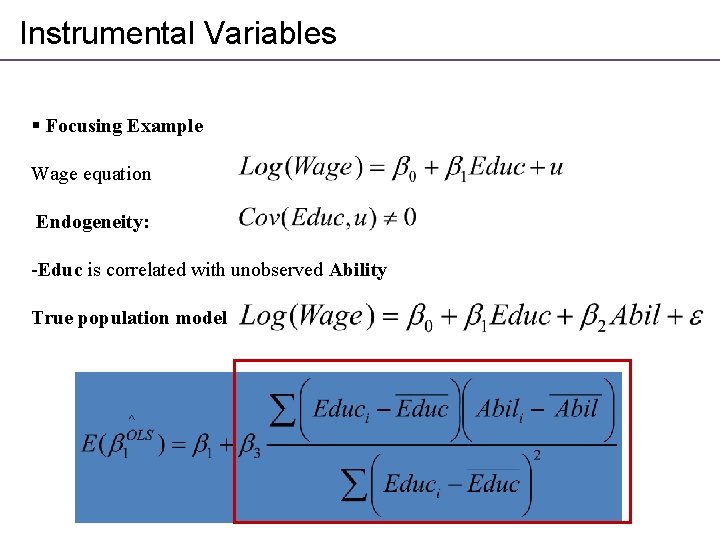
Instrumental Variables § Focusing Example Wage equation Endogeneity: -Educ is correlated with unobserved Ability True population model
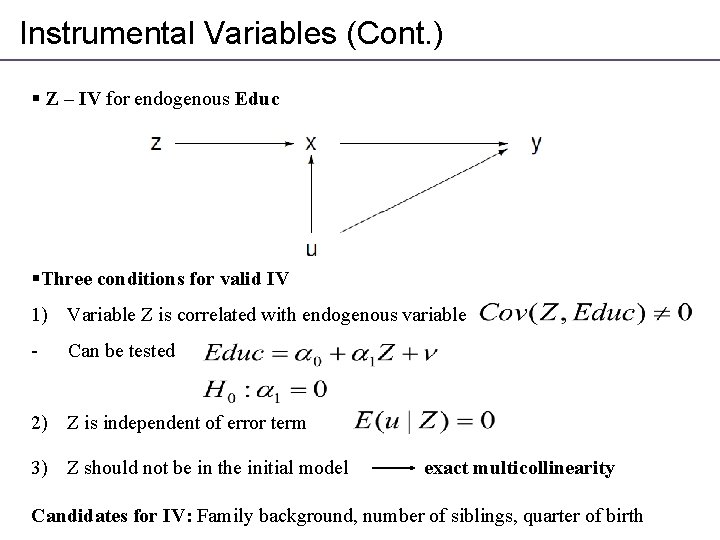
Instrumental Variables (Cont. ) § Z – IV for endogenous Educ §Three conditions for valid IV 1) Variable Z is correlated with endogenous variable - Can be tested 2) Z is independent of error term 3) Z should not be in the initial model exact multicollinearity Candidates for IV: Family background, number of siblings, quarter of birth
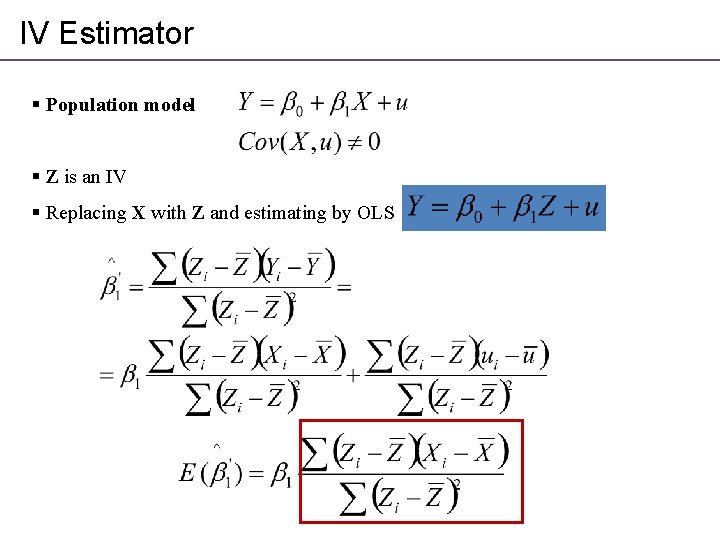
IV Estimator § Population model § Z is an IV § Replacing X with Z and estimating by OLS
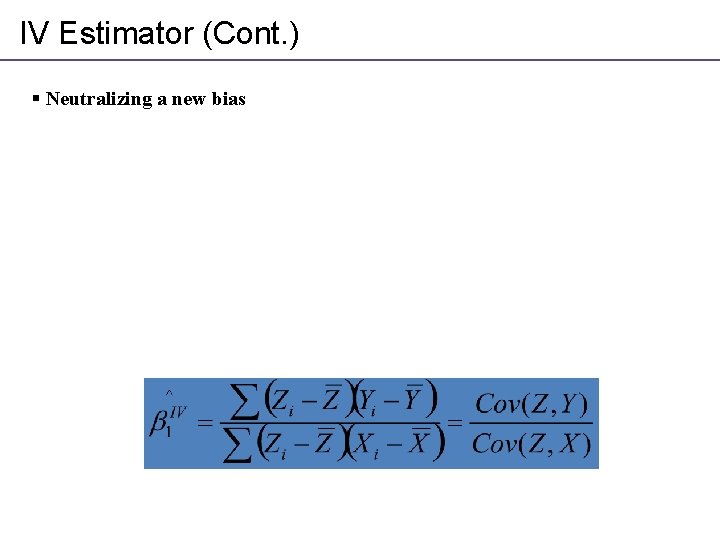
IV Estimator (Cont. ) § Neutralizing a new bias
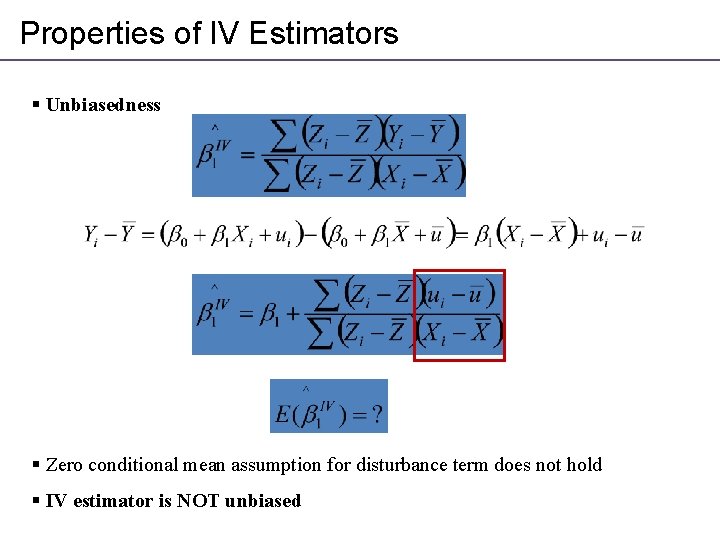
Properties of IV Estimators § Unbiasedness § Zero conditional mean assumption for disturbance term does not hold § IV estimator is NOT unbiased
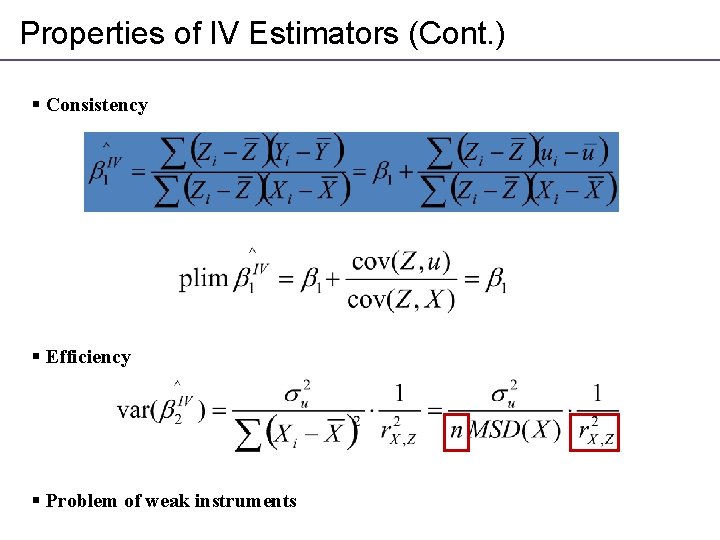
Properties of IV Estimators (Cont. ) § Consistency § Efficiency § Problem of weak instruments
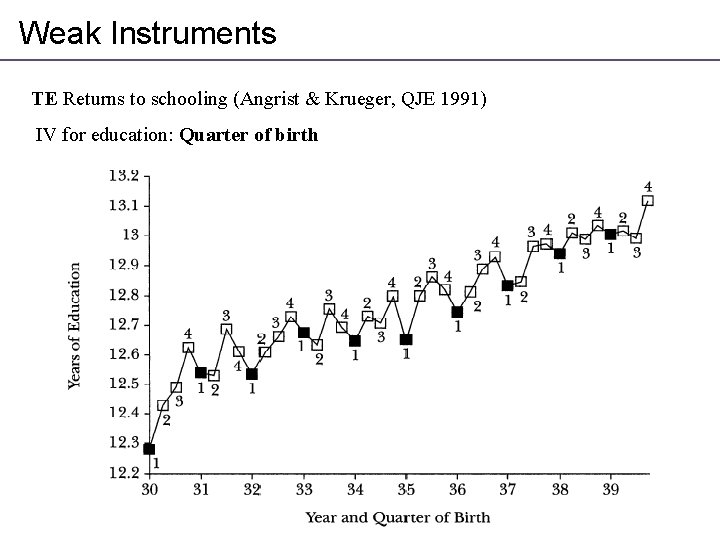
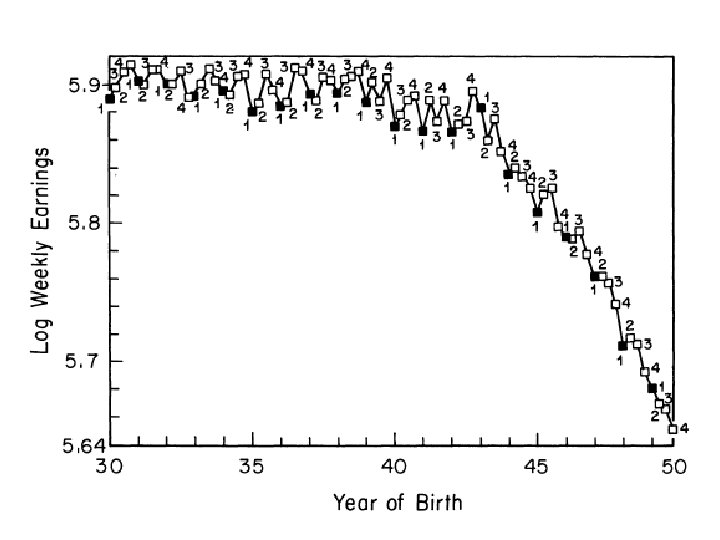
Weak Instruments TE Returns to schooling (Angrist & Krueger, QJE 1991) IV for education: Quarter of birth
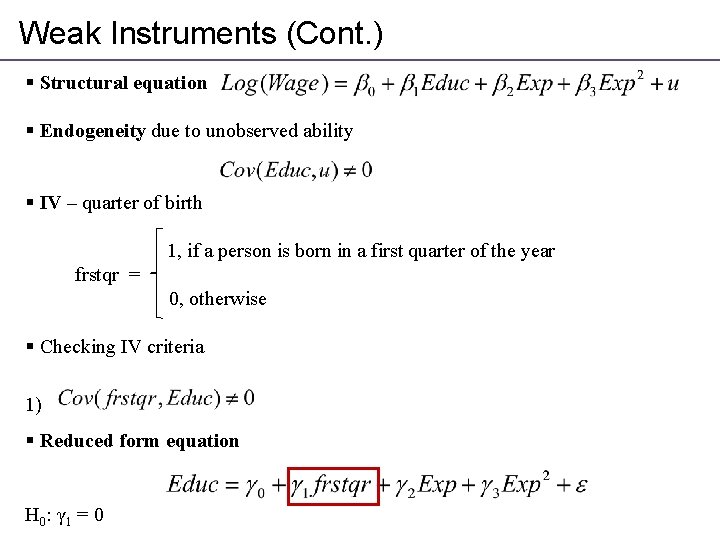
Weak Instruments (Cont. ) § Structural equation § Endogeneity due to unobserved ability § IV – quarter of birth 1, if a person is born in a first quarter of the year frstqr = 0, otherwise § Checking IV criteria 1) § Reduced form equation H 0 : γ 1 = 0
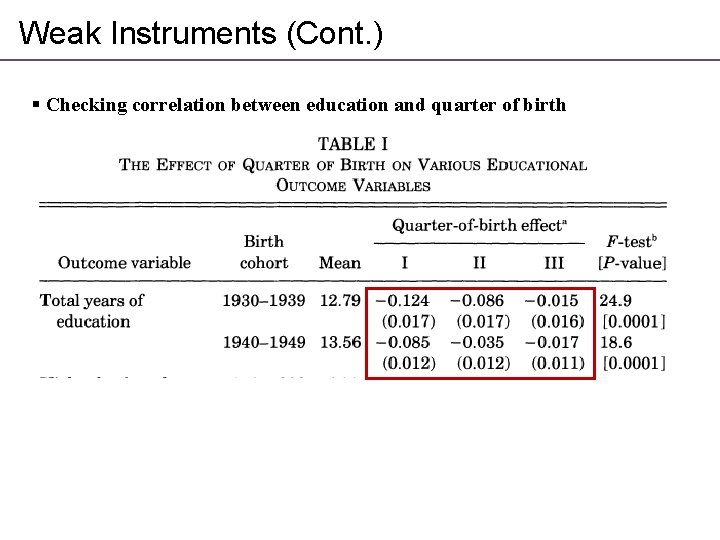
Weak Instruments (Cont. ) § Checking correlation between education and quarter of birth
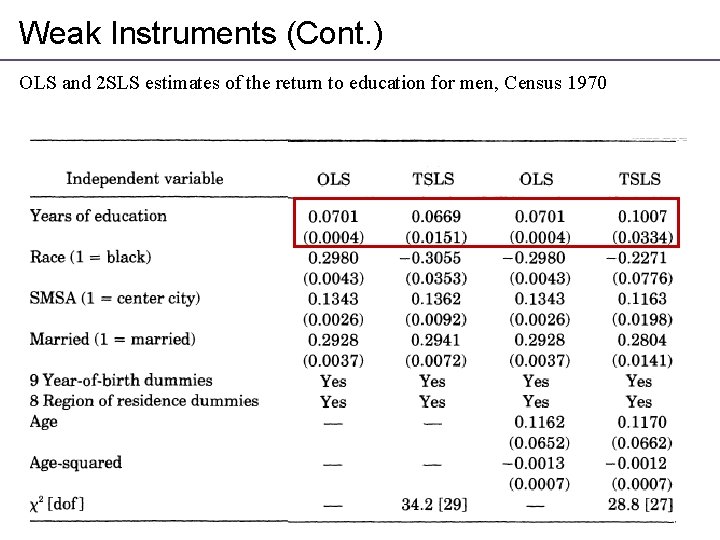
Weak Instruments (Cont. ) OLS and 2 SLS estimates of the return to education for men, Census 1970
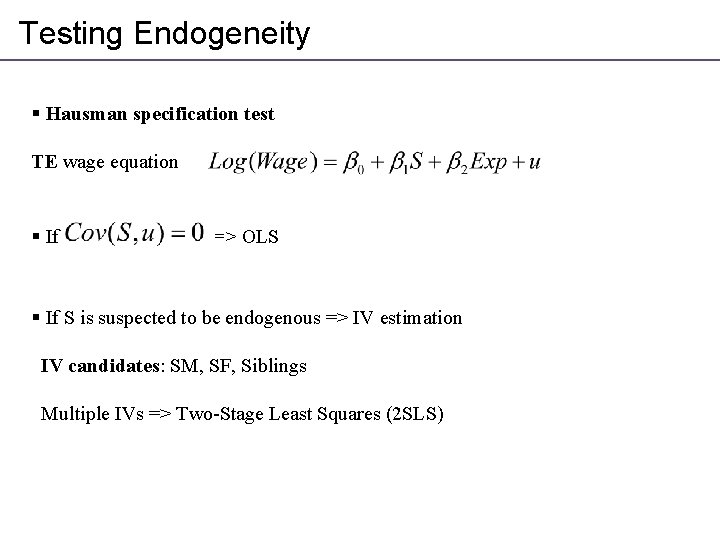
Testing Endogeneity § Hausman specification test TE wage equation § If => OLS § If S is suspected to be endogenous => IV estimation IV candidates: SM, SF, Siblings Multiple IVs => Two-Stage Least Squares (2 SLS)
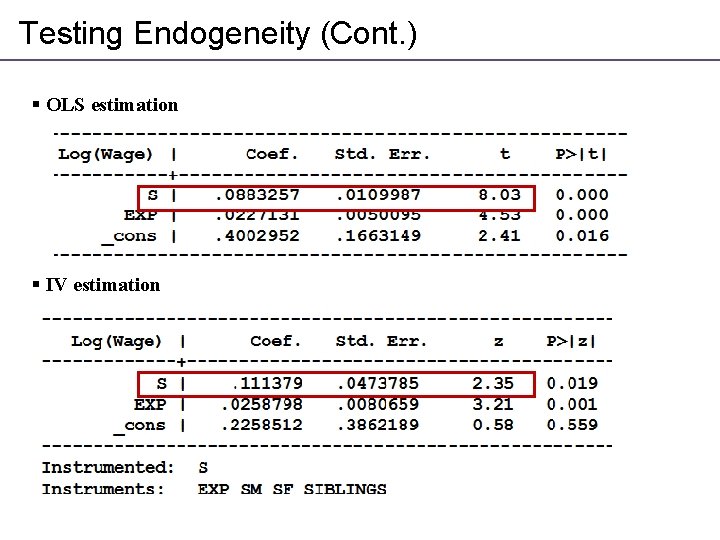
Testing Endogeneity (Cont. ) § OLS estimation § IV estimation
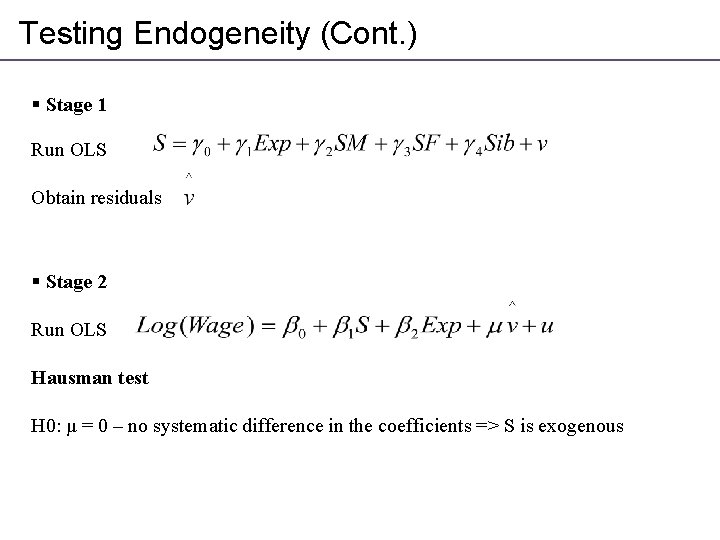
Testing Endogeneity (Cont. ) § Stage 1 Run OLS Obtain residuals § Stage 2 Run OLS Hausman test H 0: μ = 0 – no systematic difference in the coefficients => S is exogenous
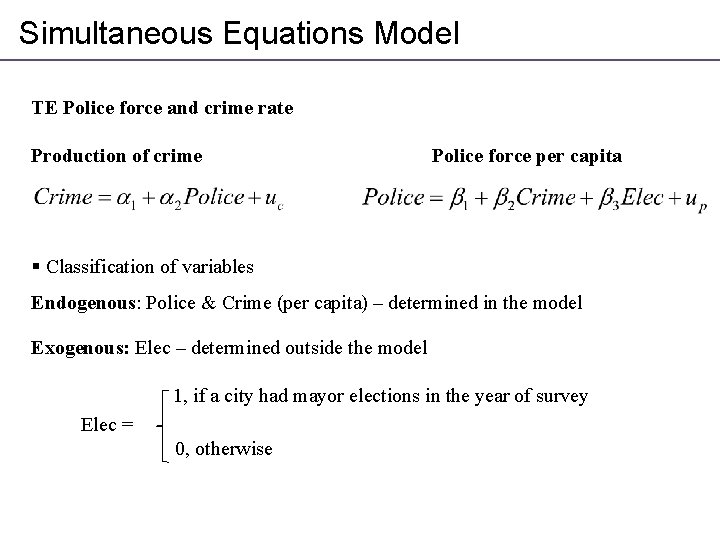
Simultaneous Equations Model TE Police force and crime rate Production of crime Police force per capita § Classification of variables Endogenous: Police & Crime (per capita) – determined in the model Exogenous: Elec – determined outside the model 1, if a city had mayor elections in the year of survey Elec = 0, otherwise
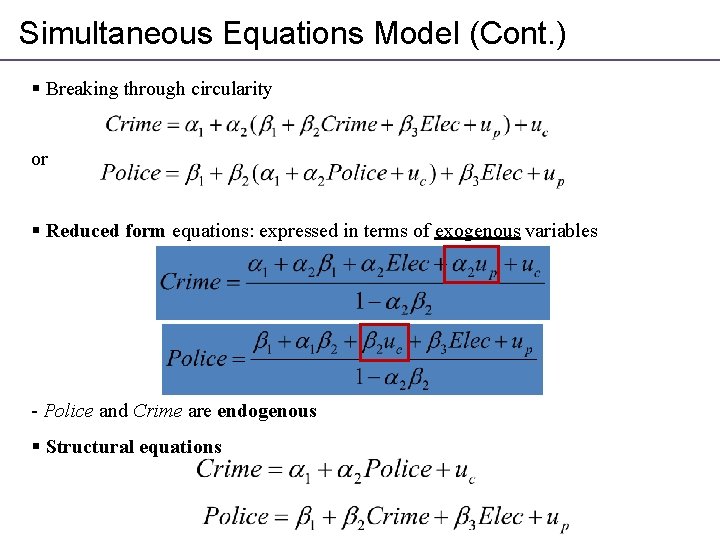
Simultaneous Equations Model (Cont. ) § Breaking through circularity or § Reduced form equations: expressed in terms of exogenous variables - Police and Crime are endogenous § Structural equations
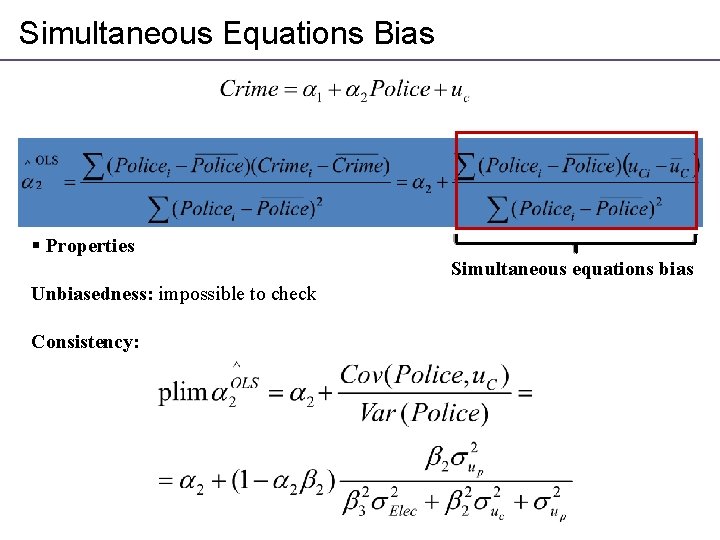
Simultaneous Equations Bias § Properties Simultaneous equations bias Unbiasedness: impossible to check Consistency:
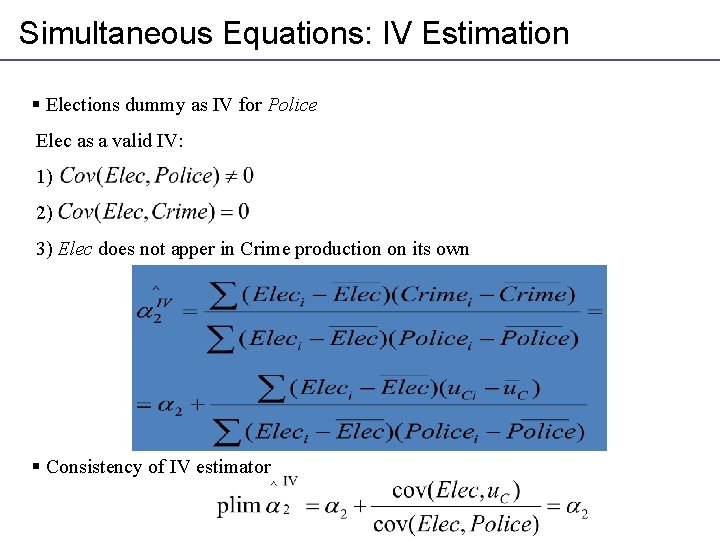
Simultaneous Equations: IV Estimation § Elections dummy as IV for Police Elec as a valid IV: 1) 2) 3) Elec does not apper in Crime production on its own § Consistency of IV estimator
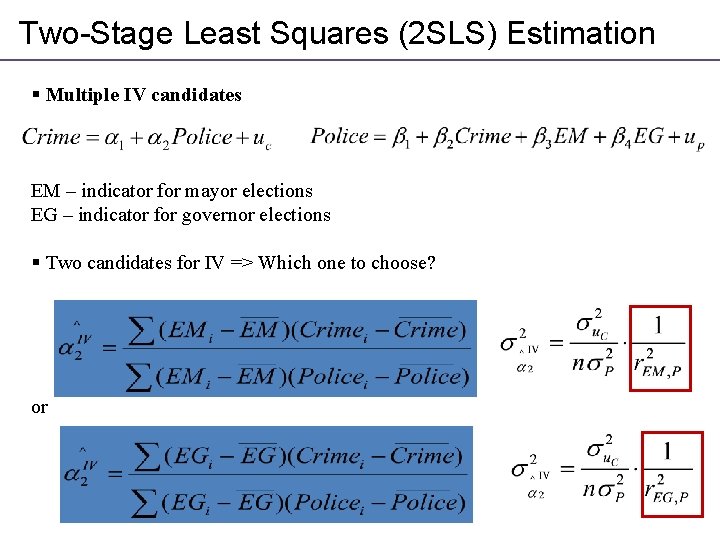
Two-Stage Least Squares (2 SLS) Estimation § Multiple IV candidates EM – indicator for mayor elections EG – indicator for governor elections § Two candidates for IV => Which one to choose? or
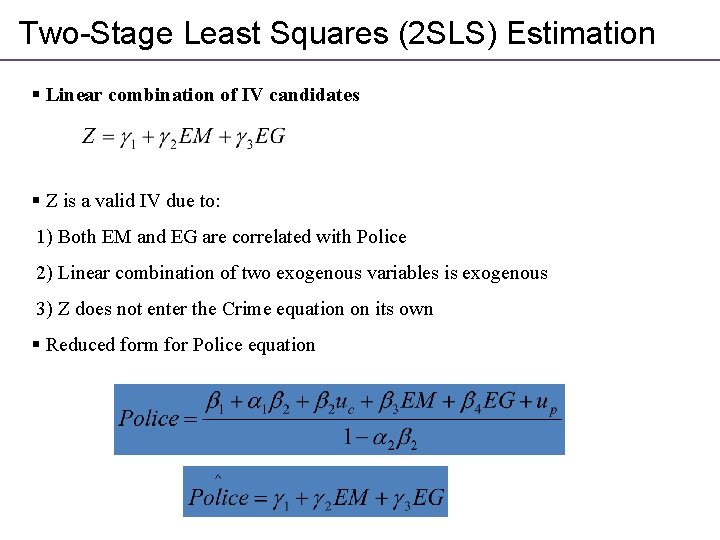
Two-Stage Least Squares (2 SLS) Estimation § Linear combination of IV candidates § Z is a valid IV due to: 1) Both EM and EG are correlated with Police 2) Linear combination of two exogenous variables is exogenous 3) Z does not enter the Crime equation on its own § Reduced form for Police equation
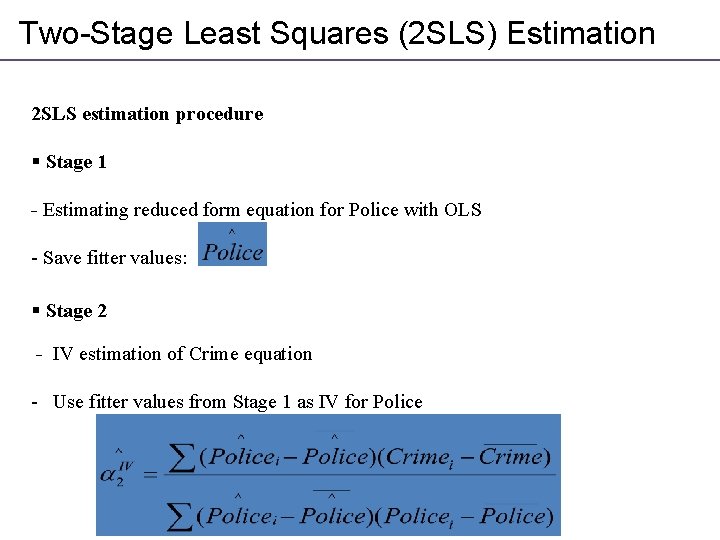
Two-Stage Least Squares (2 SLS) Estimation 2 SLS estimation procedure § Stage 1 - Estimating reduced form equation for Police with OLS - Save fitter values: § Stage 2 - IV estimation of Crime equation - Use fitter values from Stage 1 as IV for Police
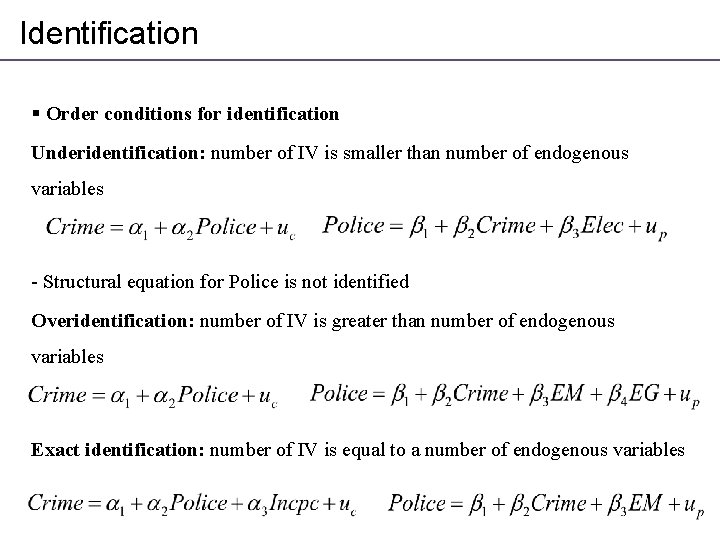
Identification § Order conditions for identification Underidentification: number of IV is smaller than number of endogenous variables - Structural equation for Police is not identified Overidentification: number of IV is greater than number of endogenous variables Exact identification: number of IV is equal to a number of endogenous variables
Next Lecture Topic: Difference-in- Differences ! Wooldridge, Chapter 13
- Slides: 27