
Applied Physics and Chemistry Limiting Reagents and Percent
- Slides: 8
Applied Physics and Chemistry Limiting Reagents and Percent Yield Lecture 1
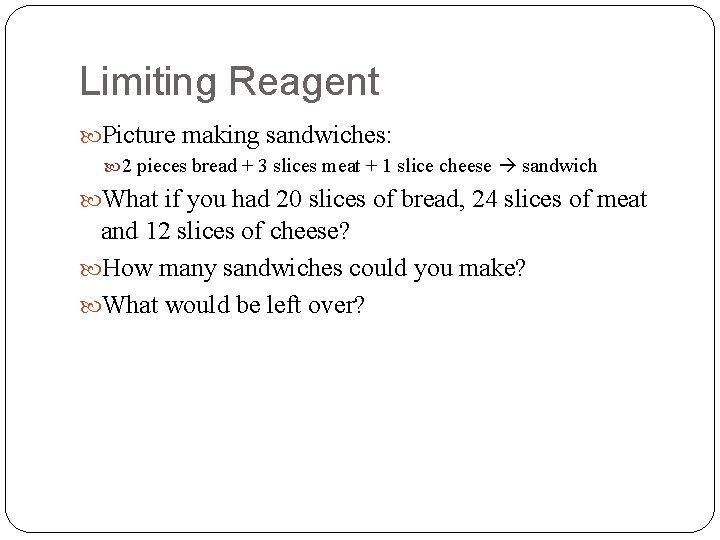
Limiting Reagent Picture making sandwiches: 2 pieces bread + 3 slices meat + 1 slice cheese sandwich What if you had 20 slices of bread, 24 slices of meat and 12 slices of cheese? How many sandwiches could you make? What would be left over?
Limiting reagent Definition: The reactant that runs out first and limits the amount of products that can be formed How do we know what’s limiting? Stoichiometry!
Calculations Requires ability to determine moles from mass and mass from moles! Requires balanced equation!
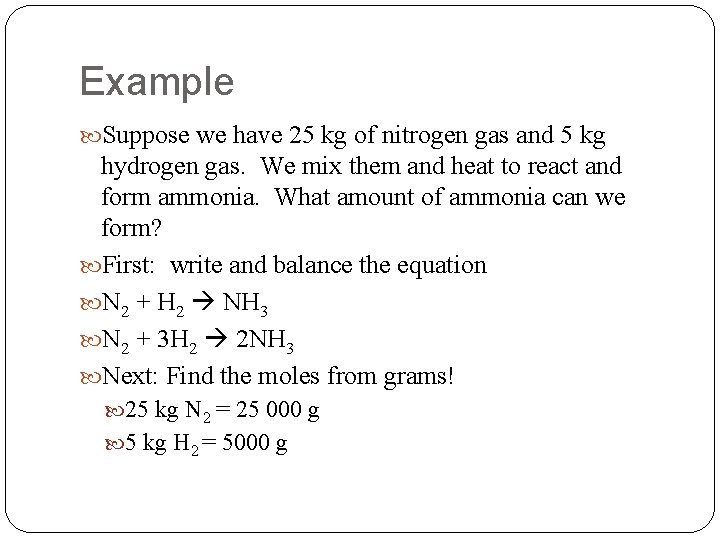
Example Suppose we have 25 kg of nitrogen gas and 5 kg hydrogen gas. We mix them and heat to react and form ammonia. What amount of ammonia can we form? First: write and balance the equation N 2 + H 2 NH 3 N 2 + 3 H 2 2 NH 3 Next: Find the moles from grams! 25 kg N 2 = 25 000 g 5 kg H 2 = 5000 g
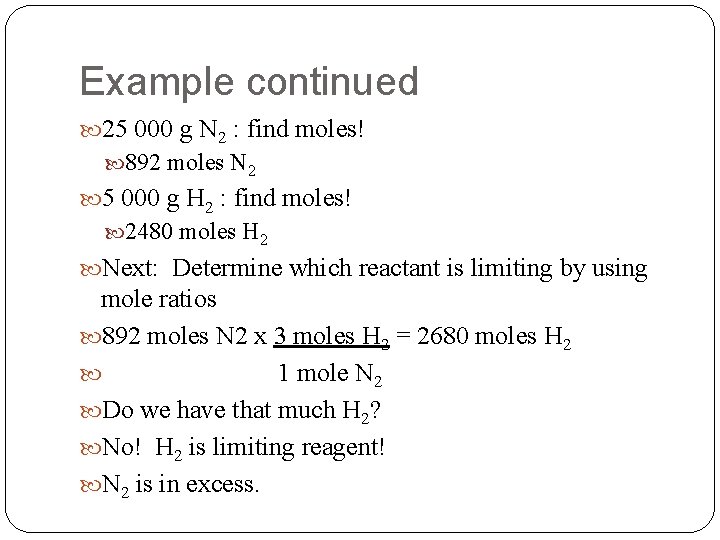
Example continued 25 000 g N 2 : find moles! 892 moles N 2 5 000 g H 2 : find moles! 2480 moles H 2 Next: Determine which reactant is limiting by using mole ratios 892 moles N 2 x 3 moles H 2 = 2680 moles H 2 1 mole N 2 Do we have that much H 2? No! H 2 is limiting reagent! N 2 is in excess.
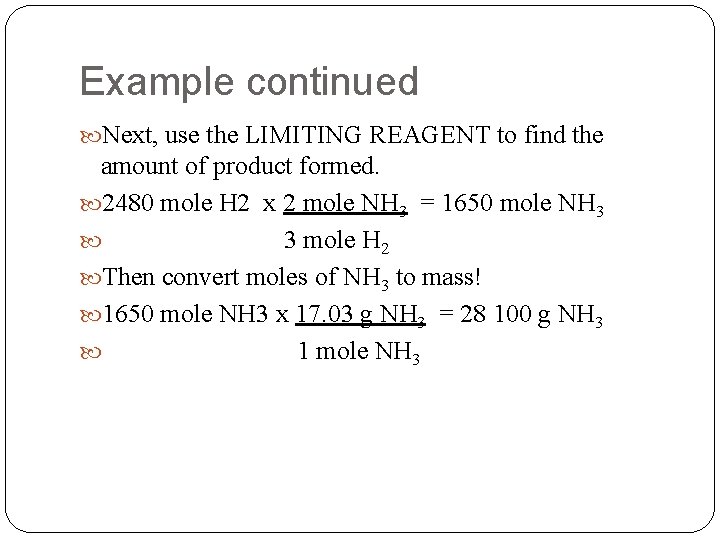
Example continued Next, use the LIMITING REAGENT to find the amount of product formed. 2480 mole H 2 x 2 mole NH 3 = 1650 mole NH 3 3 mole H 2 Then convert moles of NH 3 to mass! 1650 mole NH 3 x 17. 03 g NH 3 = 28 100 g NH 3 1 mole NH 3
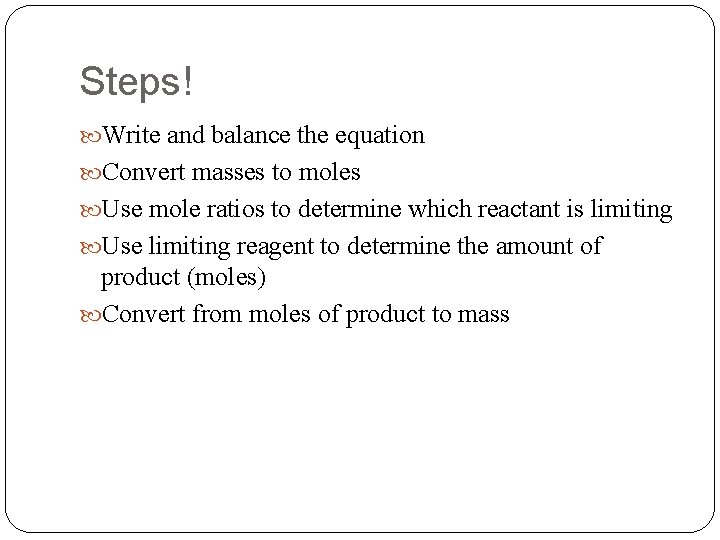
Steps! Write and balance the equation Convert masses to moles Use mole ratios to determine which reactant is limiting Use limiting reagent to determine the amount of product (moles) Convert from moles of product to mass