
Applied Physical Pharmacy Interfacial Phenomena 1 Surface Tension
- Slides: 46
Applied Physical Pharmacy Interfacial Phenomena
1. Surface Tension 2. Electric Double Layer 3. Adsorption
Surface Tension Interface & Surface Tension Surface Free Energy Measurement of Surface Tension Spreading Coefficient Contact Angle
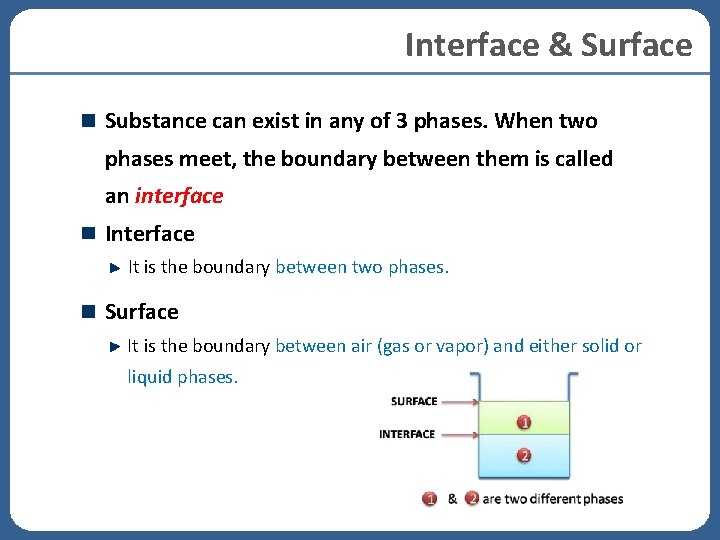
Interface & Surface Substance can exist in any of 3 phases. When two phases meet, the boundary between them is called an interface It is the boundary between two phases. Surface It is the boundary between air (gas or vapor) and either solid or liquid phases.
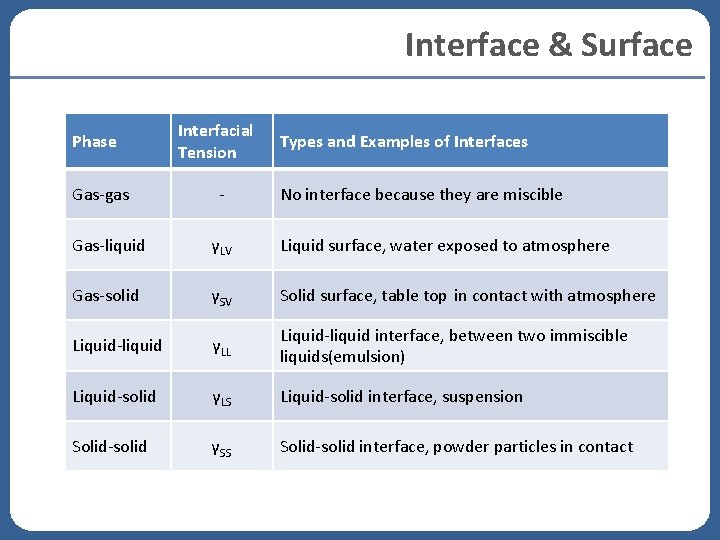
Interface & Surface Phase Gas-gas Interfacial Tension - Types and Examples of Interfaces No interface because they are miscible Gas-liquid γLV Liquid surface, water exposed to atmosphere Gas-solid γSV Solid surface, table top in contact with atmosphere Liquid-liquid γLL Liquid-liquid interface, between two immiscible liquids(emulsion) Liquid-solid γLS Liquid-solid interface, suspension Solid-solid γSS Solid-solid interface, powder particles in contact
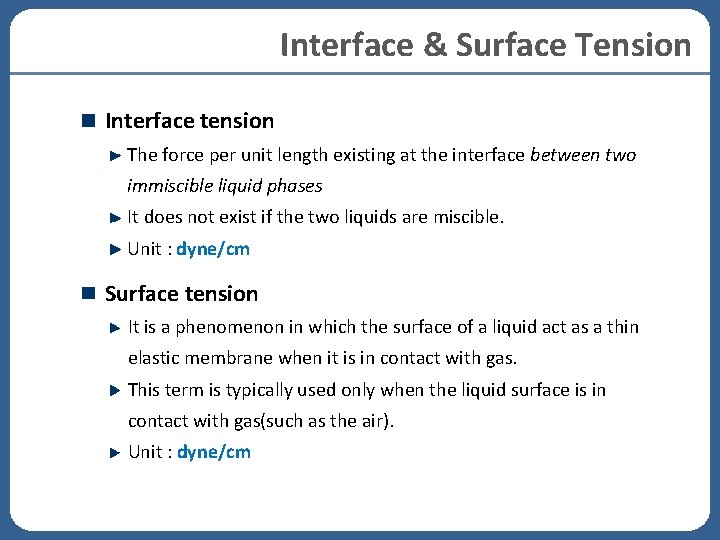
Interface & Surface Tension Interface tension The force per unit length existing at the interface between two immiscible liquid phases It does not exist if the two liquids are miscible. Unit : dyne/cm Surface tension It is a phenomenon in which the surface of a liquid act as a thin elastic membrane when it is in contact with gas. This term is typically used only when the liquid surface is in contact with gas(such as the air). Unit : dyne/cm
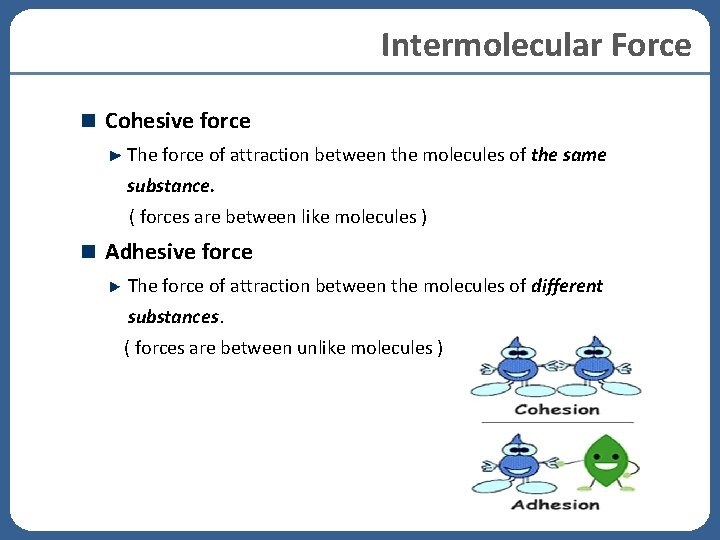
Intermolecular Force Cohesive force The force of attraction between the molecules of the same substance. ( forces are between like molecules ) Adhesive force The force of attraction between the molecules of different substances. ( forces are between unlike molecules )
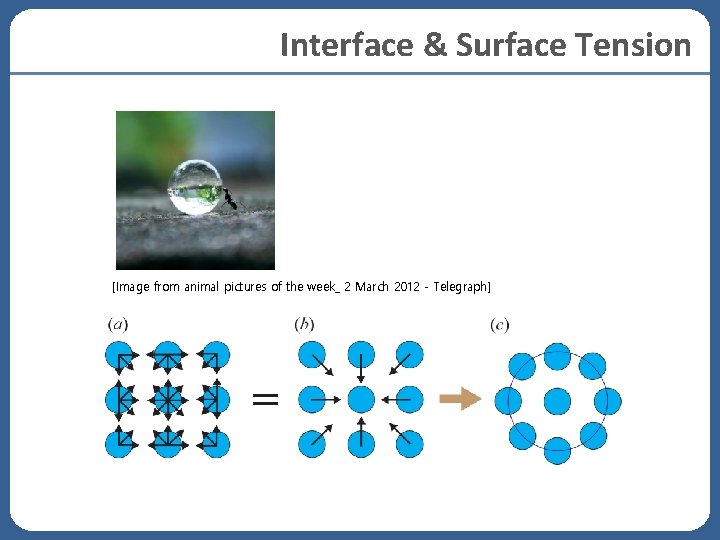
Interface & Surface Tension [Image from animal pictures of the week_ 2 March 2012 - Telegraph]
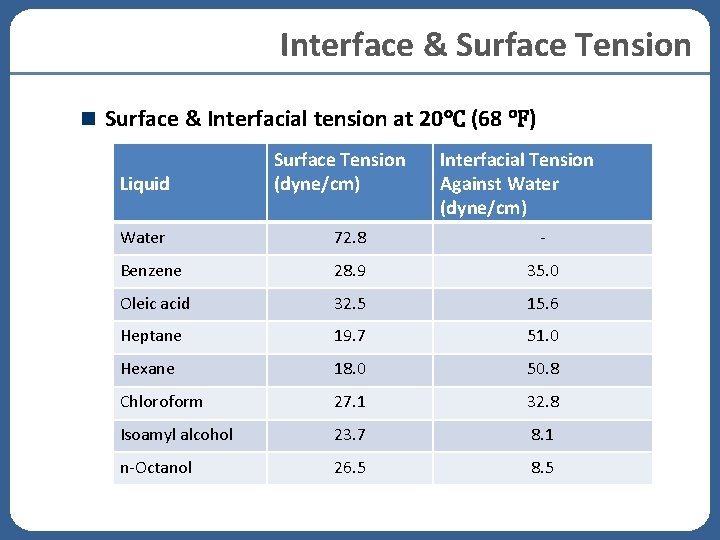
Interface & Surface Tension Surface & Interfacial tension at 20℃ (68 ℉) Liquid Surface Tension (dyne/cm) Interfacial Tension Against Water (dyne/cm) Water 72. 8 - Benzene 28. 9 35. 0 Oleic acid 32. 5 15. 6 Heptane 19. 7 51. 0 Hexane 18. 0 50. 8 Chloroform 27. 1 32. 8 Isoamyl alcohol 23. 7 8. 1 n-Octanol 26. 5 8. 5
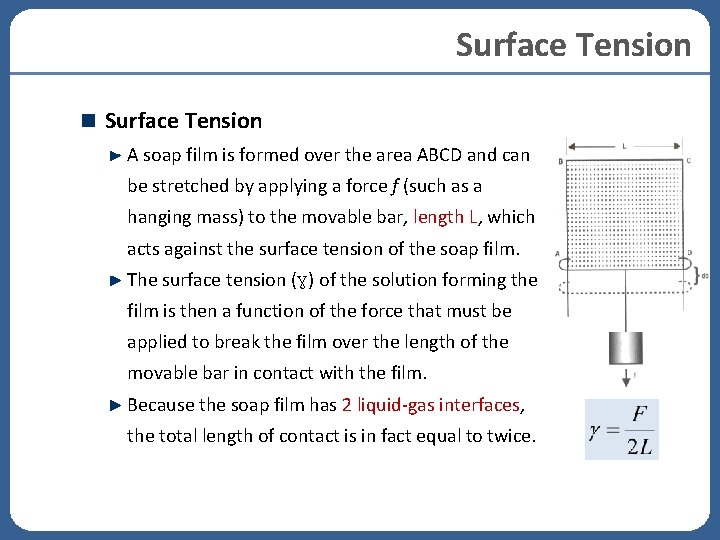
Surface Tension A soap film is formed over the area ABCD and can be stretched by applying a force f (such as a hanging mass) to the movable bar, length L, which acts against the surface tension of the soap film. The surface tension (γ) of the solution forming the film is then a function of the force that must be applied to break the film over the length of the movable bar in contact with the film. Because the soap film has 2 liquid-gas interfaces, the total length of contact is in fact equal to twice.
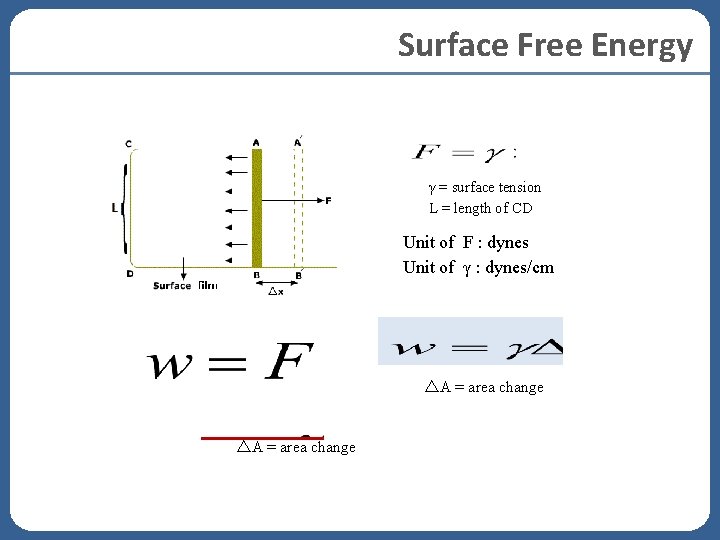
Surface Free Energy γ = surface tension L = length of CD Unit of F : dynes Unit of γ : dynes/cm △A = area change
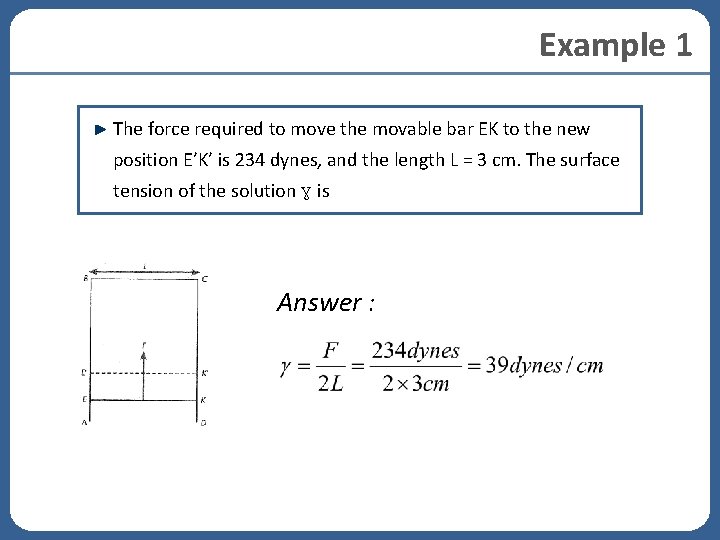
Example 1 The force required to move the movable bar EK to the new position E’K’ is 234 dynes, and the length L = 3 cm. The surface tension of the solution γ is Answer :
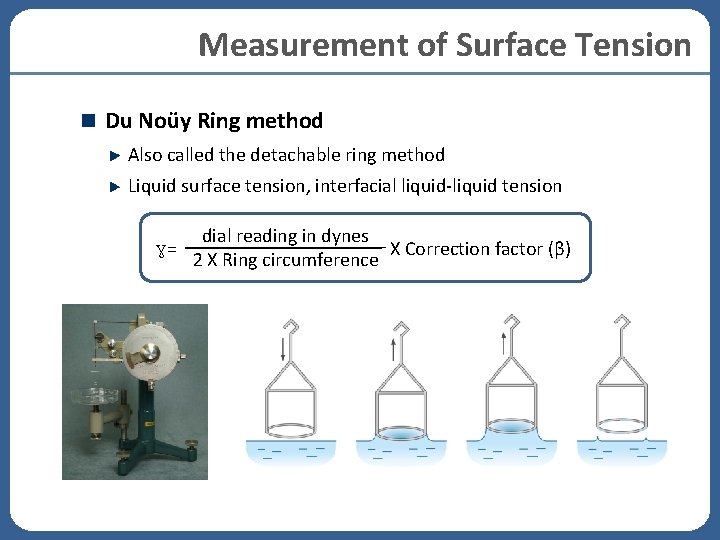
Measurement of Surface Tension Du Noüy Ring method Also called the detachable ring method Liquid surface tension, interfacial liquid-liquid tension γ= dial reading in dynes X Correction factor (β) 2 X Ring circumference
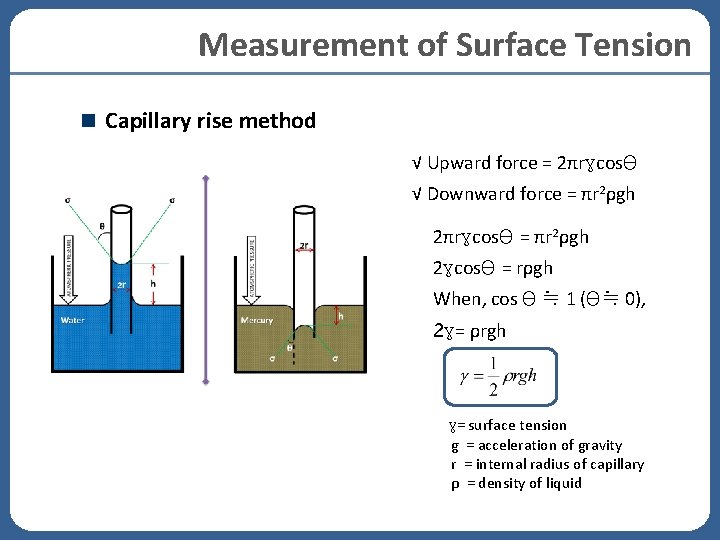
Measurement of Surface Tension Capillary rise method √ Upward force = 2πrγcosθ √ Downward force = πr 2ρgh 2πrγcosθ = πr 2ρgh 2γcosθ = rρgh When, cos θ ≒ 1 (θ≒ 0), 2γ= ρrgh γ= surface tension g = acceleration of gravity r = internal radius of capillary ρ = density of liquid
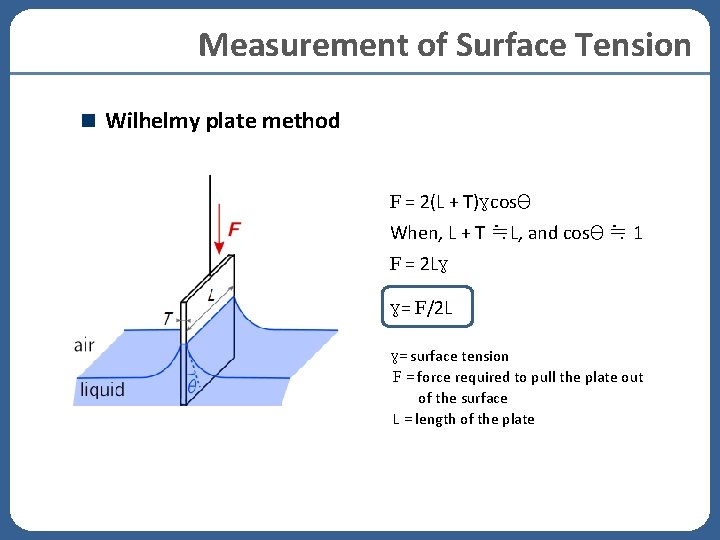
Measurement of Surface Tension Wilhelmy plate method F = 2(L + T)γcosθ When, L + T ≒L, and cosθ ≒ 1 F = 2 Lγ γ= F/2 L γ= surface tension F = force required to pull the plate out of the surface L = length of the plate
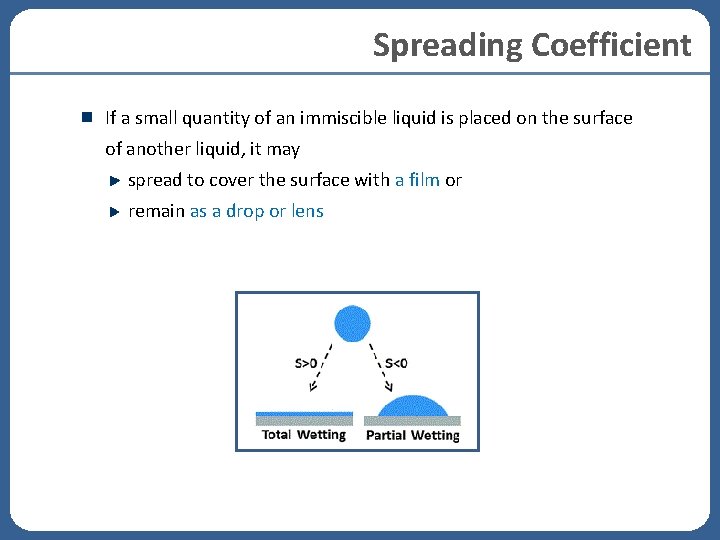
Spreading Coefficient If a small quantity of an immiscible liquid is placed on the surface of another liquid, it may spread to cover the surface with a film or remain as a drop or lens
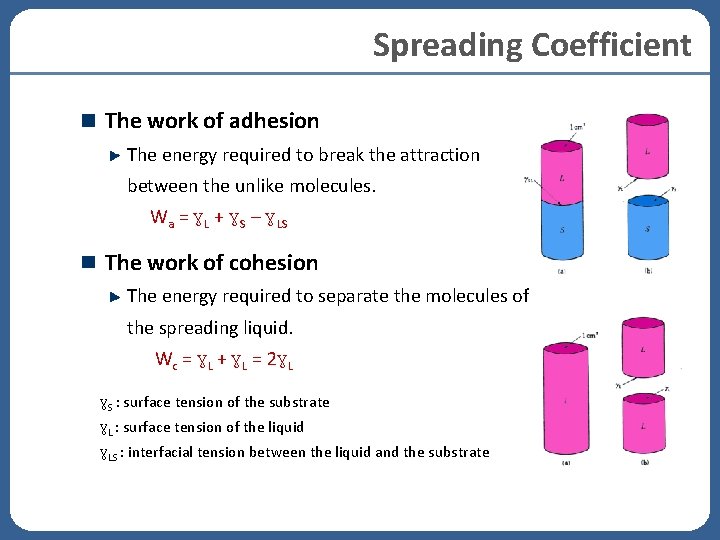
Spreading Coefficient The work of adhesion The energy required to break the attraction between the unlike molecules. Wa = γL + γS – γLS The work of cohesion The energy required to separate the molecules of the spreading liquid. Wc = γL + γL = 2γL γS : surface tension of the substrate γL : surface tension of the liquid γLS : interfacial tension between the liquid and the substrate
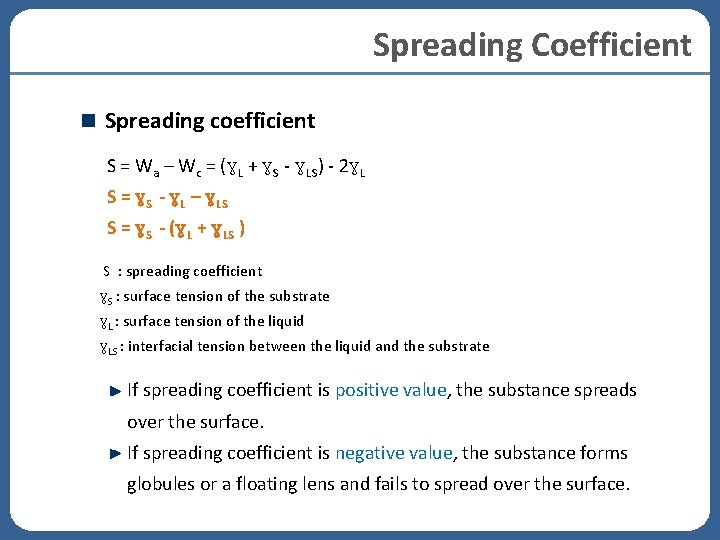
Spreading Coefficient Spreading coefficient S = Wa – Wc = (γL + γS - γLS) - 2γL S = γS - γL – γLS S = γS - (γL + γLS ) S : spreading coefficient γS : surface tension of the substrate γL : surface tension of the liquid γLS : interfacial tension between the liquid and the substrate If spreading coefficient is positive value, the substance spreads over the surface. If spreading coefficient is negative value, the substance forms globules or a floating lens and fails to spread over the surface.
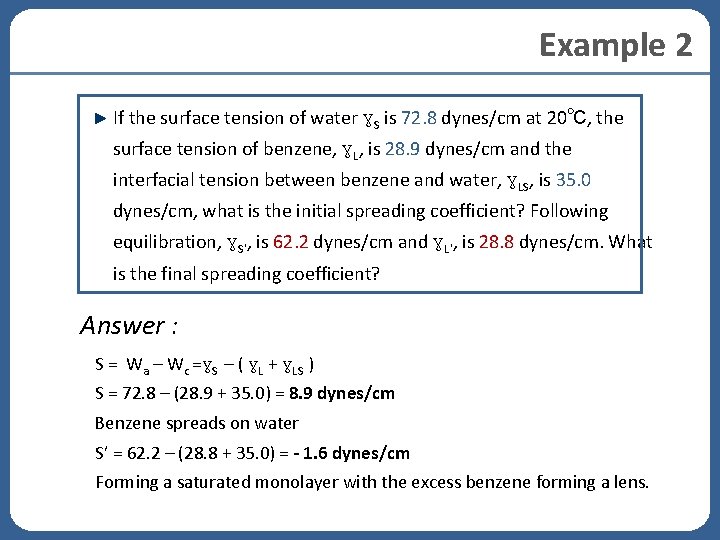
Example 2 If the surface tension of water γS is 72. 8 dynes/cm at 20℃, the surface tension of benzene, γL, is 28. 9 dynes/cm and the interfacial tension between benzene and water, γLS, is 35. 0 dynes/cm, what is the initial spreading coefficient? Following equilibration, γS', is 62. 2 dynes/cm and γL', is 28. 8 dynes/cm. What is the final spreading coefficient? Answer : S = Wa – Wc =γS – ( γL + γLS ) S = 72. 8 – (28. 9 + 35. 0) = 8. 9 dynes/cm Benzene spreads on water S’ = 62. 2 – (28. 8 + 35. 0) = - 1. 6 dynes/cm Forming a saturated monolayer with the excess benzene forming a lens.
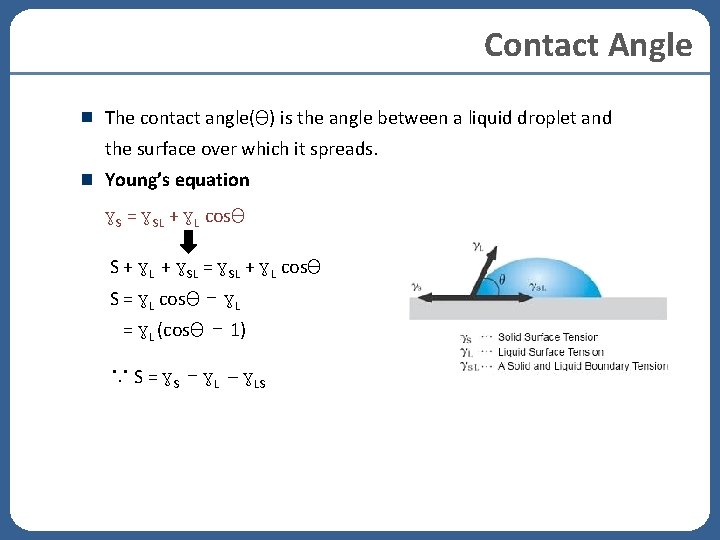
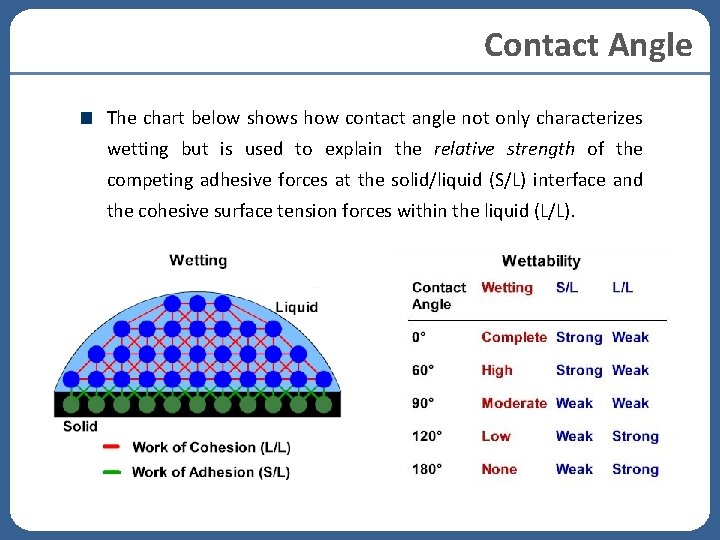
Contact Angle The contact angle(θ) is the angle between a liquid droplet and the surface over which it spreads. Young’s equation γS = γSL + γL cosθ S + γL + γSL = γSL + γL cosθ S = γL cosθ - γL = γL (cosθ - 1) ∵ S = γS - γL – γLS
Contact Angle The chart below shows how contact angle not only characterizes wetting but is used to explain the relative strength of the competing adhesive forces at the solid/liquid (S/L) interface and the cohesive surface tension forces within the liquid (L/L).
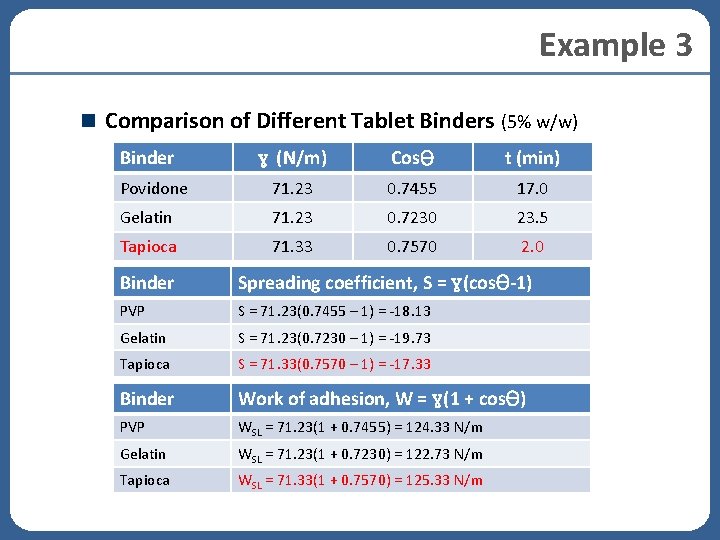
Example 3 Comparison of Different Tablet Binders (5% w/w) Binder γ (N/m) Cosθ t (min) Povidone 71. 23 0. 7455 17. 0 Gelatin 71. 23 0. 7230 23. 5 Tapioca 71. 33 0. 7570 2. 0 Binder Spreading coefficient, S = γ(cosθ-1) PVP S = 71. 23(0. 7455 – 1) = -18. 13 Gelatin S = 71. 23(0. 7230 – 1) = -19. 73 Tapioca S = 71. 33(0. 7570 – 1) = -17. 33 Binder Work of adhesion, W = γ(1 + cosθ) PVP WSL = 71. 23(1 + 0. 7455) = 124. 33 N/m Gelatin WSL = 71. 23(1 + 0. 7230) = 122. 73 N/m Tapioca WSL = 71. 33(1 + 0. 7570) = 125. 33 N/m
Electric Double Layer Zeta Potential
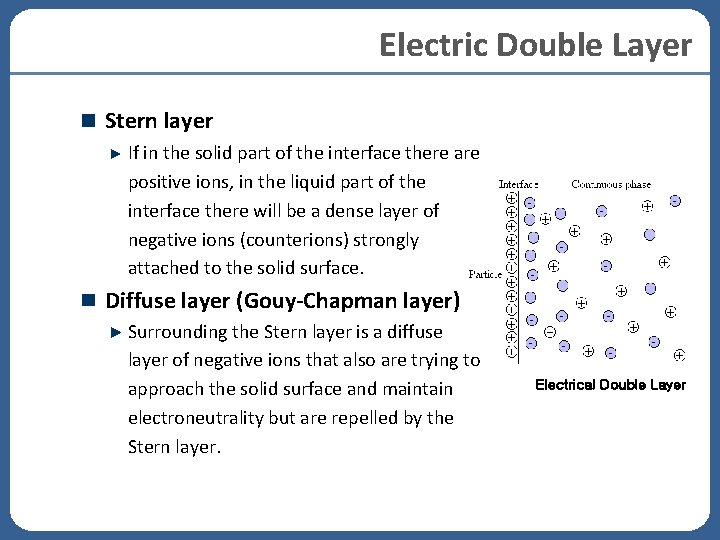
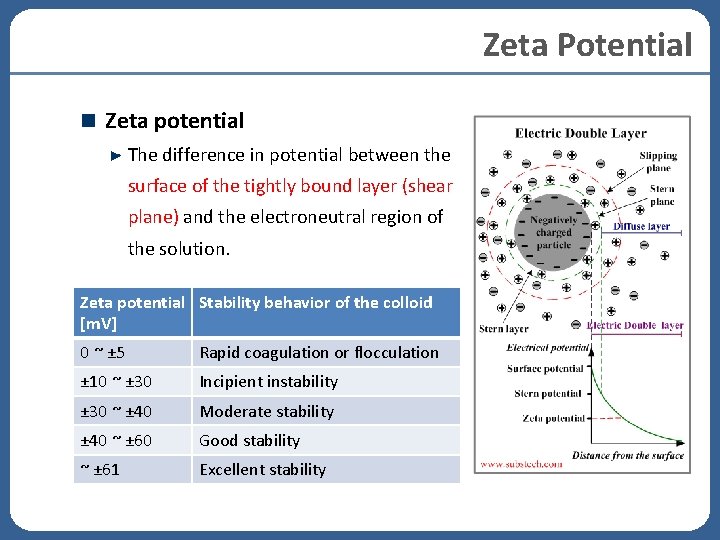
Electric Double Layer Stern layer If in the solid part of the interface there are positive ions, in the liquid part of the interface there will be a dense layer of negative ions (counterions) strongly attached to the solid surface. Diffuse layer (Gouy-Chapman layer) Surrounding the Stern layer is a diffuse layer of negative ions that also are trying to approach the solid surface and maintain electroneutrality but are repelled by the Stern layer. Electrical Double Layer
Zeta Potential Zeta potential The difference in potential between the surface of the tightly bound layer (shear plane) and the electroneutral region of the solution. Zeta potential Stability behavior of the colloid [m. V] 0 ~ ± 5 Rapid coagulation or flocculation ± 10 ~ ± 30 Incipient instability ± 30 ~ ± 40 Moderate stability ± 40 ~ ± 60 Good stability ~ ± 61 Excellent stability
Adsorption The Surfaces Adsorption of Gases at Solid Interfaces Adsorption Isotherms Factors Affecting Adsorption from Solution Adsorption at Liquid Interfaces Hydrophile-Lipophile Balance Gibbs Adsorption Equation Critical Micelle Concentration
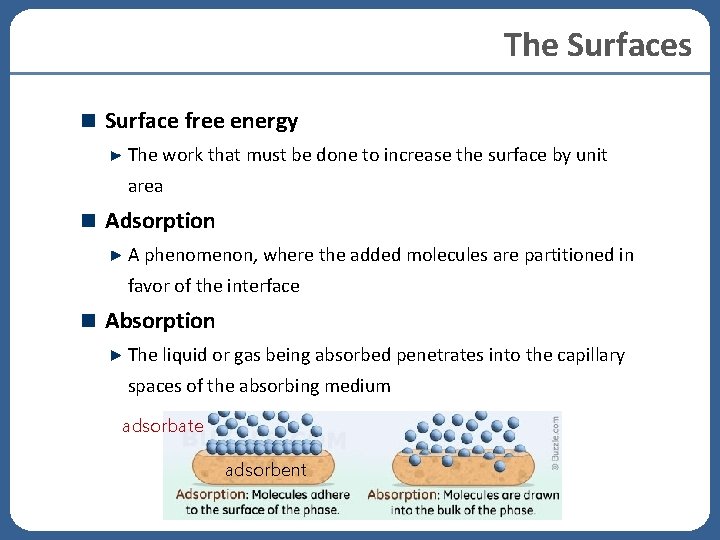
The Surfaces Surface free energy The work that must be done to increase the surface by unit area Adsorption A phenomenon, where the added molecules are partitioned in favor of the interface Absorption The liquid or gas being absorbed penetrates into the capillary spaces of the absorbing medium adsorbate adsorbent
Adsorption of Gases at Solid Interfaces Physical adsorption This is the most common form of adsorption. The molecules are attracted to the solid surface by Van Der Waals forces. The molecules remain intact and can be freed easily. Reversible (desorption) Chemical adsorption (Chemisorption) The molecules undergo a chemical bonding with the molecules of the solid surface and this attraction may be strong than the forces holding the solid together. Irreversible
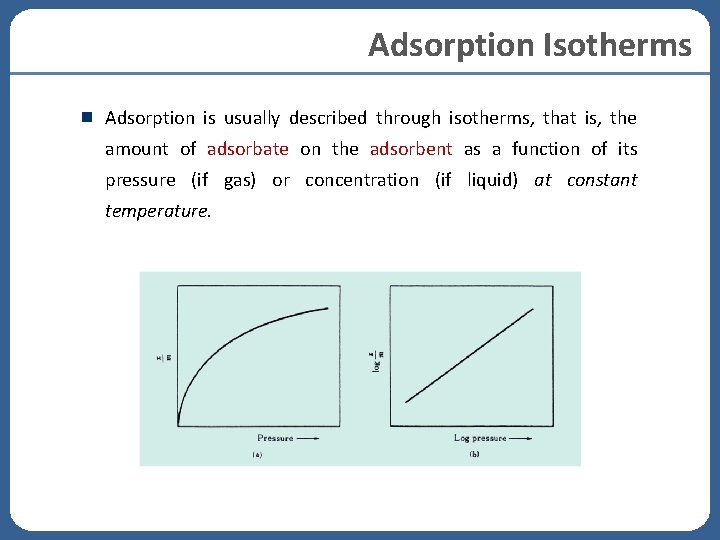
Adsorption Isotherms Adsorption is usually described through isotherms, that is, the amount of adsorbate on the adsorbent as a function of its pressure (if gas) or concentration (if liquid) at constant temperature.
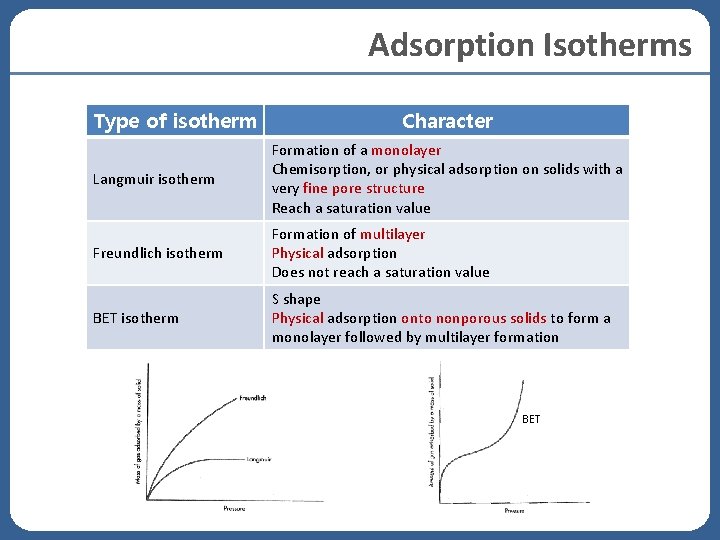
Adsorption Isotherms Type of isotherm Character Langmuir isotherm Formation of a monolayer Chemisorption, or physical adsorption on solids with a very fine pore structure Reach a saturation value Freundlich isotherm Formation of multilayer Physical adsorption Does not reach a saturation value BET isotherm S shape Physical adsorption onto nonporous solids to form a monolayer followed by multilayer formation BET
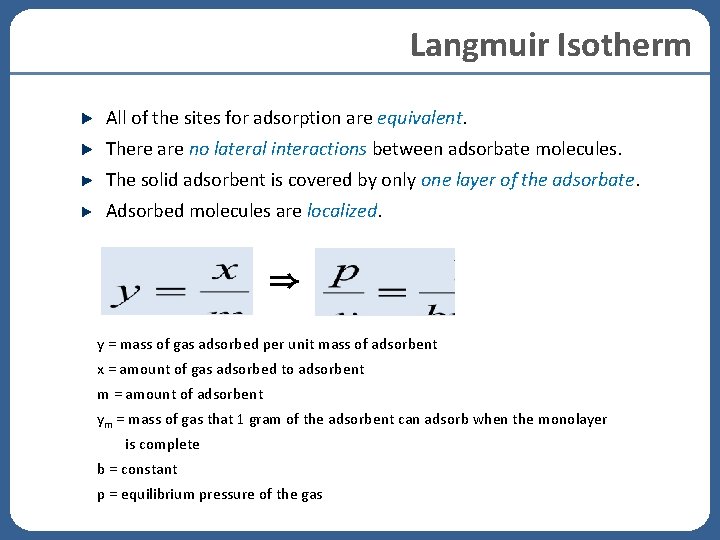
Langmuir Isotherm All of the sites for adsorption are equivalent. There are no lateral interactions between adsorbate molecules. The solid adsorbent is covered by only one layer of the adsorbate. Adsorbed molecules are localized. ⇒ y = mass of gas adsorbed per unit mass of adsorbent x = amount of gas adsorbed to adsorbent m = amount of adsorbent ym = mass of gas that 1 gram of the adsorbent can adsorb when the monolayer is complete b = constant p = equilibrium pressure of the gas
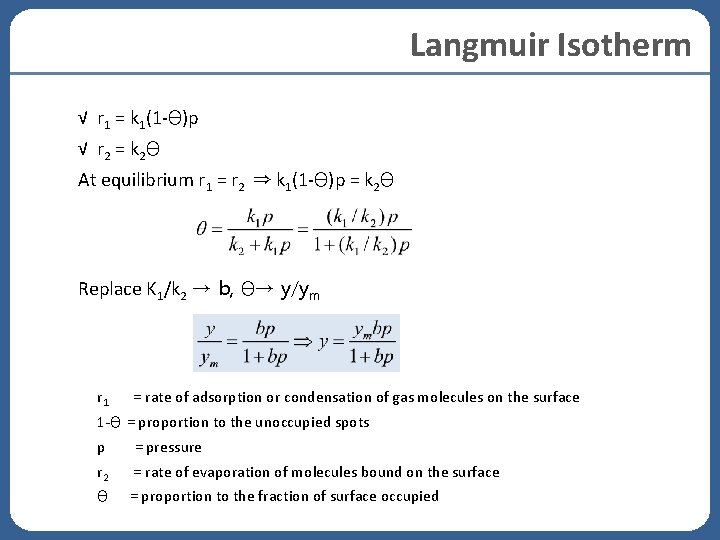
Langmuir Isotherm √ r 1 = k 1(1 -θ)p √ r 2 = k 2 θ At equilibrium r 1 = r 2 ⇒ k 1(1 -θ)p = k 2θ Replace K 1/k 2 → b, θ→ y/ym r 1 = rate of adsorption or condensation of gas molecules on the surface 1 -θ = proportion to the unoccupied spots p = pressure r 2 = rate of evaporation of molecules bound on the surface θ = proportion to the fraction of surface occupied
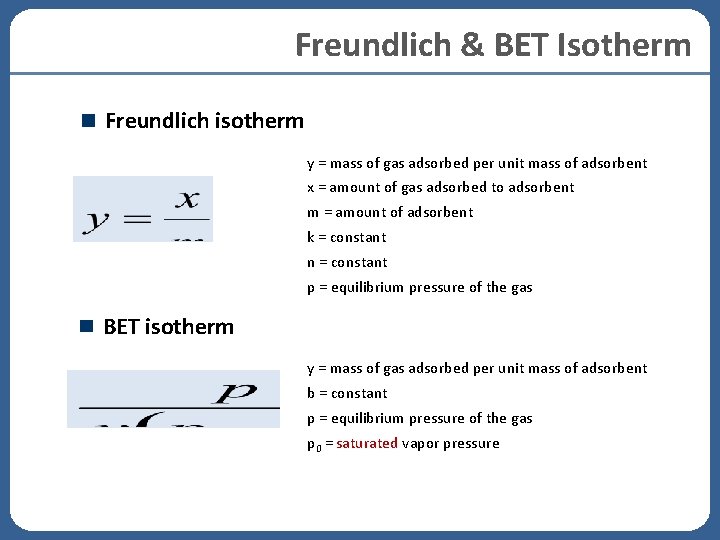
Freundlich & BET Isotherm Freundlich isotherm y = mass of gas adsorbed per unit mass of adsorbent x = amount of gas adsorbed to adsorbent m = amount of adsorbent k = constant n = constant p = equilibrium pressure of the gas BET isotherm y = mass of gas adsorbed per unit mass of adsorbent b = constant p = equilibrium pressure of the gas p 0 = saturated vapor pressure
Factors Affecting Adsorption from Solution Surface area of the adsorbent The most important property affecting adsorption Extent of the adsorption is proportional to the specific surface area. Solubility of adsorbate Adsorption of a solute is inversely proportional to its solubility. p. H The p. H of the solution affects the degree of ionization of the drug and its solubility. Temperature The amount of adsorption will decrease as the temperature increase.
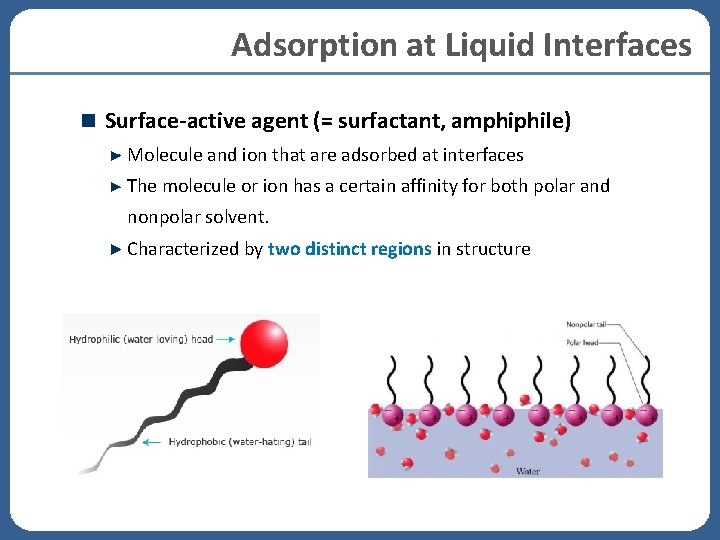
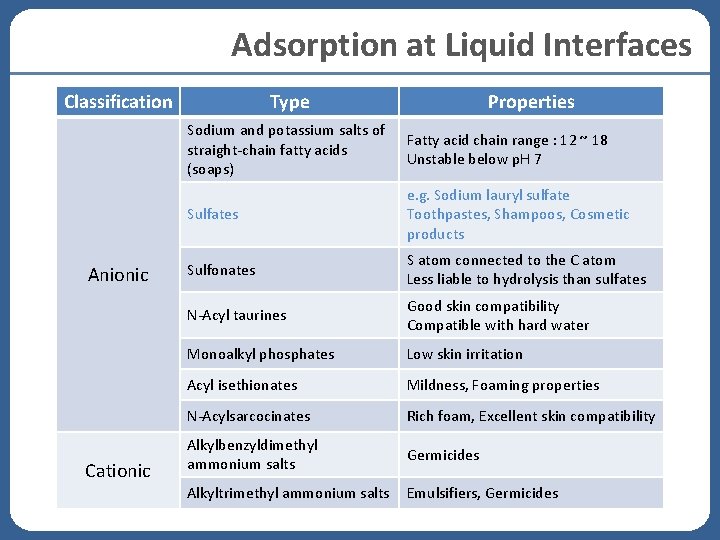
Adsorption at Liquid Interfaces Surface-active agent (= surfactant, amphiphile) Molecule and ion that are adsorbed at interfaces The molecule or ion has a certain affinity for both polar and nonpolar solvent. Characterized by two distinct regions in structure
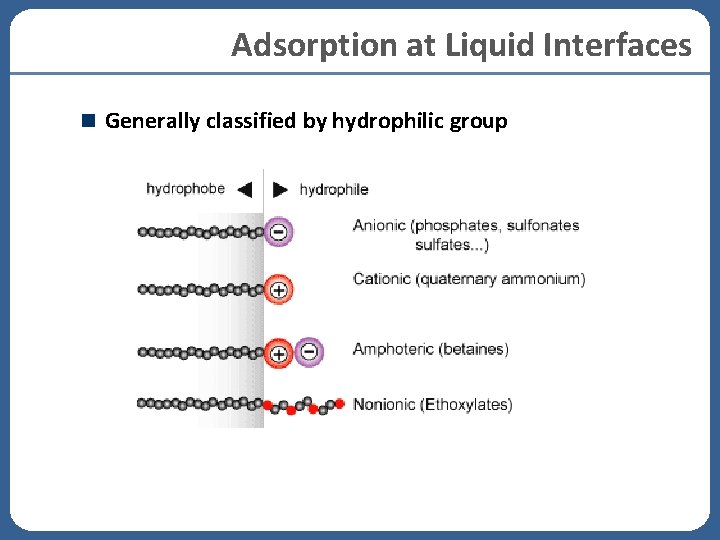
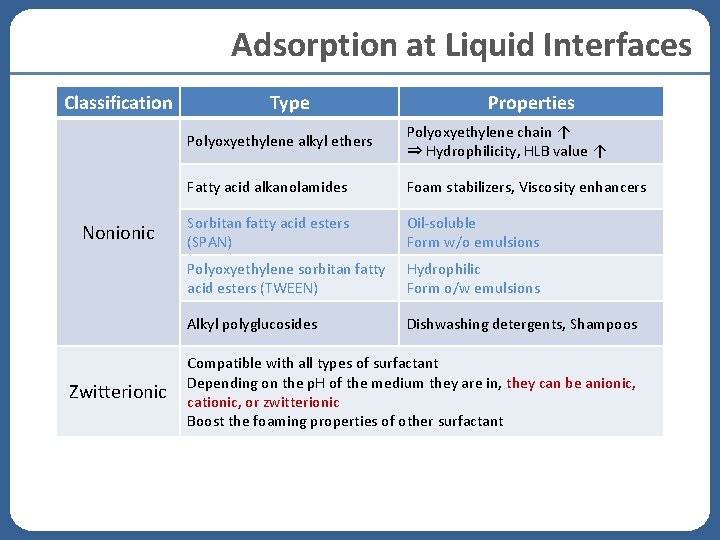
Adsorption at Liquid Interfaces Generally classified by hydrophilic group
Adsorption at Liquid Interfaces Classification Anionic Cationic Type Properties Sodium and potassium salts of straight-chain fatty acids (soaps) Fatty acid chain range : 12 ~ 18 Unstable below p. H 7 Sulfates e. g. Sodium lauryl sulfate Toothpastes, Shampoos, Cosmetic products Sulfonates S atom connected to the C atom Less liable to hydrolysis than sulfates N-Acyl taurines Good skin compatibility Compatible with hard water Monoalkyl phosphates Low skin irritation Acyl isethionates Mildness, Foaming properties N-Acylsarcocinates Rich foam, Excellent skin compatibility Alkylbenzyldimethyl ammonium salts Germicides Alkyltrimethyl ammonium salts Emulsifiers, Germicides
Adsorption at Liquid Interfaces Classification Nonionic Zwitterionic Type Properties Polyoxyethylene alkyl ethers Polyoxyethylene chain ↑ ⇒ Hydrophilicity, HLB value ↑ Fatty acid alkanolamides Foam stabilizers, Viscosity enhancers Sorbitan fatty acid esters (SPAN) Oil-soluble Form w/o emulsions Polyoxyethylene sorbitan fatty acid esters (TWEEN) Hydrophilic Form o/w emulsions Alkyl polyglucosides Dishwashing detergents, Shampoos Compatible with all types of surfactant Depending on the p. H of the medium they are in, they can be anionic, cationic, or zwitterionic Boost the foaming properties of other surfactant
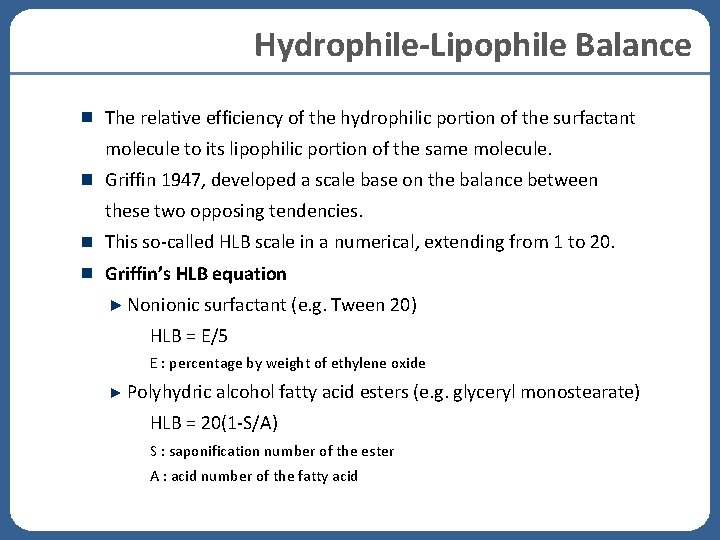
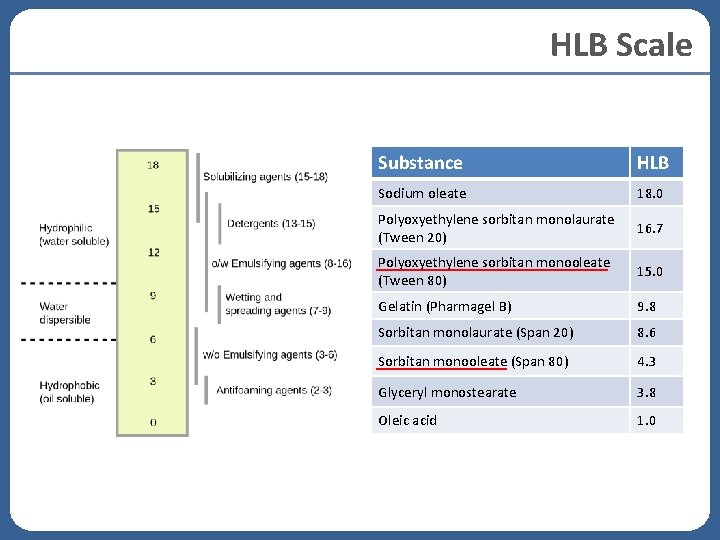
Hydrophile-Lipophile Balance The relative efficiency of the hydrophilic portion of the surfactant molecule to its lipophilic portion of the same molecule. Griffin 1947, developed a scale base on the balance between these two opposing tendencies. This so-called HLB scale in a numerical, extending from 1 to 20. Griffin’s HLB equation Nonionic surfactant (e. g. Tween 20) HLB = E/5 E : percentage by weight of ethylene oxide Polyhydric alcohol fatty acid esters (e. g. glyceryl monostearate) HLB = 20(1 -S/A) S : saponification number of the ester A : acid number of the fatty acid
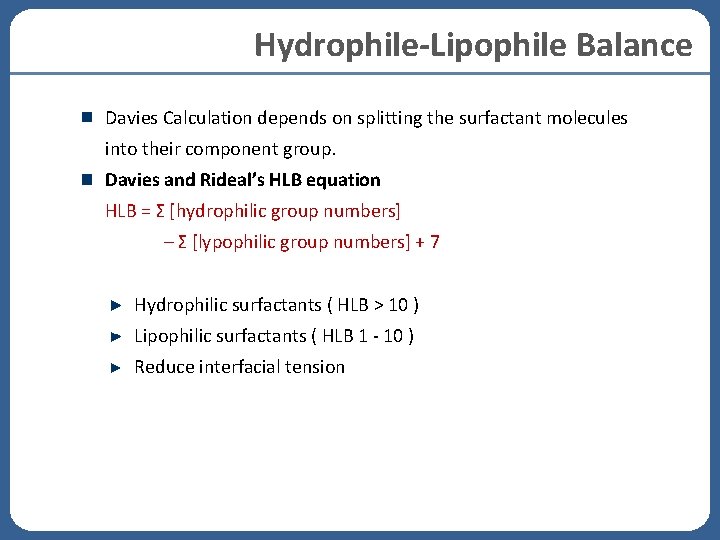
Hydrophile-Lipophile Balance Davies Calculation depends on splitting the surfactant molecules into their component group. Davies and Rideal’s HLB equation HLB = Σ [hydrophilic group numbers] – Σ [lypophilic group numbers] + 7 Hydrophilic surfactants ( HLB > 10 ) Lipophilic surfactants ( HLB 1 - 10 ) Reduce interfacial tension
HLB Scale Substance HLB Sodium oleate 18. 0 Polyoxyethylene sorbitan monolaurate (Tween 20) 16. 7 Polyoxyethylene sorbitan monooleate (Tween 80) 15. 0 Gelatin (Pharmagel B) 9. 8 Sorbitan monolaurate (Span 20) 8. 6 Sorbitan monooleate (Span 80) 4. 3 Glyceryl monostearate 3. 8 Oleic acid 1. 0
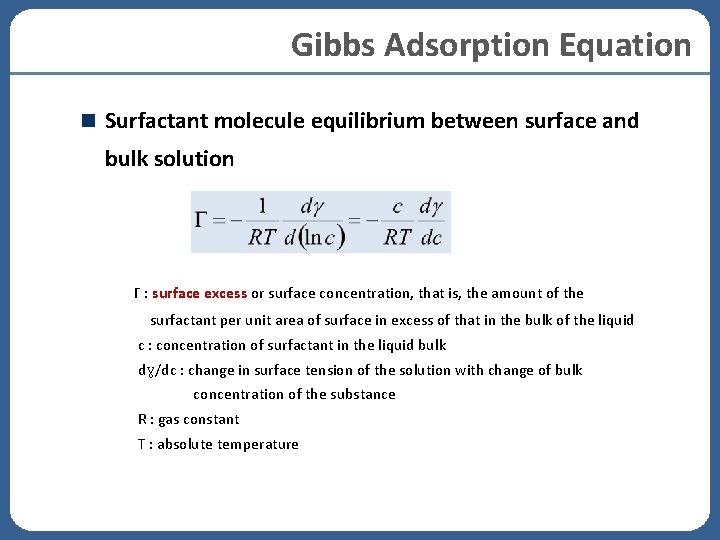
Gibbs Adsorption Equation Surfactant molecule equilibrium between surface and bulk solution Γ : surface excess or surface concentration, that is, the amount of the surfactant per unit area of surface in excess of that in the bulk of the liquid c : concentration of surfactant in the liquid bulk dγ/dc : change in surface tension of the solution with change of bulk concentration of the substance R : gas constant T : absolute temperature
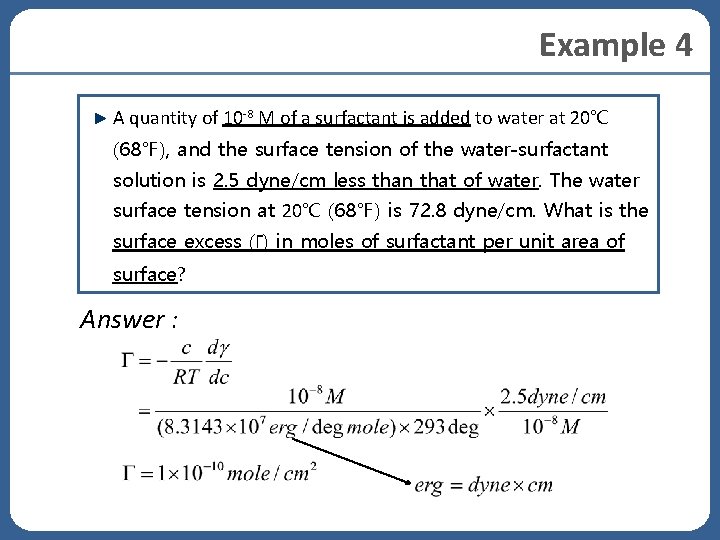
Example 4 A quantity of 10 -8 M of a surfactant is added to water at 20℃ (68℉), and the surface tension of the water-surfactant solution is 2. 5 dyne/cm less than that of water. The water surface tension at 20℃ (68℉) is 72. 8 dyne/cm. What is the surface excess (Γ) in moles of surfactant per unit area of surface? Answer :
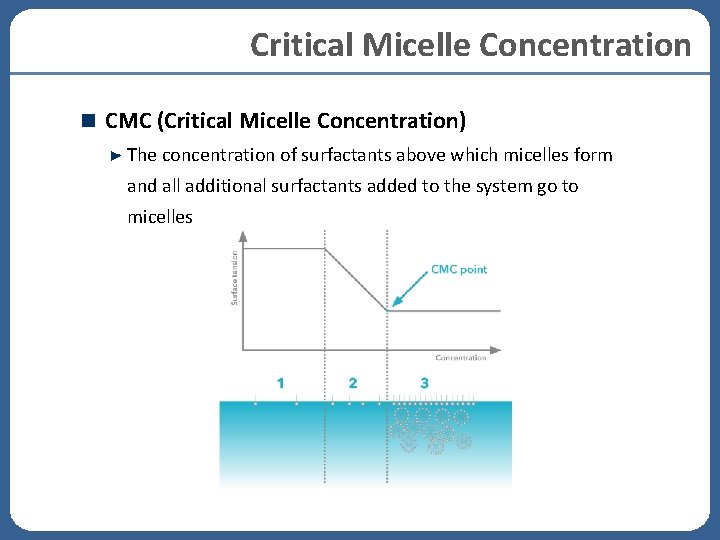
Critical Micelle Concentration CMC (Critical Micelle Concentration) The concentration of surfactants above which micelles form and all additional surfactants added to the system go to micelles
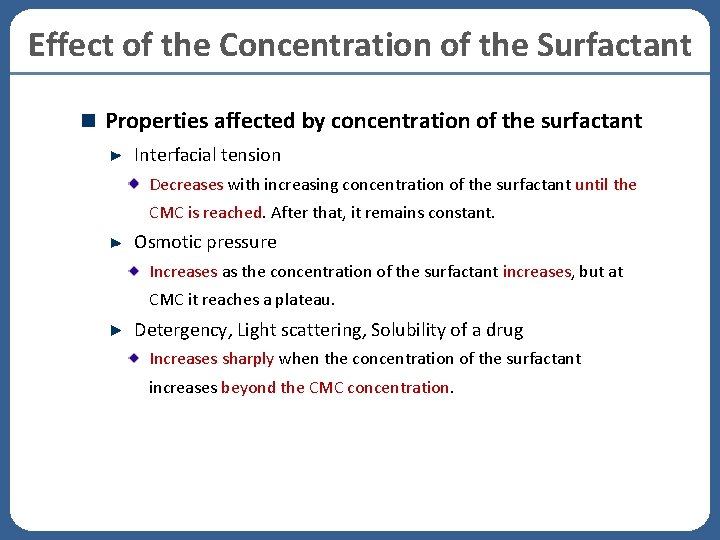
Effect of the Concentration of the Surfactant Properties affected by concentration of the surfactant Interfacial tension Decreases with increasing concentration of the surfactant until the CMC is reached. After that, it remains constant. Osmotic pressure Increases as the concentration of the surfactant increases, but at CMC it reaches a plateau. Detergency, Light scattering, Solubility of a drug Increases sharply when the concentration of the surfactant increases beyond the CMC concentration.
References 1. Mansoor M. Amiji et al. , Applied Physical Pharmacy, 2 nd Edition, International edition 2. Patrick J. Sinko, Martin’s Physical Pharmacy and Pharmaceutical Sciences, 5 th Edition, Lippincott Williams & Wilkins 3. S. P. Agarwal et al. , Physical Pharmacy, 2 nd Edition, CBS publishers & distributors 4. Denis Gentili et al. , Applications of dewetting in micro and nanotechnology, Chem. Soc. Rev. , 2012, 41