
APPLIED MULTIPLIER AND STRUCTURAL PATH ANALYSIS Andres Garcia





![Exercise 3. SPA in Stata Direct influence mat DI_1 = A[dest, mid 2] mat](https://slidetodoc.com/presentation_image_h2/8224e8e6cf6e8c9d69bcee975a4aacb2/image-14.jpg "Exercise 3. SPA in Stata Direct influence mat DI_1 = A[dest, mid 2] mat")


- Slides: 17
APPLIED MULTIPLIER AND STRUCTURAL PATH ANALYSIS Andres Garcia DERG, University of Copenhagen CIEM – July 29, 2009
Overview Economic linkages, multipliers, and structural path analysis. Exercise 1: Calculating round-by-round multiplier effects in Excel. Exercise 2: Multiplier decomposition in Stata. Exercise 3: Structural path analysis in Stata. Exercise 4: Structural path analysis figures in Node. XL.
ECONOMIC LINKAGES, MULTIPLIERS, AND STRUCTURAL PATH ANALYSIS
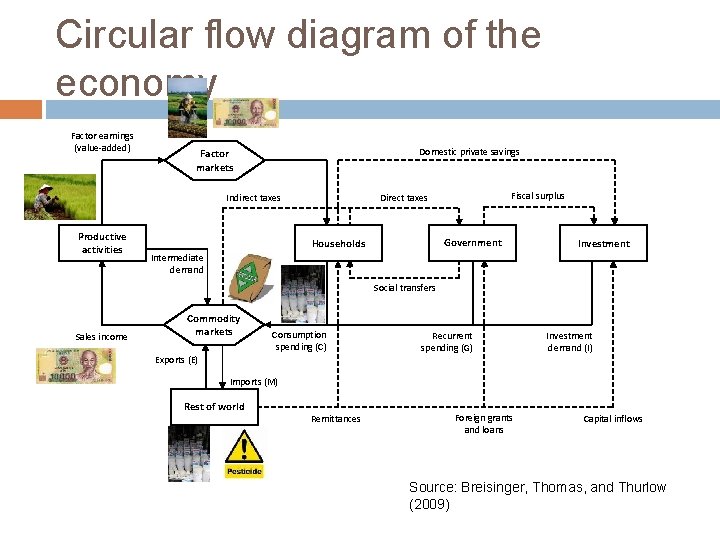
Circular flow diagram of the economy Factor earnings (value-added) Domestic private savings Factor markets Productive activities Fiscal surplus Direct taxes Indirect taxes Government Households Investment Intermediate demand Social transfers Sales income Commodity markets Consumption spending (C) Exports (E) Recurrent spending (G) Investment demand (I) Imports (M) Rest of world Remittances Foreign grants and loans Capital inflows Source: Breisinger, Thomas, and Thurlow (2009)
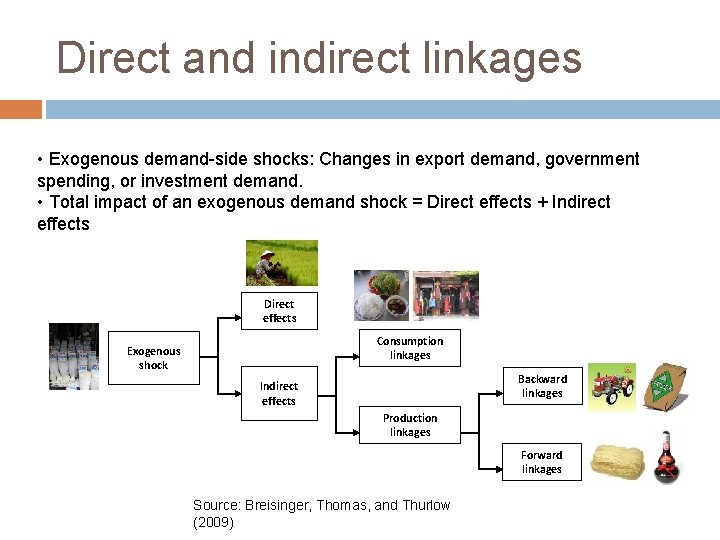
Direct and indirect linkages • Exogenous demand-side shocks: Changes in export demand, government spending, or investment demand. • Total impact of an exogenous demand shock = Direct effects + Indirect effects Direct effects Consumption linkages Exogenous shock Backward linkages Indirect effects Production linkages Forward linkages Source: Breisinger, Thomas, and Thurlow (2009)
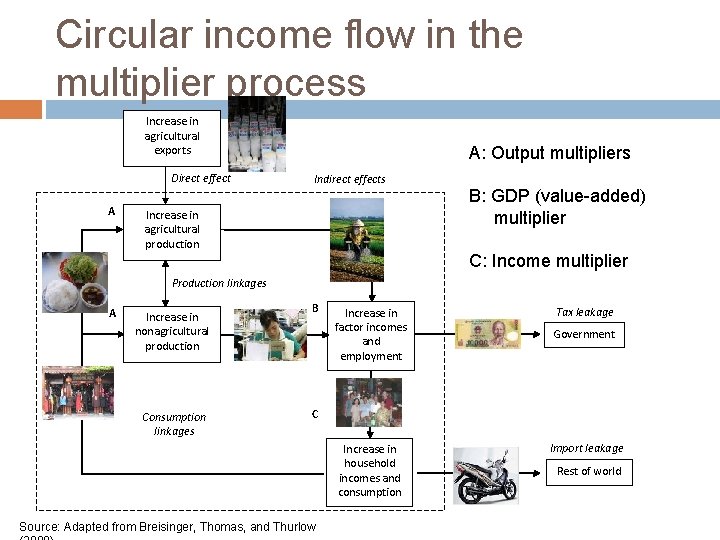
Circular income flow in the multiplier process Increase in agricultural exports Direct effect A A: Output multipliers Indirect effects Increase in agricultural production B: GDP (value-added) multiplier C: Income multiplier Production linkages A Increase in nonagricultural production Consumption linkages B Increase in factor incomes and employment Tax leakage Government C Increase in household incomes and consumption Source: Adapted from Breisinger, Thomas, and Thurlow Import leakage Rest of world
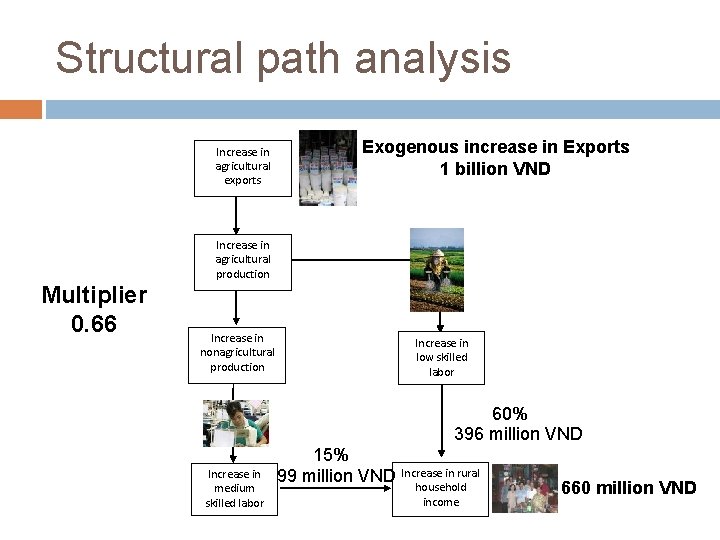
Structural path analysis Increase in agricultural exports Exogenous increase in Exports 1 billion VND Increase in agricultural production Multiplier 0. 66 Increase in nonagricultural production Increase in low skilled labor 60% 396 million VND Increase in medium skilled labor 15% 99 million VND Increase in rural household income 660 million VND
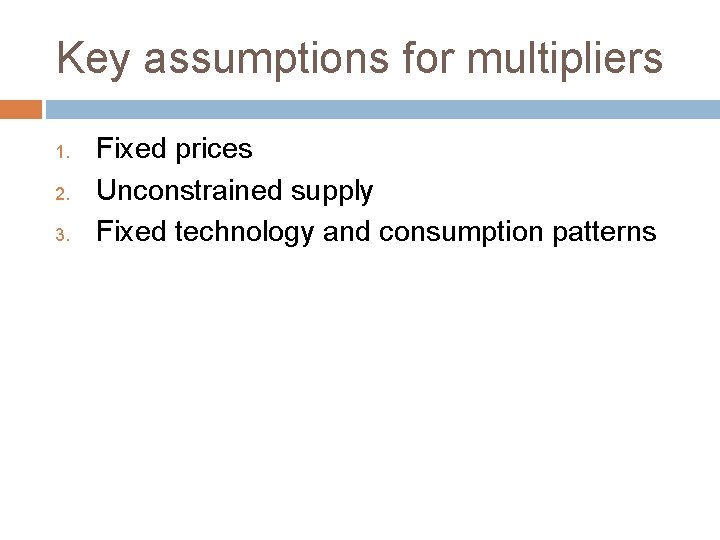
Key assumptions for multipliers 1. 2. 3. Fixed prices Unconstrained supply Fixed technology and consumption patterns
EXERCISE 1: CALCULATING ROUNDBY-ROUND MULTIPLIER EFFECTS IN EXCEL
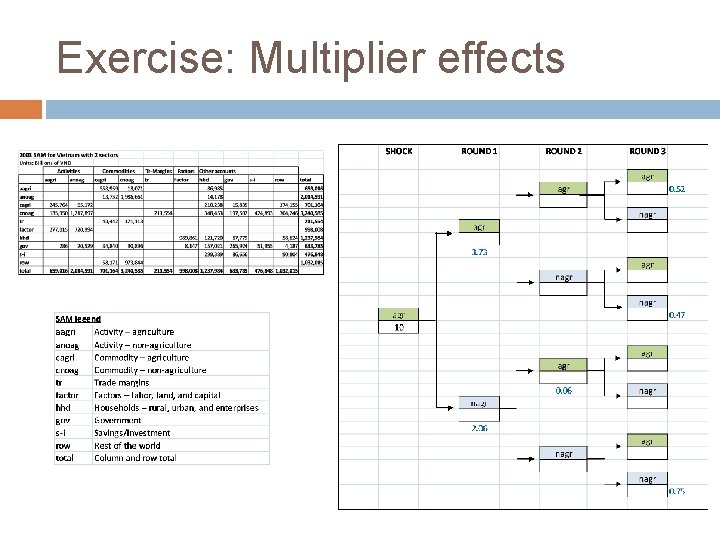
Exercise: Multiplier effects
EXERCISE 2: MULTIPLIER DECOMPOSITION IN STATA
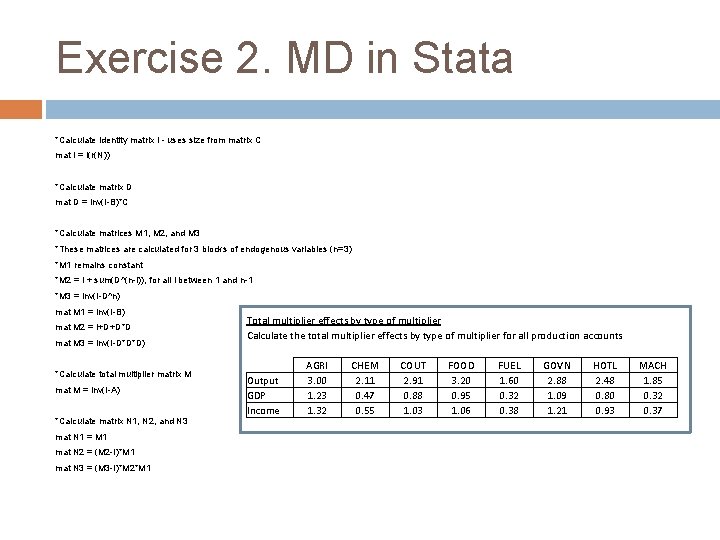
Exercise 2. MD in Stata *Calculate identity matrix I - uses size from matrix C mat I = I(r(N)) *Calculate matrix D mat D = inv(I-B)*C *Calculate matrices M 1, M 2, and M 3 *These matrices are calculated for 3 blocks of endogenous variables (n=3) *M 1 remains constant *M 2 = I + sum(D^(n-i)), for all i between 1 and n-1 *M 3 = inv(I-D^n) mat M 1 = inv(I-B) mat M 2 = I+D+D*D mat M 3 = inv(I-D*D*D) *Calculate total multiplier matrix M mat M = inv(I-A) *Calculate matrix N 1, N 2, and N 3 mat N 1 = M 1 mat N 2 = (M 2 -I)*M 1 mat N 3 = (M 3 -I)*M 2*M 1 Total multiplier effects by type of multiplier Calculate the total multiplier effects by type of multiplier for all production accounts Output GDP Income AGRI 3. 00 1. 23 1. 32 CHEM 2. 11 0. 47 0. 55 COUT 2. 91 0. 88 1. 03 FOOD 3. 20 0. 95 1. 06 FUEL 1. 60 0. 32 0. 38 GOVN 2. 88 1. 09 1. 21 HOTL 2. 48 0. 80 0. 93 MACH 1. 85 0. 32 0. 37
EXERCISE 3: STRUCTURAL PATH ANALYSIS IN STATA
Exercise 3. SPA in Stata Direct influence mat DI_1 = A[dest, mid 2] mat DI_2 = A[mid 2, mid 1] mat DI_3 = A[mid 1, orig] mat DI = DI_1*DI_2*DI_3 scalar s. DI = el(DI, 1, 1) *Required condition if s. DI>s. MDI & mid 1~=mid 2 { Origin Destination AGRI. HHD_R. Global Path Influence 0. 661 AGRI. FLAB_L. HHD_R. AGRI. FLND. HHD_R. AGRI. FCAP. ENT. HHD_R. AGRI. FLAB_M. HHD_R. AGRI. CHEM. FLAB_L. HHD_R. AGRI. TRAD. FLAB_L. HHD_R. AGRI. FOOD. FLAB_L. HHD_R. AGRI. TRAN. FLAB_L. HHD_R. AGRI. CHEM. FCAP. ENT. HHD_R. AGRI. COUT. FLAB_L. HHD_R. AGRI. FUEL. FLAB_L. HHD_R. AGRI. OSRV. FLAB_L. HHD_R. AGRI. FLAB_H. HHD_R. AGRI. TRAN. FCAP. ENT. HHD_R. AGRI. MACH. FLAB_L. HHD_R. AGRI. CHEM. FLAB_M. HHD_R. AGRI. TRAD. FCAP. ENT. HHD_R. AGRI. FOOD. FCAP. ENT. HHD_R. AGRI. TRAD. FLAB_M. HHD_R. AGRI. COUT. FCAP. ENT. HHD_R. AGRI. WOOD. FLAB_L. HHD_R. *Path multiplier use matrixa, clear drop if names==orig |names==dest | names==mid 1 | names==mid 2 drop names varn xpose, clear v drop if _varname==orig | _varname==mid 1 | _varname==mid 2 | _varname==dest drop _varname xpose, clear mkmat v*, matrix (A 12) mat I 12 = I(r(N)) mat PM = det(I 12 -A 12)/det(I-A) mat TI = DI*PM Direct Influence 0. 2070 0. 1111 0. 0178 0. 0179 0. 0035 0. 0021 0. 0016 0. 0017 0. 0009 0. 0010 0. 0009 0. 0007 0. 0008 0. 0007 0. 0005 0. 0006 0. 0004 0. 0003 Path Multiplier 1. 6968 1. 6370 1. 6908 1. 6696 2. 1379 1. 7283 1. 9667 1. 7265 2. 1300 1. 7631 1. 7419 1. 8213 1. 6571 1. 7189 2. 2406 2. 1063 1. 7221 1. 9599 1. 7016 1. 7556 1. 9469 Total Proportion Influence 0. 3512 53. 11 0. 1819 27. 51 0. 0301 4. 54 0. 0298 4. 51 0. 0075 1. 14 0. 0037 0. 56 0. 0032 0. 48 0. 0029 0. 44 0. 0020 0. 30 0. 0018 0. 26 0. 0015 0. 23 0. 0013 0. 19 0. 0012 0. 17 0. 0011 0. 16 0. 0009 0. 14 0. 0008 0. 11 0. 0006 0. 09 Accumulated Proportion 53. 11 80. 62 85. 16 89. 67 90. 81 91. 36 91. 85 92. 29 92. 58 92. 85 93. 08 93. 27 93. 46 93. 64 93. 80 93. 97 94. 11 94. 22 94. 32 94. 41 94. 50
EXERCISE 4: STRUCTURAL PATH ANALYSIS FIGURES IN NODEXL
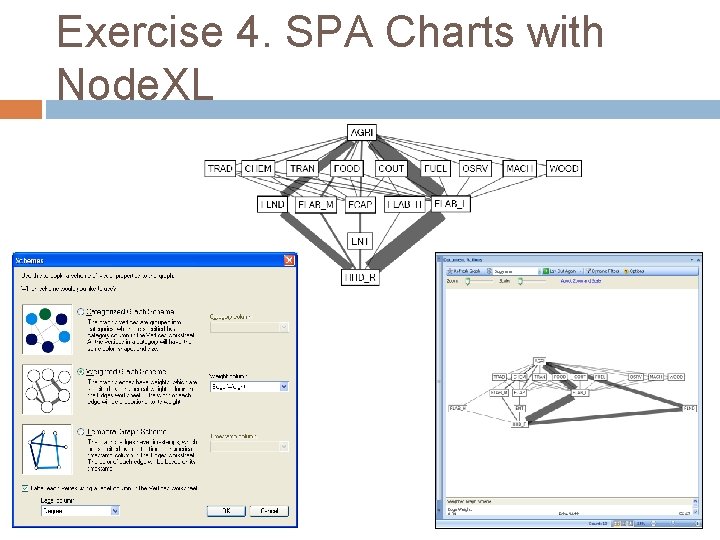
Exercise 4. SPA Charts with Node. XL
Thank you Questions?