
Applied Longitudinal Data Analysis Modeling Change and Event
- Slides: 10
Applied Longitudinal Data Analysis: Modeling Change and Event Occurrence “Time is the one immaterial object which we cannot influence— neither speed up nor slow down, add to nor diminish. ” Maya Angelou Judith D. Singer & John B. Willett Harvard Graduate School of Education ALDA websites: gseacademic. harvard. edu/alda www. oup-usa. org/alda www. ats. ucla. edu/stat/examples/alda
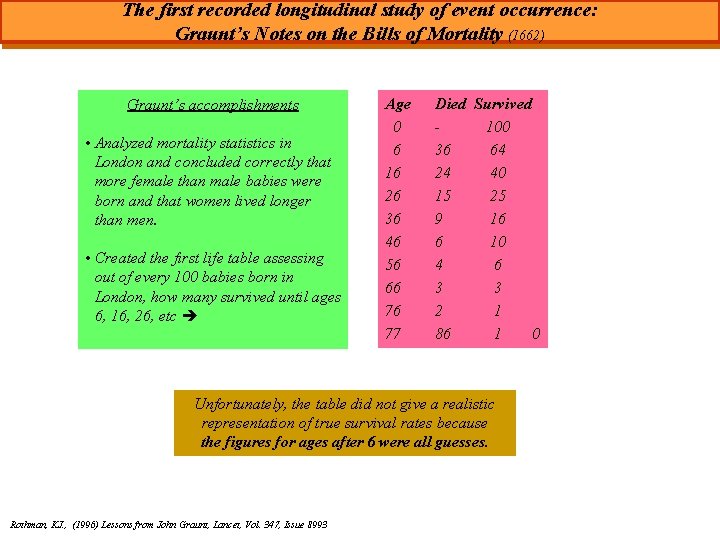
The first recorded longitudinal study of event occurrence: Graunt’s Notes on the Bills of Mortality (1662) Graunt’s accomplishments • Analyzed mortality statistics in London and concluded correctly that more female than male babies were born and that women lived longer than men. • Created the first life table assessing out of every 100 babies born in London, how many survived until ages 6, 16, 26, etc Age 0 6 16 26 36 46 56 66 76 77 Died Survived 100 36 64 24 40 15 25 9 16 6 10 4 6 3 3 2 1 86 1 0 Unfortunately, the table did not give a realistic representation of true survival rates because the figures for ages after 6 were all guesses. Rothman, KJ. , (1996) Lessons from John Graunt, Lancet, Vol. 347, Issue 8993
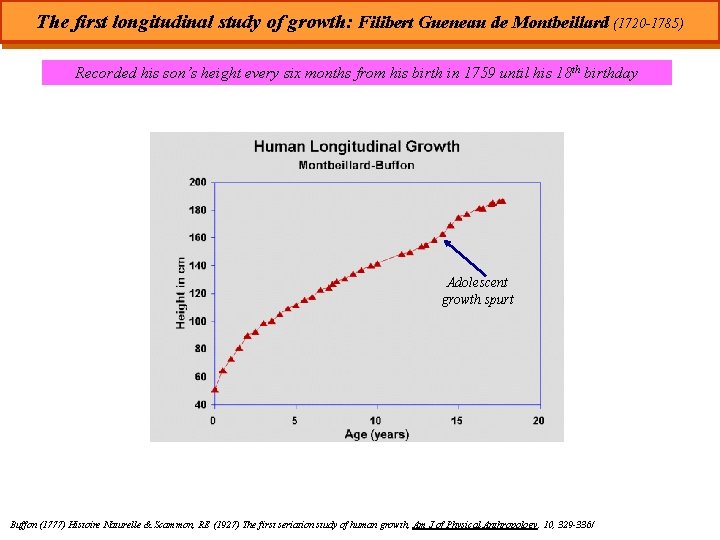
The first longitudinal study of growth: Filibert Gueneau de Montbeillard (1720 -1785) Recorded his son’s height every six months from his birth in 1759 until his 18 th birthday Adolescent growth spurt Buffon (1777) Histoire Naturelle & Scammon, RE (1927) The first seriation study of human growth, Am J of Physical Anthropology, 10, 329 -336/
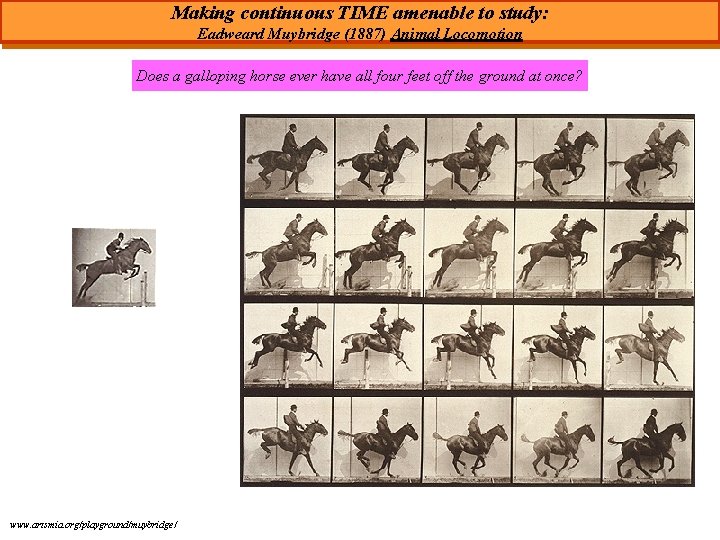
Making continuous TIME amenable to study: Eadweard Muybridge (1887) Animal Locomotion Does a galloping horse ever have all four feet off the ground at once? www. artsmia. org/playground/muybridge/
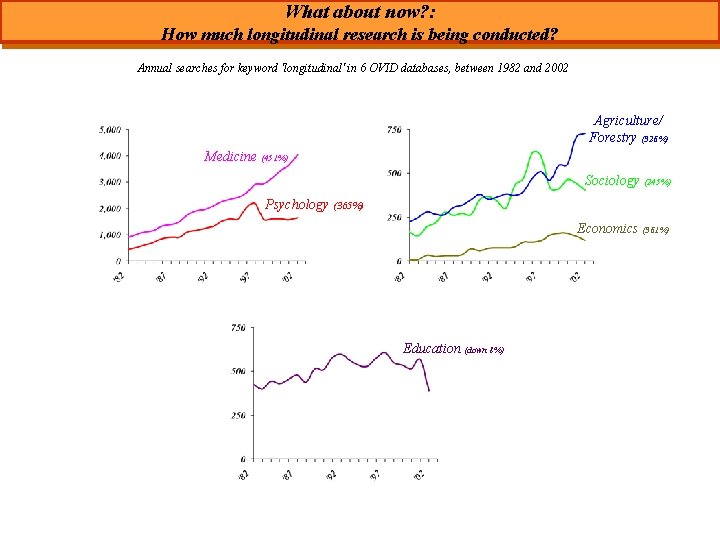
What about now? : How much longitudinal research is being conducted? Annual searches for keyword 'longitudinal' in 6 OVID databases, between 1982 and 2002 Agriculture/ Forestry (326%) Medicine (451%) Sociology (245%) Psychology (365%) Economics (361%) Education (down 8%)
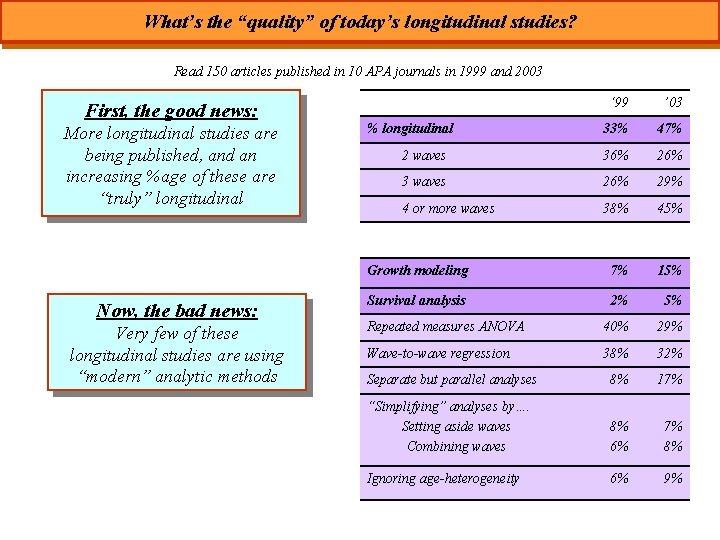
What’s the “quality” of today’s longitudinal studies? Read 150 articles published in 10 APA journals in 1999 and 2003 First, the good news: More longitudinal studies are being published, and an increasing %age of these are “truly” longitudinal Now, the bad news: Very few of these longitudinal studies are using “modern” analytic methods ‘ 99 ’ 03 33% 47% 2 waves 36% 26% 3 waves 26% 29% 4 or more waves 38% 45% Growth modeling 7% 15% Survival analysis 2% 5% Repeated measures ANOVA 40% 29% Wave-to-wave regression 38% 32% Separate but parallel analyses 8% 17% “Simplifying” analyses by…. Setting aside waves Combining waves 8% 6% 7% 8% Ignoring age-heterogeneity 6% 9% % longitudinal
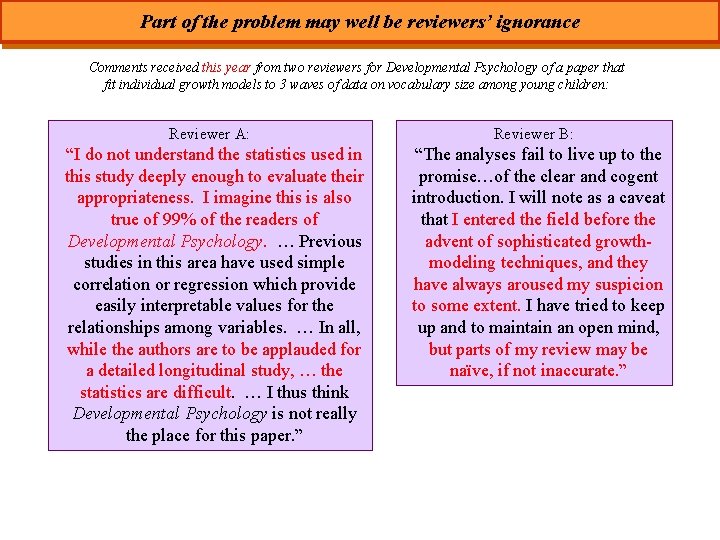
Part of the problem may well be reviewers’ ignorance Comments received this year from two reviewers for Developmental Psychology of a paper that fit individual growth models to 3 waves of data on vocabulary size among young children: Reviewer A: Reviewer B: “I do not understand the statistics used in this study deeply enough to evaluate their appropriateness. I imagine this is also true of 99% of the readers of Developmental Psychology. … Previous studies in this area have used simple correlation or regression which provide easily interpretable values for the relationships among variables. … In all, while the authors are to be applauded for a detailed longitudinal study, … the statistics are difficult. … I thus think Developmental Psychology is not really the place for this paper. ” “The analyses fail to live up to the promise…of the clear and cogent introduction. I will note as a caveat that I entered the field before the advent of sophisticated growthmodeling techniques, and they have always aroused my suspicion to some extent. I have tried to keep up and to maintain an open mind, but parts of my review may be naïve, if not inaccurate. ”
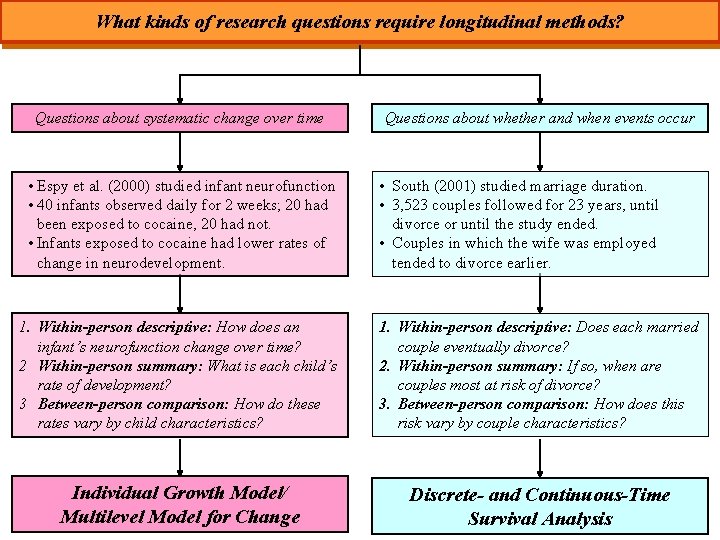
What kinds of research questions require longitudinal methods? Questions about systematic change over time • Espy et al. (2000) studied infant neurofunction • 40 infants observed daily for 2 weeks; 20 had been exposed to cocaine, 20 had not. • Infants exposed to cocaine had lower rates of change in neurodevelopment. Questions about whether and when events occur • South (2001) studied marriage duration. • 3, 523 couples followed for 23 years, until divorce or until the study ended. • Couples in which the wife was employed tended to divorce earlier. 1. Within-person descriptive: How does an infant’s neurofunction change over time? 2 Within-person summary: What is each child’s rate of development? 3 Between-person comparison: How do these rates vary by child characteristics? 1. Within-person descriptive: Does each married couple eventually divorce? 2. Within-person summary: If so, when are couples most at risk of divorce? 3. Between-person comparison: How does this risk vary by couple characteristics? Individual Growth Model/ Multilevel Model for Change Discrete- and Continuous-Time Survival Analysis
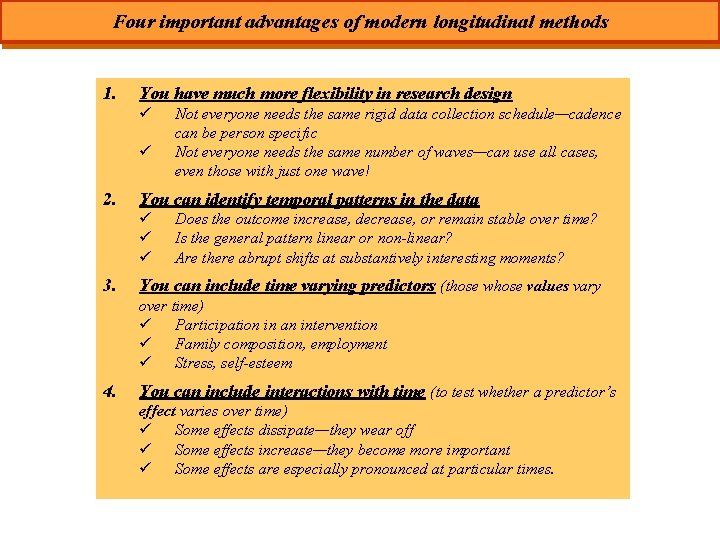
Four important advantages of modern longitudinal methods 1. You have much more flexibility in research design ü ü 2. You can identify temporal patterns in the data ü ü ü 3. Not everyone needs the same rigid data collection schedule—cadence can be person specific Not everyone needs the same number of waves—can use all cases, even those with just one wave! Does the outcome increase, decrease, or remain stable over time? Is the general pattern linear or non-linear? Are there abrupt shifts at substantively interesting moments? You can include time varying predictors (those whose values vary over time) ü Participation in an intervention ü Family composition, employment ü Stress, self-esteem 4. You can include interactions with time (to test whether a predictor’s effect varies over time) ü Some effects dissipate—they wear off ü Some effects increase—they become more important ü Some effects are especially pronounced at particular times.
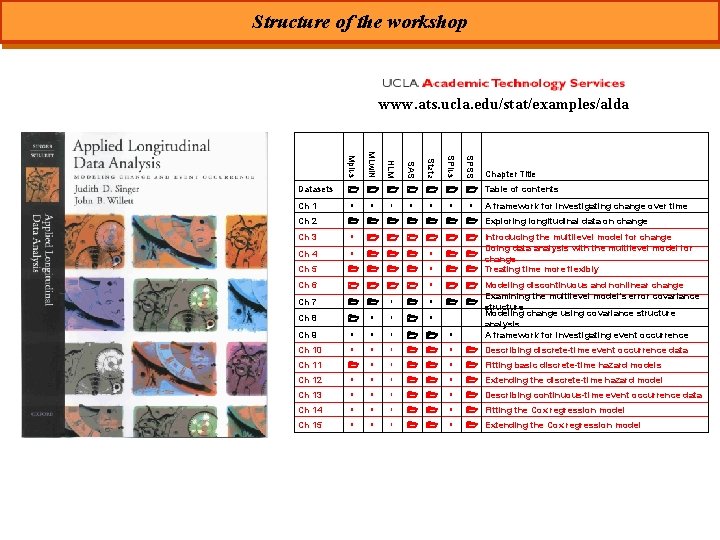
Structure of the workshop www. ats. ucla. edu/stat/examples/alda SPSS SPlus Stata SAS HLM Ch 1 MLwi. N Mplus Datasets Chapter Title 1 1 1 1 Table of contents A framework for investigating change over time Ch 2 1 1 1 1 Exploring longitudinal data on change Ch 3 Ch 5 1 1 1 Introducing the multilevel model for change Doing data analysis with the multilevel model for 1 1 1 change 1 1 Treating time more flexibly Ch 6 1 1 Ch 7 1 1 Ch 8 1 Ch 9 1 1 Modeling discontinuous and nonlinear change Examining the multilevel model’s error covariance 1 1 1 structure Modeling change using covariance structure 1 analysis 1 1 A framework for investigating event occurrence Ch 10 1 1 1 Describing discrete-time event occurrence data Ch 11 1 1 Fitting basic discrete-time hazard models Ch 12 1 1 1 Extending the discrete-time hazard model Ch 13 1 1 1 Describing continuous-time event occurrence data Ch 14 1 1 1 Fitting the Cox regression model Ch 15 1 1 1 Extending the Cox regression model Ch 4