
Applied Ergonomics for Nurses and Health Care Workers

- Slides: 34
Applied Ergonomics for Nurses and Health Care Workers 1
Why is Manual Patient Handling So Hazardous? • The Physical Demands of Work • Patient • Weight (heavy load) • Shape (bulky and awkward) • Behavior (unpredictable, confused, fragile, in pain) • High repetition of tasks • Equipment and Facilities Design • Constricted work space • Poorly maintained equipment 2
Why is Manual Patient Handling So Hazardous? • Poor Work Practices • Adjustments on equipment (e. g. , bed) not used • Personal Factors • Off the job activities e. g. , Lifting and handling children; trash; shopping, or performing yard work, etc • Previous Injury 3
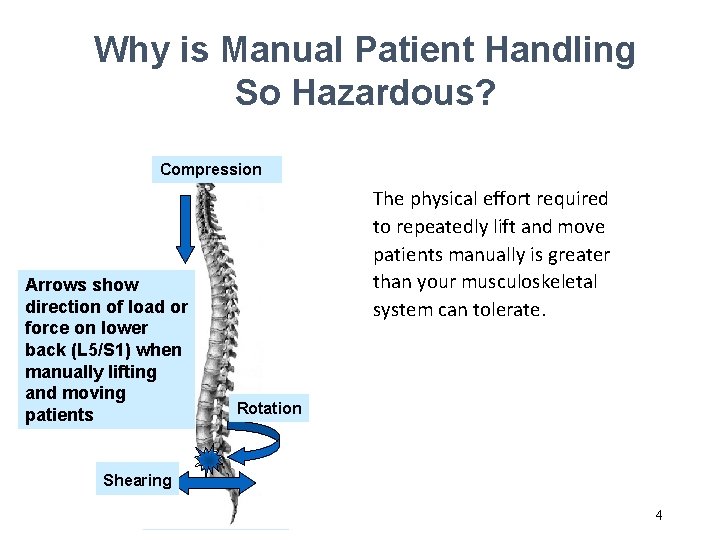
Why is Manual Patient Handling So Hazardous? Compression Arrows show direction of load or force on lower back (L 5/S 1) when manually lifting and moving patients The physical effort required to repeatedly lift and move patients manually is greater than your musculoskeletal system can tolerate. Rotation Shearing 4
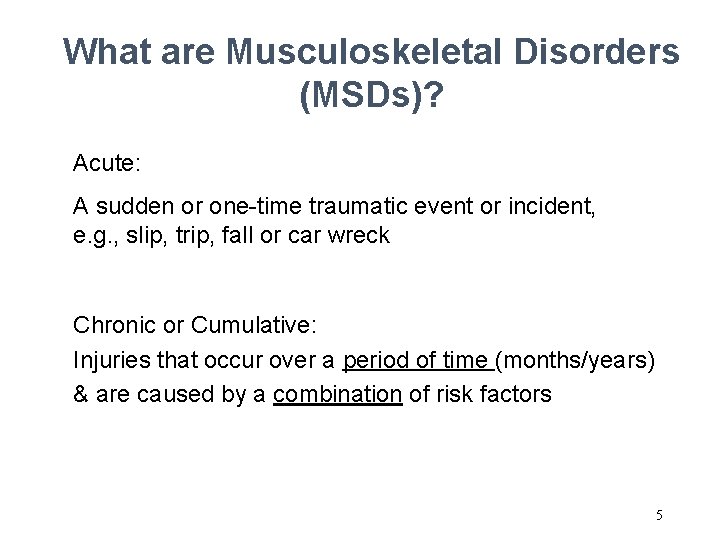
What are Musculoskeletal Disorders (MSDs)? Acute: A sudden or one-time traumatic event or incident, e. g. , slip, trip, fall or car wreck Chronic or Cumulative: Injuries that occur over a period of time (months/years) & are caused by a combination of risk factors 5
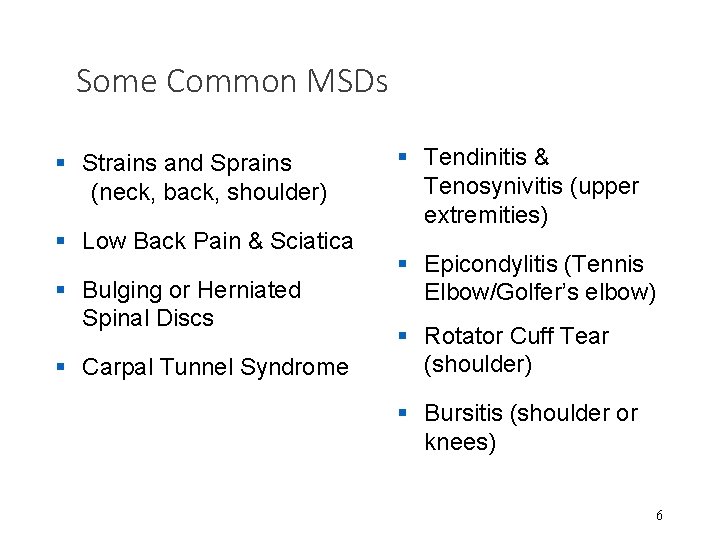
Some Common MSDs § Strains and Sprains (neck, back, shoulder) § Low Back Pain & Sciatica § Bulging or Herniated Spinal Discs § Carpal Tunnel Syndrome § Tendinitis & Tenosynivitis (upper extremities) § Epicondylitis (Tennis Elbow/Golfer’s elbow) § Rotator Cuff Tear (shoulder) § Bursitis (shoulder or knees) 6
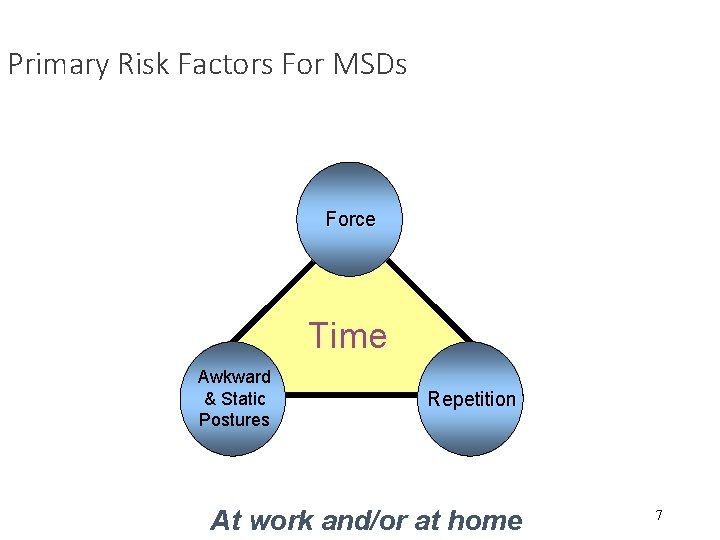
Primary Risk Factors For MSDs Force Time Awkward & Static Postures Repetition At work and/or at home 7
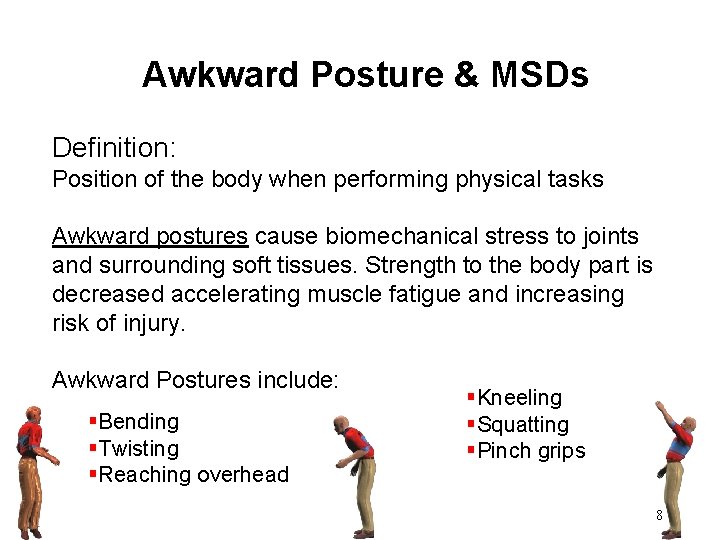
Awkward Posture & MSDs Definition: Position of the body when performing physical tasks Awkward postures cause biomechanical stress to joints and surrounding soft tissues. Strength to the body part is decreased accelerating muscle fatigue and increasing risk of injury. Awkward Postures include: §Bending §Twisting §Reaching overhead §Kneeling §Squatting §Pinch grips 8
Awkward Posture & MSDs Examples: • Providing medical care or performing personal hygiene tasks when the patient is in a chair or bed that is too low • Accessing medical equipment such as in-wall oxygen or suction equipment • Manually repositioning or transferring patients 9
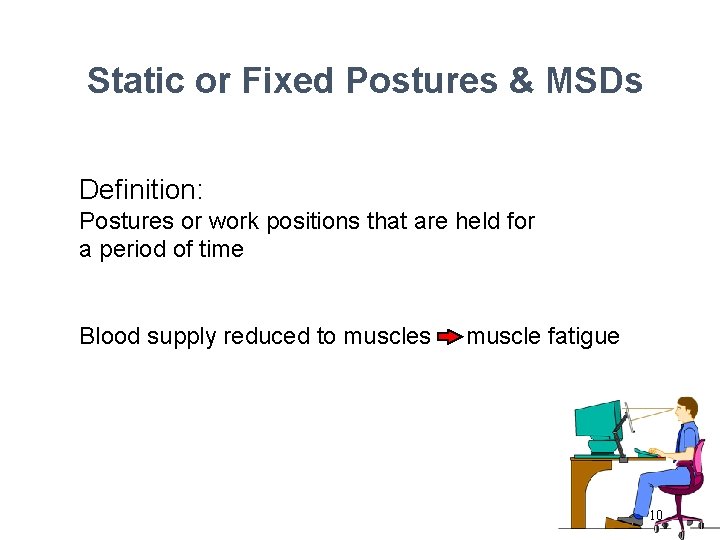
Static or Fixed Postures & MSDs Definition: Postures or work positions that are held for a period of time Blood supply reduced to muscles muscle fatigue 10
Static or Fixed Postures & MSDs Examples: • Prolonged standing or sitting • Performing patient care tasks or making a bed while bending forward at the waist for a few minutes or longer • Supporting a patients extremities or heavy instruments during a nursing task or medical procedure 11
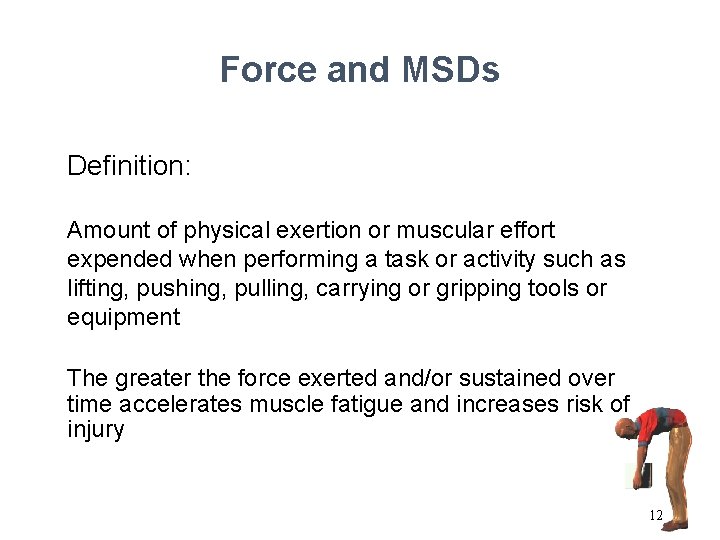
Force and MSDs Definition: Amount of physical exertion or muscular effort expended when performing a task or activity such as lifting, pushing, pulling, carrying or gripping tools or equipment The greater the force exerted and/or sustained over time accelerates muscle fatigue and increases risk of injury 12
Force and MSDs The amount of force exerted is influenced by the: • • Weight, shape and condition of the patient or equipment Body posture used Number of repetitions performed Duration or length of time that task is performed Examples: § Load or patient shifts suddenly or unexpectedly § Lifting bariatric or obese patients § Pushing a stretcher with poorly maintained or incorrect casters 13
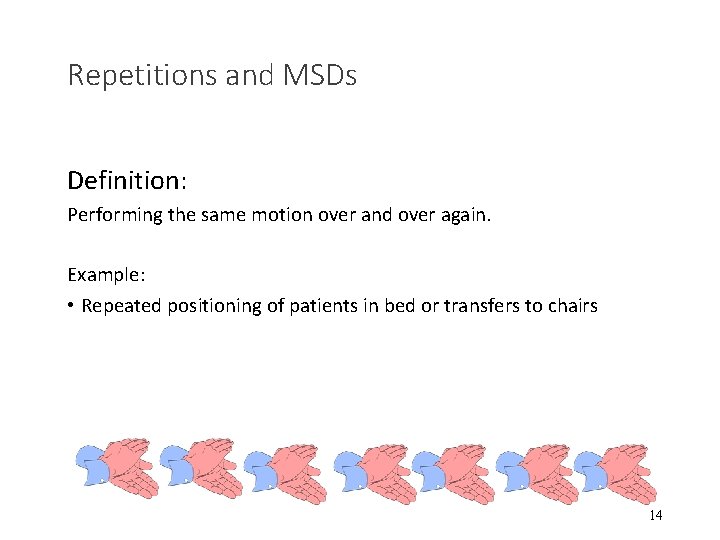
Repetitions and MSDs Definition: Performing the same motion over and over again. Example: • Repeated positioning of patients in bed or transfers to chairs 14
The Cumulative Effect Duration of Exposure to Risk Factors (Time) Affected by: § Working through breaks § Overtime § Task variability 15
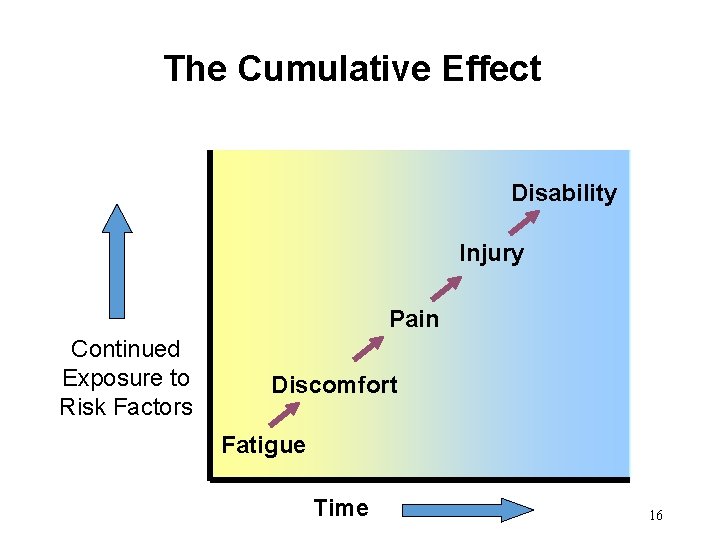
The Cumulative Effect Disability Injury Pain Continued Exposure to Risk Factors Discomfort Fatigue Time 16
Patient Handling Higher Risk Tasks • Transfer from/to bed to chair or stretcher • Manually moving patient in bed • Manually lifting from floor • Attempting to stop falls 17
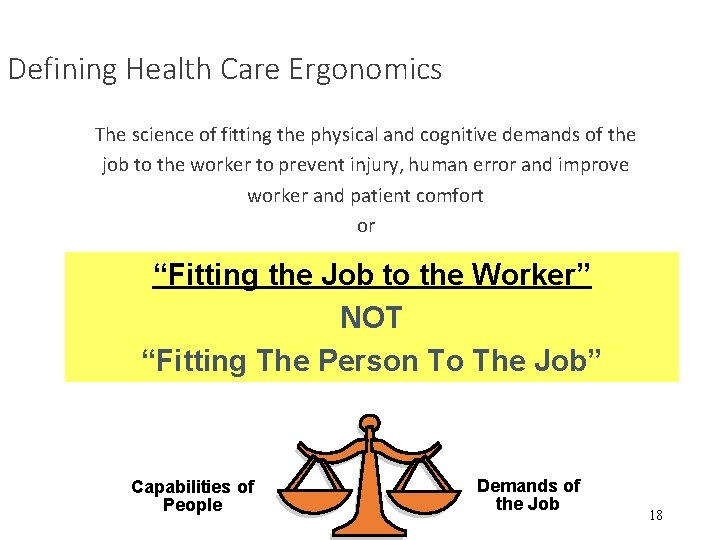
Defining Health Care Ergonomics The science of fitting the physical and cognitive demands of the job to the worker to prevent injury, human error and improve worker and patient comfort or “Fitting the Job to the Worker” NOT “Fitting The Person To The Job” Capabilities of People Demands of the Job 18
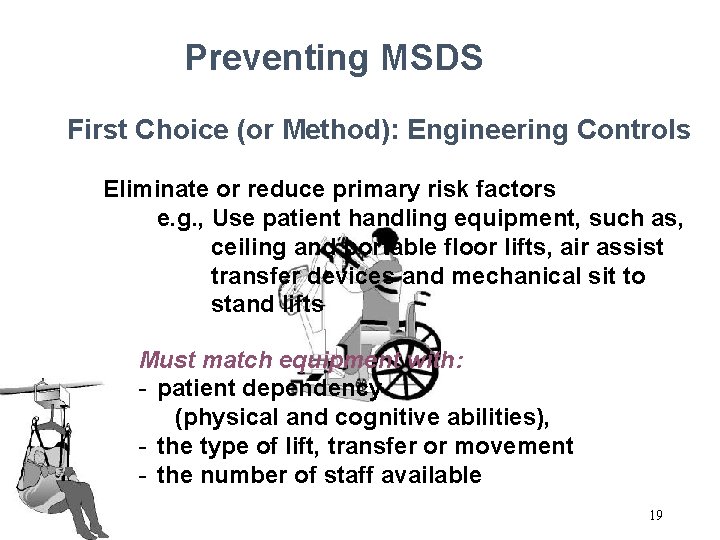
Preventing MSDS First Choice (or Method): Engineering Controls Eliminate or reduce primary risk factors e. g. , Use patient handling equipment, such as, ceiling and portable floor lifts, air assist transfer devices and mechanical sit to stand lifts Must match equipment with: - patient dependency (physical and cognitive abilities), - the type of lift, transfer or movement - the number of staff available 19
Preventing MSDS Second Choice: Work Practice Controls Reduce employee exposure to primary risk factors by using best work methods, e. g. , § § § Plan work organization Use good housekeeping practices Use adjustments on equipment Get help Eliminate unnecessary movements Don’t use broken equipment Remember – it’s the employee’s responsibility to use good work practices and follow the organizations’ safe patient handling policy and procedures 20
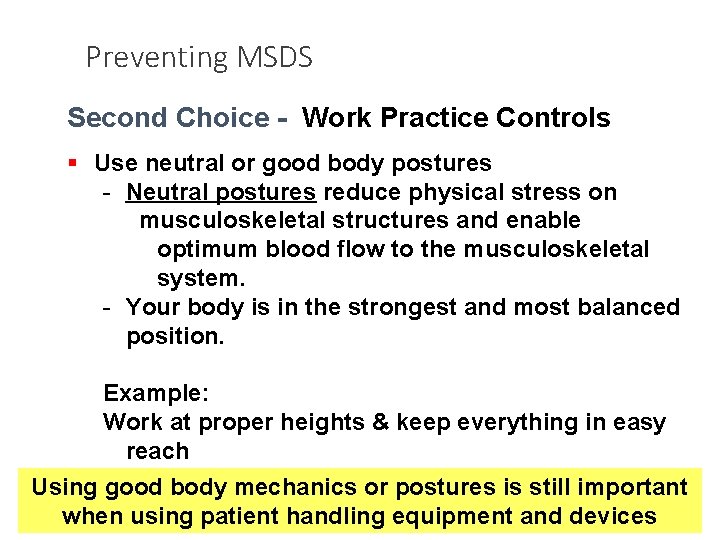
Preventing MSDS Second Choice - Work Practice Controls § Use neutral or good body postures - Neutral postures reduce physical stress on musculoskeletal structures and enable optimum blood flow to the musculoskeletal system. - Your body is in the strongest and most balanced position. Example: Work at proper heights & keep everything in easy reach Using good body mechanics or postures is still important when using patient handling equipment and devices 21
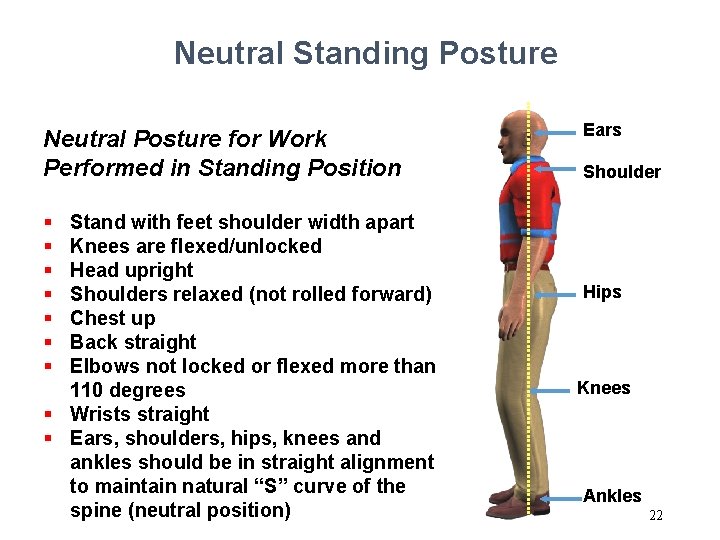
Neutral Standing Posture Neutral Posture for Work Performed in Standing Position § § § § Stand with feet shoulder width apart Knees are flexed/unlocked Head upright Shoulders relaxed (not rolled forward) Chest up Back straight Elbows not locked or flexed more than 110 degrees § Wrists straight § Ears, shoulders, hips, knees and ankles should be in straight alignment to maintain natural “S” curve of the spine (neutral position) Ears Shoulder Hips Knees Ankles 22
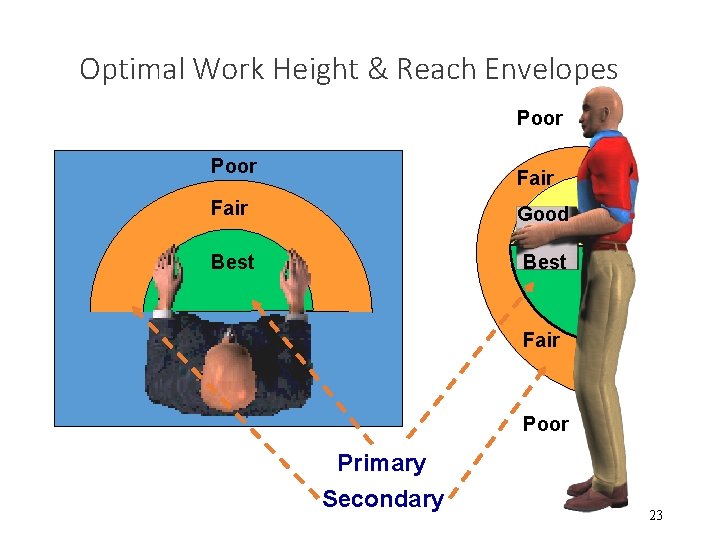
Optimal Work Height & Reach Envelopes Poor Fair Good Best Fair Poor Primary Secondary 23
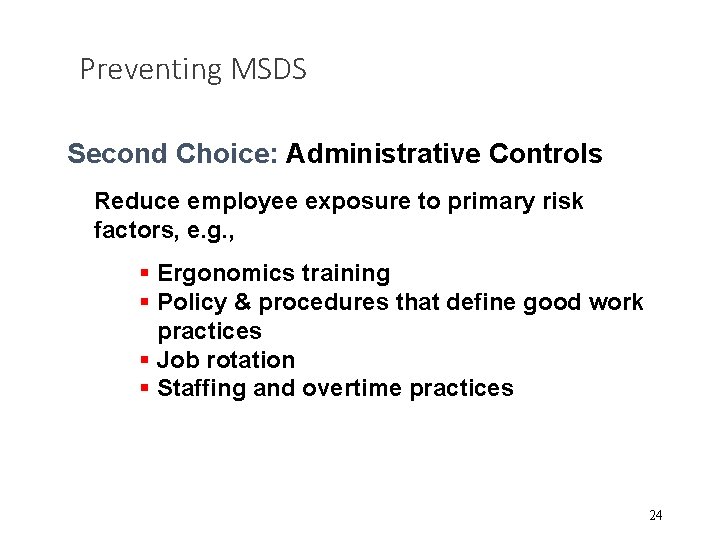
Preventing MSDS Second Choice: Administrative Controls Reduce employee exposure to primary risk factors, e. g. , § Ergonomics training § Policy & procedures that define good work practices § Job rotation § Staffing and overtime practices 24
Preventing MSDS Engineering + Work Practice + Administrative Controls = Reduce the Risk of Injury for Employees & Patients Remember - back belts are ineffective in preventing back injuries 25
What Can You Do to Reduce Your Risk of MSDs? • Conduct a hazard or risk assessment 1. Assess the patient 2. Assess & prepare the environment 3. Get necessary equipment & help 4. Perform the patient care task, lift or movement safely Plan and Prepare – It only takes a minute but can save a career 26
1. Assess the Patient Goal: To assess if patient status (physical and cognitive abilities) has changed and to determine the safest method to transfer or move the patient. Compare assessment with patient handling orders or instructions in the Patient's Care Plan and ensure that staff are alerted to changes in patient status. 27
1. Assess the Patient (continued) This brief observation includes assessment of the patient’s: • Ability to provide assistance • Physical status – ability to bear weight, upper extremity strength, coordination and balance • Ability to cooperate and follow instructions • Medical status – changes in diagnosis or symptoms, pain, fatigue, medications When in doubt, assume the patient cannot assist with the transfer/ repositioning 28
2. Assess & Prepare the Environment • Ensure that the path for transfer or movement is clear and remove (using good body posture) obstacles and clutter that constrain use of good posture and access to the patient, e. g. , • bed tables, and chairs • trip hazards, e. g. , cords from medical equipment • slip hazards , e. g. , spilled beverages or other fluids on the floor 29
2. Assess & Prepare the Environment (continued) • Consider safe handling of medical devices, such as catheters, intravenous tubing, oxygen tubing, and monitoring devices • Ensure good lighting. • Adjust equipment, such as beds to correct working height to promote good postures • Keep supplies close to body to avoid long reaches 30
3. Get Necessary Equipment & Help • Get the correct equipment and supplies for the task as determined in the Patient Care Plan and after the Patient Assessment in Step 1 • Get additional help as required • Ensure that • Equipment is in good working order • Devices such as gait belts and slings are in good condition and the correct size • The patient is wearing non-slip footwear if they are to be weight bearing 31
4. Perform the Patient Care Task, Lift or Movement Safely You should receive training on correct use of equipment, patient assessment and safe work practices before handling patients • Explain the task to the patient – agree on how much help he or she can give during the task • Position equipment correctly, e. g. , height between a stretcher and bed is equal • Apply brakes on equipment and furniture used • Lower bed rails when necessary 32
4. Perform the Patient Care Task, Lift or Movement Safely (continued) • Coordinate the task as a team (nurses and patient) • Have the patient assist as much as possible • Use good body posture – keep work close to the body and at optimal height • Know your physical limits and do not exceed them Follow your organizations safe patient handling policy and procedures 33
What Else Can You Do? • Report Ergonomic Problems to Your Supervisor • Apply Back Injury Prevention Principles to Your Off -The-Job Activities • Report Any Physical Problems Early = Quicker Recovery 34