
APPLIED EDUCATIONAL SYSTEMS Health Science CPR AED Lesson



- Slides: 43
APPLIED EDUCATIONAL SYSTEMS Health Science CPR & AED Lesson 5 Table of Contents
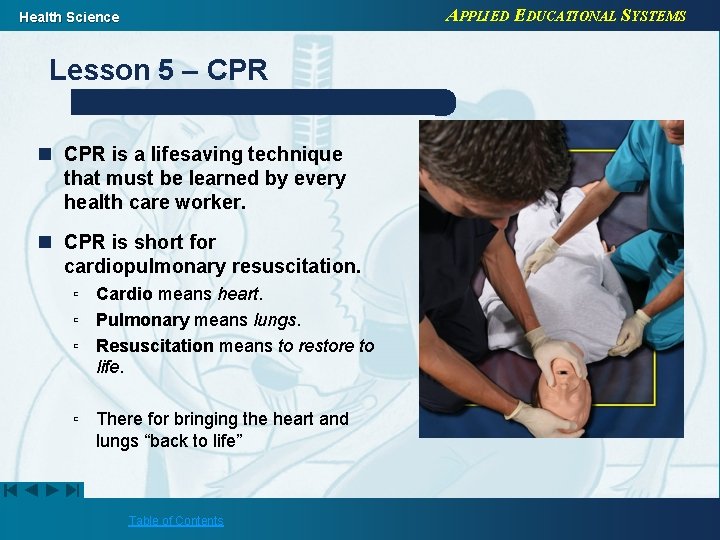
APPLIED EDUCATIONAL SYSTEMS Health Science Lesson 5 – CPR n CPR is a lifesaving technique that must be learned by every health care worker. n CPR is short for cardiopulmonary resuscitation. ▫ Cardio means heart. ▫ Pulmonary means lungs. ▫ Resuscitation means to restore to life. ▫ There for bringing the heart and lungs “back to life” Table of Contents
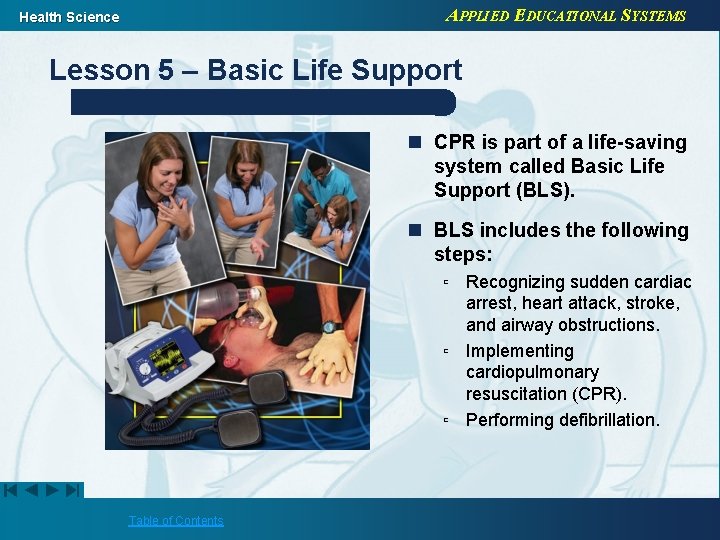
APPLIED EDUCATIONAL SYSTEMS Health Science Lesson 5 – Basic Life Support n CPR is part of a life-saving system called Basic Life Support (BLS). n BLS includes the following steps: ▫ Recognizing sudden cardiac arrest, heart attack, stroke, and airway obstructions. ▫ Implementing cardiopulmonary resuscitation (CPR). ▫ Performing defibrillation. Table of Contents
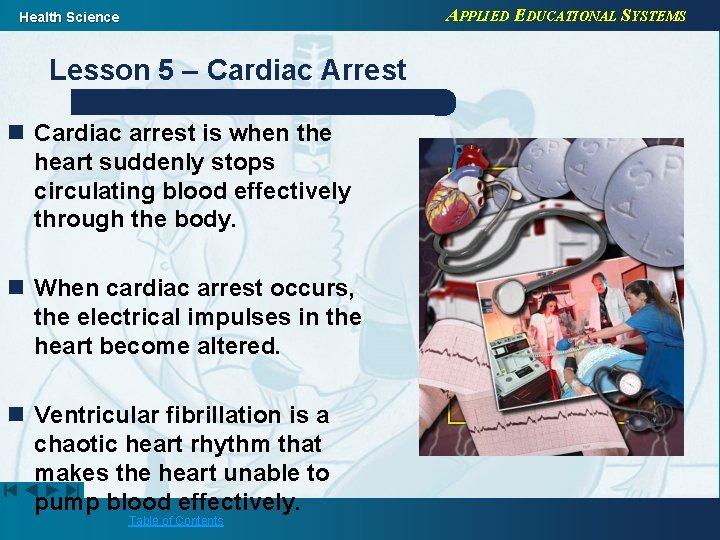
APPLIED EDUCATIONAL SYSTEMS Health Science Lesson 5 – Cardiac Arrest n Cardiac arrest is when the heart suddenly stops circulating blood effectively through the body. n When cardiac arrest occurs, the electrical impulses in the heart become altered. n Ventricular fibrillation is a chaotic heart rhythm that makes the heart unable to pump blood effectively. Table of Contents
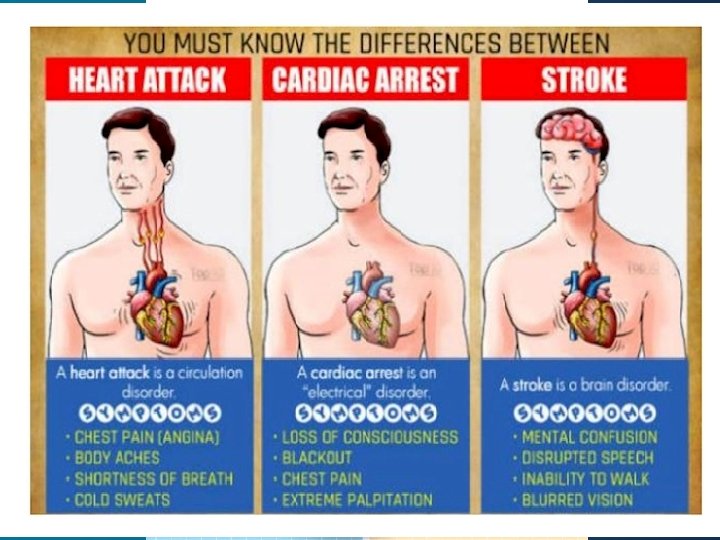
APPLIED EDUCATIONAL SYSTEMS Health Science Lesson 5 - Cardiac Arrest vs Heart Attack n Cardiac Arrest occurs when the heart malfunctions and stops beating unexpectedly. n CA is an “electrical” problem. Triggered by electrical malfunction in the heart causing irregular heartbeats. With pumping action disrupted the heart cant pump blood to the brain, lungs, or other organs. n Coronary Artery Disease, Cardiomyopathy, Long QT Syndrome, Marfan Syndrome Table of Contents n Heart attack occurs when blood flow to the heart is blocked. n HA is a “circulation” problem. Caused by a blocked artery that prevents oxygen-rich blood from reaching a section of the heart. That part of the heart normally nourished by that artery begins to die.
APPLIED EDUCATIONAL SYSTEMS Health Science Table of Contents
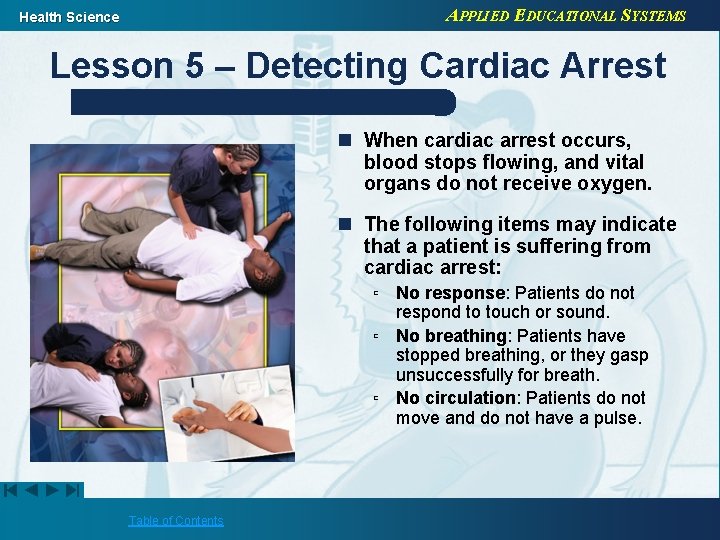
APPLIED EDUCATIONAL SYSTEMS Health Science Lesson 5 – Detecting Cardiac Arrest n When cardiac arrest occurs, blood stops flowing, and vital organs do not receive oxygen. n The following items may indicate that a patient is suffering from cardiac arrest: ▫ No response: Patients do not respond to touch or sound. ▫ No breathing: Patients have stopped breathing, or they gasp unsuccessfully for breath. ▫ No circulation: Patients do not move and do not have a pulse. Table of Contents
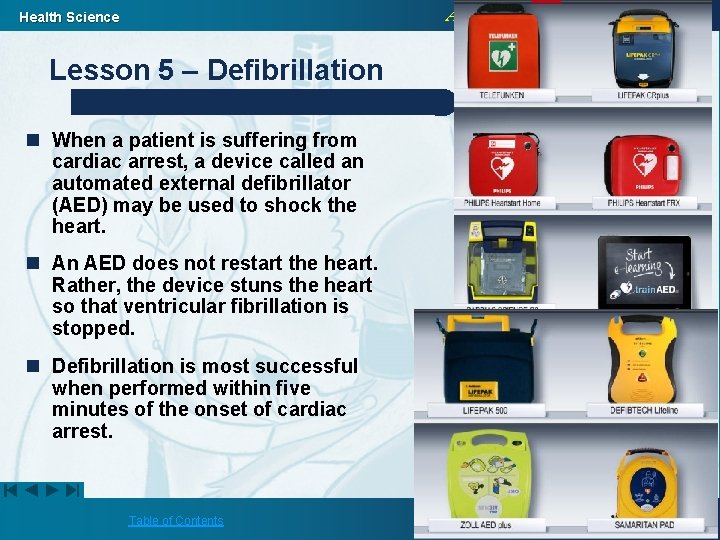
APPLIED EDUCATIONAL SYSTEMS Health Science Lesson 5 – Defibrillation n When a patient is suffering from cardiac arrest, a device called an automated external defibrillator (AED) may be used to shock the heart. n An AED does not restart the heart. Rather, the device stuns the heart so that ventricular fibrillation is stopped. n Defibrillation is most successful when performed within five minutes of the onset of cardiac arrest. Table of Contents
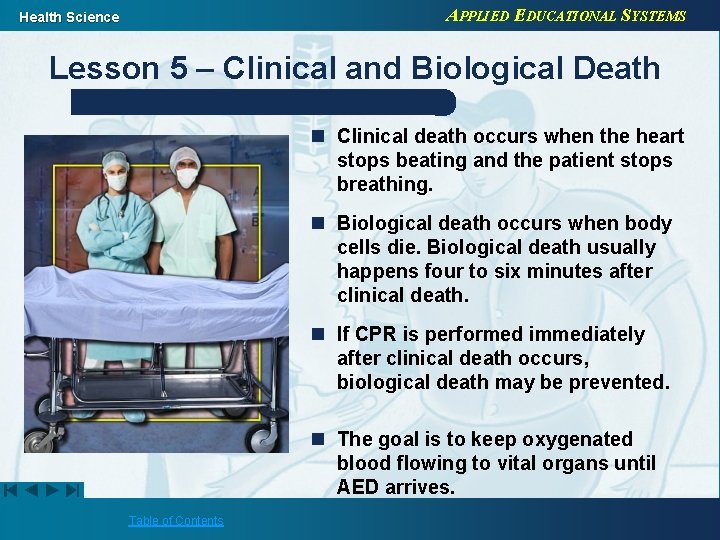
APPLIED EDUCATIONAL SYSTEMS Health Science Lesson 5 – Clinical and Biological Death n Clinical death occurs when the heart stops beating and the patient stops breathing. n Biological death occurs when body cells die. Biological death usually happens four to six minutes after clinical death. n If CPR is performed immediately after clinical death occurs, biological death may be prevented. n The goal is to keep oxygenated blood flowing to vital organs until AED arrives. Table of Contents
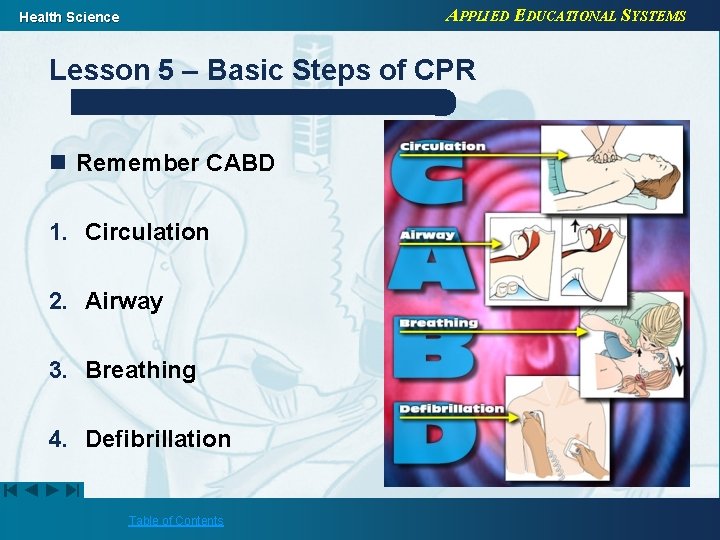
APPLIED EDUCATIONAL SYSTEMS Health Science Lesson 5 – Basic Steps of CPR n Remember CABD 1. Circulation 2. Airway 3. Breathing 4. Defibrillation Table of Contents
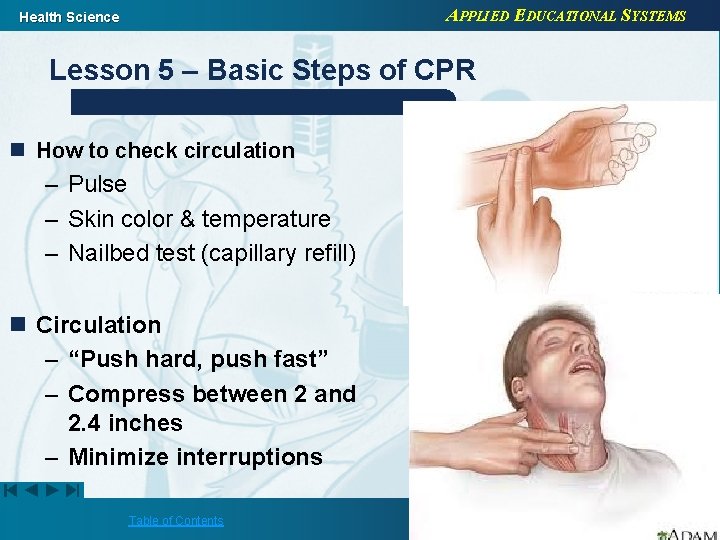
APPLIED EDUCATIONAL SYSTEMS Health Science Lesson 5 – Basic Steps of CPR n How to check circulation – Pulse – Skin color & temperature – Nailbed test (capillary refill) n Circulation – “Push hard, push fast” – Compress between 2 and 2. 4 inches – Minimize interruptions Table of Contents
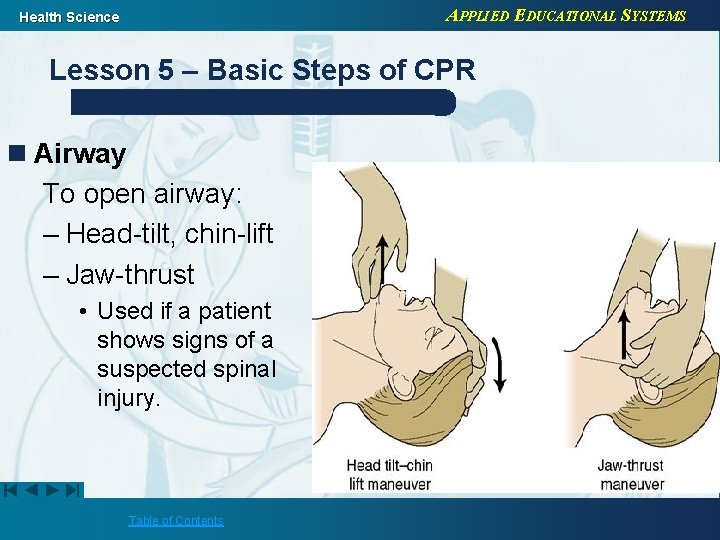
APPLIED EDUCATIONAL SYSTEMS Health Science Lesson 5 – Basic Steps of CPR n Airway To open airway: – Head-tilt, chin-lift – Jaw-thrust • Used if a patient shows signs of a suspected spinal injury. Table of Contents
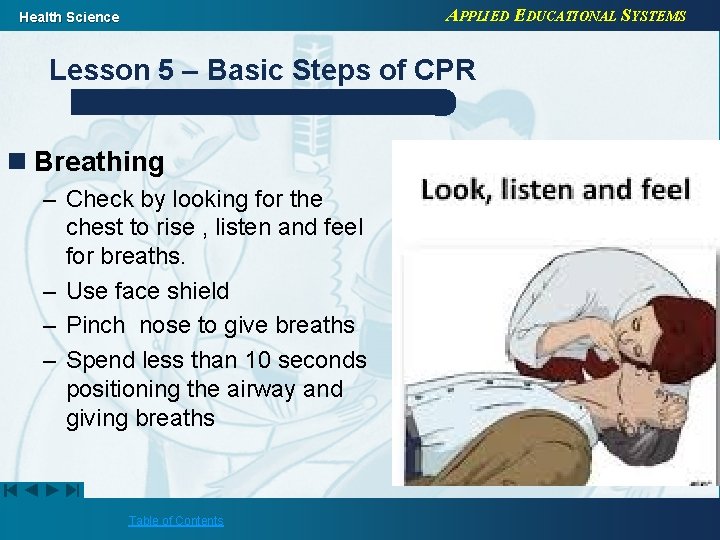
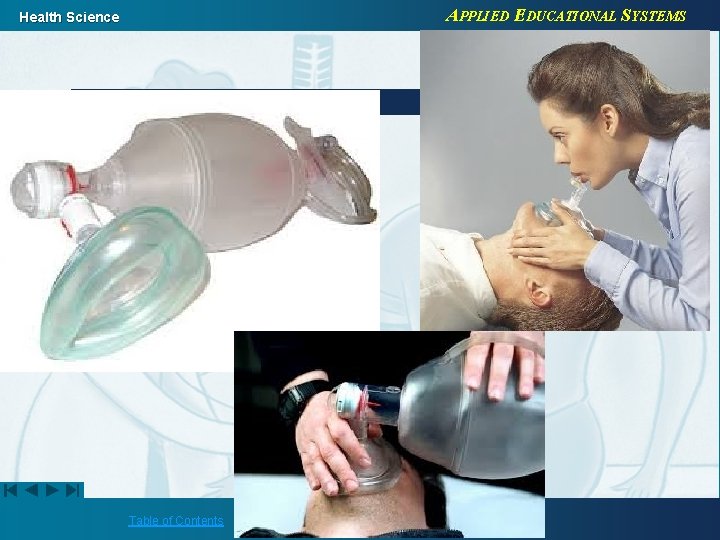
APPLIED EDUCATIONAL SYSTEMS Health Science Lesson 5 – Basic Steps of CPR n Breathing – Check by looking for the chest to rise , listen and feel for breaths. – Use face shield – Pinch nose to give breaths – Spend less than 10 seconds positioning the airway and giving breaths Table of Contents
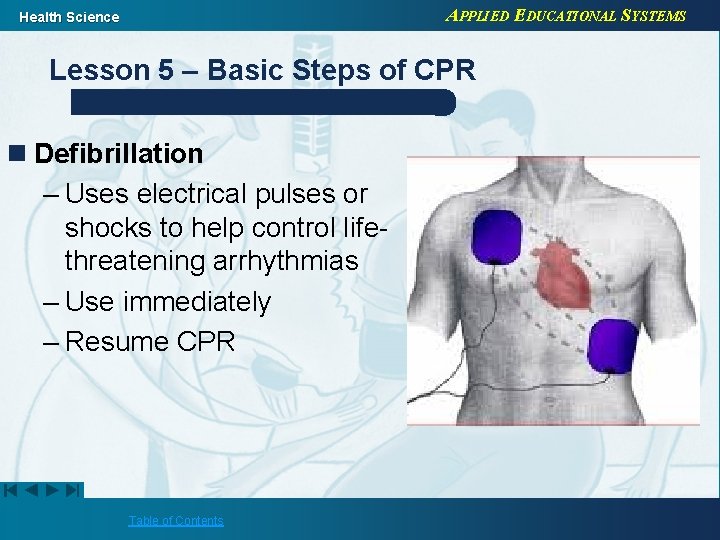
APPLIED EDUCATIONAL SYSTEMS Health Science Lesson 5 – Basic Steps of CPR n Defibrillation – Uses electrical pulses or shocks to help control lifethreatening arrhythmias – Use immediately – Resume CPR Table of Contents
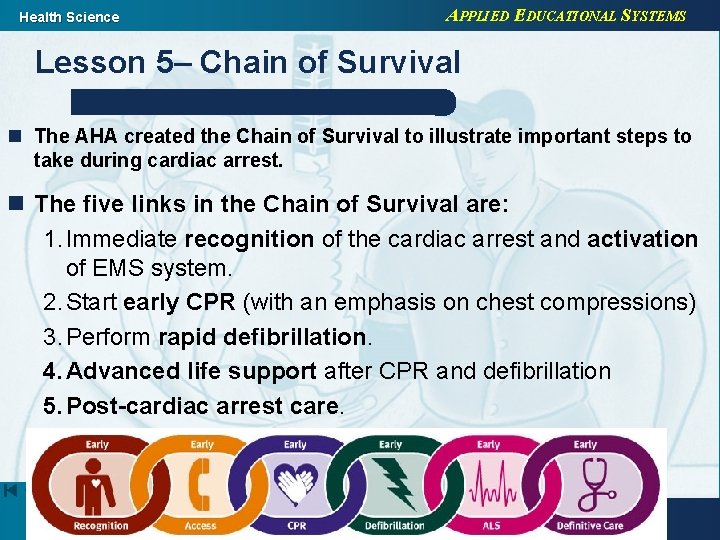
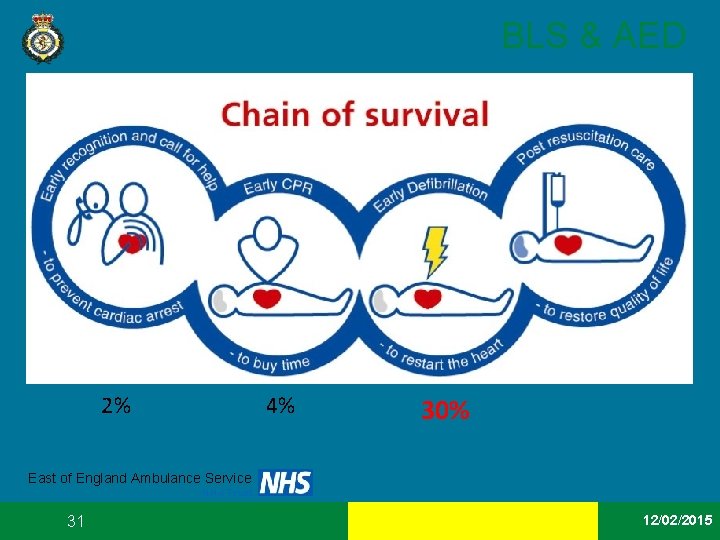
APPLIED EDUCATIONAL SYSTEMS Health Science Lesson 5– Chain of Survival n The AHA created the Chain of Survival to illustrate important steps to take during cardiac arrest. n The five links in the Chain of Survival are: 1. Immediate recognition of the cardiac arrest and activation of EMS system. 2. Start early CPR (with an emphasis on chest compressions) 3. Perform rapid defibrillation. 4. Advanced life support after CPR and defibrillation 5. Post-cardiac arrest care. Table of Contents
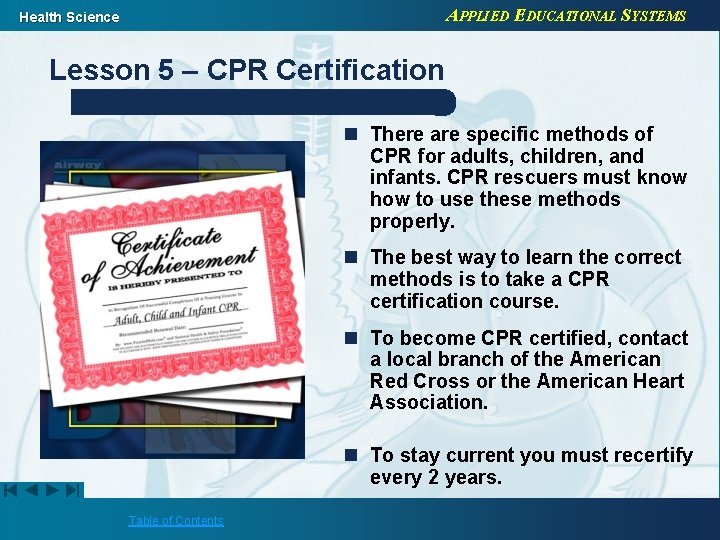
APPLIED EDUCATIONAL SYSTEMS Health Science Lesson 5 – CPR Certification n There are specific methods of CPR for adults, children, and infants. CPR rescuers must know how to use these methods properly. n The best way to learn the correct methods is to take a CPR certification course. n To become CPR certified, contact a local branch of the American Red Cross or the American Heart Association. n To stay current you must recertify every 2 years. Table of Contents
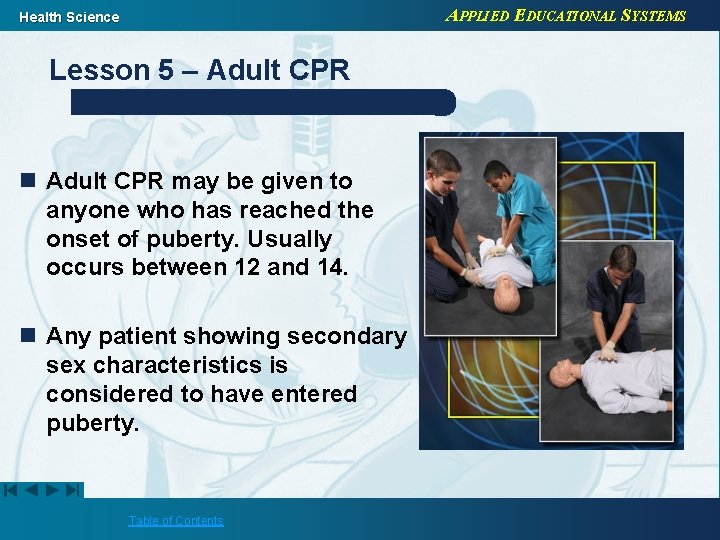
APPLIED EDUCATIONAL SYSTEMS Health Science Lesson 5 – Adult CPR n Adult CPR may be given to anyone who has reached the onset of puberty. Usually occurs between 12 and 14. n Any patient showing secondary sex characteristics is considered to have entered puberty. Table of Contents
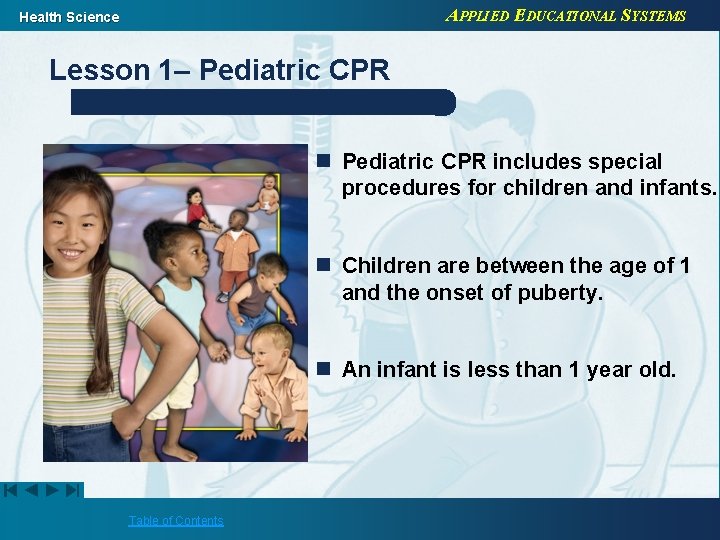
APPLIED EDUCATIONAL SYSTEMS Health Science Lesson 1– Pediatric CPR n Pediatric CPR includes special procedures for children and infants. n Children are between the age of 1 and the onset of puberty. n An infant is less than 1 year old. Table of Contents
APPLIED EDUCATIONAL SYSTEMS Health Science Lesson 1– Causes of Cardiac Arrest n Heart disease is uncommon in pediatrics. However, cardiac arrest may occur as a result of insufficient oxygen to the brain, heart, and vital organs. n Lack of oxygen is often caused by: ▫ Airway obstruction ▫ Suffocation ▫ Overdose of medication ▫ Consuming household chemicals ▫ Drowning ▫ Asthma and other respiratory disorders ▫ Trauma Table of Contents
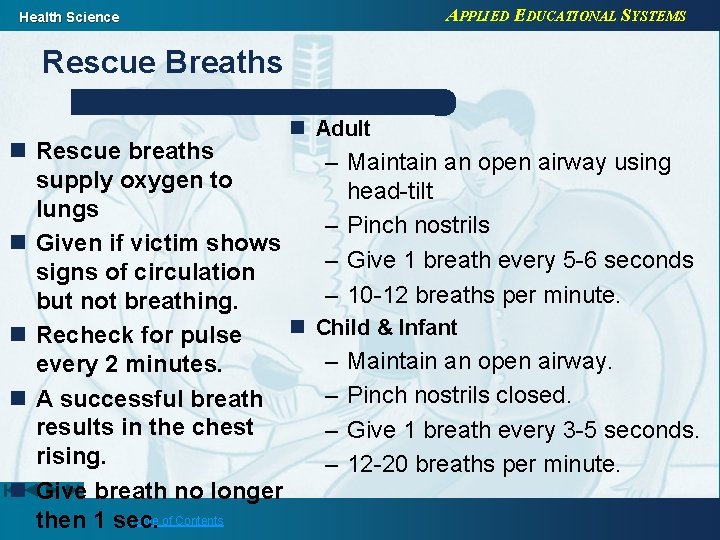
APPLIED EDUCATIONAL SYSTEMS Health Science Rescue Breaths n Adult n Rescue breaths supply oxygen to lungs n Given if victim shows signs of circulation but not breathing. n n Recheck for pulse every 2 minutes. n A successful breath results in the chest rising. n Give breath no longer Table of Contents then 1 sec. – Maintain an open airway using head-tilt – Pinch nostrils – Give 1 breath every 5 -6 seconds – 10 -12 breaths per minute. Child & Infant – – Maintain an open airway. Pinch nostrils closed. Give 1 breath every 3 -5 seconds. 12 -20 breaths per minute.
APPLIED EDUCATIONAL SYSTEMS Health Science Table of Contents
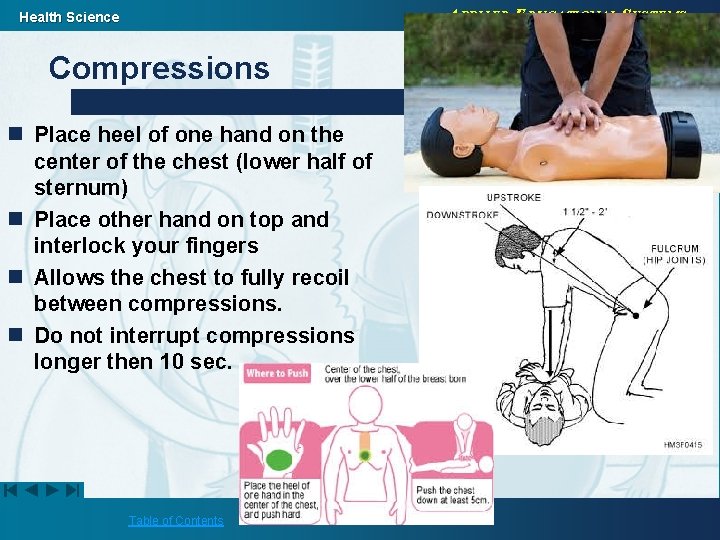
APPLIED EDUCATIONAL SYSTEMS Health Science Compressions n Place heel of one hand on the center of the chest (lower half of sternum) n Place other hand on top and interlock your fingers n Allows the chest to fully recoil between compressions. n Do not interrupt compressions longer then 10 sec. Table of Contents
APPLIED EDUCATIONAL SYSTEMS Health Science Adult CPR Procedures • 1 & 2 Rescuer Ratio- n 1: Check the Scene n 2: Check for responsiveness & activate emergency plan n 3: Check pulse (carotid) while watching and feeling for breaths. No longer then 10 sec (atleast 5). n 4: No pulse or breathing give compressions & breaths till AED arrives n If you are alone activate the EMS and get the AED before beginning CPR Table of Contents • 30 compressions 2 breaths (30: 2) • 100 -120 compressions per minute • Compress chest atleast 2 inchs • 5 cycles then reassess for pulse and breathing • Compress chest atleast 2 inchs
APPLIED EDUCATIONAL SYSTEMS Health Science Child CPR Procedures n Alone and did not witness collapse, 2 minutes of CPR before activating EMS. n Depress chest about 2 inches (1/3 the depth of chest) n For two rescuers, give 15 compressions followed by 2 breaths Table of Contents n For 1 Rescuer: n Compress straight down about 2 inches n 30 x at a rate of 100 -120 times per minute. n Give 2 breaths n Do 5 cycles of 30: 2 (2 min) n Reassess for pulse and breathing n 2 rescuers: 1 person gives breaths while other does compressions. Switch every 5 cycles (15: 2 ratio)
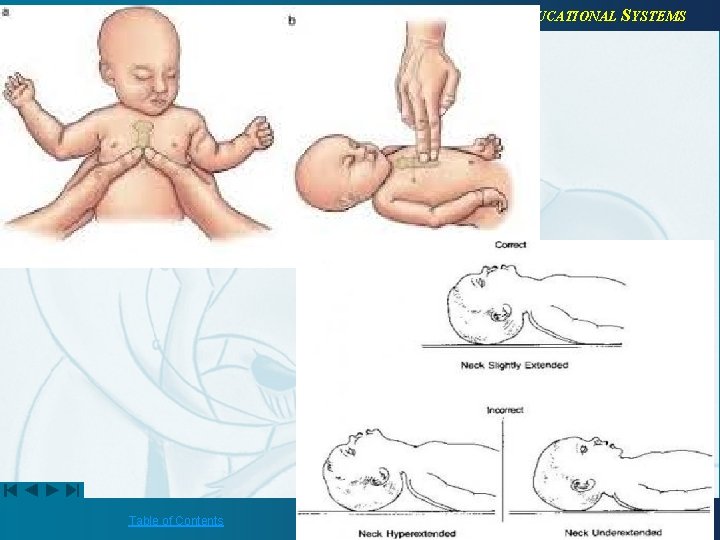
APPLIED EDUCATIONAL SYSTEMS Health Science Infant CPR Procedures n Alone and did not witness, 2 minutes of CPR before activating EMS n Depress chest about 1. 5 inches (atleast 1/3 the depth of chest) n 1 Rescuer 30: 2 ratio n 2 Rescuer 15: 2 ratio n Use manual defibrillator, if available Table of Contents n Pulse Check: Brachial pulse, 2 fingers on inside of upper arm between elbow & underarm. n Breaths: seal mouth around nose and mouth n 1 Rescuer Hand Placement: – 2 fingers in the center of the chest n 2 Rescuer Hand Placement: – just below the nipple line 2 or more Rescuers 2 thumbencircling hands in the center of the chest just below the nipple line
APPLIED EDUCATIONAL SYSTEMS Health Science Table of Contents
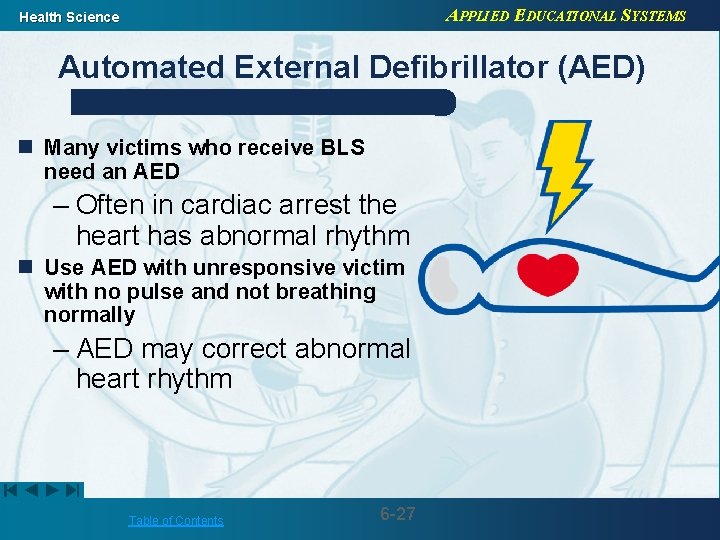
APPLIED EDUCATIONAL SYSTEMS Health Science Automated External Defibrillator (AED) n Many victims who receive BLS need an AED – Often in cardiac arrest the heart has abnormal rhythm n Use AED with unresponsive victim with no pulse and not breathing normally – AED may correct abnormal heart rhythm Table of Contents 6 -27
APPLIED EDUCATIONAL SYSTEMS Health Science AUTOMATED EXTERNAL DEFIBRILLATORS n An AED is an “electric shock box” used to stop the electrical activity of the heart when it is in a life threatening rhythm, this allows the Heart to re-establish an effective rhythm. n The AED will; – analyse the size, rate, and wave shape of the cardiac rhythm – only advise a shock for a shockable rhythm (ventricular fibrillation & ventricular tachycardia) – advise the operator step-by-step what to do Table of Contents
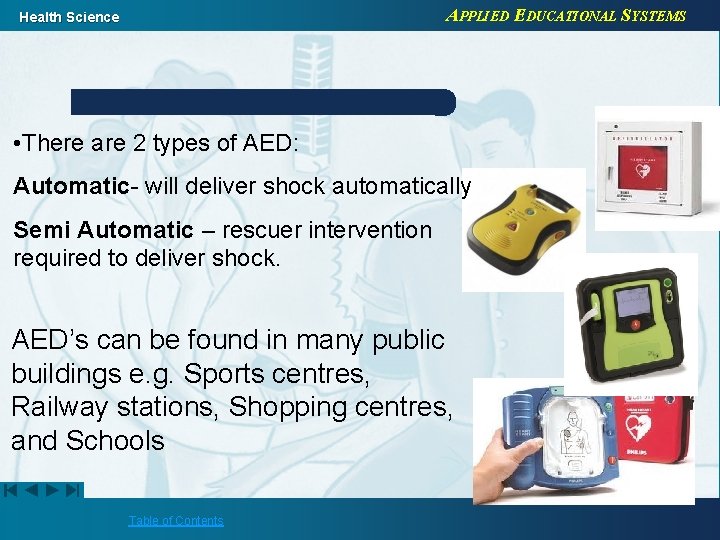
APPLIED EDUCATIONAL SYSTEMS Health Science • There are 2 types of AED: Automatic- will deliver shock automatically Semi Automatic – rescuer intervention required to deliver shock. AED’s can be found in many public buildings e. g. Sports centres, Railway stations, Shopping centres, and Schools Table of Contents
APPLIED EDUCATIONAL SYSTEMS Health Science AED Time & Rates n Sudden Cardiac Arrest Reversal Rates – CPR Only 0 -2% – EMS/ER 5 -15% – CPR/AED 30 -75% – AED should be used within 3 -5 minutes after collapse. – With every minute that goes by, survival drops by about 10% Table of Contents
BLS & AED 2% 4% 30% East of England Ambulance Service NHS Trust 31 Date 12/02/2015
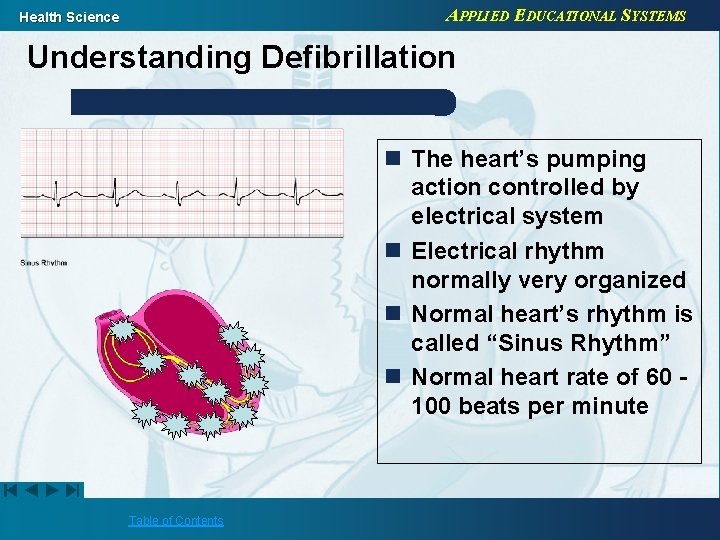
APPLIED EDUCATIONAL SYSTEMS Health Science Understanding Defibrillation n The heart’s pumping action controlled by electrical system n Electrical rhythm normally very organized n Normal heart’s rhythm is called “Sinus Rhythm” n Normal heart rate of 60 100 beats per minute Table of Contents
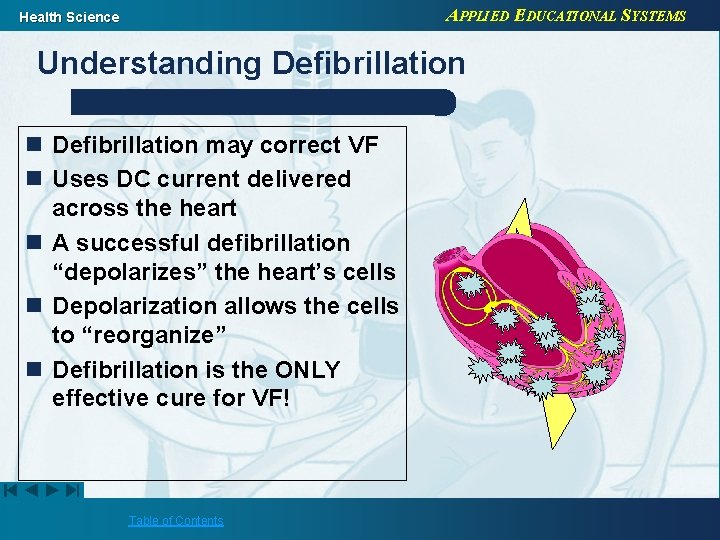
APPLIED EDUCATIONAL SYSTEMS Health Science Understanding Defibrillation n Defibrillation may correct VF n Uses DC current delivered across the heart n A successful defibrillation “depolarizes” the heart’s cells n Depolarization allows the cells to “reorganize” n Defibrillation is the ONLY effective cure for VF! Table of Contents
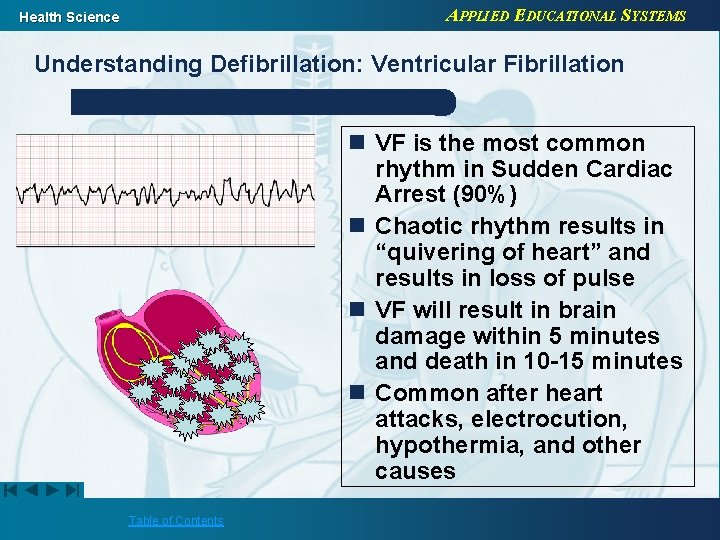
APPLIED EDUCATIONAL SYSTEMS Health Science Understanding Defibrillation: Ventricular Fibrillation n VF is the most common rhythm in Sudden Cardiac Arrest (90%) n Chaotic rhythm results in “quivering of heart” and results in loss of pulse n VF will result in brain damage within 5 minutes and death in 10 -15 minutes n Common after heart attacks, electrocution, hypothermia, and other causes Table of Contents
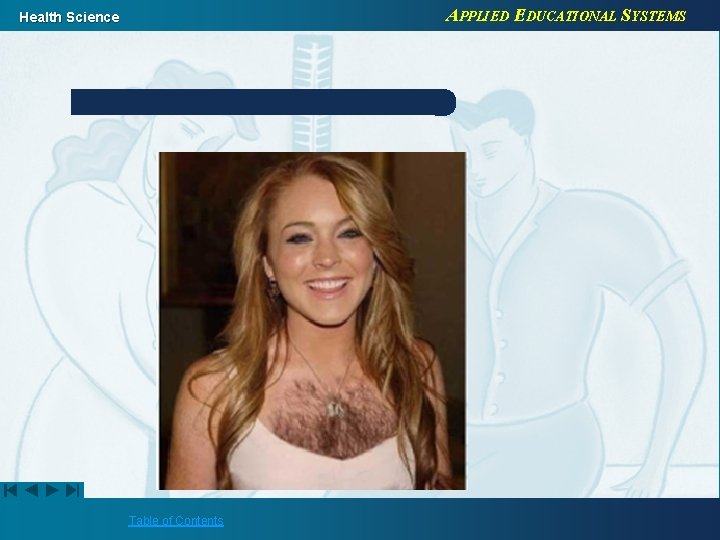
APPLIED EDUCATIONAL SYSTEMS Health Science DEFIBRILLATION SAFETY ! § § § THE PATIENT. Check: Pacemaker Jewellery Hair on chest Damp/Wet skin Table of Contents § § THE AED. In good working order Do Not use in Heavy rain Do Not use if they lay in a pool of water § Do Not use in an explosive environment!
APPLIED EDUCATIONAL SYSTEMS Health Science Internal Pacemaker/Defibrillator n May see bulge beneath victim’s skin n Do not place AED over area—place it at least one or more inches away n If victim’s body is jerking – Implanted defibrillator may be giving shocks – Wait until jerking ends Table of Contents 6 -36
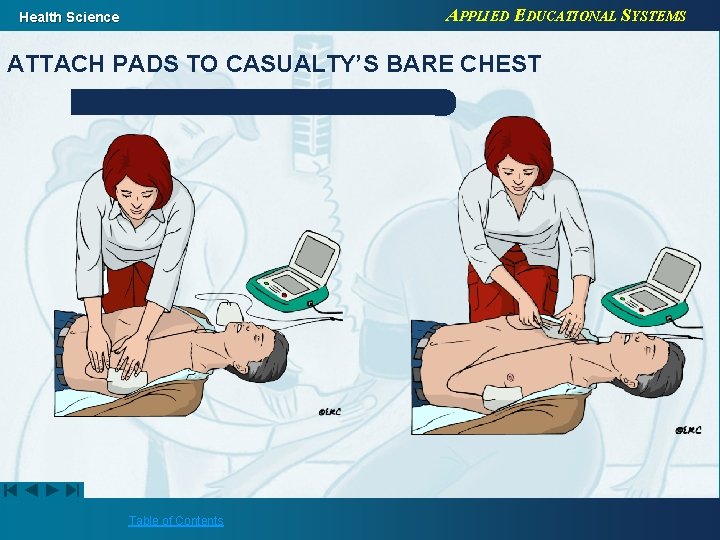
APPLIED EDUCATIONAL SYSTEMS Health Science ATTACH PADS TO CASUALTY’S BARE CHEST Table of Contents
APPLIED EDUCATIONAL SYSTEMS Health Science ANALYSING RHYTHM DO NOT TOUCH PATIENT Table of Contents
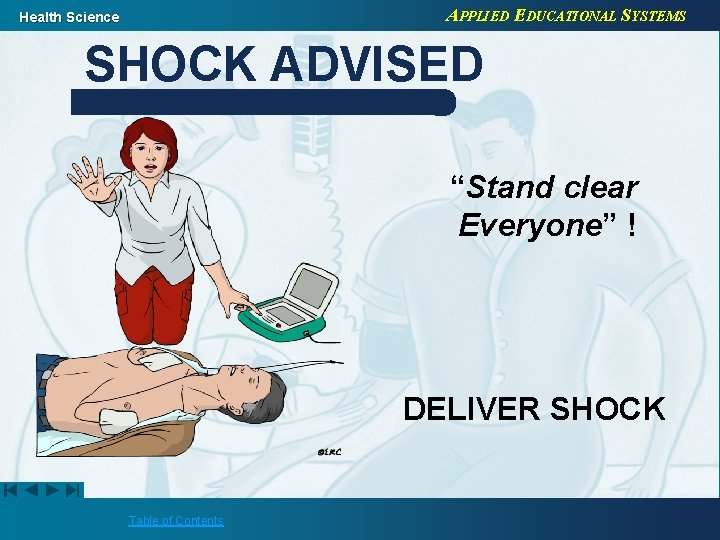
APPLIED EDUCATIONAL SYSTEMS Health Science SHOCK ADVISED “Stand clear Everyone” ! DELIVER SHOCK Table of Contents
APPLIED EDUCATIONAL SYSTEMS Health Science DEFIBRILLATION Table of Contents
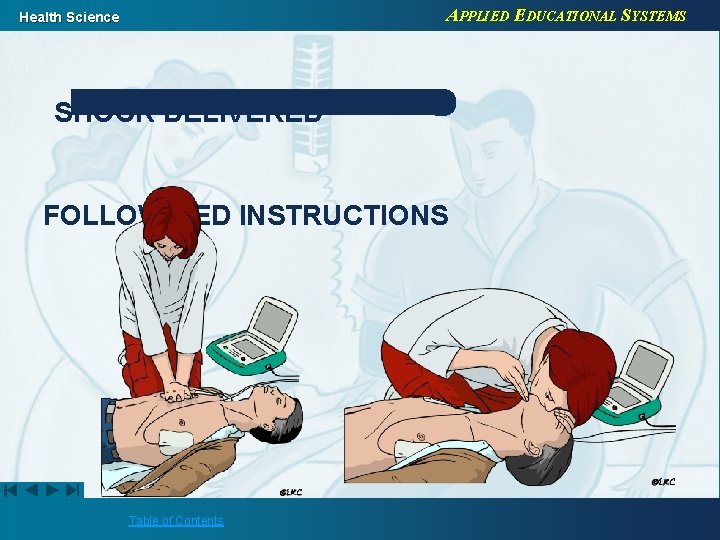
APPLIED EDUCATIONAL SYSTEMS Health Science SHOCK DELIVERED FOLLOW AED INSTRUCTIONS Table of Contents
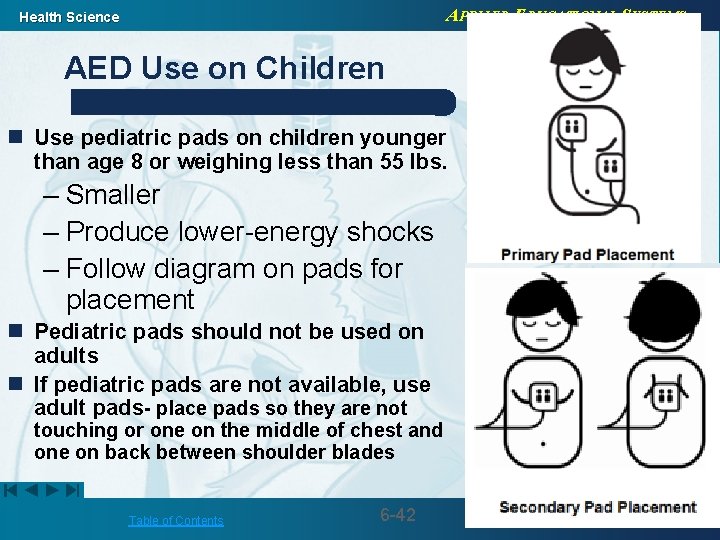
APPLIED EDUCATIONAL SYSTEMS Health Science AED Use on Children n Use pediatric pads on children younger than age 8 or weighing less than 55 lbs. – Smaller – Produce lower-energy shocks – Follow diagram on pads for placement n Pediatric pads should not be used on adults n If pediatric pads are not available, use adult pads- place pads so they are not touching or one on the middle of chest and one on back between shoulder blades Table of Contents 6 -42
APPLIED EDUCATIONAL SYSTEMS Health Science Table of Contents