
Applied Combinatorics Alan Tucker th 4 Ed Section
Applied Combinatorics, Alan Tucker th 4 Ed. Section 4. 4 Algorithmic Matching Prepared by Joshua Schoenly and Kathleen Mc. Namara 04/12/2005 Tucker, Sec. 4. 4 1
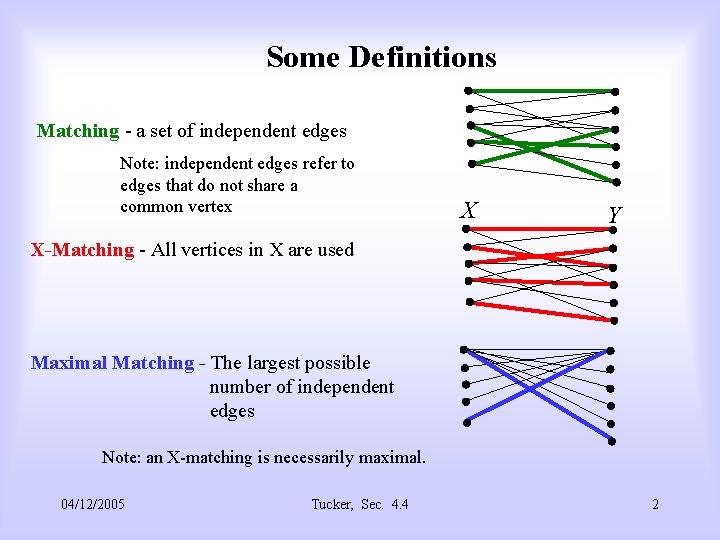
Some Definitions Matching - a set of independent edges Note: independent edges refer to edges that do not share a common vertex X Y X-Matching - All vertices in X are used Maximal Matching - The largest possible number of independent edges Note: an X-matching is necessarily maximal. 04/12/2005 Tucker, Sec. 4. 4 2

More Definitions R(A) Range of a set A of vertices Edge Cover R(A) is the set of vertices adjacent to at least one vertex in A A set of vertices so that every edge is incident to at least one of them A = red, R(A) = green 04/12/2005 Tucker, Sec. 4. 4 3
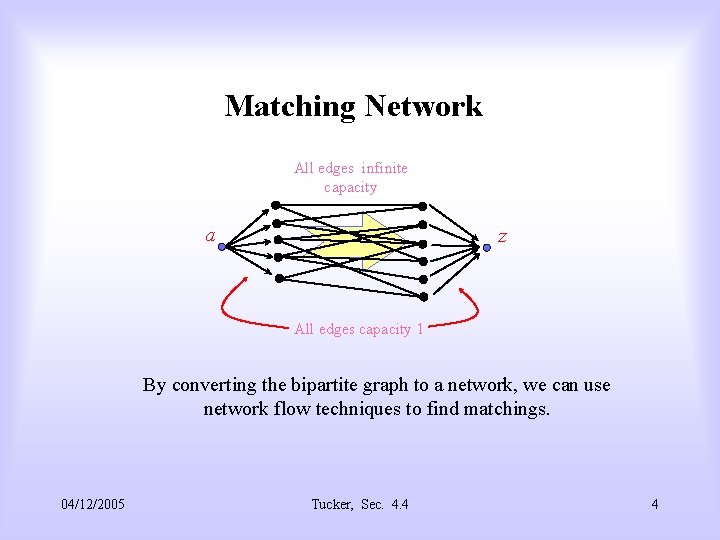
Matching Network All edges infinite capacity a z All edges capacity 1 By converting the bipartite graph to a network, we can use network flow techniques to find matchings. 04/12/2005 Tucker, Sec. 4. 4 4

Matching Network zz a Matching X – matching 04/12/2005 asaturation – z flow at a Tucker, Sec. 4. 4 5

Matching Network a Maximal matching 04/12/2005 z Maximal flow Tucker, Sec. 4. 4 6
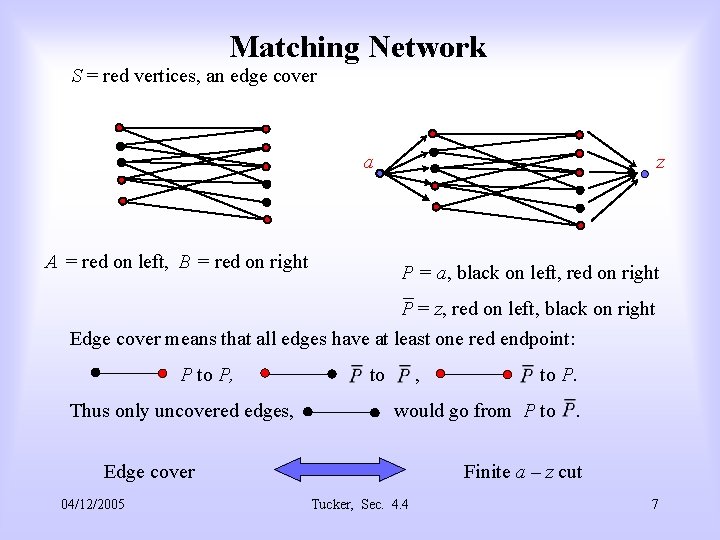
Matching Network S = red vertices, an edge cover a A = red on left, B = red on right z P = a, black on left, red on right P = z, red on left, black on right Edge cover means that all edges have at least one red endpoint: P to P, Thus only uncovered edges, to , would go from P to Edge cover 04/12/2005 to P. . Finite a – z cut Tucker, Sec. 4. 4 7
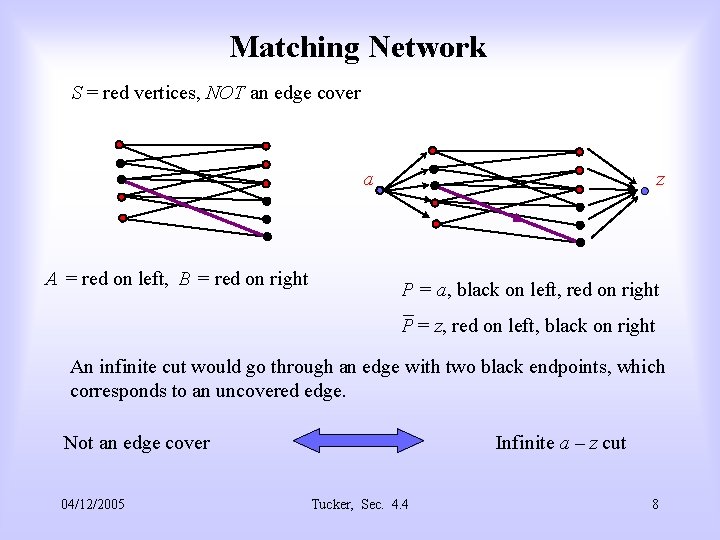
Matching Network S = red vertices, NOT an edge cover a A = red on left, B = red on right z P = a, black on left, red on right P = z, red on left, black on right An infinite cut would go through an edge with two black endpoints, which corresponds to an uncovered edge. Not an edge cover 04/12/2005 Infinite a – z cut Tucker, Sec. 4. 4 8
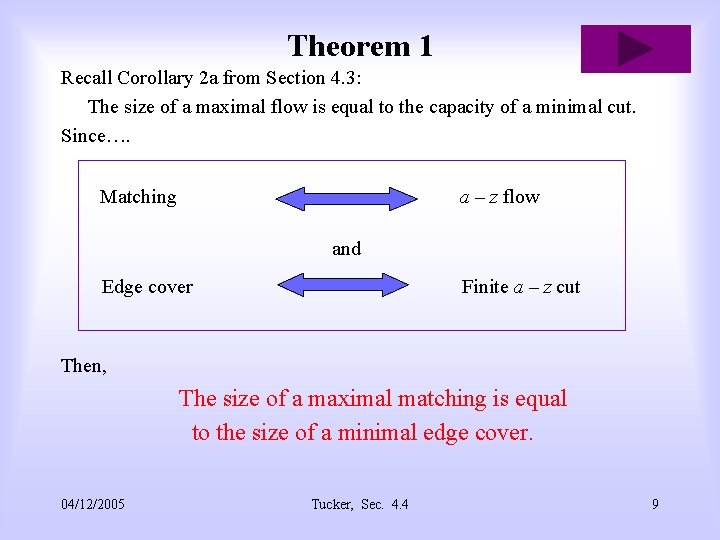
Theorem 1 Recall Corollary 2 a from Section 4. 3: The size of a maximal flow is equal to the capacity of a minimal cut. Since…. Matching a – z flow and Edge cover Finite a – z cut Then, The size of a maximal matching is equal to the size of a minimal edge cover. 04/12/2005 Tucker, Sec. 4. 4 9
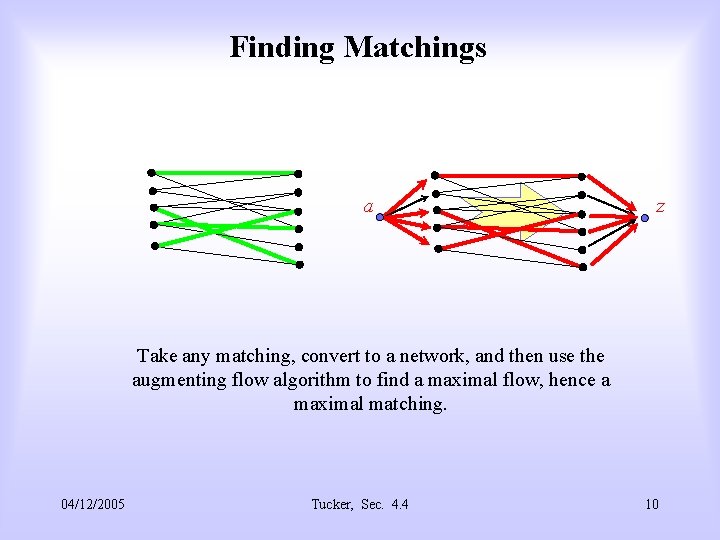
Finding Matchings a z Take any matching, convert to a network, and then use the augmenting flow algorithm to find a maximal flow, hence a maximal matching. 04/12/2005 Tucker, Sec. 4. 4 10
An easy way to think about it 1. Start with any matching. 2. From an unmatched vertex in X, alternate between nonmatching and matching edges until you hit an unmatched vertex in Y. 3. Then switch between the non-matching and matching edges along to path to pick up one more matching edge. 4. Continue this until no unmatched vertex in X leads to an unmatched vertex in Y. 04/12/2005 Tucker, Sec. 4. 4 11
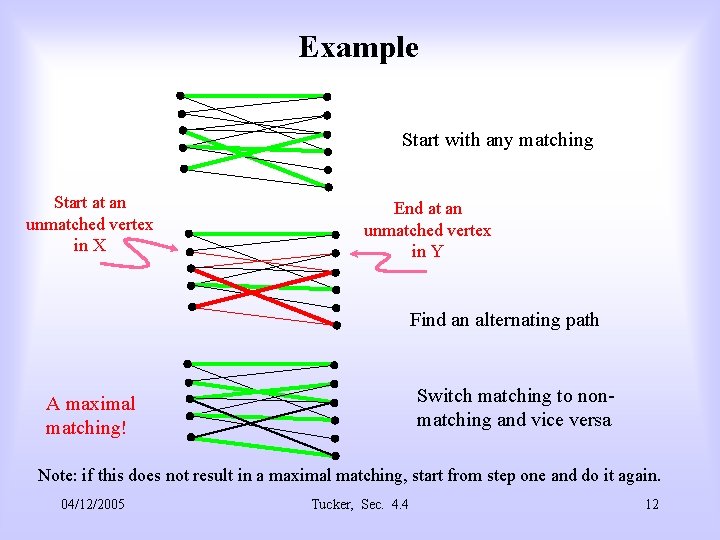
Example Start with any matching Start at an unmatched vertex in X End at an unmatched vertex in Y Find an alternating path Switch matching to nonmatching and vice versa A maximal matching! Note: if this does not result in a maximal matching, start from step one and do it again. 04/12/2005 Tucker, Sec. 4. 4 12
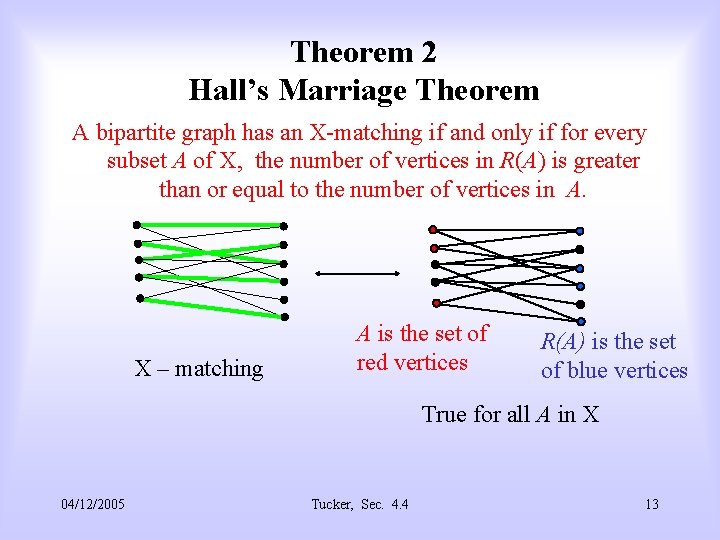
Theorem 2 Hall’s Marriage Theorem A bipartite graph has an X-matching if and only if for every subset A of X, the number of vertices in R(A) is greater than or equal to the number of vertices in A. X – matching A is the set of red vertices R(A) is the set of blue vertices True for all A in X 04/12/2005 Tucker, Sec. 4. 4 13
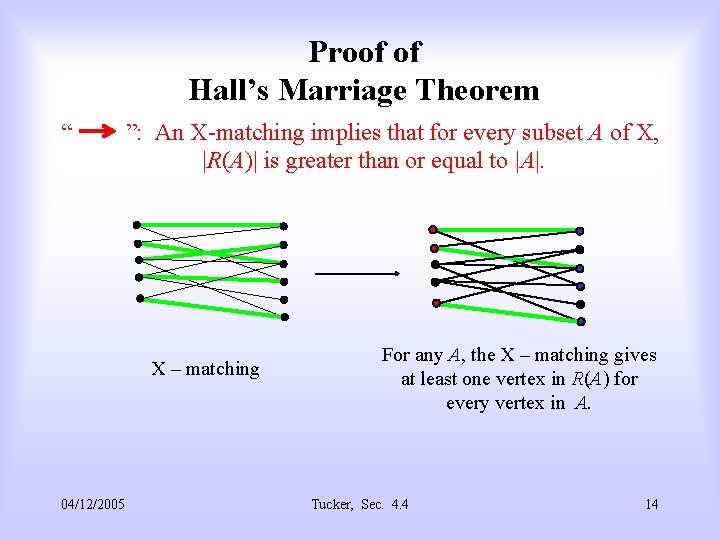
Proof of Hall’s Marriage Theorem “ ”: An X-matching implies that for every subset A of X, |R(A)| is greater than or equal to |A|. X – matching 04/12/2005 For any A, the X – matching gives at least one vertex in R(A) for every vertex in A. Tucker, Sec. 4. 4 14
Proof of Hall’s Marriage Theorem “ ”: If |R(A)| is greater than or equal to |A| for every subset A of X, then there is an X-matching. • First note that if M is a maximal matching, then • Taking A = X, we have that contained in Y. Thus since the range of X is. • Also, by Theorem 1, if S is a minimal edge cover, then • Note that if • Thus, it suffices to show that 04/12/2005 . . , then M must be an X – matching. Tucker, Sec. 4. 4 for all edge covers S. 15
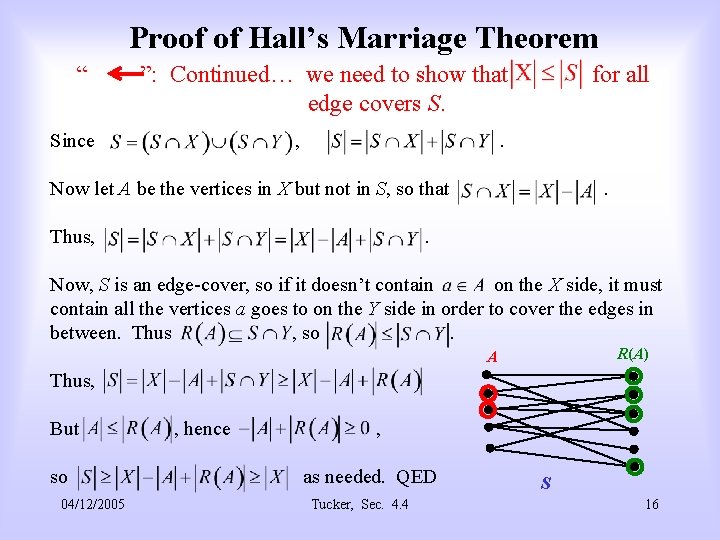
Proof of Hall’s Marriage Theorem “ ”: Continued… we need to show that edge covers S. Since , for all . Now let A be the vertices in X but not in S, so that Thus, . . Now, S is an edge-cover, so if it doesn’t contain on the X side, it must contain all the vertices a goes to on the Y side in order to cover the edges in between. Thus , so. R(A) A Thus, But so 04/12/2005 , hence , as needed. QED Tucker, Sec. 4. 4 S 16
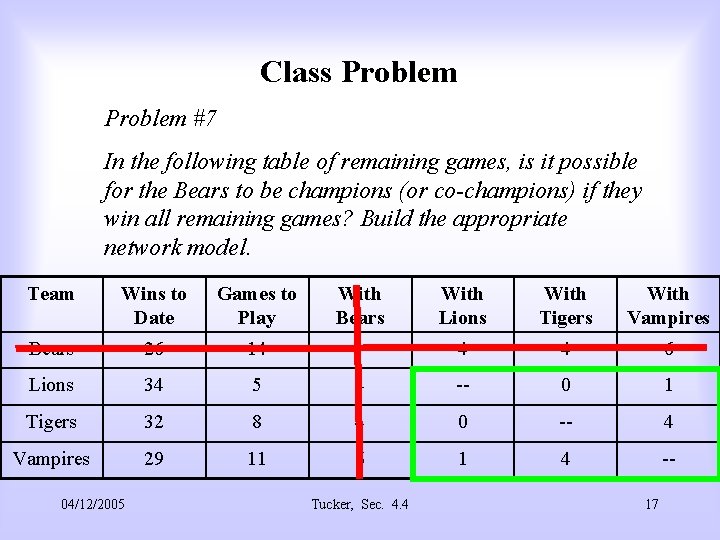
Class Problem #7 In the following table of remaining games, is it possible for the Bears to be champions (or co-champions) if they win all remaining games? Build the appropriate network model. Team Wins to Date Games to Play With Bears With Lions With Tigers With Vampires Bears 26 14 -- 4 4 6 Lions 34 5 4 -- 0 1 Tigers 32 8 4 0 -- 4 Vampires 29 11 6 1 4 -- 04/12/2005 Tucker, Sec. 4. 4 17
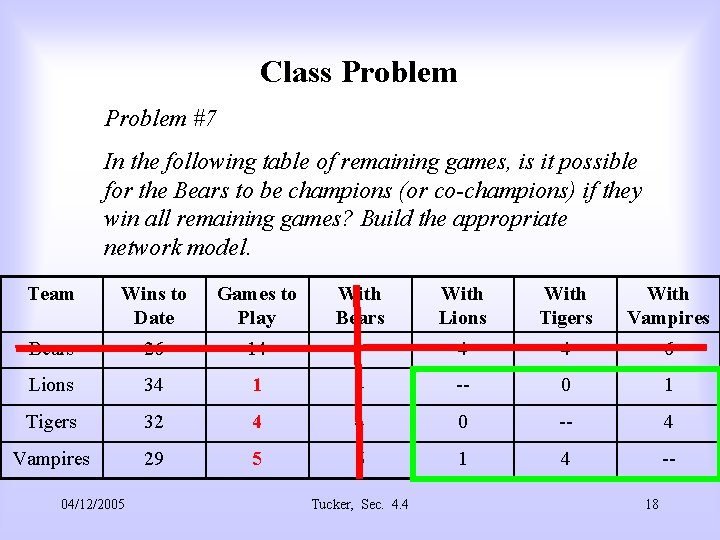
Class Problem #7 In the following table of remaining games, is it possible for the Bears to be champions (or co-champions) if they win all remaining games? Build the appropriate network model. Team Wins to Date Games to Play With Bears With Lions With Tigers With Vampires Bears 26 14 -- 4 4 6 Lions 34 1 4 -- 0 1 Tigers 32 4 4 0 -- 4 Vampires 29 5 6 1 4 -- 04/12/2005 Tucker, Sec. 4. 4 18
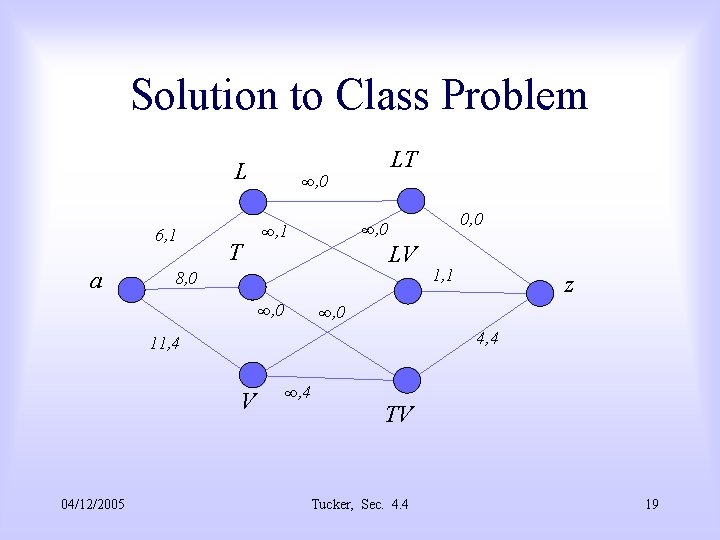
Solution to Class Problem L 6, 1 a T LT ∞, 0 0, 0 ∞, 1 LV 8, 0 ∞, 0 z ∞, 0 4, 4 11, 4 V 04/12/2005 1, 1 ∞, 4 TV Tucker, Sec. 4. 4 19
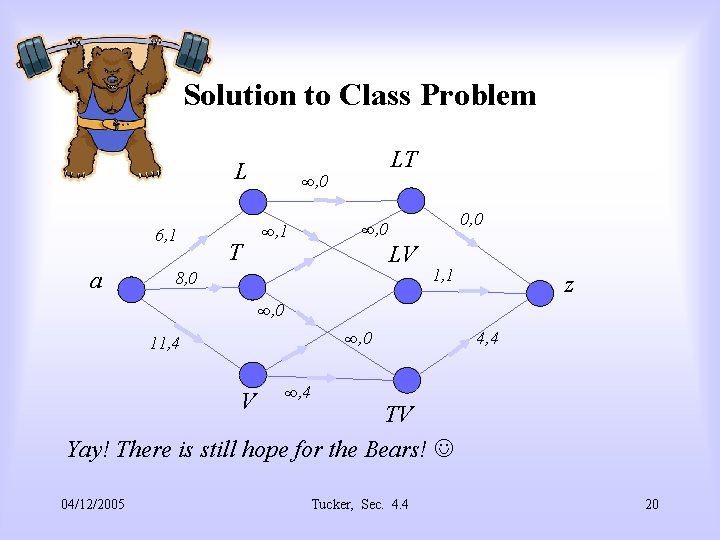
Solution to Class Problem L 6, 1 a T LT ∞, 0 0, 0 ∞, 1 LV 8, 0 1, 1 z ∞, 0 11, 4 V 4, 4 ∞, 4 TV Yay! There is still hope for the Bears! 04/12/2005 Tucker, Sec. 4. 4 20
- Slides: 20