
Applied Algebra B Lesson 1 3 Commutative and
Applied Algebra B Lesson: 1 – 3 Commutative and Associative Properties Objective: Lear to use the commutative and associative properties to simplify expressions.
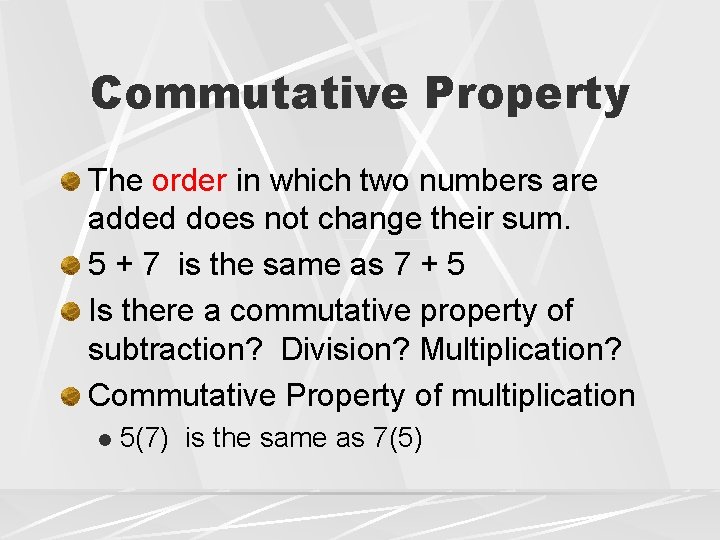
Commutative Property The order in which two numbers are added does not change their sum. 5 + 7 is the same as 7 + 5 Is there a commutative property of subtraction? Division? Multiplication? Commutative Property of multiplication l 5(7) is the same as 7(5)
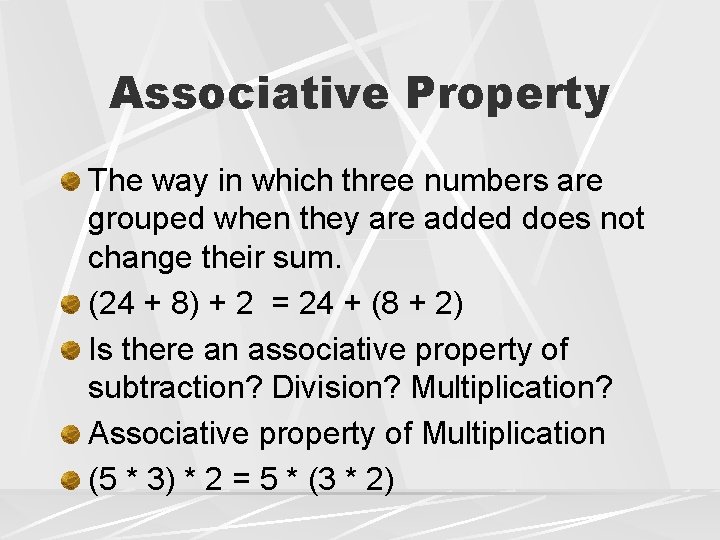
Associative Property The way in which three numbers are grouped when they are added does not change their sum. (24 + 8) + 2 = 24 + (8 + 2) Is there an associative property of subtraction? Division? Multiplication? Associative property of Multiplication (5 * 3) * 2 = 5 * (3 * 2)
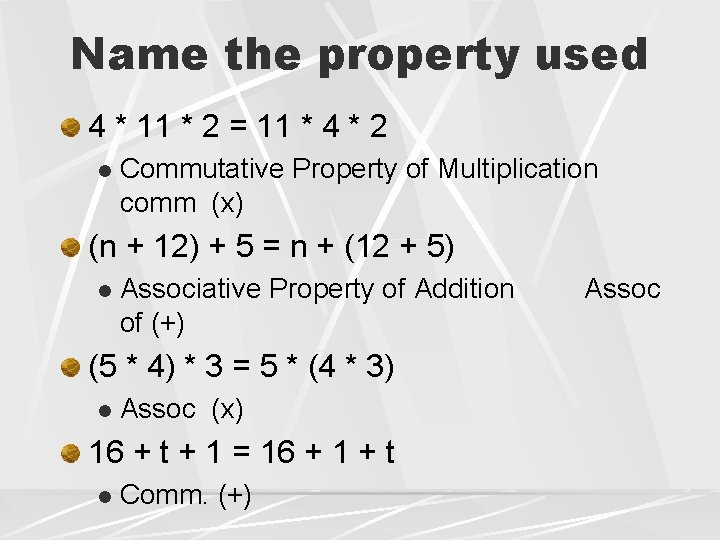
Name the property used 4 * 11 * 2 = 11 * 4 * 2 l Commutative Property of Multiplication comm (x) (n + 12) + 5 = n + (12 + 5) l Associative Property of Addition of (+) (5 * 4) * 3 = 5 * (4 * 3) l Assoc (x) 16 + t + 1 = 16 + 1 + t l Comm. (+) Assoc
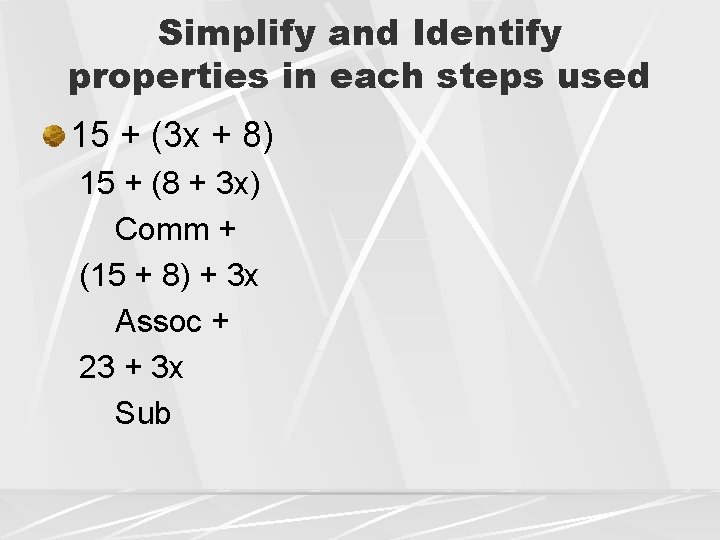
Simplify and Identify properties in each steps used 15 + (3 x + 8) 15 + (8 + 3 x) Comm + (15 + 8) + 3 x Assoc + 23 + 3 x Sub

The volume of a box can be found using the expression l x w x h, where l is the length, w is the width, and h is the height. Find the volume of a box whose length is 30 inches, width is 6 inches, and height is 5 inches. l x w x h = 30 x 6 x 5 = 30 x 30 = 900 cubic inches
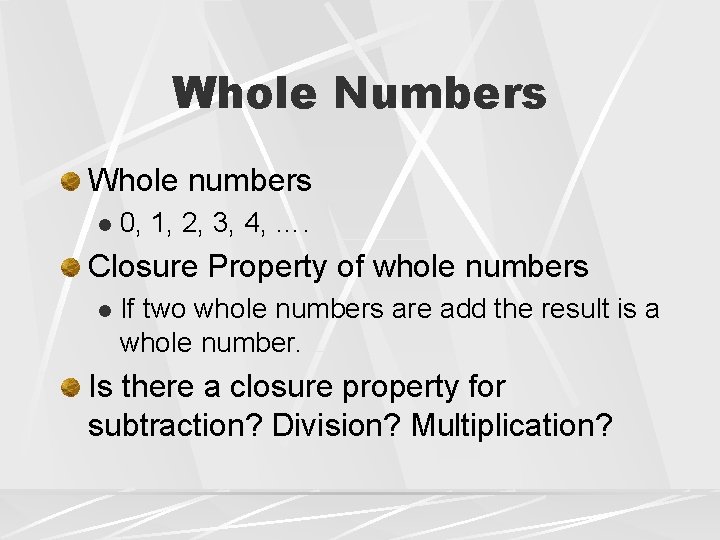
Whole Numbers Whole numbers l 0, 1, 2, 3, 4, …. Closure Property of whole numbers l If two whole numbers are add the result is a whole number. Is there a closure property for subtraction? Division? Multiplication?
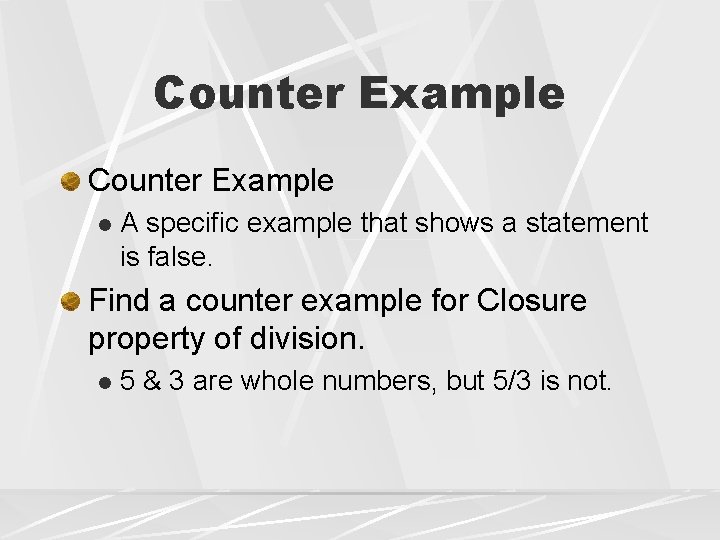
Counter Example l A specific example that shows a statement is false. Find a counter example for Closure property of division. l 5 & 3 are whole numbers, but 5/3 is not.
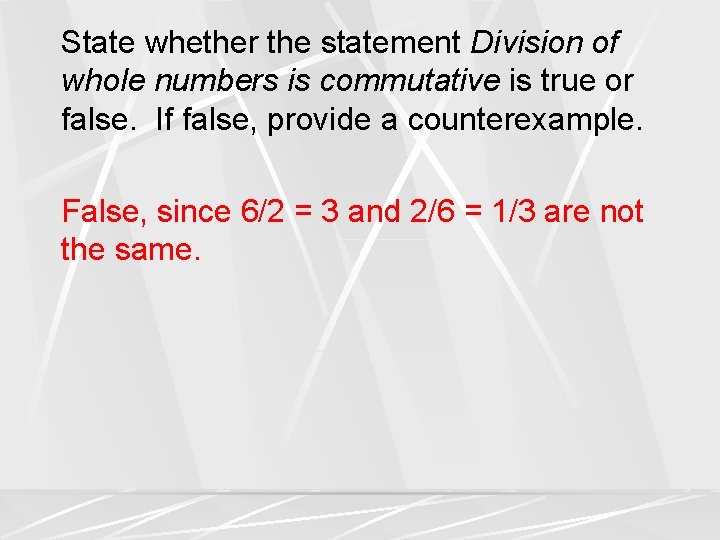
State whether the statement Division of whole numbers is commutative is true or false. If false, provide a counterexample. False, since 6/2 = 3 and 2/6 = 1/3 are not the same.
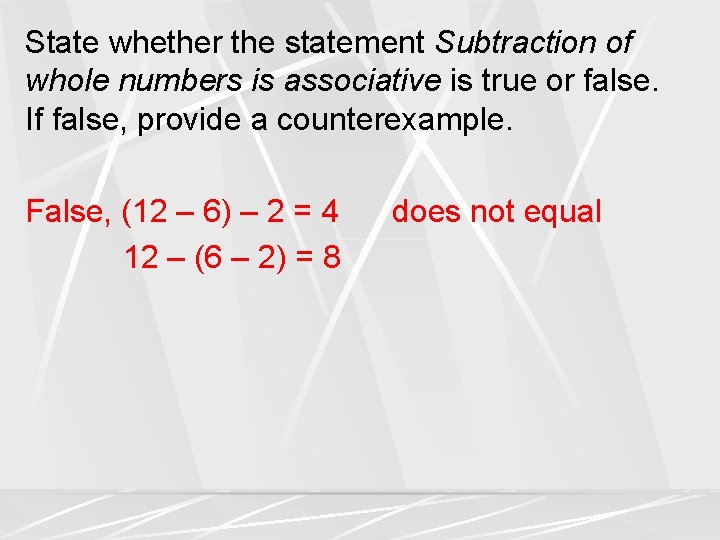
State whether the statement Subtraction of whole numbers is associative is true or false. If false, provide a counterexample. False, (12 – 6) – 2 = 4 12 – (6 – 2) = 8 does not equal
Homework Pg. 17 1 – 9 all, 10 – 32 E
- Slides: 11