
Applications Systems Development A very brief overview of
Applications & Systems Development A very brief overview of the SDLC and the security issues involved.
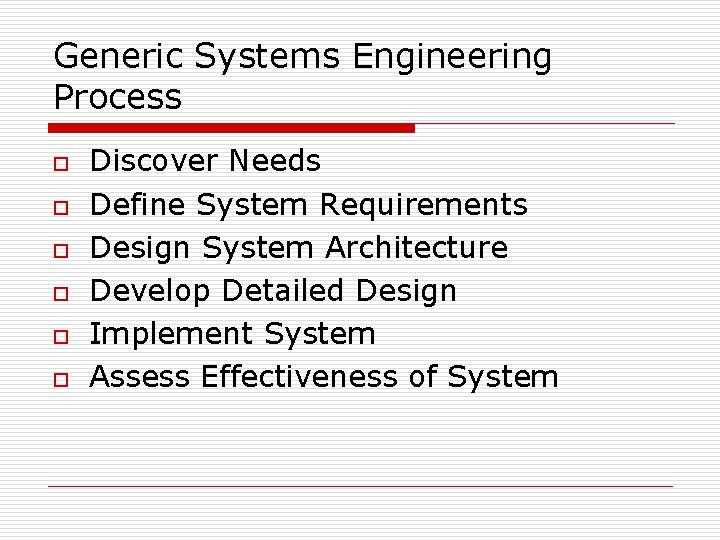
Generic Systems Engineering Process o o o Discover Needs Define System Requirements Design System Architecture Develop Detailed Design Implement System Assess Effectiveness of System
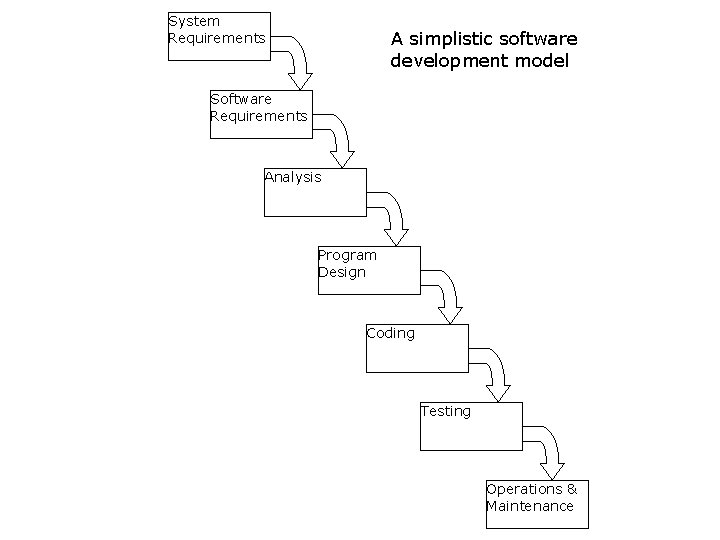
System Requirements A simplistic software development model Software Requirements Analysis Program Design Coding Testing Operations & Maintenance
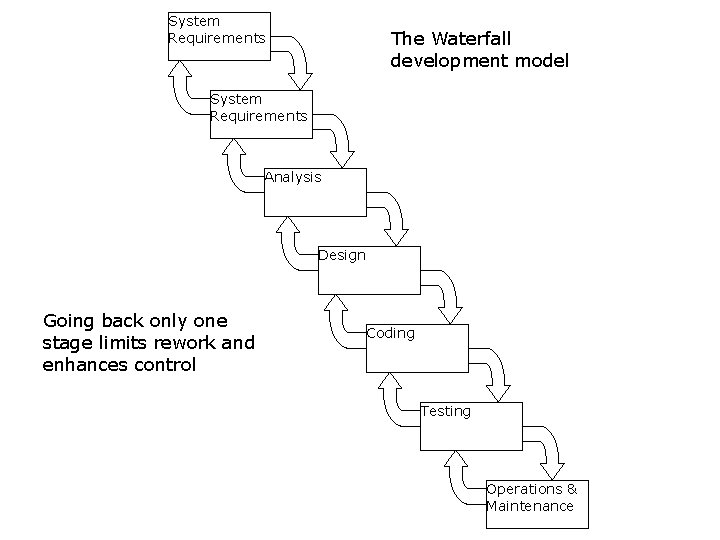
System Requirements The Waterfall development model System Requirements Analysis Design Going back only one stage limits rework and enhances control Coding Testing Operations & Maintenance
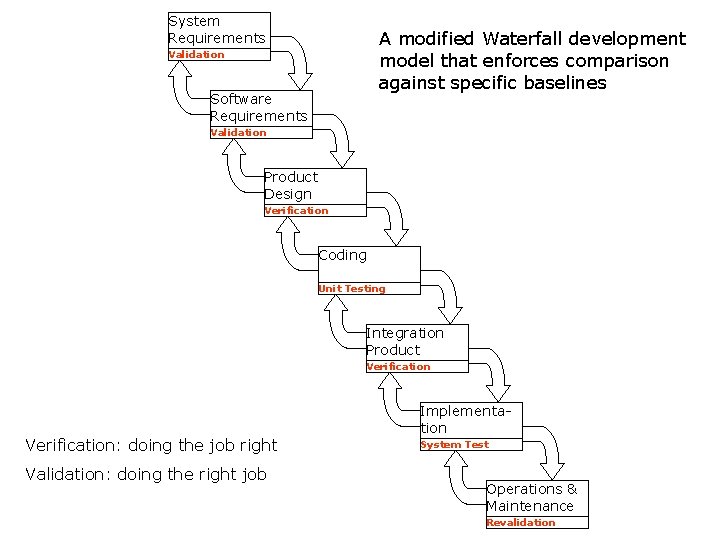
System Requirements A modified Waterfall development model that enforces comparison against specific baselines Validation Software Requirements Validation Product Design Verification Coding Unit Testing Integration Product Verification: doing the job right Validation: doing the right job Implementation System Test Operations & Maintenance Revalidation
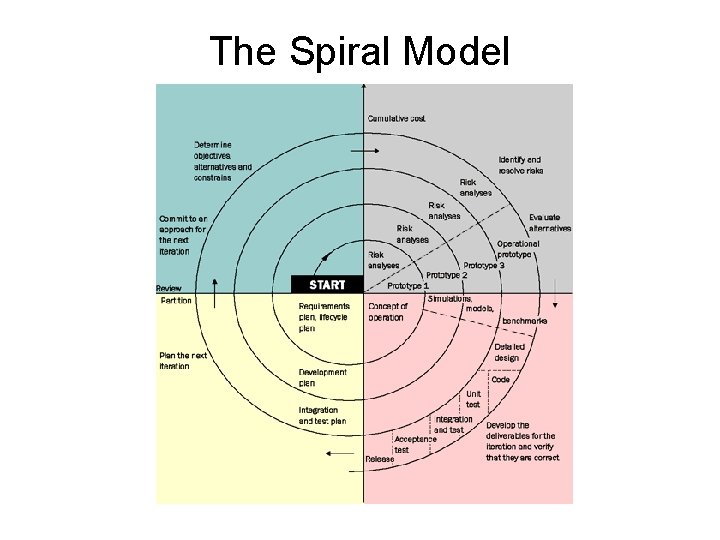
The Spiral Model
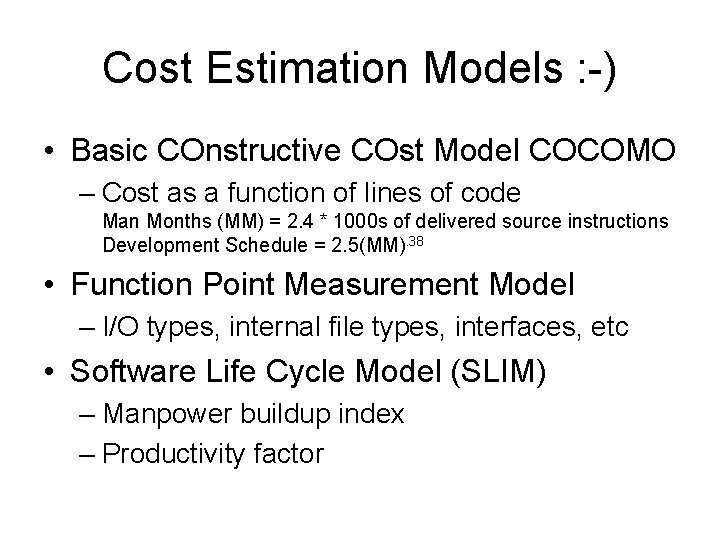
Cost Estimation Models : -) • Basic COnstructive COst Model COCOMO – Cost as a function of lines of code Man Months (MM) = 2. 4 * 1000 s of delivered source instructions Development Schedule = 2. 5(MM). 38 • Function Point Measurement Model – I/O types, internal file types, interfaces, etc • Software Life Cycle Model (SLIM) – Manpower buildup index – Productivity factor
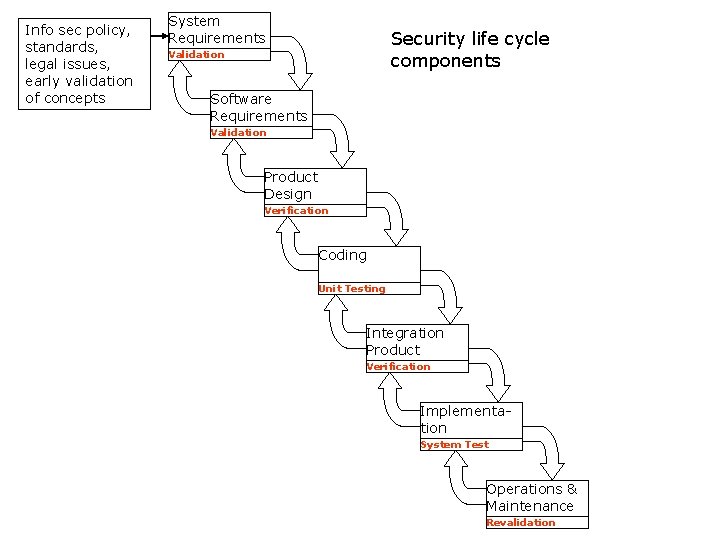
Info sec policy, standards, legal issues, early validation of concepts System Requirements Security life cycle components Validation Software Requirements Validation Product Design Verification Coding Unit Testing Integration Product Verification Implementation System Test Operations & Maintenance Revalidation
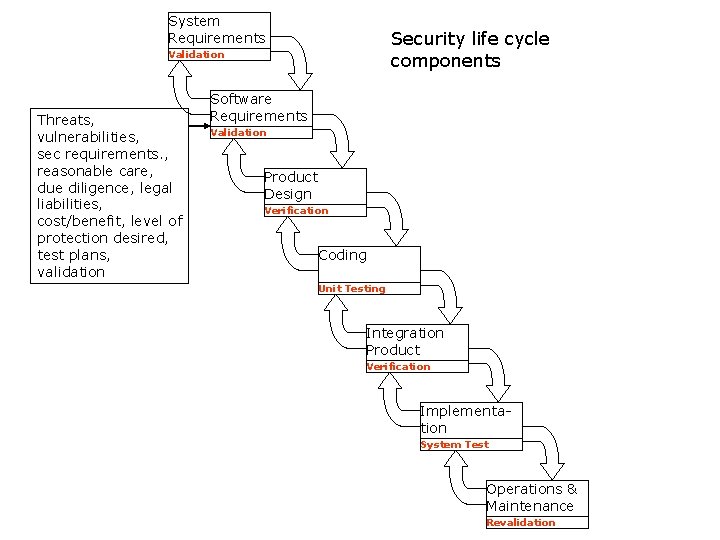
System Requirements Security life cycle components Validation Threats, vulnerabilities, sec requirements. , reasonable care, due diligence, legal liabilities, cost/benefit, level of protection desired, test plans, validation Software Requirements Validation Product Design Verification Coding Unit Testing Integration Product Verification Implementation System Test Operations & Maintenance Revalidation
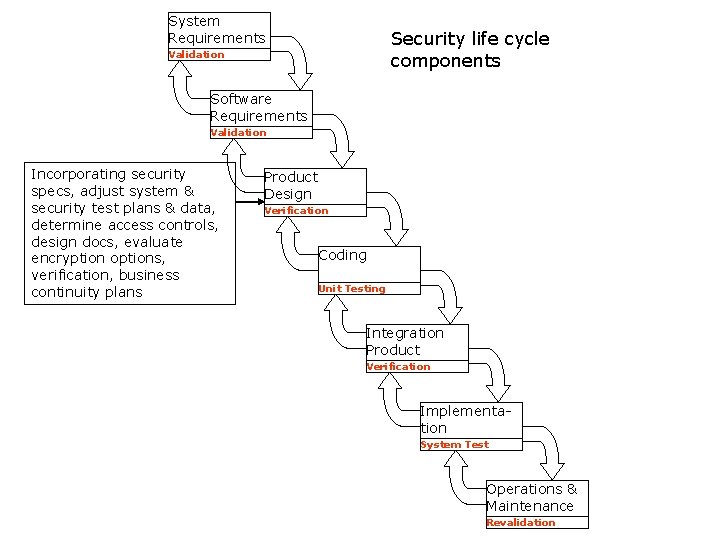
System Requirements Security life cycle components Validation Software Requirements Validation Incorporating security specs, adjust system & security test plans & data, determine access controls, design docs, evaluate encryption options, verification, business continuity plans Product Design Verification Coding Unit Testing Integration Product Verification Implementation System Test Operations & Maintenance Revalidation
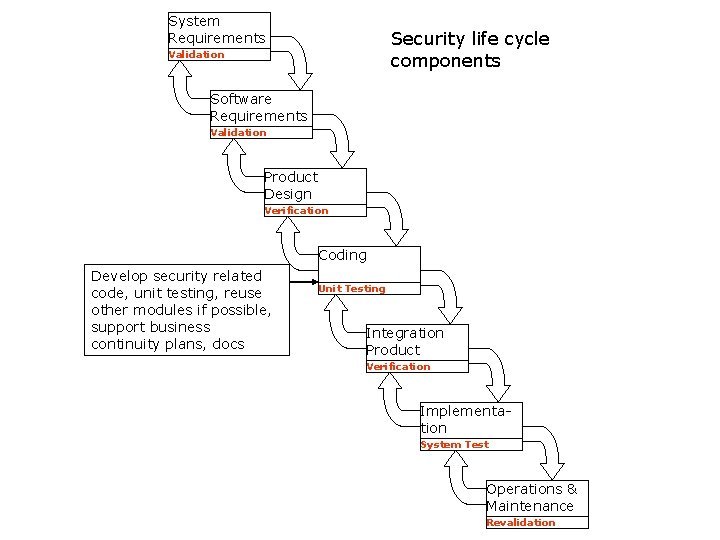
System Requirements Security life cycle components Validation Software Requirements Validation Product Design Verification Coding Develop security related code, unit testing, reuse other modules if possible, support business continuity plans, docs Unit Testing Integration Product Verification Implementation System Test Operations & Maintenance Revalidation
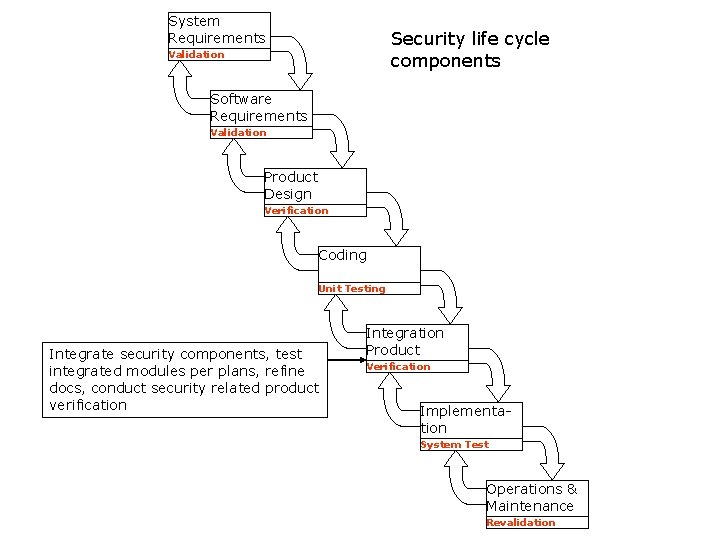
System Requirements Security life cycle components Validation Software Requirements Validation Product Design Verification Coding Unit Testing Integrate security components, test integrated modules per plans, refine docs, conduct security related product verification Integration Product Verification Implementation System Test Operations & Maintenance Revalidation
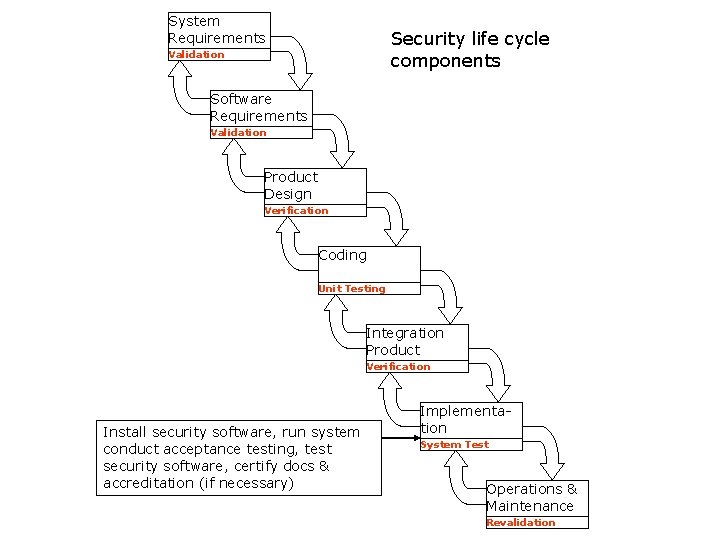
System Requirements Security life cycle components Validation Software Requirements Validation Product Design Verification Coding Unit Testing Integration Product Verification Install security software, run system conduct acceptance testing, test security software, certify docs & accreditation (if necessary) Implementation System Test Operations & Maintenance Revalidation
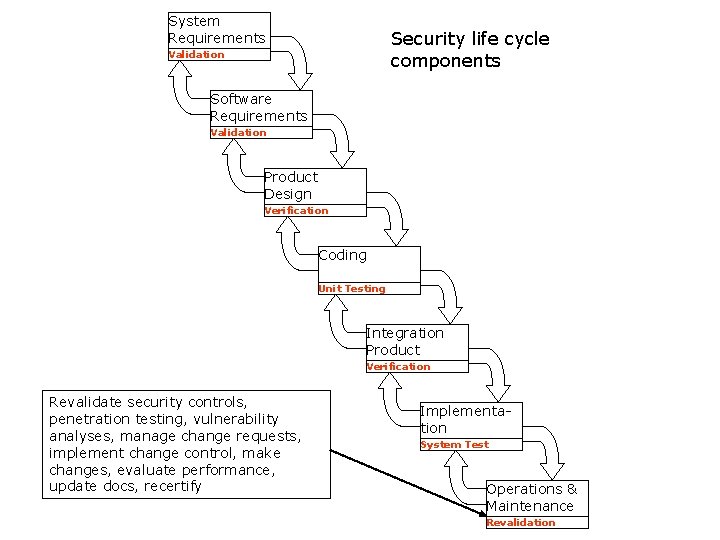
System Requirements Security life cycle components Validation Software Requirements Validation Product Design Verification Coding Unit Testing Integration Product Verification Revalidate security controls, penetration testing, vulnerability analyses, manage change requests, implement change control, make changes, evaluate performance, update docs, recertify Implementation System Test Operations & Maintenance Revalidation
Testing • Unit testing • Done by separate personnel • Check all I/O, modules, files, security, etc
Extreme Programming (XP) Principles • Feedback: most useful if it is done rapidly. • Assuming simplicity: treating every problem as if it can be solved "extremely simply". • Incremental changes: small releases • Embracing change: not working against changes but embracing them.
Manifesto for Agile Software Development • We are uncovering better ways of developing software by doing it and helping others do it. Through this work we have come to value: – – Individuals and interactions over processes and tools Working software over comprehensive documentation Customer collaboration over contract negotiation Responding to change over following a plan • That is, while there is value in the items on the right, we value the items on the left more.
Maintenance Phase 1. Request Control • • Establish request priorities, do Cost estimates User Interface Determine tools to use, determine change effects on other code 2. Change Control • • Recreate & Analyze the problem Develop changes & tests Quality Control Document changes, & recertify 3. Release Control
Software Capability Maturity Model (CMM) • Phase 1: Initiate – Format improvement initiative – Management approval • Phase 2: Diagnose – Assess current systems • Phase 3: Establish Action Plan • Phase 4: Action • Phase 5: Leverage – Review changes and process looking for improvements
Object Oriented Systems • • • OO Requirements Analysis OO Aanalysis Domain Analysis OO Design OO Programming • Object Request Brokers: CORBA, SOAP
Artificial Intelligence Systems • Expert Systems (ES) – algorithm + data structures = Normal Program – Inference engine + knowledge base = ES • • Blackboards Bayesian Networks Fuzzy logic Neural Networks: weighted inputs to “neurons” yield outputs, “training period” • Genetic Algorithms: evolutionary computing, fitness values, cross breeding, mutation
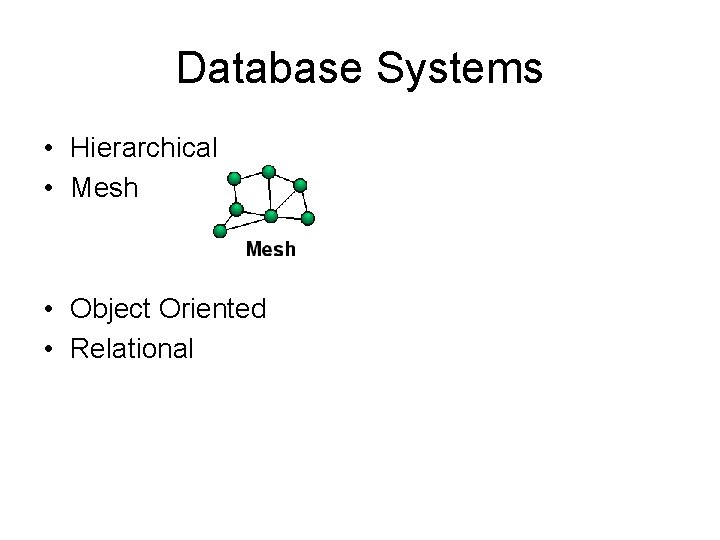
Database Systems • Hierarchical • Mesh • Object Oriented • Relational
DB Security Issues • Views • Granularity • Aggregation: – combining higher sensitivity with lower • Inference – Users “guessing” higher level values • Multiple connections, backups, etc • Data warehousing & Mining
Application Controls • Service Level Agreements – Turn around time, avg response time, number of users, system utilization rates, up times, transaction volumes, problem resolution • Control Types – Preventative – Detective – Corrective
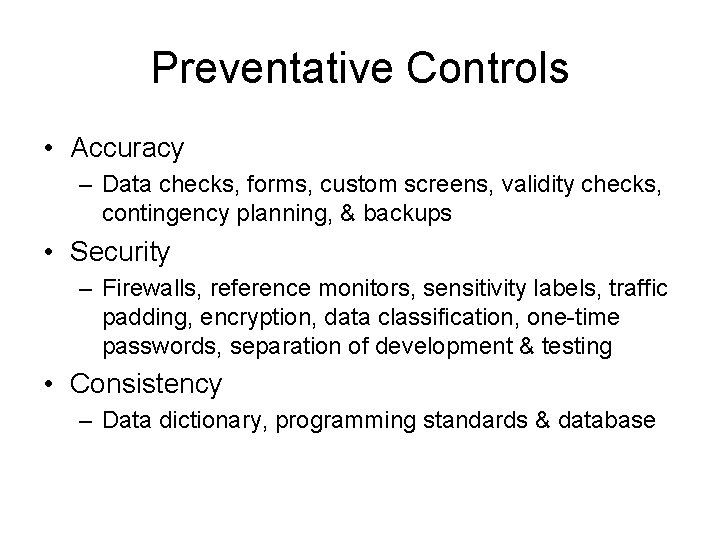
Preventative Controls • Accuracy – Data checks, forms, custom screens, validity checks, contingency planning, & backups • Security – Firewalls, reference monitors, sensitivity labels, traffic padding, encryption, data classification, one-time passwords, separation of development & testing • Consistency – Data dictionary, programming standards & database
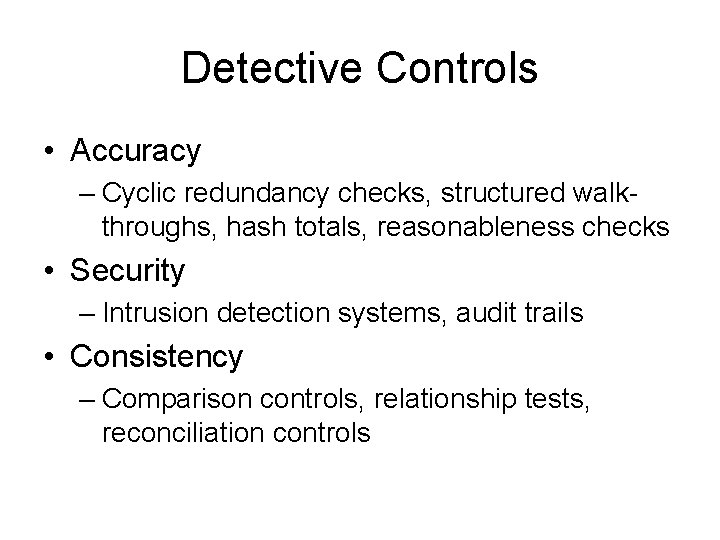
Detective Controls • Accuracy – Cyclic redundancy checks, structured walkthroughs, hash totals, reasonableness checks • Security – Intrusion detection systems, audit trails • Consistency – Comparison controls, relationship tests, reconciliation controls
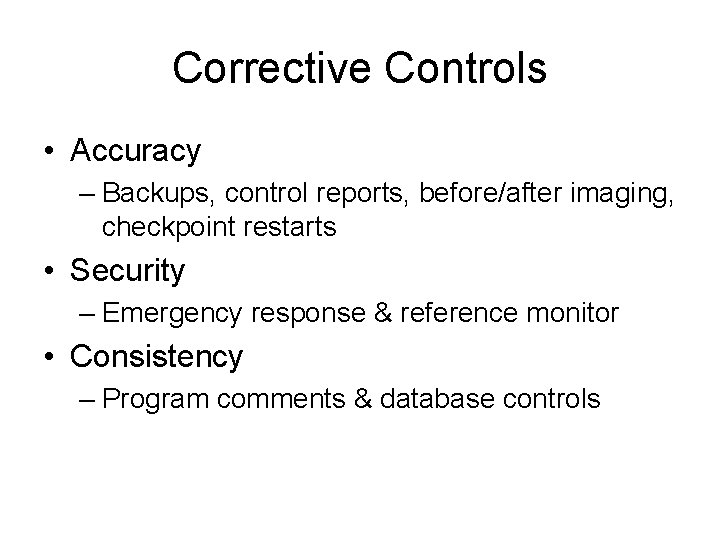
Corrective Controls • Accuracy – Backups, control reports, before/after imaging, checkpoint restarts • Security – Emergency response & reference monitor • Consistency – Program comments & database controls
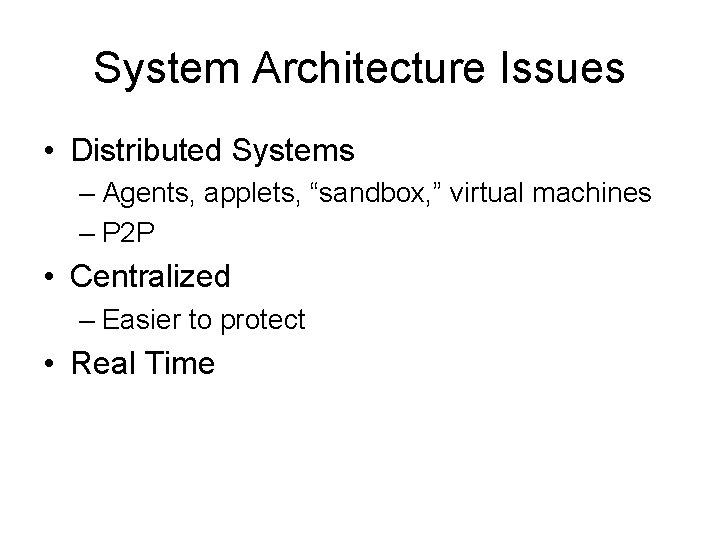
System Architecture Issues • Distributed Systems – Agents, applets, “sandbox, ” virtual machines – P 2 P • Centralized – Easier to protect • Real Time
- Slides: 28