
Applications of Verbal Behavior and Relational Frame Theory
Applications of Verbal Behavior and Relational Frame Theory to Autism Treatment: Can we Get Along? Mark L. Sundberg, Ph. D. , BCBA-D Florida Association for Behavior Analysis 38 th Annual Meeting September 12 -15, 2018 Thank you Carl T. Sundberg and Bob Ryan
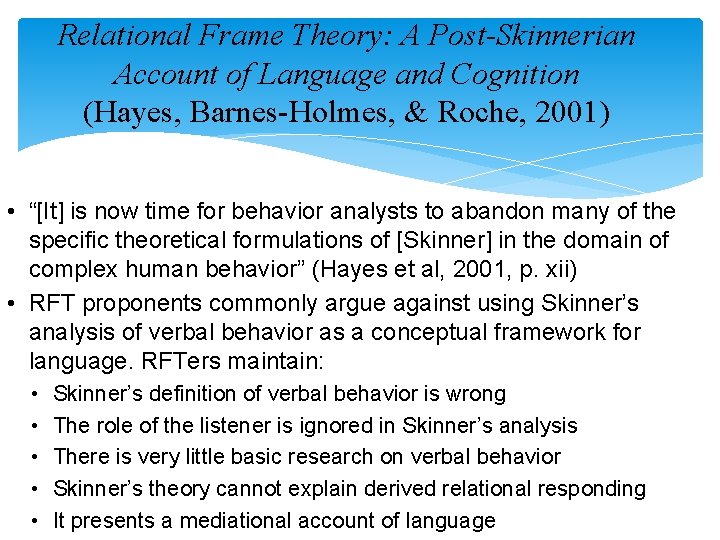
Relational Frame Theory: A Post-Skinnerian Account of Language and Cognition (Hayes, Barnes-Holmes, & Roche, 2001) • “[It] is now time for behavior analysts to abandon many of the specific theoretical formulations of [Skinner] in the domain of complex human behavior” (Hayes et al, 2001, p. xii) • RFT proponents commonly argue against using Skinner’s analysis of verbal behavior as a conceptual framework for language. RFTers maintain: • • • Skinner’s definition of verbal behavior is wrong The role of the listener is ignored in Skinner’s analysis There is very little basic research on verbal behavior Skinner’s theory cannot explain derived relational responding It presents a mediational account of language
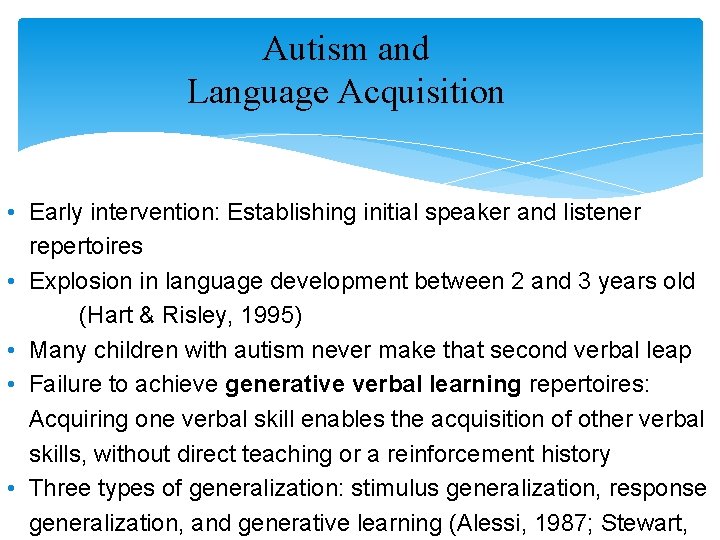
Autism and Language Acquisition • Early intervention: Establishing initial speaker and listener repertoires • Explosion in language development between 2 and 3 years old (Hart & Risley, 1995) • Many children with autism never make that second verbal leap • Failure to achieve generative verbal learning repertoires: Acquiring one verbal skill enables the acquisition of other verbal skills, without direct teaching or a reinforcement history • Three types of generalization: stimulus generalization, response generalization, and generative learning (Alessi, 1987; Stewart,

Verbal Behavior (VB) and Relational Frame Theory (RFT) • Molecular (B. F. Skinner) versus molar (J. R. Kantor) approaches to behavior analysis and language • VB represents a molecular approach that “deals with behavior in terms of the moment-to-moment sequences of events in a given setting” (Catania, 2013, p. 109) • RFT represents a molar approach that “deals with the properties that can be measured only over an extended period of time” (Catania, 2013, p. 109)
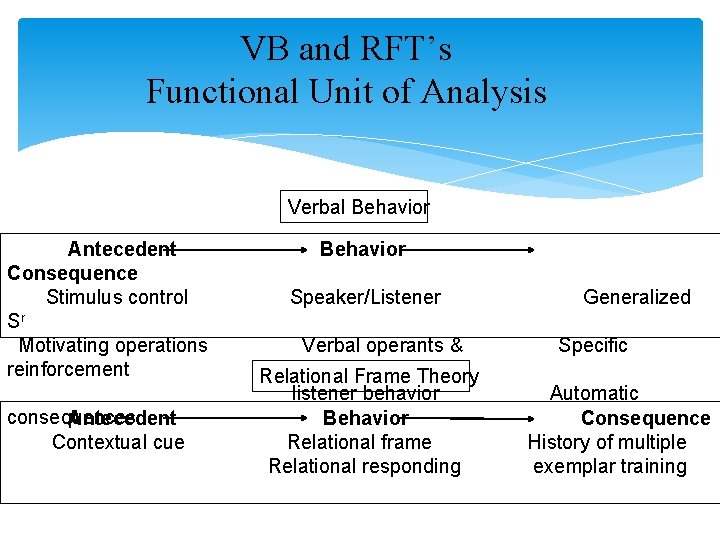
VB and RFT’s Functional Unit of Analysis Verbal Behavior Antecedent Consequence Stimulus control Sr Motivating operations reinforcement consequences Antecedent Contextual cue Behavior Speaker/Listener Verbal operants & Relational Frame Theory listener behavior Behavior Relational frame Relational responding Generalized Specific Automatic Consequence History of multiple exemplar training
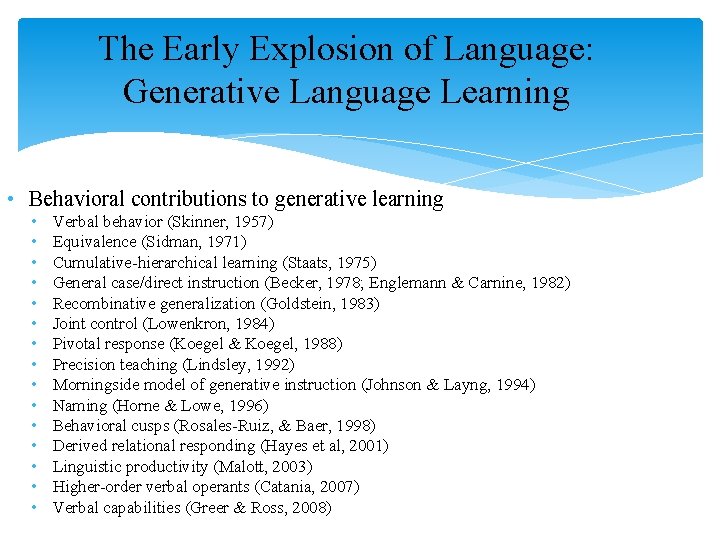
The Early Explosion of Language: Generative Language Learning • Behavioral contributions to generative learning • • • • Verbal behavior (Skinner, 1957) Equivalence (Sidman, 1971) Cumulative-hierarchical learning (Staats, 1975) General case/direct instruction (Becker, 1978; Englemann & Carnine, 1982) Recombinative generalization (Goldstein, 1983) Joint control (Lowenkron, 1984) Pivotal response (Koegel & Koegel, 1988) Precision teaching (Lindsley, 1992) Morningside model of generative instruction (Johnson & Layng, 1994) Naming (Horne & Lowe, 1996) Behavioral cusps (Rosales-Ruiz, & Baer, 1998) Derived relational responding (Hayes et al, 2001) Linguistic productivity (Malott, 2003) Higher-order verbal operants (Catania, 2007) Verbal capabilities (Greer & Ross, 2008)
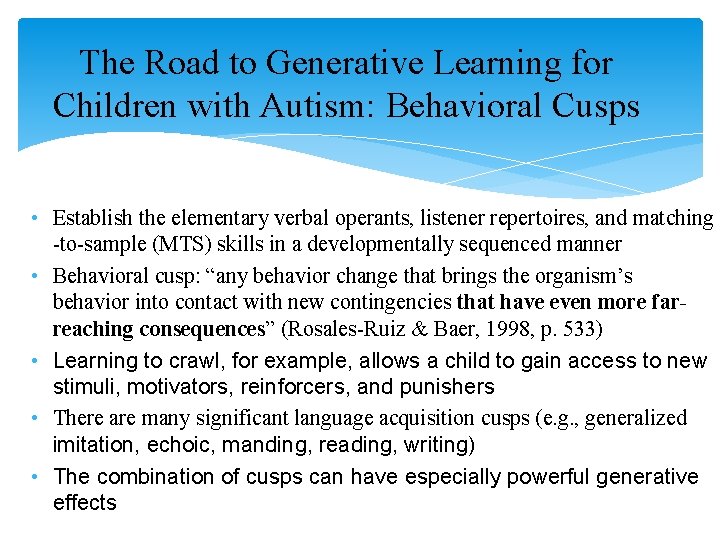
The Road to Generative Learning for Children with Autism: Behavioral Cusps • Establish the elementary verbal operants, listener repertoires, and matching -to-sample (MTS) skills in a developmentally sequenced manner • Behavioral cusp: “any behavior change that brings the organism’s behavior into contact with new contingencies that have even more farreaching consequences” (Rosales-Ruiz & Baer, 1998, p. 533) • Learning to crawl, for example, allows a child to gain access to new stimuli, motivators, reinforcers, and punishers • There are many significant language acquisition cusps (e. g. , generalized imitation, echoic, manding, reading, writing) • The combination of cusps can have especially powerful generative effects
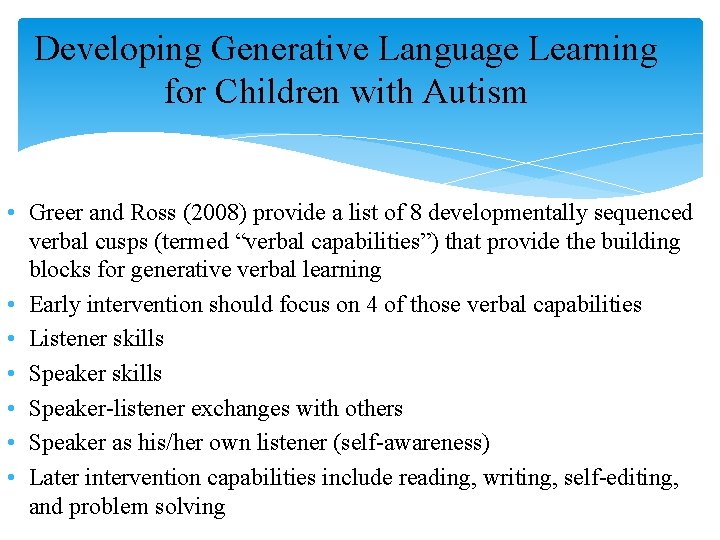
Developing Generative Language Learning for Children with Autism • Greer and Ross (2008) provide a list of 8 developmentally sequenced verbal cusps (termed “verbal capabilities”) that provide the building blocks for generative verbal learning • Early intervention should focus on 4 of those verbal capabilities • Listener skills • Speaker-listener exchanges with others • Speaker as his/her own listener (self-awareness) • Later intervention capabilities include reading, writing, self-editing, and problem solving
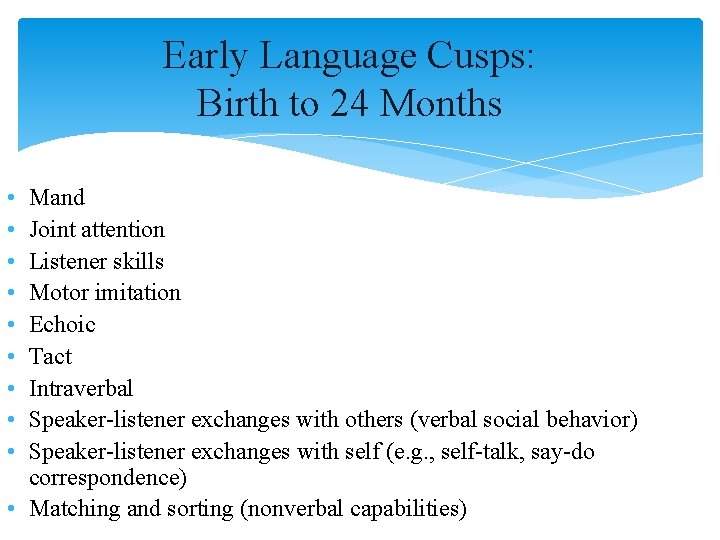
Early Language Cusps: Birth to 24 Months • • • Mand Joint attention Listener skills Motor imitation Echoic Tact Intraverbal Speaker-listener exchanges with others (verbal social behavior) Speaker-listener exchanges with self (e. g. , self-talk, say-do correspondence) • Matching and sorting (nonverbal capabilities)
Expanding Early Linguistic Cusps: Stimulus Equivalence, RFT, Naming, and Joint Control • The beginning of “true language” (Chase & Danforth, 1991; Hayes et al, 2001; Hockett, 1960; Horne & Lowe, 1996; Malott, 2003) • Sidman (1971) showed that the combination of matching-tosample (MTS), echoic, and listener cusps, generated emergent textual and tact relations • Sidman termed this effect stimulus equivalence, and RFT extends Sidman’s work to nonequivalent relations • Naming and joint control accounts are based on Skinner (1957)
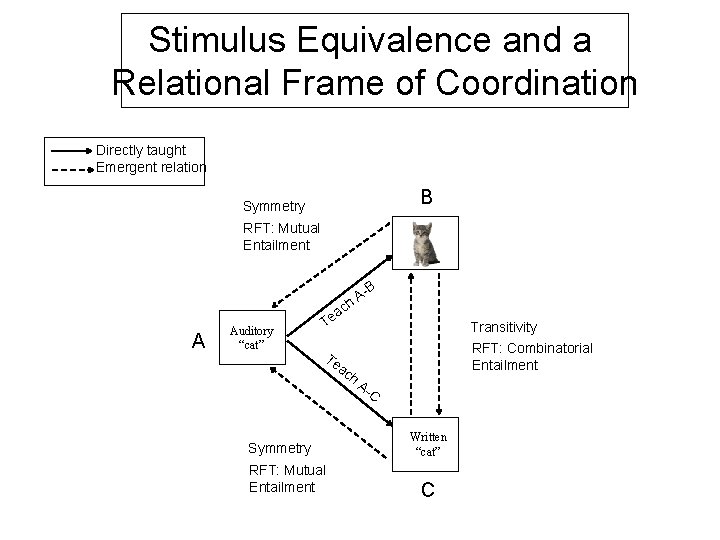
Stimulus Equivalence and a Relational Frame of Coordination Directly taught Emergent relation B Symmetry RFT: Mutual Entailment ch A Auditory “cat” B A- a Te Transitivity Te ac RFT: Combinatorial Entailment h A- C Symmetry RFT: Mutual Entailment Written “cat” C
Relational Frame Theory (Hayes et al, 2001) • A relational frame must contain mutual entailment, combinatory entailment, and transformation of function • RFT introduces several types of nonequivalent relational frames beyond Sidman’s equivalence (RFT: frame of coordination) • Nonequivalent relational frames include • • comparison opposition distinction hierarchy temporal spatial deictic
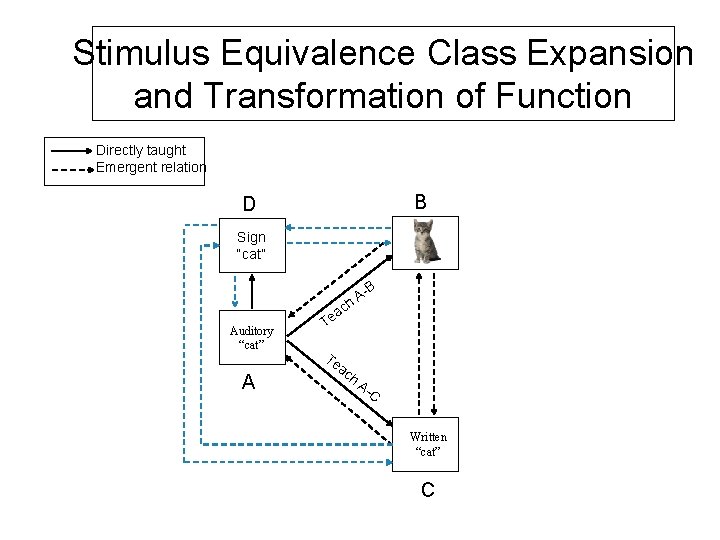
Stimulus Equivalence Class Expansion and Transformation of Function Directly taught Emergent relation B D Sign “cat” ch Auditory “cat” A B A- a Te Te ac h A- C Written “cat” C
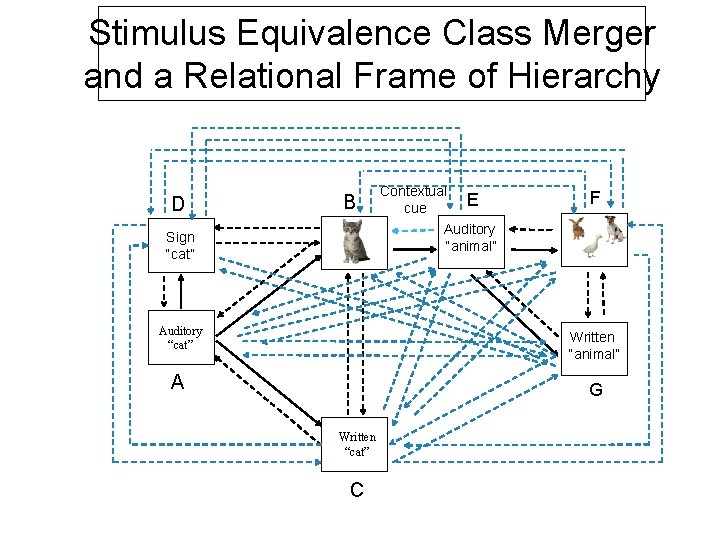
Stimulus Equivalence Class Merger and a Relational Frame of Hierarchy D B Contextual cue E F Auditory “animal” Sign “cat” Auditory “cat” Written “animal” A G Written “cat” C
Bi-Directional Common Naming (C-Bi. N) (Horne & Lowe, 1996) • C-Bi. N: the acquisition of a tact relation immediately produces a corresponding listener relation, and vice versa, without training or reinforcement • Also, Intraverbal Bi. Ns and Visual Bi. Ns (Miguel, 2018) • C-Bi. N initially establishes a child’s interlocking speaker and listener repertoires • C-Bi. N involves the merging of four verbal cusps: echoic, tact, listener, and self-listener (Greer & Ross, 2008; Horne & Lowe, 1996; Miguel, 2018) • The confluence of these repertoires generates a more powerful cusp; one that can produce stimulus equivalence and relational frames
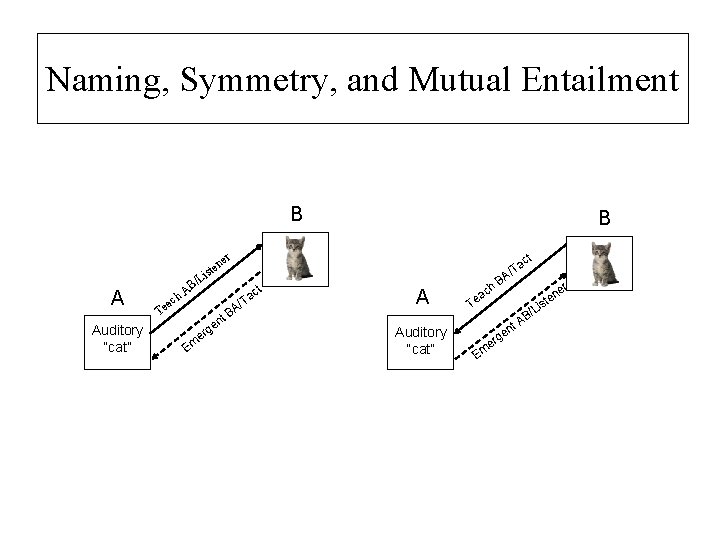
Naming, Symmetry, and Mutual Entailment B B er A Auditory “cat” ct n ste Li a /T / AB h ac Te Em n ge r e A t. B / ct Ta A Auditory “cat” ch BA ea T er Li nt Em e e rg / AB n ste
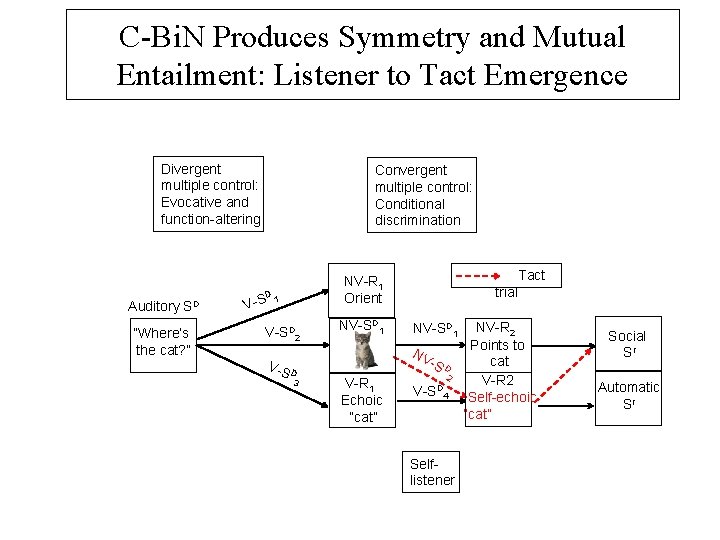
C-Bi. N Produces Symmetry and Mutual Entailment: Listener to Tact Emergence Divergent multiple control: Evocative and function-altering Auditory SD “Where’s the cat? ” Convergent multiple control: Conditional discrimination D V-S Tact NV-R 1 Orient 1 V-SD 2 V-S D 3 NV-SD 1 trial NV-SD 1 NV -S D V-R 1 Echoic “cat” 2 D V-S 4 Selflistener NV-R 2 Points to cat V-R 2 Self-echoic “cat” Social Sr Automatic Sr
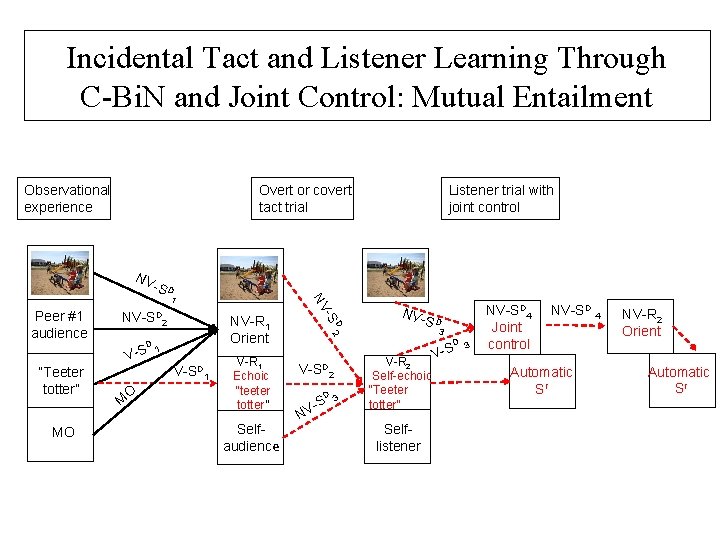
Incidental Tact and Listener Learning Through C-Bi. N and Joint Control: Mutual Entailment Observational experience Overt or covert tact trial Listener trial with joint control NV -S D NV-SD 2 MO O M V-SD 1 V-R 1 Echoic “teeter totter” Selfaudience D 2 “Teeter totter” NV-R 1 Orient D 1 V-S -S Peer #1 audience NV 1 NV- SD 3 V-SD 2 D 3 N S V- V-R 2 Self-echoic “Teeter totter” Selflistener V-S NV-SD 4 Joint control NV-SD 4 Automatic Sr NV-R 2 Orient Automatic Sr
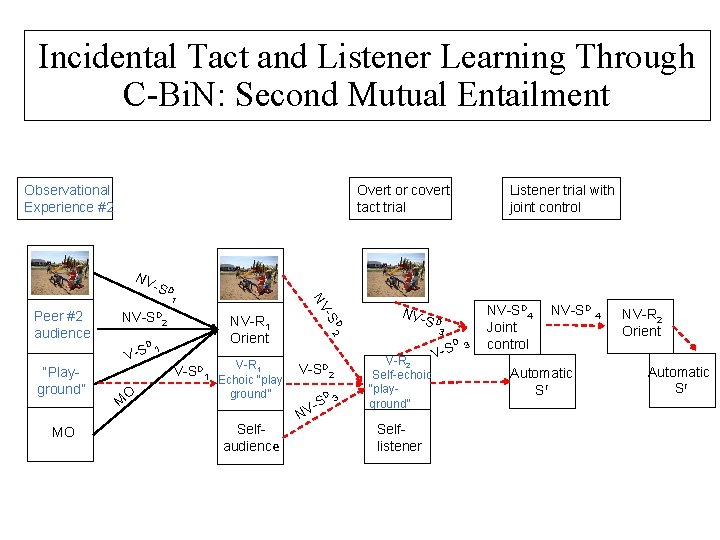
Incidental Tact and Listener Learning Through C-Bi. N: Second Mutual Entailment Observational Experience #2 Overt or covert tact trial Listener trial with joint control NV -S D NV-SD 2 MO O M V-SD 1 V-R 1 Echoic “play ground” Selfaudience D 2 “Playground” NV-R 1 Orient D 1 V-S -S Peer #2 audience NV 1 NV- SD 3 V-SD 2 D 3 N S V- V-R 2 Self-echoic “playground” Selflistener V-S NV-SD 4 Joint control NV-SD 4 Automatic Sr NV-R 2 Orient Automatic Sr
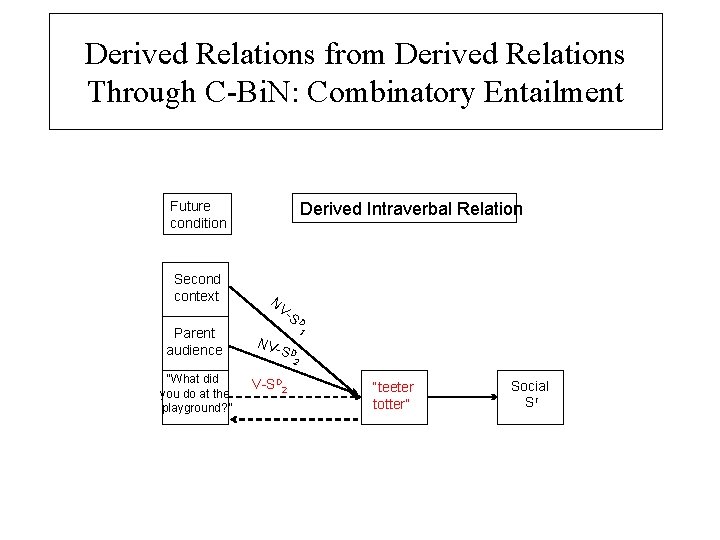
Derived Relations from Derived Relations Through C-Bi. N: Combinatory Entailment Future condition Second context Parent audience “What did you do at the playground? ” Derived Intraverbal Relation NV NV- SD 1 SD V-SD 2 2 “teeter totter” Social Sr
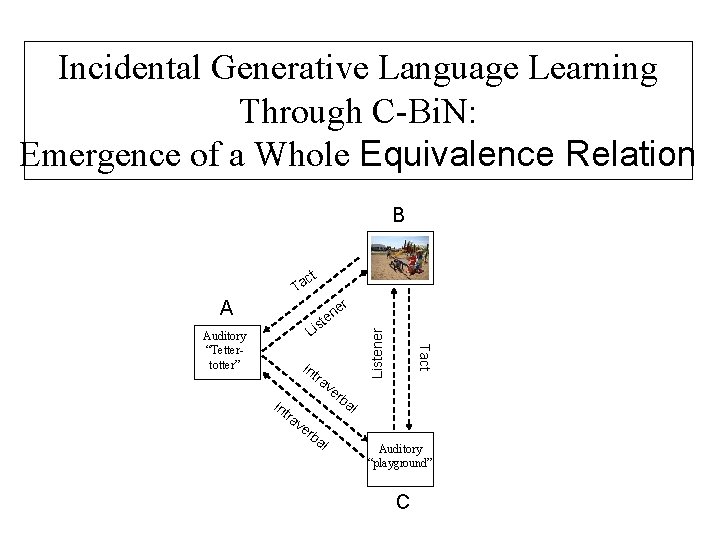
Incidental Generative Language Learning Through C-Bi. N: Emergence of a Whole Equivalence Relation B t c Ta er n ste Li In tra ve r ba l ve Tact Auditory “Tettertotter” Listener A rb al Auditory “playground” C
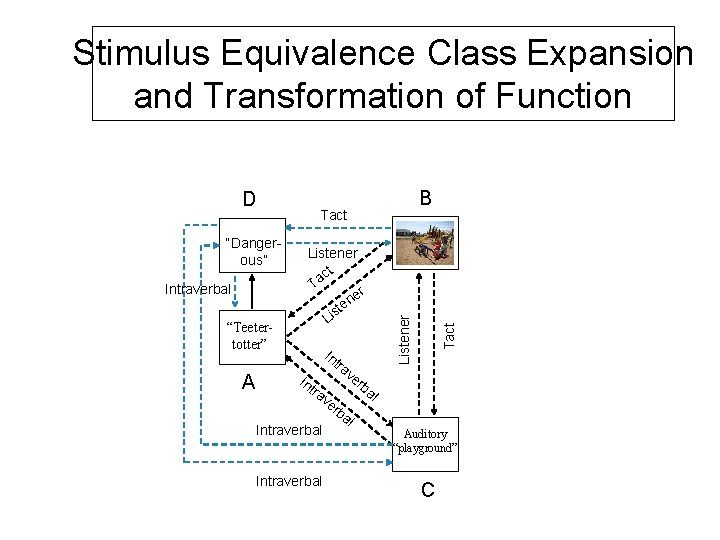
Stimulus Equivalence Class Expansion and Transformation of Function Intraverbal “Teetertotter” A Tact Listener ct a T er n te Lis In tra ve rb Intraverbal ve al rb Listener “Dangerous” B Tact D al Auditory “playground” C
Verbal Behavior Research on Generative Learning • 369 empirical VB studies published between 2005 -2016; 60 of these were on emergent relations (Petursdottir, 2018) • Establishing C-Bi. N and I-Bi. N can produce stimulus equivalence (e. g. , Carp & Petursdottir, 2015; Horne & Lowe, 1996; Ma, Miguel, & Jennings, 2016; Perez-Gonzalez, Salameh, & Garcia. Asenjo, 2018) • Joint control research demonstrates how a participant’s overt and covert verbal behavior can mediate responding in MTS and RFT problem solving tasks (e. g. , Clough, Meyer, & Miguel, 2016; De. Graaf & Schlinger, 2012; Lowenkron, 2006; Sidener & Michael, 2006; Sundberg, & Michael, 2018)
Naming and Generative Language for Children with Autism • First, build the verbal operants and listener skills to cusp status • Establish social VB (speaker-listener exchanges with others) • Establish self-observation, self-listening, self-echoic, and delayed self-echoic skills • Self-listener repertoires are necessary for autoclitics, selfediting, joint control, naming, equivalence, relational framing, and problem solving • Establish Bi. N repertoires
Naming and Generative Language for Children with Autism • Intersperse variations of tact, listener, intraverbal, MTS, mand, echoic, and imitation trials in DTT and NET procedures (mixed VB) • For example, in LRFFC transfer procedures speaker and listener responding is fused together generating C-Bi. Ns and IBi. Ns, equivalence relations, and relational frames • Transformation of function outcomes can be produced by verbal function-altering processes (Schlinger & Blakely, 1987, 1994) • “Naming appears to be the source of the explosion in language development” (Greer & Longano, 2010, p. 73)
Concerns About RFT and the PEAK Application to Autism • The PEAK equivalence and transformation manuals contain 360 framing exercises mostly in an MTS discrete-trial teaching format, heavy on adult presented SDs, and 1: 1 instruction • PEAK tasks are not in a developmental sequence • The PEAK framing procedures do not address the social communication deficits of autism • Relational frames, like equivalence, involve stimulus relations, not MO relations, thus motivating operations are not considered in RFT, or in PEAK’s framing exercises • Verbal stimulus control is neglected (molarized as “contextual control”)
Conclusions • Generative learning is the driving force of language acquisition and in autism treatment we can benefit from several different lines of research • Bi. N provides a molecular treatment of the processes involved in generative learning • RFT research demonstrates an important and powerful behavioral cusp that can promote generative learning • RFT is not a replacement for Skinner’s Verbal Behavior, it is an extension of that work • More precisely, RFT is an extension of Sidman’s work
- Slides: 27