
Applications Of Ultrasound in Textile Dye Processes Nadhir

- Slides: 9
Applications Of Ultrasound in Textile Dye Processes Nadhir Sait
Ultrasonics - Ultrasonics: the study of the effects of propagation of ultrasound waves and their interaction with matter. - Ultrasonic is referring to sound waves that vibrate at frequencies higher than is audible to humans - Broadly speaking, ultrasonics also includes the diverse range of applications of ultrasound to engineering, sciences, and medicine.
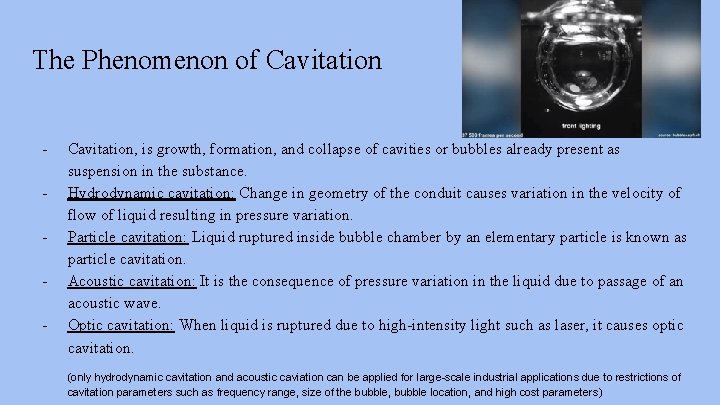
The Phenomenon of Cavitation - Cavitation, is growth, formation, and collapse of cavities or bubbles already present as suspension in the substance. Hydrodynamic cavitation: Change in geometry of the conduit causes variation in the velocity of flow of liquid resulting in pressure variation. Particle cavitation: Liquid ruptured inside bubble chamber by an elementary particle is known as particle cavitation. Acoustic cavitation: It is the consequence of pressure variation in the liquid due to passage of an acoustic wave. Optic cavitation: When liquid is ruptured due to high-intensity light such as laser, it causes optic cavitation. (only hydrodynamic cavitation and acoustic caviation can be applied for large-scale industrial applications due to restrictions of cavitation parameters such as frequency range, size of the bubble, bubble location, and high cost parameters)
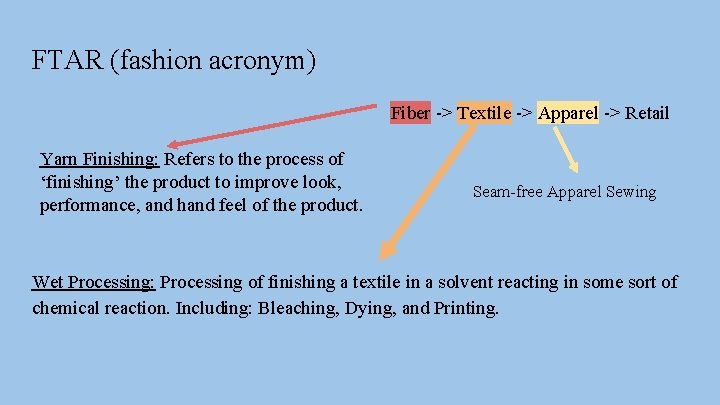
FTAR (fashion acronym) Fiber -> Textile -> Apparel -> Retail Yarn Finishing: Refers to the process of ‘finishing’ the product to improve look, performance, and hand feel of the product. Seam-free Apparel Sewing Wet Processing: Processing of finishing a textile in a solvent reacting in some sort of chemical reaction. Including: Bleaching, Dying, and Printing.
Findings and Applications The usage of ultrasound in textile finishing: - Paste Homogenization: Most yarn is finished with a starch paste that is mixed with sizing agents and water that is heated just past the gelatinization point, and is kept that high heat for a long time along with high-speed stirring to make sure the paste is homogenous and the particles are evenly sized. The usage of ultrasound along with the mechanical stirring can lower the temperature needed to homogenize the mixture, make more effective homogenization, lessen the time required to homogenize, and can reduce energy required in the input.
Findings and applications Preparatory Wet-Processing “The rationale behind preparatory wet processing is to get rid of added and natural impurities from the fiber surface and interior to improve the absorbability of textile material for getting better penetration and diffusion of dyes and chemicals into fiber during dyeing and finishing processes. ” When Ultrasound application are used in the instance of a solid-liquid interface. The ultrasound can create a micro-stream of solvent that is more efficiently sent through the porous outer layer of the solid, thus creating a more efficient and quick drying/finishing process.
Findings and Applications Seam-free Apparel Finishings: Industrial overlock: Using a machine that simultaneously cuts and hems a garment in order to quickly produce garments. Using ultrasound application in finishing a whole garment is as such: - In garments such as bathing suits, holes are not to be created, using ultrasound in the form of a wheel and a vibrating horn, ultrasound can generate enough to fuse the microplastics within synthetic textiles creating a “seam” simply through ultrasound, finishing the garment.
Thank You!
Reference ● Tissera, Nadeeka D. , Ruchira N. Wijesena, and K. M. N. de Silva. "Ultrasound Energy to Accelerate Dye Uptake and dye–fiber Interaction of Reactive Dye on Knitted Cotton Fabric at Low Temperatures. " Ultrasonics - Sonochemistry, vol. 29, 2016, pp. 270 -278.