
Applications of the NWS Research Distributed Hydrologic Model
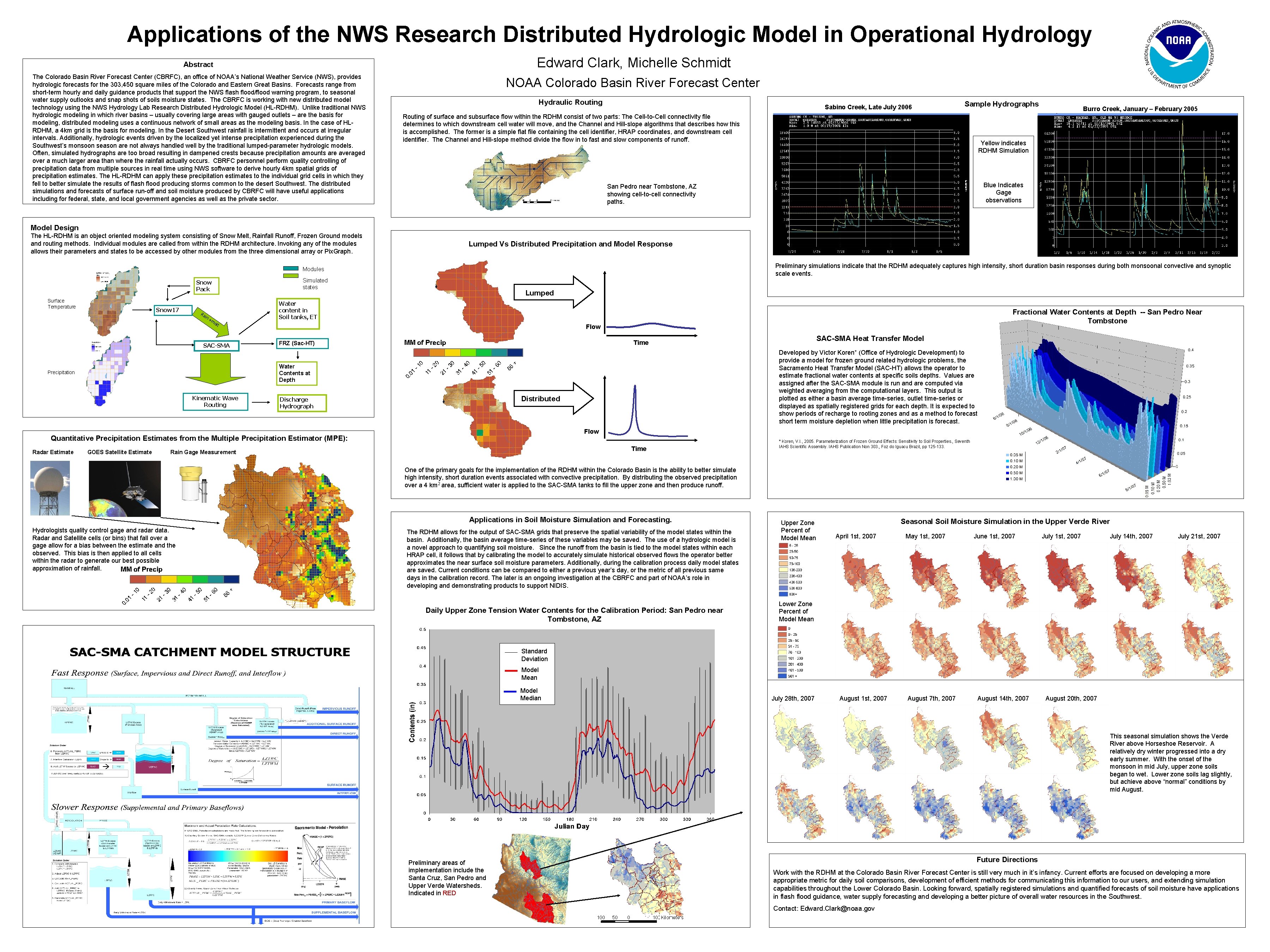
Applications of the NWS Research Distributed Hydrologic Model in Operational Hydrology Edward Clark, Michelle Schmidt Abstract The Colorado Basin River Forecast Center (CBRFC), an office of NOAA’s National Weather Service (NWS), provides hydrologic forecasts for the 303, 450 square miles of the Colorado and Eastern Great Basins. Forecasts range from short-term hourly and daily guidance products that support the NWS flash flood/flood warning program, to seasonal water supply outlooks and snap shots of soils moisture states. The CBRFC is working with new distributed model technology using the NWS Hydrology Lab Research Distributed Hydrologic Model (HL-RDHM). Unlike traditional NWS hydrologic modeling in which river basins – usually covering large areas with gauged outlets – are the basis for modeling, distributed modeling uses a continuous network of small areas as the modeling basis. In the case of HLRDHM, a 4 km grid is the basis for modeling. In the Desert Southwest rainfall is intermittent and occurs at irregular intervals. Additionally, hydrologic events driven by the localized yet intense precipitation experienced during the Southwest’s monsoon season are not always handled well by the traditional lumped-parameter hydrologic models. Often, simulated hydrographs are too broad resulting in dampened crests because precipitation amounts are averaged over a much larger area than where the rainfall actually occurs. CBRFC personnel perform quality controlling of precipitation data from multiple sources in real time using NWS software to derive hourly 4 km spatial grids of precipitation estimates. The HL-RDHM can apply these precipitation estimates to the individual grid cells in which they fell to better simulate the results of flash flood producing storms common to the desert Southwest. The distributed simulations and forecasts of surface run-off and soil moisture produced by CBRFC will have useful applications including for federal, state, and local government agencies as well as the private sector. NOAA Colorado Basin River Forecast Center Hydraulic Routing Sabino Creek, Late July 2006 Sample Hydrographs Routing of surface and subsurface flow within the RDHM consist of two parts: The Cell-to-Cell connectivity file determines to which downstream cell water will move, and the Channel and Hill-slope algorithms that describes how this is accomplished. The former is a simple flat file containing the cell identifier, HRAP coordinates, and downstream cell identifier. The Channel and Hill-slope method divide the flow in to fast and slow components of runoff. Burro Creek, January – February 2005 Yellow indicates RDHM Simulation Blue Indicates Gage observations San Pedro near Tombstone, AZ showing cell-to-cell connectivity paths. Model Design The HL-RDHM is an object oriented modeling system consisting of Snow Melt, Rainfall Runoff, Frozen Ground models and routing methods. Individual modules are called from within the RDHM architecture. Invoking any of the modules allows their parameters and states to be accessed by other modules from the three dimensional array or Pix. Graph. Lumped Vs Distributed Precipitation and Model Response Preliminary simulations indicate that the RDHM adequately captures high intensity, short duration basin responses during both monsoonal convective and synoptic scale events. Modules Simulated states Snow Pack Surface Temperature Snow 17 Ra in +m elt SAC-SMA Lumped Water content in Soil tanks, ET Flow Kinematic Wave Routing Developed by Victor Koren* (Office of Hydrologic Development) to provide a model for frozen ground related hydrologic problems, the Sacramento Heat Transfer Model (SAC-HT) allows the operator to estimate fractional water contents at specific soils depths. Values are assigned after the SAC-SMA module is run and are computed via weighted averaging from the computational layers. This output is plotted as either a basin average time-series, outlet time-series or displayed as spatially registered grids for each depth. It is expected to show periods of recharge to rooting zones and as a method to forecast short term moisture depletion when little precipitation is forecast. Distributed Discharge Hydrograph Water Fraction of Soil at Depth Flow Quantitative Precipitation Estimates from the Multiple Precipitation Estimator (MPE): GOES Satellite Estimate SAC-SMA Heat Transfer Model Time FRZ (Sac-HT) Water Contents at Depth Precipitation Radar Estimate Fractional Water Contents at Depth -- San Pedro Near Tombstone Time Rain Gage Measurement * Koren, V. I. , 2005. Parameterization of Frozen Ground Effects: Sensitivity to Soil Properties. , Seventh IAHS Scientific Assembly. IAHS Publication Non 303. , Foz do Iguacu Brazil, pp 125 -133. One of the primary goals for the implementation of the RDHM within the Colorado Basin is the ability to better simulate high intensity, short duration events associated with convective precipitation. By distributing the observed precipitation over a 4 km 2 area, sufficient water is applied to the SAC-SMA tanks to fill the upper zone and then produce runoff. Applications in Soil Moisture Simulation and Forecasting. Hydrologists quality control gage and radar data. Radar and Satellite cells (or bins) that fall over a gage allow for a bias between the estimate and the observed. This bias is then applied to all cells within the radar to generate our best possible approximation of rainfall. The RDHM allows for the output of SAC-SMA grids that preserve the spatial variability of the model states within the basin. Additionally, the basin average time-series of these variables may be saved. The use of a hydrologic model is a novel approach to quantifying soil moisture. Since the runoff from the basin is tied to the model states within each HRAP cell, it follows that by calibrating the model to accurately simulate historical observed flows the operator better approximates the near surface soil moisture parameters. Additionally, during the calibration process daily model states are saved. Current conditions can be compared to either a previous year’s day, or the metric of all previous same days in the calibration record. The later is an ongoing investigation at the CBRFC and part of NOAA’s role in developing and demonstrating products to support NIDIS. Daily Upper Zone Tension Water Contents for the Calibration Period: San Pedro near Tombstone, AZ Upper Zone Percent of Model Mean Seasonal Soil Moisture Simulation in the Upper Verde River April 1 st, 2007 May 1 st, 2007 June 1 st, 2007 July 14 th, 2007 July 21 st, 2007 Lower Zone Percent of Model Mean Standard Deviation Model Mean Model Median July 28 th, 2007 August 1 st, 2007 August 7 th, 2007 August 14 th, 2007 August 20 th, 2007 This seasonal simulation shows the Verde River above Horseshoe Reservoir. A relatively dry winter progressed into a dry early summer. With the onset of the monsoon in mid July, upper zone soils began to wet. Lower zone soils lag slightly, but achieve above “normal” conditions by mid August. Preliminary areas of implementation include the Santa Cruz, San Pedro and Upper Verde Watersheds. Indicated in RED Future Directions Work with the RDHM at the Colorado Basin River Forecast Center is still very much in it’s infancy. Current efforts are focused on developing a more appropriate metric for daily soil comparisons, development of efficient methods for communicating this information to our users, and extending simulation capabilities throughout the Lower Colorado Basin. Looking forward, spatially registered simulations and quantified forecasts of soil moisture have applications in flash flood guidance, water supply forecasting and developing a better picture of overall water resources in the Southwest. Contact: Edward. Clark@noaa. gov
- Slides: 1