
Applications of Synchrotron Infrared Microspectroscopy SIRMS to Corrosion

- Slides: 33
Applications of Synchrotron Infrared Microspectroscopy (SIRMS) to Corrosion, Contamination and Coatings Gary P. Halada and Clive R. Clayton 199 th Meeting of the Electrochemical Society F 1 - State-of-the-Art Application of Surface and Interface Analysis Methods to Environmental Material Interactions: In Honor of James E. Castle's 65 th Year Tuesday, March 27, 2001 Laboratory for Surface Analysis and Corrosion Science
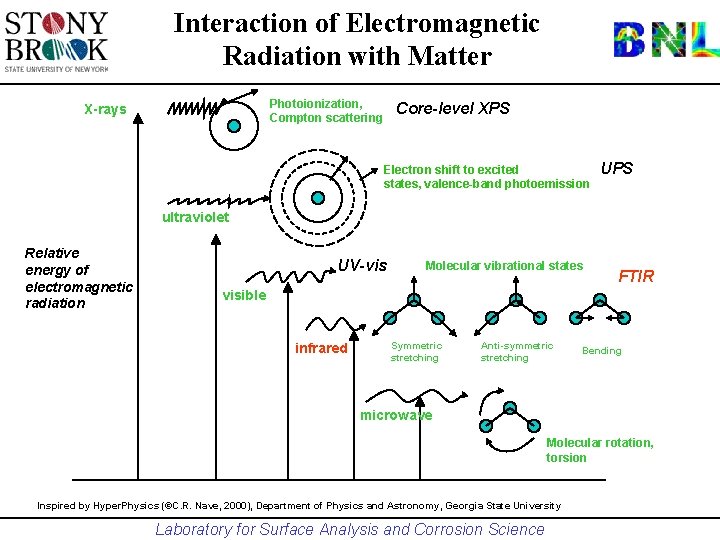
Interaction of Electromagnetic Radiation with Matter Photoionization, Compton scattering X-rays Core-level XPS Electron shift to excited states, valence-band photoemission UPS ultraviolet Relative energy of electromagnetic radiation UV-vis Molecular vibrational states FTIR visible infrared Symmetric stretching Anti-symmetric stretching Bending microwave Molecular rotation, torsion Inspired by Hyper. Physics (©C. R. Nave, 2000), Department of Physics and Astronomy, Georgia State University Laboratory for Surface Analysis and Corrosion Science
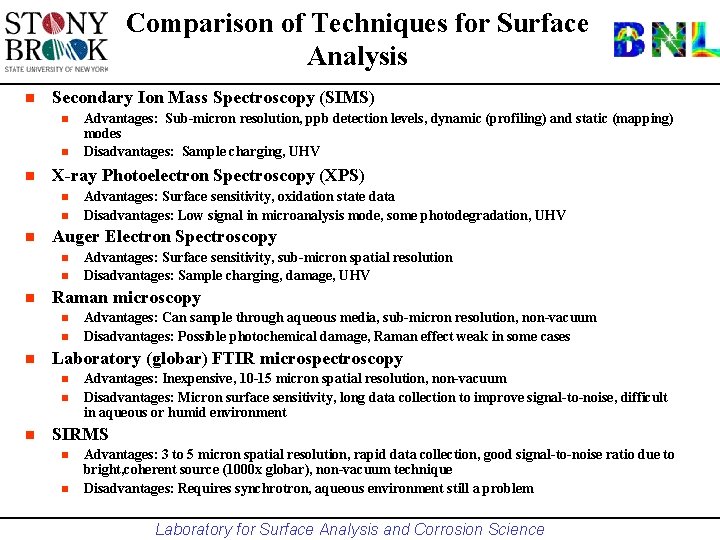
Comparison of Techniques for Surface Analysis n Secondary Ion Mass Spectroscopy (SIMS) n n n X-ray Photoelectron Spectroscopy (XPS) n n n Advantages: Can sample through aqueous media, sub-micron resolution, non-vacuum Disadvantages: Possible photochemical damage, Raman effect weak in some cases Laboratory (globar) FTIR microspectroscopy n n n Advantages: Surface sensitivity, sub-micron spatial resolution Disadvantages: Sample charging, damage, UHV Raman microscopy n n Advantages: Surface sensitivity, oxidation state data Disadvantages: Low signal in microanalysis mode, some photodegradation, UHV Auger Electron Spectroscopy n n Advantages: Sub-micron resolution, ppb detection levels, dynamic (profiling) and static (mapping) modes Disadvantages: Sample charging, UHV Advantages: Inexpensive, 10 -15 micron spatial resolution, non-vacuum Disadvantages: Micron surface sensitivity, long data collection to improve signal-to-noise, difficult in aqueous or humid environment SIRMS n n Advantages: 3 to 5 micron spatial resolution, rapid data collection, good signal-to-noise ratio due to bright, coherent source (1000 x globar), non-vacuum technique Disadvantages: Requires synchrotron, aqueous environment still a problem Laboratory for Surface Analysis and Corrosion Science
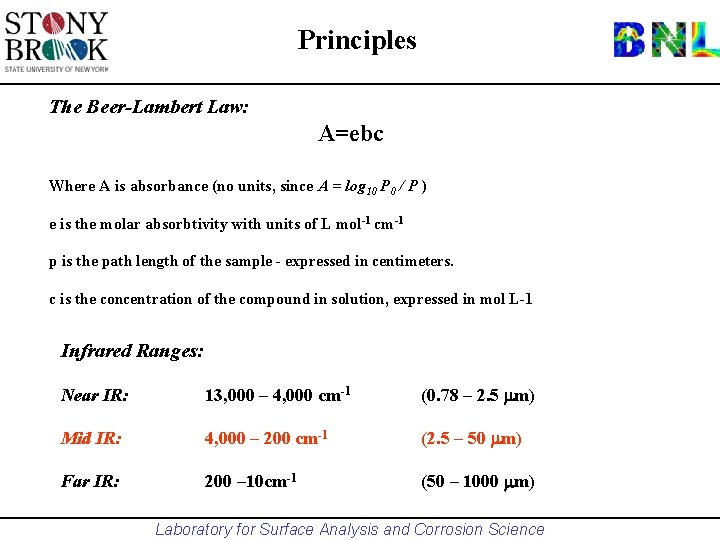
Principles The Beer-Lambert Law: A=ebc Where A is absorbance (no units, since A = log 10 P 0 / P ) e is the molar absorbtivity with units of L mol-1 cm-1 p is the path length of the sample - expressed in centimeters. c is the concentration of the compound in solution, expressed in mol L-1 Infrared Ranges: Near IR: 13, 000 – 4, 000 cm-1 (0. 78 – 2. 5 m) Mid IR: 4, 000 – 200 cm-1 (2. 5 – 50 m) Far IR: 200 – 10 cm-1 (50 – 1000 m) Laboratory for Surface Analysis and Corrosion Science
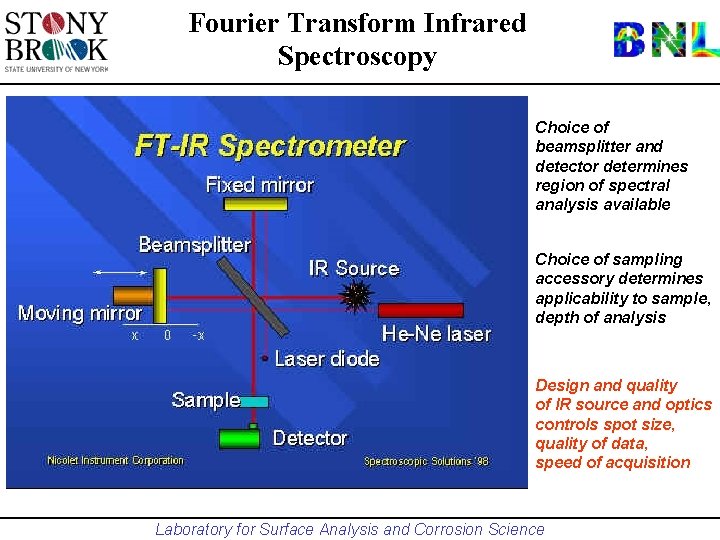
Fourier Transform Infrared Spectroscopy Choice of beamsplitter and detector determines region of spectral analysis available Choice of sampling accessory determines applicability to sample, depth of analysis Design and quality of IR source and optics controls spot size, quality of data, speed of acquisition Laboratory for Surface Analysis and Corrosion Science
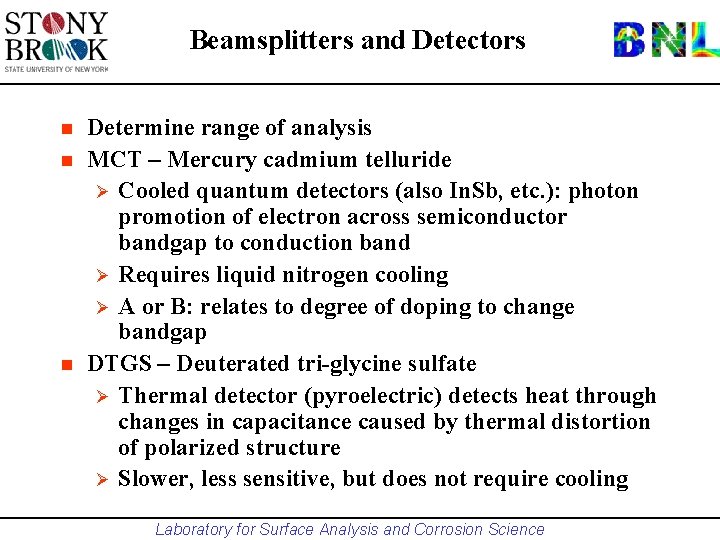
Beamsplitters and Detectors n n n Determine range of analysis MCT – Mercury cadmium telluride Ø Cooled quantum detectors (also In. Sb, etc. ): photon promotion of electron across semiconductor bandgap to conduction band Ø Requires liquid nitrogen cooling Ø A or B: relates to degree of doping to change bandgap DTGS – Deuterated tri-glycine sulfate Ø Thermal detector (pyroelectric) detects heat through changes in capacitance caused by thermal distortion of polarized structure Ø Slower, less sensitive, but does not require cooling Laboratory for Surface Analysis and Corrosion Science
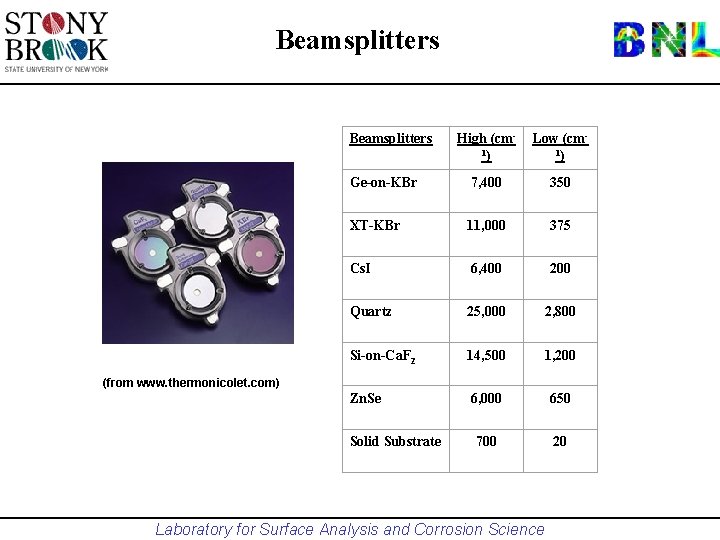
Beamsplitters High (cm 1) Low (cm 1) Ge-on-KBr 7, 400 350 XT-KBr 11, 000 375 Cs. I 6, 400 200 Quartz 25, 000 2, 800 Si-on-Ca. F 2 14, 500 1, 200 Zn. Se 6, 000 650 700 20 (from www. thermonicolet. com) Solid Substrate Laboratory for Surface Analysis and Corrosion Science
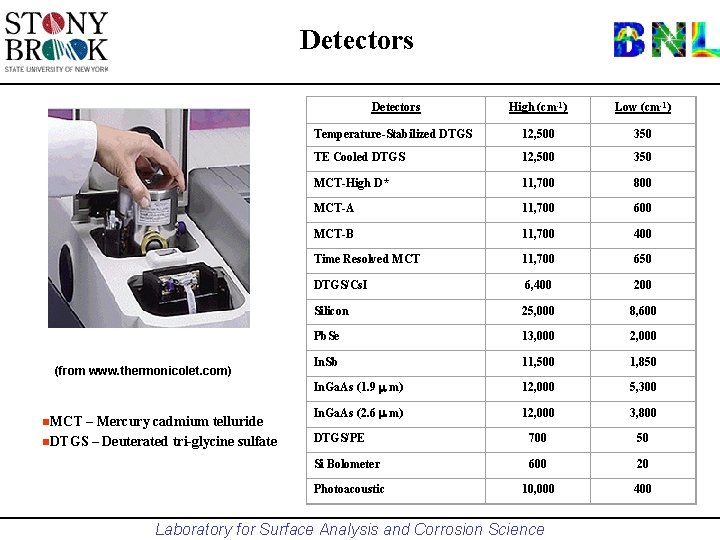
Detectors (from www. thermonicolet. com) n. MCT – Mercury cadmium telluride n. DTGS – Deuterated tri-glycine sulfate Detectors High (cm-1) Low (cm-1) Temperature-Stabilized DTGS 12, 500 350 TE Cooled DTGS 12, 500 350 MCT-High D* 11, 700 800 MCT-A 11, 700 600 MCT-B 11, 700 400 Time Resolved MCT 11, 700 650 DTGS/Cs. I 6, 400 200 Silicon 25, 000 8, 600 Pb. Se 13, 000 2, 000 In. Sb 11, 500 1, 850 In. Ga. As (1. 9 m) 12, 000 5, 300 In. Ga. As (2. 6 m) 12, 000 3, 800 DTGS/PE 700 50 Si Bolometer 600 20 Photoacoustic 10, 000 400 Laboratory for Surface Analysis and Corrosion Science
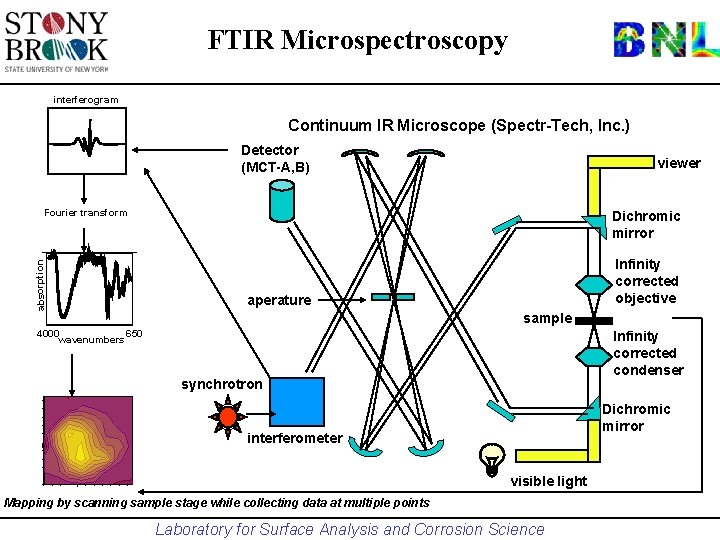
FTIR Microspectroscopy interferogram Continuum IR Microscope (Spectr-Tech, Inc. ) Detector (MCT-A, B) viewer absorption Fourier transform Dichromic mirror Infinity corrected objective aperature sample 650 4000 wavenumbers Infinity corrected condenser synchrotron Dichromic mirror interferometer visible light Mapping by scanning sample stage while collecting data at multiple points Laboratory for Surface Analysis and Corrosion Science
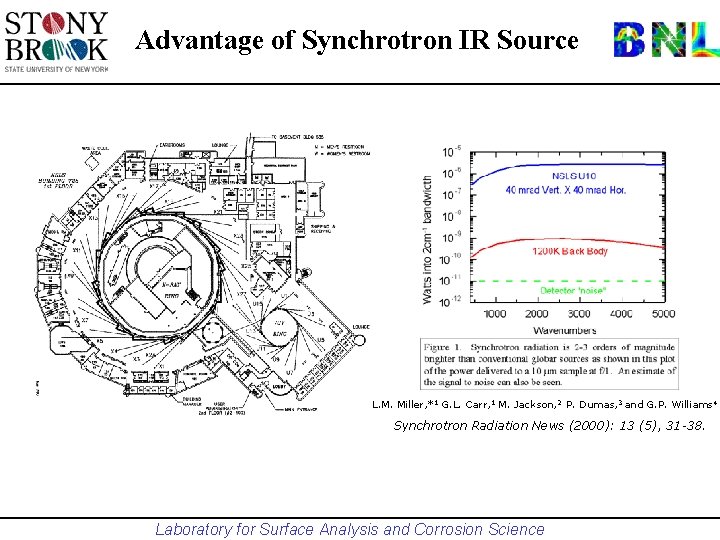
Advantage of Synchrotron IR Source L. M. Miller, *1 G. L. Carr, 1 M. Jackson, 2 P. Dumas, 3 and G. P. Williams 4 Synchrotron Radiation News (2000): 13 (5), 31 -38. Laboratory for Surface Analysis and Corrosion Science
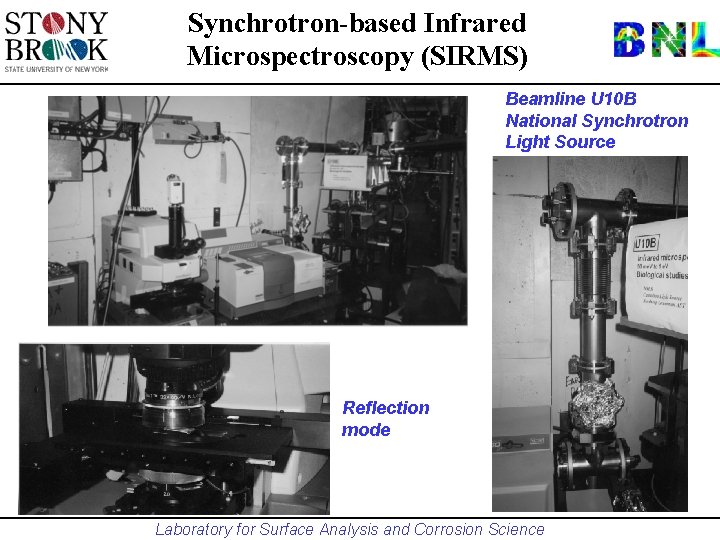
Synchrotron-based Infrared Microspectroscopy (SIRMS) Beamline U 10 B National Synchrotron Light Source Reflection mode Laboratory for Surface Analysis and Corrosion Science
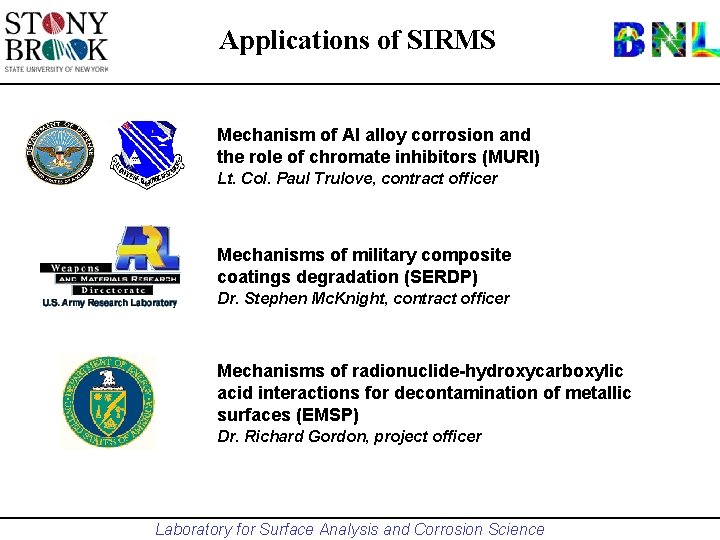
Applications of SIRMS Mechanism of Al alloy corrosion and the role of chromate inhibitors (MURI) Lt. Col. Paul Trulove, contract officer Mechanisms of military composite coatings degradation (SERDP) Dr. Stephen Mc. Knight, contract officer Mechanisms of radionuclide-hydroxycarboxylic acid interactions for decontamination of metallic surfaces (EMSP) Dr. Richard Gordon, project officer Laboratory for Surface Analysis and Corrosion Science
SIRMS of Surface Treatments on AA 2024 -T 3 Mechanism of Al alloy corrosion and the role of chromate inhibitors (MURI) Lt. Col. Paul Trulove, contract officer n n n Develop a model of the mechanisms of operation and the structure of chromate conversion coatings (CCC) on aluminum-copper aerospace alloy (AA 2024 -T 3) Model can provide guidelines for replacement of CCC with benign surface treatments Requires an understanding of alloy surface cleaning and preparation Characterize depth-dependent and spatial variations in the structure of CCC’s Determine the role of intermetallic compounds on the structure and homogeneity of CCC’s Laboratory for Surface Analysis and Corrosion Science
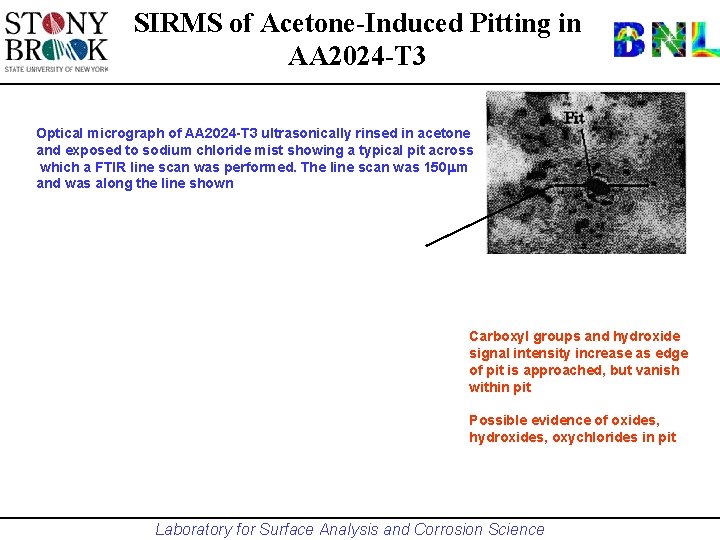
SIRMS of Acetone-Induced Pitting in AA 2024 -T 3 Optical micrograph of AA 2024 -T 3 ultrasonically rinsed in acetone and exposed to sodium chloride mist showing a typical pit across which a FTIR line scan was performed. The line scan was 150 m and was along the line shown Carboxyl groups and hydroxide signal intensity increase as edge of pit is approached, but vanish within pit Possible evidence of oxides, hydroxides, oxychlorides in pit Laboratory for Surface Analysis and Corrosion Science
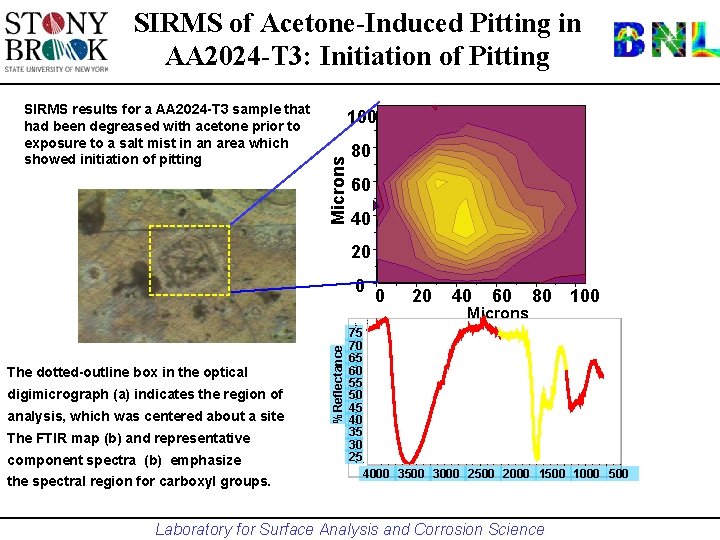
SIRMS of Acetone-Induced Pitting in AA 2024 -T 3: Initiation of Pitting 100 Microns SIRMS results for a AA 2024 -T 3 sample that had been degreased with acetone prior to exposure to a salt mist in an area which showed initiation of pitting 80 60 40 20 The dotted-outline box in the optical digimicrograph (a) indicates the region of analysis, which was centered about a site The FTIR map (b) and representative component spectra (b) emphasize the spectral region for carboxyl groups. %Reflectance 0 0 20 40 60 Microns 80 100 75 70 65 60 55 50 45 40 35 30 25 4000 3500 3000 2500 2000 1500 1000 500 Laboratory for Surface Analysis and Corrosion Science
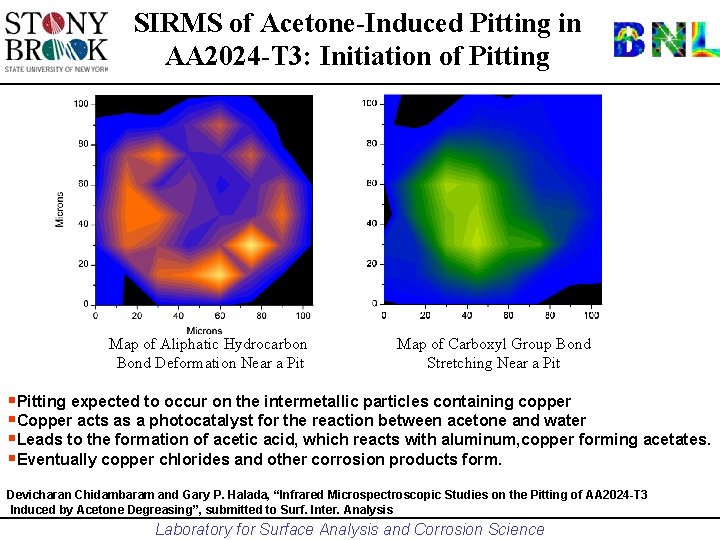
SIRMS of Acetone-Induced Pitting in AA 2024 -T 3: Initiation of Pitting Map of Aliphatic Hydrocarbon Bond Deformation Near a Pit Map of Carboxyl Group Bond Stretching Near a Pit §Pitting expected to occur on the intermetallic particles containing copper §Copper acts as a photocatalyst for the reaction between acetone and water §Leads to the formation of acetic acid, which reacts with aluminum, copper forming acetates. §Eventually copper chlorides and other corrosion products form. Devicharan Chidambaram and Gary P. Halada, “Infrared Microspectroscopic Studies on the Pitting of AA 2024 -T 3 Induced by Acetone Degreasing”, submitted to Surf. Inter. Analysis Laboratory for Surface Analysis and Corrosion Science
SIMS Maps of CCC on AA 2024 -T 3 2 min of sputtering (~1/5 of total coating thickness) are likely associated Mg The ions shown, except Si with IMC Al. OCr, 2 2 11 22 2 Cu Fe 1 1 1 - ‘Blocky’ Alx. Cuy(Mn. Fe)z Cr 2 - ‘ Spherical’ Al 2 Cu. Mg 1 1 1 2 l. Individual Region in boxes associated with IMC: 1 25 m 2 2 intermetallic particles appear to have different levels of CCC coverage Halada, G. P. , C. R. Clayton, M. J. Vasquez, J. R. Kearns, M. W. Kendig, S. L. Jeanjaquet, G. G. Peterson and G. Shea-Mc. Carthy. Spatially Resolved Microchemical Analysis of Chromate Conversion Coated Aluminum Alloys and Constituent IMC, in Critical Factors in Localized Corrosion III -–Jerome Kruger 70 th Birthday Symposium, The Electrochemical Society (1998) Laboratory for Surface Analysis and Corrosion Science
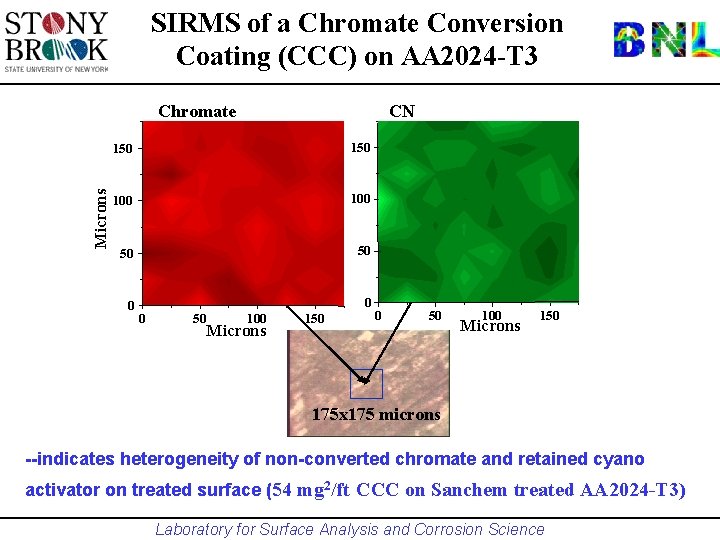
SIRMS of a Chromate Conversion Coating (CCC) on AA 2024 -T 3 CN Microns Chromate 150 100 50 50 100 Microns 150 0 50 100 Microns 150 175 x 175 microns --indicates heterogeneity of non-converted chromate and retained cyano activator on treated surface (54 mg 2/ft CCC on Sanchem treated AA 2024 -T 3) Laboratory for Surface Analysis and Corrosion Science
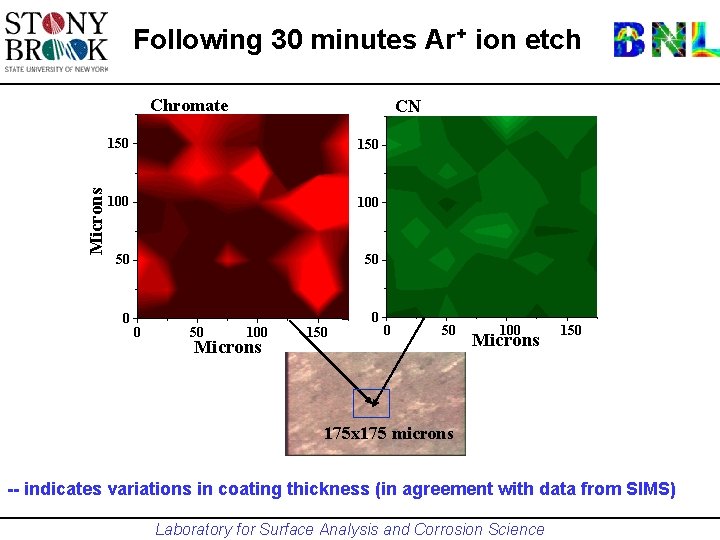
Following 30 minutes Ar+ ion etch Microns Chromate CN 150 100 50 50 100 Microns 150 0 50 100 Microns 150 175 x 175 microns -- indicates variations in coating thickness (in agreement with data from SIMS) Laboratory for Surface Analysis and Corrosion Science
Grazing Angle Objective -- need to analyze early stages of CCC Laboratory for Surface Analysis and Corrosion Science
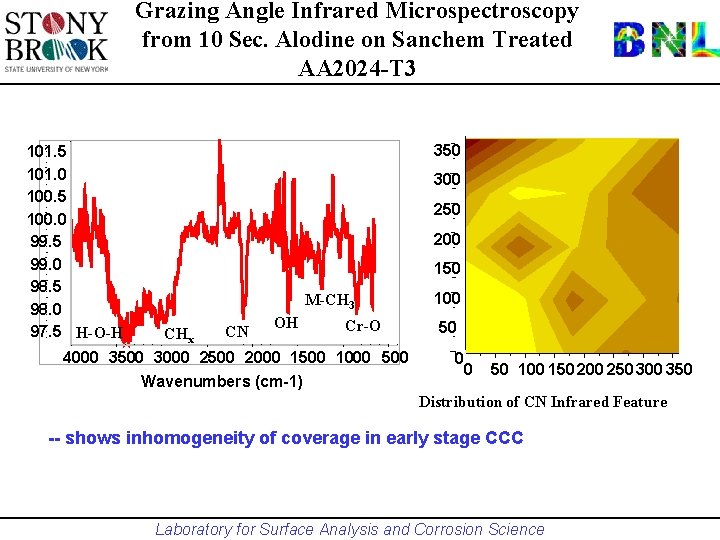
Grazing Angle Infrared Microspectroscopy from 10 Sec. Alodine on Sanchem Treated AA 2024 -T 3 101. 5 101. 0 100. 5 100. 0 99. 5 99. 0 98. 5 98. 0 97. 5 H-O-H 350 300 250 200 150 M-CH 3 CHx CN OH Cr-O 4000 3500 3000 2500 2000 1500 1000 500 Wavenumbers (cm-1) 100 50 0 0 50 100 150 200 250 300 350 Distribution of CN Infrared Feature -- shows inhomogeneity of coverage in early stage CCC Laboratory for Surface Analysis and Corrosion Science
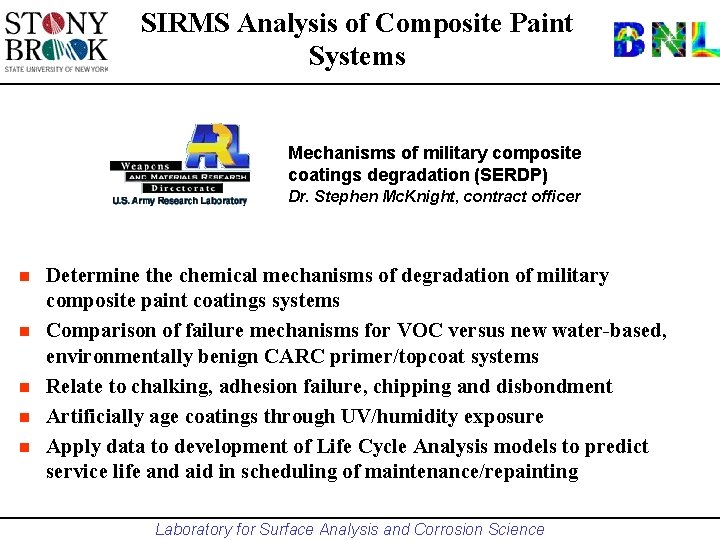
SIRMS Analysis of Composite Paint Systems Mechanisms of military composite coatings degradation (SERDP) Dr. Stephen Mc. Knight, contract officer n n n Determine the chemical mechanisms of degradation of military composite paint coatings systems Comparison of failure mechanisms for VOC versus new water-based, environmentally benign CARC primer/topcoat systems Relate to chalking, adhesion failure, chipping and disbondment Artificially age coatings through UV/humidity exposure Apply data to development of Life Cycle Analysis models to predict service life and aid in scheduling of maintenance/repainting Laboratory for Surface Analysis and Corrosion Science
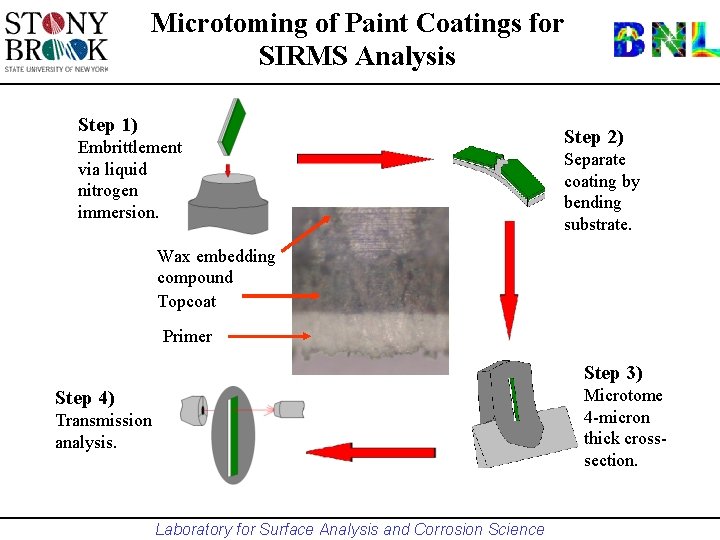
Microtoming of Paint Coatings for SIRMS Analysis Step 1) Embrittlement via liquid nitrogen immersion. Step 2) Separate coating by bending substrate. Wax embedding compound Topcoat Primer Step 3) Microtome 4 -micron thick crosssection. Step 4) Transmission analysis. Laboratory for Surface Analysis and Corrosion Science
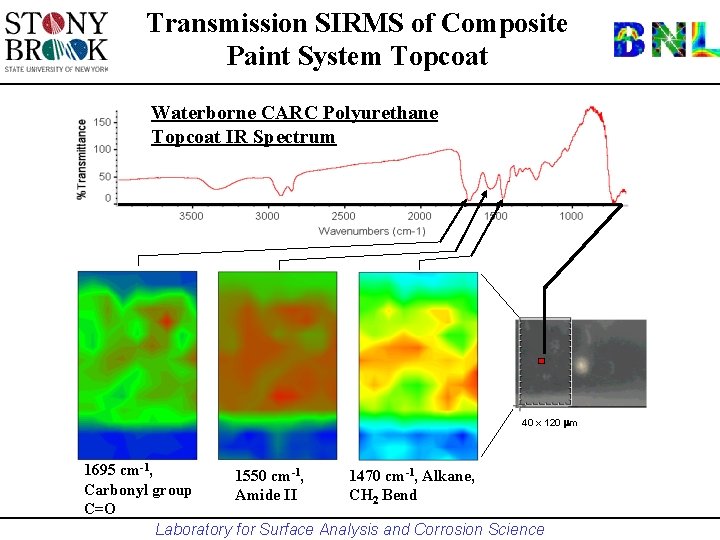
Transmission SIRMS of Composite Paint System Topcoat Waterborne CARC Polyurethane Topcoat IR Spectrum 40 x 120 m 1695 cm-1, 1550 cm-1, 1470 cm-1, Alkane, Carbonyl group Amide II CH 2 Bend C=O Laboratory for Surface Analysis and Corrosion Science
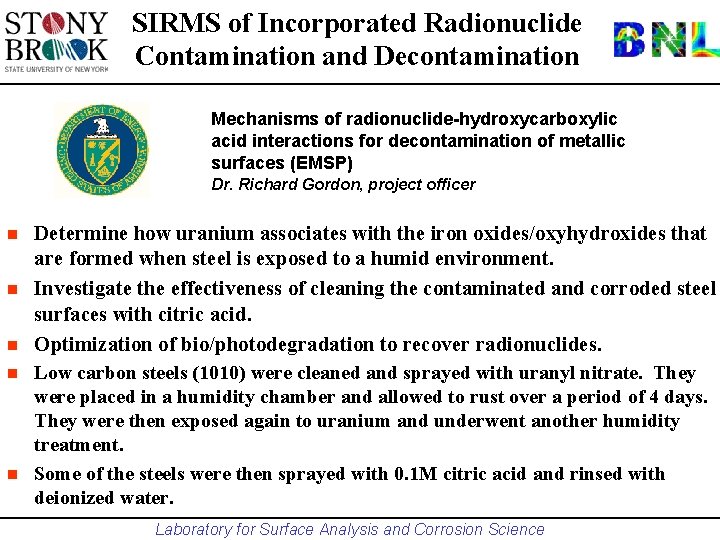
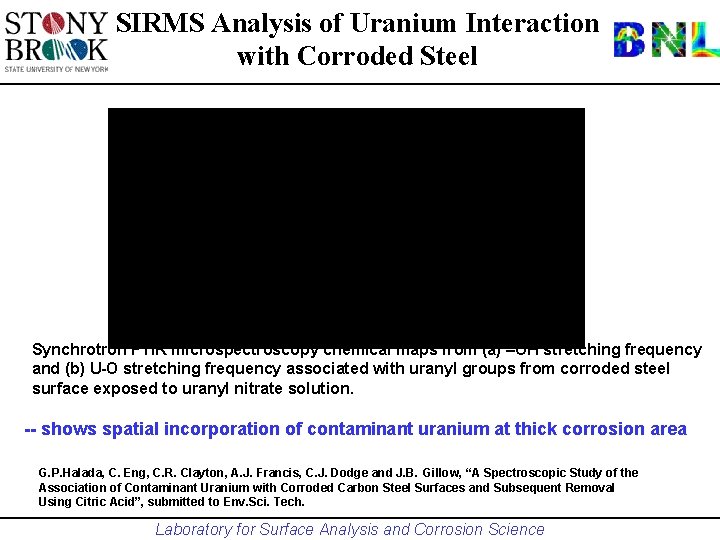
SIRMS of Incorporated Radionuclide Contamination and Decontamination Mechanisms of radionuclide-hydroxycarboxylic acid interactions for decontamination of metallic surfaces (EMSP) Dr. Richard Gordon, project officer n n n Determine how uranium associates with the iron oxides/oxyhydroxides that are formed when steel is exposed to a humid environment. Investigate the effectiveness of cleaning the contaminated and corroded steel surfaces with citric acid. Optimization of bio/photodegradation to recover radionuclides. Low carbon steels (1010) were cleaned and sprayed with uranyl nitrate. They were placed in a humidity chamber and allowed to rust over a period of 4 days. They were then exposed again to uranium and underwent another humidity treatment. Some of the steels were then sprayed with 0. 1 M citric acid and rinsed with deionized water. Laboratory for Surface Analysis and Corrosion Science
SIRMS Analysis of Uranium Interaction with Corroded Steel Synchrotron FTIR microspectroscopy chemical maps from (a) –OH stretching frequency and (b) U-O stretching frequency associated with uranyl groups from corroded steel surface exposed to uranyl nitrate solution. -- shows spatial incorporation of contaminant uranium at thick corrosion area G. P. Halada, C. Eng, C. R. Clayton, A. J. Francis, C. J. Dodge and J. B. Gillow, “A Spectroscopic Study of the Association of Contaminant Uranium with Corroded Carbon Steel Surfaces and Subsequent Removal Using Citric Acid”, submitted to Env. Sci. Tech. Laboratory for Surface Analysis and Corrosion Science
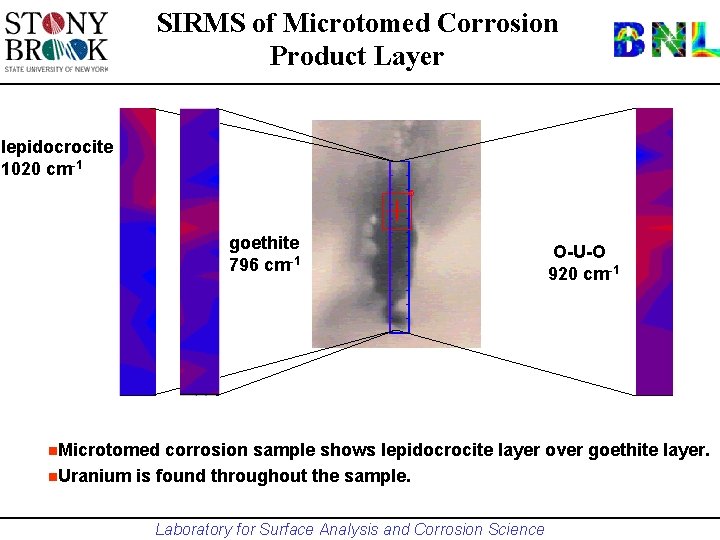
SIRMS of Microtomed Corrosion Product Layer lepidocrocite 1020 cm-1 goethite 796 cm-1 n. Microtomed O-U-O 920 cm-1 corrosion sample shows lepidocrocite layer over goethite layer. n. Uranium is found throughout the sample. Laboratory for Surface Analysis and Corrosion Science
Decontamination of Uranium on Corroded Steel Using 0. 1 M Citric Acid Synchrotron-based infrared chemical maps of the O-U-O stretching frequency feature at approximately 900 wave numbers from a portion of the surface of a contaminated carbon steel surface corroded in a cyclic humidity chamber, before (left) and after (right) decontamination using a citric acid treatment (0. 1 M followed by rinse with distilled water) Laboratory for Surface Analysis and Corrosion Science
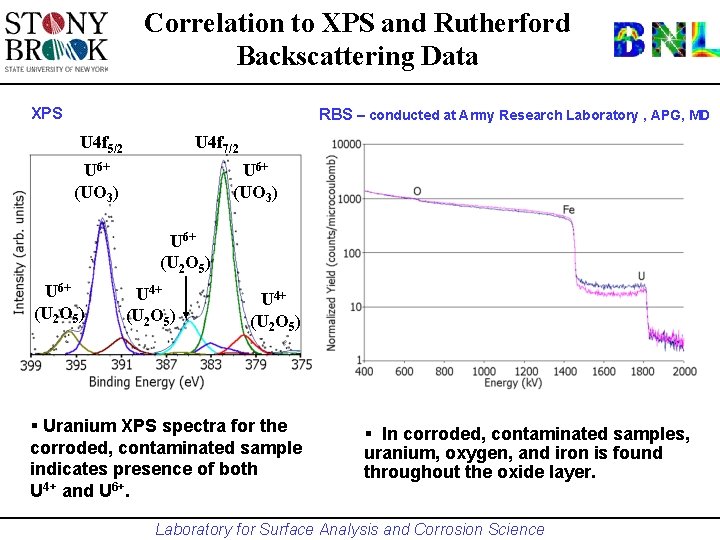
Correlation to XPS and Rutherford Backscattering Data XPS RBS – conducted at Army Research Laboratory , APG, MD U 4 f 5/2 U 4 f 7/2 U 6+ (UO 3) U 6+ (U 2 O 5) U 4+ (U 2 O 5) § Uranium XPS spectra for the corroded, contaminated sample indicates presence of both U 4+ and U 6+. § In corroded, contaminated samples, uranium, oxygen, and iron is found throughout the oxide layer. Laboratory for Surface Analysis and Corrosion Science
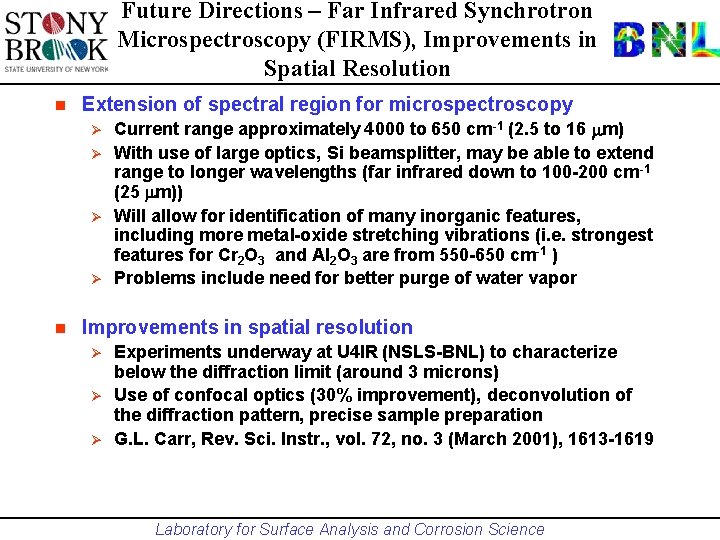
Future Directions – Far Infrared Synchrotron Microspectroscopy (FIRMS), Improvements in Spatial Resolution n Extension of spectral region for microspectroscopy Ø Ø n Current range approximately 4000 to 650 cm-1 (2. 5 to 16 m) With use of large optics, Si beamsplitter, may be able to extend range to longer wavelengths (far infrared down to 100 -200 cm-1 (25 m)) Will allow for identification of many inorganic features, including more metal-oxide stretching vibrations (i. e. strongest features for Cr 2 O 3 and Al 2 O 3 are from 550 -650 cm-1 ) Problems include need for better purge of water vapor Improvements in spatial resolution Ø Ø Ø Experiments underway at U 4 IR (NSLS-BNL) to characterize below the diffraction limit (around 3 microns) Use of confocal optics (30% improvement), deconvolution of the diffraction pattern, precise sample preparation G. L. Carr, Rev. Sci. Instr. , vol. 72, no. 3 (March 2001), 1613 -1619 Laboratory for Surface Analysis and Corrosion Science
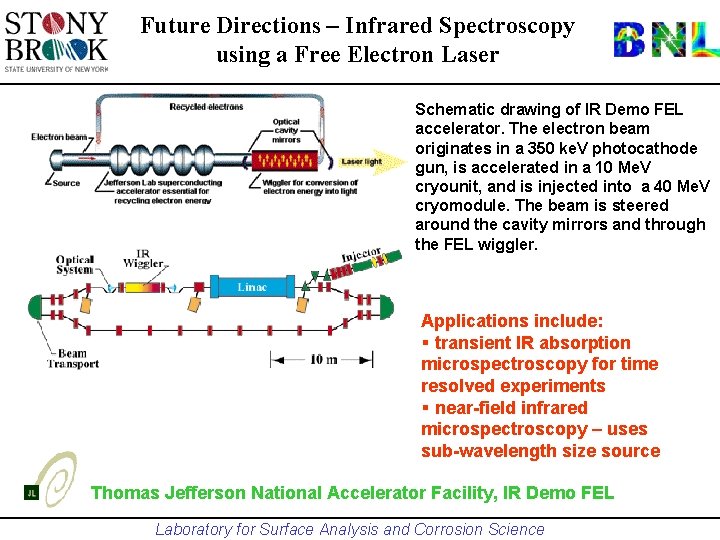
Future Directions – Infrared Spectroscopy using a Free Electron Laser Schematic drawing of IR Demo FEL accelerator. The electron beam originates in a 350 ke. V photocathode gun, is accelerated in a 10 Me. V cryounit, and is injected into a 40 Me. V cryomodule. The beam is steered around the cavity mirrors and through the FEL wiggler. Applications include: § transient IR absorption microspectroscopy for time resolved experiments § near-field infrared microspectroscopy – uses sub-wavelength size source Thomas Jefferson National Accelerator Facility, IR Demo FEL Laboratory for Surface Analysis and Corrosion Science
Conclusions n n n Synchrotron-based infrared microspectroscopy is a powerful tool for the spatially-resolved characterization of surface and interfacial chemistry. Applicability can be enhanced through novel sample preparation techniques and choice of optics. Combination with other techniques, including XPS, SIMS, RBS, optical analysis and laboratory-based FTIR, is essential for the creation of comprehensive and consistent models of surfaces and coatings Limitations of synchrotron-based infrared analysis arise from availability of detector/beamsplitter combinations, quality of IR source, physics of diffraction limits and aqueous environments. Studies currently underway at synchrotron and FEL facilities to overcome these limitations show great promise Laboratory for Surface Analysis and Corrosion Science
Additional Acknowledgements In addition to the funding programs shown earlier, we wish to acknowledge the students who have worked on these measurements: Marvin Vasquez, Devicharan Chidambaram , Lionel Keene, Charlotte Eng and Michael Cuiffo as well as our collaborators at the National Synchrotron Light Source At Brookhaven National Laboratory: Gwyn Williams, Larry Carr and Lisa Miller Laboratory for Surface Analysis and Corrosion Science