
Applications of Supply and Demand Introduction to Stocks
- Slides: 12
Applications of Supply and Demand
Introduction to Stocks • Together we will watch the short episode on the stock market.
Securities Bonds - A fixed debt that the corporation borrows from a buyer and must pay back at a fixed date - The longer the period of borrow the higher the payment (interest) that the company must pay the buyer - The corporation pays interest usually every six months to the buyer - The corporation usually then pays the principal back to the investor at the end of the period - The bondholder can re-sell the bond with all its conditions at anytime at whatever the market will bear - The bondholder does not own a piece of the company, but is a creditor before shareholders if the company fails
Stocks • Shares of ownership of a company • Common or Preferred (preferred do not usually give shareholders voting rights while common does) • Asset Value: a portion of the company’s net worth • Sold through a stockbroker who is a part of the exchange (they pay a fee to be able to do this) OR Through the Internet and trading apps like Wealthsimple. Go to the link and list your Top Pro and Top Con of trading with online companies like Wealthsimple. • The actual price of a share is whatever it will fetch in the market (supply vs. Demand)
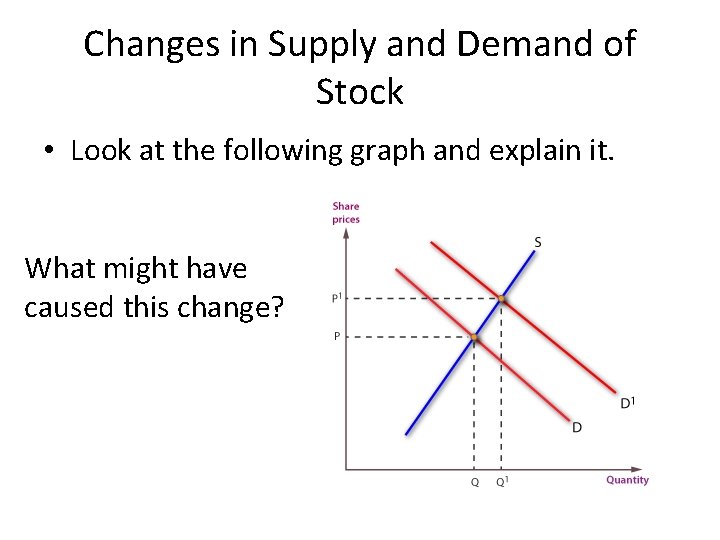
Changes in Supply and Demand of Stock • Look at the following graph and explain it. What might have caused this change?
Mutual Funds • A more passive investment. Expert fund managers lump together the investment dollars of many clients and create a diverse portfolio of investments and then manage this fund on behalf of clients. • Usually a much more long – term investment and way to trade stock.
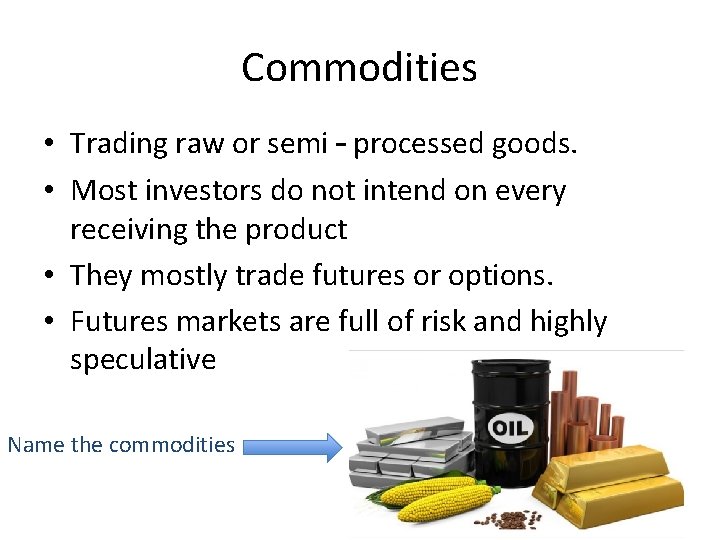
Commodities • Trading raw or semi – processed goods. • Most investors do not intend on every receiving the product • They mostly trade futures or options. • Futures markets are full of risk and highly speculative Name the commodities
Trading – Call and Put Call (buyer) Put (seller) • Both parties are committed to a transaction on a fixed price on a fixed date. A Call Option is giving the holder the right but not obligation to buy at a pre arranged price and date. • A contract giving the right but not the obligation to sell at a pre arranged date and price The difference between the contract price and market price on the day the contract matures is paid by one party to the futures market. The futures market transfers this into the account of the other party to satisfy the contract. If the market price is above the contract price the buyer profits; if the market price is below the contract price the seller profits.
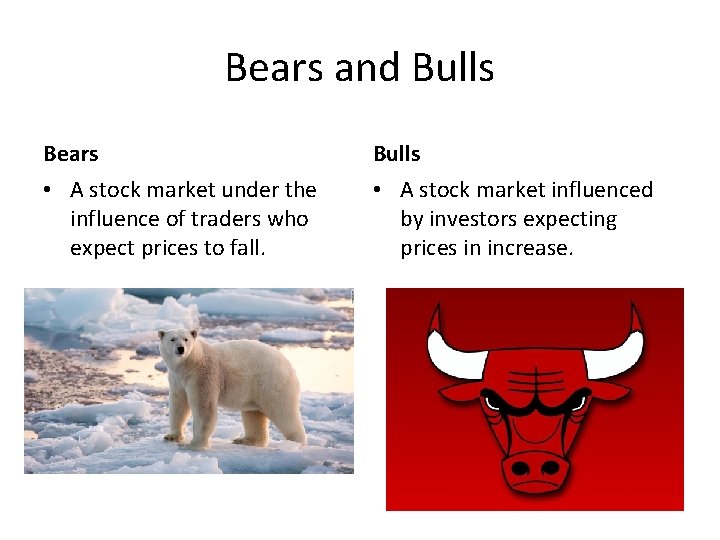
Bears and Bulls Bears Bulls • A stock market under the influence of traders who expect prices to fall. • A stock market influenced by investors expecting prices in increase.
Cryptocurrency • Together we will begin by watching the short explanation of cryptocurrency. • Then we will watch the Kraken Cryptocurrency Exchange video here • Then visit the Kraken link and check the prices of the different currencies. Click the “Classic Chart View” How is crypto currency a perfect example of market capitalism and supply and demand economics?
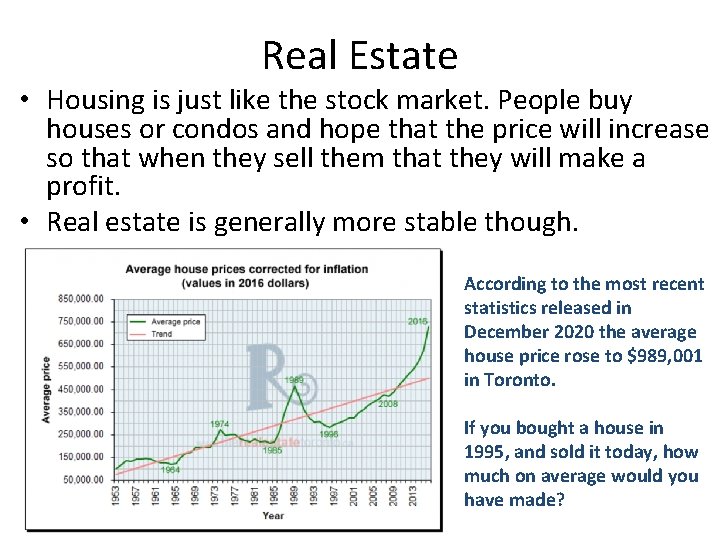
Real Estate • Housing is just like the stock market. People buy houses or condos and hope that the price will increase so that when they sell them that they will make a profit. • Real estate is generally more stable though. According to the most recent statistics released in December 2020 the average house price rose to $989, 001 in Toronto. If you bought a house in 1995, and sold it today, how much on average would you have made?
Overall What have you learned about investments?