
Applications of SMT Solving at Microsoft Nikolaj Bjrner
Applications of SMT Solving at Microsoft Nikolaj Bjørner Microsoft Research FSE &
This Talk Using Decision Engines for Software @ Microsoft. Dynamic Symbolic Execution Bit-precise Scalable Static Analysis and several others What is Important for Decision Engines The sweet spot for SMT solvers Shameless, blatant propaganda for the SMT solver Z 3
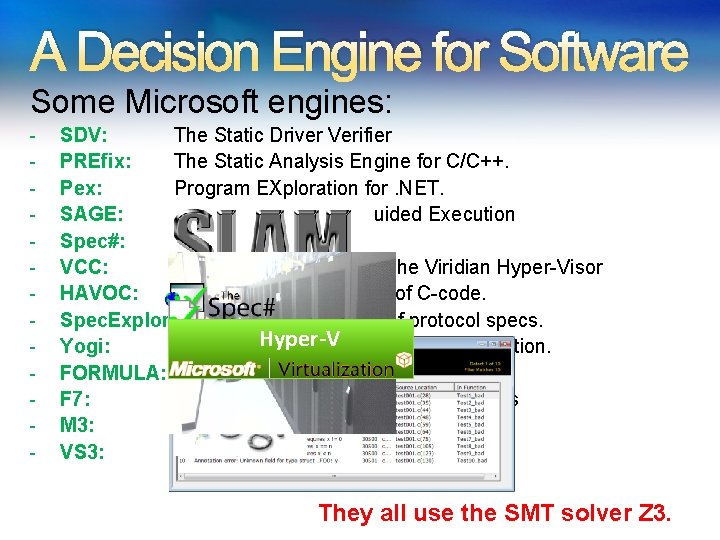
A Decision Engine for Software Some Microsoft engines: - SDV: The Static Driver Verifier PREfix: The Static Analysis Engine for C/C++. Pex: Program EXploration for. NET. SAGE: Scalable Automated Guided Execution Spec#: C# + contracts VCC: Verifying C Compiler for the Viridian Hyper-Visor HAVOC: Heap-Aware Verification of C-code. Spec. Explorer: Model-based testing of protocol specs. Hyper-Vexecution + abstraction. Yogi: Dynamic symbolic FORMULA: Model-based Design F 7: Refinement types for security protocols M 3: Model Program Modeling VS 3: Abstract interpretation and Synthesis They all use the SMT solver Z 3.
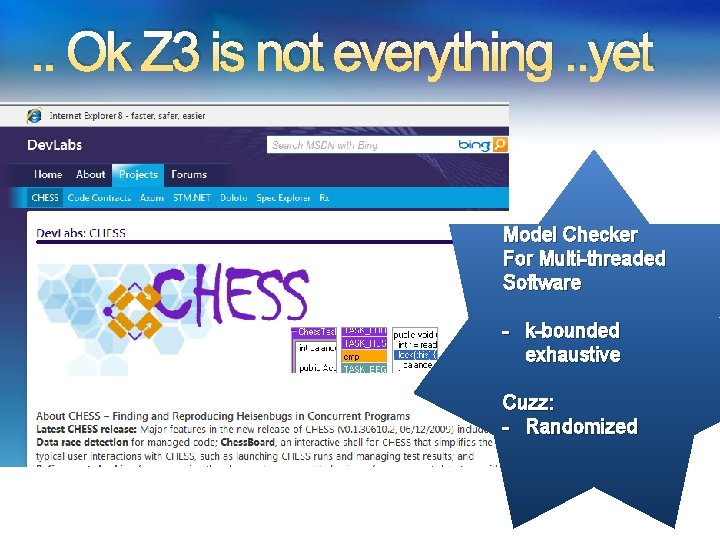
. . Ok Z 3 is not everything. . yet Model Checker For Multi-threaded Software - k-bounded exhaustive Cuzz: - Randomized

The Inner Research Market @ MSFT
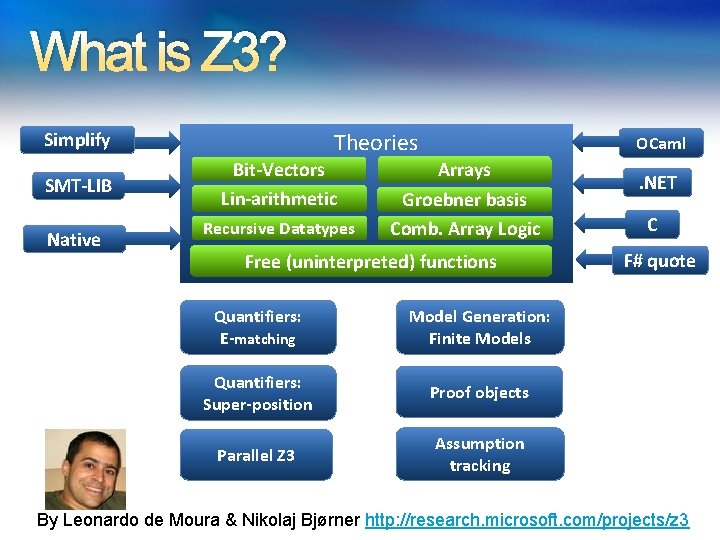
What is Z 3? Theories Simplify SMT-LIB Native Bit-Vectors Lin-arithmetic Recursive Datatypes OCaml Arrays Groebner basis Comb. Array Logic Free (uninterpreted) functions Quantifiers: E-matching Model Generation: Finite Models Quantifiers: Super-position Proof objects Parallel Z 3 Assumption tracking . NET C F# quote By Leonardo de Moura & Nikolaj Bjørner http: //research. microsoft. com/projects/z 3
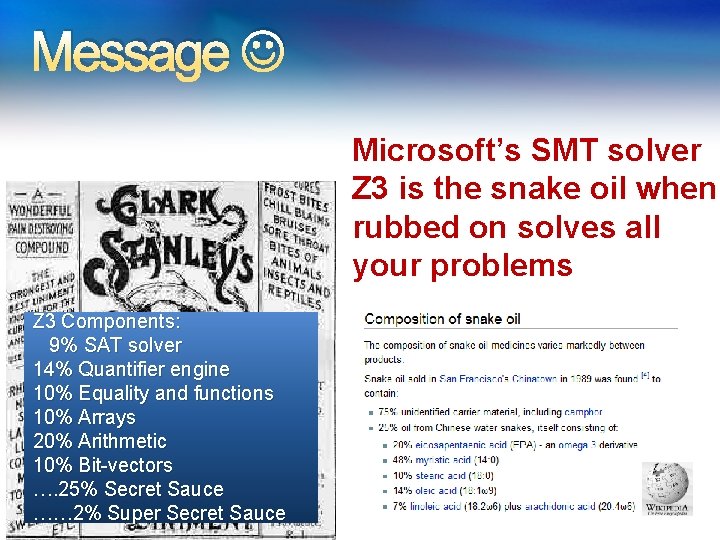
Message Microsoft’s SMT solver Z 3 is the snake oil when rubbed on solves all your problems Z 3 Components: 9% SAT solver 14% Quantifier engine 10% Equality and functions 10% Arrays 20% Arithmetic 10% Bit-vectors …. 25% Secret Sauce …… 2% Super Secret Sauce
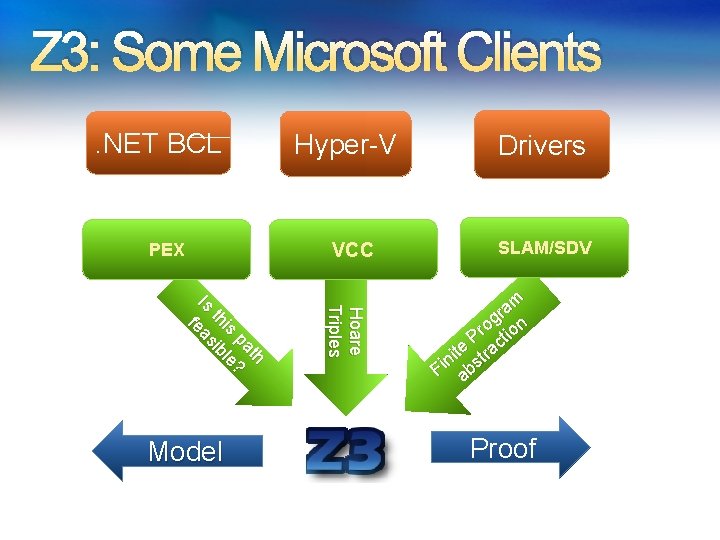
Z 3: Some Microsoft Clients. NET BCL PEX VCC Hoare Triples th pa ? is le th ib Is eas f Model Hyper-V Drivers SLAM/SDV am r og ion r P ct e a t ni str i F ab Proof
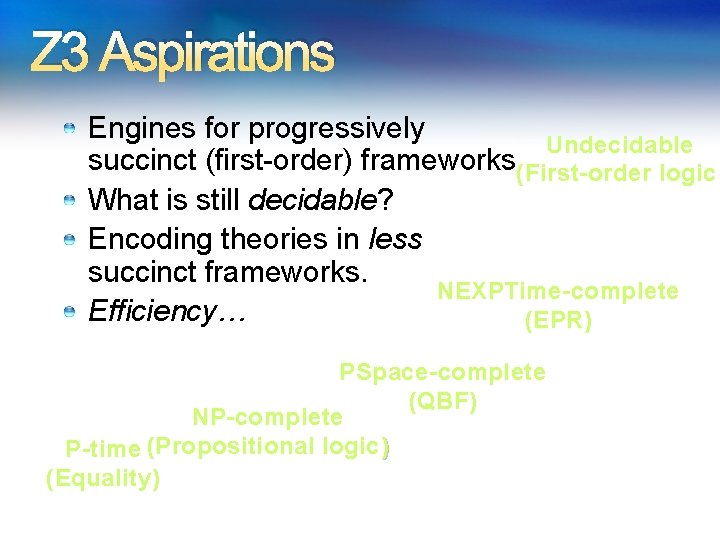
Z 3 Aspirations Engines for progressively Undecidable succinct (first-order) frameworks(First-order logic) What is still decidable? Encoding theories in less succinct frameworks. NEXPTime-complete Efficiency… (EPR) PSpace-complete (QBF) NP-complete P-time (Propositional logic ) (Equality)
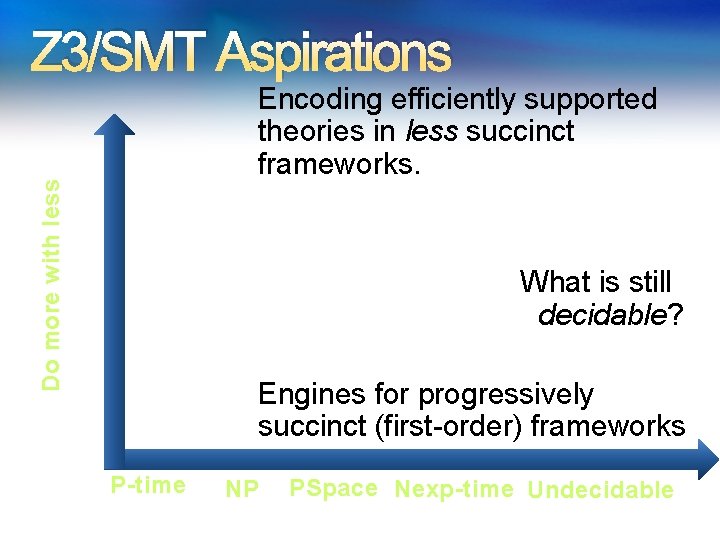
Z 3/SMT Aspirations Do more with less Encoding efficiently supported theories in less succinct frameworks. What is still decidable? Engines for progressively succinct (first-order) frameworks P-time NP PSpace Nexp-time Undecidable
What is SMT?
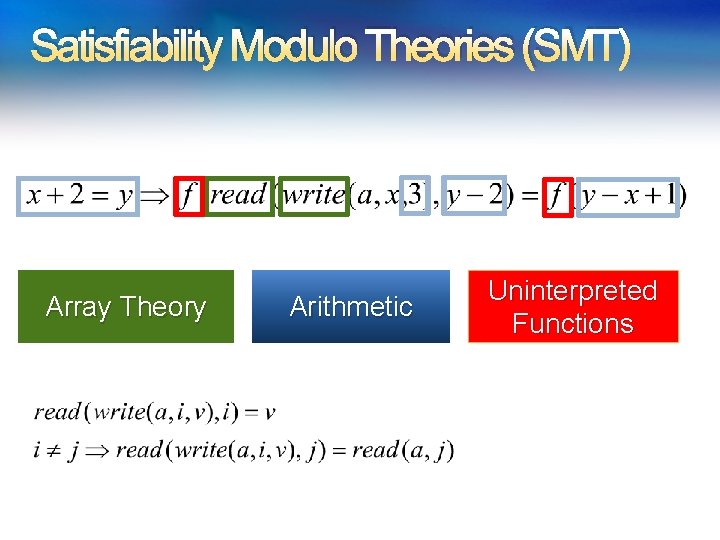
Satisfiability Modulo Theories (SMT) Array Theory Z 3: An Efficient SMT Arithmetic Uninterpreted Functions
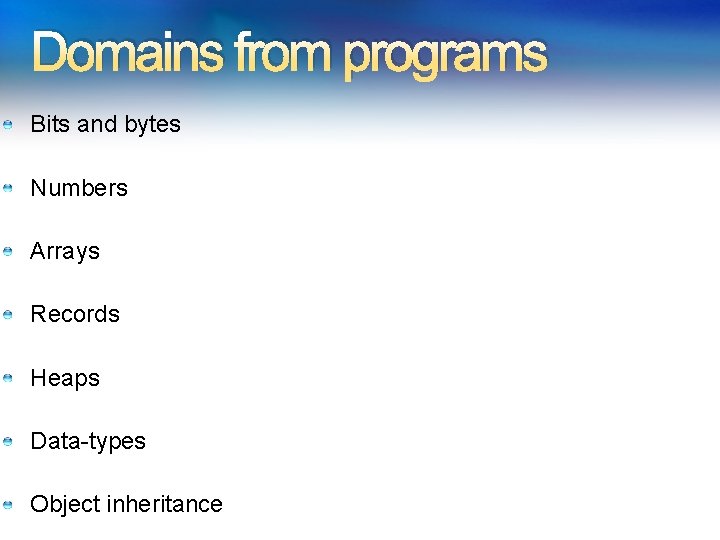
Domains from programs Bits and bytes Numbers Arrays Records Heaps Data-types Object inheritance
Dynamic Application: Symbolic Execution - Pex, SAGE, Yogi, Vigilante
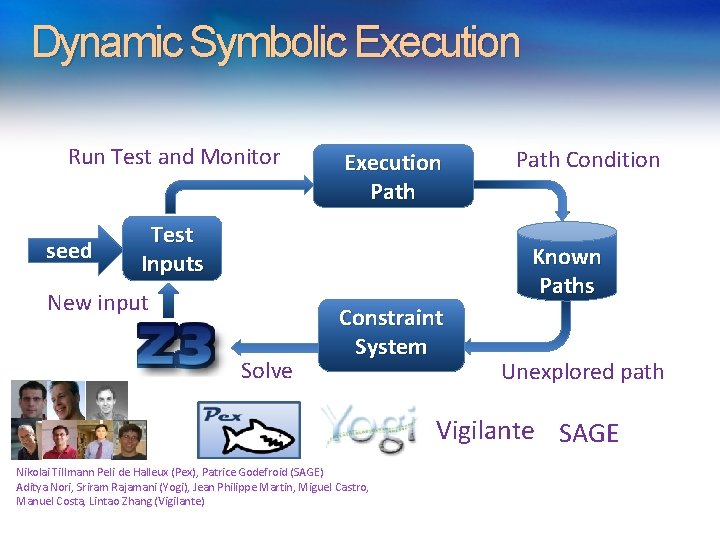
Dynamic Symbolic Execution Run Test and Monitor seed Execution Path Test Inputs Path Condition Known Paths New input Solve Constraint System Unexplored path Vigilante SAGE Nikolai Tillmann Peli de Halleux (Pex), Patrice Godefroid (SAGE) Aditya Nori, Sriram Rajamani (Yogi), Jean Philippe Martin, Miguel Castro, Manuel Costa, Lintao Zhang (Vigilante)
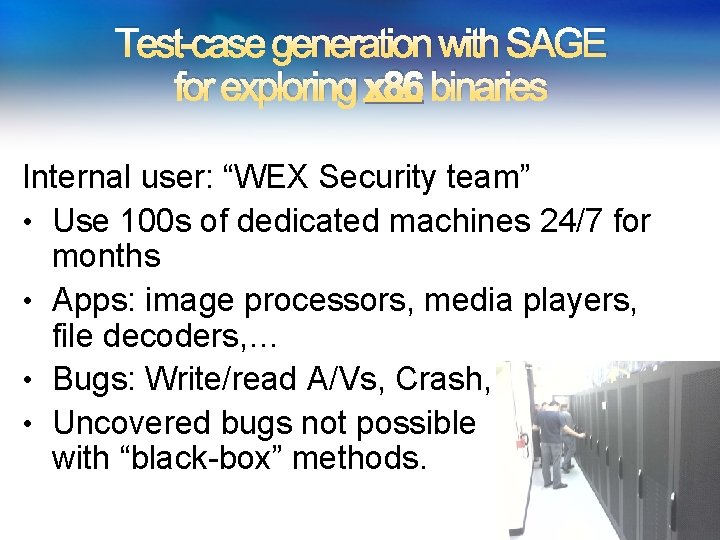
Test-case generation with SAGE for exploring x 86 binaries Internal user: “WEX Security team” • Use 100 s of dedicated machines 24/7 for months • Apps: image processors, media players, file decoders, … • Bugs: Write/read A/Vs, Crash, … • Uncovered bugs not possible with “black-box” methods.
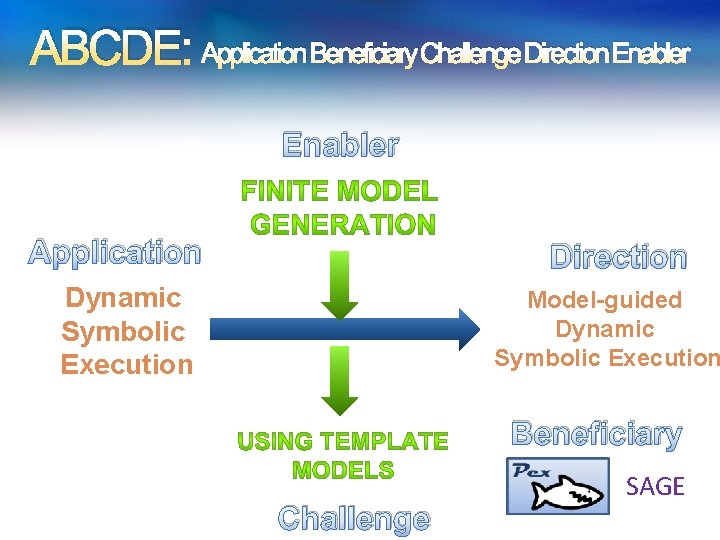
ABCDE: Application Beneficiary Challenge Direction Enabler Application Direction Dynamic Symbolic Execution Model-guided Dynamic Symbolic Execution Beneficiary Challenge SAGE
![Application: Bit-precise Scalable Static Analysis PREfix [Moy, B. , Sielaff 2010]](http://slidetodoc.com/presentation_image_h2/d065fa1ad28d7849dfda1e8c02791242/image-18.jpg "Application: Bit-precise Scalable Static Analysis PREfix [Moy, B. , Sielaff 2010]")
Application: Bit-precise Scalable Static Analysis PREfix [Moy, B. , Sielaff 2010]
![What is wrong here? -INT_MIN= INT_MIN 3(INT_MAX+1)/4 + (INT_MAX+1)/4 int binary_search(int[] arr, int low,](http://slidetodoc.com/presentation_image_h2/d065fa1ad28d7849dfda1e8c02791242/image-19.jpg "What is wrong here? -INT_MIN= INT_MIN 3(INT_MAX+1)/4 + (INT_MAX+1)/4 int binary_search(int[] arr, int low,")
What is wrong here? -INT_MIN= INT_MIN 3(INT_MAX+1)/4 + (INT_MAX+1)/4 int binary_search(int[] arr, int low, = INT_MIN int high, int key) while (low <= high) { // Find middle value int mid = (low + high) / 2; int val = arr[mid]; if (val == key) return mid; if (val < key) low = mid+1; else high = mid-1; } return -1; } Package: java. util. Arrays Function: binary_search void itoa(int n, char* s) { if (n < 0) { *s++ = ‘-’; n = -n; } // Add digits to s …. Book: Kernighan and Ritchie Function: itoa (integer to ascii)
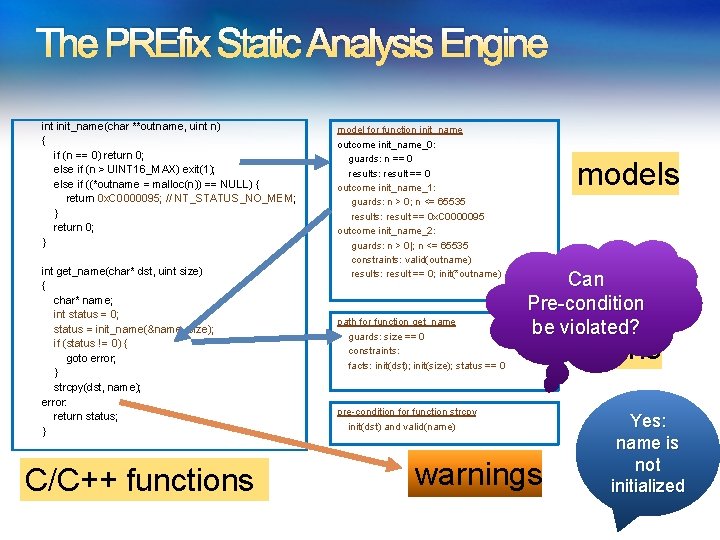
The PREfix Static Analysis Engine int init_name(char **outname, uint n) { if (n == 0) return 0; else if (n > UINT 16_MAX) exit(1); else if ((*outname = malloc(n)) == NULL) { return 0 x. C 0000095; // NT_STATUS_NO_MEM; } return 0; } int get_name(char* dst, uint size) { char* name; int status = 0; status = init_name(&name, size); if (status != 0) { goto error; } strcpy(dst, name); error: return status; } C/C++ functions 6/26/2009 model for function init_name outcome init_name_0: guards: n == 0 results: result == 0 outcome init_name_1: guards: n > 0; n <= 65535 results: result == 0 x. C 0000095 outcome init_name_2: guards: n > 0|; n <= 65535 constraints: valid(outname) results: result == 0; init(*outname) path for function get_name guards: size == 0 constraints: facts: init(dst); init(size); status == 0 models Can Pre-condition be violated? pre-condition for function strcpy init(dst) and valid(name) warnings paths Yes: name is not initialized
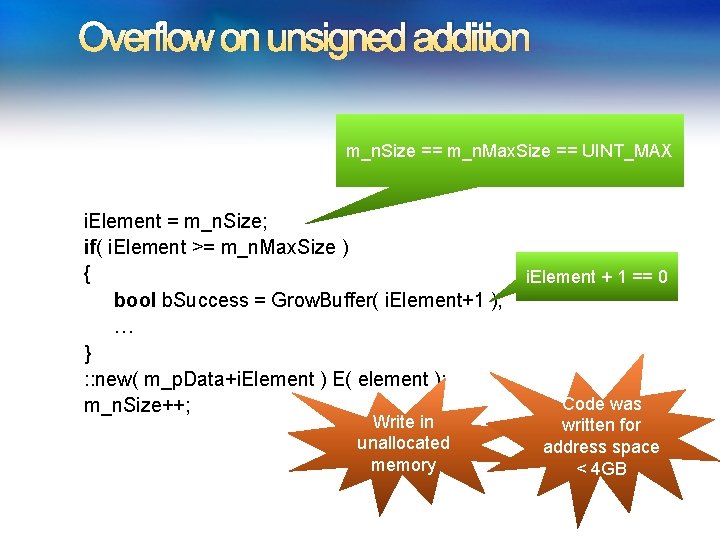
Overflow on unsigned addition m_n. Size == m_n. Max. Size == UINT_MAX i. Element = m_n. Size; if( i. Element >= m_n. Max. Size ) { bool b. Success = Grow. Buffer( i. Element+1 ); … } : : new( m_p. Data+i. Element ) E( element ); m_n. Size++; Write in unallocated memory 6/26/2009 in Formal Constraints i. Element + 1 == 0 Code was written for address space < 4 GB 21
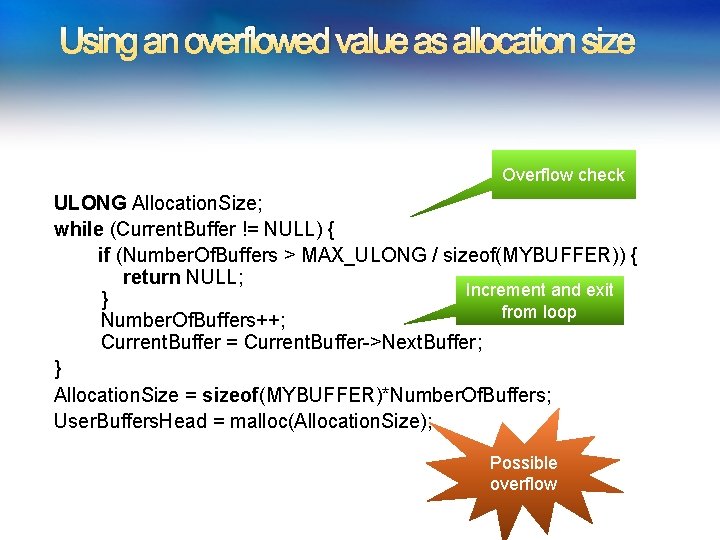
Using an overflowed value as allocation size Overflow check ULONG Allocation. Size; while (Current. Buffer != NULL) { if (Number. Of. Buffers > MAX_ULONG / sizeof(MYBUFFER)) { return NULL; Increment and exit } from loop Number. Of. Buffers++; Current. Buffer = Current. Buffer->Next. Buffer; } Allocation. Size = sizeof(MYBUFFER)*Number. Of. Buffers; User. Buffers. Head = malloc(Allocation. Size); Possible overflow 6/26/2009 in Formal Constraints 22
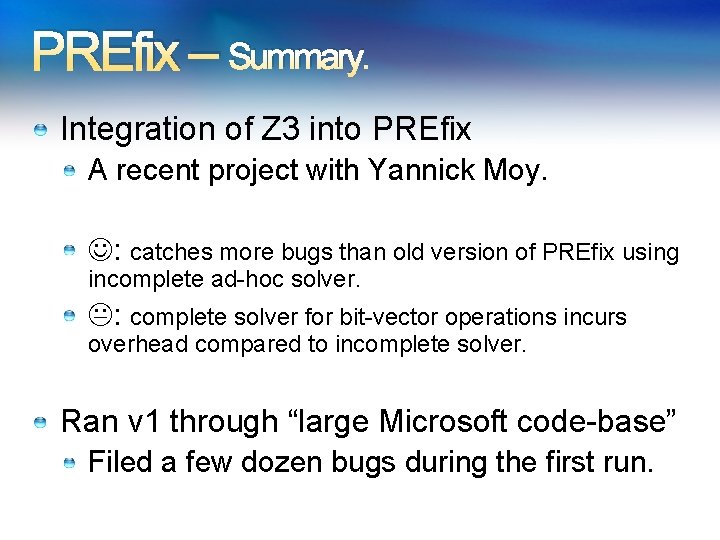
PREfix – Summary. Integration of Z 3 into PREfix A recent project with Yannick Moy. : catches more bugs than old version of PREfix using incomplete ad-hoc solver. : complete solver for bit-vector operations incurs overhead compared to incomplete solver. Ran v 1 through “large Microsoft code-base” Filed a few dozen bugs during the first run.
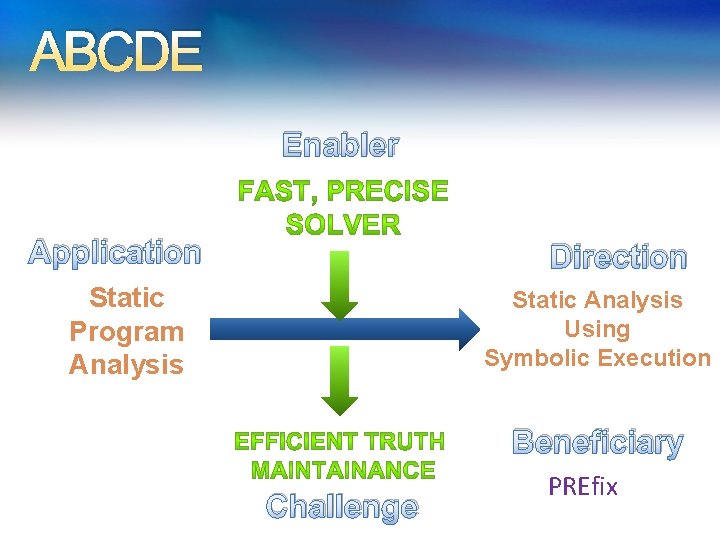
ABCDE Enabler Application Direction Static Program Analysis Static Analysis Using Symbolic Execution Beneficiary Challenge PREfix

Application: Program Verification - Spec#, VCC, HAVOC
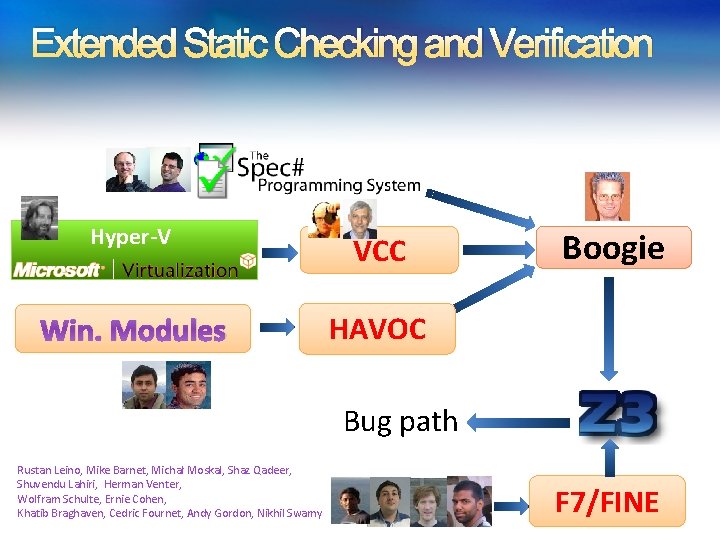
Extended Static Checking and Verification Hyper-V VCC Win. Modules HAVOC Boogie Verification condition Bug path Rustan Leino, Mike Barnet, Michał Moskal, Shaz Qadeer, Shuvendu Lahiri, Herman Venter, Wolfram Schulte, Ernie Cohen, Khatib Braghaven, Cedric Fournet, Andy Gordon, Nikhil Swamy F 7/FINE
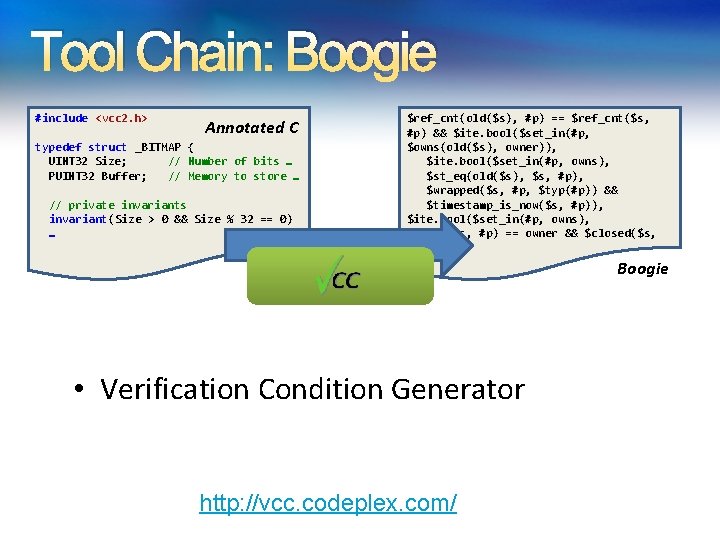
Tool Chain: Boogie #include <vcc 2. h> Annotated C typedef struct _BITMAP { UINT 32 Size; // Number of bits … PUINT 32 Buffer; // Memory to store … // private invariants invariant(Size > 0 && Size % 32 == 0) … $ref_cnt(old($s), #p) == $ref_cnt($s, #p) && $ite. bool($set_in(#p, $owns(old($s), owner)), $ite. bool($set_in(#p, owns), $st_eq(old($s), $s, #p), $wrapped($s, #p, $typ(#p)) && $timestamp_is_now($s, #p)), $ite. bool($set_in(#p, owns), $owner($s, #p) == owner && $closed($s, Boogie • Verification Condition Generator http: //vcc. codeplex. com/
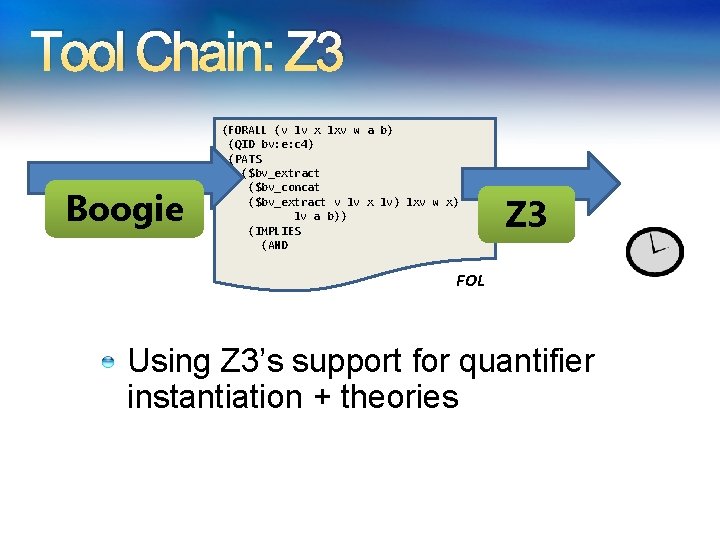
Tool Chain: Z 3 Boogie (FORALL (v lv x lxv w a b) (QID bv: e: c 4) (PATS ($bv_extract ($bv_concat ($bv_extract v lv x lv) lxv w x) lv a b)) (IMPLIES (AND Z 3 FOL Using Z 3’s support for quantifier instantiation + theories
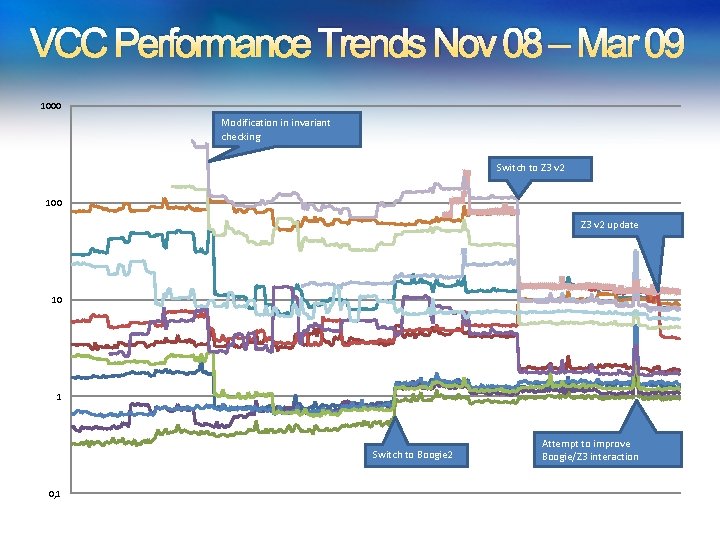
VCC Performance Trends Nov 08 – Mar 09 1000 Modification in invariant checking Switch to Z 3 v 2 100 Z 3 v 2 update 10 1 Switch to Boogie 2 0, 1 Attempt to improve Boogie/Z 3 interaction
The Importance of Speed
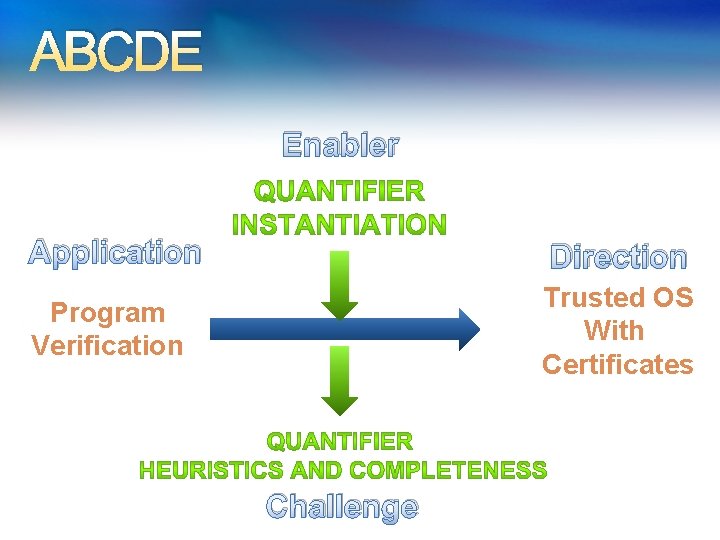
ABCDE Enabler Application Direction Program Verification Trusted OS With Certificates Challenge

Application: Model-Based Design - FORMULA

FORMULA: Design Space Exploration Use Design Space Exploration to identify valid candidate architectures
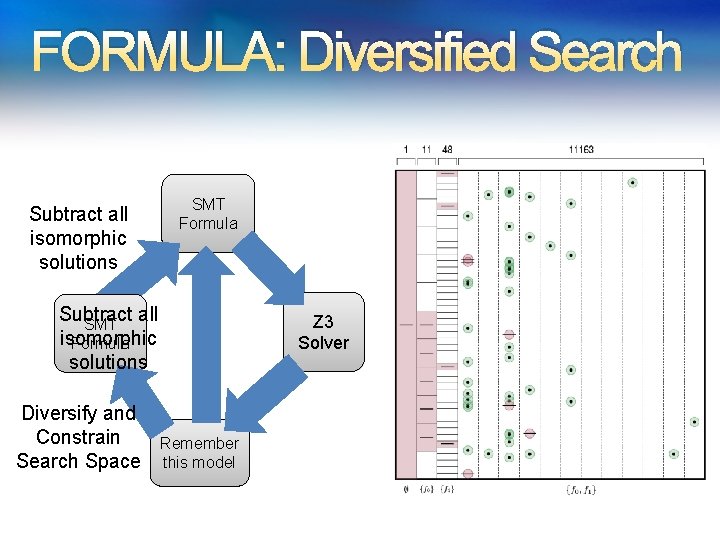
FORMULA: Diversified Search Subtract all isomorphic solutions SMT Formula Subtract all SMT isomorphic Formula solutions Diversify and Constrain Search Space Z 3 Solver Remember this model
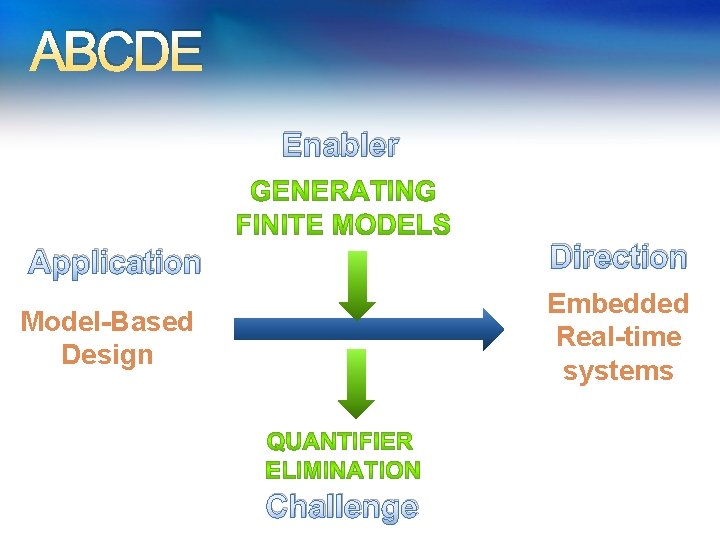
ABCDE Enabler Direction Application Embedded Real-time systems Model-Based Design Challenge
Application: Model-Based Testing - Spec. Explorer, M 3
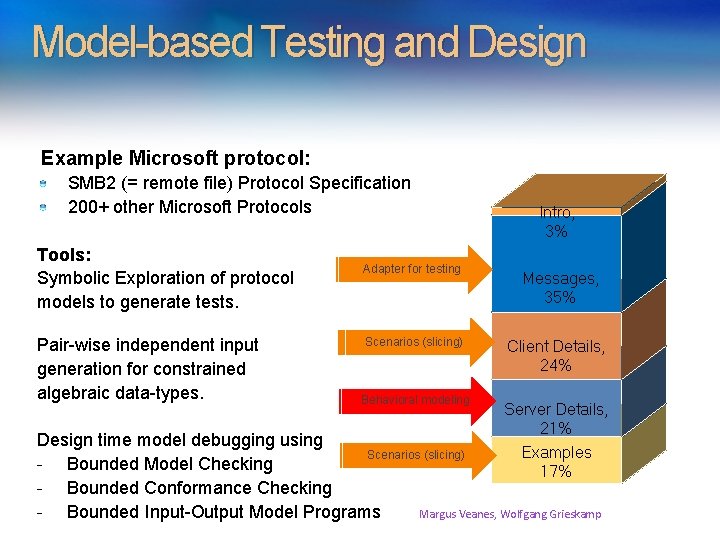
Model-based Testing and Design Example Microsoft protocol: SMB 2 (= remote file) Protocol Specification 200+ other Microsoft Protocols Tools: Symbolic Exploration of protocol models to generate tests. Pair-wise independent input generation for constrained algebraic data-types. Adapter for testing Scenarios (slicing) Behavioral modeling Intro, 3% Messages, 35% Client Details, 24% Server Details, 21% Examples 17% Design time model debugging using Scenarios (slicing) - Bounded Model Checking - Bounded Conformance Checking - Bounded Input-Output Model Programs Margus Veanes, Wolfgang Grieskamp
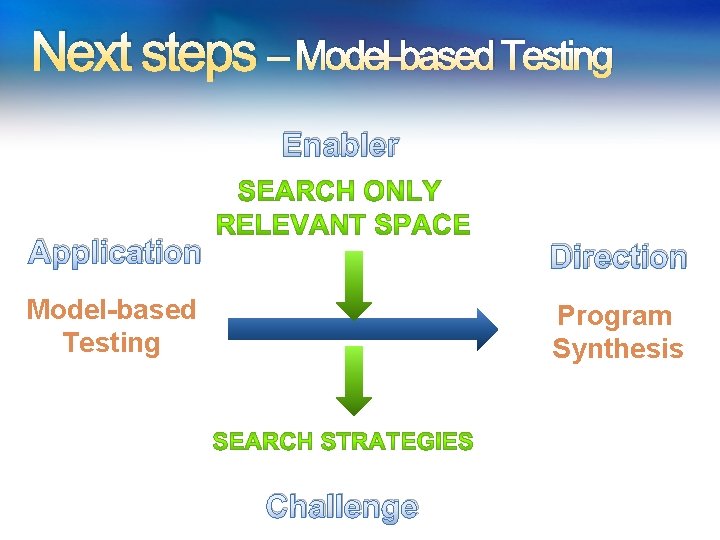
Next steps – Model-based Testing Enabler Application Direction Model-based Testing Program Synthesis Challenge

Selected Z 3 Technologies
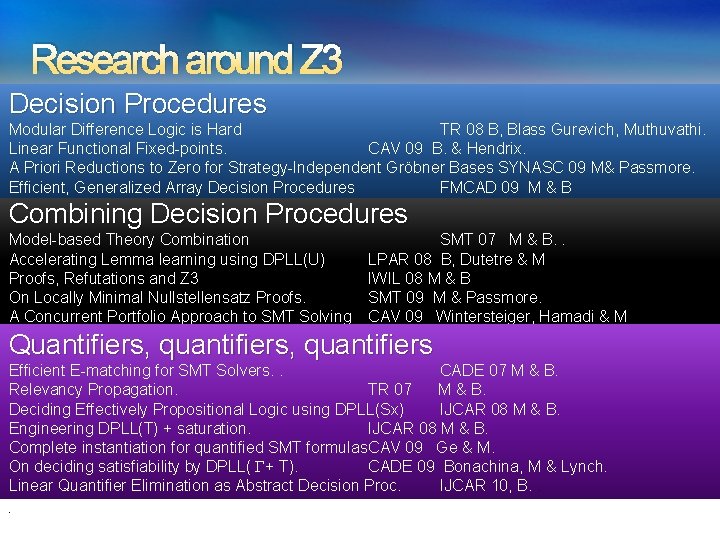
Research around Z 3 Decision Procedures Modular Difference Logic is Hard TR 08 B, Blass Gurevich, Muthuvathi. Linear Functional Fixed-points. CAV 09 B. & Hendrix. A Priori Reductions to Zero for Strategy-Independent Gröbner Bases SYNASC 09 M& Passmore. Efficient, Generalized Array Decision Procedures FMCAD 09 M & B Combining Decision Procedures Model-based Theory Combination Accelerating Lemma learning using DPLL(U) Proofs, Refutations and Z 3 On Locally Minimal Nullstellensatz Proofs. A Concurrent Portfolio Approach to SMT Solving SMT 07 M & B. . LPAR 08 B, Dutetre & M IWIL 08 M & B SMT 09 M & Passmore. CAV 09 Wintersteiger, Hamadi & M Quantifiers, quantifiers Efficient E-matching for SMT Solvers. . CADE 07 M & B. Relevancy Propagation. TR 07 M & B. Deciding Effectively Propositional Logic using DPLL(Sx) IJCAR 08 M & B. Engineering DPLL(T) + saturation. IJCAR 08 M & B. . Complete instantiation for quantified SMT formulas. CAV 09 Ge & M. CADE 09 Bonachina, M & Lynch. . On deciding satisfiability by DPLL( + T). Linear Quantifier Elimination as Abstract Decision Proc. IJCAR 10, B. . .
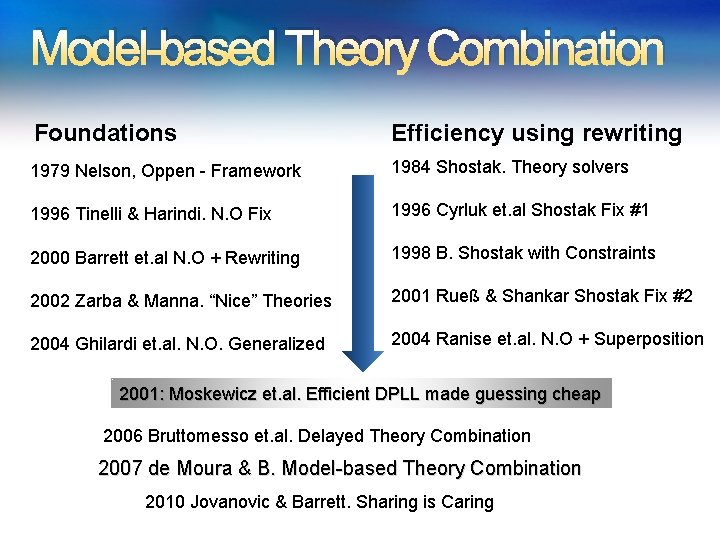
Model-based Theory Combination Foundations Efficiency using rewriting 1979 Nelson, Oppen - Framework 1984 Shostak. Theory solvers 1996 Tinelli & Harindi. N. O Fix 1996 Cyrluk et. al Shostak Fix #1 2000 Barrett et. al N. O + Rewriting 1998 B. Shostak with Constraints 2002 Zarba & Manna. “Nice” Theories 2001 Rueß & Shankar Shostak Fix #2 2004 Ghilardi et. al. N. O. Generalized 2004 Ranise et. al. N. O + Superposition 2001: Moskewicz et. al. Efficient DPLL made guessing cheap 2006 Bruttomesso et. al. Delayed Theory Combination 2007 de Moura & B. Model-based Theory Combination 2010 Jovanovic & Barrett. Sharing is Caring
![Combinatory Array Logic A basis of operations [FMCAD 2009]](http://slidetodoc.com/presentation_image_h2/d065fa1ad28d7849dfda1e8c02791242/image-42.jpg "Combinatory Array Logic A basis of operations [FMCAD 2009]")
Combinatory Array Logic A basis of operations [FMCAD 2009]
Combinatory Array Logic Derived operations
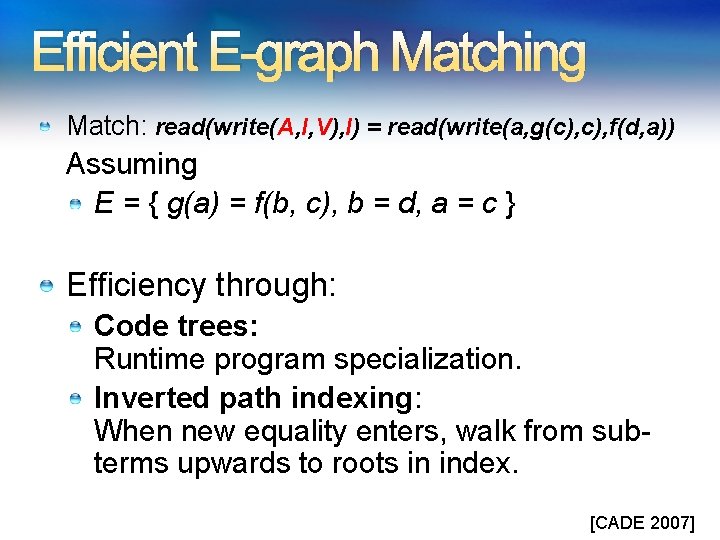
Efficient E-graph Matching Match: read(write(A, I, V), I) = read(write(a, g(c), f(d, a)) Assuming E = { g(a) = f(b, c), b = d, a = c } Efficiency through: Code trees: Runtime program specialization. Inverted path indexing: When new equality enters, walk from subterms upwards to roots in index. [CADE 2007]
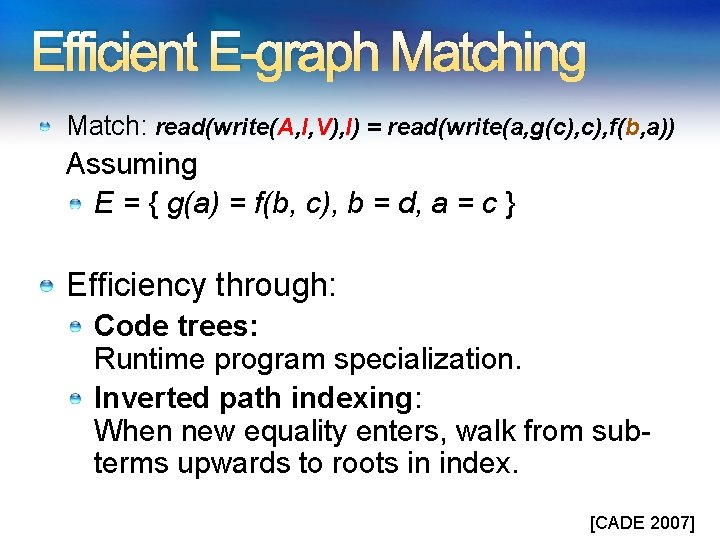
Efficient E-graph Matching Match: read(write(A, I, V), I) = read(write(a, g(c), f(b, a)) Assuming E = { g(a) = f(b, c), b = d, a = c } Efficiency through: Code trees: Runtime program specialization. Inverted path indexing: When new equality enters, walk from subterms upwards to roots in index. [CADE 2007]
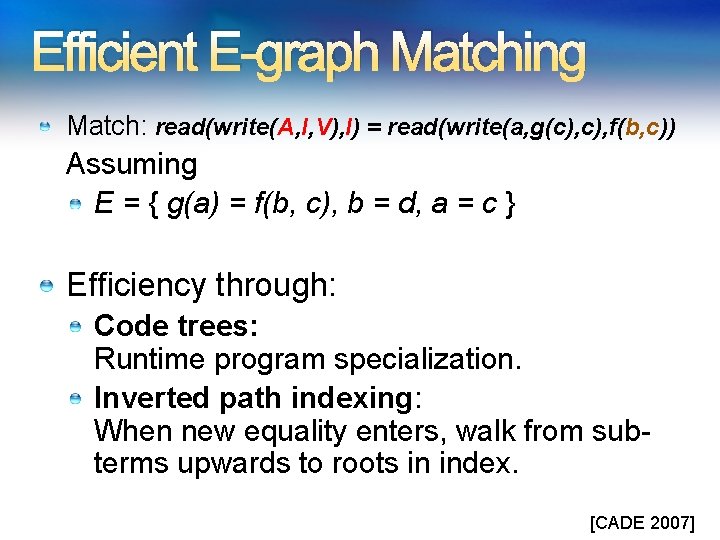
Efficient E-graph Matching Match: read(write(A, I, V), I) = read(write(a, g(c), f(b, c)) Assuming E = { g(a) = f(b, c), b = d, a = c } Efficiency through: Code trees: Runtime program specialization. Inverted path indexing: When new equality enters, walk from subterms upwards to roots in index. [CADE 2007]
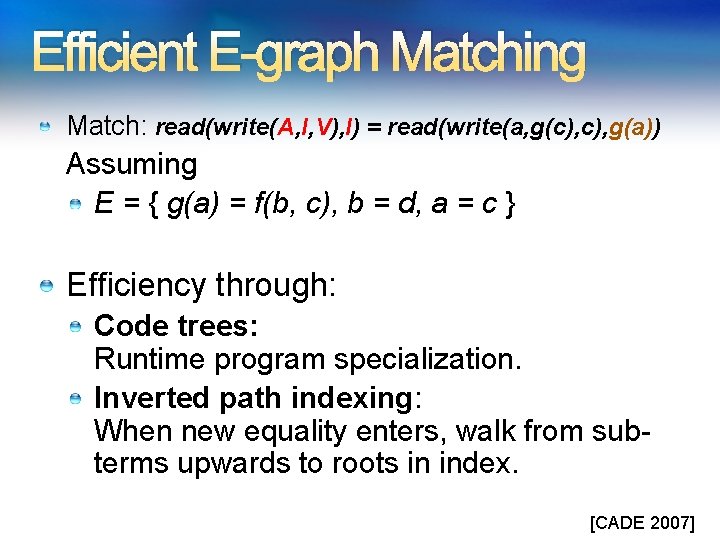
Efficient E-graph Matching Match: read(write(A, I, V), I) = read(write(a, g(c), g(a)) Assuming E = { g(a) = f(b, c), b = d, a = c } Efficiency through: Code trees: Runtime program specialization. Inverted path indexing: When new equality enters, walk from subterms upwards to roots in index. [CADE 2007]
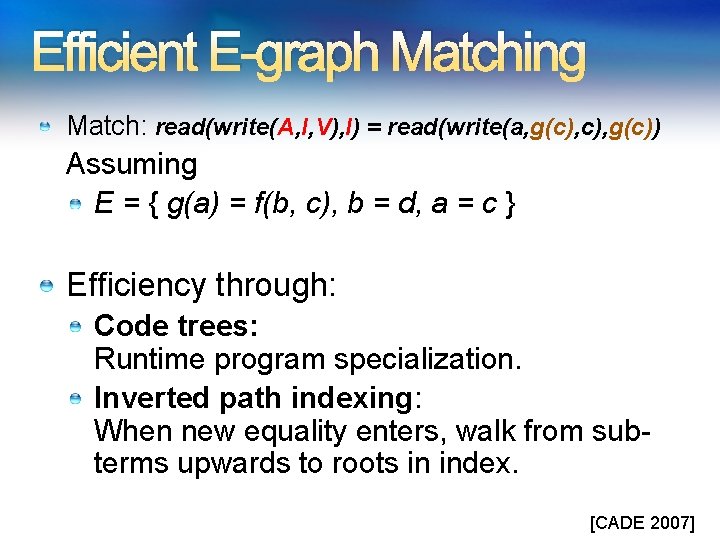
Efficient E-graph Matching Match: read(write(A, I, V), I) = read(write(a, g(c), g(c)) Assuming E = { g(a) = f(b, c), b = d, a = c } Efficiency through: Code trees: Runtime program specialization. Inverted path indexing: When new equality enters, walk from subterms upwards to roots in index. [CADE 2007]
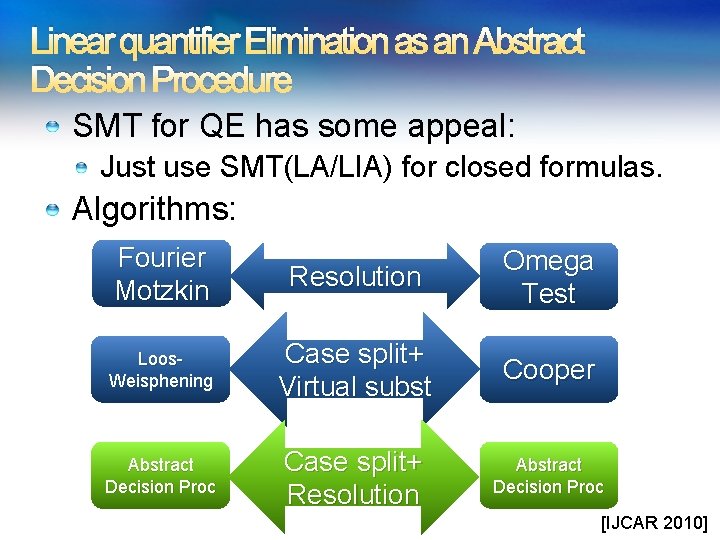
Linear quantifier Elimination as an Abstract Decision Procedure SMT for QE has some appeal: Just use SMT(LA/LIA) for closed formulas. Algorithms: Fourier Motzkin Resolution Omega Test Loos. Weisphening Case split+ Virtual subst Cooper Abstract Decision Proc Case split+ Resolution Abstract Decision Proc [IJCAR 2010]

Conclusions SMT solvers are a great fit for software tools Current main applications: Test-case generation. Verifying compilers. Model Checking & Predicate Abstraction. Model-based testing and development Future opportunities in SMT research and applications abound
- Slides: 50