
Applications of RF and Microwave Sampling to Instrumentation

- Slides: 22
Applications of RF and Microwave Sampling to Instrumentation and Measurement Mark Kahrs Dept. of Electrical Engineering University of Pittsburgh, PA 15261 e-mail: kahrs@ee. pitt. edu
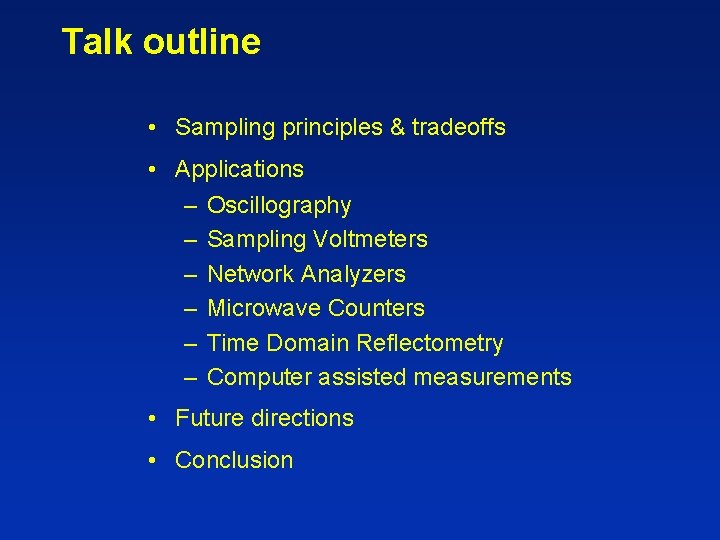
Talk outline • Sampling principles & tradeoffs • Applications – Oscillography – Sampling Voltmeters – Network Analyzers – Microwave Counters – Time Domain Reflectometry – Computer assisted measurements • Future directions • Conclusion
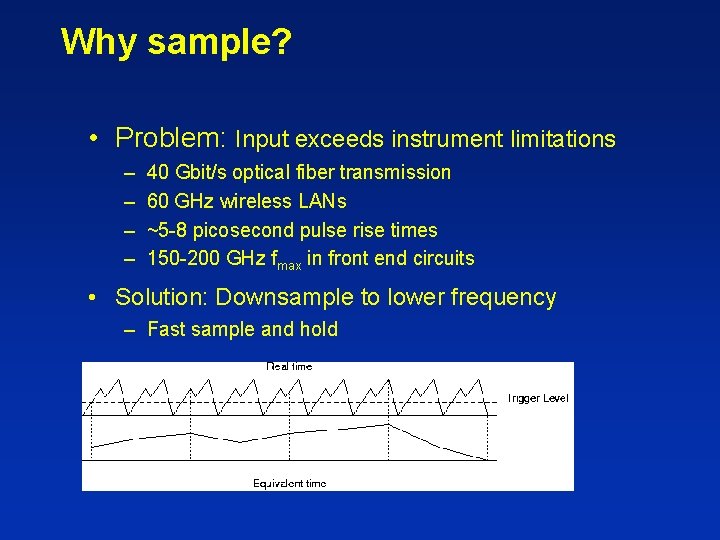
Why sample? • Problem: Input exceeds instrument limitations – – 40 Gbit/s optical fiber transmission 60 GHz wireless LANs ~5 -8 picosecond pulse rise times 150 -200 GHz fmax in front end circuits • Solution: Downsample to lower frequency – Fast sample and hold
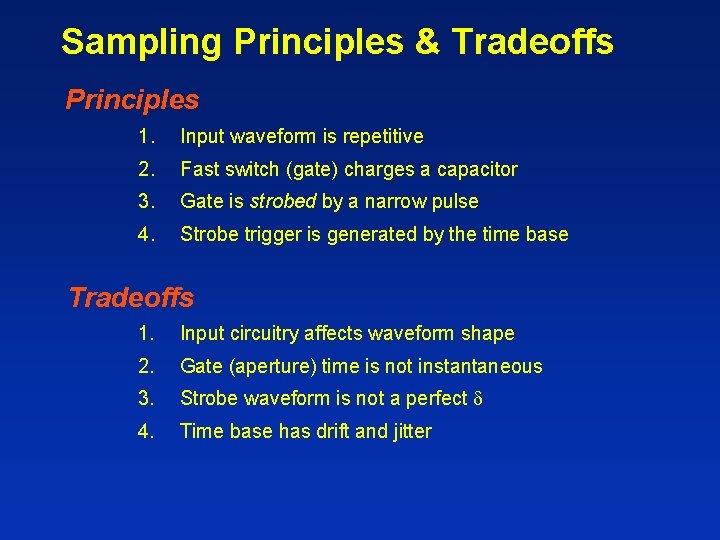
Sampling Principles & Tradeoffs Principles 1. Input waveform is repetitive 2. Fast switch (gate) charges a capacitor 3. Gate is strobed by a narrow pulse 4. Strobe trigger is generated by the time base Tradeoffs 1. Input circuitry affects waveform shape 2. Gate (aperture) time is not instantaneous 3. Strobe waveform is not a perfect d 4. Time base has drift and jitter
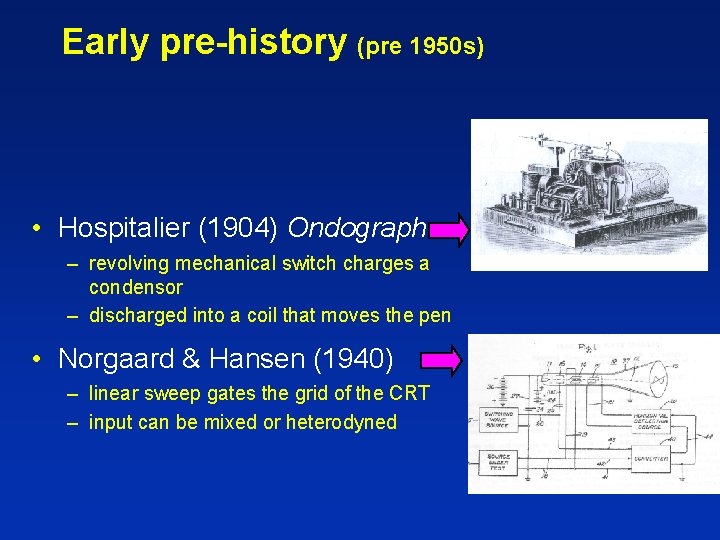
Early pre-history (pre 1950 s) • Hospitalier (1904) Ondograph – revolving mechanical switch charges a condensor – discharged into a coil that moves the pen • Norgaard & Hansen (1940) – linear sweep gates the grid of the CRT – input can be mixed or heterodyned
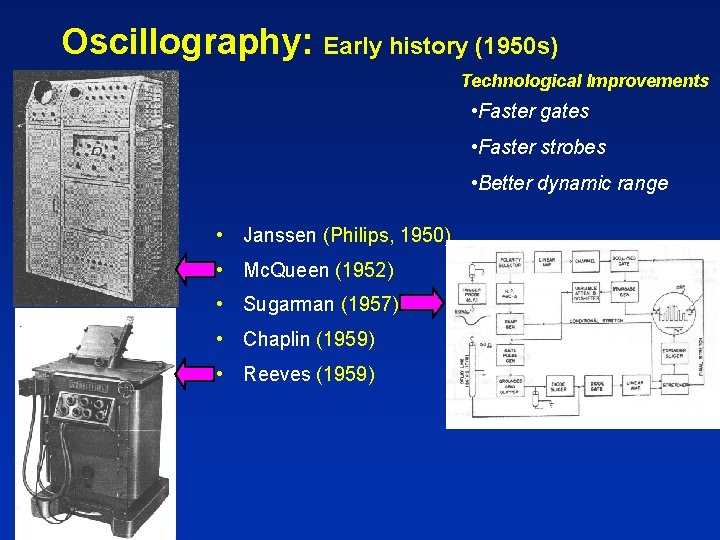
Oscillography: Early history (1950 s) Technological Improvements • Faster gates • Faster strobes • Better dynamic range • Janssen (Philips, 1950) • Mc. Queen (1952) • Sugarman (1957) • Chaplin (1959) • Reeves (1959)
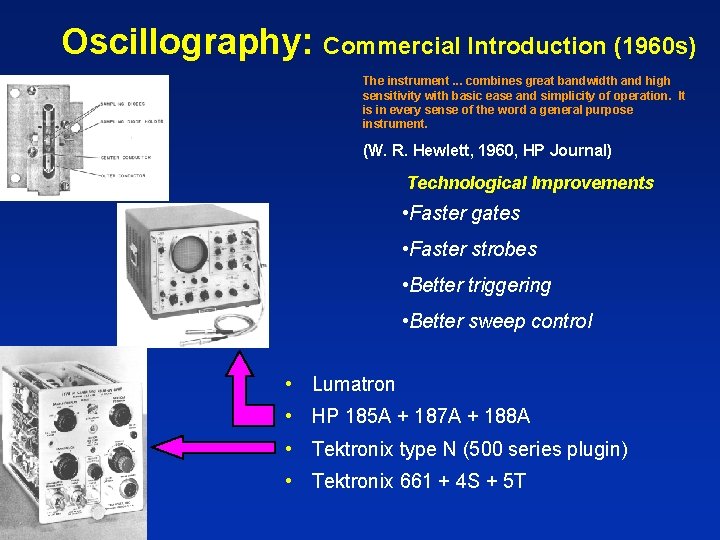
Oscillography: Commercial Introduction (1960 s) The instrument. . . combines great bandwidth and high sensitivity with basic ease and simplicity of operation. It is in every sense of the word a general purpose instrument. (W. R. Hewlett, 1960, HP Journal) Technological Improvements • Faster gates • Faster strobes • Better triggering • Better sweep control • Lumatron • HP 185 A + 187 A + 188 A • Tektronix type N (500 series plugin) • Tektronix 661 + 4 S + 5 T
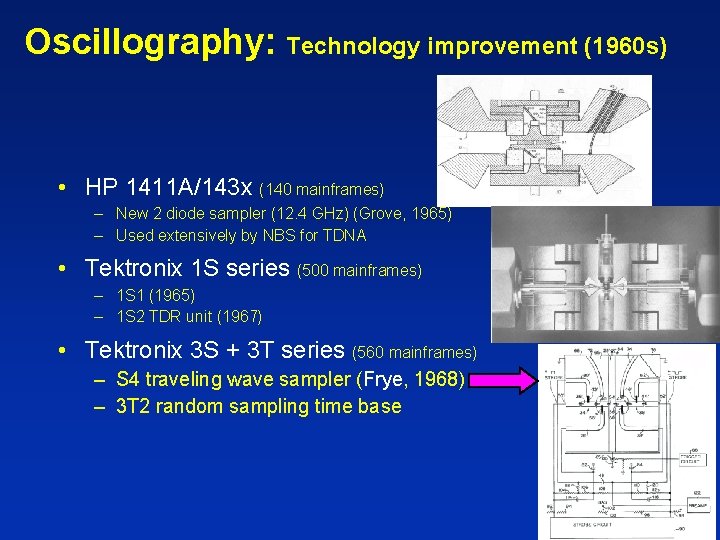
Oscillography: Technology improvement (1960 s) • HP 1411 A/143 x (140 mainframes) – New 2 diode sampler (12. 4 GHz) (Grove, 1965) – Used extensively by NBS for TDNA • Tektronix 1 S series (500 mainframes) – 1 S 1 (1965) – 1 S 2 TDR unit (1967) • Tektronix 3 S + 3 T series (560 mainframes) – S 4 traveling wave sampler (Frye, 1968) – 3 T 2 random sampling time base
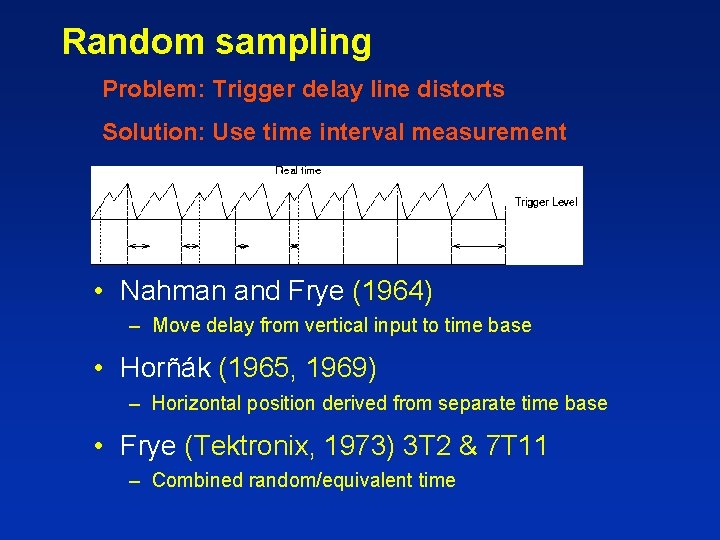
Random sampling Problem: Trigger delay line distorts Solution: Use time interval measurement • Nahman and Frye (1964) – Move delay from vertical input to time base • Horñák (1965, 1969) – Horizontal position derived from separate time base • Frye (Tektronix, 1973) 3 T 2 & 7 T 11 – Combined random/equivalent time
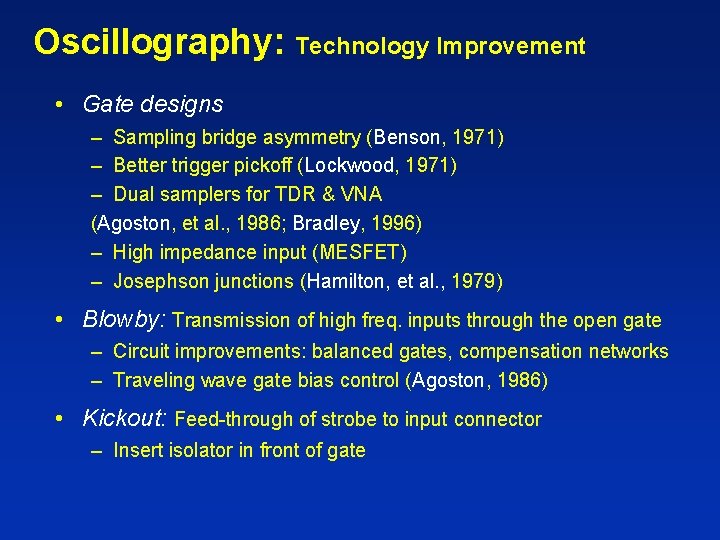
Oscillography: Technology Improvement • Gate designs – Sampling bridge asymmetry (Benson, 1971) – Better trigger pickoff (Lockwood, 1971) – Dual samplers for TDR & VNA (Agoston, et al. , 1986; Bradley, 1996) – High impedance input (MESFET) – Josephson junctions (Hamilton, et al. , 1979) • Blowby: Transmission of high freq. inputs through the open gate – Circuit improvements: balanced gates, compensation networks – Traveling wave gate bias control (Agoston, 1986) • Kickout: Feed-through of strobe to input connector – Insert isolator in front of gate
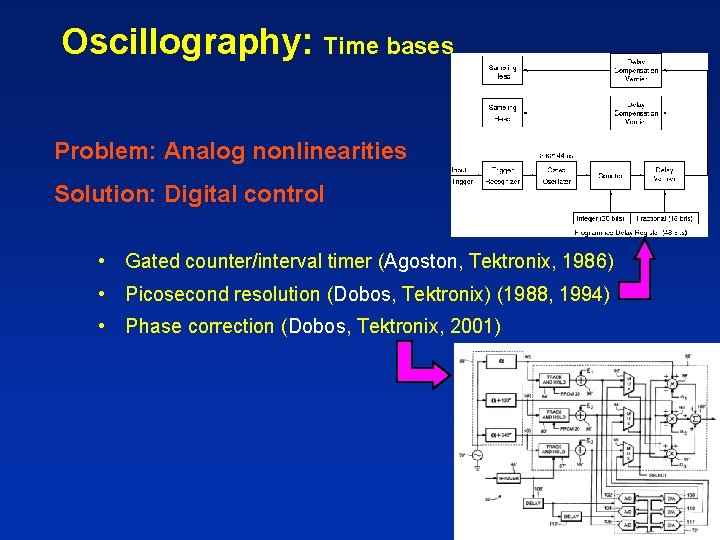
Oscillography: Time bases Problem: Analog nonlinearities Solution: Digital control • Gated counter/interval timer (Agoston, Tektronix, 1986) • Picosecond resolution (Dobos, Tektronix) (1988, 1994) • Phase correction (Dobos, Tektronix, 2001)
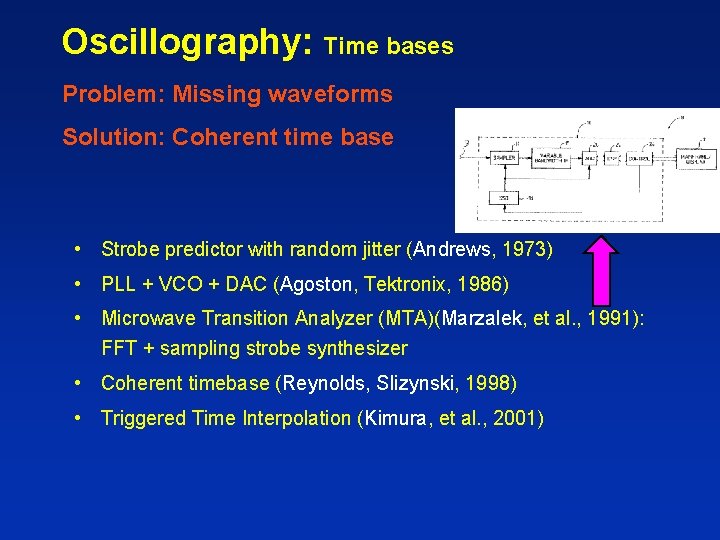
Oscillography: Time bases Problem: Missing waveforms Solution: Coherent time base • Strobe predictor with random jitter (Andrews, 1973) • PLL + VCO + DAC (Agoston, Tektronix, 1986) • Microwave Transition Analyzer (MTA)(Marzalek, et al. , 1991): FFT + sampling strobe synthesizer • Coherent timebase (Reynolds, Slizynski, 1998) • Triggered Time Interpolation (Kimura, et al. , 2001)
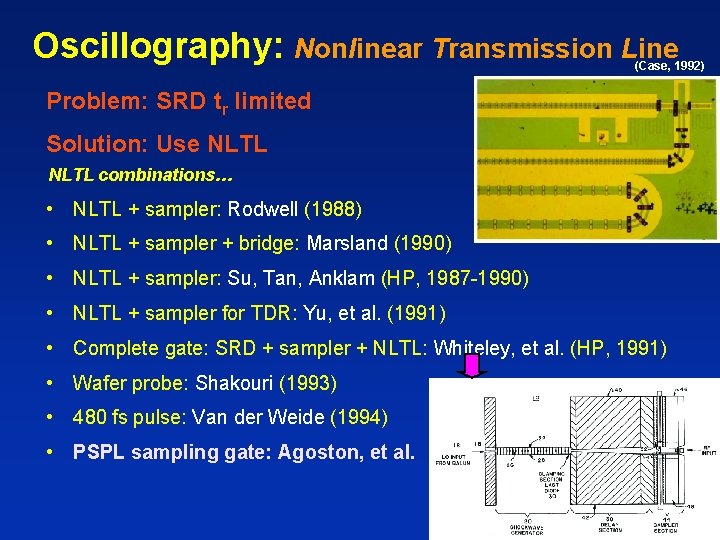
Oscillography: Nonlinear Transmission Line (Case, 1992) Problem: SRD tr limited Solution: Use NLTL combinations… • NLTL + sampler: Rodwell (1988) • NLTL + sampler + bridge: Marsland (1990) • NLTL + sampler: Su, Tan, Anklam (HP, 1987 -1990) • NLTL + sampler for TDR: Yu, et al. (1991) • Complete gate: SRD + sampler + NLTL: Whiteley, et al. (HP, 1991) • Wafer probe: Shakouri (1993) • 480 fs pulse: Van der Weide (1994) • PSPL sampling gate: Agoston, et al.
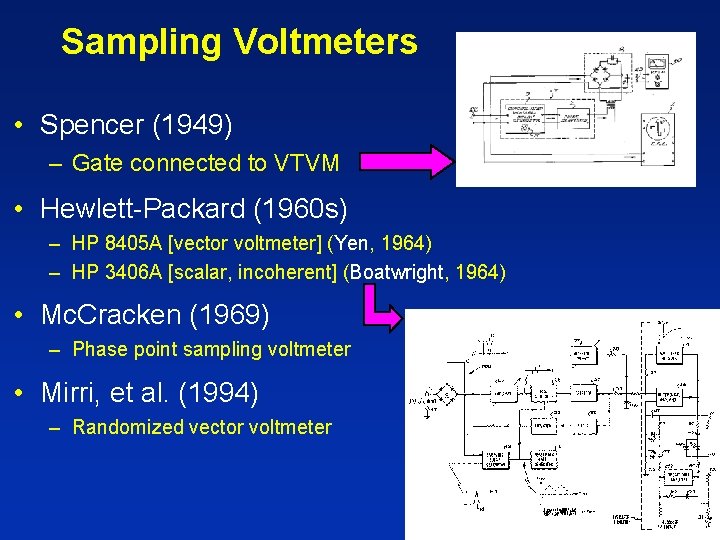
Sampling Voltmeters • Spencer (1949) – Gate connected to VTVM • Hewlett-Packard (1960 s) – HP 8405 A [vector voltmeter] (Yen, 1964) – HP 3406 A [scalar, incoherent] (Boatwright, 1964) • Mc. Cracken (1969) – Phase point sampling voltmeter • Mirri, et al. (1994) – Randomized vector voltmeter
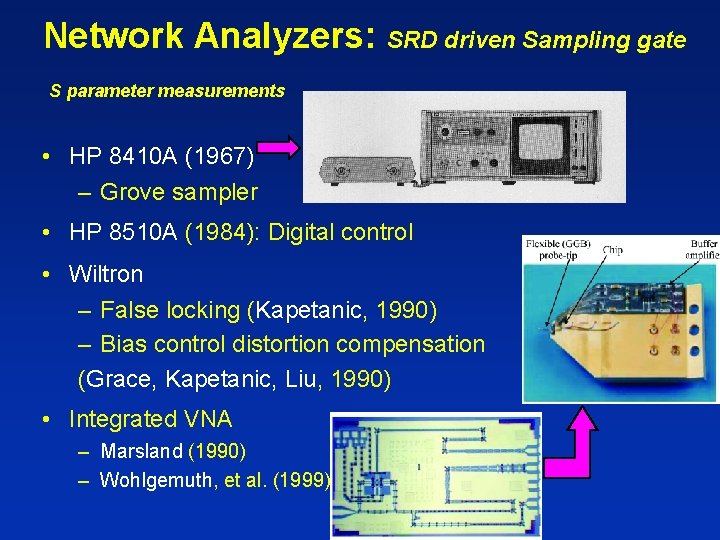
Network Analyzers: SRD driven Sampling gate S parameter measurements • HP 8410 A (1967) – Grove sampler • HP 8510 A (1984): Digital control • Wiltron – False locking (Kapetanic, 1990) – Bias control distortion compensation (Grace, Kapetanic, Liu, 1990) • Integrated VNA – Marsland (1990) – Wohlgemuth, et al. (1999)
Network Analyzers: VNNA & LSNA Problem: Measurement of nonlinear regions of operation Solution: Use non-ratioed (absolute) measurements • Vector(ial) Nonlinear Network Analyzer – Sine Generator + Oscilloscope (7854): Sipilä, Lehtinen, Porra (1988) – Harmonic Generator + VNA: Lott (1989) – Oscilloscope + VNA: Kompa, van Raay (1990) – 4 channel Oscilloscope (54120 T) + couplers: Van den Broeck, Verspecht (1992) • Large Signal Network Analyzer – Van Damme, et al. (2000) – Scott, et al. (2002)
Microwave Counters • Techniques – Prescaling (non-sampler) – Heterodyne (non-sampler) – Transfer Oscillator • Phase locks lower frequency oscillator to input • Single sampler (Chu, 1975) – Harmonic Heterodyne • Combines heterodyne with transfer oscillator method • Single sampler + microprocessor (Peregrino, Throne, 1977) • Gate improvements – Thin film gate (Merkelo, 1971) – Thin film hybrid (Sayed, 1980) – Ga. As gate (Gibson, 1986)
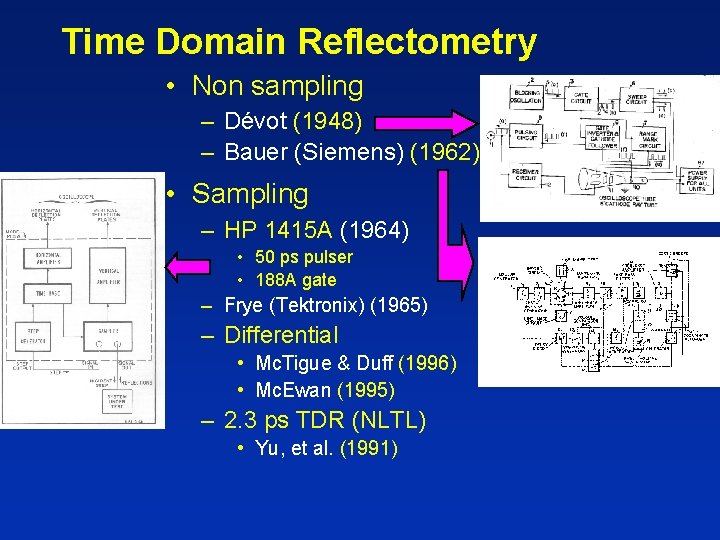
Time Domain Reflectometry • Non sampling – Dévot (1948) – Bauer (Siemens) (1962) • Sampling – HP 1415 A (1964) • 50 ps pulser • 188 A gate – Frye (Tektronix) (1965) – Differential • Mc. Tigue & Duff (1996) • Mc. Ewan (1995) – 2. 3 ps TDR (NLTL) • Yu, et al. (1991)
Computer Assisted Measurements • Computer interfaces: digital signal processing – CAOS (Stuckert, 1969) – NBS TDNA (Andrews, et al. , 1969 -1978) • Time base correction due to jitter and drift – Deconvolution: Gans (1983) – Markov estimation: Souders, et al. (1990) – Phase demodulation: Verspecht (1994) – Distortion compensation: Schoukens, et al. (1997) • Deconvolution & Normalization of sampler – Frequency Domain complications: Nahman and Riad (1974 -1990) – Sampler Characterization • Riad’s Grove sampler model (1978 -1982) • Nose-to-nose (Rush, Verspecht, 1990 -1995; Scott) • Analytic model (Remley, Williams)
Future improvements (courtesy of M. Rodwell, UCSB) • Sampling Oscilloscopes – Improved timebase stability and flexibility in triggering – Better time bases: PLL, DDS, … – Network-analyzer-like calibration procedures • Network Analysis – combined accuracy, frequency coverage, and cost – better calibration methods needed for testing above 300 GHz ft and fmax
Acknowledgements • J. R. Andrews (PSPL) • N. S. Nahman • Acoustics Lab, HUT • Fulbright
Conclusion The End