
Applications of Radiation Overview General applications by radiation
Applications of Radiation

Overview • • • General applications by radiation type Radiography - process Medical Research Medical Applications Space

Alpha Radiation • Highly ionizing • Removes Static Charge Alpha Particle Static Charge
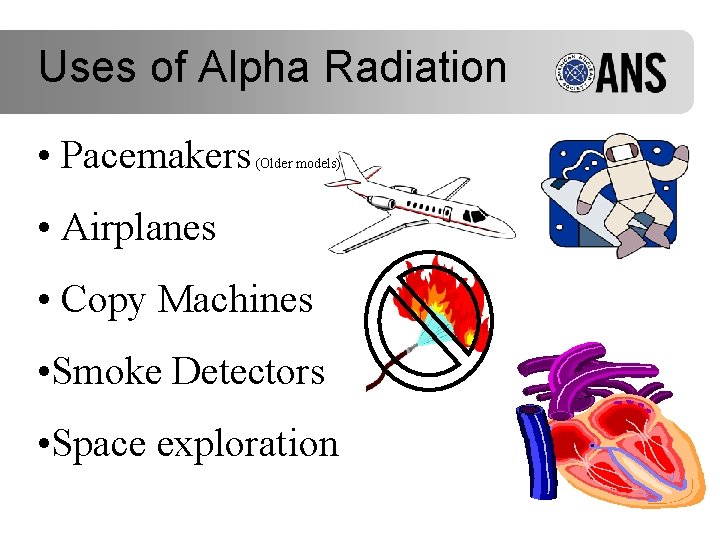
Uses of Alpha Radiation • Pacemakers (Older models) • Airplanes • Copy Machines • Smoke Detectors • Space exploration
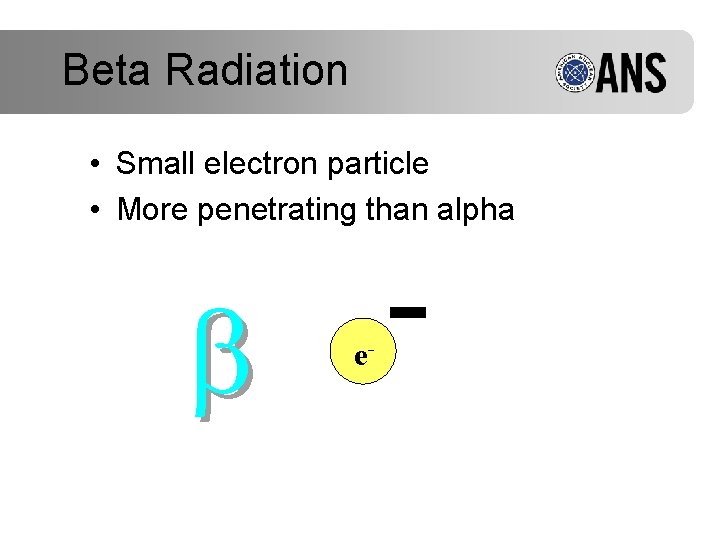
Beta Radiation • Small electron particle • More penetrating than alpha e-
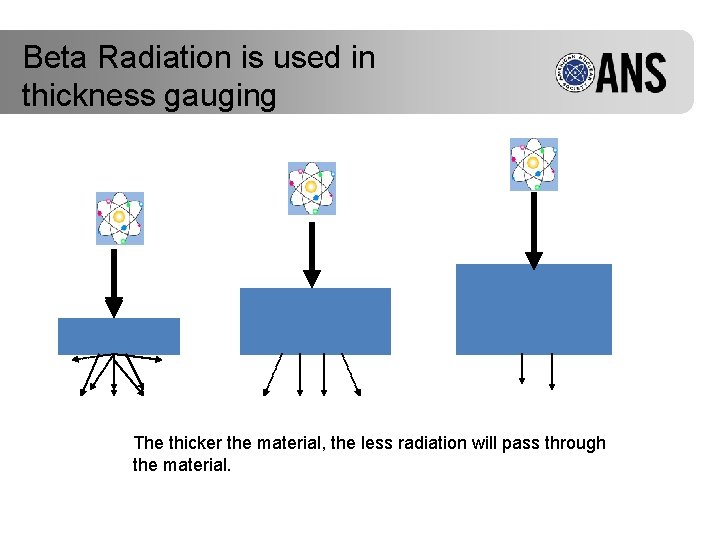
Beta Radiation is used in thickness gauging The thicker the material, the less radiation will pass through the material.
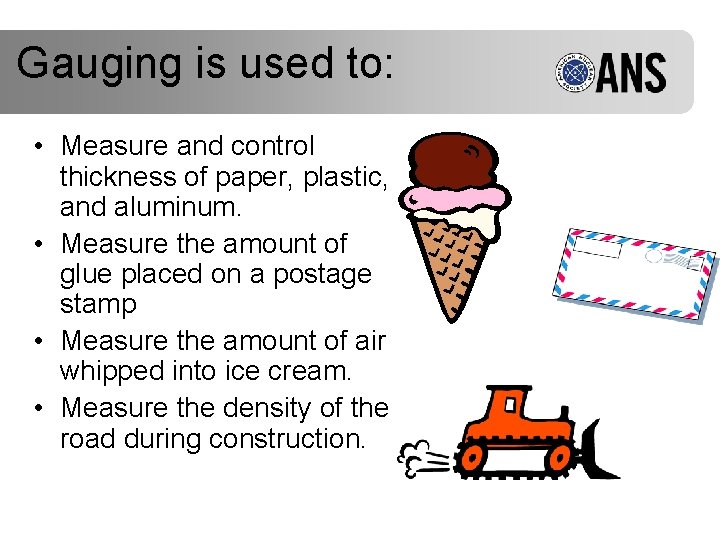
Gauging is used to: • Measure and control thickness of paper, plastic, and aluminum. • Measure the amount of glue placed on a postage stamp • Measure the amount of air whipped into ice cream. • Measure the density of the road during construction.
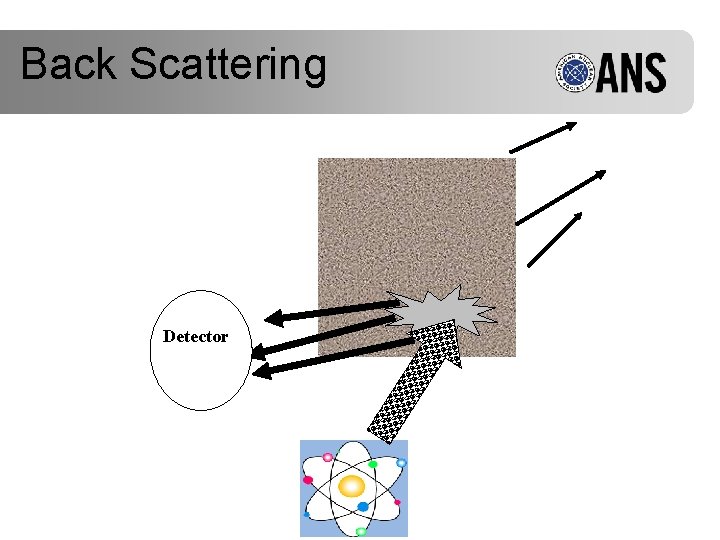
Back Scattering Detector
Gamma Radiation A penetrating wave
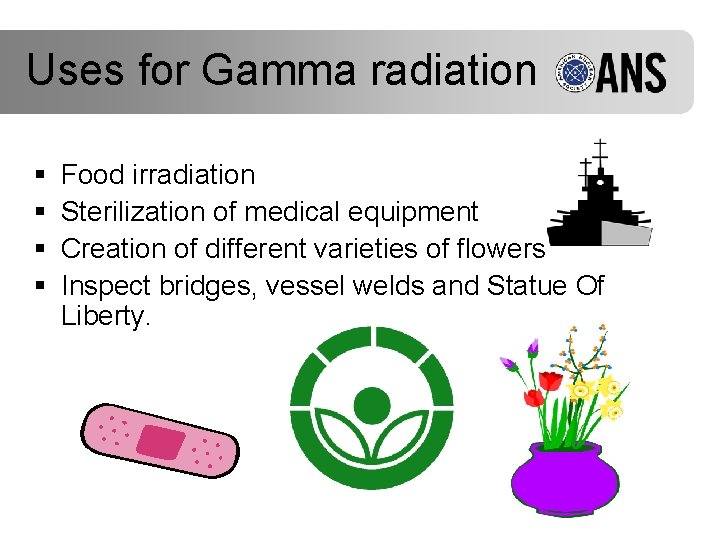
Uses for Gamma radiation § § Food irradiation Sterilization of medical equipment Creation of different varieties of flowers Inspect bridges, vessel welds and Statue Of Liberty.
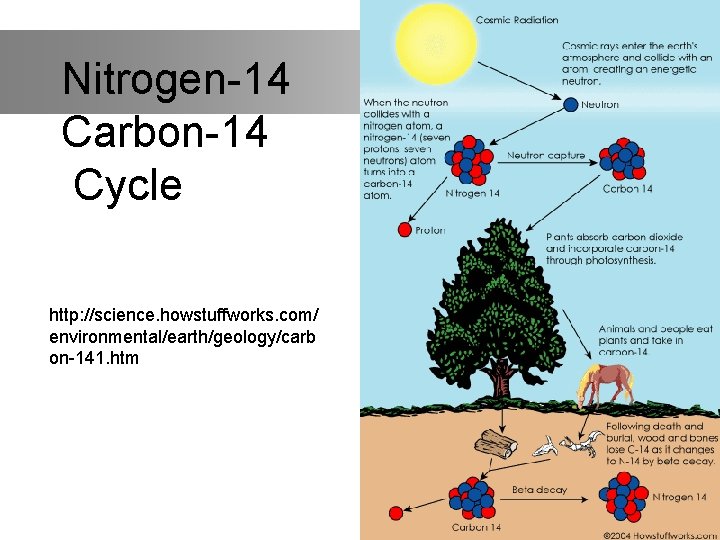
Nitrogen-14 Carbon-14 Cycle http: //science. howstuffworks. com/ environmental/earth/geology/carb on-141. htm
What were original uses of mysterious rays? • Becquerel’s discovery • Roentgen X-ray of Wife’s hand • Marie Curie – WWI – x-ray unit
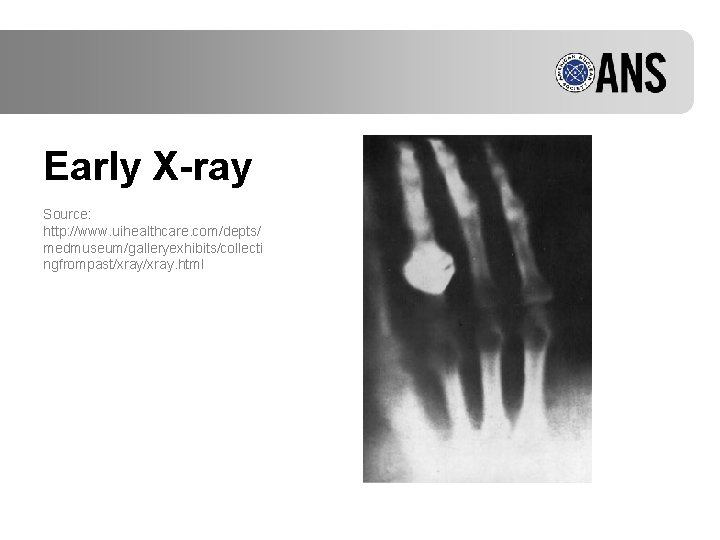
Early X-ray Source: http: //www. uihealthcare. com/depts/ medmuseum/galleryexhibits/collecti ngfrompast/xray. html
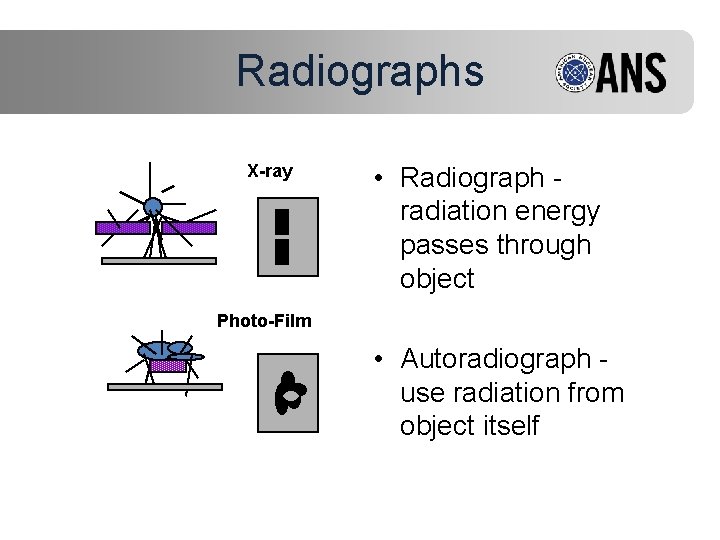
Radiographs X-ray • Radiograph radiation energy passes through object Photo-Film • Autoradiograph use radiation from object itself
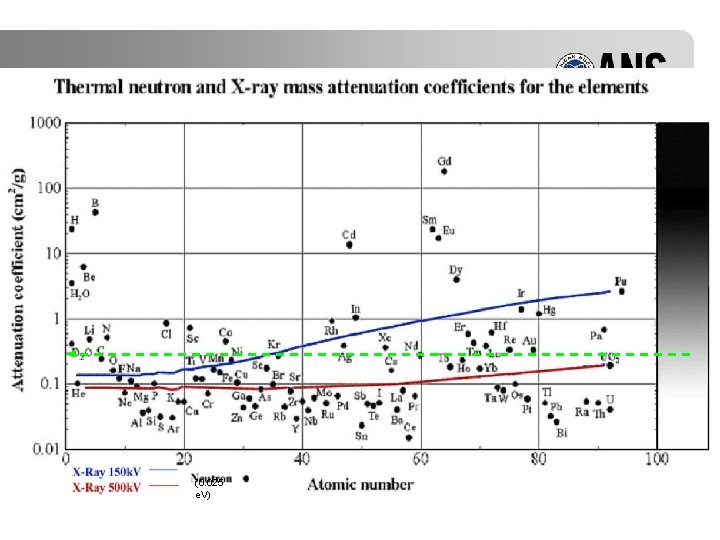
(0. 025 e. V)
Compare Different Materials • Cadmium ( Cd ) • Lead ( Pb ) • Polyethylene ( (CH 3)n )
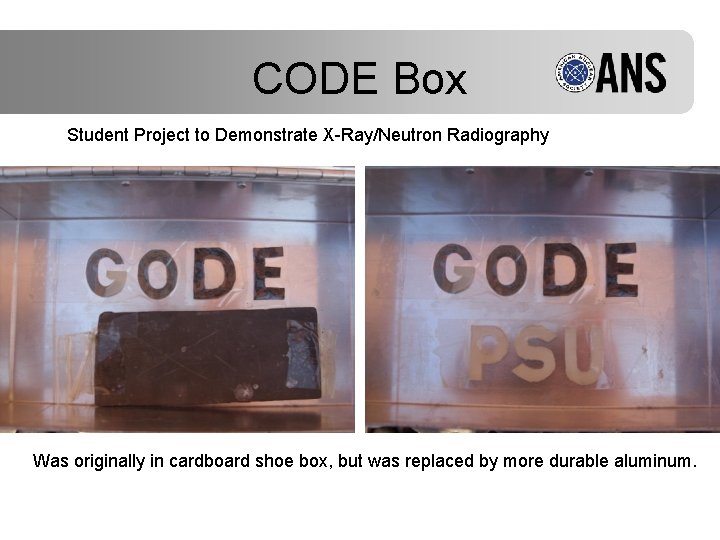
CODE Box Student Project to Demonstrate X-Ray/Neutron Radiography Was originally in cardboard shoe box, but was replaced by more durable aluminum.
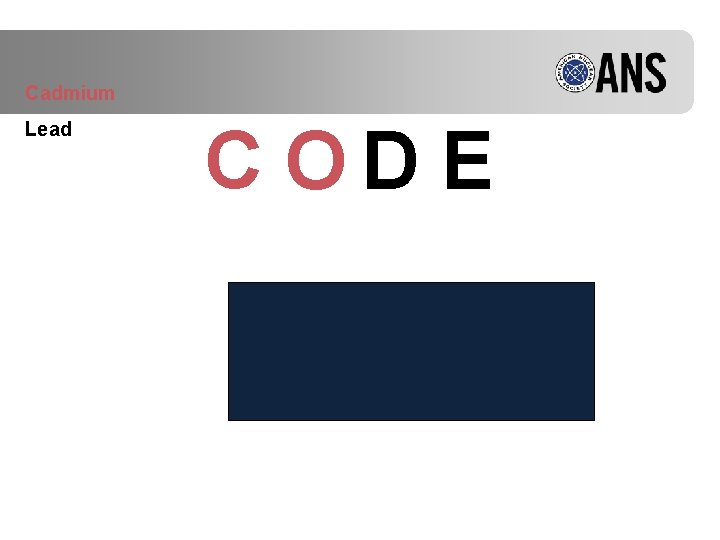
Cadmium Lead C OD E
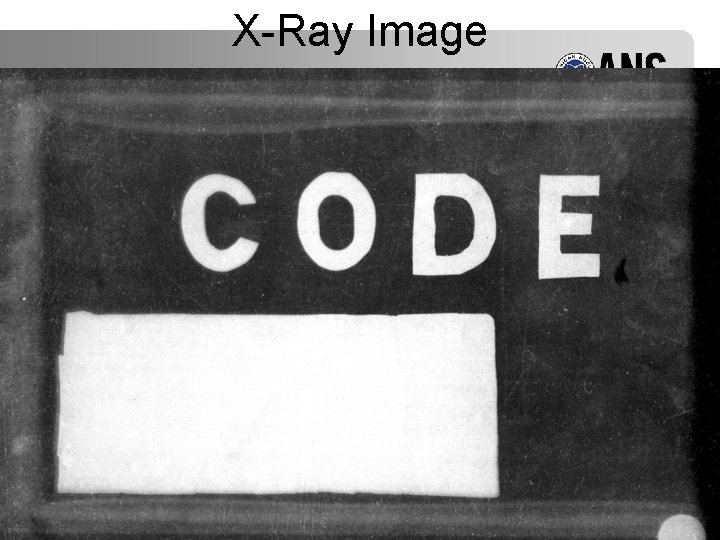
X-Ray Image
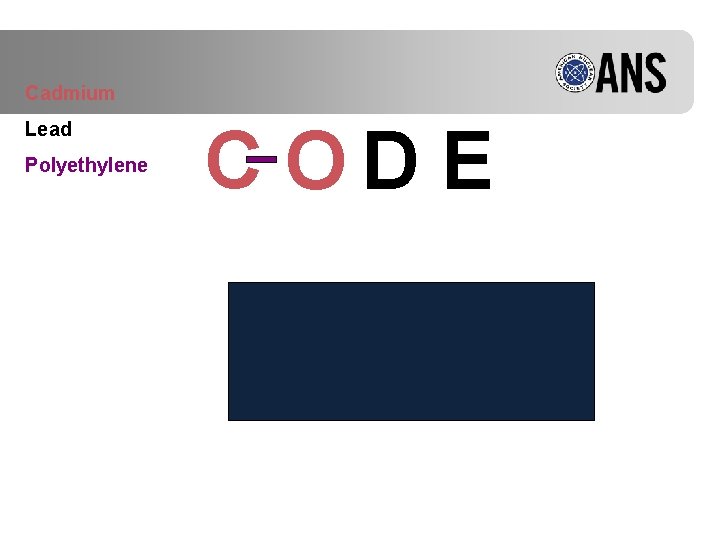
Cadmium Lead Polyethylene C OD E P S U
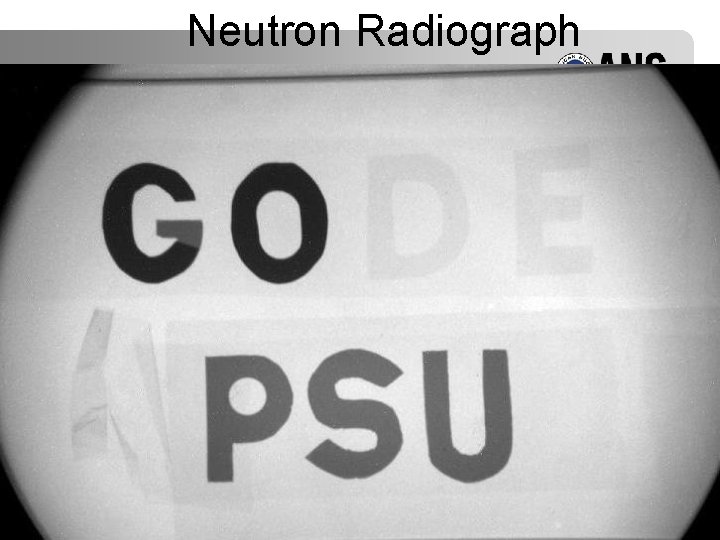
Neutron Radiograph
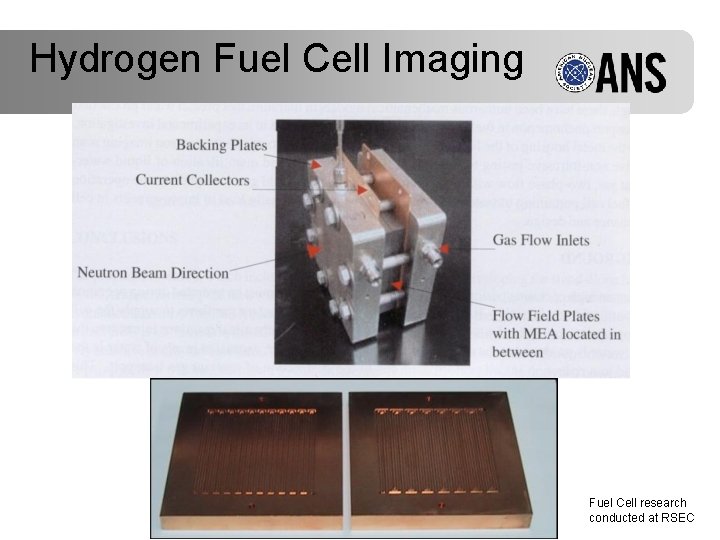
Hydrogen Fuel Cell Imaging Fuel Cell research conducted at RSEC
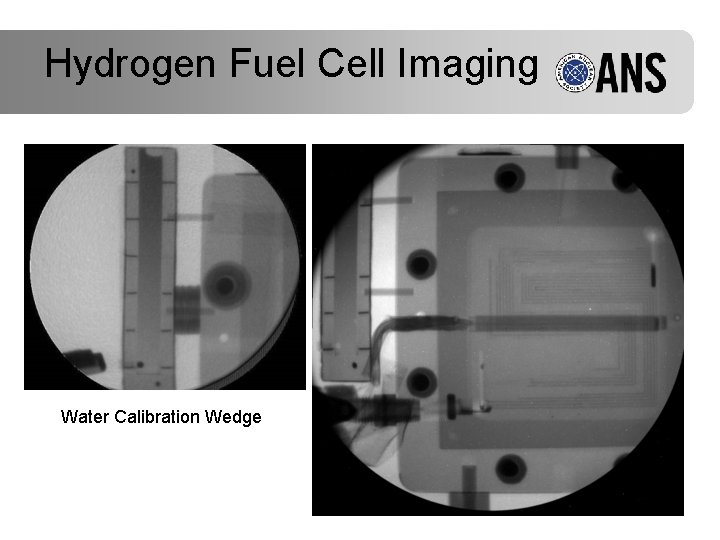
Hydrogen Fuel Cell Imaging Water Calibration Wedge
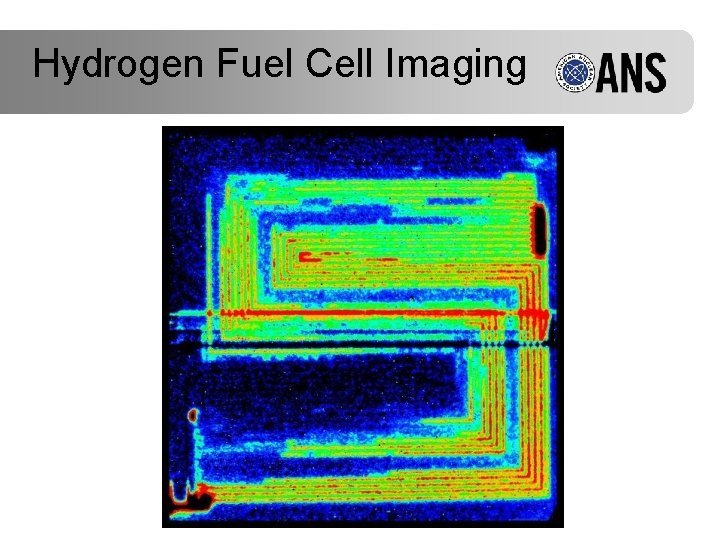
Hydrogen Fuel Cell Imaging
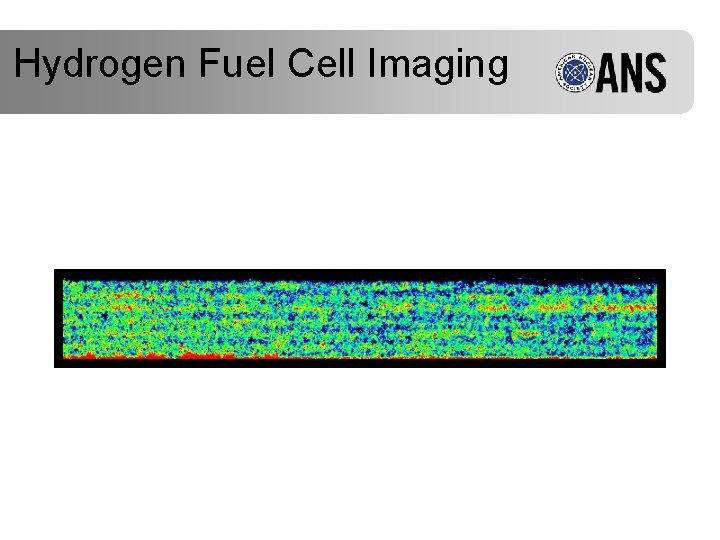
Hydrogen Fuel Cell Imaging
Clinical Uses of Radioactive Materials
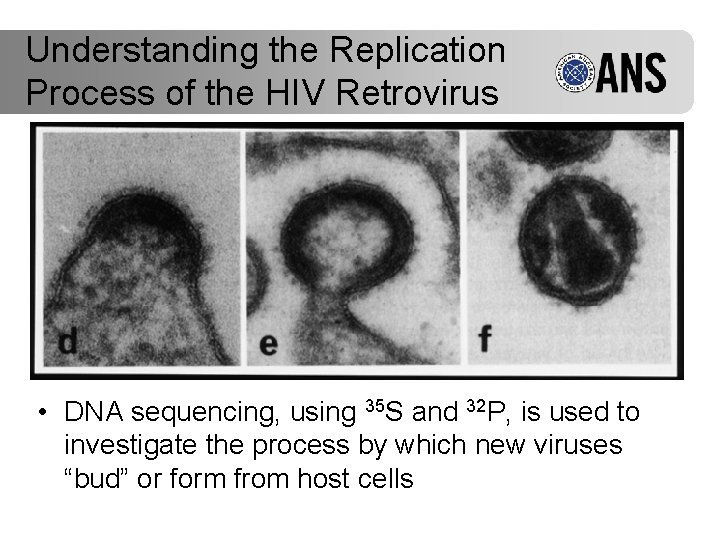
Understanding the Replication Process of the HIV Retrovirus • DNA sequencing, using 35 S and 32 P, is used to investigate the process by which new viruses “bud” or form from host cells
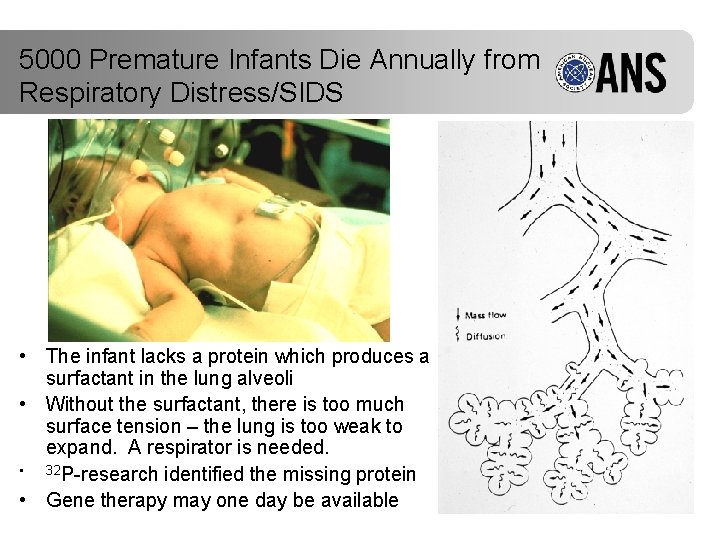
5000 Premature Infants Die Annually from Respiratory Distress/SIDS • The infant lacks a protein which produces a surfactant in the lung alveoli • Without the surfactant, there is too much surface tension – the lung is too weak to expand. A respirator is needed. • 32 P-research identified the missing protein • Gene therapy may one day be available
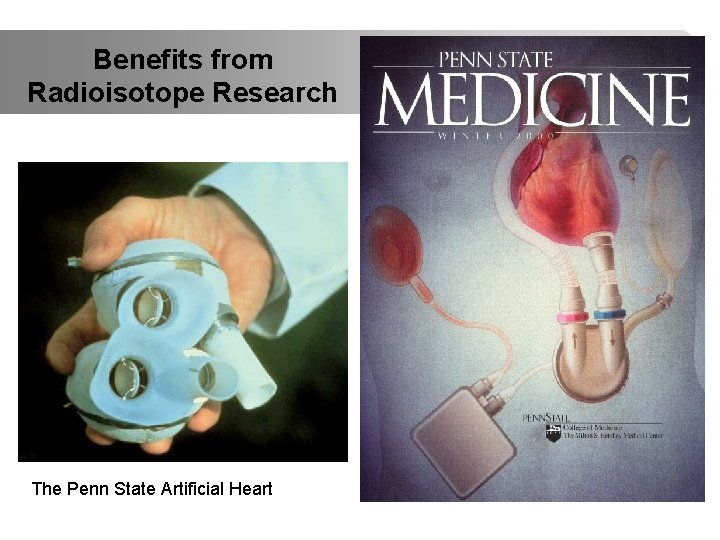
Benefits from Radioisotope Research The Penn State Artificial Heart
RIA (Radio Immuno Assay) • Extremely sensitive test for the presence of radiolabeled antibodies in blood serum samples • Dr. Rosalyn Yalow developed the technique ca. 1961, won 1977 Nobel Prize • Many tests exist for: – Adrenal Function – Anemia – Diabetes - Related – Drugs of Abuse – Newborn Screening Reproductive Hormones Therapeutic Drugs Thyroid Function Tumor Markers Veterinary Tests
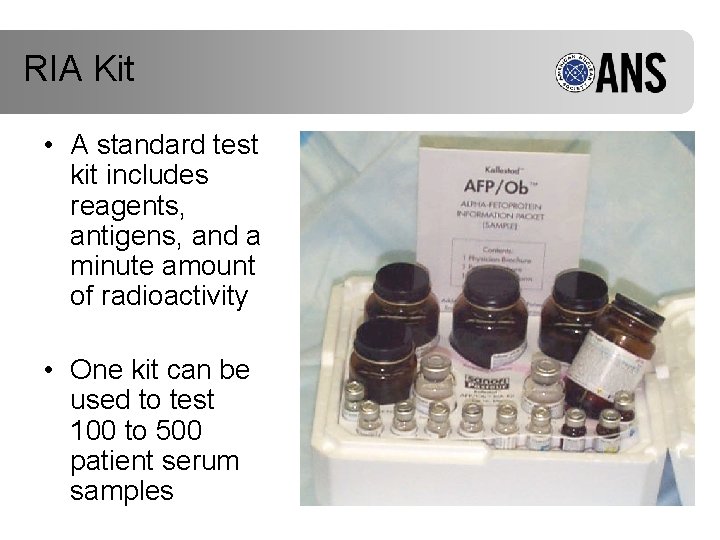
RIA Kit • A standard test kit includes reagents, antigens, and a minute amount of radioactivity • One kit can be used to test 100 to 500 patient serum samples
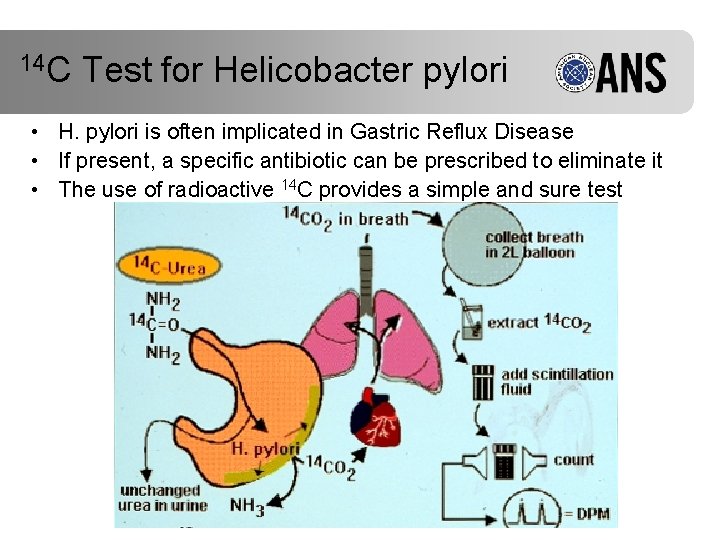
14 C Test for Helicobacter pylori • H. pylori is often implicated in Gastric Reflux Disease • If present, a specific antibiotic can be prescribed to eliminate it • The use of radioactive 14 C provides a simple and sure test
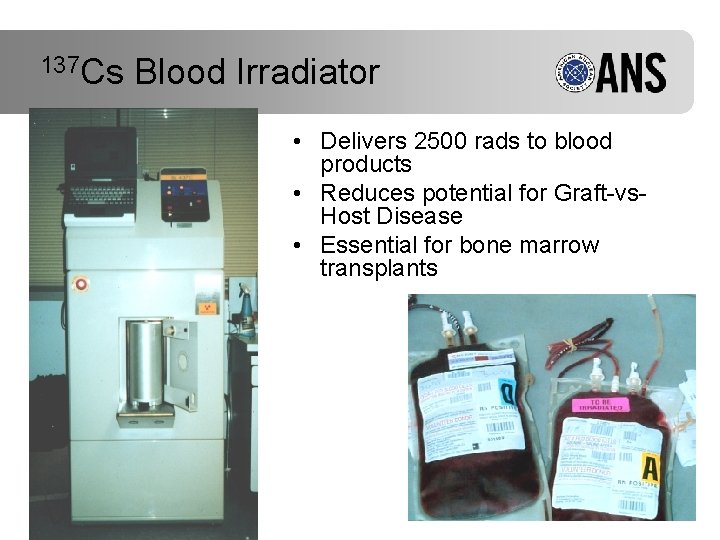
137 Cs Blood Irradiator • Delivers 2500 rads to blood products • Reduces potential for Graft-vs. Host Disease • Essential for bone marrow transplants
Diagnostic Radiology Modalities • X-Ray (Roentgenology) – Radiography – Fluoroscopy – CT (Computed Tomography) – Interventional Radiology • Angiography • Cardiac Catheterization • Neuro-Interventional
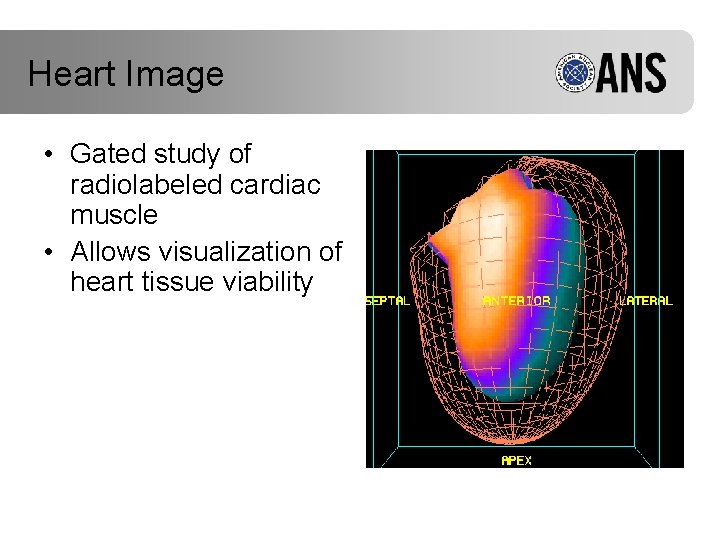
Heart Image • Gated study of radiolabeled cardiac muscle • Allows visualization of heart tissue viability
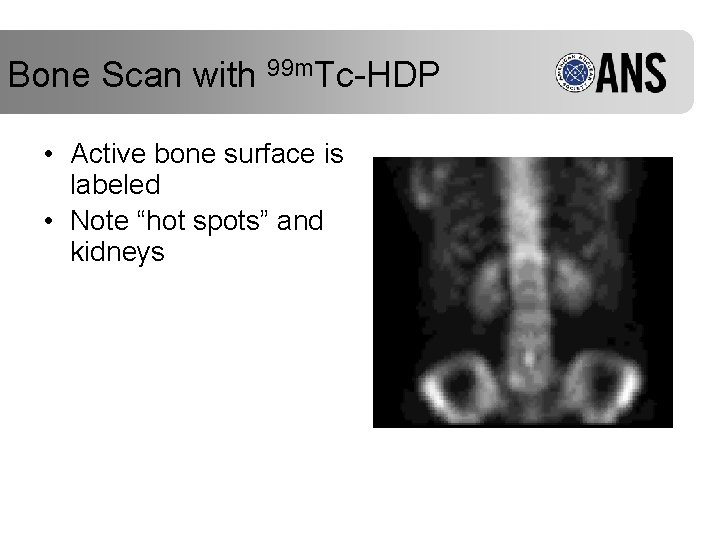
Bone Scan with 99 m. Tc-HDP • Active bone surface is labeled • Note “hot spots” and kidneys
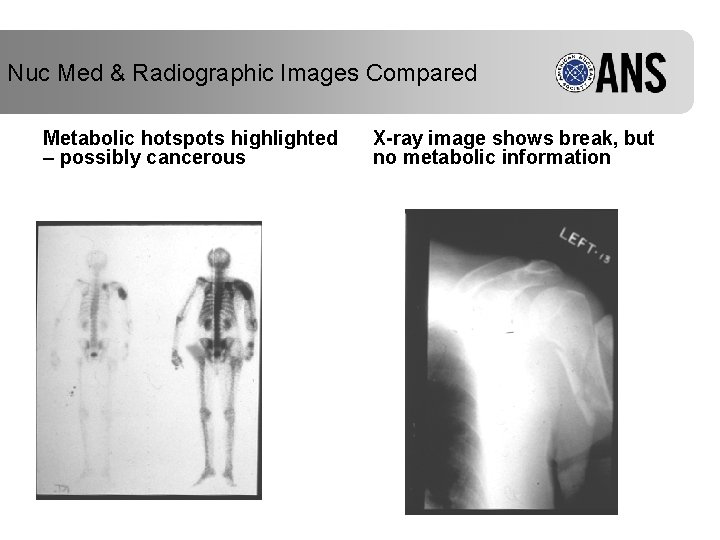
Nuc Med & Radiographic Images Compared Metabolic hotspots highlighted – possibly cancerous X-ray image shows break, but no metabolic information
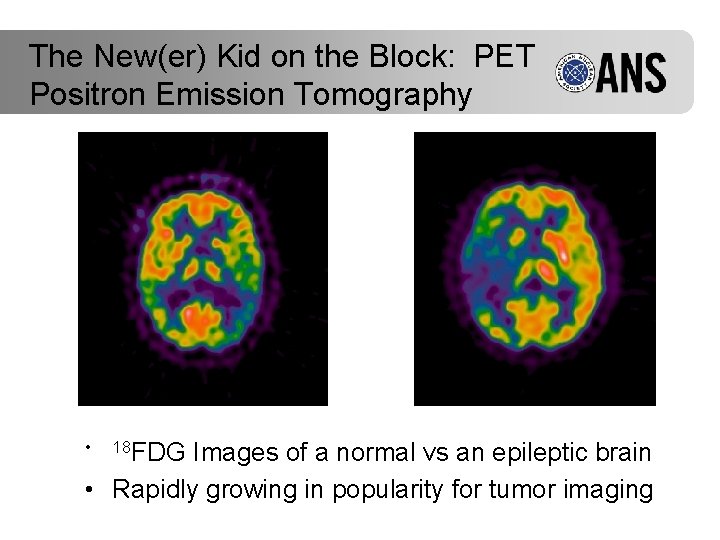
The New(er) Kid on the Block: PET Positron Emission Tomography • 18 FDG Images of a normal vs an epileptic brain • Rapidly growing in popularity for tumor imaging
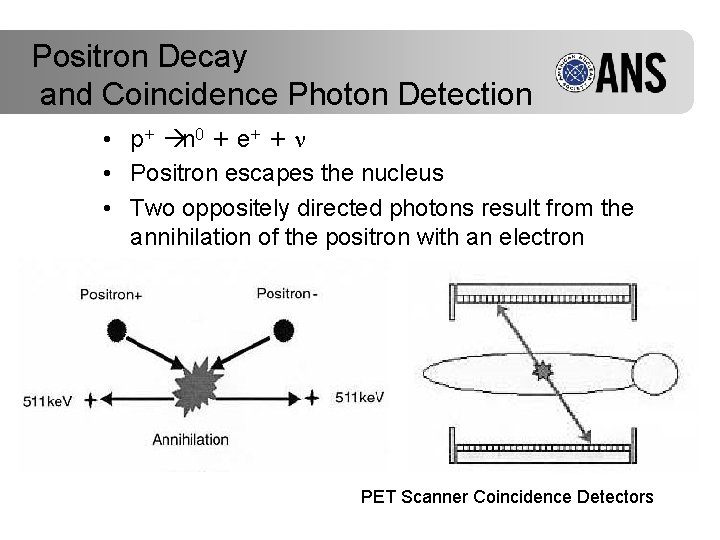
Positron Decay and Coincidence Photon Detection • p+ àn 0 + e+ + n • Positron escapes the nucleus • Two oppositely directed photons result from the annihilation of the positron with an electron PET Scanner Coincidence Detectors
18 FDG • Fluorodeoxyglucose • Most commonly used PET radiocompound • A glucose analog, useful for – Differentiating malignant from benign tumors – Differentiating scar from viable myocardial tissue – Brain function studies
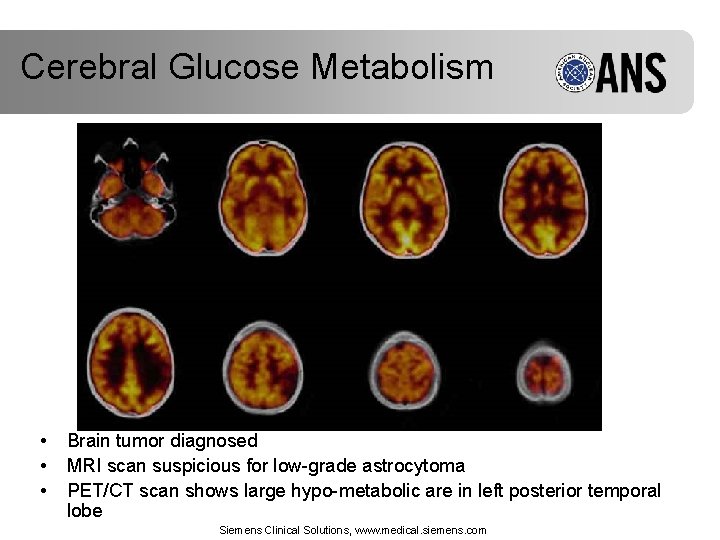
Cerebral Glucose Metabolism • • • Brain tumor diagnosed MRI scan suspicious for low-grade astrocytoma PET/CT scan shows large hypo-metabolic are in left posterior temporal lobe Siemens Clinical Solutions, www. medical. siemens. com
Other PET Applications • Neurological studies – – Epilepsy Alzheimers Parkinson’s Disease Addictions • Cancer imaging and localization – In demand by Oncologists • Cardiology studies
The ‘Historical’ Problem in Modern Radiology • Images obtained from Nuclear Medicine were obtained on a computer platform different from those obtained from CT, and also from MRI, Ultrasound, etc. • Thus, images could not be easily overlaid • A common software was needed to make best use of the information from each modality
Radiation Doses from Some Medical X-ray Exams • Medical Radiation (Effective Whole Body Dose Equivalent) – – Chest X-ray: 8 mrem (0. 08 m. Sv) Head CT scan: 111 mrem (1. 11 m. Sv) Barium Enema: 406 mrem (4. 06 m. Sv) Extremity X-ray: 1 mrem (0. 01 m. Sv) » Source: NCRP Report 100
Radiation Doses and Dose Limits Flight from Los Angeles to London Annual public dose limit Annual natural background Fetal dose limit Barium enema Annual radiation worker dose limit Heart catheterization Life saving actions guidance (NCRP-116) Mild acute radiation syndrome LD 50/60 for humans (bone marrow dose) Radiation therapy (localized & fractionated) 5 mrem 100 mrem 300 mrem 500 mrem 870 mrem 5, 000 mrem 45, 000 mrem 50, 000 mrem 200, 000 mrem 350, 000 mrem 6, 000 mrem
MRI: Radio Waves & Magnetic Fields
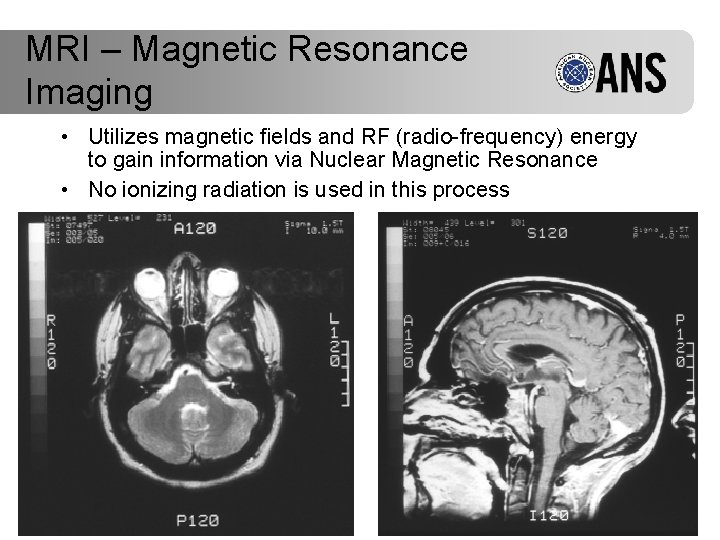
MRI – Magnetic Resonance Imaging • Utilizes magnetic fields and RF (radio-frequency) energy to gain information via Nuclear Magnetic Resonance • No ionizing radiation is used in this process
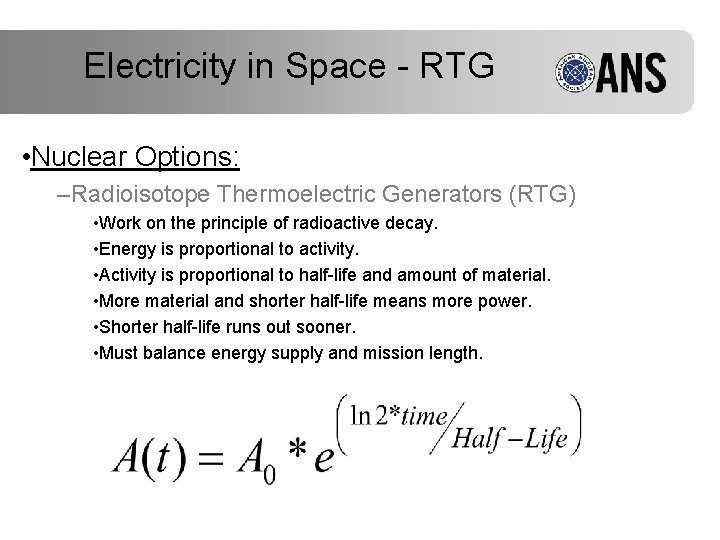
Electricity in Space - RTG • Nuclear Options: –Radioisotope Thermoelectric Generators (RTG) • Work on the principle of radioactive decay. • Energy is proportional to activity. • Activity is proportional to half-life and amount of material. • More material and shorter half-life means more power. • Shorter half-life runs out sooner. • Must balance energy supply and mission length.
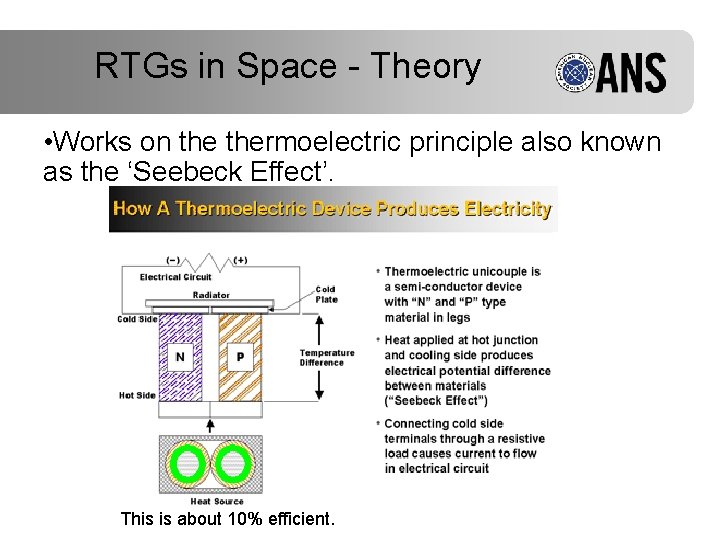
RTGs in Space - Theory • Works on thermoelectric principle also known as the ‘Seebeck Effect’. This is about 10% efficient.
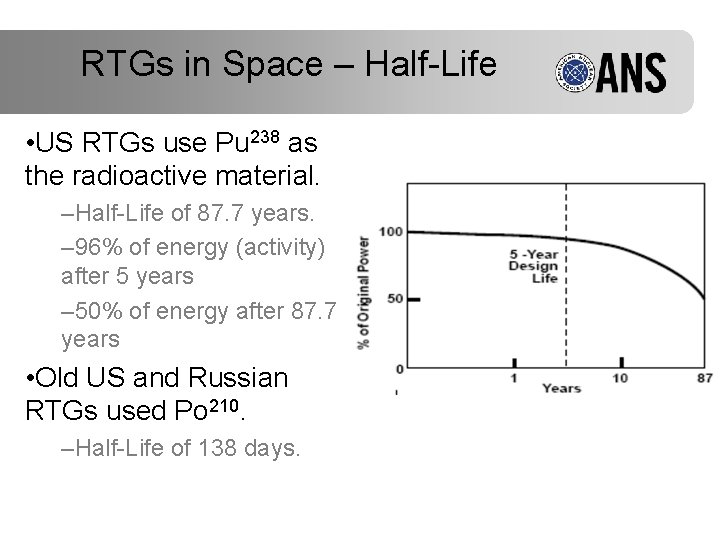
RTGs in Space – Half-Life • US RTGs use Pu 238 as the radioactive material. –Half-Life of 87. 7 years. – 96% of energy (activity) after 5 years – 50% of energy after 87. 7 years • Old US and Russian RTGs used Po 210. –Half-Life of 138 days.
RTGs in Space - Radiation • Pu-238 and Po 210 are alpha (α) emitters. • Alpha radiation cannot penetrate very far. – Stopped by a sheet of paper or 10 cm of air. – Turns into heat in the RTG material. – Very little radiation gets out of the shielding. – Not ‘weapons grade’ material. – Ceramic form that is very heat and impact resistant.
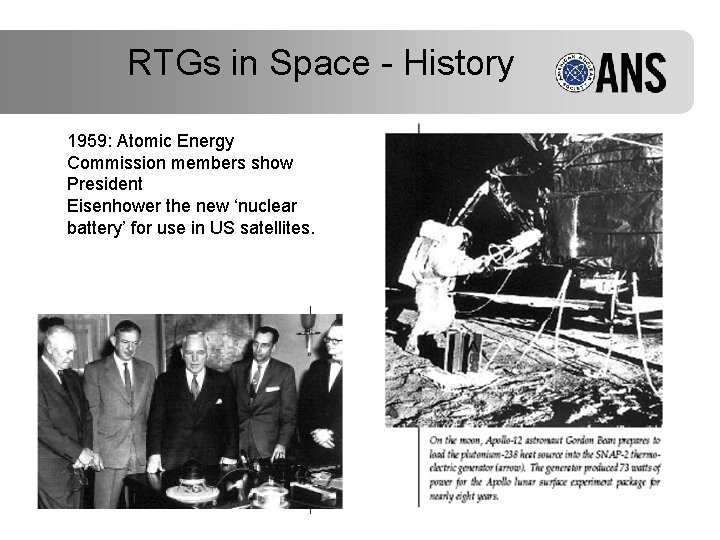
RTGs in Space - History 1959: Atomic Energy Commission members show President Eisenhower the new ‘nuclear battery’ for use in US satellites.
RTGs in Space - History • Original RTG is space was for a US Navy navigation satellite. – 1961 SNAP-3 unit (Space Nuclear Auxiliary Power) – 2. 7 watts of electrical power. – Lasted for 15 years. • RTGs were used in 25 other missions from 1961 to 2005 from military satellites to the Apollo missions.
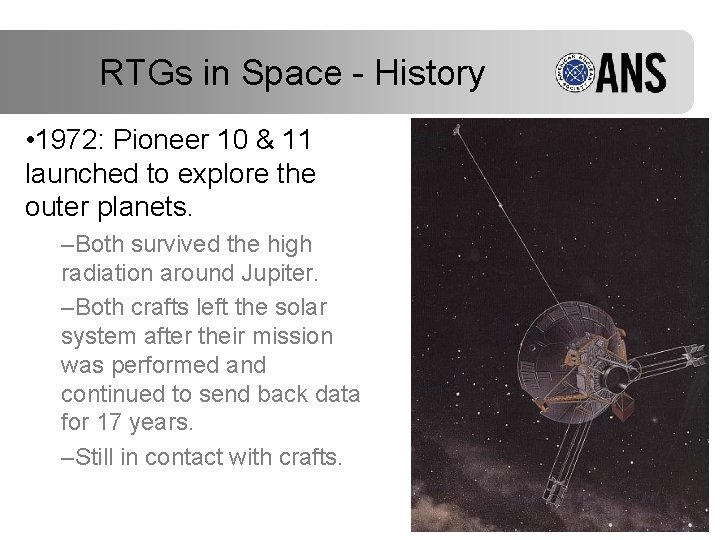
RTGs in Space - History • 1972: Pioneer 10 & 11 launched to explore the outer planets. –Both survived the high radiation around Jupiter. –Both crafts left the solar system after their mission was performed and continued to send back data for 17 years. –Still in contact with crafts.
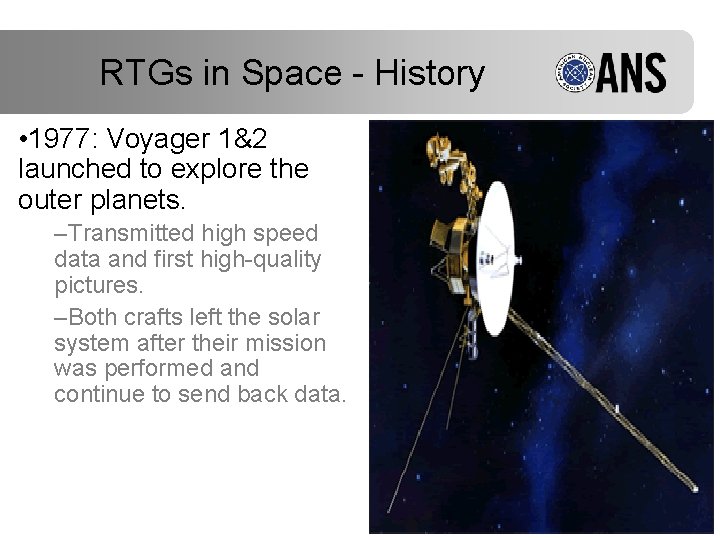
RTGs in Space - History • 1977: Voyager 1&2 launched to explore the outer planets. –Transmitted high speed data and first high-quality pictures. –Both crafts left the solar system after their mission was performed and continue to send back data.
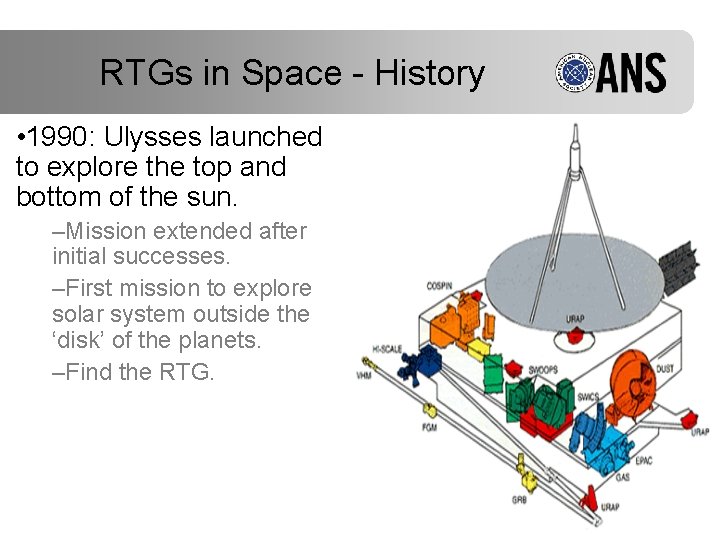
RTGs in Space - History • 1990: Ulysses launched to explore the top and bottom of the sun. –Mission extended after initial successes. –First mission to explore solar system outside the ‘disk’ of the planets. –Find the RTG.
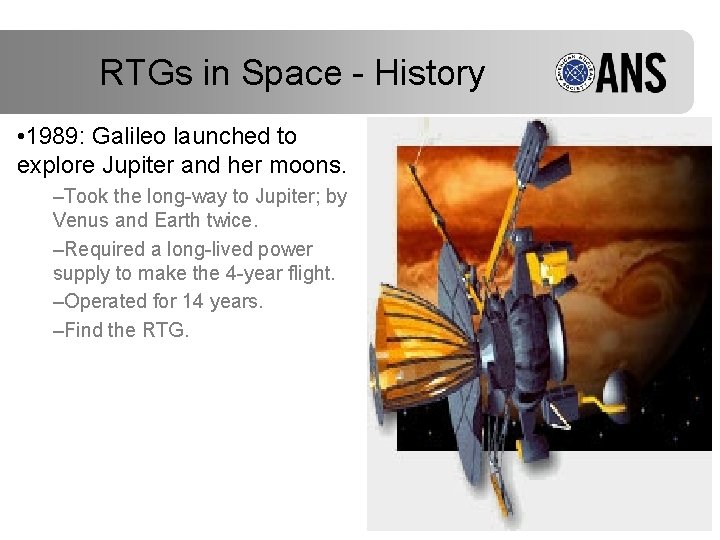
RTGs in Space - History • 1989: Galileo launched to explore Jupiter and her moons. –Took the long-way to Jupiter; by Venus and Earth twice. –Required a long-lived power supply to make the 4 -year flight. –Operated for 14 years. –Find the RTG.
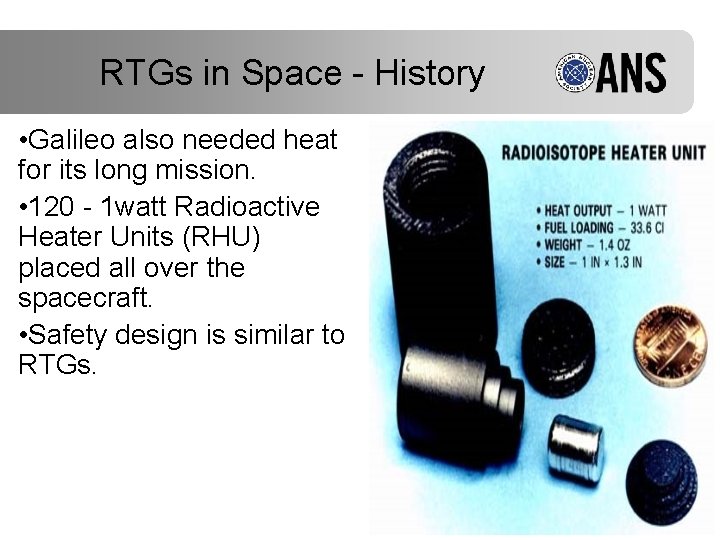
RTGs in Space - History • Galileo also needed heat for its long mission. • 120 - 1 watt Radioactive Heater Units (RHU) placed all over the spacecraft. • Safety design is similar to RTGs.
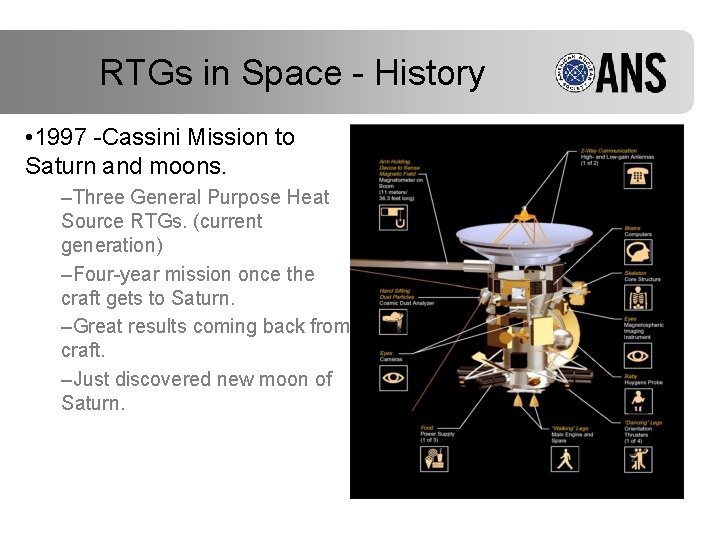
RTGs in Space - History • 1997 -Cassini Mission to Saturn and moons. –Three General Purpose Heat Source RTGs. (current generation) –Four-year mission once the craft gets to Saturn. –Great results coming back from craft. –Just discovered new moon of Saturn.
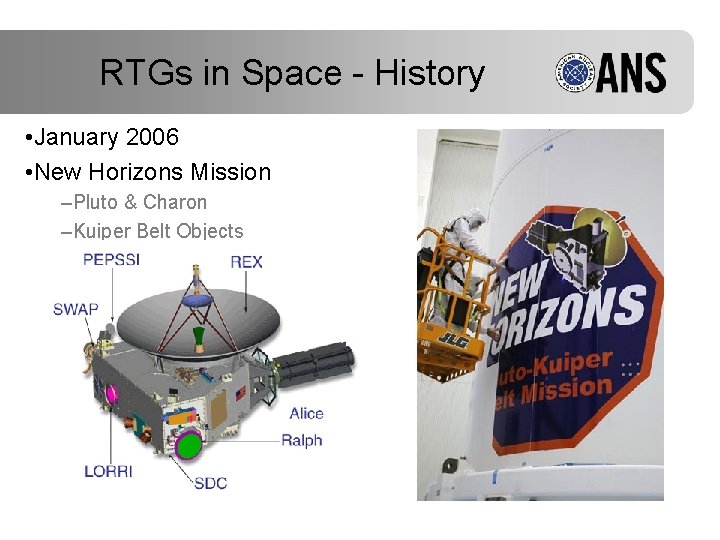
RTGs in Space - History • January 2006 • New Horizons Mission –Pluto & Charon –Kuiper Belt Objects
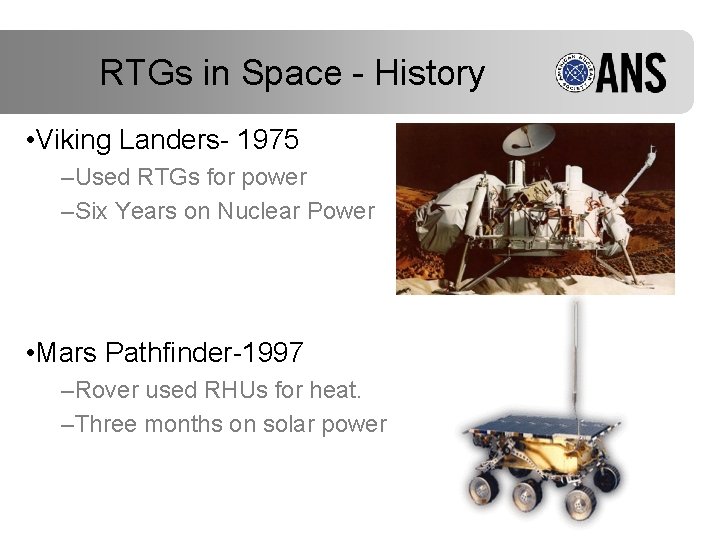
RTGs in Space - History • Viking Landers- 1975 –Used RTGs for power –Six Years on Nuclear Power • Mars Pathfinder-1997 –Rover used RHUs for heat. –Three months on solar power

American Nuclear Society
- Slides: 62