
Applications of neutron spectrometry 1 Introduction 2 Research
- Slides: 10
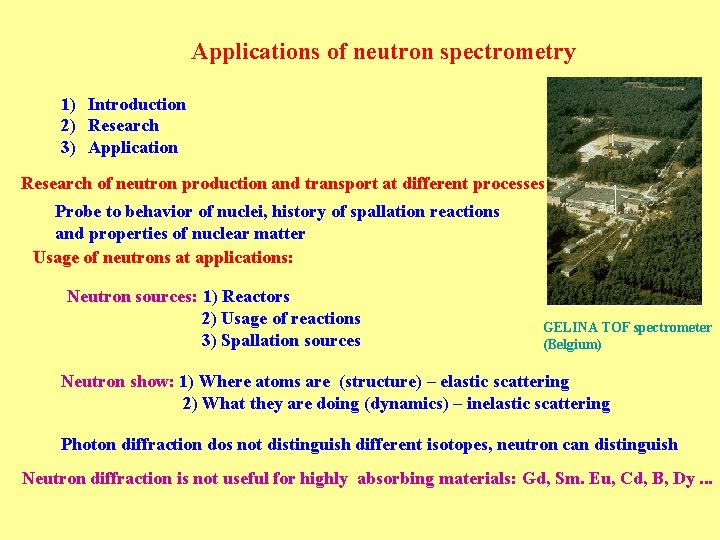
Applications of neutron spectrometry 1) Introduction 2) Research 3) Application Research of neutron production and transport at different processes Probe to behavior of nuclei, history of spallation reactions and properties of nuclear matter Usage of neutrons at applications: Neutron sources: 1) Reactors 2) Usage of reactions 3) Spallation sources GELINA TOF spectrometer (Belgium) Neutron show: 1) Where atoms are (structure) – elastic scattering 2) What they are doing (dynamics) – inelastic scattering Photon diffraction dos not distinguish different isotopes, neutron can distinguish Neutron diffraction is not useful for highly absorbing materials: Gd, Sm. Eu, Cd, B, Dy. . .
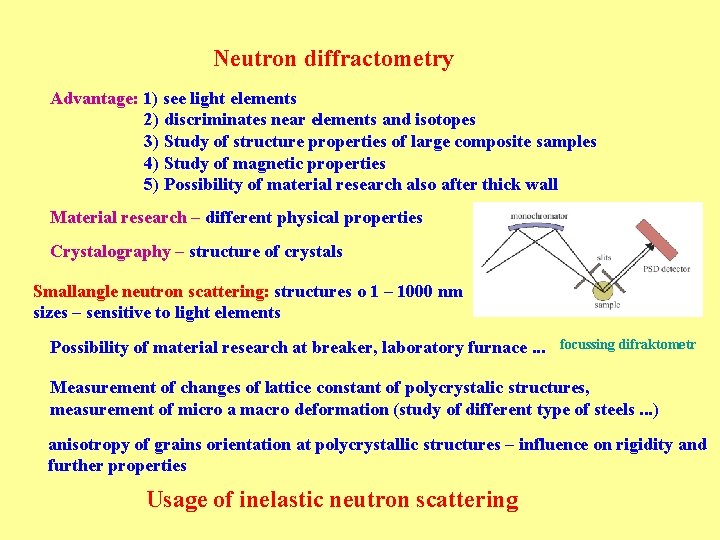
Neutron diffractometry Advantage: 1) see light elements 2) discriminates near elements and isotopes 3) Study of structure properties of large composite samples 4) Study of magnetic properties 5) Possibility of material research also after thick wall Material research – different physical properties Crystalography – structure of crystals Smallangle neutron scattering: structures o 1 – 1000 nm sizes – sensitive to light elements Possibility of material research at breaker, laboratory furnace. . . focussing difraktometr Measurement of changes of lattice constant of polycrystalic structures, measurement of micro a macro deformation (study of different type of steels. . . ) anisotropy of grains orientation at polycrystallic structures – influence on rigidity and further properties Usage of inelastic neutron scattering
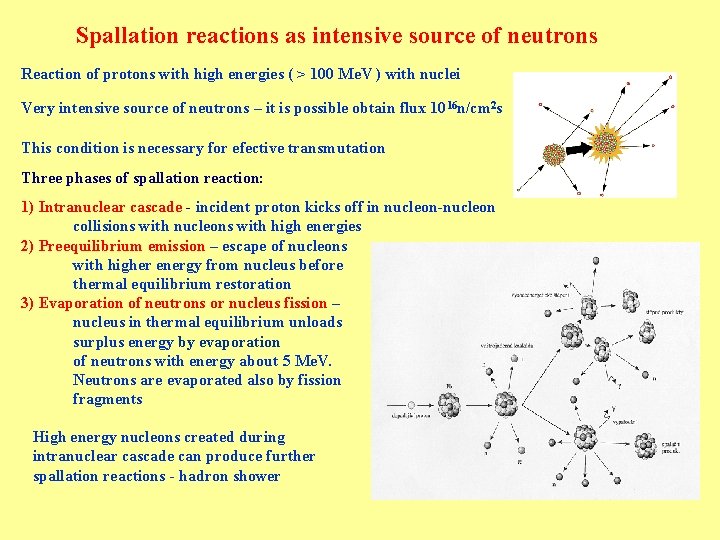
Spallation reactions as intensive source of neutrons Reaction of protons with high energies ( > 100 Me. V ) with nuclei Very intensive source of neutrons – it is possible obtain flux 1016 n/cm 2 s This condition is necessary for efective transmutation Three phases of spallation reaction: 1) Intranuclear cascade - incident proton kicks off in nucleon-nucleon collisions with nucleons with high energies 2) Preequilibrium emission – escape of nucleons with higher energy from nucleus before thermal equilibrium restoration 3) Evaporation of neutrons or nucleus fission – nucleus in thermal equilibrium unloads surplus energy by evaporation of neutrons with energy about 5 Me. V. Neutrons are evaporated also by fission fragments High energy nucleons created during intranuclear cascade can produce further spallation reactions - hadron shower
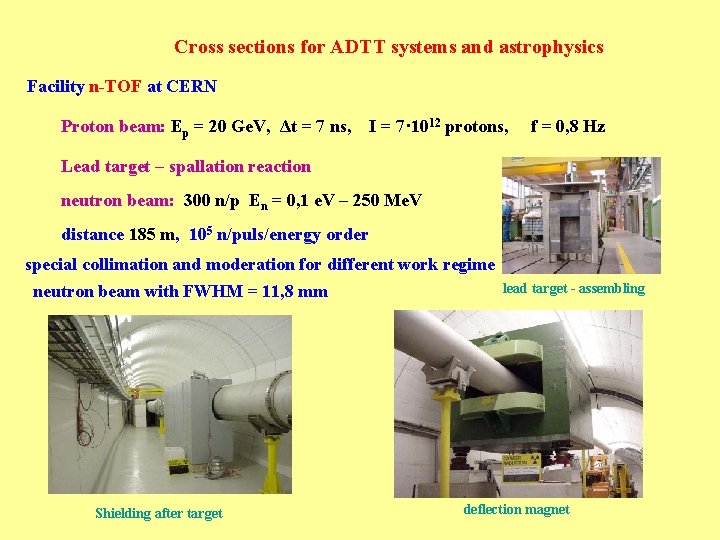
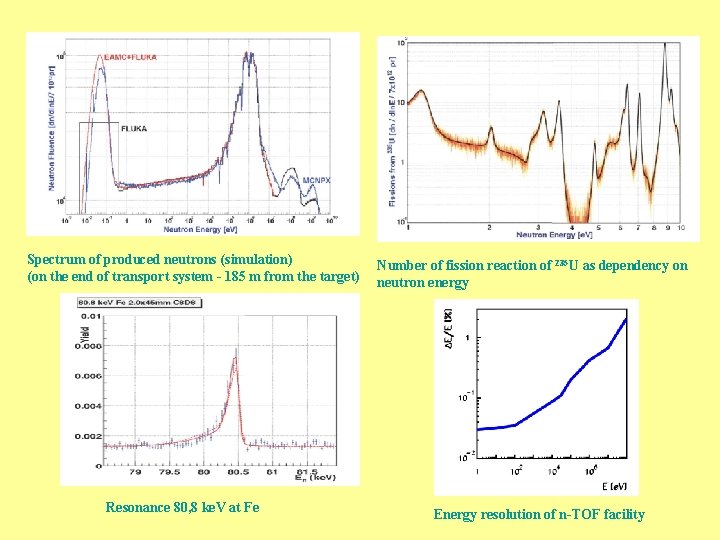
Cross sections for ADTT systems and astrophysics Facility n-TOF at CERN Proton beam: Ep = 20 Ge. V, Δt = 7 ns, I = 7·1012 protons, f = 0, 8 Hz Lead target – spallation reaction neutron beam: 300 n/p En = 0, 1 e. V – 250 Me. V distance 185 m, 105 n/puls/energy order special collimation and moderation for different work regime neutron beam with FWHM = 11, 8 mm Shielding after target lead target - assembling deflection magnet
Spectrum of produced neutrons (simulation) (on the end of transport system - 185 m from the target) Resonance 80, 8 ke. V at Fe Number of fission reaction of 235 U as dependency on neutron energy Energy resolution of n-TOF facility
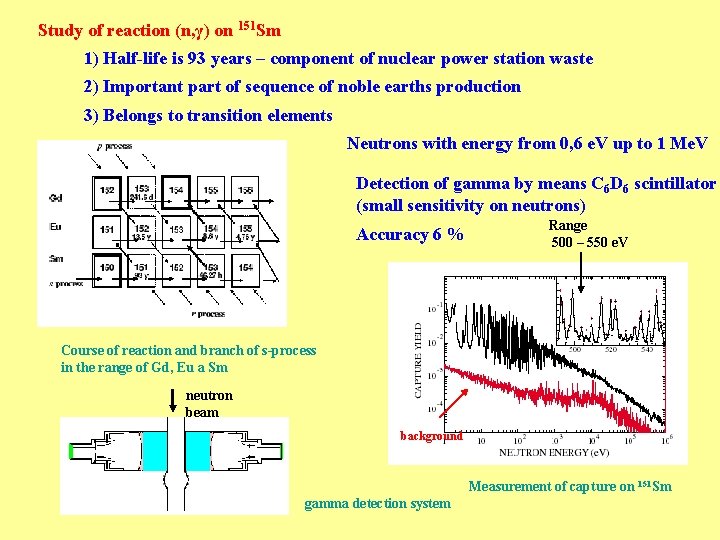
Study of reaction (n, γ) on 151 Sm 1) Half-life is 93 years – component of nuclear power station waste 2) Important part of sequence of noble earths production 3) Belongs to transition elements Neutrons with energy from 0, 6 e. V up to 1 Me. V Detection of gamma by means C 6 D 6 scintillator (small sensitivity on neutrons) Accuracy 6 % Range 500 – 550 e. V Course of reaction and branch of s-process in the range of Gd, Eu a Sm neutron beam background Measurement of capture on 151 Sm gamma detection system
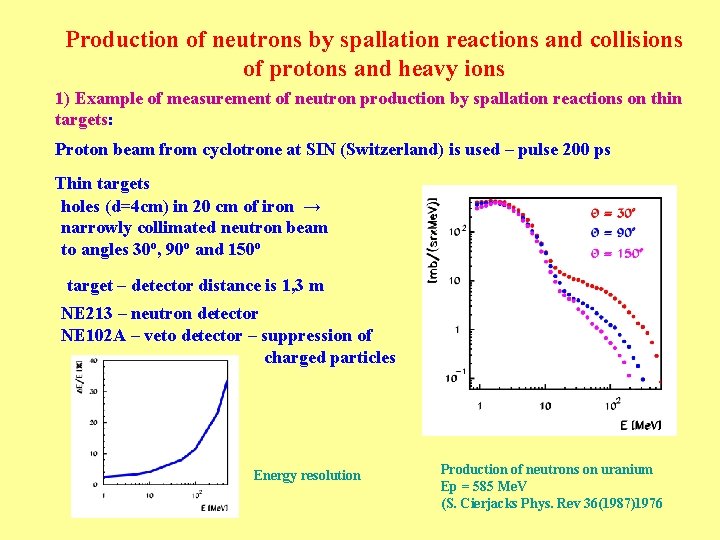
Production of neutrons by spallation reactions and collisions of protons and heavy ions 1) Example of measurement of neutron production by spallation reactions on thin targets: Proton beam from cyclotrone at SIN (Switzerland) is used – pulse 200 ps Thin targets holes (d=4 cm) in 20 cm of iron → narrowly collimated neutron beam to angles 30 o, 90 o and 150 o target – detector distance is 1, 3 m NE 213 – neutron detector NE 102 A – veto detector – suppression of charged particles Energy resolution Production of neutrons on uranium Ep = 585 Me. V (S. Cierjacks Phys. Rev 36(1987)1976
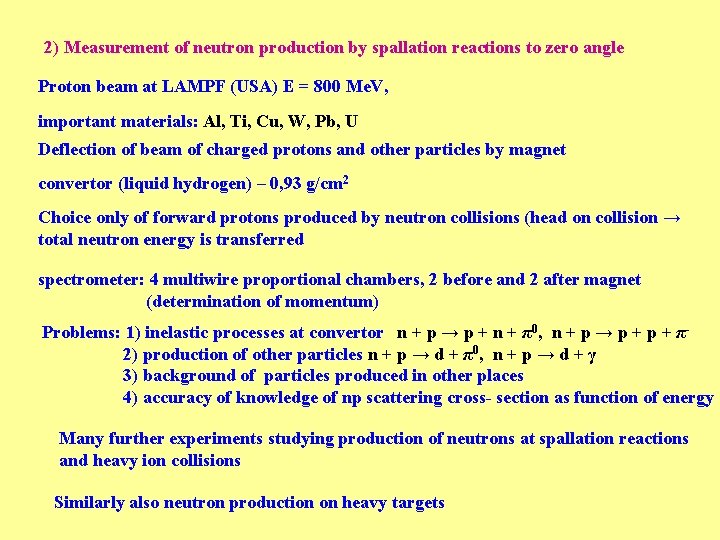
2) Measurement of neutron production by spallation reactions to zero angle Proton beam at LAMPF (USA) E = 800 Me. V, important materials: Al, Ti, Cu, W, Pb, U Deflection of beam of charged protons and other particles by magnet convertor (liquid hydrogen) – 0, 93 g/cm 2 Choice only of forward protons produced by neutron collisions (head on collision → total neutron energy is transferred spectrometer: 4 multiwire proportional chambers, 2 before and 2 after magnet (determination of momentum) Problems: 1) inelastic processes at convertor n + p → p + n + π0, n + p → p + π2) production of other particles n + p → d + π0, n + p → d + γ 3) background of particles produced in other places 4) accuracy of knowledge of np scattering cross- section as function of energy Many further experiments studying production of neutrons at spallation reactions and heavy ion collisions Similarly also neutron production on heavy targets
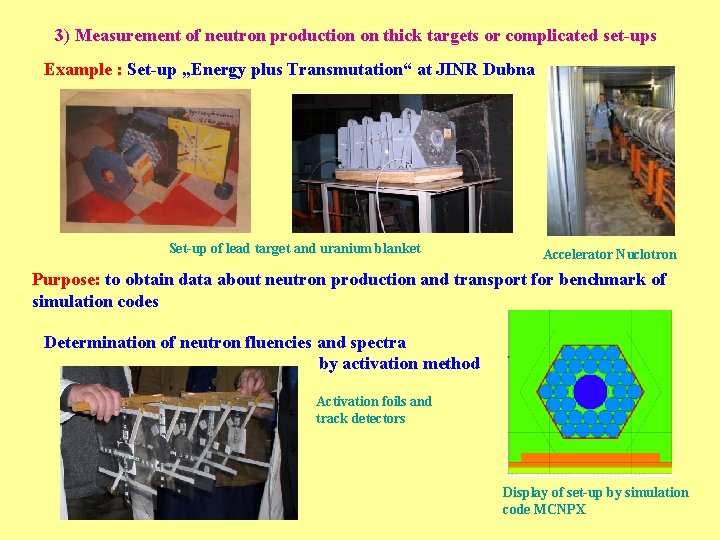
3) Measurement of neutron production on thick targets or complicated set-ups Example : Set-up „Energy plus Transmutation“ at JINR Dubna Set-up of lead target and uranium blanket Accelerator Nuclotron Purpose: to obtain data about neutron production and transport for benchmark of simulation codes Determination of neutron fluencies and spectra by activation method Activation foils and track detectors Display of set-up by simulation code MCNPX
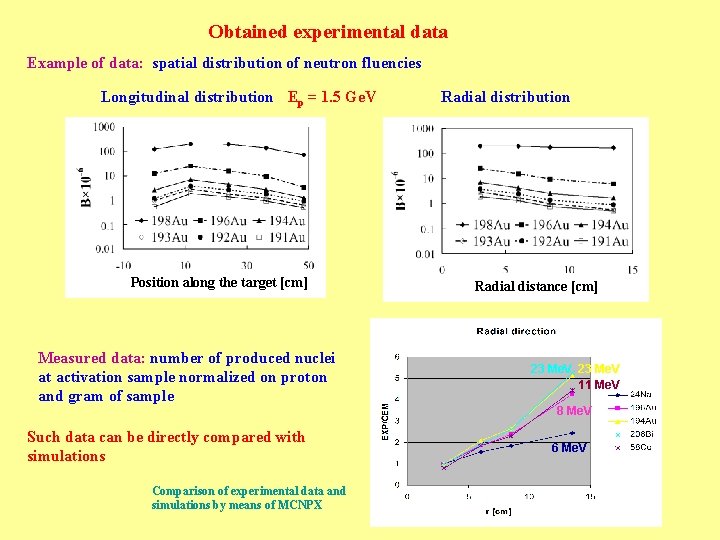
Obtained experimental data Example of data: spatial distribution of neutron fluencies Longitudinal distribution Ep = 1. 5 Ge. V Position along the target [cm] Measured data: number of produced nuclei at activation sample normalized on proton and gram of sample Such data can be directly compared with simulations Comparison of experimental data and simulations by means of MCNPX Radial distribution Radial distance [cm] 23 Me. V 11 Me. V 8 Me. V 6 Me. V