
APPLICATIONS OF MOLECULAR BIOLOGY TECHNIQUES TO MEDICAL MICROBIOLOGY
APPLICATIONS OF MOLECULAR BIOLOGY TECHNIQUES TO MEDICAL MICROBIOLOGY
Two principle molecular techniques used in detection of microorganisms 1 - Nucleic acid hybridization( Southern Blotting ( 2 - Polymerase chain reaction (PCR(
Polymerase chain reaction The benefits of PCR based diagnostic testing: Rapid diagnosis Detection Same day result High accuracy, high specifity, high sensitivity
The role of PCR in diagnosis of infectious diseases Fastidious and slow growing microorganism Detect antimicrobial resistance Detect microorganism cannt be cultivated Measurment value of viral load
Polymerase chain reaction PCR- Amplify minute amounts of target DNA within a few hours Develobed by Nobel laureate biochemist Kary Mullis in 1984 Discovered of thermostable polymerase work at 100 c Taq polymerase
PCR methodology Materials Target DNA Taq polymerase Four DNA nucleotides Tow primer. S Reaction buffer Temperature cycles
PCR methods 1 - Denaturation: doble stranded DNA eprated into two single strands 90 -95 c 2 - Cooling at 30 -60 c 3 - Annealing: Primers attached complementary region of target DNA 4 - Heating at 70 c 5 - Extention : The primers extended to form a new strand of DNA
Defferentversions of PCR 1 -Nested PCR: Increased sensitivity and specifity 2 -Reverse transcriptase PCR: (RT-PCR( PCR also applied to amplification of RNA 3 -Amplified fragment length polymorphism(AFLP) replaced southern blotting 4 -Inverse PCR : Amplifies unknown DNA
Ideal applications for PCR applied in the research setting to hundreds of microbes: 1 - Routine culture are limited -microbe cannt grow e. g. , Mycobacterium lepra, HCV 2 -Grow slowly- M. tuberculosis 3 -Diffecult to culture - Brucella, HIV
Diagnosis of infectious diseases Examples of infection agents that detected by PCR: Chlamydia trachomatis C. pneumonia Mycobacterium tuberculosis Mycoblasma pneumoniae Neisseria gonorrhoeae Herbes simplex virus
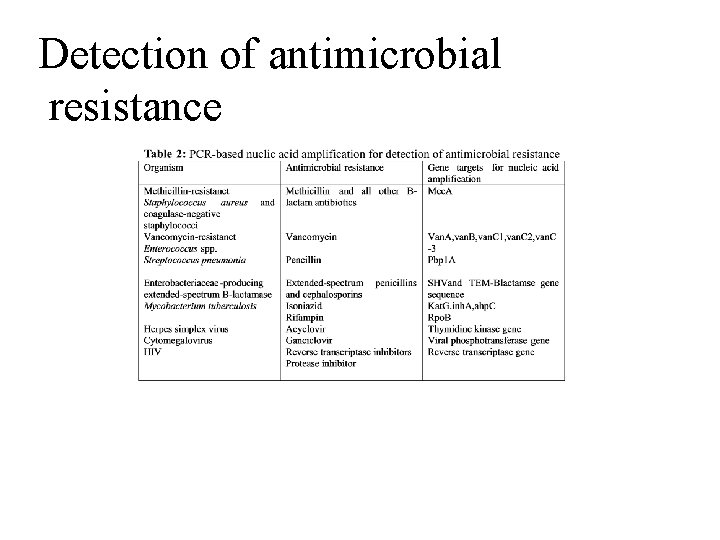
Detection of antimicrobial resistance
Southern blotting Named after Edward M. Southern who developed this procedure in 1975 Allow investigators to detrmine the molecular weight of a restriction fragment To measure relative amounts in different samples To locate a particular sequence of DNA within a complex mixture
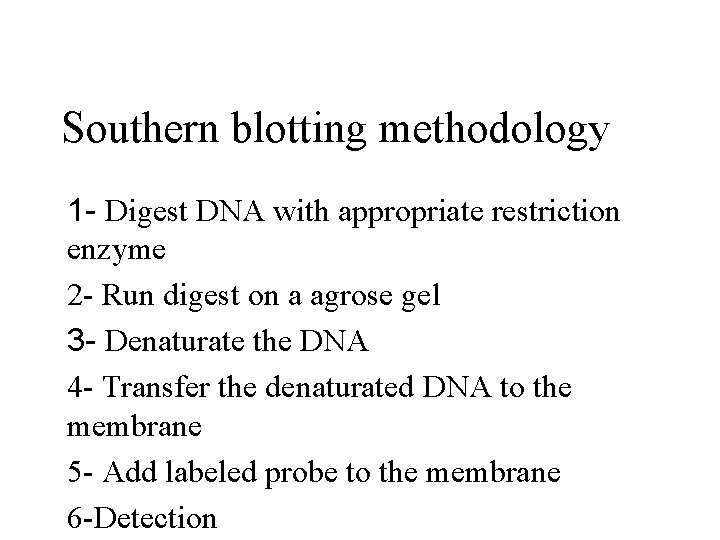
Southern blotting methodology 1 - Digest DNA with appropriate restriction enzyme 2 - Run digest on a agrose gel 3 - Denaturate the DNA 4 - Transfer the denaturated DNA to the membrane 5 - Add labeled probe to the membrane 6 -Detection
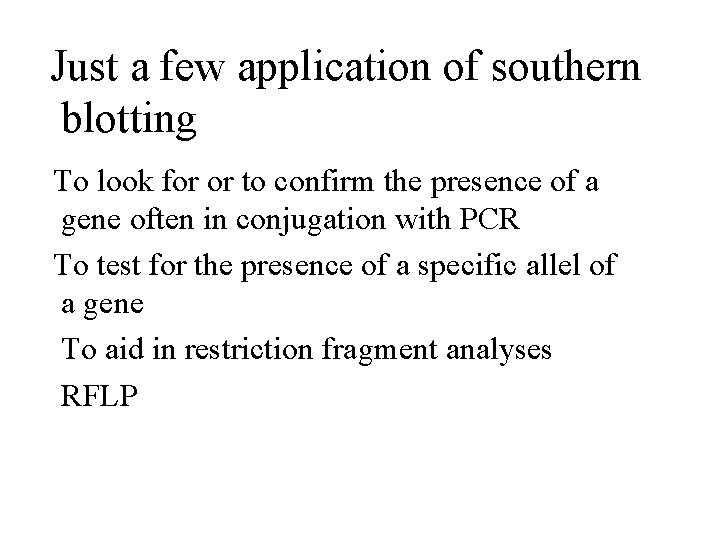
Just a few application of southern blotting To look for or to confirm the presence of a gene often in conjugation with PCR To test for the presence of a specific allel of a gene To aid in restriction fragment analyses RFLP
- Slides: 14