
Applications of Machine Learning in Relativistic Heavy Ion
- Slides: 37
Applications of Machine Learning in Relativistic Heavy Ion Collisions Huichao Song 宋慧超 Peking University QCD and Quark Matter Physics SCNU, Guangzhou,Nov. 12 -13 2018 热烈祝贺华南师范大学量子物质研究院成立 Nov 13, 2018
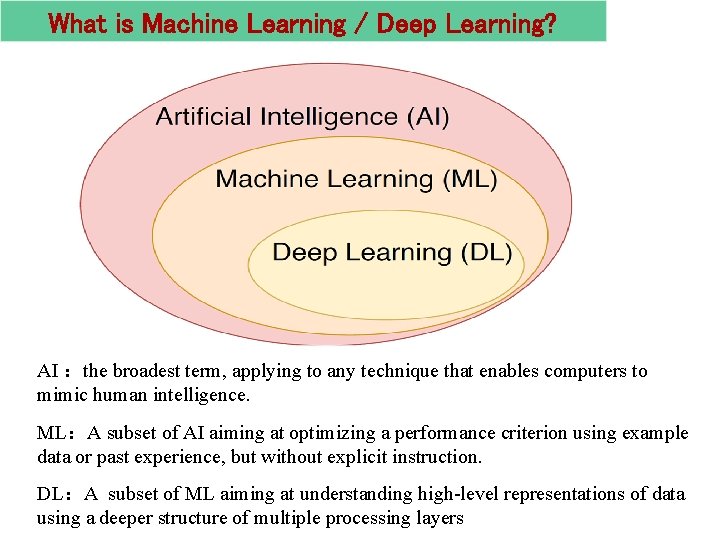
What is Machine Learning / Deep Learning? AI :the broadest term, applying to any technique that enables computers to mimic human intelligence. ML:A subset of AI aiming at optimizing a performance criterion using example data or past experience, but without explicit instruction. DL:A subset of ML aiming at understanding high-level representations of data using a deeper structure of multiple processing layers
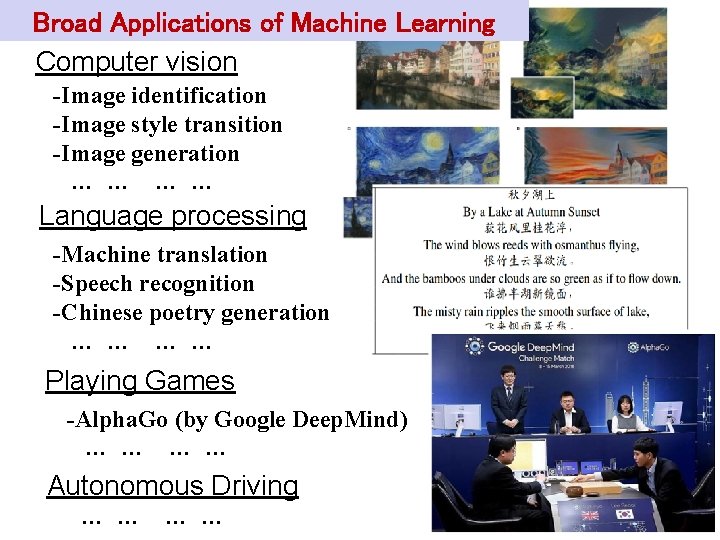
Broad Applications of Machine Learning Computer vision -Image identification -Image style transition -Image generation … … Language processing -Machine translation -Speech recognition -Chinese poetry generation … … Playing Games -Alpha. Go (by Google Deep. Mind) … … Autonomous Driving … …
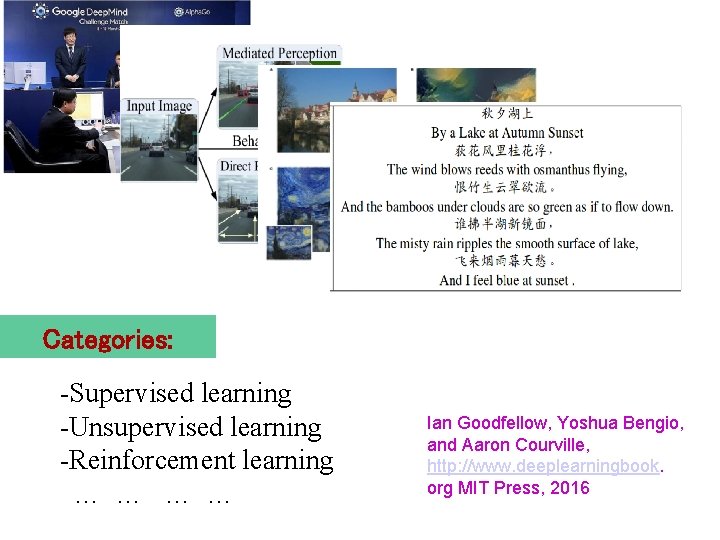
Categories: -Supervised learning -Unsupervised learning -Reinforcement learning … … Ian Goodfellow, Yoshua Bengio, and Aaron Courville, http: //www. deeplearningbook. org MIT Press, 2016
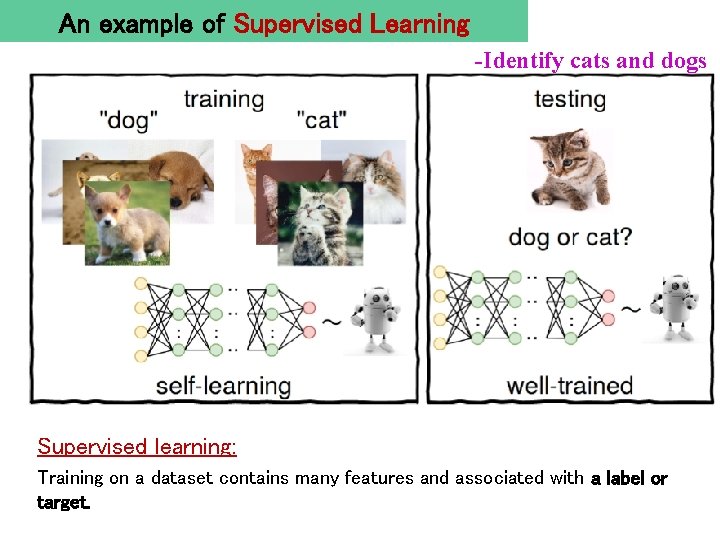
An example of Supervised Learning -Identify cats and dogs Supervised learning: Training on a dataset contains many features and associated with a label or target.
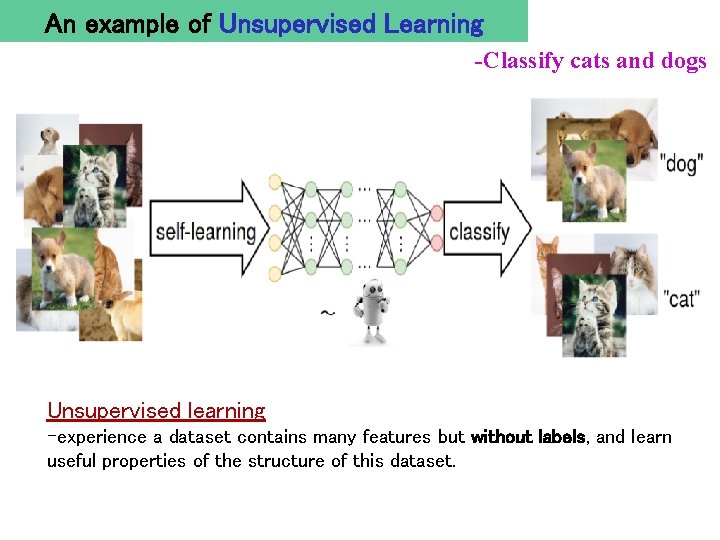
An example of Unsupervised Learning -Classify cats and dogs Unsupervised learning -experience a dataset contains many features but without labels, and learn useful properties of the structure of this dataset.
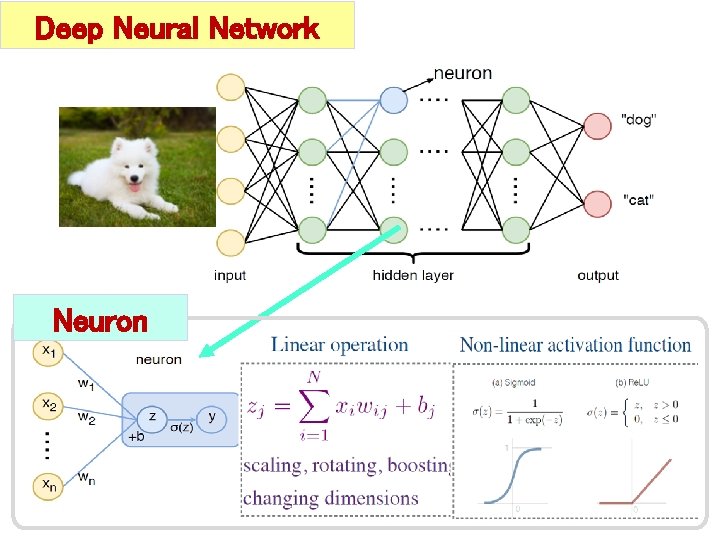
Deep Neural Network Neuron
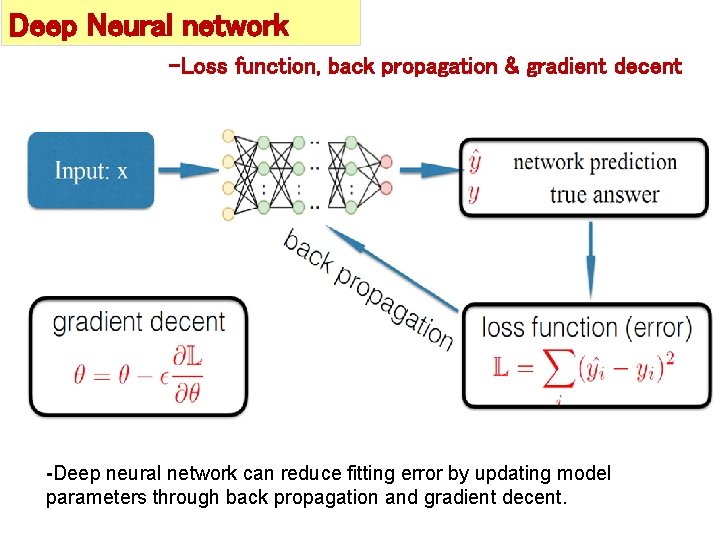
Deep Neural network -Loss function, back propagation & gradient decent Back propagation and gradient decent -Deep neural network can reduce fitting error by updating model parameters through back propagation and gradient decent.
Applications of Machine Learning in Physics
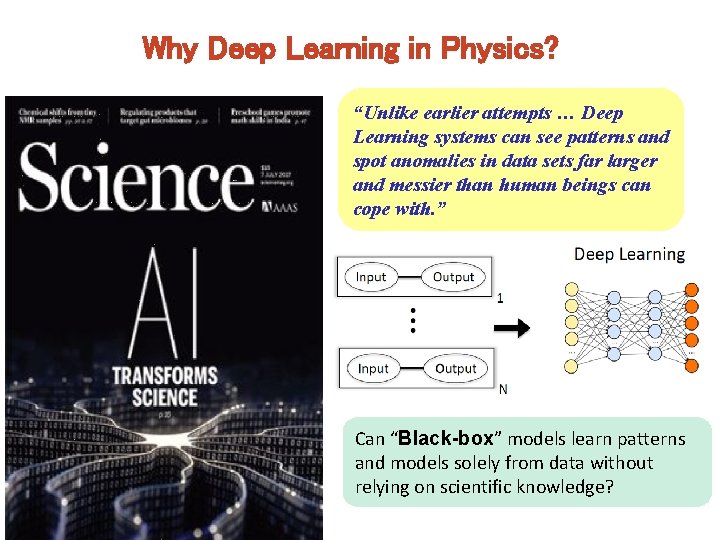
Why Deep Learning in Physics? “Unlike earlier attempts … Deep Learning systems can see patterns and spot anomalies in data sets far larger and messier than human beings can cope with. ” Can “Black-box” models learn patterns and models solely from data without relying on scientific knowledge?
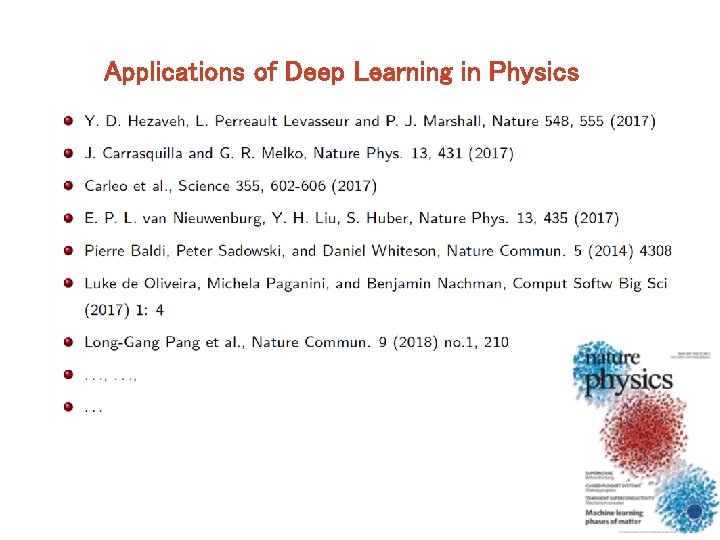
Applications of Deep Learning in Physics
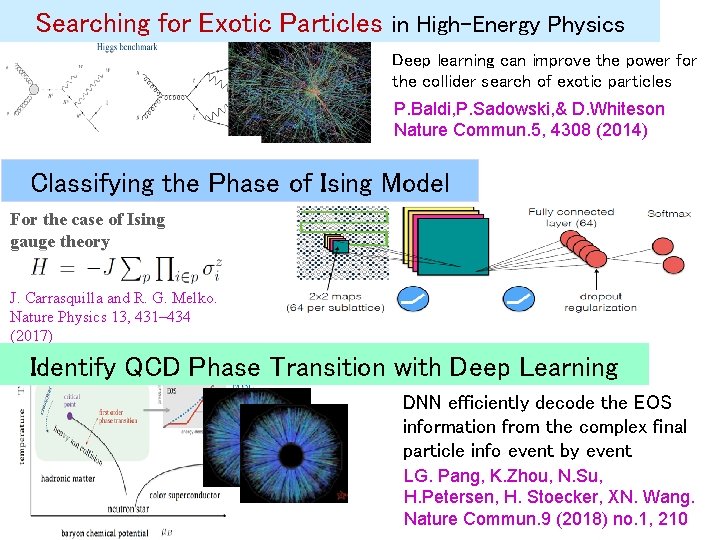
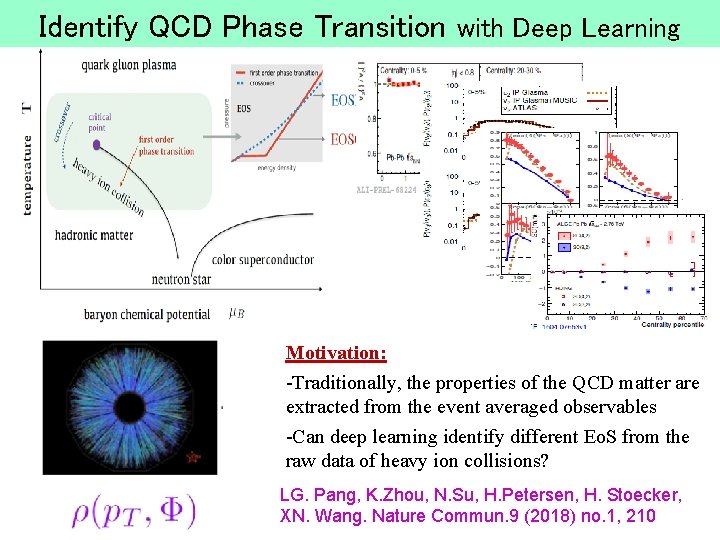
Searching for Exotic Particles in High-Energy Physics Deep learning can improve the power for the collider search of exotic particles P. Baldi, P. Sadowski, & D. Whiteson Nature Commun. 5, 4308 (2014) Classifying the Phase of Ising Model For the case of Ising gauge theory J. Carrasquilla and R. G. Melko. Nature Physics 13, 431– 434 (2017) Identify QCD Phase Transition with Deep Learning DNN efficiently decode the EOS information from the complex final particle info event by event LG. Pang, K. Zhou, N. Su, H. Petersen, H. Stoecker, XN. Wang. Nature Commun. 9 (2018) no. 1, 210
Identify QCD Phase Transition with Deep Learning Motivation: -Traditionally, the properties of the QCD matter are extracted from the event averaged observables -Can deep learning identify different Eo. S from the raw data of heavy ion collisions? LG. Pang, K. Zhou, N. Su, H. Petersen, H. Stoecker, XN. Wang. Nature Commun. 9 (2018) no. 1, 210
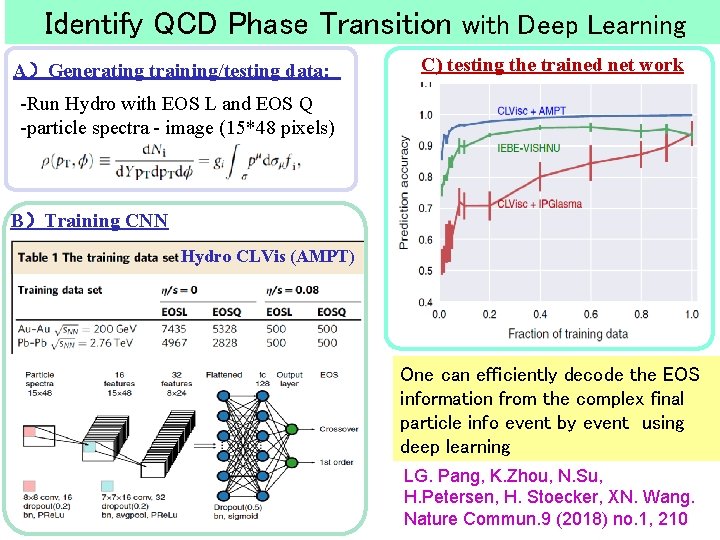
Identify QCD Phase Transition with Deep Learning A)Generating training/testing data: C) testing the trained net work -Run Hydro with EOS L and EOS Q -particle spectra - image (15*48 pixels) B)Training CNN Hydro CLVis (AMPT) One can efficiently decode the EOS information from the complex final particle info event by event using deep learning LG. Pang, K. Zhou, N. Su, H. Petersen, H. Stoecker, XN. Wang. Nature Commun. 9 (2018) no. 1, 210
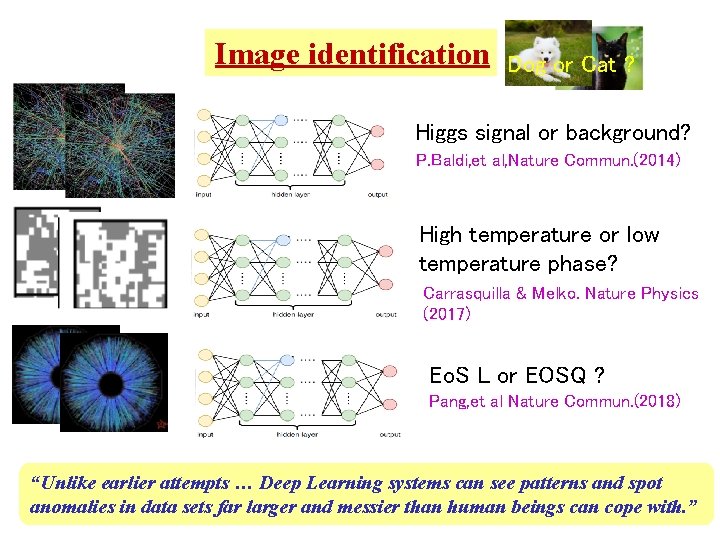
Image identification Dog or Cat ? Higgs signal or background? P. Baldi, et al, Nature Commun. (2014) High temperature or low temperature phase? Carrasquilla & Melko. Nature Physics (2017) Eo. S L or EOSQ ? Pang, et al Nature Commun. (2018) “Unlike earlier attempts … Deep Learning systems can see patterns and spot anomalies in data sets far larger and messier than human beings can cope with. ”
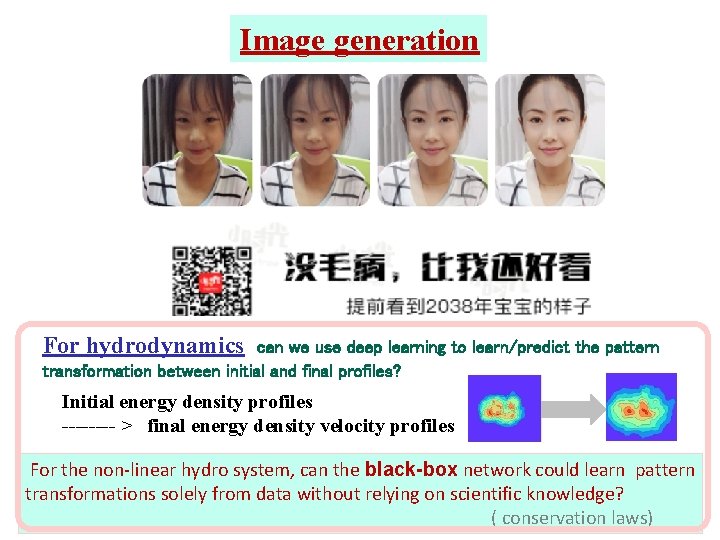
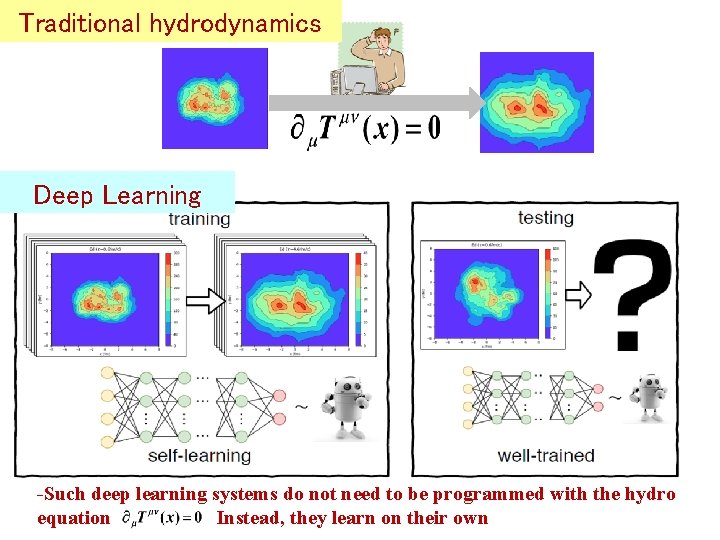
Image generation For hydrodynamics can we use deep learning to learn/predict the pattern transformation between initial and final profiles? Initial energy density profiles ---- > final energy density velocity profiles For the non-linear hydro system, can the black-box network could learn pattern transformations solely from data without relying on scientific knowledge? ( conservation laws)
Applications of deep learning to relativistic hydrodynamics H. Huang, B. Xiao, H. Xiong, Z. Wu, Y. Mu and H. Song ar. Xiv: 1801. 03334; NPA 2018
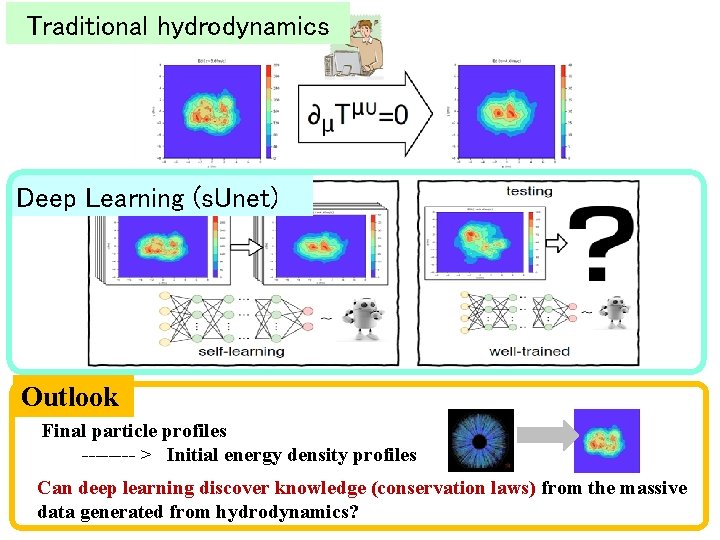
Traditional hydrodynamics Deep Learning -Such deep learning systems do not need to be programmed with the hydro equation Instead, they learn on their own
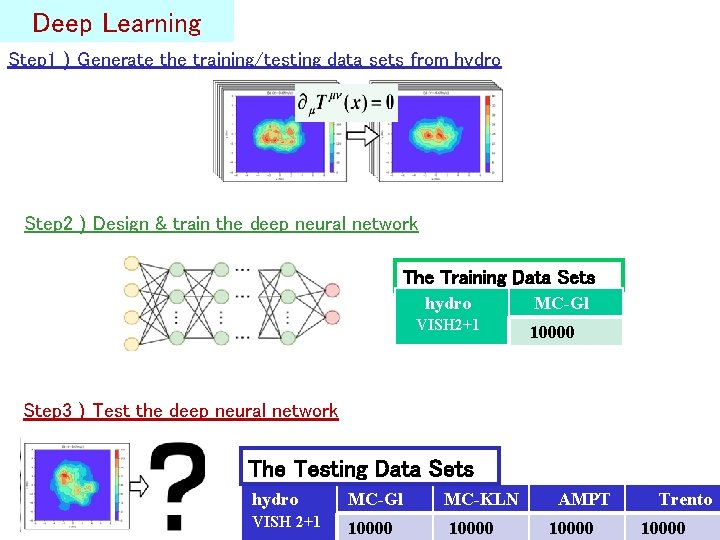
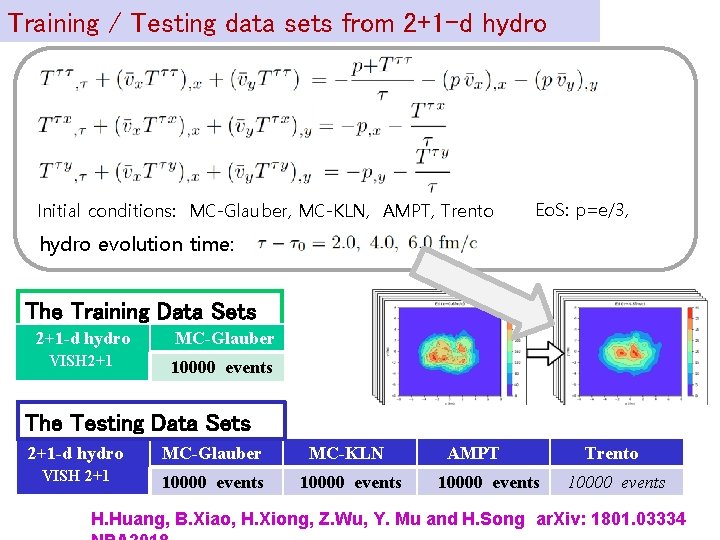
Deep Learning Step 1)Generate the training/testing data sets from hydro Step 2)Design & train the deep neural network The Training Data Sets hydro VISH 2+1 MC-Gl 10000 Step 3)Test the deep neural network The Testing Data Sets hydro MC-Gl MC-KLN VISH 2+1 10000 AMPT 10000 Trento 10000
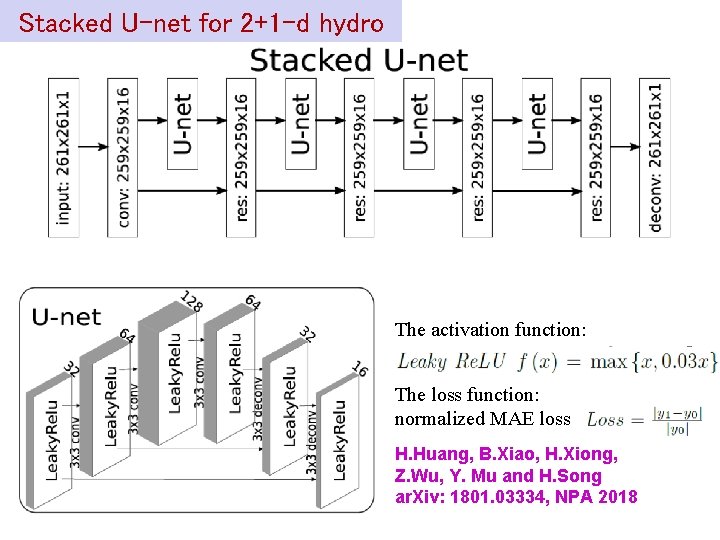
Stacked U-net for 2+1 -d hydro The activation function: The loss function: normalized MAE loss H. Huang, B. Xiao, H. Xiong, Z. Wu, Y. Mu and H. Song ar. Xiv: 1801. 03334, NPA 2018
Training / Testing data sets from 2+1 -d hydro Initial conditions: MC-Glauber, MC-KLN, AMPT, Trento Eo. S: p=e/3, hydro evolution time: The Training Data Sets 2+1 -d hydro MC-Glauber VISH 2+1 10000 events The Testing Data Sets 2+1 -d hydro MC-Glauber MC-KLN VISH 2+1 10000 events AMPT 10000 events Trento 10000 events H. Huang, B. Xiao, H. Xiong, Z. Wu, Y. Mu and H. Song ar. Xiv: 1801. 03334
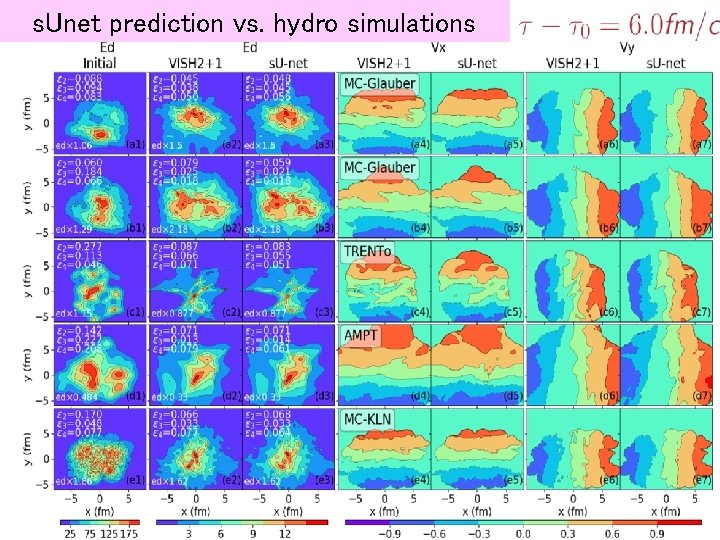
s. Unet prediction vs. hydro simulations
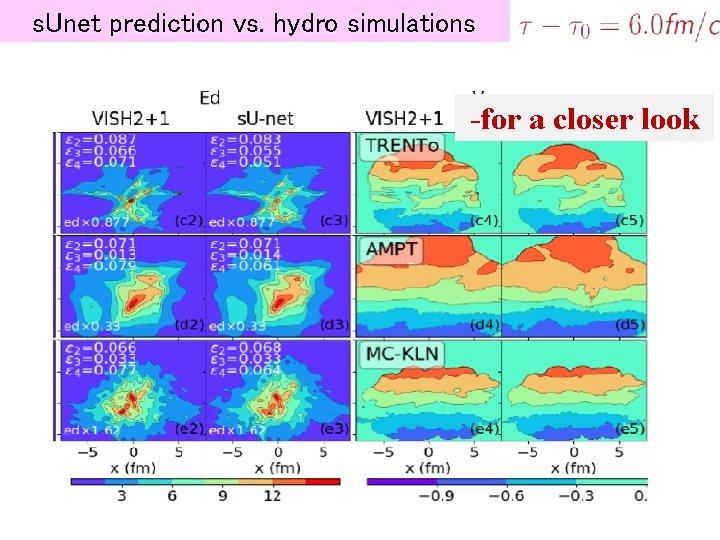
s. Unet prediction vs. hydro simulations -for a closer look
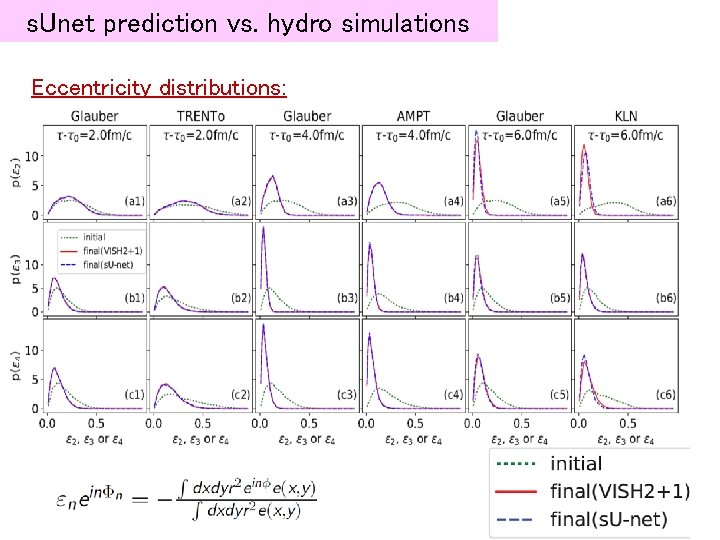
s. Unet prediction vs. hydro simulations Eccentricity distributions:
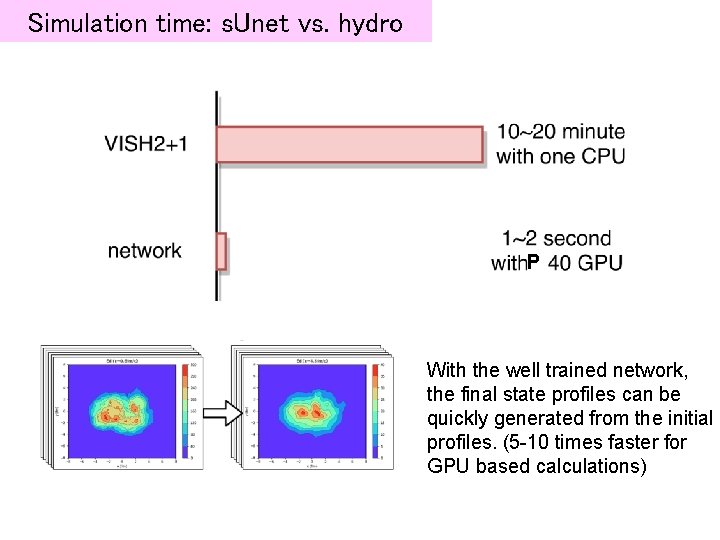
Simulation time: s. Unet vs. hydro P With the well trained network, the final state profiles can be quickly generated from the initial profiles. (5 -10 times faster for GPU based calculations)
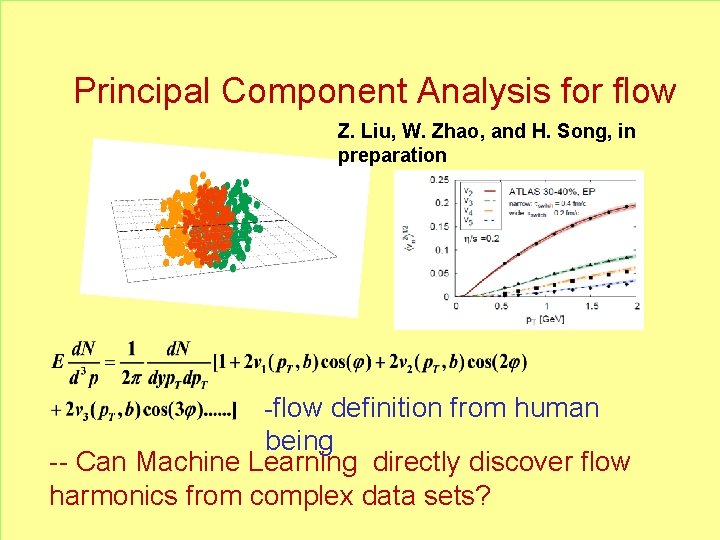
Principal Component Analysis for flow Z. Liu, W. Zhao, and H. Song, in preparation -flow definition from human being -- Can Machine Learning directly discover flow harmonics from complex data sets?
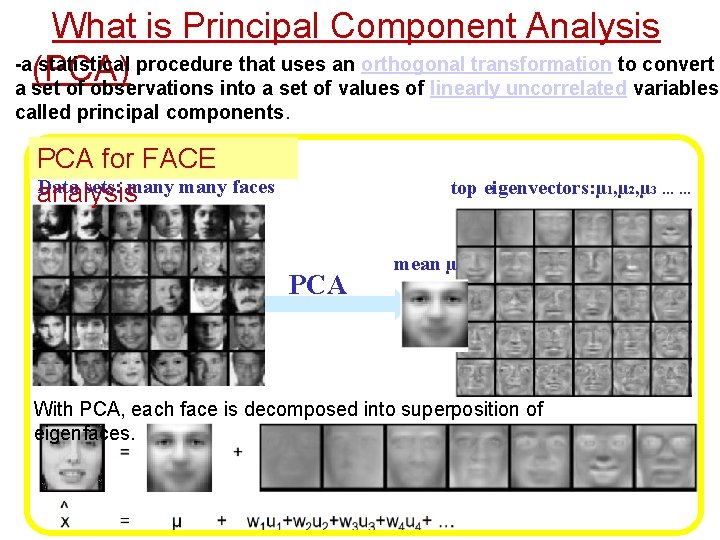
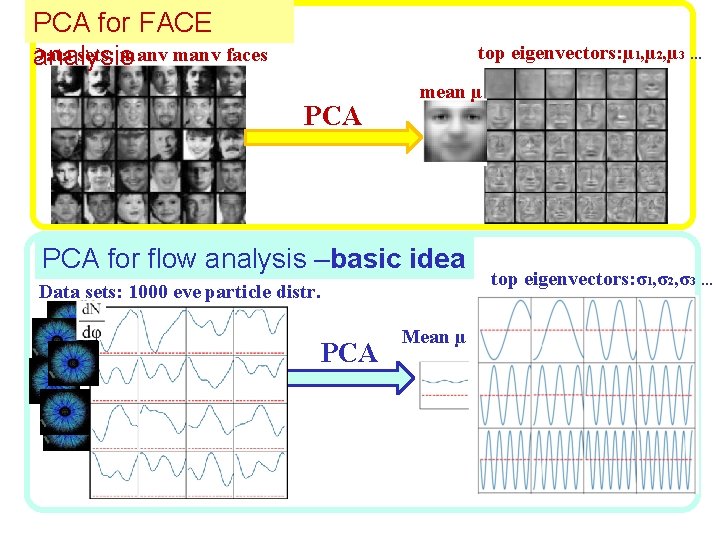
What is Principal Component Analysis -a statistical procedure that uses an orthogonal transformation to convert (PCA) a set of observations into a set of values of linearly uncorrelated variables called principal components. PCA for FACE Data sets: many faces analysis top eigenvectors: µ 1, µ 2, µ 3 … … PCA mean µ With PCA, each face is decomposed into superposition of eigenfaces.
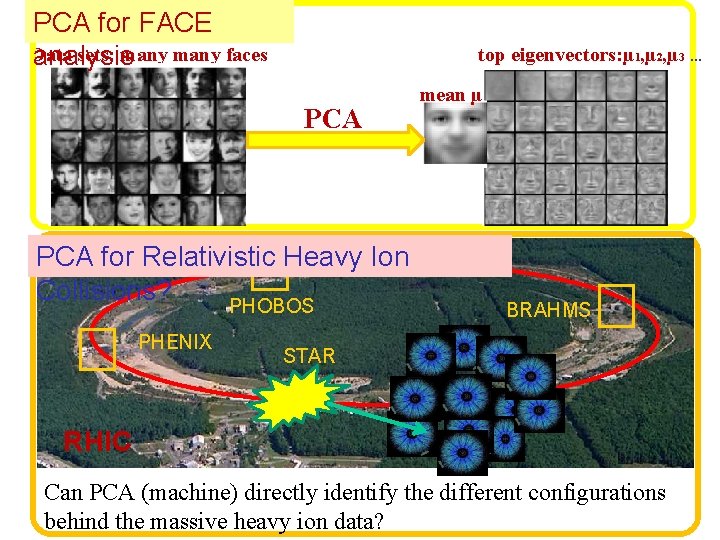
PCA for FACE Data sets: many faces analysis top eigenvectors: µ 1, µ 2, µ 3 … PCA for Relativistic Heavy Ion Collisions? PHOBOS PHENIX mean µ BRAHMS STAR RHIC Can PCA (machine) directly identify the different configurations behind the massive heavy ion data?
PCA for FACE Data sets: many faces analysis top eigenvectors: µ 1, µ 2, µ 3 … PCA mean µ PCA for flow analysis –basic idea Data sets: 1000 eve particle distr. PCA Mean µ top eigenvectors: σ1, σ2, σ3 …
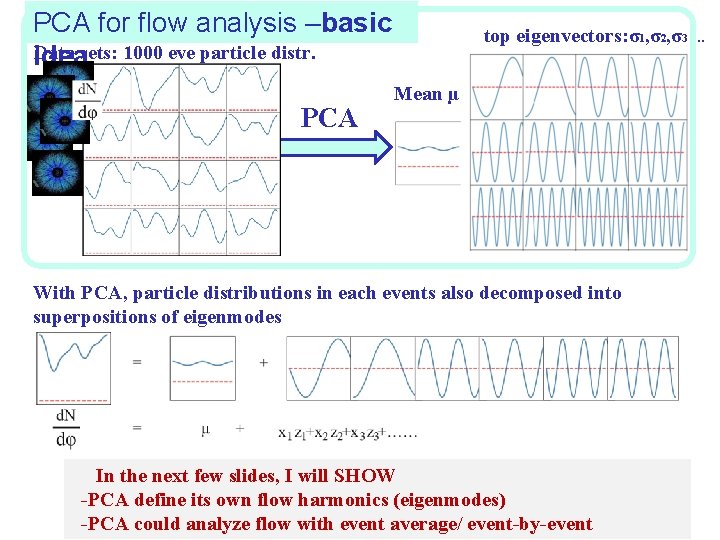
PCA for flow analysis –basic Data sets: 1000 eve particle distr. idea PCA top eigenvectors: σ1, σ2, σ3 … Mean µ With PCA, particle distributions in each events also decomposed into superpositions of eigenmodes In the next few slides, I will SHOW -PCA define its own flow harmonics (eigenmodes) -PCA could analyze flow with event average/ event-by-event
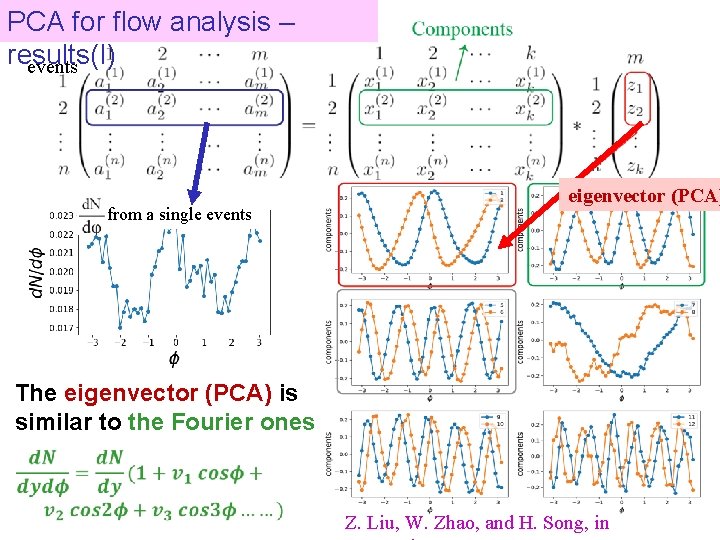
PCA for flow analysis – results(I) events from a single events eigenvector (PCA) The eigenvector (PCA) is similar to the Fourier ones Z. Liu, W. Zhao, and H. Song, in
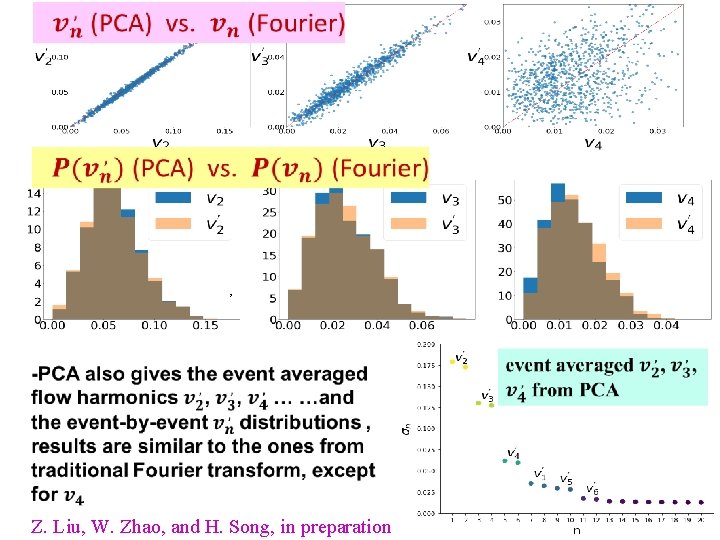
, Z. Liu, W. Zhao, and H. Song, in preparation
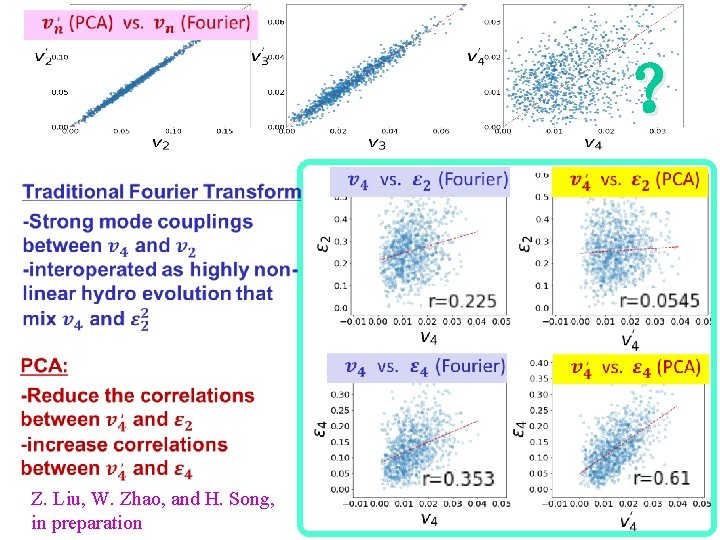
? Z. Liu, W. Zhao, and H. Song, in preparation
Summary & outlook
Traditional hydrodynamics Deep Learning (s. Unet) Outlook Final particle profiles ---- > Initial energy density profiles Can deep learning discover knowledge (conservation laws) from the massive data generated from hydrodynamics?
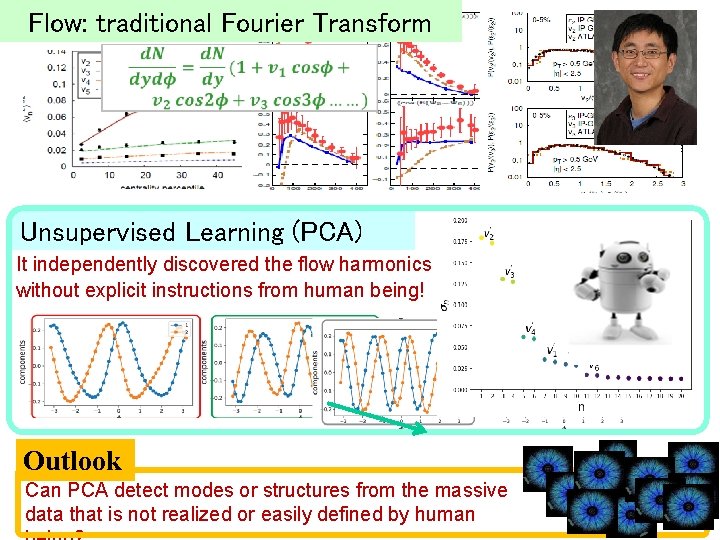
Flow: traditional Fourier Transform Unsupervised Learning (PCA) It independently discovered the flow harmonics without explicit instructions from human being! Outlook Can PCA detect modes or structures from the massive data that is not realized or easily defined by human