
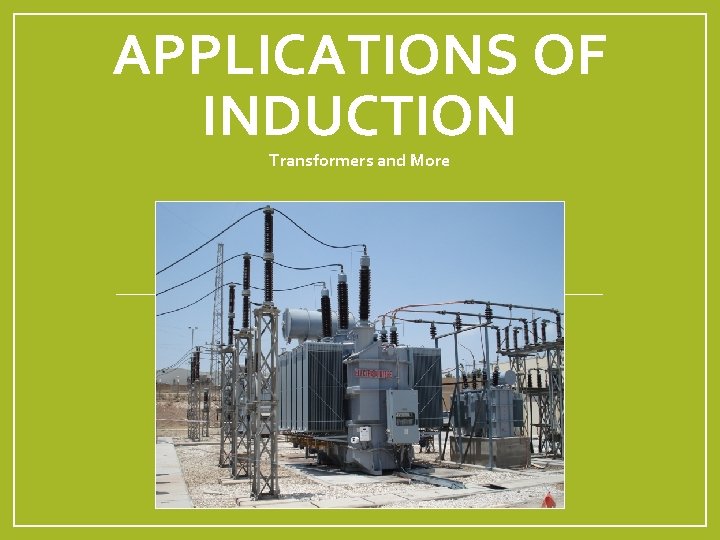
APPLICATIONS OF INDUCTION Transformers and More 21 7
- Slides: 16
APPLICATIONS OF INDUCTION Transformers and More
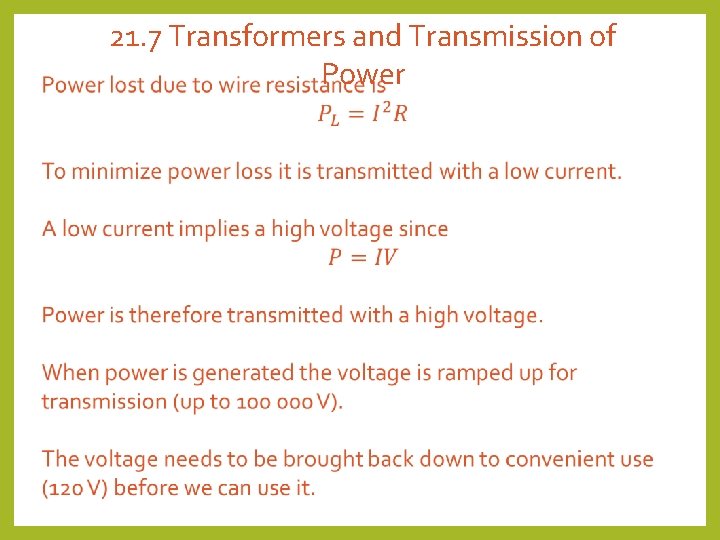
21. 7 Transformers and Transmission of Power
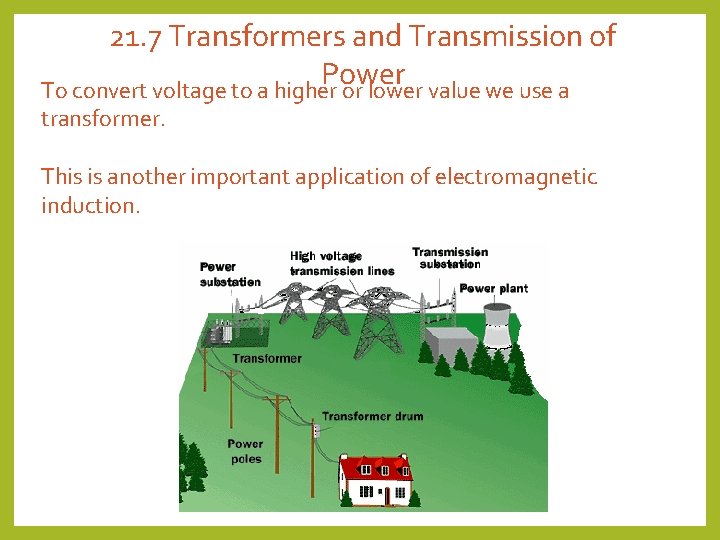
21. 7 Transformers and Transmission of Power To convert voltage to a higher or lower value we use a transformer. This is another important application of electromagnetic induction.
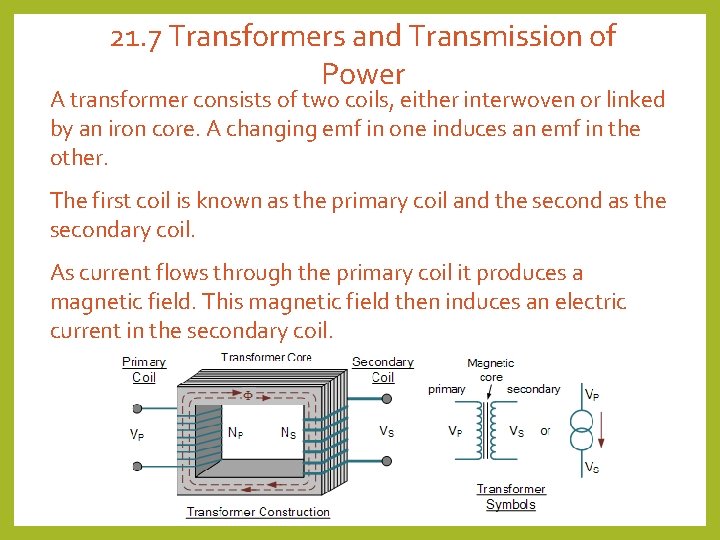
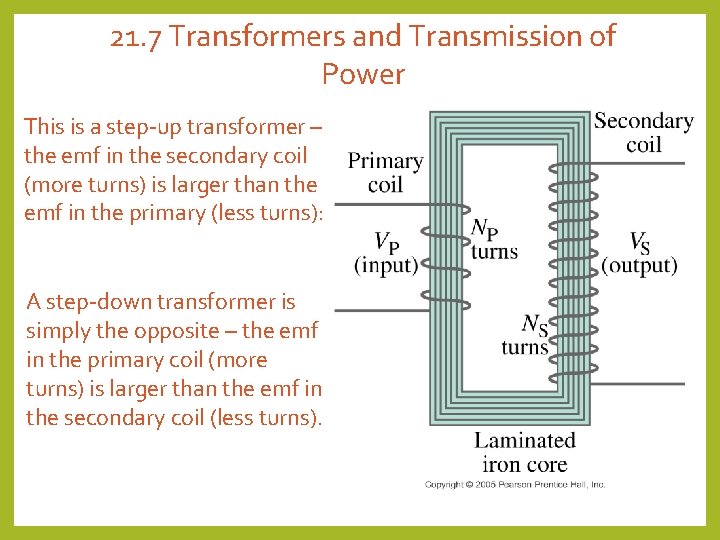
21. 7 Transformers and Transmission of Power A transformer consists of two coils, either interwoven or linked by an iron core. A changing emf in one induces an emf in the other. The first coil is known as the primary coil and the second as the secondary coil. As current flows through the primary coil it produces a magnetic field. This magnetic field then induces an electric current in the secondary coil.
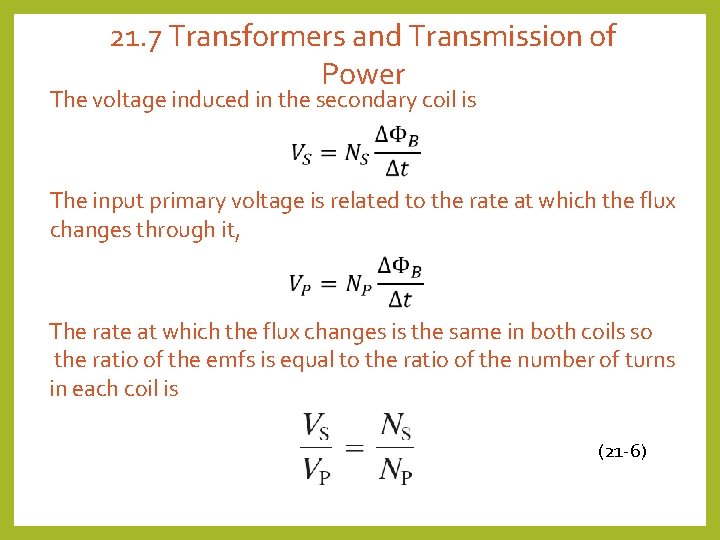
21. 7 Transformers and Transmission of Power The voltage induced in the secondary coil is The input primary voltage is related to the rate at which the flux changes through it, The rate at which the flux changes is the same in both coils so the ratio of the emfs is equal to the ratio of the number of turns in each coil is (21 -6)
21. 7 Transformers and Transmission of Power This is a step-up transformer – the emf in the secondary coil (more turns) is larger than the emf in the primary (less turns): A step-down transformer is simply the opposite – the emf in the primary coil (more turns) is larger than the emf in the secondary coil (less turns).
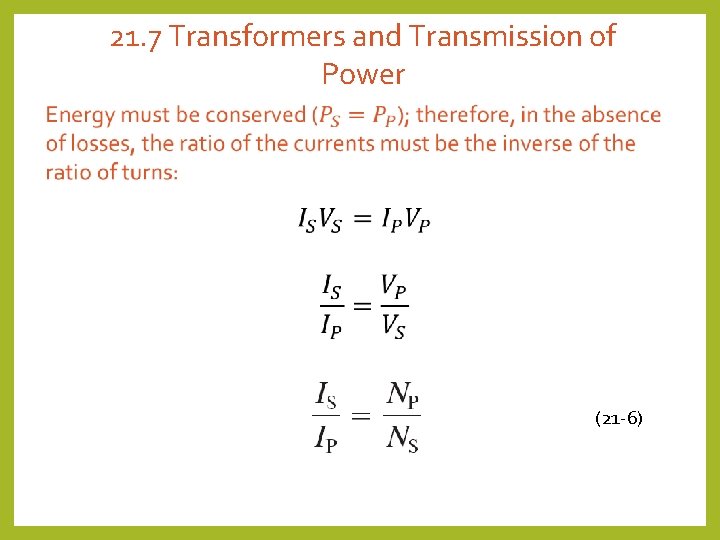
21. 7 Transformers and Transmission of Power (21 -6)
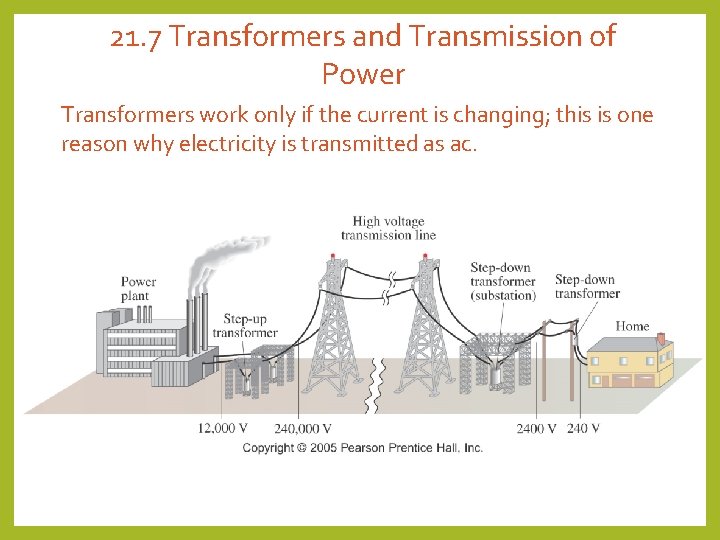
21. 7 Transformers and Transmission of Power Transformers work only if the current is changing; this is one reason why electricity is transmitted as ac.
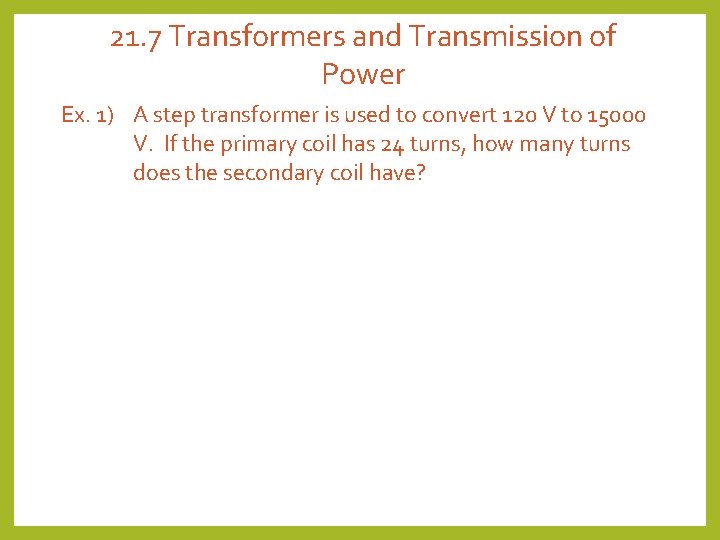
21. 7 Transformers and Transmission of Power Ex. 1) A step transformer is used to convert 120 V to 15000 V. If the primary coil has 24 turns, how many turns does the secondary coil have?
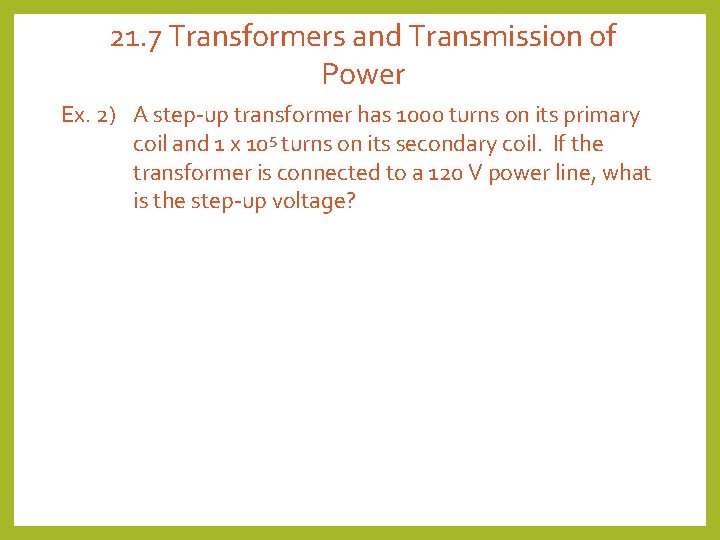
21. 7 Transformers and Transmission of Power Ex. 2) A step-up transformer has 1000 turns on its primary coil and 1 x 10⁵ turns on its secondary coil. If the transformer is connected to a 120 V power line, what is the step-up voltage?
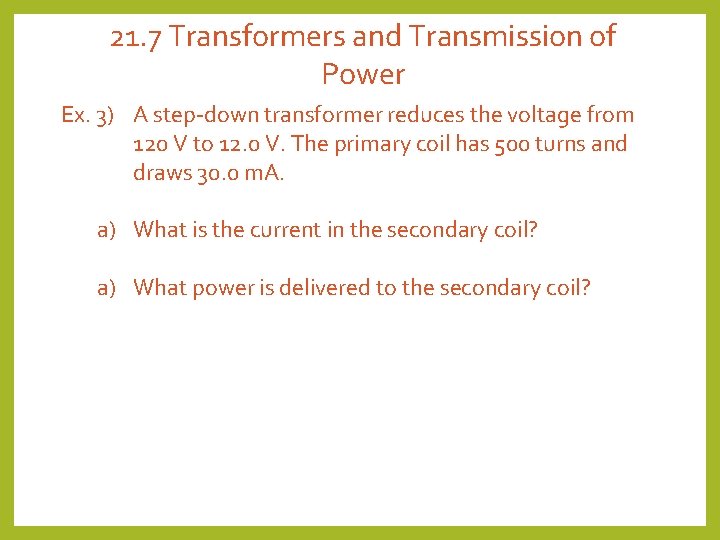
21. 7 Transformers and Transmission of Power Ex. 3) A step-down transformer reduces the voltage from 120 V to 12. 0 V. The primary coil has 500 turns and draws 30. 0 m. A. a) What is the current in the secondary coil? a) What power is delivered to the secondary coil?
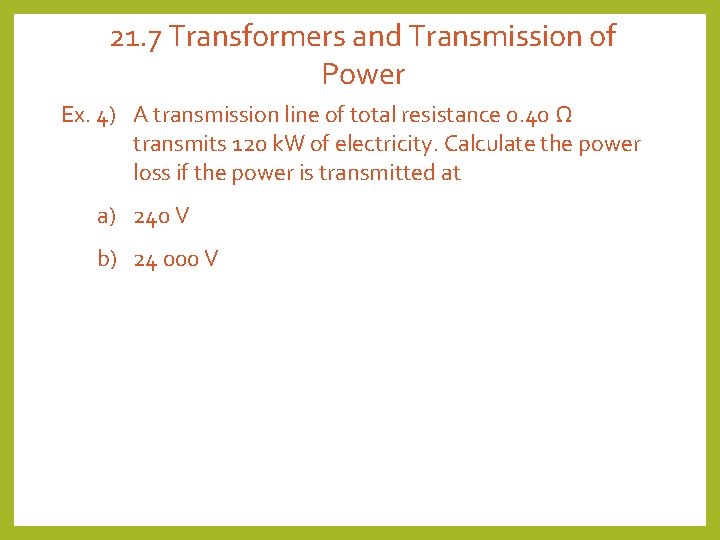
21. 7 Transformers and Transmission of Power Ex. 4) A transmission line of total resistance 0. 40 Ω transmits 120 k. W of electricity. Calculate the power loss if the power is transmitted at a) 240 V b) 24 000 V
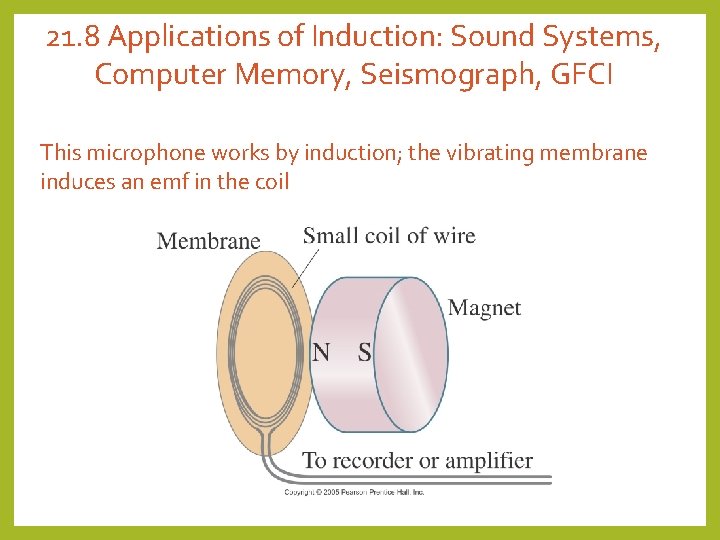
21. 8 Applications of Induction: Sound Systems, Computer Memory, Seismograph, GFCI This microphone works by induction; the vibrating membrane induces an emf in the coil
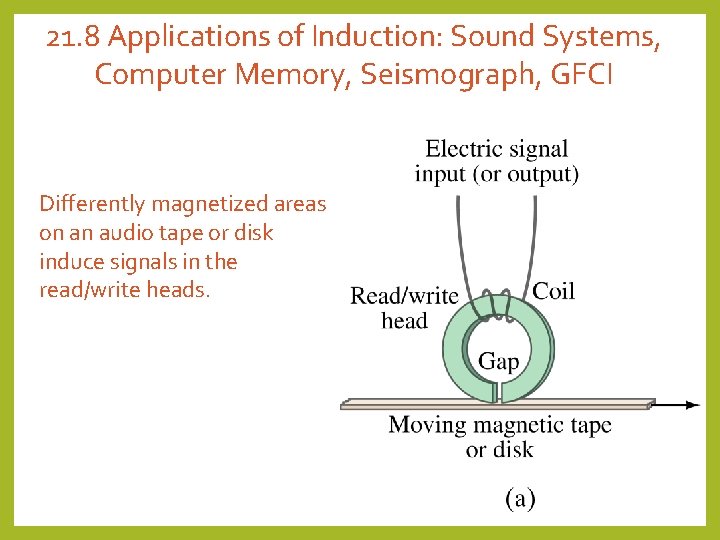
21. 8 Applications of Induction: Sound Systems, Computer Memory, Seismograph, GFCI Differently magnetized areas on an audio tape or disk induce signals in the read/write heads.
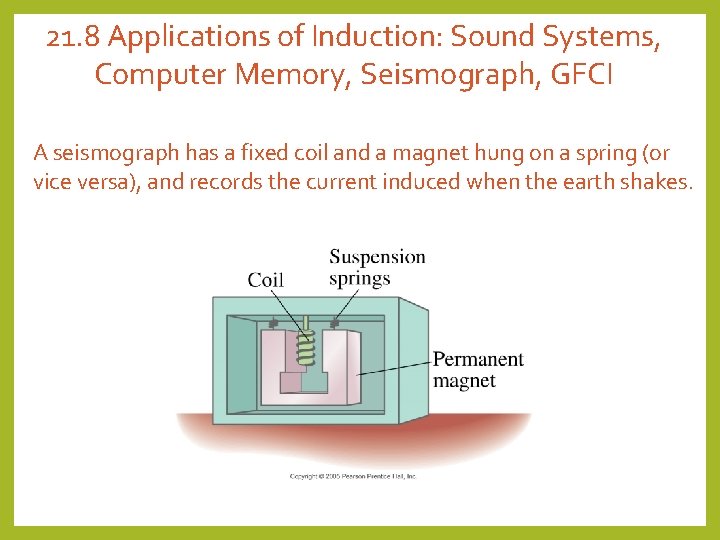
21. 8 Applications of Induction: Sound Systems, Computer Memory, Seismograph, GFCI A seismograph has a fixed coil and a magnet hung on a spring (or vice versa), and records the current induced when the earth shakes.
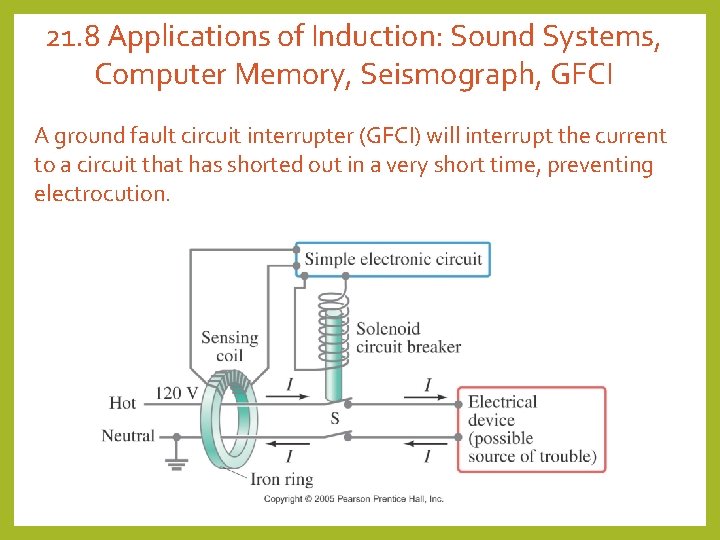
21. 8 Applications of Induction: Sound Systems, Computer Memory, Seismograph, GFCI A ground fault circuit interrupter (GFCI) will interrupt the current to a circuit that has shorted out in a very short time, preventing electrocution.