
Applications of Exponential Function Compound Interest One of
- Slides: 10
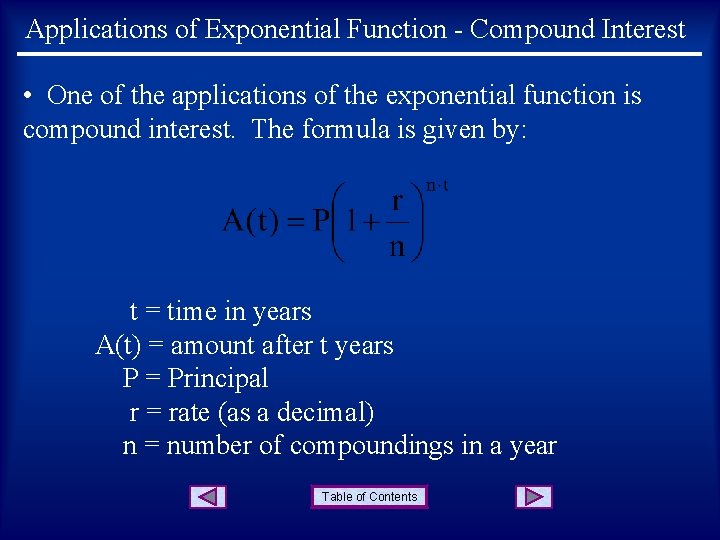
Applications of Exponential Function - Compound Interest • One of the applications of the exponential function is compound interest. The formula is given by: t = time in years A(t) = amount after t years P = Principal r = rate (as a decimal) n = number of compoundings in a year Table of Contents
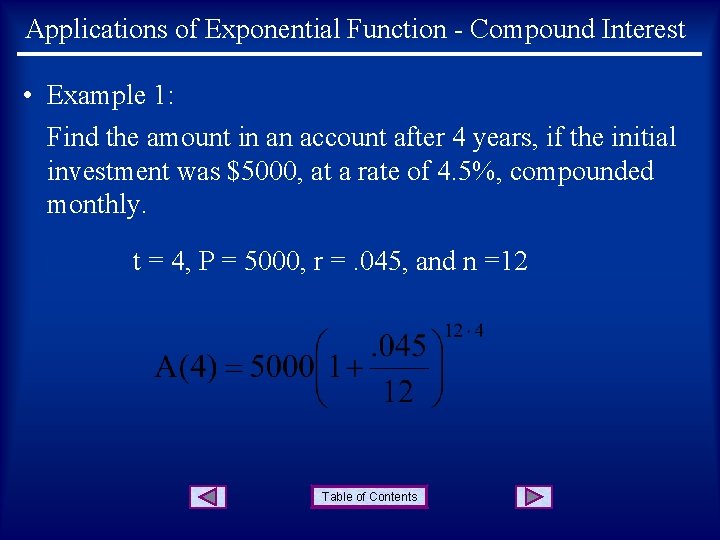
Applications of Exponential Function - Compound Interest • Example 1: Find the amount in an account after 4 years, if the initial investment was $5000, at a rate of 4. 5%, compounded monthly. t = 4, P = 5000, r =. 045, and n =12 Table of Contents
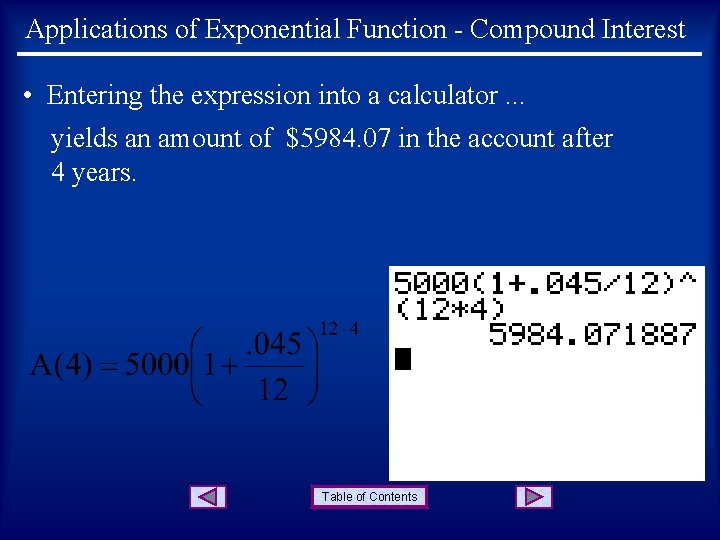
Applications of Exponential Function - Compound Interest • Entering the expression into a calculator. . . yields an amount of $5984. 07 in the account after 4 years. Table of Contents
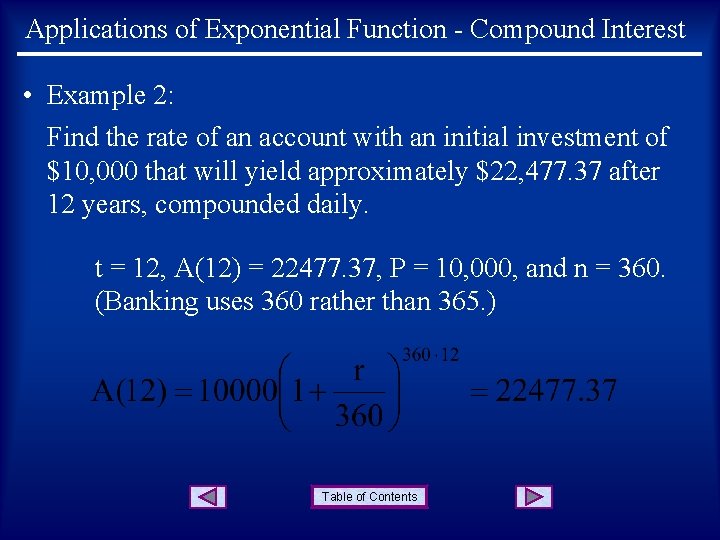
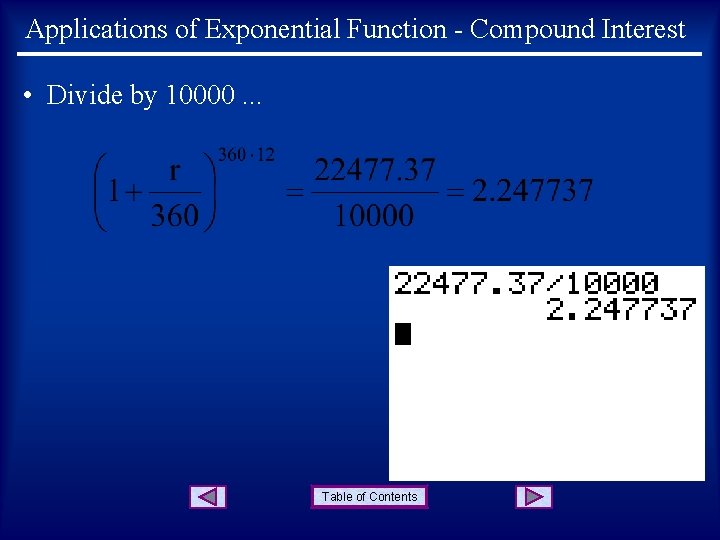
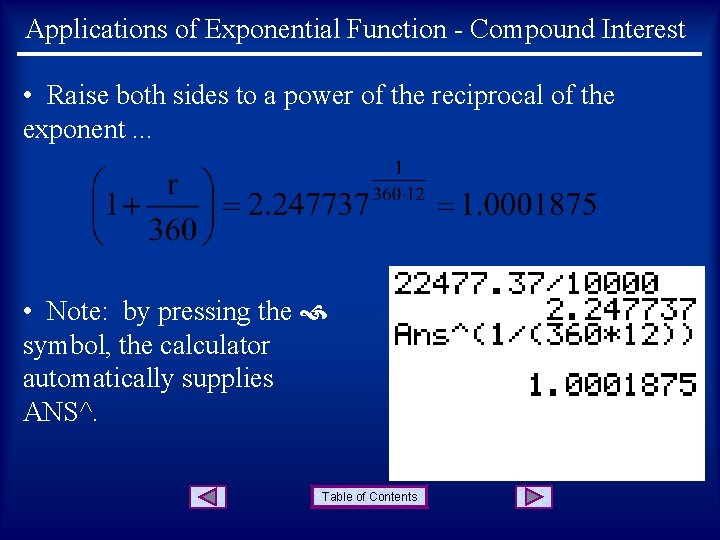
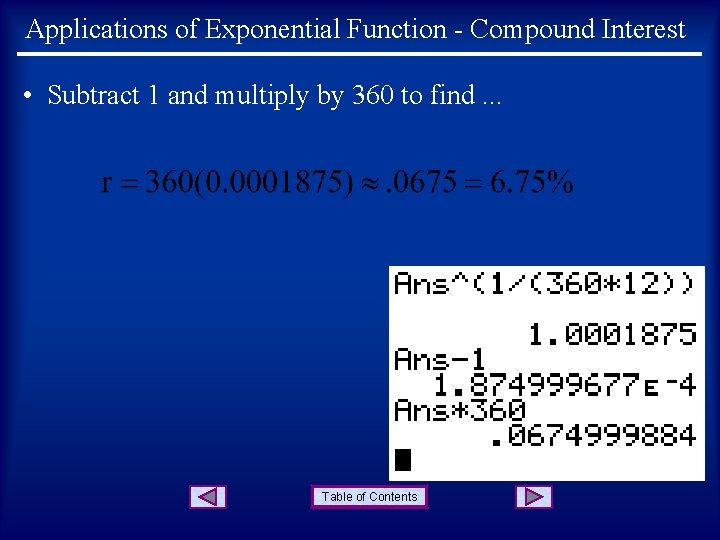
Applications of Exponential Function - Compound Interest • Example 2: Find the rate of an account with an initial investment of $10, 000 that will yield approximately $22, 477. 37 after 12 years, compounded daily. t = 12, A(12) = 22477. 37, P = 10, 000, and n = 360. (Banking uses 360 rather than 365. ) Table of Contents
Applications of Exponential Function - Compound Interest • Divide by 10000. . . Table of Contents
Applications of Exponential Function - Compound Interest • Raise both sides to a power of the reciprocal of the exponent. . . • Note: by pressing the symbol, the calculator automatically supplies ANS^. Table of Contents
Applications of Exponential Function - Compound Interest • Subtract 1 and multiply by 360 to find. . . Table of Contents
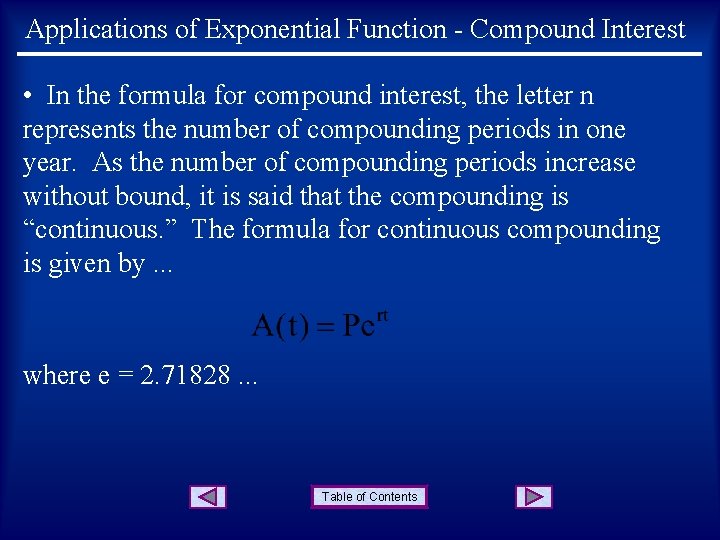
Applications of Exponential Function - Compound Interest • In the formula for compound interest, the letter n represents the number of compounding periods in one year. As the number of compounding periods increase without bound, it is said that the compounding is “continuous. ” The formula for continuous compounding is given by. . . where e = 2. 71828. . . Table of Contents
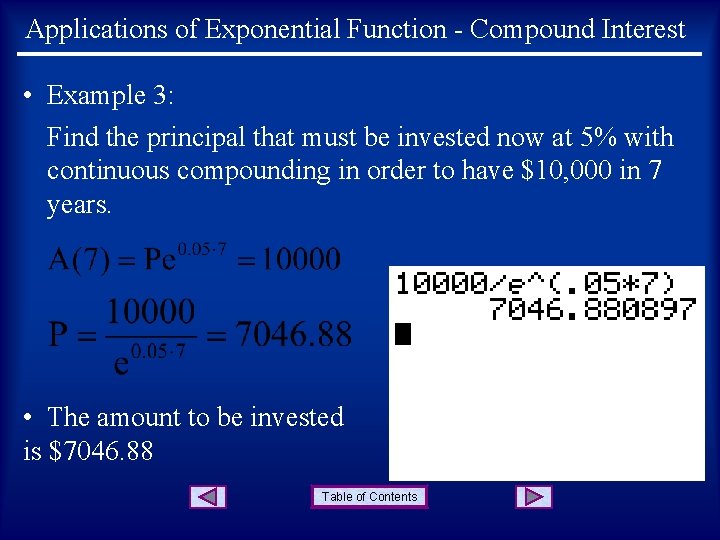
Applications of Exponential Function - Compound Interest • Example 3: Find the principal that must be invested now at 5% with continuous compounding in order to have $10, 000 in 7 years. • The amount to be invested is $7046. 88 Table of Contents
Applications of Exponential Function - Compound Interest Table of Contents