
Applications of Electromagnetic Waves By Dr Sadekar H
Applications of Electromagnetic Waves By Dr. Sadekar H. K. Head, Department of Physics Arts, Commerce and Science College, Sonai
Electromagnetic Waves… Electromagnetic waves are formed when an electric field comes in contact with a magnetic field. n It can be shown from maxwell’s equations that electric and magnetic fields are perpendicular to each other and to the direction of propagation. n Do not need matter to transfer energy. n
Electromagnetic Waves… n EM waves can travel through space by transferring energy between vibrating electric and magnetic fields. n In 1887 Henrich Hertz, a German physicist produced first man-made electromagnetic waves.
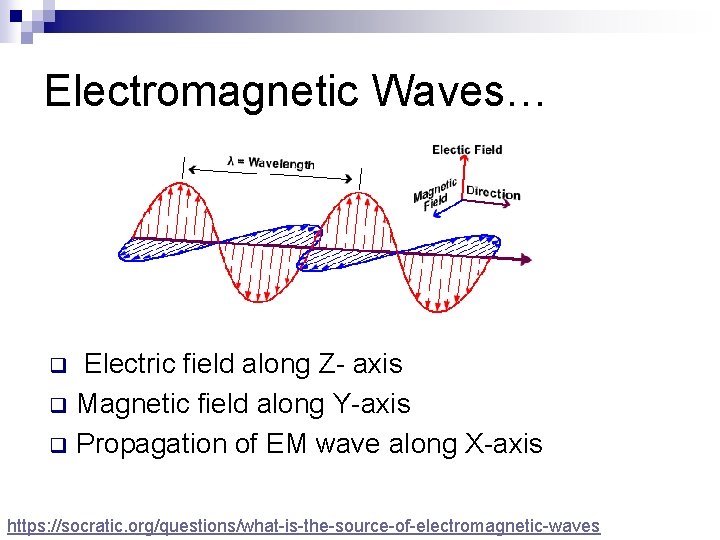
Electromagnetic Waves… Electric field along Z- axis q Magnetic field along Y-axis q Propagation of EM wave along X-axis q https: //socratic. org/questions/what-is-the-source-of-electromagnetic-waves
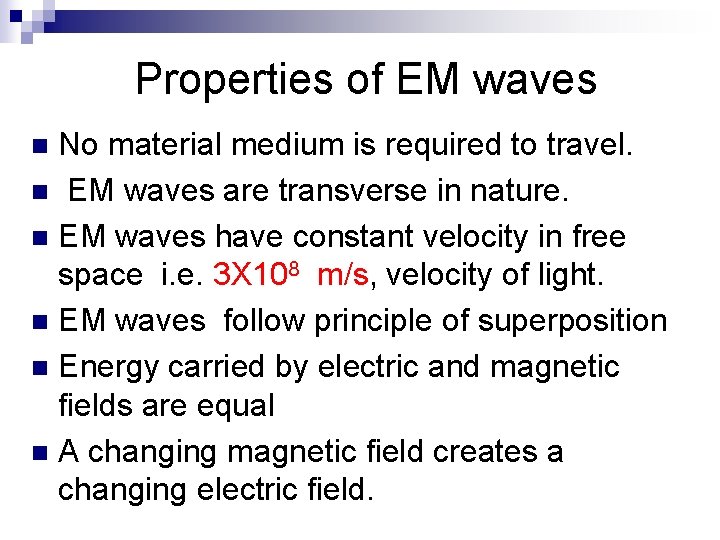
Properties of EM waves No material medium is required to travel. n EM waves are transverse in nature. n EM waves have constant velocity in free space i. e. 3 X 10⁸ m/s, velocity of light. n EM waves follow principle of superposition n Energy carried by electric and magnetic fields are equal n A changing magnetic field creates a changing electric field. n
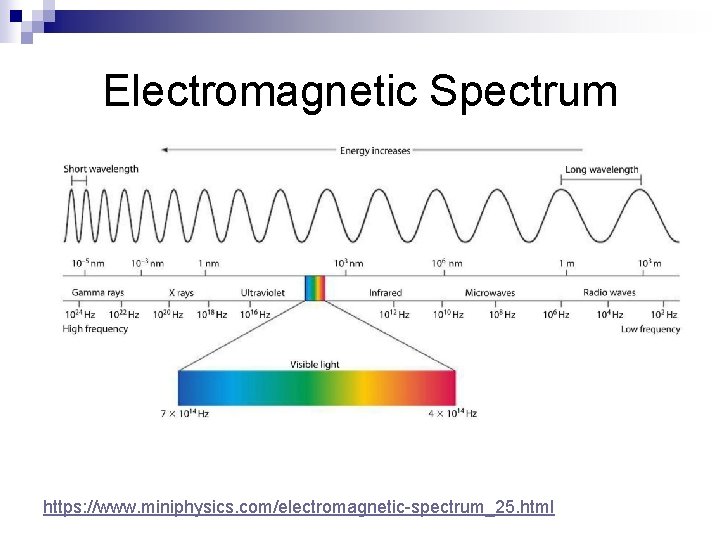
Electromagnetic Spectrum https: //www. miniphysics. com/electromagnetic-spectrum_25. html
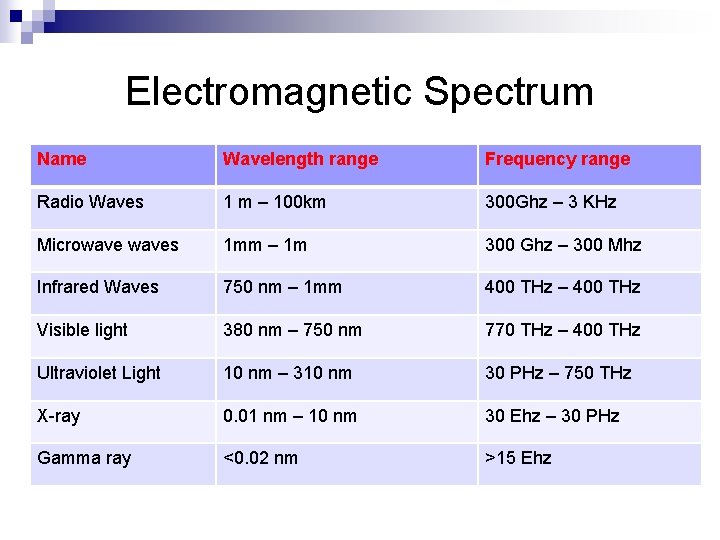
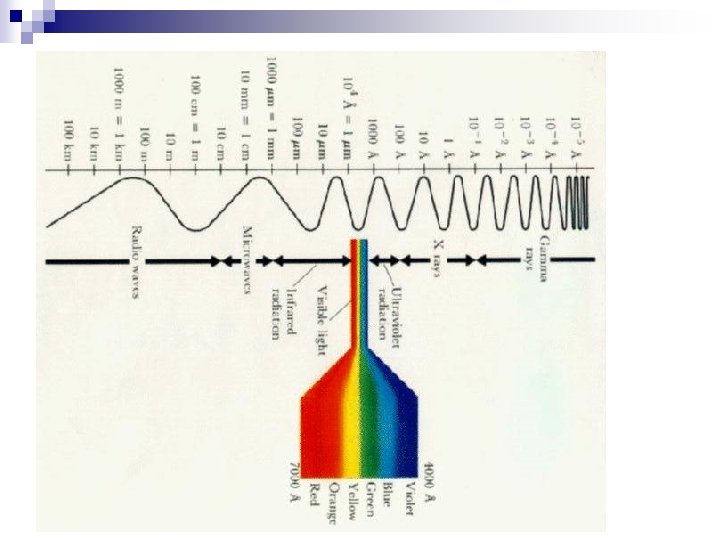
Electromagnetic Spectrum Name Wavelength range Frequency range Radio Waves 1 m – 100 km 300 Ghz – 3 KHz Microwaves 1 mm – 1 m 300 Ghz – 300 Mhz Infrared Waves 750 nm – 1 mm 400 THz – 400 THz Visible light 380 nm – 750 nm 770 THz – 400 THz Ultraviolet Light 10 nm – 310 nm 30 PHz – 750 THz X-ray 0. 01 nm – 10 nm 30 Ehz – 30 PHz Gamma ray <0. 02 nm >15 Ehz
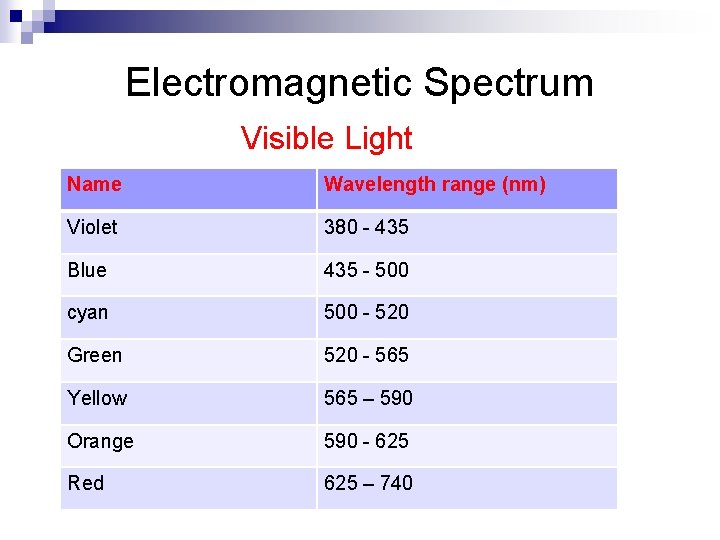
Electromagnetic Spectrum Visible Light Name Wavelength range (nm) Violet 380 - 435 Blue 435 - 500 cyan 500 - 520 Green 520 - 565 Yellow 565 – 590 Orange 590 - 625 Red 625 – 740
Applications of EM Waves EM waves have wide range of frequency. n EM waves carry energy itself. n EM waves occupy prominent places both in our daily lives and in our technology. n Here we have to discuss some applications, in the area of microwave, radiowave, infrared and visible ray region n
Applications of EM Waves Microwave Oven Microwave oven is most familiar as the energy source for cooking food Principle: 1. Generate microwave radiation of appropriate frequency in the working space of the oven where food is kept. 2. The energy is not wasted in heating up the vessel as in conventional method. 3. The energy is directly delivered to water molecules which are shared by the entire food. .
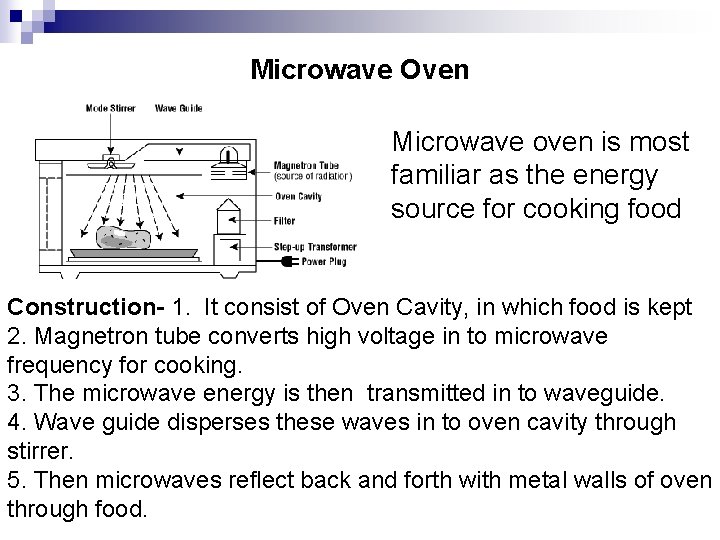
Microwave Oven Microwave oven is most familiar as the energy source for cooking food Construction- 1. It consist of Oven Cavity, in which food is kept 2. Magnetron tube converts high voltage in to microwave frequency for cooking. 3. The microwave energy is then transmitted in to waveguide. 4. Wave guide disperses these waves in to oven cavity through stirrer. 5. Then microwaves reflect back and forth with metal walls of oven through food.

Microwave Oven n n Working – Microwave changes polarity from positive to negative, millions of times in a second. Water is a polar molecule (positive and negative ends). When microwave passes through water content of food, they cause water molecule to rotate at the same frequency of microwave (millions of time in one second). Rotating of the water molecule creates a friction, which heats up the food. Microwave do not interact with molecules of glass, plastic or paper, only the food is heated.
Microwave Oven Characteristics/Advantages n Microwave cooking is more energy efficient and faster than conventional cooking. n Microwave does not reduce the nutritional value of food. n Food with high water content, like fresh vegetables, can be cooked more quickly than other foods. n It cannot make food radioactive or contaminated. n It cooks food from outside to inside.

RADAR n n n RADAR is acronym for Radio Detection And Ranging RADAR is an electromagnetic system, used for sensing, detecting, and locating the object present in the ambience. Used to detect direction, speed, velocity, range, altitude of an object with the help of radio waves Radar find applications in various systems such as Air Traffic Control to track planes both on and off the grounds Used to track satellites
RADAR Principle n n n A short pulse of electromagnetic radiation (radio wave) is transmitted from a highly, directional antenna. When this transmitted radiation hits a distant target, a part is reflected back and echo pulse is picked by receiver The time interval between transmitted and echo pulse provides an accurate measure of the distant target.

RADAR Basic Arrangement n n n Very powerful EM radiation is transmitted from a highly, directional antenna. EM wave then hits target and reflect back, called echo pulse. Echo pulse again received through same antenna and allowed to pass through receiver to display unit. Receiver process this signal and gives information about an object through display unit. Since the same antenna is used for reception echo pulse, duplexer is used. http: //coreel. com/components-of-radio-detecting-and-ranging-radar /
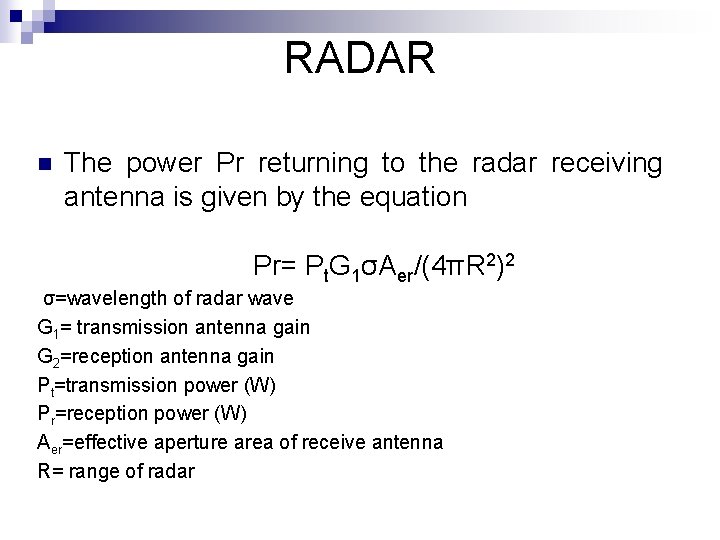
RADAR n The power Pr returning to the radar receiving antenna is given by the equation Pr= Pt. G 1σAer/(4πR 2)2 σ=wavelength of radar wave G 1= transmission antenna gain G 2=reception antenna gain Pt=transmission power (W) Pr=reception power (W) Aer=effective aperture area of receive antenna R= range of radar
RADAR Operating Characteristics n n n Choice of operating frequency: High frequency greater than 109 Hz Pulse duration: For a good range resolution, pulse duration of 1 sec or less is employed. Pulse repetition frequency: For larger range 350 to 10000 cycles/sec. Transmitted Power Output: For maximum distance communication, it is more than 1 MW Maximum Range: Depends upon energy of the transmitted pulse and sensitivity of receiving system
RADAR Basic Types of RADAR n n Primary RADAR: It is also called Primary Surveillance Radar (PSR). It is not target friendly. Transmitter radiates signal in all direction and get reflected back from target. It is used in military applications to detect aircraft or ships. It requires high power signal. It cannot provide lot of information about target, such as size and location with precise accuracy. Secondary RADAR: It is also called secondary Surveillance Radar (SSR). It is a target friendly. Transmitter radiates signal in the direction of target. Target receives this signal and process it through transponder. Then response telegram is generated with different frequency and sends this signal to receiver. This information tells the receiver about the location, altitude, status and many more other useful information. It is used in Aircraft and Ship communication.
RADAR Uses of RADAR n n n Civilian Uses: Air craft and ship communication. Military Uses : To detect and locate hostile targets. Scientific Uses: To guide space vehicles, satellites. Scientists use radar for better study of movement of animals, birds and insects. Remote Sensing and Environment: For detecting weather conditions of the atmosphere. Law Enforcements: Highway police force widely uses radar to measure the vehicle speed for safety regulations.
Pyroelectric Thermometer Pyroelectric thermometer is used to measure high temperatures. n The heat leaving a body by radiation and the wavelength of that radiation are functions of the temperature of the body. n Usually ceramics materials are used for construction of pyroelectric thermometer. n

What is the wavelength & frequency of an EM wave? Wavelength= distance from crest to crest. n Frequency= number of wavelengths that pass a given point in 1 s. n As frequency increases, wavelength becomes…. n
What is the wavelength & frequency of an EM wave? Wavelength= distance from crest to crest. n Frequency= number of wavelengths that pass a given point in 1 s. n As frequency increases, wavelength becomes smaller. n

Can a wave be a particle? n In 1887, Heinrich Hertz discovered that shining light on a metal caused electrons to be ejected.

Can a wave be a particle? In 1887, Heinrich Hertz discovered that shining light on a metal caused electrons to be ejected. n Whether or not electrons were ejected depended upon frequency not the amplitude of the light! Remember energy depends on amplitude. n
Can a wave be a particle? n Years later, Albert Einstein explained Hertz’s discovery: EM waves can behave as a particle called a photon whose energy depends on the frequency of the waves.
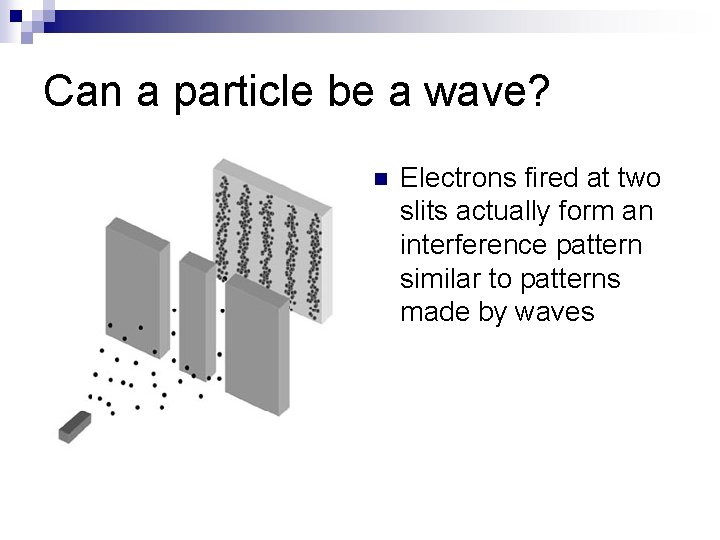
Can a particle be a wave? n Electrons fired at two slits actually form an interference pattern similar to patterns made by waves
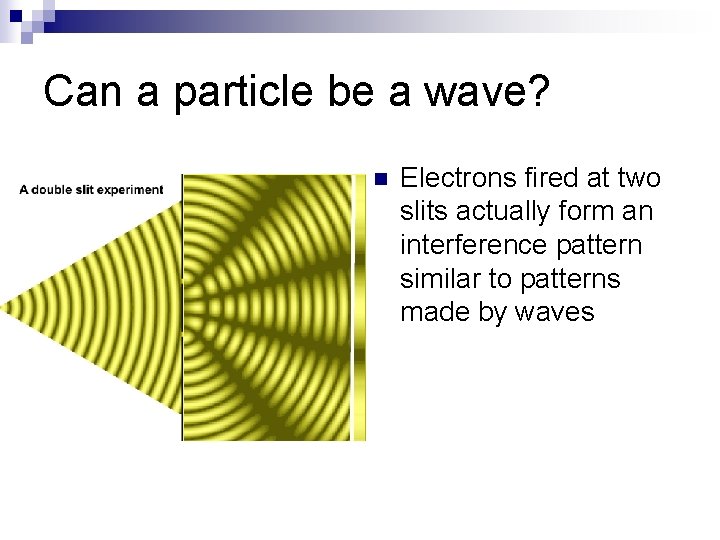
Can a particle be a wave? n Electrons fired at two slits actually form an interference pattern similar to patterns made by waves
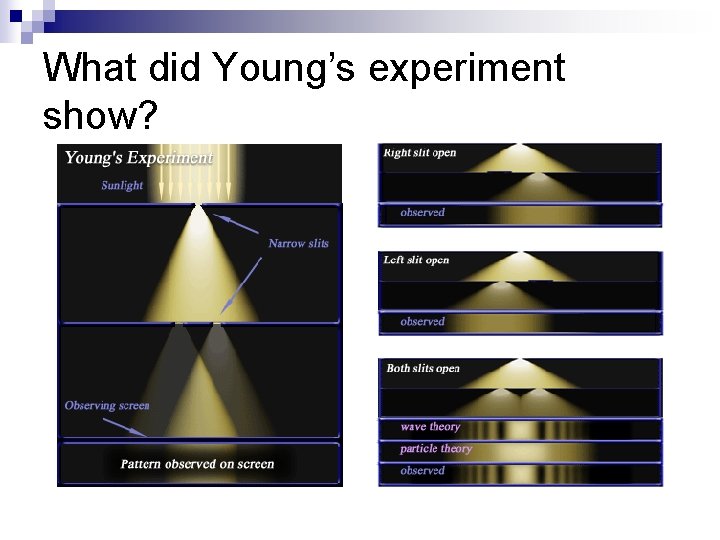
What did Young’s experiment show?
Electromagnetic Waves How they are formed Kind of wave Sometimes behave as
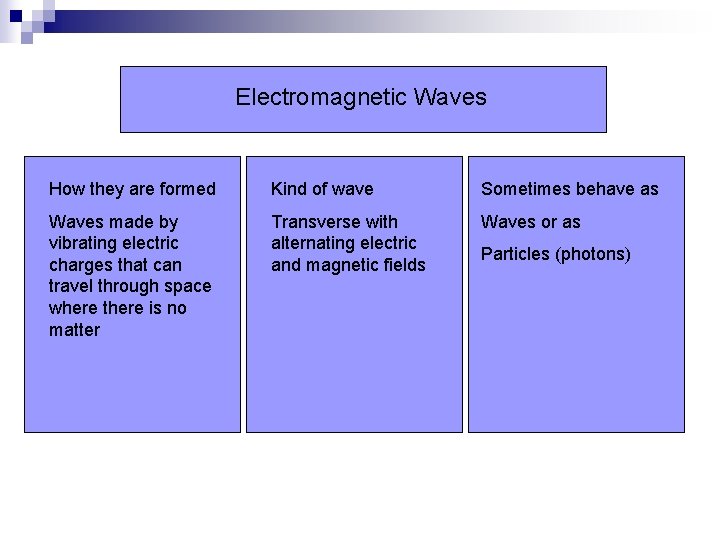
Electromagnetic Waves How they are formed Kind of wave Sometimes behave as Waves made by vibrating electric charges that can travel through space where there is no matter Transverse with alternating electric and magnetic fields Waves or as Particles (photons)
Electromagnetic Waves Section 2 The Electromagnetic Spectrum
The whole range of EM wave… n Frequencies is called the electromagnetic spectrum.
The whole range of EM wave… Frequencies is called the electromagnetic spectrum. n Different parts interact with matter in different ways. n
The whole range of EM wave… Frequencies is called the electromagnetic spectrum. n Different parts interact with matter in different ways. n The ones humans can see are called visible light, a small part of the whole spectrum. n
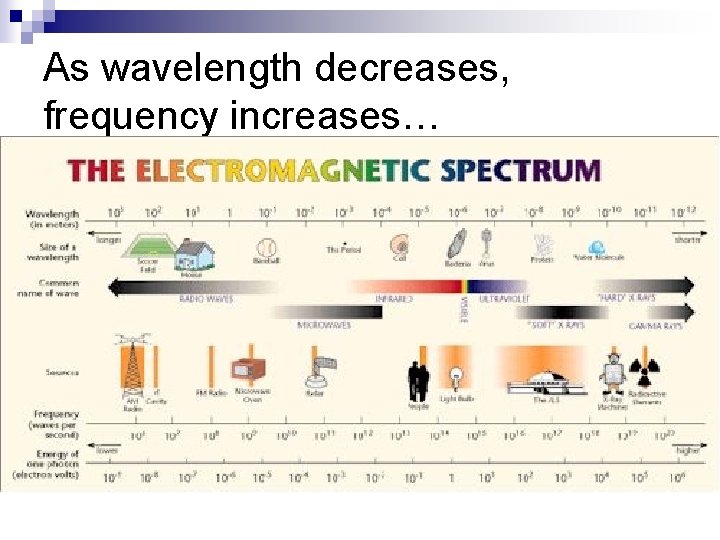
As wavelength decreases, frequency increases…
Devices detect other frequencies: n Antennae of a radio detects radio waves.
Devices detect other frequencies: Antennae of a radio detects radio waves. n Radio waves are low frequency EM waves with wavelengths longer than 1 mm. n
Devices detect other frequencies: Antennae of a radio detects radio waves. n Radio waves are low frequency EM waves with wavelengths longer than 1 mm. n These waves must be turned into sound waves by a radio before you can hear them. n
What are microwaves? n Microwaves are radio waves with wavelengths less than 30 cm and higher frequency & shorter wavelength.
What are microwaves? Microwaves are radio waves with wavelengths less than 30 cm and higher frequency & shorter wavelength. n Cell phones and satellites use microwaves between 1 cm & 20 cm for communication. n

What are microwaves? n n n Microwaves are radio waves with wavelengths less than 30 cm and higher frequency & shorter wavelength. Cell phones and satellites use microwaves between 1 cm & 20 cm for communication. In microwave ovens, a vibrating electric field causes water molecules to rotate billions of times per second causing friction, creating TE which heats the food.

How does radar work? n Radio Detecting And Ranging or radar is used to find position and speed of objects by bouncing radio waves off the object.

What is magnetic resonance imaging? n MRI was developed in the 1980 s to use radio waves to diagnose illnesses with a strong magnet and a radio wave emitter and a receiver. Protons in H atoms of the body act like magnets lining up with the field. This releases energy which the receiver detects and creates a map of the body’s tissues.
Infrared Waves EM with wavelengths between 1 mm & 750 billionths of a meter. n Used daily in remote controls, to read CDROMs n Every objects gives off infrared waves; hotter objects give off more than cooler ones. Satellites can ID types of plants growing in a region with infrared detectors n
Visible Light Range of EM humans can see from 750 billionths to 00 billionths of a meter. n You see different wavelengths as colors. n ¨ Blue has shortest ¨ Red is the longest ¨ Light looks white if all colors are present

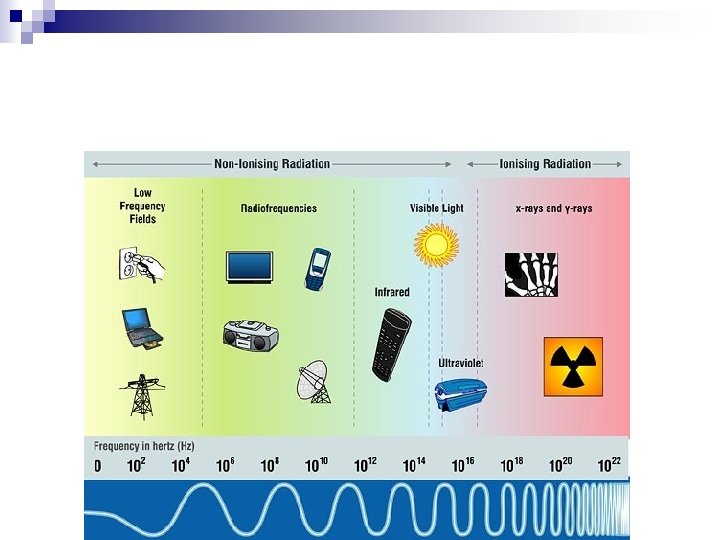
A range of frequencies In order of increasing frequency and decreasing wavelength, the EM spectrum consists of: very long wave radio, used for communication with submarines; long, medium and short wave radio (used for AM broadcasting); FM radio, television and radar; infra-red (heat) radiation, which is recorded in the Earth photographs taken by survey satellites; visible light; ultraviolet light, which, while invisible, stimulates fluorescence in some materials; x rays & gamma rays used in medicine and released in radioactive decay
Ultraviolet Waves EM waves with wavelengths from about 400 billionths to 10 billionths of a meter. n Have enough energy to enter skin cells n ¨ Longer wavelengths – UVA ¨ Shorter wavelengths – UVB rays ¨ Both can cause skin cancer
Can UV radiation be useful? Helps body make vitamin D for healthy bones and teeth n Used to sterilize medical supplies & equip n Detectives use fluorescent powder (absorbs UV & glows) to find fingerprints n
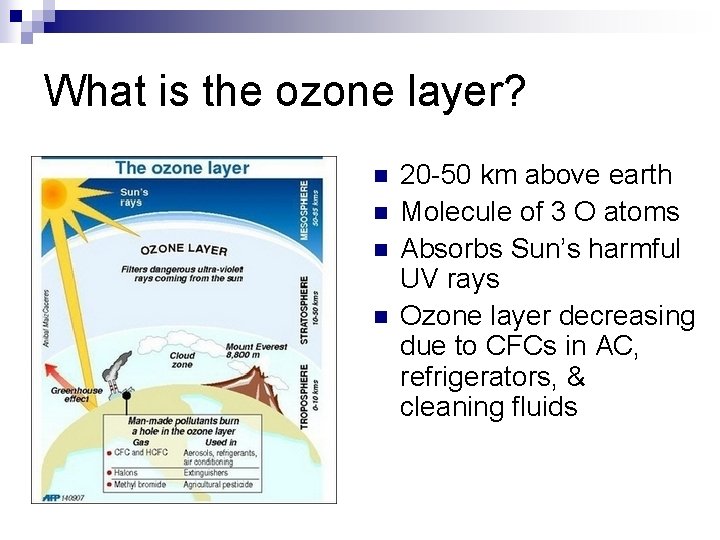
What is the ozone layer? n n 20 -50 km above earth Molecule of 3 O atoms Absorbs Sun’s harmful UV rays Ozone layer decreasing due to CFCs in AC, refrigerators, & cleaning fluids
What could happen to humans… n And other life on Earth if the ozone layer is destroyed?
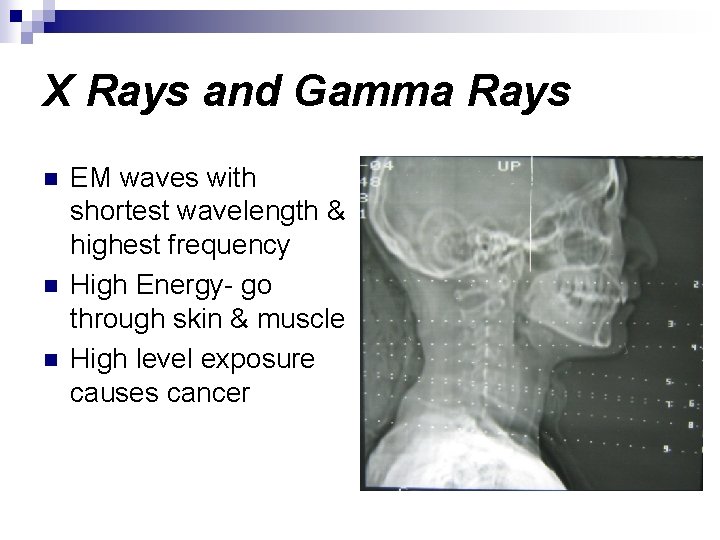
X Rays and Gamma Rays n n n EM waves with shortest wavelength & highest frequency High Energy- go through skin & muscle High level exposure causes cancer
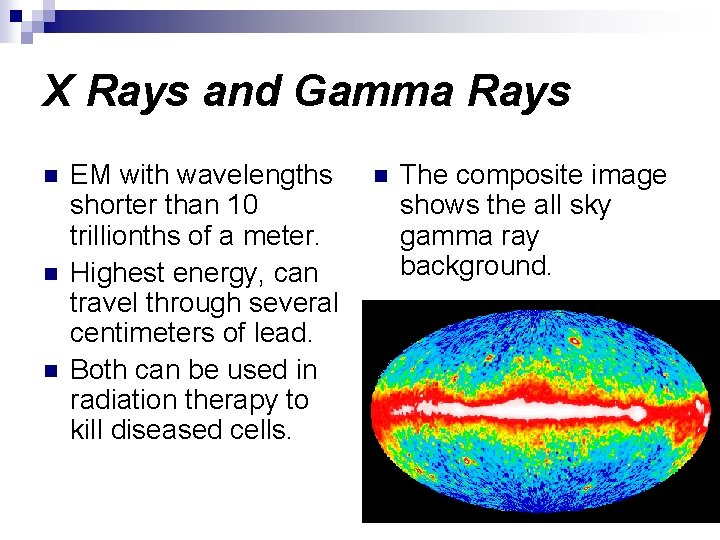
X Rays and Gamma Rays n n n EM with wavelengths shorter than 10 trillionths of a meter. Highest energy, can travel through several centimeters of lead. Both can be used in radiation therapy to kill diseased cells. n The composite image shows the all sky gamma ray background.
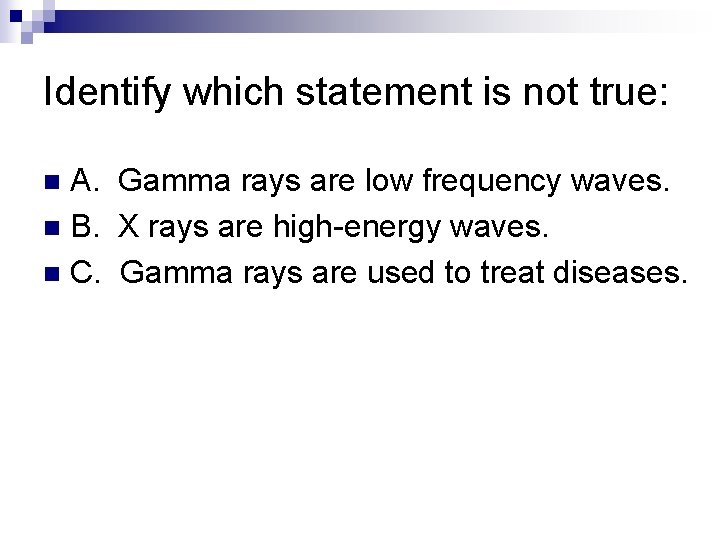
Identify which statement is not true: A. Gamma rays are low frequency waves. n B. X rays are high-energy waves. n C. Gamma rays are used to treat diseases. n
Why do you think MRIs cause. . . n Less harm than X rays?
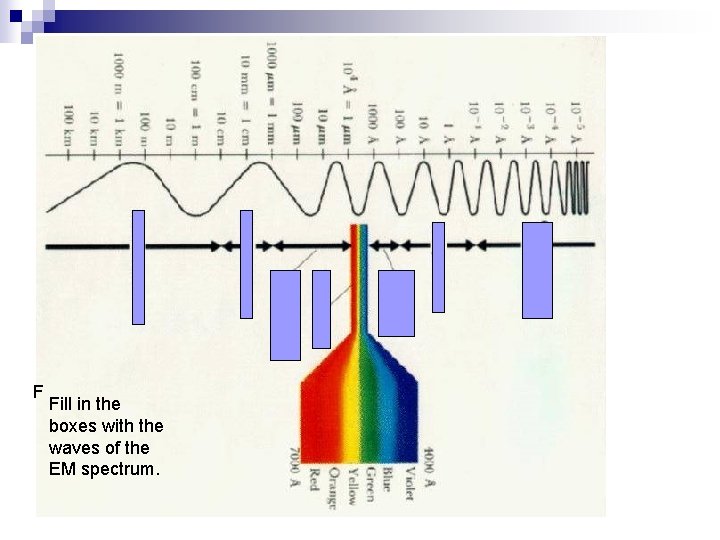
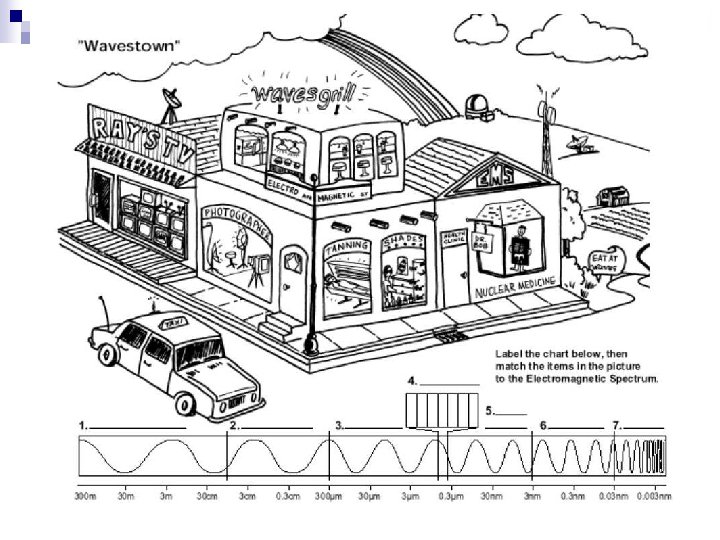
F Fill in the boxes with the waves of the EM spectrum.
Electromagnetic Waves Chp. 12 Section 3 Radio Communication
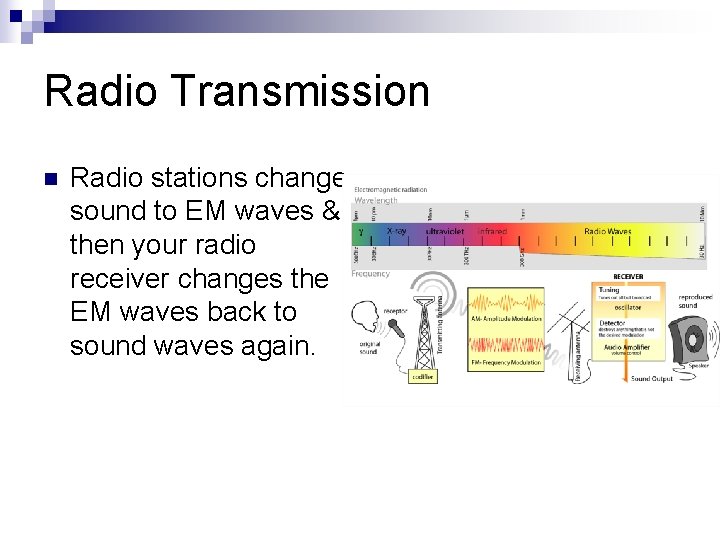
Radio Transmission n Radio stations change sound to EM waves & then your radio receiver changes the EM waves back to sound waves again.

How does a radio receive different stations? Each station broadcasts at a certain frequency which you tune in by choosing their frequency. n Carrier wave- the frequency of the EM wave that a station uses n Microphones convert sound waves to a changing electric current or electronic signal containing the words & music. n
How does a radio receive different stations? Microphones convert sound waves to a changing electric current or electronic signal containing the words & music. n The modified carrier wave vibrates electrons in the station’s antennae creating a radio wave that travels out in all directions at the speed of light to your radio antennae. n
How does a radio receive different stations? n n The modified carrier wave vibrates electrons in the station’s antennae creating a radio wave that travels out in all directions at the speed of light to your radio antennae. The vibrating electrons produce a changing electric current which your radio separates the carrier wave from the signal to make the speakers vibrate creating sound waves….

What is AM radio? In AM amplitude changes but frequency does not. AM frequencies range from 540, 000 Hz to 1, 6000, 000 Hz usually listed in k. Hz.
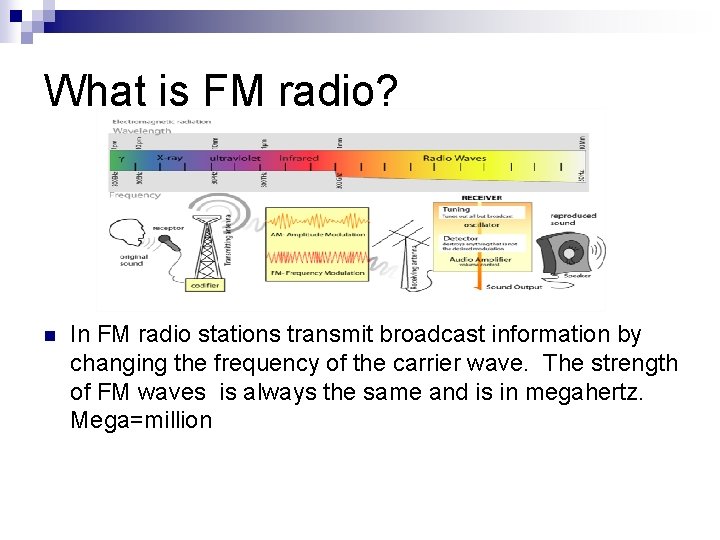
What is FM radio? n In FM radio stations transmit broadcast information by changing the frequency of the carrier wave. The strength of FM waves is always the same and is in megahertz. Mega=million
Television Uses radio waves to send electronic signals in a carrier wave. n Sound is sent by FM; color and brightness is sent at the same time by AM signals. n
What is a cathode-ray tube? Many TVs and computer monitors display images on a CRT, a sealed vacuum tube in which beams of electrons are produced. n Color TV produces 3 electron beams inside the CRT which strike the inside of the screen that is covered with more than 100, 000 rectangular spots. n
What is a cathode-ray tube? There are 3 types of spots, red, green and blue. The electron beams move back and forth across the screen. n The signal from the TV station controls how bright each spot is. Three spots together can form any color. n You see a full color image on the TV. n

Telephones n Sound waves microphone electric signal radio waves transmitted to and from microwave tower receiver electric signal speaker sound wave Mobile Phone BTS Base Transceiver Station BSC Base Station Controller MSC Mobile services Switching Centre VLR Visitor Location Register HLR Home Location Register
How do cordless phones work? Cell phones and cordless telephones are transceivers, device that transmits one signal & receives another radio signal from a base unit. n You can talk and listen at the same time because the two signals are at different frequencies. n
How do pagers work? A pager is a small radio receiver with a phone number. A caller leaves a message at a terminal with a call-back number. n At the terminal, the message is turned into an electronic signal transmitted by radio waves. n Newer pagers can send and receive messages. n

Communications Satellites n Thousands of satellites orbit Earth. A radio or TV station sends microwave signals to the satellite which amplifies the signal and sends it back to a different place on Earth. Satellite uses dif freq to send & receive.
Global Positioning System n GPS is a system of 24 satellites, ground monitoring stations and portable receivers that determine your exact location on Earth. GPS receiver measures the time it takes for radio waves to travel from 4 different satellites to the receiver. The system is owned and operated by the US Dept of Defense, but the microwaves can be used by anyone.
- Slides: 74