
Applications of Circular Motion Newtons 2 nd Law
- Slides: 11
Applications of Circular Motion
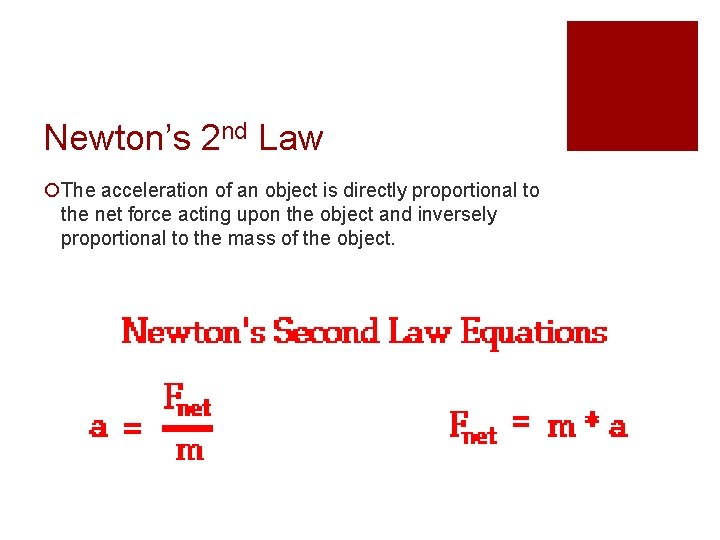
Newton’s 2 nd Law ¡The acceleration of an object is directly proportional to the net force acting upon the object and inversely proportional to the mass of the object.
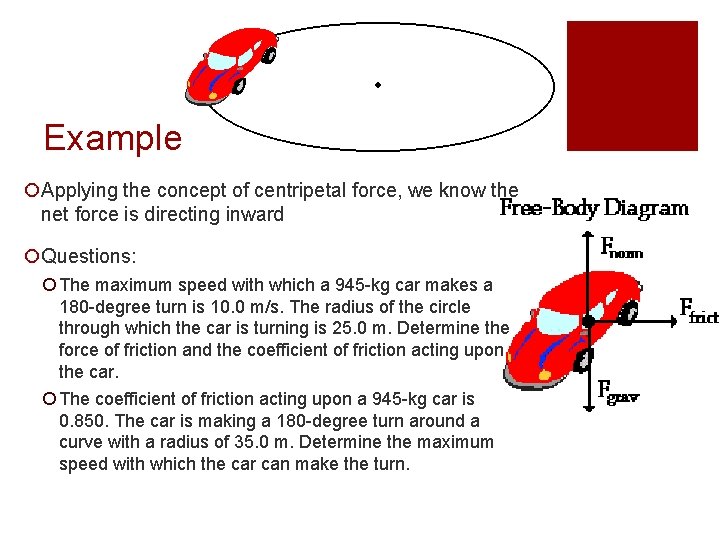
Example ¡Applying the concept of centripetal force, we know the net force is directing inward ¡Questions: ¡ The maximum speed with which a 945 -kg car makes a 180 -degree turn is 10. 0 m/s. The radius of the circle through which the car is turning is 25. 0 m. Determine the force of friction and the coefficient of friction acting upon the car. ¡ The coefficient of friction acting upon a 945 -kg car is 0. 850. The car is making a 180 -degree turn around a curve with a radius of 35. 0 m. Determine the maximum speed with which the car can make the turn.
Tips to Solve Problems 1. Construct a free-body diagram 2. Identify the given and the unknown information 3. If any of the individual forces are directed at angles to the horizontal and vertical, then use vector principles to resolve into horizontal and vertical components. 4. Determine the magnitude of any known forces and label them on the diagram 5. Use circular motion equations to determine the unknown information 6. Use any remaining information to solve for the rest
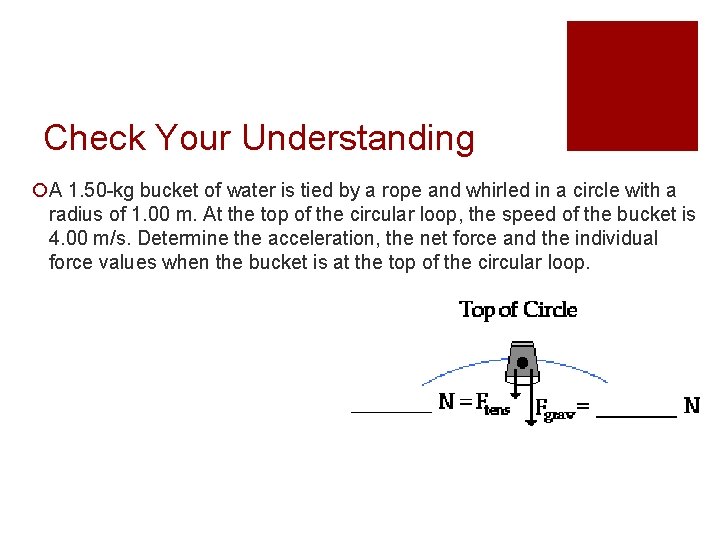
Check Your Understanding ¡A 1. 50 -kg bucket of water is tied by a rope and whirled in a circle with a radius of 1. 00 m. At the top of the circular loop, the speed of the bucket is 4. 00 m/s. Determine the acceleration, the net force and the individual force values when the bucket is at the top of the circular loop.
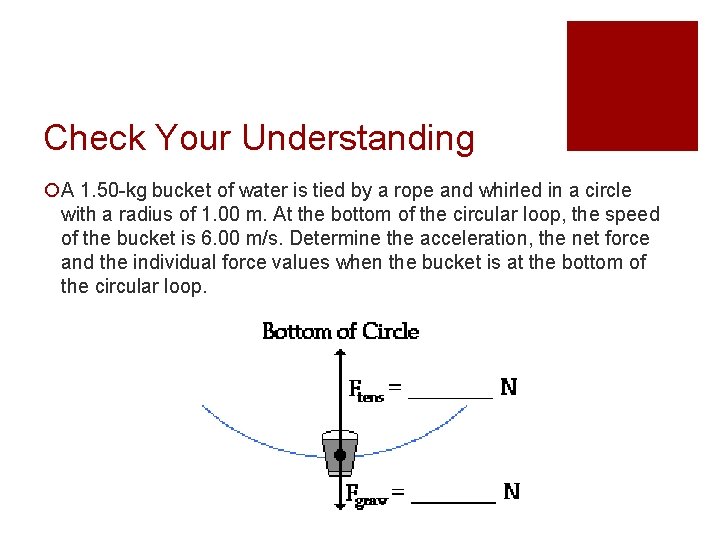
Check Your Understanding ¡A 1. 50 -kg bucket of water is tied by a rope and whirled in a circle with a radius of 1. 00 m. At the bottom of the circular loop, the speed of the bucket is 6. 00 m/s. Determine the acceleration, the net force and the individual force values when the bucket is at the bottom of the circular loop.
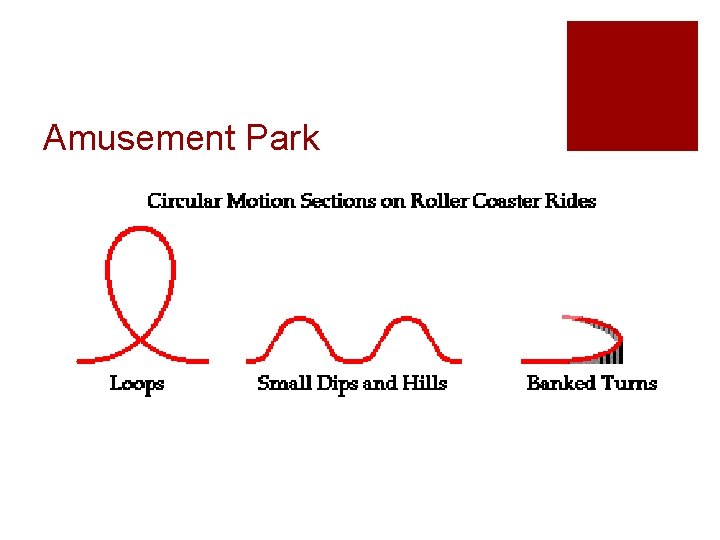
Amusement Park
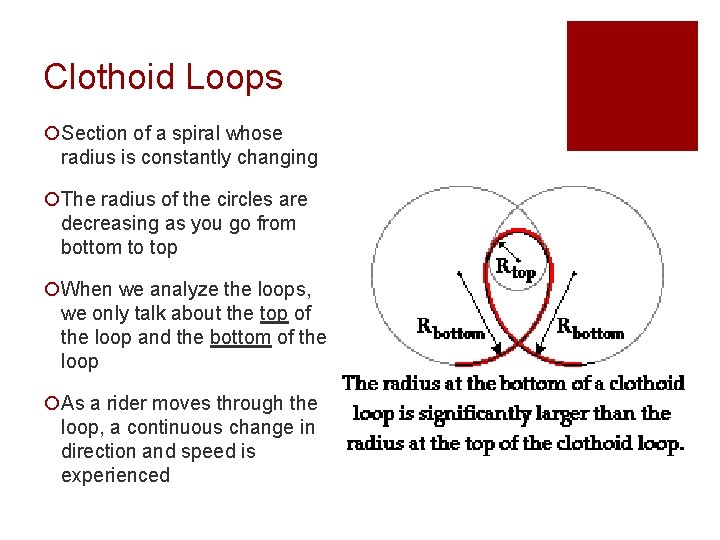
Clothoid Loops ¡Section of a spiral whose radius is constantly changing ¡The radius of the circles are decreasing as you go from bottom to top ¡When we analyze the loops, we only talk about the top of the loop and the bottom of the loop ¡As a rider moves through the loop, a continuous change in direction and speed is experienced
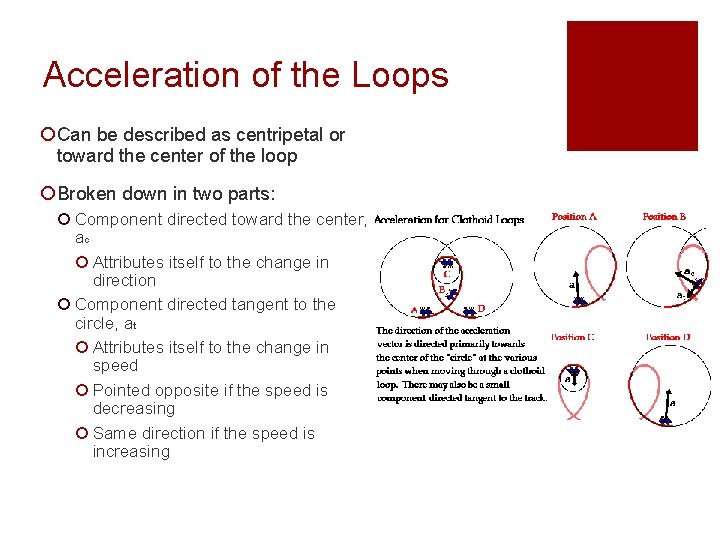
Acceleration of the Loops ¡ Can be described as centripetal or toward the center of the loop ¡ Broken down in two parts: ¡ Component directed toward the center, ac ¡ Attributes itself to the change in direction ¡ Component directed tangent to the circle, at ¡ Attributes itself to the change in speed ¡ Pointed opposite if the speed is decreasing ¡ Same direction if the speed is increasing
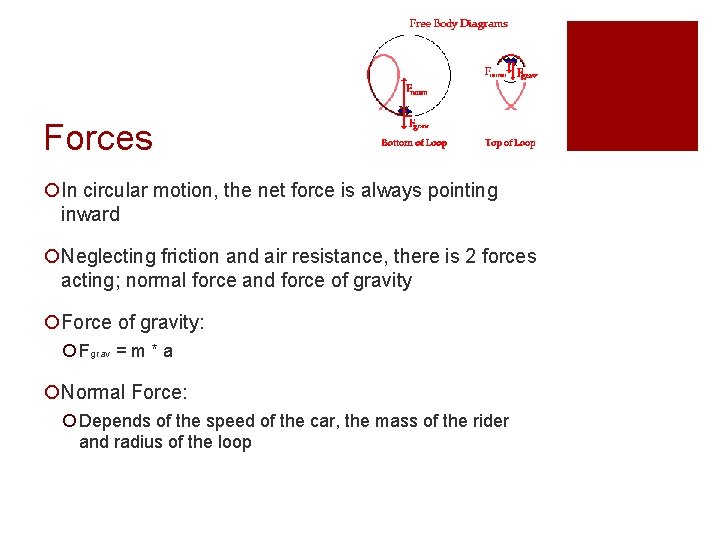
Forces ¡In circular motion, the net force is always pointing inward ¡Neglecting friction and air resistance, there is 2 forces acting; normal force and force of gravity ¡Force of gravity: ¡ Fgrav = m * a ¡Normal Force: ¡ Depends of the speed of the car, the mass of the rider and radius of the loop
Example ¡Anna Litical is riding on The Demon at Great America. Anna experiences a downward acceleration of 15. 6 m/s^2 at the top of the loop and an upward acceleration of 26. 3 m/s^2 at the bottom of the loop. Use Netwon’s second law to determine the normal force acting upon Anna’s 864 kg roller coaster car.