
Applications of CavityEnhanced Direct Frequency Comb Spectroscopy Kevin
Applications of Cavity-Enhanced Direct Frequency Comb Spectroscopy Kevin Cossel Ye Group JILA/University of Colorado-Boulder OSU Symposium on Molecular Spectroscopy 2010
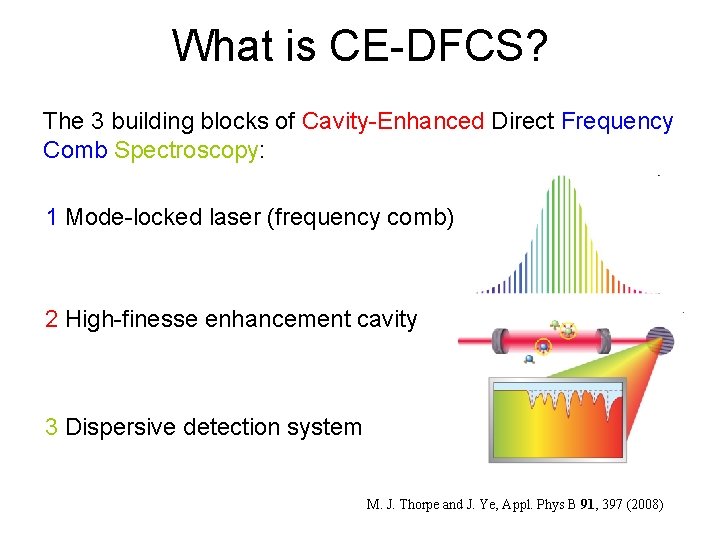
What is CE-DFCS? The 3 building blocks of Cavity-Enhanced Direct Frequency Comb Spectroscopy: 1 Mode-locked laser (frequency comb) 2 High-finesse enhancement cavity 3 Dispersive detection system M. J. Thorpe and J. Ye, Appl. Phys B 91, 397 (2008)

Benefits of frequency combs Single ultrashort pulse Train of pulses from S. T. Cundiff, J. Ye, and J. L. Hall, Scientific American, Apr 2008 Frequency combs provide narrow lines over a wide spectral bandwidth: • High resolution Multi-species detection • Broad bandwidth with high sensitivity in • Rapid acquisition near real time • Spatially coherent
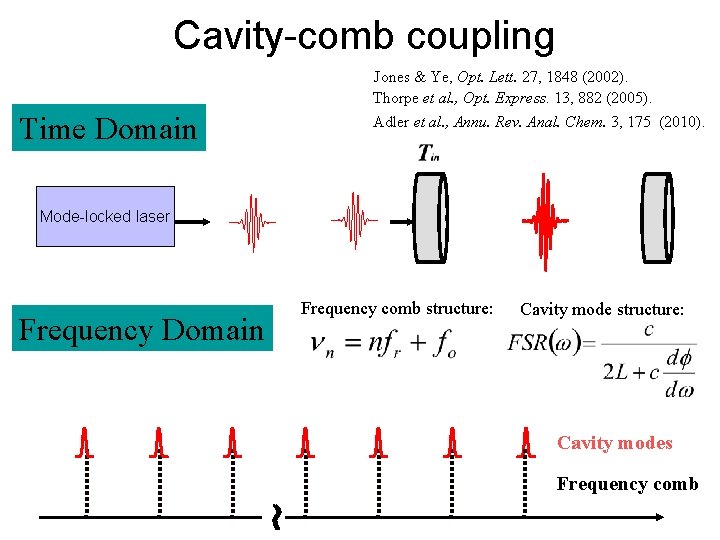
Cavity-comb coupling Time Domain Jones & Ye, Opt. Lett. 27, 1848 (2002). Thorpe et al. , Opt. Express. 13, 882 (2005). Adler et al. , Annu. Rev. Anal. Chem. 3, 175 (2010). Mode-locked laser Frequency Domain Frequency comb structure: Cavity modes Frequency comb
I. Trace contaminant detection
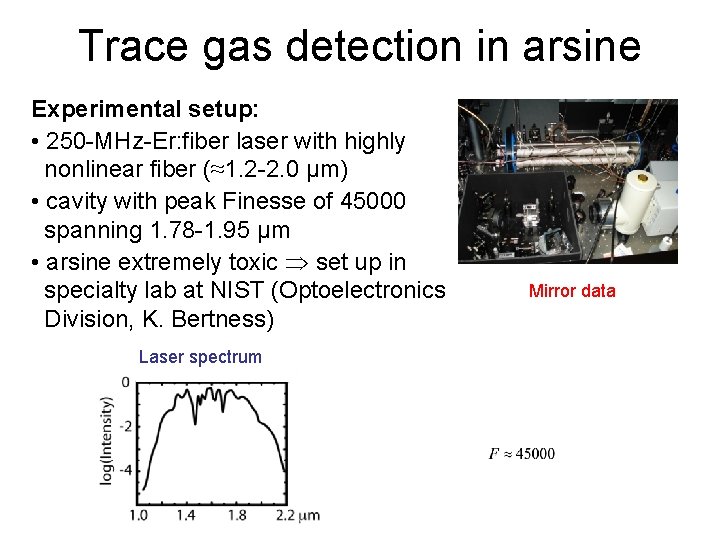
Trace gas detection in arsine Experimental setup: • 250 -MHz-Er: fiber laser with highly nonlinear fiber (≈1. 2 -2. 0 µm) • cavity with peak Finesse of 45000 spanning 1. 78 -1. 95 µm • arsine extremely toxic set up in specialty lab at NIST (Optoelectronics Division, K. Bertness) Laser spectrum Mirror data
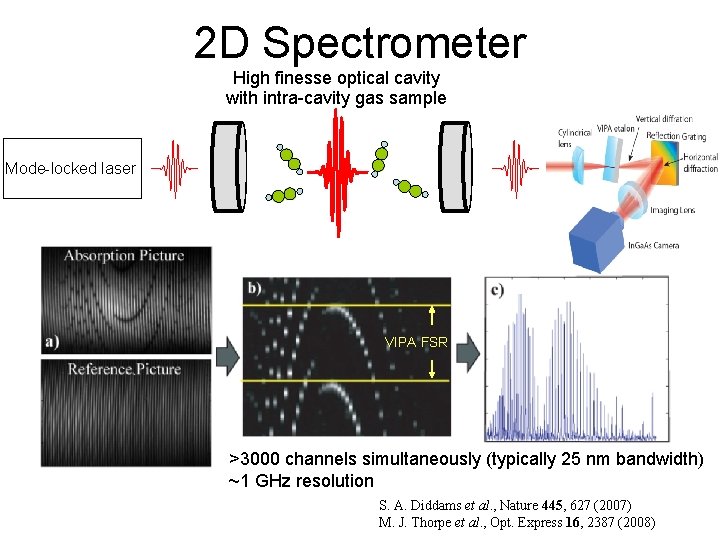
2 D Spectrometer High finesse optical cavity with intra-cavity gas sample VIPA spectrometer Mode-locked laser VIPA FSR >3000 channels simultaneously (typically 25 nm bandwidth) ~1 GHz resolution S. A. Diddams et al. , Nature 445, 627 (2007) M. J. Thorpe et al. , Opt. Express 16, 2387 (2008)
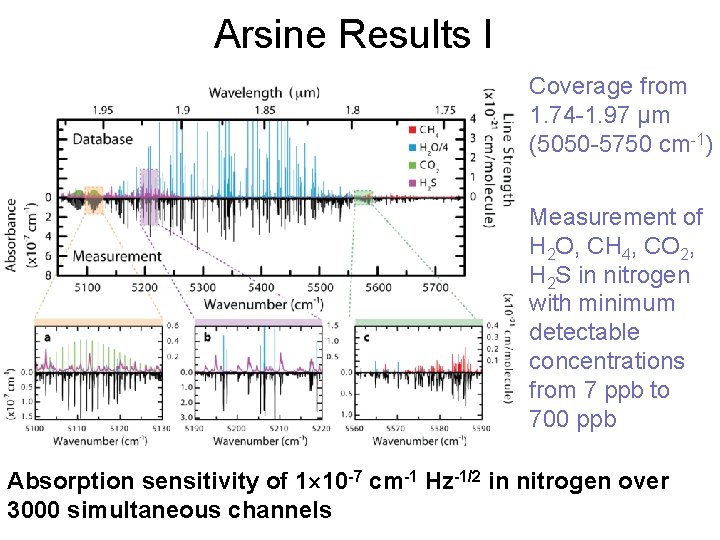
Arsine Results I Coverage from 1. 74 -1. 97 µm (5050 -5750 cm-1) Measurement of H 2 O, CH 4, CO 2, H 2 S in nitrogen with minimum detectable concentrations from 7 ppb to 700 ppb Absorption sensitivity of 1 10 -7 cm-1 Hz-1/2 in nitrogen over 3000 simultaneous channels
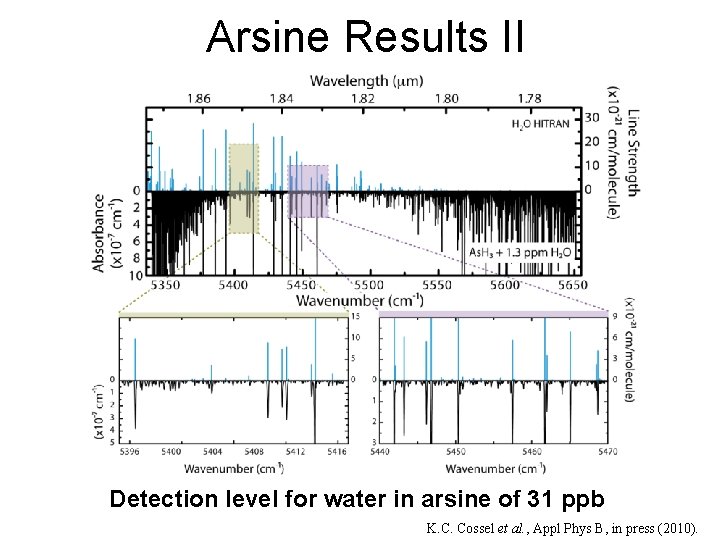
Arsine Results II Detection level for water in arsine of 31 ppb K. C. Cossel et al. , Appl Phys B, in press (2010).
II. Breath Analysis
Application: breath analysis Medical research has (maybe) identified many molecules as markers for certain diseases in breath. Our focus: lung cancer & COPD Collaborators: CU Medical School (O. Reiss, J. Repine) CU Cancer Center (N. Peled) Samples: from cell cultures, rats, and humans What are the challenges? • many molecules present in breath samples • complex molecules have “messy” spectra • recognize molecule spectra • bottom line: Can we definitely link certain molecules to cancer?
Application: breath analysis Why use comb spectroscopy? • simultaneous detection of multiple molecule species (generate marker pattern!) • high sensitivity (fundamental mid-IR band!) • fast acquisition (compared to GC-MS) • high resolution (separate mixtures) Develop CE-DFCS system in the mid-IR First test with NIR comb: M. J. Thorpe et al. , Opt. Express 16, 2387 (2008)
III. Atmospheric Chemistry
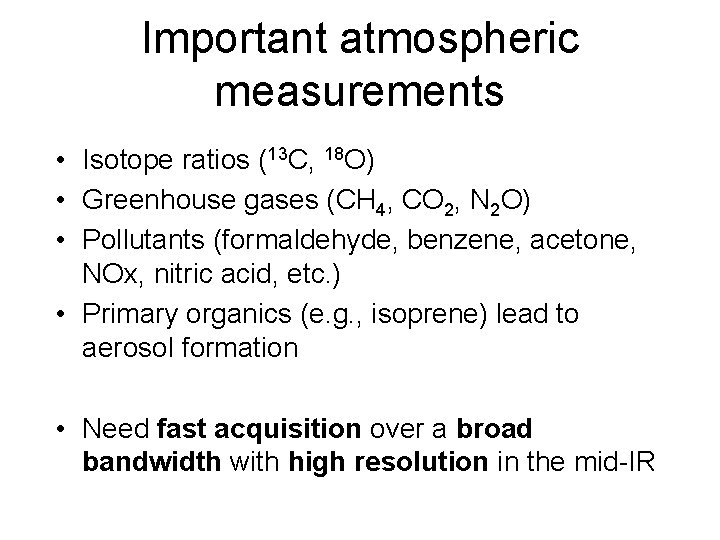
Important atmospheric measurements • Isotope ratios (13 C, 18 O) • Greenhouse gases (CH 4, CO 2, N 2 O) • Pollutants (formaldehyde, benzene, acetone, NOx, nitric acid, etc. ) • Primary organics (e. g. , isoprene) lead to aerosol formation • Need fast acquisition over a broad bandwidth with high resolution in the mid-IR
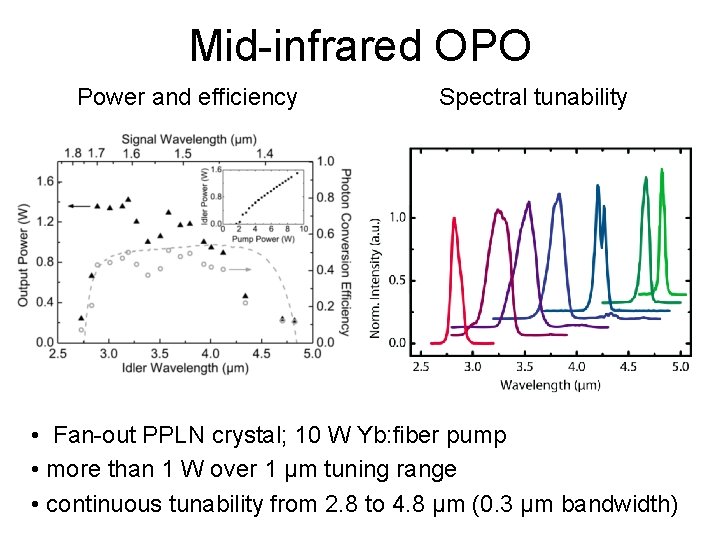
Mid-infrared OPO Power and efficiency Spectral tunability • Fan-out PPLN crystal; 10 W Yb: fiber pump • more than 1 W over 1 µm tuning range • continuous tunability from 2. 8 to 4. 8 µm (0. 3 µm bandwidth)
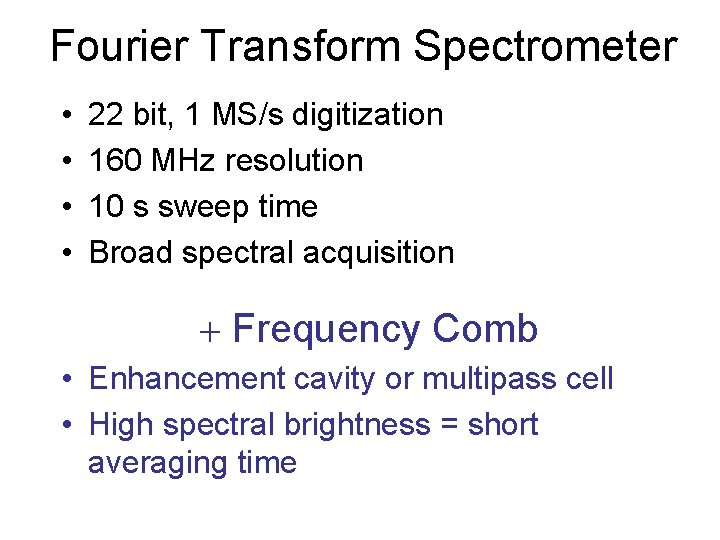
Fourier Transform Spectrometer • • 22 bit, 1 MS/s digitization 160 MHz resolution 10 s sweep time Broad spectral acquisition Frequency Comb • Enhancement cavity or multipass cell • High spectral brightness = short averaging time
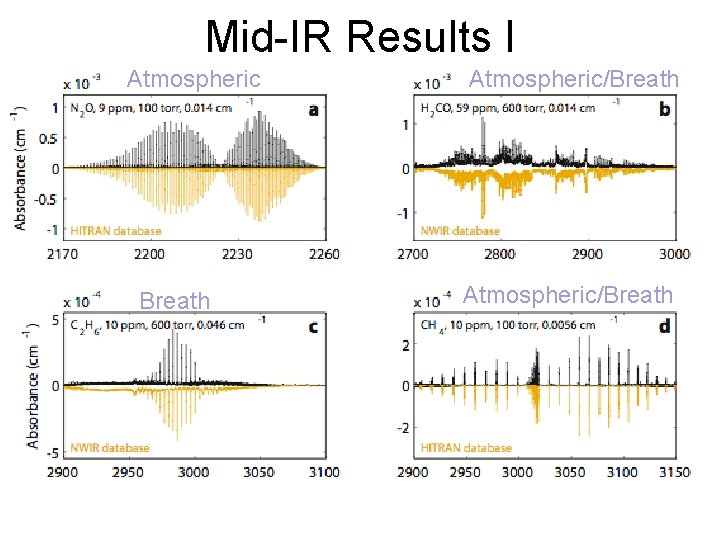
Mid-IR Results I Atmospheric Breath Atmospheric/Breath
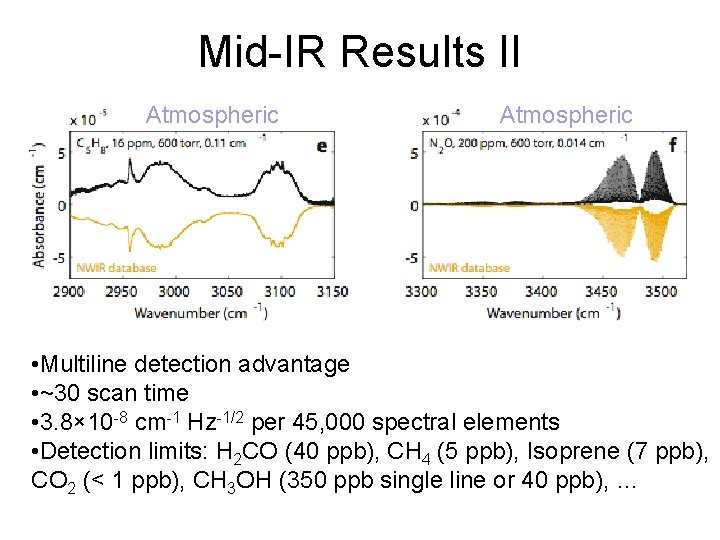
Mid-IR Results II Atmospheric • Multiline detection advantage • ~30 scan time • 3. 8× 10 -8 cm-1 Hz-1/2 per 45, 000 spectral elements • Detection limits: H 2 CO (40 ppb), CH 4 (5 ppb), Isoprene (7 ppb), CO 2 (< 1 ppb), CH 3 OH (350 ppb single line or 40 ppb), …
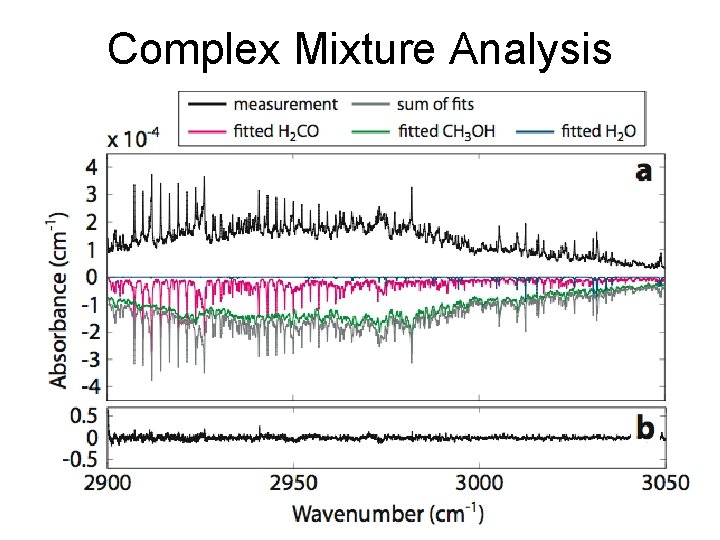
Complex Mixture Analysis
Summary • CE-DFCS provides a unique combination of broad bandwidth, high resolution, high sensitivity and rapid data acquisition • Detection of many species and complex mixtures in near real time Collaborations: Scott Diddams (NIST) Martin Fermann (IMRA) Ingmar Hartl (IMRA) Axel Ruehl (IMRA) Ronald Holzwarth (Menlo) Kris Bertness (NIST - Arsine) Jun Feng (Matheson - Arsine) Mark Raynor (Matheson -Arsine) Miao Zhu (Agilent) Funding: NSF, AFOSR, NIST, DARPA, DTRA, Agilent CE-DFCS: Mike Thorpe Florian Adler Piotr Maslowski Aleksandra Foltynowicz Travis Briles Kevin Moll David Balslev-Clausen Matt Kirchner
- Slides: 20