
Applications in Nuclear Medicine and Radiology Professor Bob

Applications in Nuclear Medicine and Radiology Professor Bob Ott Institute of Cancer Research and Royal Marsden Hospital

Topics • • Digital x-ray imaging Fast CT scanning SPECT scanners for small animals SPECT/CT scanning PET scanners for small animals New crystals for PET and SPECT Active pixel sensors in medical imaging
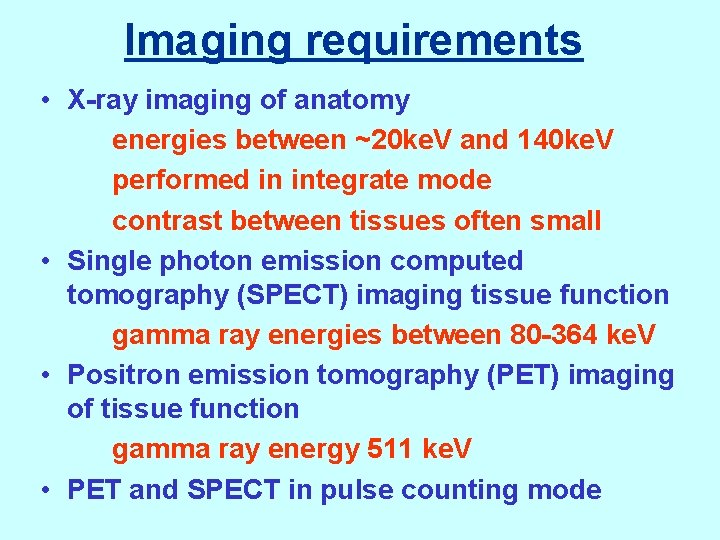
Imaging requirements • X-ray imaging of anatomy energies between ~20 ke. V and 140 ke. V performed in integrate mode contrast between tissues often small • Single photon emission computed tomography (SPECT) imaging tissue function gamma ray energies between 80 -364 ke. V • Positron emission tomography (PET) imaging of tissue function gamma ray energy 511 ke. V • PET and SPECT in pulse counting mode

Digital planar X-ray imaging • Systems have been based on the use of: storage phosphor plates flat panel detectors such as amorphous silicon or selenium scanning slot devices with CCDs phosphors imaged with a CCD or CMOS devices • Typically 70 microns spatial resolution is possible for breast imaging with ~100% photon detection at ~20 ke. V • 10 lp/mm possible compared to 15 lp/mm with film
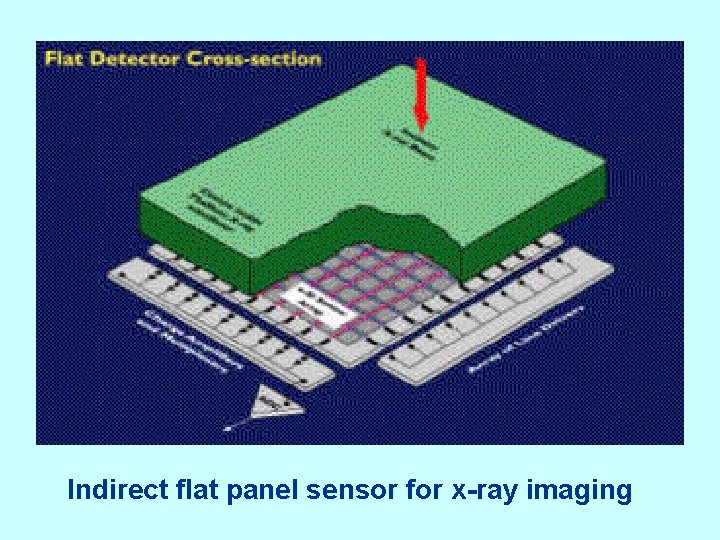
Indirect flat panel sensor for x-ray imaging
Diagnostic X-ray CT scanning • Historically detectors based on the use of Cs. I coupled to silicon diodes or Xe gas detectors • More recent developments involve the use of Cd. WO 4 or ceramic scintillators such as Yttrium Gadolinium Oxide which have ~2 x the light output of Cd. WO 4 • New fast ceramic detectors use gadolinium oxide (GDOS) have a short decay time and reduced afterglow (by 400 times). • Can make fast images with 30% less radiation dose
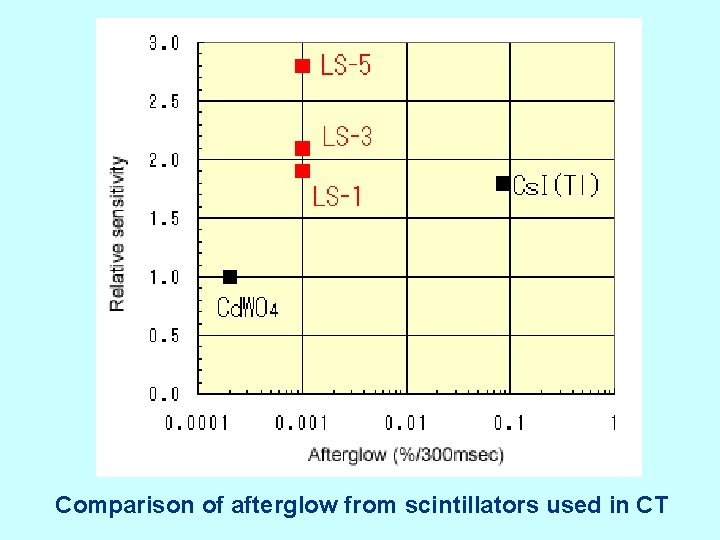
Comparison of afterglow from scintillators used in CT
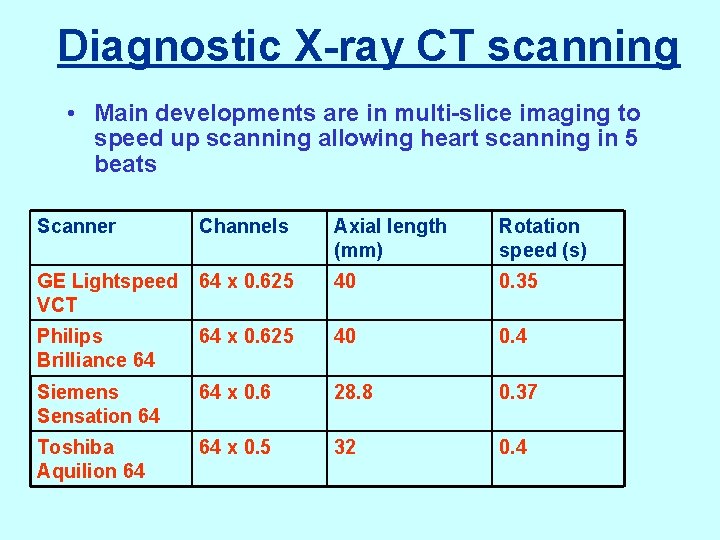
Diagnostic X-ray CT scanning • Main developments are in multi-slice imaging to speed up scanning allowing heart scanning in 5 beats Scanner Channels Axial length (mm) Rotation speed (s) GE Lightspeed VCT 64 x 0. 625 40 0. 35 Philips Brilliance 64 64 x 0. 625 40 0. 4 Siemens Sensation 64 64 x 0. 6 28. 8 0. 37 Toshiba Aquilion 64 64 x 0. 5 32 0. 4
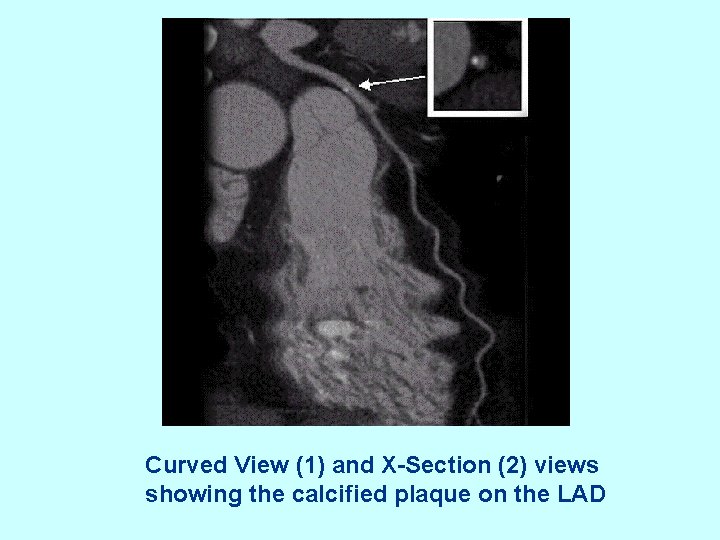
Curved View (1) and X-Section (2) views showing the calcified plaque on the LAD
X-ray CT future developments • Toshiba have developed a new 256 x 0. 5 mm row detector array which is soon to be commercial • GE and Siemens are developing flat panel detector CT systems which can be used for RT planning but are presently too slow for diagnostics

High resolution animal SPECT • The Hi. SPECT system is an add-on to existing Na. I(Tl)-based gamma cameras to give multi-pinhole aperture sensitivity and enhanced resolution. • The Nano-SPECT system is a purpose built (Mediso) small animal imaging gamma camera system with a resolution of <0. 8 mm and with multi-pinhole sensitivity.
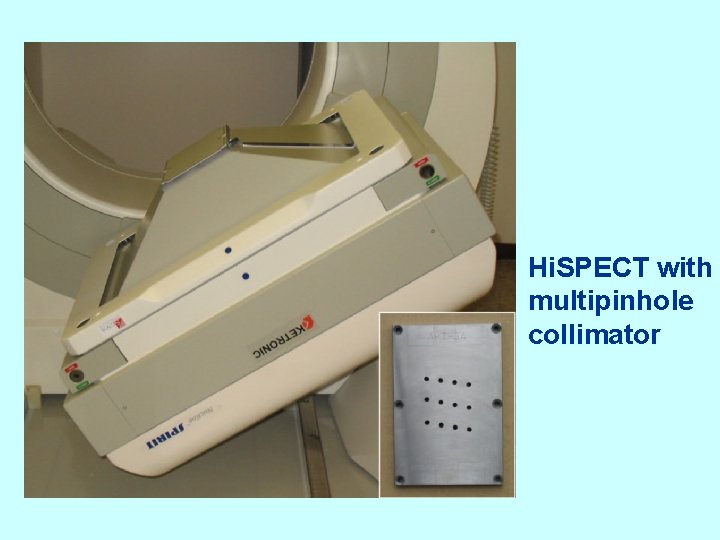
Hi. SPECT with multipinhole collimator
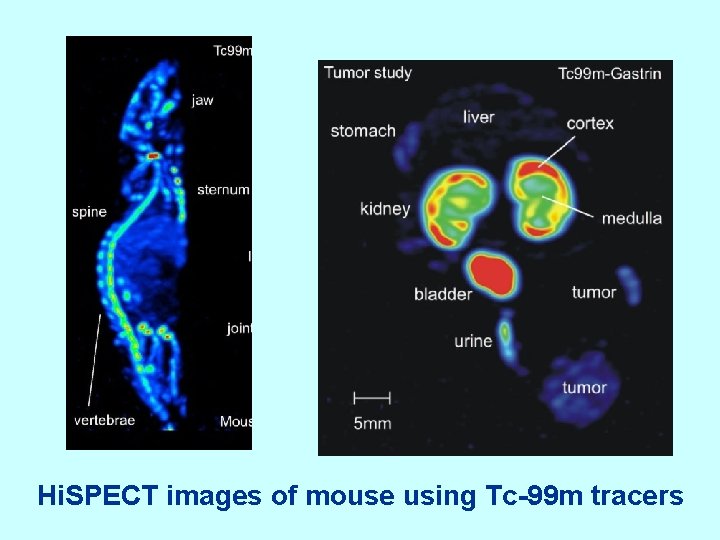
Hi. SPECT images of mouse using Tc-99 m tracers

Nano-SPECT system

Nano-SPECT images of mouse taken in helical mode

SPECT/CT scanning • Following the development of PET/CT scanners several SPECT/CT scanners have now been developed • Provide improved attenuation/scatter correction plus anatomy as well as function • Siemens and Philips have just connected double headed gamma cameras to conventional CT scanners • GE have produced a gamma camera gantry incorporating a low cost CT scanner

SPECT/CT images

The new Lab. PET system Made with APDs coupled to individual scintillating crystals (LSO)

Properties of the Lab. PET system Specification Ring diam (cm) Lab. PET 3. 6 Lab. PET 7. 2 15. 6 Aperture (cm) 11 11 Axial Fo. V (cm) 3. 6 7. 2 # of APDs 1536 3072 Scint size (mm) 2 x 2 Linear spatial Resolution (mm) 1. 1 Volume resolution ( l) 2. 4 2 -12 Coinc time window (ns)
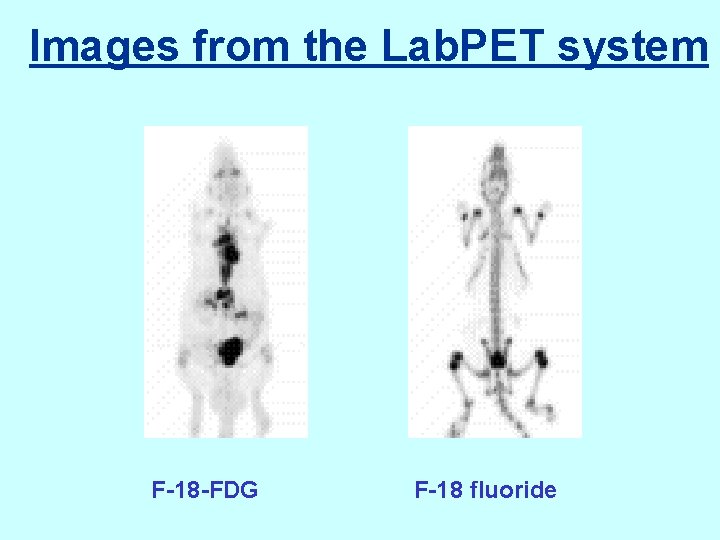
Images from the Lab. PET system F-18 -FDG F-18 fluoride

HIDAC MWPC PET system

HIDAC MWPC PET system F-18 fluoride F-18 FDG

The new PETMOT system • The system will combine phoswitch- PET and micro-lens array optical tomograph • Optical lens system is 1 cm 2 block containing 100 x 1 mm lenses • Optical collimator used to reject nonorthogonal rays • Coupled to photodiodes

Multi lens array assembly for a single block Without (l) and with (r) optical collimator

PET-MOT system Transaxial With and without optical collimator
PET-MOT system • Allows both optical and positron emission tomography simultaneously • The optical system inside the PET array has little effect on the 511 ke. V photons and is insensitive to them • J Peter and W Semmler, German Cancer Centre, Heidelberg

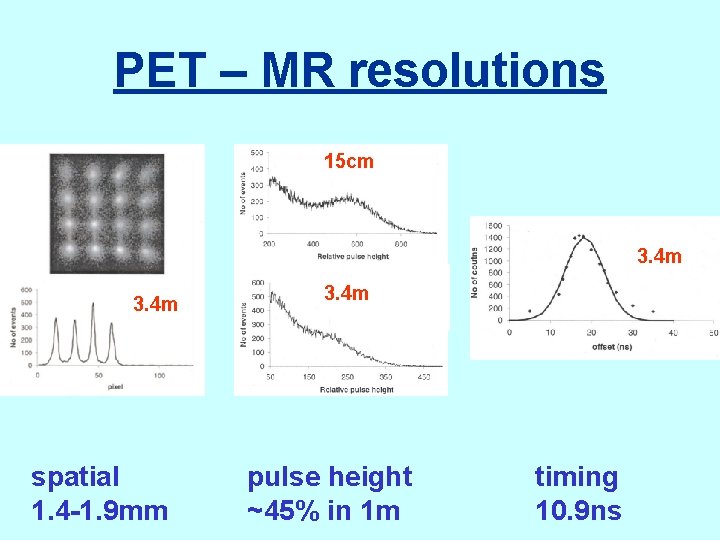
An MR compatible PET system for small animals • LSO multi ring PET system mounted inside the MR magnet with a purpose-built RF coil within PET ring • 104 2 mm x 3 mm x 5 mm crystals coupled to 2 mm diameter optical fibres • Fibres connected to MC-PMTs mounted in an RF screened box • Ring diameter 75. 5 mm • P Marsden et al at St Thomas’ Hospital
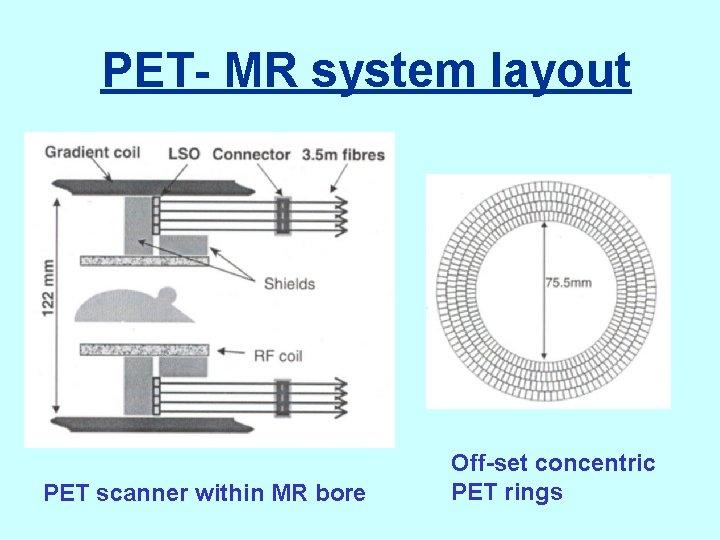
PET- MR system layout PET scanner within MR bore Off-set concentric PET rings
PET – MR resolutions 15 cm 3. 4 m spatial 1. 4 -1. 9 mm 3. 4 m pulse height ~45% in 1 m timing 10. 9 ns
New crystals for PET/SPECT Crystal Rel. light output 1/e decay Peak time (ns) (nm) Refractive Density index (g. ml) Na. I (Tl) 1. 0 250 415 1. 85 3. 67 La. Cl 3(Ce) 0. 7 -0. 9 28 350 ~1. 9 3. 79 Ba. F 2 0. 05/0. 16 0. 6/630 195/310 1. 5 4. 88 BGO 0. 2 300 480 2. 15 7. 13 LSO 0. 75 40 420 1. 82 7. 4 GSO 0. 2 60 430 1. 85 6. 71 La. Br 3(Ce) 1. 3 26 380 ~1. 9 5. 29

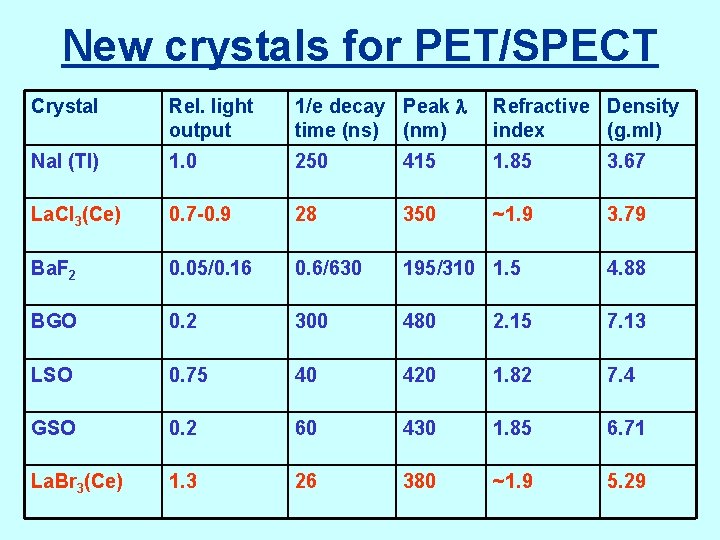
La. Br 3: Ce scintillation camera • Pani et al have developed a small scintillation camera using this new scintillator coupled to a flat panel PSPMT • Achieve an energy resolution of 6. 5% and a spatial resolution of 1. 1 mm FWHM • Efficiency at 140 ke. V is twice that of Na. I(Tl) with a 6 mm crystal
La. Br 3: Ce TOF PET scanner • Karp et al have developed a ring PET scanner using La. Br 3: Ce crystals 4 mm x 4 mm by 30 mm coupled via continuous light guide to PMTs • Energy resolution (8. 5%) is better than the equivalent LSO scanner (>20%) leading to a reduced scatter fraction (22% vs 42%) • Peak NEC rates are better than the LSO scanners • Timing resolution is ~315 ps!!
Active Pixels Sensors in Medical Imaging • Active pixel sensors are being developed under the MI-3 basic technology grant • Will allow on-chip intelligence and ‘individual pixel/ROI’ read-out • Applications include: High resolution (sub-mm) gamma camera imaging Digital X-ray imaging High resolution (<5 ) digital autoradiography
Summary • Still plenty of mileage in new detectors for both NM and Radiology to: improve image contrast improve spatial resolution combine modalities reduce radiation dose pixel intelligence
- Slides: 34