
APPLICATIONS For this geometry can you determine angles
- Slides: 11
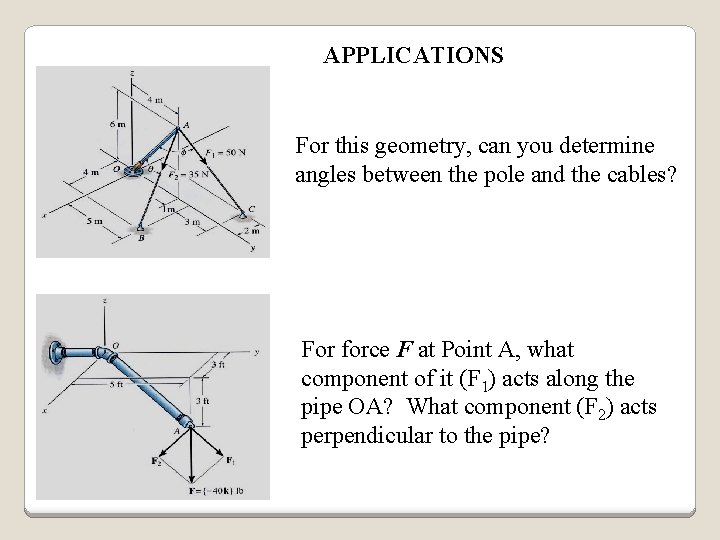
APPLICATIONS For this geometry, can you determine angles between the pole and the cables? For force F at Point A, what component of it (F 1) acts along the pipe OA? What component (F 2) acts perpendicular to the pipe?
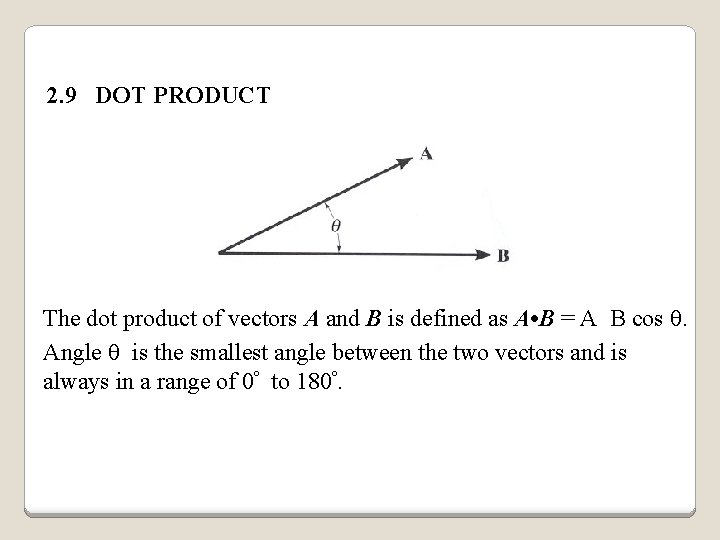
2. 9 DOT PRODUCT The dot product of vectors A and B is defined as A • B = A B cos . Angle is the smallest angle between the two vectors and is always in a range of 0º to 180º.
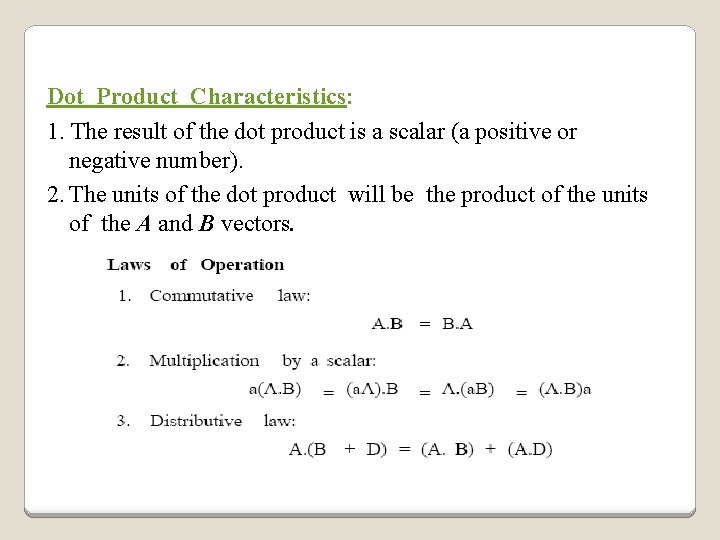
Dot Product Characteristics: 1. The result of the dot product is a scalar (a positive or negative number). 2. The units of the dot product will be the product of the units of the A and B vectors.
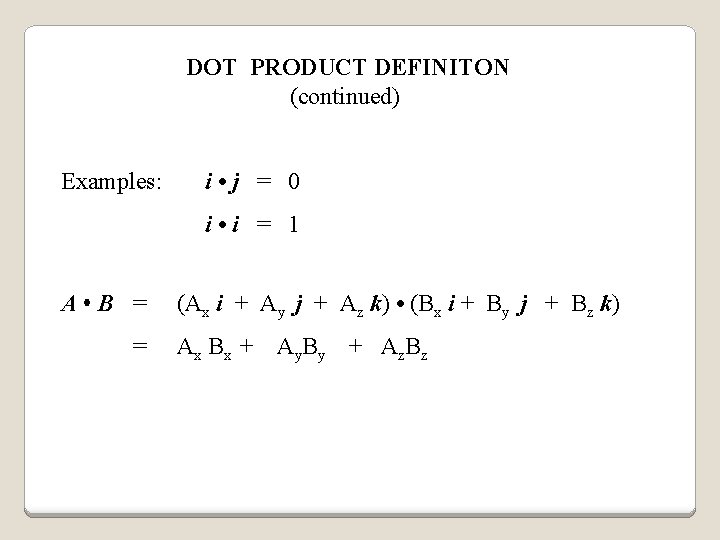
DOT PRODUCT DEFINITON (continued) Examples: i • j = 0 i • i = 1 A • B = = (Ax i + Ay j + Az k) • (Bx i + By j + Bz k) Ax Bx + Ay. By + Az. Bz
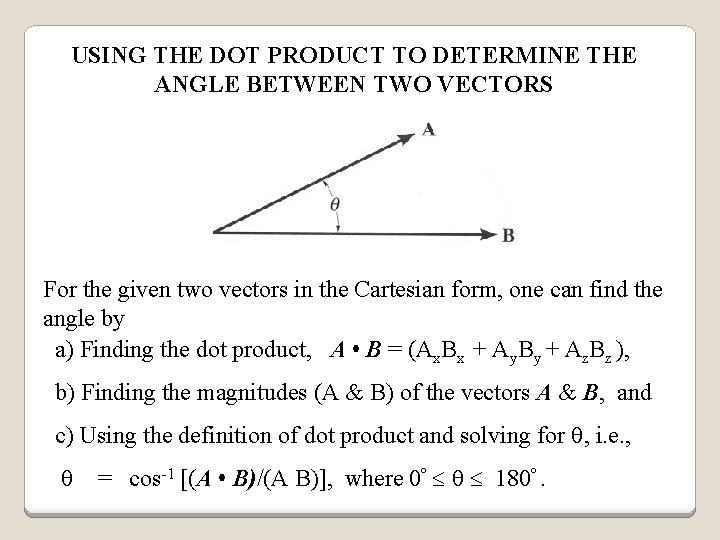
USING THE DOT PRODUCT TO DETERMINE THE ANGLE BETWEEN TWO VECTORS For the given two vectors in the Cartesian form, one can find the angle by a) Finding the dot product, A • B = (Ax. Bx + Ay. By + Az. Bz ), b) Finding the magnitudes (A & B) of the vectors A & B, and c) Using the definition of dot product and solving for , i. e. , = cos-1 [(A • B)/(A B)], where 0º 180º.
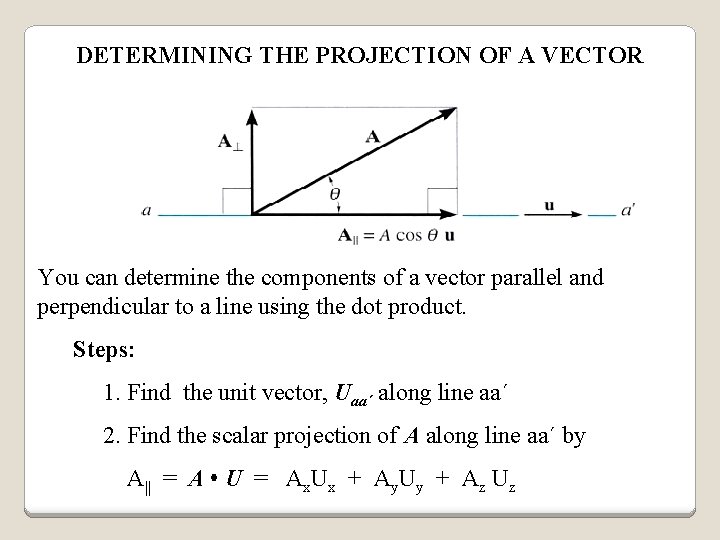
DETERMINING THE PROJECTION OF A VECTOR You can determine the components of a vector parallel and perpendicular to a line using the dot product. Steps: 1. Find the unit vector, Uaa´ along line aa´ 2. Find the scalar projection of A along line aa´ by A|| = A • U = Ax. Ux + Ay. Uy + Az Uz
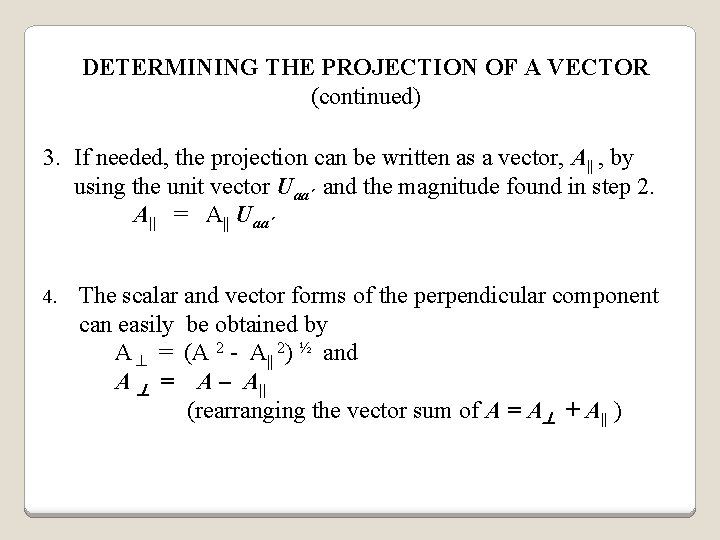
DETERMINING THE PROJECTION OF A VECTOR (continued) 3. If needed, the projection can be written as a vector, A|| , by using the unit vector Uaa´ and the magnitude found in step 2. A|| = A|| Uaa´ 4. The scalar and vector forms of the perpendicular component can easily be obtained by A = (A 2 - A|| 2) ½ and A = A – A|| (rearranging the vector sum of A = A + A|| )
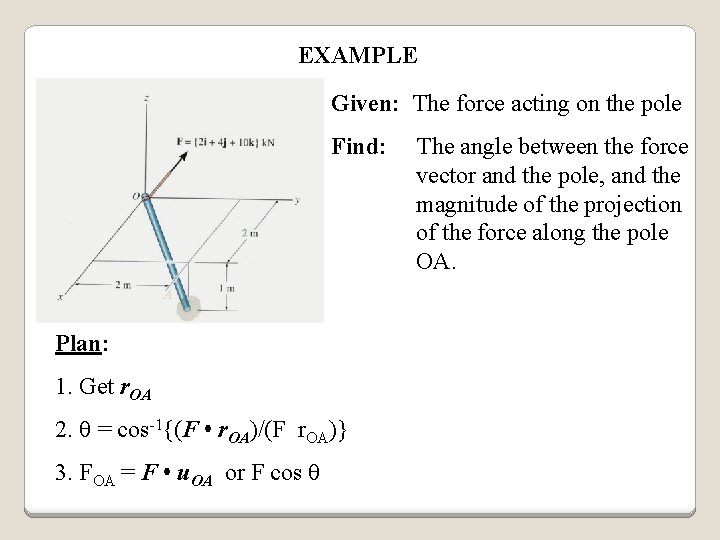
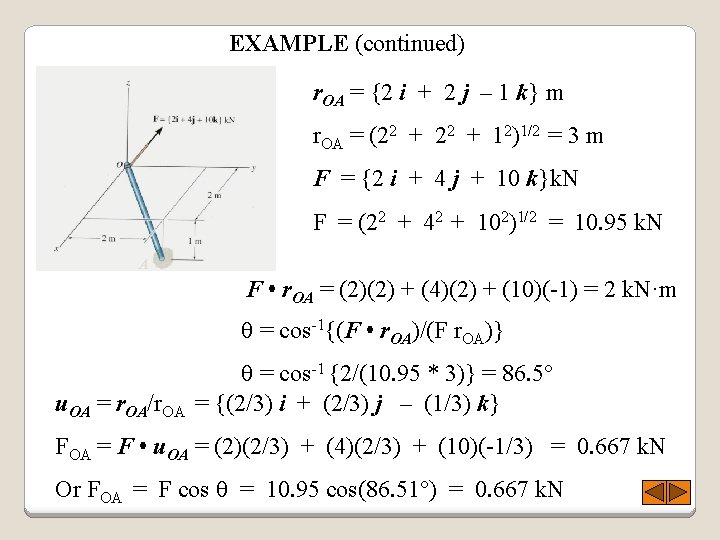
EXAMPLE Given: The force acting on the pole Find: A Plan: 1. Get r. OA 2. = cos-1{(F • r. OA)/(F r. OA)} 3. FOA = F • u. OA or F cos The angle between the force vector and the pole, and the magnitude of the projection of the force along the pole OA.
EXAMPLE (continued) r. OA = {2 i + 2 j – 1 k} m r. OA = (22 + 12)1/2 = 3 m F = {2 i + 4 j + 10 k}k. N F = (22 + 42 + 102)1/2 = 10. 95 k. N A F • r. OA = (2)(2) + (4)(2) + (10)(-1) = 2 k. N·m = cos-1{(F • r. OA)/(F r. OA)} u. OA = r. OA/r. OA = cos-1 {2/(10. 95 * 3)} = 86. 5° = {(2/3) i + (2/3) j – (1/3) k} FOA = F • u. OA = (2)(2/3) + (4)(2/3) + (10)(-1/3) = 0. 667 k. N Or FOA = F cos = 10. 95 cos(86. 51°) = 0. 667 k. N
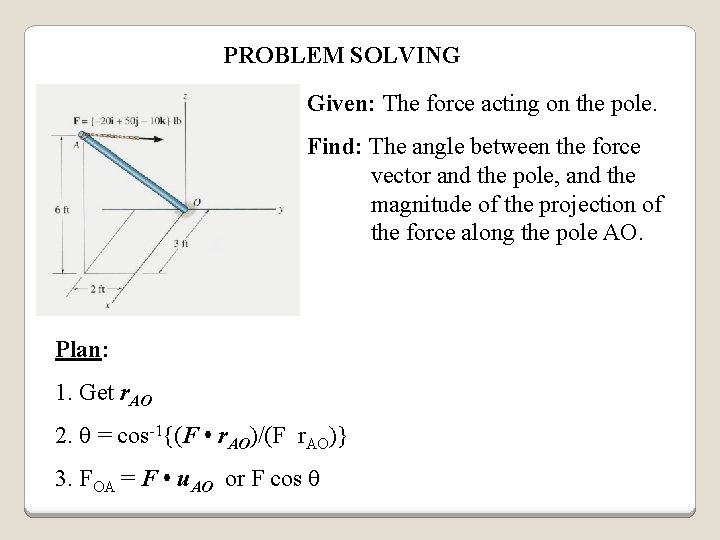
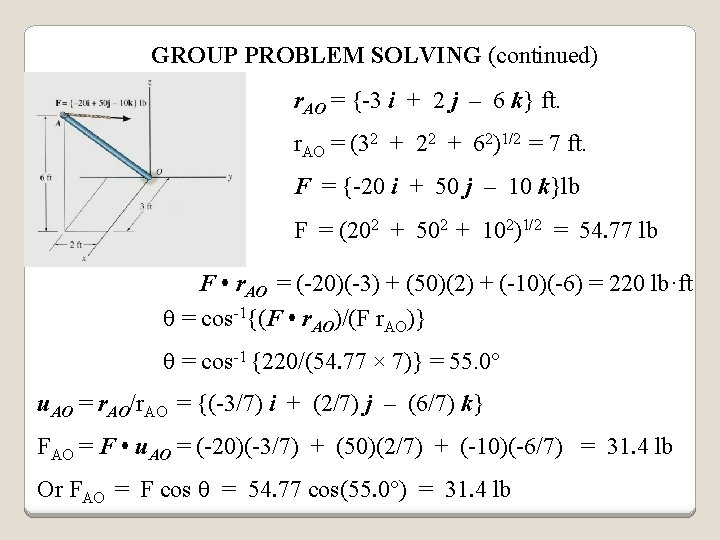
PROBLEM SOLVING Given: The force acting on the pole. Find: The angle between the force vector and the pole, and the magnitude of the projection of the force along the pole AO. Plan: 1. Get r. AO 2. = cos-1{(F • r. AO)/(F r. AO)} 3. FOA = F • u. AO or F cos
GROUP PROBLEM SOLVING (continued) r. AO = {-3 i + 2 j – 6 k} ft. r. AO = (32 + 22 + 62)1/2 = 7 ft. F = {-20 i + 50 j – 10 k}lb F = (202 + 502 + 102)1/2 = 54. 77 lb F • r. AO = (-20)(-3) + (50)(2) + (-10)(-6) = 220 lb·ft = cos-1{(F • r. AO)/(F r. AO)} = cos-1 {220/(54. 77 × 7)} = 55. 0° u. AO = r. AO/r. AO = {(-3/7) i + (2/7) j – (6/7) k} FAO = F • u. AO = (-20)(-3/7) + (50)(2/7) + (-10)(-6/7) = 31. 4 lb Or FAO = F cos = 54. 77 cos(55. 0°) = 31. 4 lb