
Applications for FTIR Testing for Semiconductor Facilities Strengths

- Slides: 15
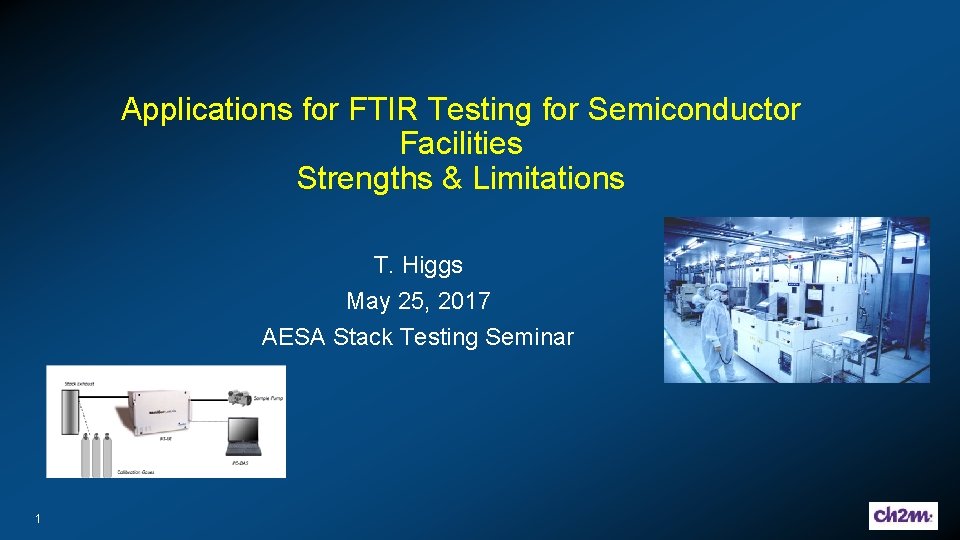
Applications for FTIR Testing for Semiconductor Facilities Strengths & Limitations T. Higgs May 25, 2017 AESA Stack Testing Seminar 1
Potential Applications FTIR testing widely used in semiconductor industry – Centralized abatement system testing – Performance efficiency testing, quantifying total mass emissions – Scrubber systems – Thermal oxidizers/VOC abatement – Fab process tool characterization – Plasma tools on etch/CVD operations – Lithography tools – Point of use abatement device performance 2
Pollutants of Interest Semiconductor fabs have diverse mix of pollutant types – Hazardous Air Pollutants (HAPs) – Hydrofluoric Acid (HF), Hydrochloric Acid (HCl), Chlorine (Cl 2) – Volatile Organic Compounds (VOCs) – Speciation of individual organics sometimes desired (e. g. organic HAPs) – Greenhouse gases – Fluorinated gases (e. g. NF 3, CF 4, SF 6) – Nitrous oxide (N 2 O) – Combustion sources (CO, NOx) 3
Semiconductor Emissions Characteristics Semiconductor fab emissions characterized by: – Large number of individual emission generating units – Hundreds of individual fab tools, connected to common exhaust systems – Some tools emit multiple pollutants, pollutant types Separate exhaust systems - VOCs, acids, ammonia/bases Complex mix of pollutants in some exhaust systems – High flow, relatively low concentration FTIR a good fit for fab emissions measurement – Capable of measuring wide range of pollutants – Low detection limits achievable on many 4
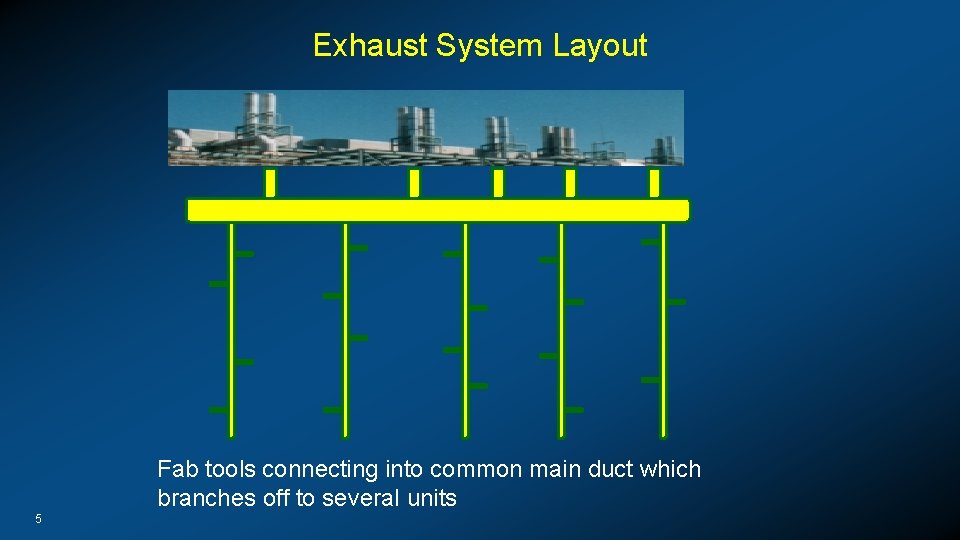
Exhaust System Layout Fab tools connecting into common main duct which branches off to several units 5
Proper Uses, Limitations for FTIR in SC Industry FTIR ideal for many testing needs - must understand limits, uncertainties – Cl 2, F 2 emissions common in industry; not measurable by FTIR – Detection limits vary by compound, conditions – ND readings can have material impact on results in high flow systems – VOC abatement efficiency best measured by total hydrocarbon method – Emissions variability important if using short term test to quantify longer term emissions – e. g. monthly, annual Interferences between compounds in complex exhaust stream – High level of FTIR expertise needed to ensure quality results 6
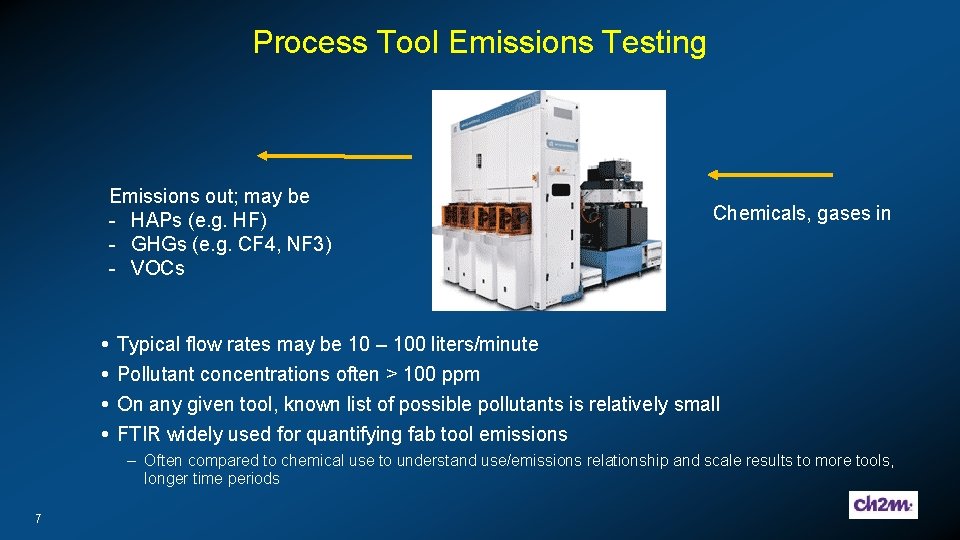
Process Tool Emissions Testing Emissions out; may be - HAPs (e. g. HF) - GHGs (e. g. CF 4, NF 3) - VOCs Chemicals, gases in Typical flow rates may be 10 – 100 liters/minute Pollutant concentrations often > 100 ppm On any given tool, known list of possible pollutants is relatively small FTIR widely used for quantifying fab tool emissions – Often compared to chemical use to understand use/emissions relationship and scale results to more tools, longer time periods 7
Point of use device testing Fab Tool Emissions in - Relatively high concentration, low flow - Short list of known pollutants 8 Many emissions reduced >95% - Others converted to different materials, then treated - E. g. CF 4, NF 3 HF Simultaneous FTIR inlet/outlet testing often used to measure device removal efficiency
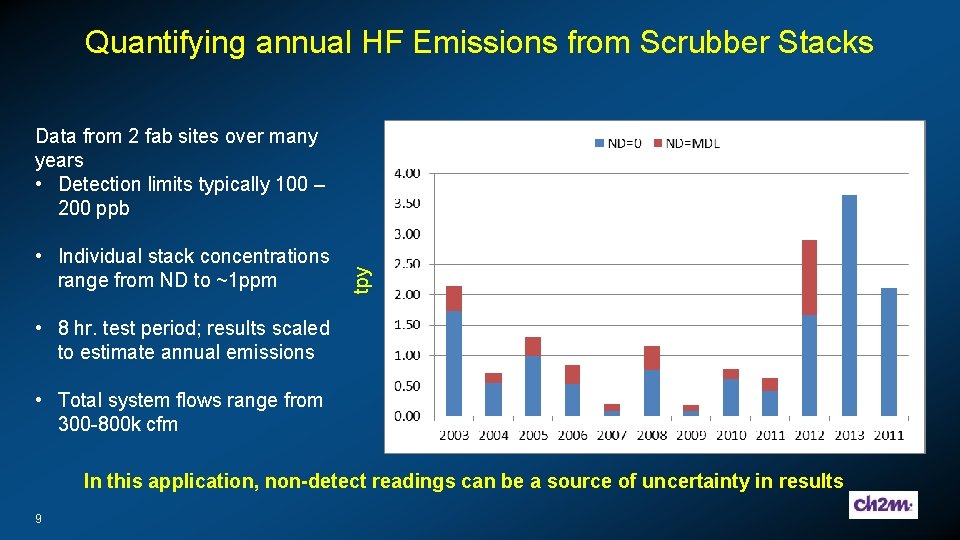
Quantifying annual HF Emissions from Scrubber Stacks • Individual stack concentrations range from ND to ~1 ppm tpy Data from 2 fab sites over many years • Detection limits typically 100 – 200 ppb • 8 hr. test period; results scaled to estimate annual emissions • Total system flows range from 300 -800 k cfm In this application, non-detect readings can be a source of uncertainty in results 9
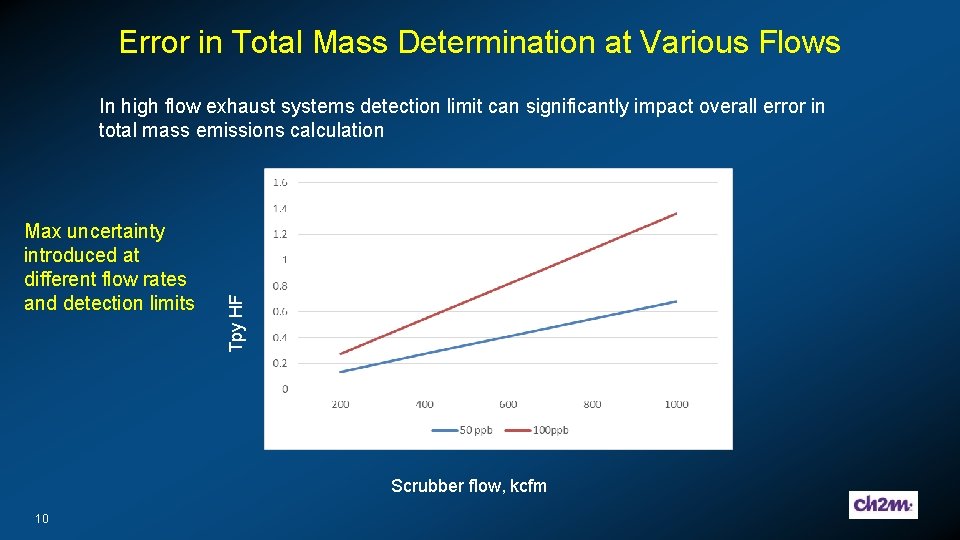
Error in Total Mass Determination at Various Flows Max uncertainty introduced at different flow rates and detection limits Tpy HF In high flow exhaust systems detection limit can significantly impact overall error in total mass emissions calculation Scrubber flow, kcfm 10
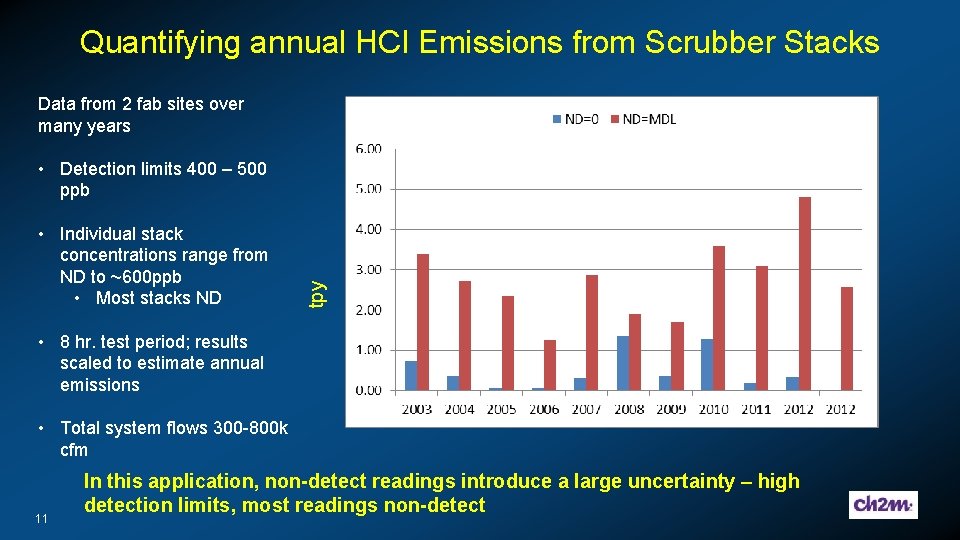
Quantifying annual HCl Emissions from Scrubber Stacks Data from 2 fab sites over many years • Individual stack concentrations range from ND to ~600 ppb • Most stacks ND tpy • Detection limits 400 – 500 ppb • 8 hr. test period; results scaled to estimate annual emissions • Total system flows 300 -800 k cfm 11 In this application, non-detect readings introduce a large uncertainty – high detection limits, most readings non-detect
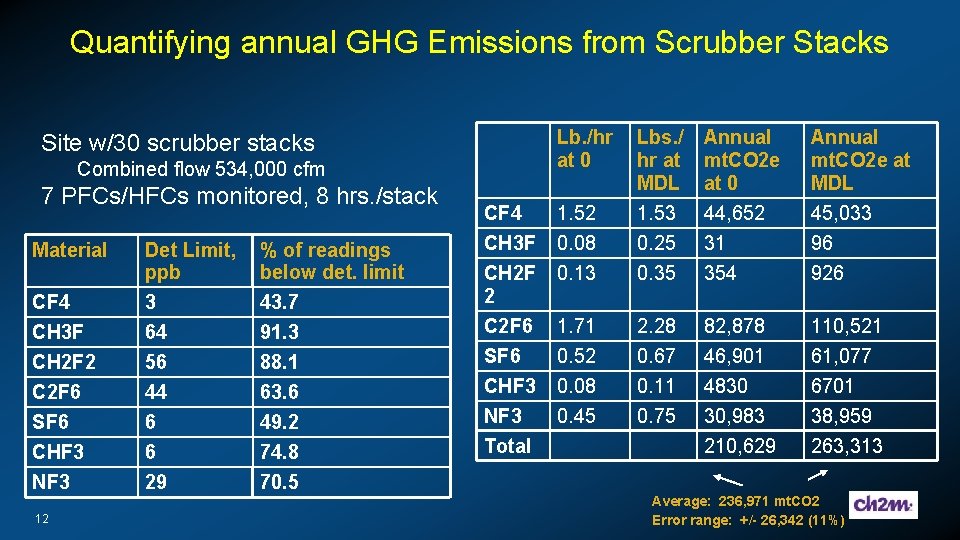
Quantifying annual GHG Emissions from Scrubber Stacks Lb. /hr at 0 CF 4 CH 3 F 1. 52 0. 08 Lbs. / hr at MDL 1. 53 0. 25 CH 2 F 2 C 2 F 6 SF 6 CHF 3 NF 3 Total 0. 13 0. 35 354 926 1. 71 0. 52 0. 08 0. 45 2. 28 0. 67 0. 11 0. 75 82, 878 46, 901 4830 30, 983 210, 629 110, 521 61, 077 6701 38, 959 263, 313 Site w/30 scrubber stacks Combined flow 534, 000 cfm 7 PFCs/HFCs monitored, 8 hrs. /stack Material CF 4 CH 3 F CH 2 F 2 C 2 F 6 SF 6 CHF 3 NF 3 12 Det Limit, ppb % of readings below det. limit 3 64 56 44 6 6 29 43. 7 91. 3 88. 1 63. 6 49. 2 74. 8 70. 5 Annual mt. CO 2 e at 0 44, 652 31 Annual mt. CO 2 e at MDL 45, 033 96 Average: 236, 971 mt. CO 2 Error range: +/- 26, 342 (11%)
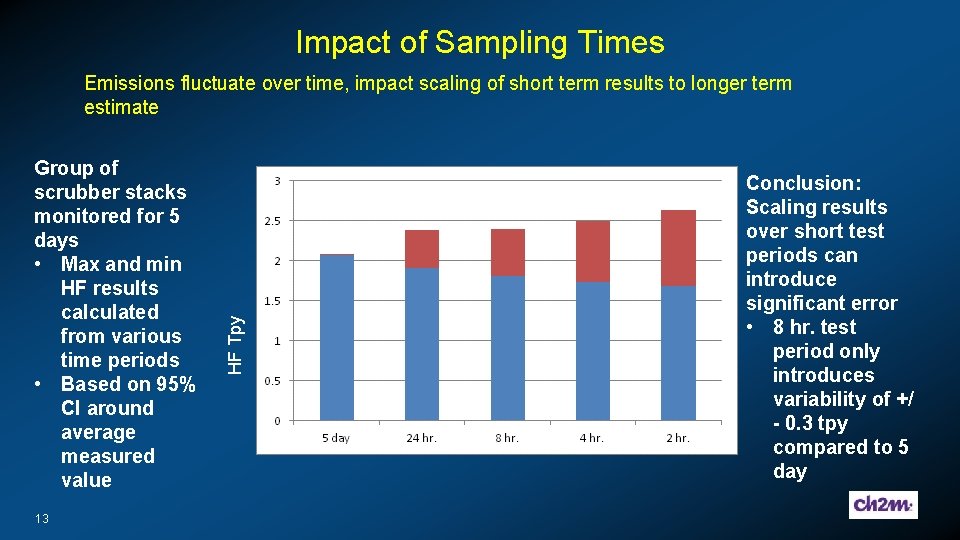
Impact of Sampling Times Group of scrubber stacks monitored for 5 days • Max and min HF results calculated from various time periods • Based on 95% CI around average measured value 13 HF Tpy Emissions fluctuate over time, impact scaling of short term results to longer term estimate Conclusion: Scaling results over short test periods can introduce significant error • 8 hr. test period only introduces variability of +/ - 0. 3 tpy compared to 5 day
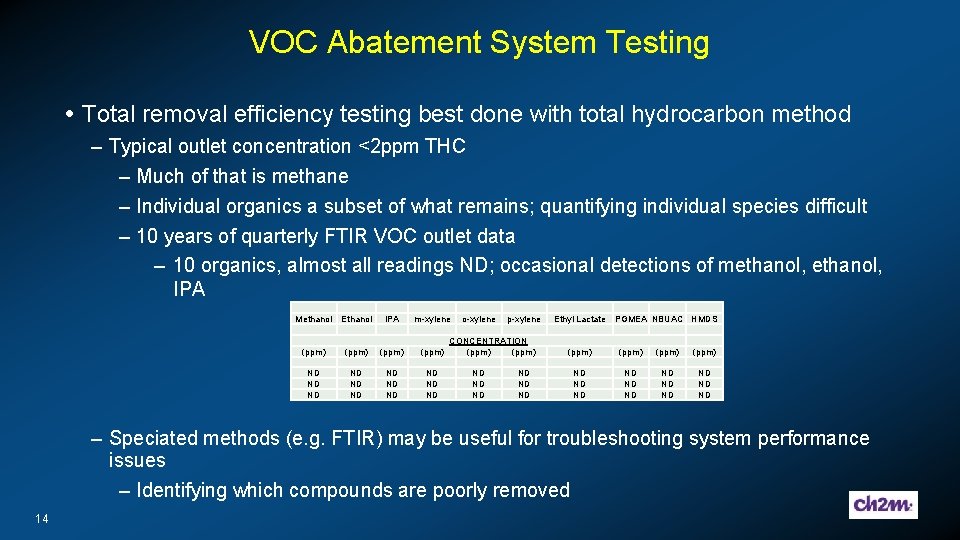
VOC Abatement System Testing Total removal efficiency testing best done with total hydrocarbon method – Typical outlet concentration <2 ppm THC – Much of that is methane – Individual organics a subset of what remains; quantifying individual species difficult – 10 years of quarterly FTIR VOC outlet data – 10 organics, almost all readings ND; occasional detections of methanol, IPA Methanol Ethanol IPA m-xylene (ppm) ND ND ND o-xylene p-xylene CONCENTRATION (ppm) ND ND ND Ethyl Lactate PGMEA NBUAC HMDS (ppm) ND ND ND – Speciated methods (e. g. FTIR) may be useful for troubleshooting system performance issues – Identifying which compounds are poorly removed 14
Summary Semiconductor manufacturing emissions are complex and highly variable – Wide range of different pollutants, many contributing sources – Often dilute at final emission point; relatively high concentration at source Stack testing has multiple purposes – Abatement device removal efficiency – Characterizing emissions from individual process steps – Determining plant wide mass emissions – By individual chemical, or group of chemicals (e. g. total hydrocarbons) FTIR is powerful tool for complex emissions with wide range of chemicals – Important to understand both strengths and limits on ability to draw conclusions 15