
Application on Shock Wave in a ConvergingDiverging Nozzle

- Slides: 8
Application on Shock Wave in a Converging–Diverging Nozzle
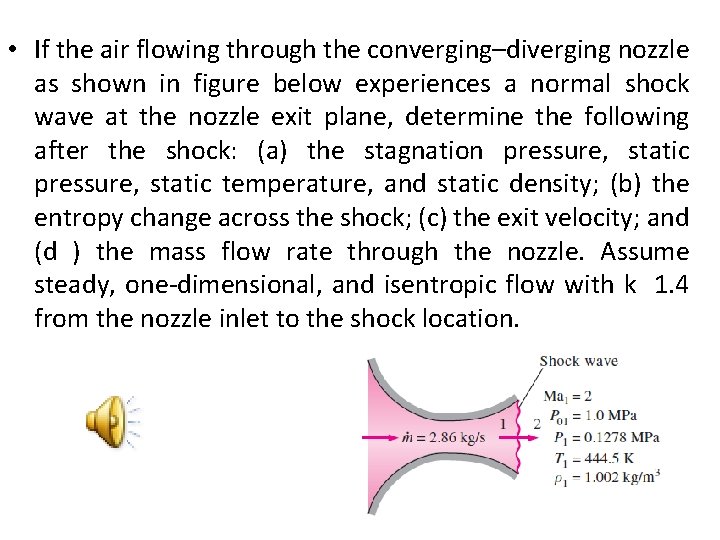
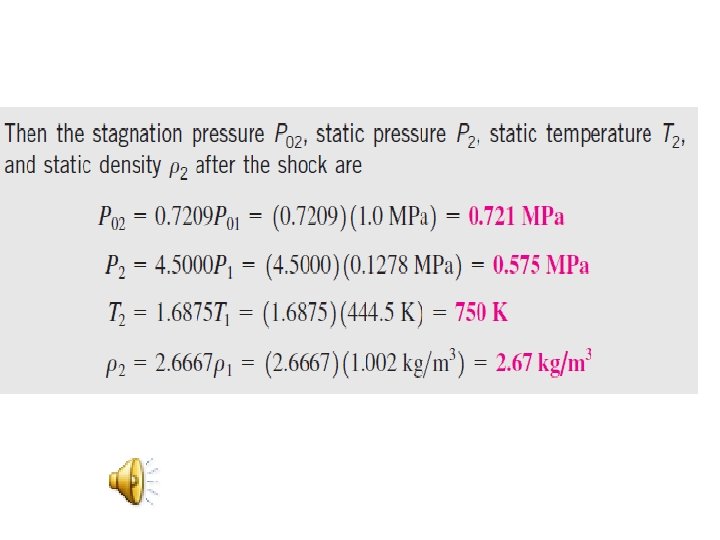
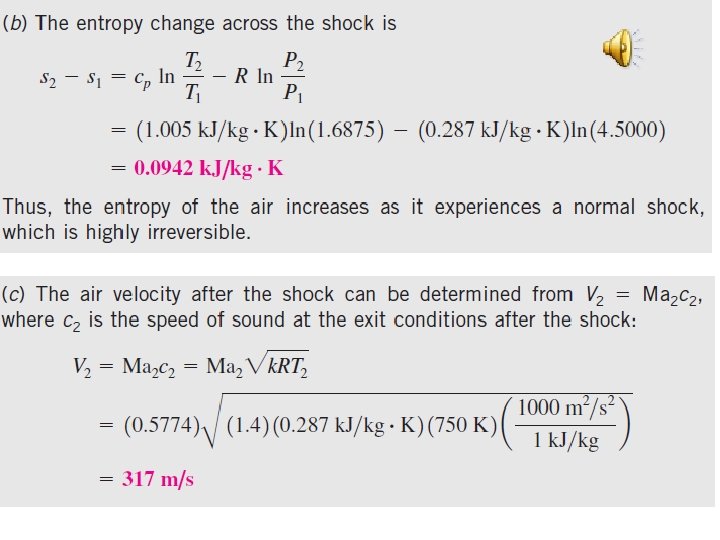
• If the air flowing through the converging–diverging nozzle as shown in figure below experiences a normal shock wave at the nozzle exit plane, determine the following after the shock: (a) the stagnation pressure, static temperature, and static density; (b) the entropy change across the shock; (c) the exit velocity; and (d ) the mass flow rate through the nozzle. Assume steady, one-dimensional, and isentropic flow with k 1. 4 from the nozzle inlet to the shock location.
Solution: • Air flowing through a converging–diverging nozzle experiences a normal shock at the exit. The effect of the shock wave on various properties is to be determined. Assumptions: 1. Air is an ideal gas with constant specific heats at room temperature. 2. Flow through the nozzle is steady, one-dimensional, and isentropic before the shock occurs. 3. The shock wave occurs at the exit plane.
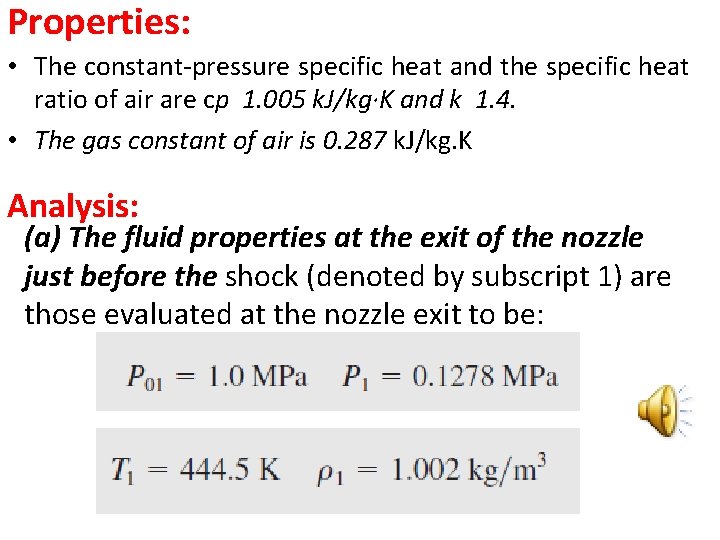
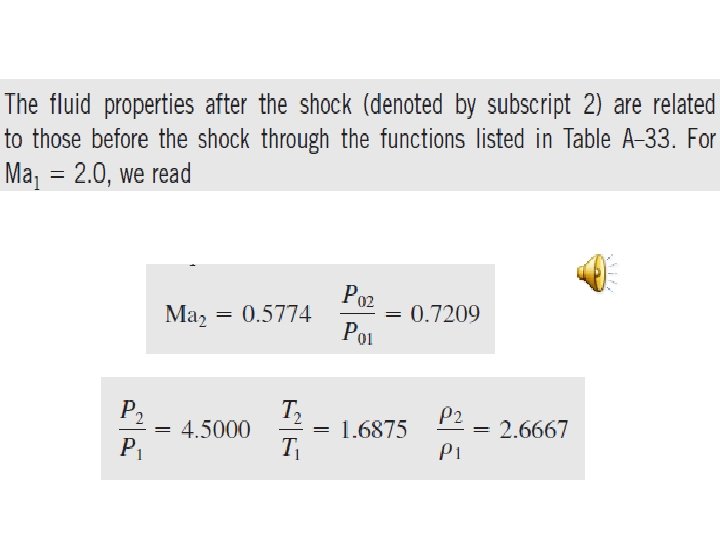
Properties: • The constant-pressure specific heat and the specific heat ratio of air are cp 1. 005 k. J/kg·K and k 1. 4. • The gas constant of air is 0. 287 k. J/kg. K Analysis: (a) The fluid properties at the exit of the nozzle just before the shock (denoted by subscript 1) are those evaluated at the nozzle exit to be:
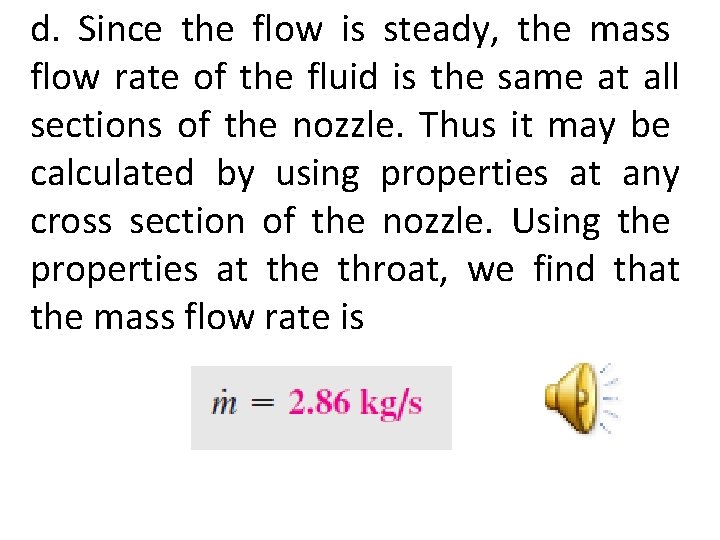
d. Since the flow is steady, the mass flow rate of the fluid is the same at all sections of the nozzle. Thus it may be calculated by using properties at any cross section of the nozzle. Using the properties at the throat, we find that the mass flow rate is