
Application of the VIC Hydrologic Model to Explore
- Slides: 1
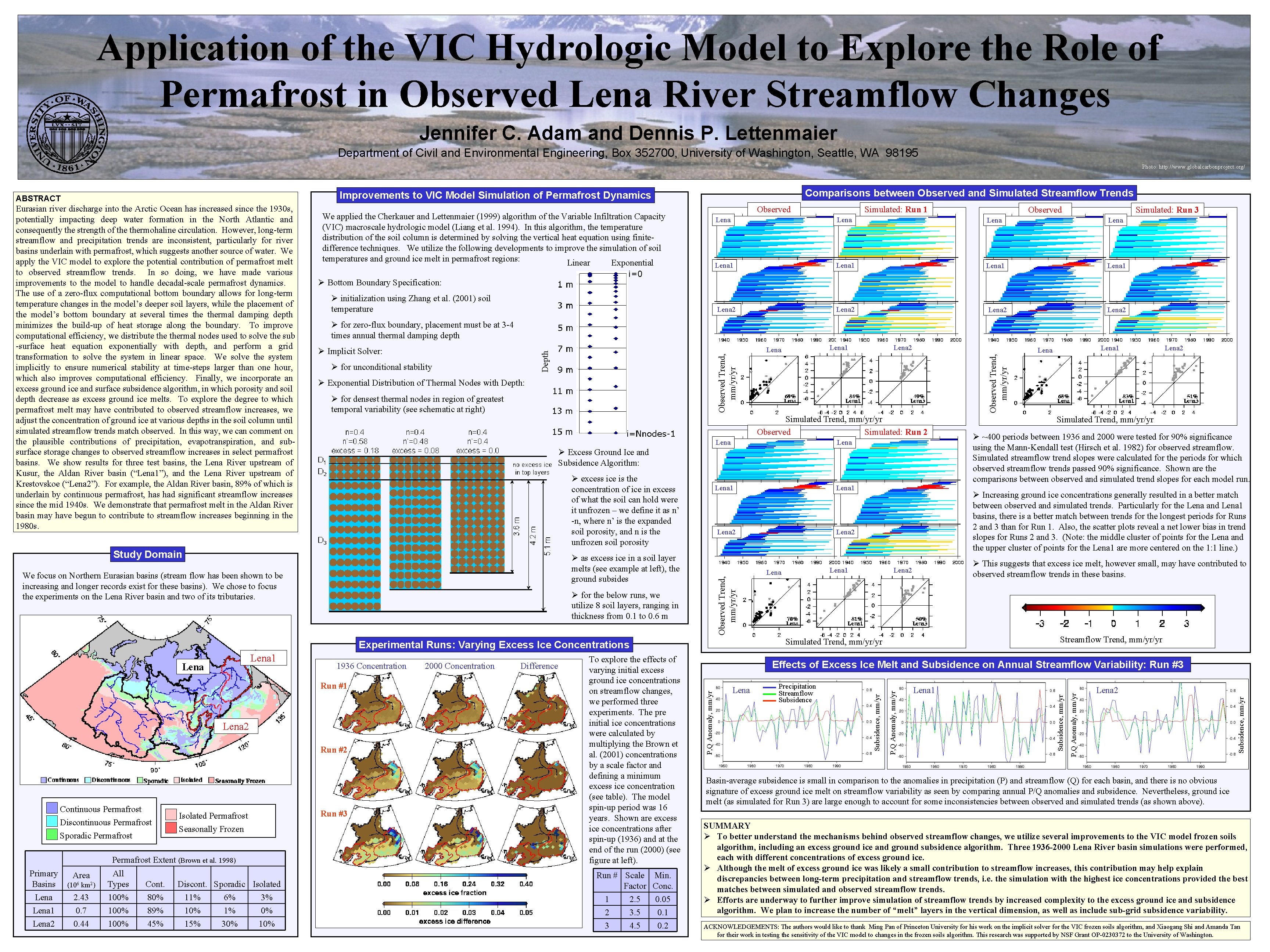
Application of the VIC Hydrologic Model to Explore the Role of Permafrost in Observed Lena River Streamflow Changes Jennifer C. Adam and Dennis P. Lettenmaier Department of Civil and Environmental Engineering, Box 352700, University of Washington, Seattle, WA 98195 Photo: http: //www. globalcarbonproject. org/ Comparisons between Observed and Simulated Streamflow Trends Improvements to VIC Model Simulation of Permafrost Dynamics Observed We applied the Cherkauer and Lettenmaier (1999) algorithm of the Variable Infiltration Capacity (VIC) macroscale hydrologic model (Liang et al. 1994). In this algorithm, the temperature distribution of the soil column is determined by solving the vertical heat equation using finitedifference techniques. We utilize the following developments to improve the simulation of soil temperatures and ground ice melt in permafrost regions: Linear Exponential Ø initialization using Zhang et al. (2001) soil temperature Lena 1 Lena 2 Lena 2 Ø for zero-flux boundary, placement must be at 3 -4 times annual thermal damping depth Ø Exponential Distribution of Thermal Nodes with Depth: Ø for densest thermal nodes in region of greatest temporal variability (see schematic at right) Simulated Trend, mm/yr/yr Observed Simulated: Run 2 Ø excess ice is the concentration of ice in excess of what the soil can hold were it unfrozen – we define it as n’ -n, where n’ is the expanded soil porosity, and n is the unfrozen soil porosity Lena 1 Lena 2 Ø as excess ice in a soil layer melts (see example at left), the ground subsides Run #3 Permafrost Extent (Brown et al. 1998) Primary Basins Lena 1 Lena 2 (106 km 2) All Types Cont. 2. 43 0. 7 0. 44 100% 89% 45% Area Discont. Sporadic Isolated 11% 10% 15% 6% 1% 30% 3% 0% 10% Run # Scale Min. Factor Conc. 1 2 3 2. 5 3. 5 4. 5 Lena 2 0. 05 0. 1 0. 2 Ø ~400 periods between 1936 and 2000 were tested for 90% significance using the Mann-Kendall test (Hirsch et al. 1982) for observed streamflow. Simulated streamflow trend slopes were calculated for the periods for which observed streamflow trends passed 90% significance. Shown are the comparisons between observed and simulated trend slopes for each model run. Streamflow Trend, mm/yr/yr Lena 1 Lena 2 Subsidence, mm/yr Precipitation Streamflow Subsidence P, Q Anomaly, mm/yr Lena Subsidence, mm/yr Effects of Excess Ice Melt and Subsidence on Annual Streamflow Variability: Run #3 P, Q Anomaly, mm/yr Run #2 Difference Lena 1 Subsidence, mm/yr Lena 2 2000 Concentration P, Q Anomaly, mm/yr 1936 Concentration Simulated Trend, mm/yr/yr Ø This suggests that excess ice melt, however small, may have contributed to observed streamflow trends in these basins. Simulated Trend, mm/yr/yr To explore the effects of varying initial excess ground ice concentrations on streamflow changes, we performed three experiments. The pre initial ice concentrations were calculated by multiplying the Brown et al. (2001) concentrations by a scale factor and defining a minimum excess ice concentration (see table). The model spin-up period was 16 years. Shown are excess ice concentrations after spin-up (1936) and at the end of the run (2000) (see figure at left). Lena 2 Ø Increasing ground ice concentrations generally resulted in a better match between observed and simulated trends. Particularly for the Lena and Lena 1 basins, there is a better match between trends for the longest periods for Runs 2 and 3 than for Run 1. Also, the scatter plots reveal a net lower bias in trend slopes for Runs 2 and 3. (Note: the middle cluster of points for the Lena and the upper cluster of points for the Lena 1 are more centered on the 1: 1 line. ) Lena 2 Lena Ø for the below runs, we utilize 8 soil layers, ranging in thickness from 0. 1 to 0. 6 m Lena 1 Lena Ø Excess Ground Ice and Subsidence Algorithm: Run #1 Isolated Permafrost Seasonally Frozen Lena 2 Observed Trend, mm/yr/yr Ø for unconditional stability Lena 1 Lena Observed Trend, mm/yr/yr Ø Implicit Solver: Experimental Runs: Varying Excess Ice Concentrations Continuous Permafrost Discontinuous Permafrost Sporadic Permafrost Simulated: Run 3 Lena 2 We focus on Northern Eurasian basins (stream flow has been shown to be increasing and longer records exist for these basins). We chose to focus the experiments on the Lena River basin and two of its tributaries. Lena Observed Ø Bottom Boundary Specification: Study Domain Lena 1 Simulated: Run 1 Observed Trend, mm/yr/yr Eurasian river discharge into the Arctic Ocean has increased since the 1930 s, potentially impacting deep water formation in the North Atlantic and consequently the strength of thermohaline circulation. However, long-term streamflow and precipitation trends are inconsistent, particularly for river basins underlain with permafrost, which suggests another source of water. We apply the VIC model to explore the potential contribution of permafrost melt to observed streamflow trends. In so doing, we have made various improvements to the model to handle decadal-scale permafrost dynamics. The use of a zero-flux computational bottom boundary allows for long-term temperature changes in the model’s deeper soil layers, while the placement of the model’s bottom boundary at several times thermal damping depth minimizes the build-up of heat storage along the boundary. To improve computational efficiency, we distribute thermal nodes used to solve the sub -surface heat equation exponentially with depth, and perform a grid transformation to solve the system in linear space. We solve the system implicitly to ensure numerical stability at time-steps larger than one hour, which also improves computational efficiency. Finally, we incorporate an excess ground ice and surface subsidence algorithm, in which porosity and soil depth decrease as excess ground ice melts. To explore the degree to which permafrost melt may have contributed to observed streamflow increases, we adjust the concentration of ground ice at various depths in the soil column until simulated streamflow trends match observed. In this way, we can comment on the plausible contributions of precipitation, evapotranspiration, and subsurface storage changes to observed streamflow increases in select permafrost basins. We show results for three test basins, the Lena River upstream of Kusur, the Aldan River basin (“Lena 1”), and the Lena River upstream of Krestovskoe (“Lena 2”). For example, the Aldan River basin, 89% of which is underlain by continuous permafrost, has had significant streamflow increases since the mid 1940 s. We demonstrate that permafrost melt in the Aldan River basin may have begun to contribute to streamflow increases beginning in the 1980 s. Depth ABSTRACT Basin-average subsidence is small in comparison to the anomalies in precipitation (P) and streamflow (Q) for each basin, and there is no obvious signature of excess ground ice melt on streamflow variability as seen by comparing annual P/Q anomalies and subsidence. Nevertheless, ground ice melt (as simulated for Run 3) are large enough to account for some inconsistencies between observed and simulated trends (as shown above). SUMMARY Ø To better understand the mechanisms behind observed streamflow changes, we utilize several improvements to the VIC model frozen soils algorithm, including an excess ground ice and ground subsidence algorithm. Three 1936 -2000 Lena River basin simulations were performed, each with different concentrations of excess ground ice. Ø Although the melt of excess ground ice was likely a small contribution to streamflow increases, this contribution may help explain discrepancies between long-term precipitation and streamflow trends, i. e. the simulation with the highest ice concentrations provided the best matches between simulated and observed streamflow trends. Ø Efforts are underway to further improve simulation of streamflow trends by increased complexity to the excess ground ice and subsidence algorithm. We plan to increase the number of “melt” layers in the vertical dimension, as well as include sub-grid subsidence variability. ACKNOWLEDGEMENTS: The authors would like to thank Ming Pan of Princeton University for his work on the implicit solver for the VIC frozen soils algorithm, and Xiaogang Shi and Amanda Tan for their work in testing the sensitivity of the VIC model to changes in the frozen soils algorithm. This research was supported by NSF Grant OP-0230372 to the University of Washington.