
Application of the Mentoring Competency Assessment Tool in
- Slides: 1
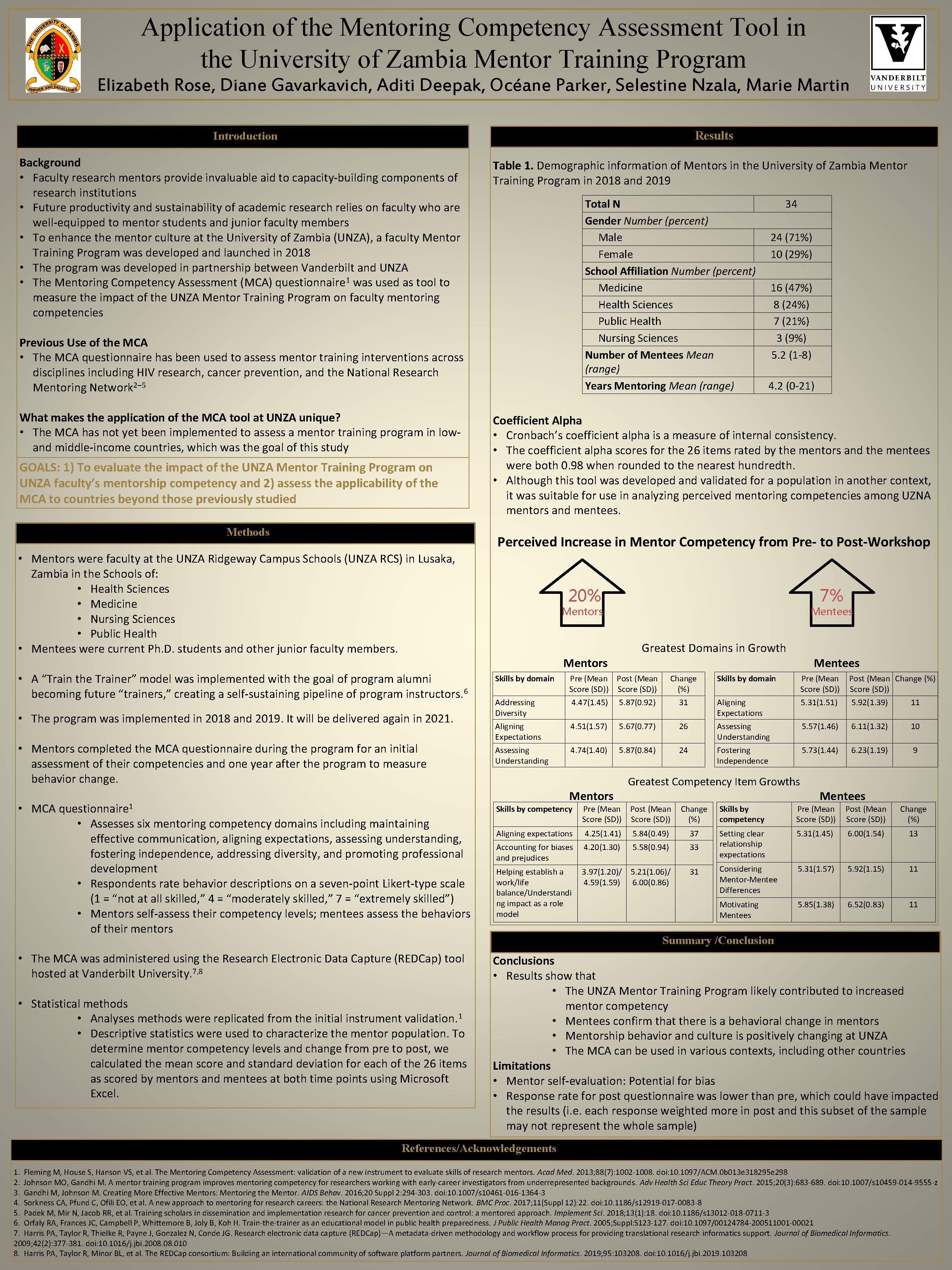
Application of the Mentoring Competency Assessment Tool in the University of Zambia Mentor Training Program Elizabeth Rose, Diane Gavarkavich, Aditi Deepak, Océane Parker, Selestine Nzala, Marie Martin Results Introduction Background • Faculty research mentors provide invaluable aid to capacity-building components of research institutions • Future productivity and sustainability of academic research relies on faculty who are well-equipped to mentor students and junior faculty members • To enhance the mentor culture at the University of Zambia (UNZA), a faculty Mentor Training Program was developed and launched in 2018 • The program was developed in partnership between Vanderbilt and UNZA • The Mentoring Competency Assessment (MCA) questionnaire 1 was used as tool to measure the impact of the UNZA Mentor Training Program on faculty mentoring competencies Table 1. Demographic information of Mentors in the University of Zambia Mentor Training Program in 2018 and 2019 Total N Gender Number (percent) Male Female School Affiliation Number (percent) Medicine Health Sciences Public Health Nursing Sciences Number of Mentees Mean (range) Years Mentoring Mean (range) Previous Use of the MCA • The MCA questionnaire has been used to assess mentor training interventions across disciplines including HIV research, cancer prevention, and the National Research Mentoring Network 2– 5 What makes the application of the MCA tool at UNZA unique? • The MCA has not yet been implemented to assess a mentor training program in lowand middle-income countries, which was the goal of this study GOALS: 1) To evaluate the impact of the UNZA Mentor Training Program on UNZA faculty’s mentorship competency and 2) assess the applicability of the MCA to countries beyond those previously studied Methods 34 24 (71%) 10 (29%) 16 (47%) 8 (24%) 7 (21%) 3 (9%) 5. 2 (1 -8) 4. 2 (0 -21) Coefficient Alpha • Cronbach’s coefficient alpha is a measure of internal consistency. • The coefficient alpha scores for the 26 items rated by the mentors and the mentees were both 0. 98 when rounded to the nearest hundredth. • Although this tool was developed and validated for a population in another context, it was suitable for use in analyzing perceived mentoring competencies among UZNA mentors and mentees. Perceived Increase in Mentor Competency from Pre- to Post-Workshop • Mentors were faculty at the UNZA Ridgeway Campus Schools (UNZA RCS) in Lusaka, Zambia in the Schools of: • Health Sciences • Medicine • Nursing Sciences • Public Health • Mentees were current Ph. D. students and other junior faculty members. • A “Train the Trainer” model was implemented with the goal of program alumni becoming future “trainers, ” creating a self-sustaining pipeline of program instructors. 6 • The program was implemented in 2018 and 2019. It will be delivered again in 2021. • Mentors completed the MCA questionnaire during the program for an initial assessment of their competencies and one year after the program to measure behavior change. • MCA questionnaire 1 • Assesses six mentoring competency domains including maintaining effective communication, aligning expectations, assessing understanding, fostering independence, addressing diversity, and promoting professional development • Respondents rate behavior descriptions on a seven-point Likert-type scale (1 = “not at all skilled, ” 4 = “moderately skilled, ” 7 = “extremely skilled”) • Mentors self-assess their competency levels; mentees assess the behaviors of their mentors • The MCA was administered using the Research Electronic Data Capture (REDCap) tool hosted at Vanderbilt University. 7, 8 • Statistical methods • Analyses methods were replicated from the initial instrument validation. 1 • Descriptive statistics were used to characterize the mentor population. To determine mentor competency levels and change from pre to post, we calculated the mean score and standard deviation for each of the 26 items as scored by mentors and mentees at both time points using Microsoft Excel. 20% 7% Mentors Mentees Greatest Domains in Growth Mentors Skills by domain Addressing Diversity Pre (Mean Post (Mean Score (SD)) 4. 47(1. 45) 5. 87(0. 92) Change (%) 31 Mentees Skills by domain Aligning Expectations Pre (Mean Score (SD)) 5. 31(1. 51) Post (Mean Change (%) Score (SD)) 5. 92(1. 39) 11 Aligning Expectations 4. 51(1. 57) 5. 67(0. 77) 26 Assessing Understanding 5. 57(1. 46) 6. 11(1. 32) 10 Assessing Understanding 4. 74(1. 40) 5. 87(0. 84) 24 Fostering Independence 5. 73(1. 44) 6. 23(1. 19) 9 Mentors Greatest Competency Item Growths Skills by competency Pre (Mean Post (Mean Score (SD)) Aligning expectations 4. 25(1. 41) Accounting for biases and prejudices 4. 20(1. 30) Helping establish a work/life balance/Understandi ng impact as a role model Mentees Change (%) Skills by competency Pre (Mean Score (SD)) Post (Mean Score (SD)) Change (%) 5. 84(0. 49) 37 5. 31(1. 45) 6. 00(1. 54) 13 5. 58(0. 94) 33 Setting clear relationship expectations 3. 97(1. 20)/ 5. 21(1. 06)/ 4. 59(1. 59) 6. 00(0. 86) 31 Considering Mentor-Mentee Differences 5. 31(1. 57) 5. 92(1. 15) 11 Motivating Mentees 5. 85(1. 38) 6. 52(0. 83) 11 Summary /Conclusions • Results show that • The UNZA Mentor Training Program likely contributed to increased mentor competency • Mentees confirm that there is a behavioral change in mentors • Mentorship behavior and culture is positively changing at UNZA • The MCA can be used in various contexts, including other countries Limitations • Mentor self-evaluation: Potential for bias • Response rate for post questionnaire was lower than pre, which could have impacted the results (i. e. each response weighted more in post and this subset of the sample may not represent the whole sample) References/Acknowledgements 1. Fleming M, House S, Hanson VS, et al. The Mentoring Competency Assessment: validation of a new instrument to evaluate skills of research mentors. Acad Med. 2013; 88(7): 1002 -1008. doi: 10. 1097/ACM. 0 b 013 e 318295 e 298 2. Johnson MO, Gandhi M. A mentor training program improves mentoring competency for researchers working with early-career investigators from underrepresented backgrounds. Adv Health Sci Educ Theory Pract. 2015; 20(3): 683 -689. doi: 10. 1007/s 10459 -014 -9555 -z 3. Gandhi M, Johnson M. Creating More Effective Mentors: Mentoring the Mentor. AIDS Behav. 2016; 20 Suppl 2: 294 -303. doi: 10. 1007/s 10461 -016 -1364 -3 4. Sorkness CA, Pfund C, Ofili EO, et al. A new approach to mentoring for research careers: the National Research Mentoring Network. BMC Proc. 2017; 11(Suppl 12): 22. doi: 10. 1186/s 12919 -017 -0083 -8 5. Padek M, Mir N, Jacob RR, et al. Training scholars in dissemination and implementation research for cancer prevention and control: a mentored approach. Implement Sci. 2018; 13(1): 18. doi: 10. 1186/s 13012 -018 -0711 -3 6. Orfaly RA, Frances JC, Campbell P, Whittemore B, Joly B, Koh H. Train-the-trainer as an educational model in public health preparedness. J Public Health Manag Pract. 2005; Suppl: S 123 -127. doi: 10. 1097/00124784 -200511001 -00021 7. Harris PA, Taylor R, Thielke R, Payne J, Gonzalez N, Conde JG. Research electronic data capture (REDCap)—A metadata-driven methodology and workflow process for providing translational research informatics support. Journal of Biomedical Informatics. 2009; 42(2): 377 -381. doi: 10. 1016/j. jbi. 2008. 010 8. Harris PA, Taylor R, Minor BL, et al. The REDCap consortium: Building an international community of software platform partners. Journal of Biomedical Informatics. 2019; 95: 103208. doi: 10. 1016/j. jbi. 2019. 103208