
Application of the Complex Event Processing system for






- Slides: 32
Application of the Complex Event Processing system for anomaly detection and network monitoring Marek Pawłowski, Gerard Frankowski, Marcin Jerzak, Maciej Miłostan, Tomasz Nowak Poznań Supercomputing and Networking Center
Agenda • Introduction • System Architecture • Blocks of Analysis (BAs) • • • Petri nets Machine learning Neural networks Graph Clustering algorithms Statistical anomaly detection • WSO 2 2
PSNC • • Operator of Polish NREN – PIONIER and POZMAN networks Participant of EU-level and national R&D Projects R&D activities together with science, education, administration and business Main areas of interest: – – – New Generation Networks New data processing architectures Advanced applications Io. T services Security of networks and systems 3
The SECOR Project • SECOR – Sensor Data Correlation Engine for Attack Detection and Support of the Decision Process – Applied Research Programme (PBS) of the National Centre for Research and Development (NCBi. R) – December 2012 – May 2015 – The Consortium: • Military Communication Institute (WIŁ) • Poznań Supercomputing and Networking Center • ITTI Sp. z o. o. 4
Agenda • Introduction • System Architecture • Blocks of Analysis (BAs) • • • Petri nets Machine learning Neural networks Graph Clustering algorithms Statistical anomaly detection • WSO 2 5
System Architecture (1) 6
System Architecture (2) 7
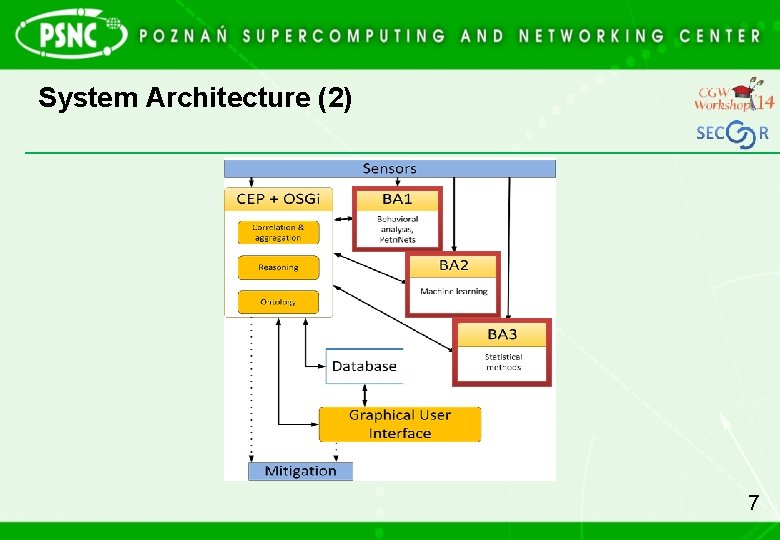
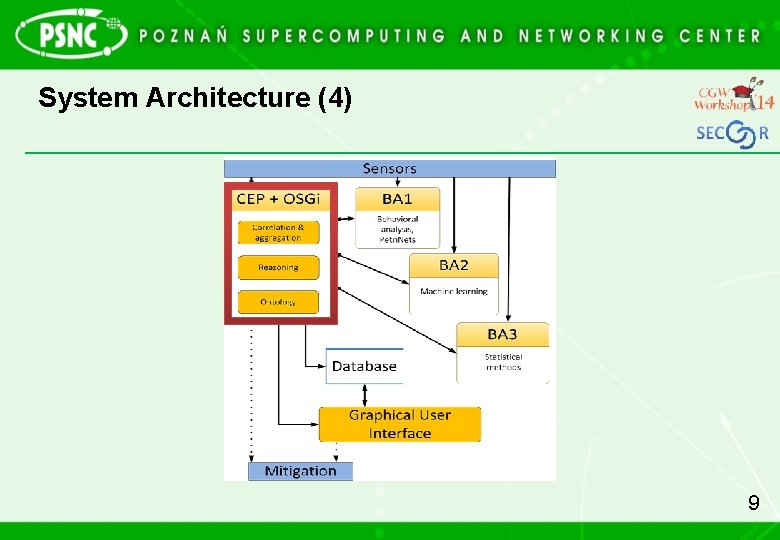
System Architecture (3) • Blocks of Analysis (BAs) – BA 1: behavioral analysis, Petri nets – BA 2: machine learning • Neural networks • Graph clustering algorithms • Machine learning – BA 3: statistical methods 8
System Architecture (4) 9
System Architecture (5) 10
System Architecture (6) 11
Agenda • Introduction • System Architecture • Blocks of Analysis (BAs) • • • Petri nets Machine learning Neural networks Graph Clustering algorithms Statistical anomaly detection • WSO 2 12
Blocks of Analysis – Ontology and Petri nets • Detects: malware • Which attacks are detected: malware • Sensors: Process Monitor (Sysinternals) [system file activity, system registry, process and services activity, network communication] • Data: Process Index, Time of Day, Process Name, PID, Operation, Path, Result, Detail 13
Agenda • Introduction • System Architecture • Blocks of Analysis (BAs) • • • Petri nets Machine learning Neural networks Graph Clustering algorithms Statistical anomaly detection • WSO 2 14
Blocks of Analysis – Machine learning • Detects: anomaly/attacks in network traffic • Which attacks are detected: SQL Injection, XSS, attacks on application layer • Sensors: SNORT, TCPDump, NGREP, ICD, PHP-IDS, Green. SQL, SCALP • Data: – Transport layer (WWW services connections) – Application layer (HTTP protocol) – Application layer logs (data in the filesystem) 15
Agenda • Introduction • System Architecture • Blocks of Analysis (BAs) • • • Petri nets Machine learning Neural networks Graph Clustering algorithms Statistical anomaly detection • WSO 2 16
Blocks of Analysis – Neural networks (1) • Detects: anomaly/attacks on operating system • Which attacks are detected: changed code in memory, incorrect activity of replaced binaries • Sensors: strace • Data: syscall (system calls) 17
Blocks of Analysis – Neural networks (2) • System calls • Altered code in memory even if the binaries on disk are left intact • Networks trained on genuine binaries 18
Blocks of Analysis – Neural networks (3) 19
Agenda • Introduction • System Architecture • Blocks of Analysis (BAs) • • • Petri nets Machine learning Neural networks Graph Clustering algorithms Statistical anomaly detection • WSO 2 20
Blocks of Analysis – Graph Clustering algorithms • • Detects: malware, network anomaly/attacks Which attacks are detected: network attacks Sensors: network device, system daemons, ntdump, flow-tool Data: Net. Flow 21
Network flows (Net. Flows) – collecting data for graph based model • Net. Flow/IPFIX processing general schema 22
Network flows (Net. Flows) – graph representations 23
Examples of simplified Net. Flow graphs DARPA sets SMTP HTTP and SSH 24
Querying the Graph. DB – example • Identification of services listening on high ports and their clients • Cypher query: MATCH (ip: IPclust)->(s: IPnode)--> (f: Flow {current: true})<--(d: IPnode) WHERE d. port >1024 RETURN DISTINCT ip. ip, d. ip; Table with information only about the host initiating the connection s. Ip (source IP) d. Ip (dest. IP) 172. 16. 114. 168 194. 27. 251. 21 172. 16. 114. 168 197. 182. 91. 233 172. 16. 114. 168 195. 115. 218. 108 172. 16. 114. 50 194. 27. 251. 21 172. 16. 114. 50 197. 218. 177. 69 172. 16. 114. 50 195. 115. 218. 108 172. 16. 114. 50 196. 37. 75. 158 172. 16. 114. 50 195. 73. 151. 50 172. 16. 114. 50 197. 182. 91. 233 172. 16. 114. 50 199. 174. 194. 1625
Agenda • Introduction • System Architecture • Blocks of Analysis (BAs) • • • Petri nets Machine learning Neural networks Graph Clustering algorithms Statistical anomaly detection • WSO 2 26
Blocks of Analysis – Statistical anomaly detection • Detects: network anomalies/attacks, malware • Which attacks are detected: viruses, action scanners, malware (botnets) • Sensors: network device, softflowd, nfcapd • Data: src(dst), address(port), flows length, packets, bytes, in(out)degree 27
Agenda • Introduction • System Architecture • Blocks of Analysis (BAs) • • • Petri nets Machine learning Neural networks Graph Clustering algorithms Statistical anomaly detection • WSO 2 28
WSO 2 (1) • The user application is based on the WSO 2 system • • Comprehensive tool for the analysis of event streams Contains useful built-in components, some of which we use in SECOR): – – – CEP system High performance engine to analyze events streaming (Esper or Siddhi) Events monitoring system Web-based management application Convenient integration with other systems (RESTful HTTP, JMS, SOAP, files and e-mail messages sent as JSON, XML or text messages) 29
WSO 2 (2) • Siddhi Query Language examples: 30
Questions? • Contact information of Security Team in PSNC: – marek. pawlowski@man. poznan. pl (Marek Pawłowski) – security@man. poznan. pl – http: //security. psnc. pl/en 31
This work was partially supported by Applied Research Programme (PBS) of the National Centre for Research and Development (NCBi. R) funds allocated for the Research Project number PBS 1/A 3/14/2012 (SECOR). Poznań Supercomputing and Networking Center affiliated to the Institute of Bioorganic Chemistry of the Polish Academy of Sciences, ul. Noskowskiego 12/14, 61 -704 Poznań, POLAND, Office: phone center: (+48 61) 858 -20 -00, fax: (+48 61) 852 -59 -54, e-mail: office@man. poznan. pl, http: //www. psnc. pl