
APPLICATION OF NURSING THEORIES Katherine Kolcabas Theory of
APPLICATION OF NURSING THEORIES: Katherine Kolcaba’s Theory of Comfort & Jean Watson’s Human Caring Theory Maryam Mohamed Student ID: 3475558 NURS 608: Philosophical Foundations of Nursing November 10, 2020

KATHERINE KOLCABA Katherine Kolcaba was born in Cleveland, Ohio and graduated from St. Luke’s Hospital School of Nursing in Cleveland in 1965. She practiced in medical surgical nursing, long-term care, and later on took on a master’s degree specialized in gerontology (Kolcaba, 2002). While pursing her doctorate she developed the Theory of Comfort and graduated with a Ph. D in Nursing in 1997 (Kolcaba, 2002) The comfort theory promotes comfort as a positive outcome of nursing care (Kolcaba, 2017). Retrieved from https: //2013 upoujohanearlman. wordpress. com/2013/06/27/biograph y-2/

KATHARINE KOLCABA’S COMFORT THEORY Kolcaba et al. , (2006) states that comfort exists in three forms: Relief Ease Transcendence Retrieved from: https: //www. npr. org/sections/healthshots/2015/06/22/415048075/to-ease-painreach-for-your-playlist-instead-of-popping-a -pill
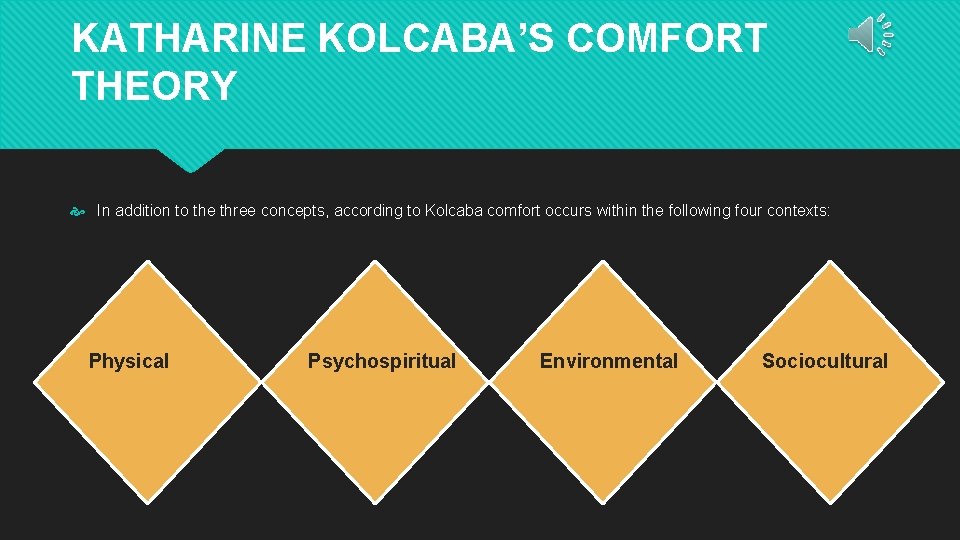
KATHARINE KOLCABA’S COMFORT THEORY In addition to the three concepts, according to Kolcaba comfort occurs within the following four contexts: Physical Psychospiritual Environmental Sociocultural
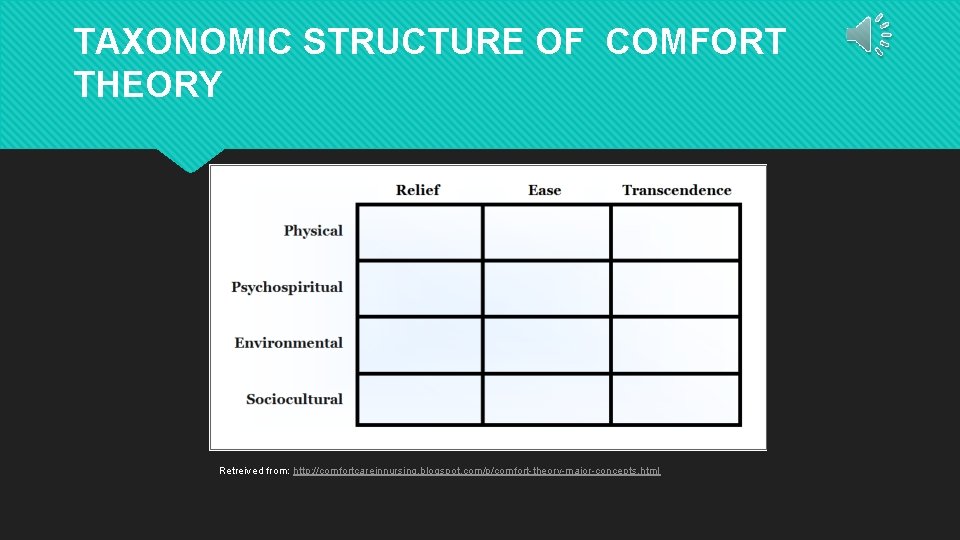
TAXONOMIC STRUCTURE OF COMFORT THEORY Retreived from: http: //comfortcareinnursing. blogspot. com/p/comfort-theory-major-concepts. html
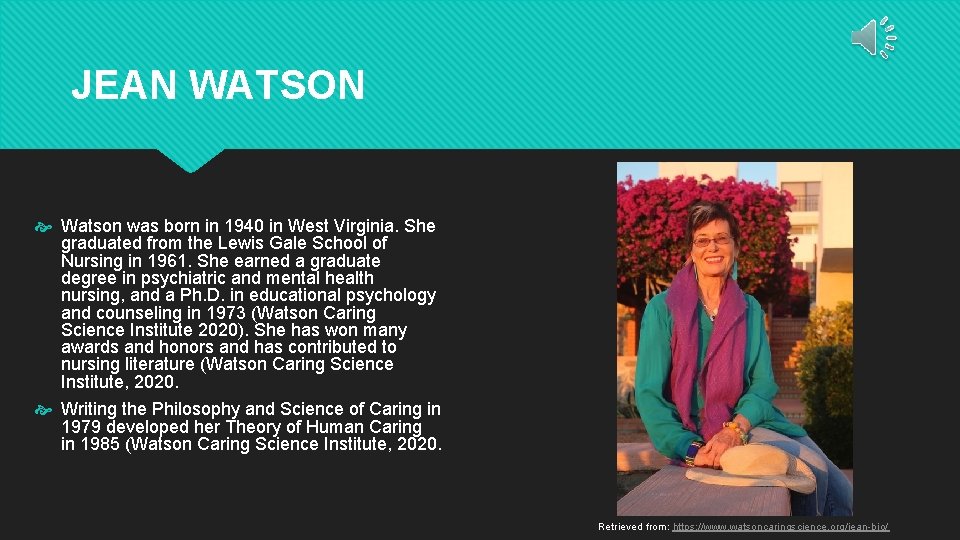
JEAN WATSON Watson was born in 1940 in West Virginia. She graduated from the Lewis Gale School of Nursing in 1961. She earned a graduate degree in psychiatric and mental health nursing, and a Ph. D. in educational psychology and counseling in 1973 (Watson Caring Science Institute 2020). She has won many awards and honors and has contributed to nursing literature (Watson Caring Science Institute, 2020. Writing the Philosophy and Science of Caring in 1979 developed her Theory of Human Caring in 1985 (Watson Caring Science Institute, 2020. Retrieved from: https: //www. watsoncaringscience. org/jean-bio/
JEAN WATSON’S THEORY OF HUMAN CARING Jean Watson’s Theory of Human Caring emphasizes the human component of care, which comprises of the caregiver, the client-patient, and the spiritual connection between the two. (Aghaei et al. , 2020) The theory encourages harmony between mind, body, and soul (Aghaei et al. , 2020). Retrieved from: https: //www. dailypioneer. com/2018/vivacity/spiritual-way-toharmony. html

WATSON’S 10 CARITAS PROCESSES 1. Practicing loving-kindness and equanimity within context of caring consciousness. 2. Being authentically present and enabling, and sustaining the deep belief system and subjective life world of self and one-being cared for. 3. Cultivating one’s own spiritual practices and transpersonal self, going beyond ego self. 4. Developing and sustaining a helping-trusting, authentic caring relationship. 5. Being present to, and supportive of the expression of positive and negative feelings. 6. Creatively using self and all ways of knowing as part of the caring process; engaging in artistry of caring-healing practices. 7. Engaging in genuine teaching-learning experience that attends to wholeness and meaning, attempting to stay within other’s frame of reference. 8. Creating healing environment at all levels, whereby wholeness, beauty, comfort, dignity, and peace are potentiated. 9. Assisting with basic needs, with an intentional caring consciousness, administering ‘human care essentials, ’ which potentiate alignment of mind-body-spirit, wholeness in all aspects of care. 10. Opening and attending to mysterious dimensions of one’s life-death; soul care for self and the one-being-cared for; “allowing and being open to miracles. (Hesook & Kollak, 2006) Retrieved from: https: //www. watsoncaringscience. org/
Practise Scenario Laura is recently diagnosed with end staged cancer. Since admission, she reports having severe pain not subsiding with oral narcotics. Laura is tearful and disengaged. When asked how she is feeling today Laura yells “I haven’t slept all night from this pain and I smell terrible from not being offered to wash in days!” She continues to say, “how am I going to face my children and husband whom I haven’t seen since I got here to tell them I’m dying? !” I assure her that I will care for her to the best of my ability. I begin by informing the physician about Laura’s uncontrolled pain and ask for a consult to the palliative care team for pain management. I set up a morphine infusion pump and Laura reports that her pain is much more tolerable. I affirm to Laura that she demonstrates strength during this difficult time and appears happier than this morning. I help her wash and change. After decluttering the patient’s room, with her permission, I phone the family and ask if they would like to come for a visit. Laura expresses that she calm and ready to address her family without support. Before the end of my shift, I confirm that there is enough morphine in the pump for the night, provide a glass of water, and supply Laura with a heated blanket.
COMPARING THEORIES Kolcaba’s Comfort Theory Watson’s Human Caring Theory Task-based interventions are implemented to meet the patient’s need Focus is placed on compassionate care, active listening, hope, and spiritual calmness The ultimate goal is patient comfort and transcendence The fundamental goal is a trusting deep transpersonal relationship The Comfort Theory can be applied to many health care settings Challenges arise when attempting to apply this theory to brief clinical encounters (Aghaei et al. , 2020) More research need to be conducted to study the effects on nurses (Krinsky et al. , 2014) Despite the differences between these two theories, they both represent holistic based approaches to healthcare!
REFERENCES Aghaei, M. H, Vanaki, Z. , & Mohammadi E. (2020). Watson’s Human Caring Theory-Based Palliative Care: A Discussion Paper. International Journal of Cancer Management. , 13(6): e 103027. doi: 10. 5812/ijcm. 103027. Hessok, S. K. , & Kollak, I. (2006). Nursing Theories; Conceptual and Philosophical Foundations, Second Edition: Vol. 2 nd ed. Springer Publishing Company. [ebook]. Kolcaba, K. , & Di. Marco, M. A. (2005). Comfort Theory and its application to pediatric nursing. Pediatric nursing, 31(3), 187– 194. https: //pubmed. ncbi. nlm. nih. gov/16060582/. Kolcaba, K. (2017). Comfort theory. In J. Fitzpatrick (Ed. ), Encyclopedia of nursing research (4 th ed. ). Springer Publishing Company. https: //0 -search-credoreferencecom. aupac. lib. athabascau. ca/content/entry/spennurres/comfort_theory/0 Krinsky, R. , Murillo, I. , & Johnson, J. (2014). A practical application of Katharine Kolcaba's comfort theory to cardiac patients. Applied nursing research: ANR, 27(2), 147– 150. https: //doi. org/10. 1016/j. apnr. 2014. 02. 004 Shu Hua NG. (2017). Application of Kolcaba’s Comfort Theory to the Management of Patients with Hepatocellular Carcinoma. Singapore Nursing Journal, 44(1), 16 -23. http: //eds. a. ebscohost. com/eds/detail? vid=0&sid=6 da 62672 -8 f 40 -4 ee 1 -876 e-ead 124 bf 2 ec 0%40 sessionmgr 4007&bdata=Jn. Npd. GU 9 ZWRz. LWxpdm. U%3 d#AN=124789969&db=rzh Watson Caring Science Institute. (2020). 10 Caritas Processes. https: //www. watsoncaringscience. org/jean-bio/caring-science-theory/10 -caritasprocesses/
![IMAGE REFERENCES Earl, J. (2013). Katherine Kolcaba [Image]. https: //2013 upoujohanearlman. wordpress. com/category/the-comfort-theory/ Fabrizio,](http://slidetodoc.com/presentation_image_h2/6b0a9933e2e1696e7adb02bfaca197a6/image-12.jpg "IMAGE REFERENCES Earl, J. (2013). Katherine Kolcaba [Image]. https: //2013 upoujohanearlman. wordpress. com/category/the-comfort-theory/ Fabrizio,")
IMAGE REFERENCES Earl, J. (2013). Katherine Kolcaba [Image]. https: //2013 upoujohanearlman. wordpress. com/category/the-comfort-theory/ Fabrizio, M. (2015). Girl listening to music [Image]. NPR. https: //www. npr. org/sections/healthshots/2015/06/22/415048075/to-ease-pain-reach-for-your-playlist-instead-of-popping-a-pill Kolcaba, K. (2003). Taxonomical Structure [Image]. Springer Publishing Company. http: //comfortcareinnursing. blogspot. com/p/comfort-theory-major-concepts. html Nikunj, R. (2018). Beach. [Image] The Daily Pioneer. https: //www. dailypioneer. com/2018/vivacity/spiritual-way-toharmony. html Watson Caring Science Insitute. (2020). Jean Watson [Image]. https: //www. watsoncaringscience. org/jean-bio/
- Slides: 12