
Application of Kalman Filters in Orbit Determination Abdul
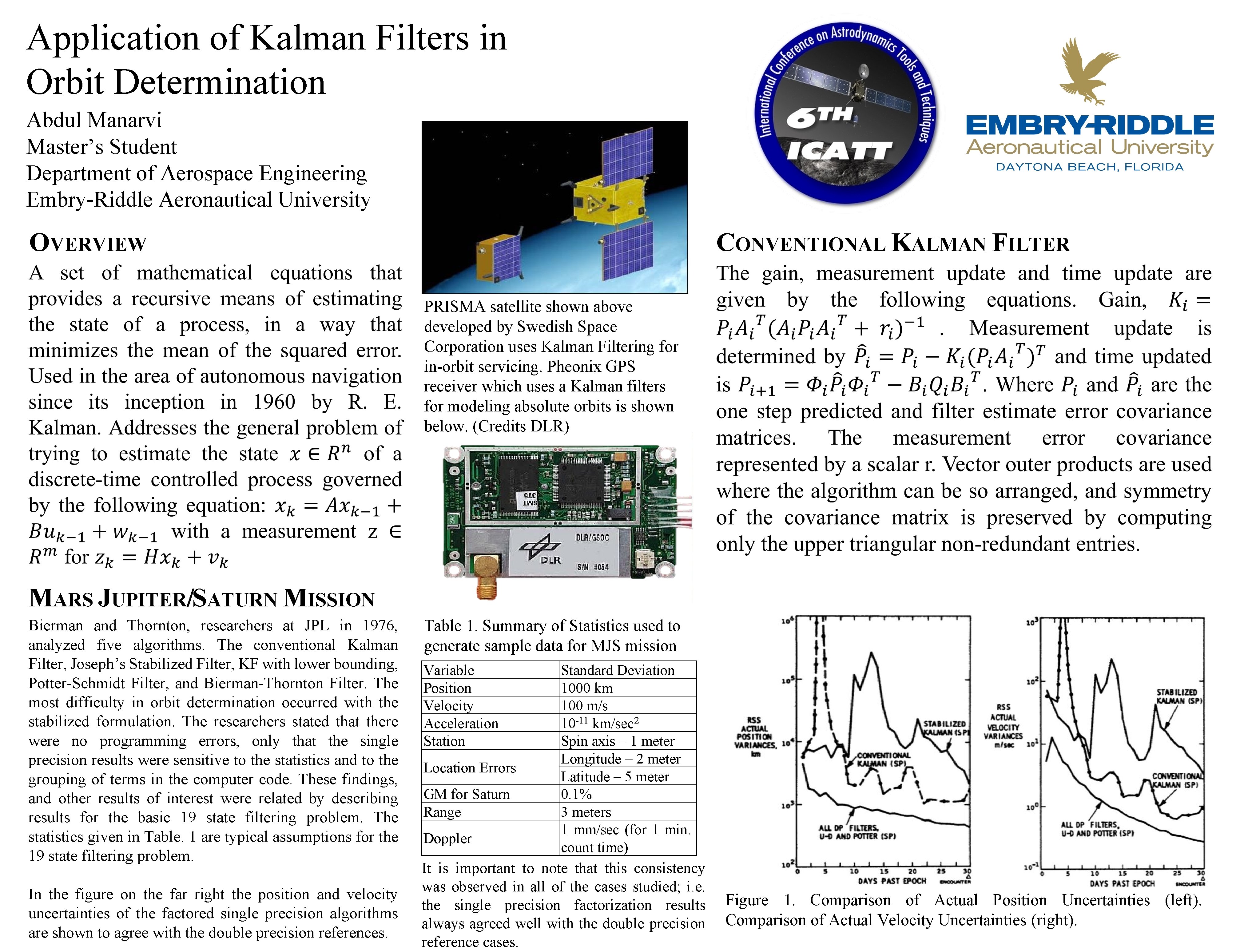
Application of Kalman Filters in Orbit Determination Abdul Manarvi Master’s Student Department of Aerospace Engineering Embry-Riddle Aeronautical University OVERVIEW CONVENTIONAL KALMAN FILTER PRISMA satellite shown above developed by Swedish Space Corporation uses Kalman Filtering for in-orbit servicing. Pheonix GPS receiver which uses a Kalman filters for modeling absolute orbits is shown below. (Credits DLR) MARS JUPITER/SATURN MISSION Bierman and Thornton, researchers at JPL in 1976, analyzed five algorithms. The conventional Kalman Filter, Joseph’s Stabilized Filter, KF with lower bounding, Potter-Schmidt Filter, and Bierman-Thornton Filter. The most difficulty in orbit determination occurred with the stabilized formulation. The researchers stated that there were no programming errors, only that the single precision results were sensitive to the statistics and to the grouping of terms in the computer code. These findings, and other results of interest were related by describing results for the basic 19 state filtering problem. The statistics given in Table. 1 are typical assumptions for the 19 state filtering problem. In the figure on the far right the position and velocity uncertainties of the factored single precision algorithms are shown to agree with the double precision references. Table 1. Summary of Statistics used to generate sample data for MJS mission Variable Position Velocity Acceleration Standard Deviation 1000 km 100 m/s 10 -11 km/sec 2 Spin axis – 1 meter Longitude – 2 meter Location Errors Latitude – 5 meter GM for Saturn 0. 1% Range 3 meters 1 mm/sec (for 1 min. Doppler count time) It is important to note that this consistency was observed in all of the cases studied; i. e. the single precision factorization results always agreed well with the double precision reference cases. Figure 1. Comparison of Actual Position Uncertainties (left). Comparison of Actual Velocity Uncertainties (right).
- Slides: 1