
Application of Ethical Principles During the Informed Consent

- Slides: 32
Application of Ethical Principles During the Informed Consent Process for Clinical Trials Barbara E. Barnes, MD, MS Joanne Russell, MPPM Maurice Clifton, MD, MSEd David Barnard, Ph. D University of Pittsburgh School of Medicine
Funded by Human Subject Research Enhancement Program S 07 RR 018239 -02 Department of Health and Human Services National Institutes of Health National Center for Research Resources
Background • Informed consent is the foundation for ethical research with human subjects • Actual process presents many challenges – Gulf between scientists and laypeople – Required language in consent documents – Psychological situation of patient-subjects
Goals • Develop communications skills curriculum for informed consent to research for clinical investigators and coordinators – Demonstrate benchmark standards for ethical consent – Interactive session to practice their skills – Utilize their own protocols – Focused feedback to the workshop participants on their communications skills – Measure effect and satisfaction
Tools • Background reading • Guidelines for ethical consent – Behaviorally operationalize guidelines • “Gold standard” video example • Standardized Patient (SPs) cases
Background Reading • Pre-assigned reading material distributed three weeks prior to seminar – Belmont Report – Five articles on informed consent for research – Course handouts
Guidelines for Ethical Consent • Content items and process items • Formed basis for didactic curriculum • Observer checklists (dichotomous) – Content items – Communication behaviors • SP checklist (Likert) – Communication behaviors
Observer Content Checklist • 27 items (Yes/No) • Examples: – Prognosis without treatment – Review standard treatments, including the no treatment option – Advantages of standard treatment – Disadvantages of standard treatment
Observer communication checklist • 14 items (Yes/No) • Examples: – Context: Establishing a mutual understanding of the patient’s current situation – Describe joint decision making – Check preferred decision making style (involved or not) – Check information preference of patient – Assess medical knowledge
SP communication checklist • • 14 items (Likert 1 -5) Examples: – The investigator provided opportunities for me to take an active role in the decision-making process. – The investigator invited me to make comments about what I was told and invited me to ask him/her questions about things I did not completely understand. Not at all 1 Some of the time 2 3 All of the time 4 5
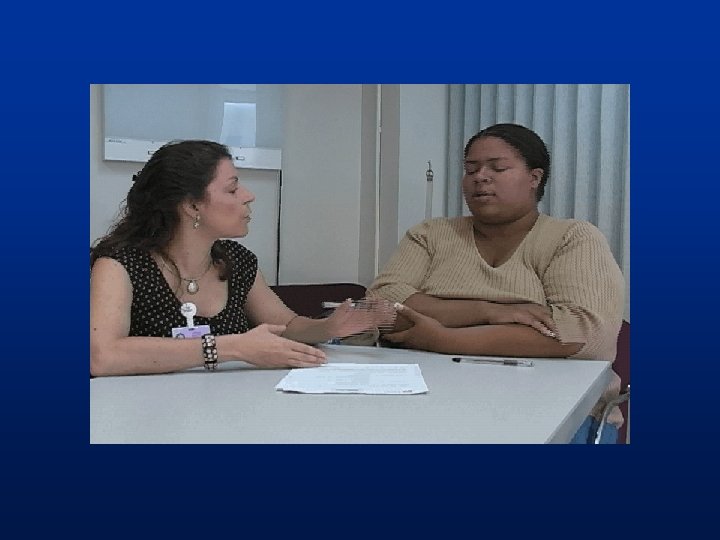
“Gold standard” Video Example • Script written to include all positive behaviors • 17 short clips integrated into didactic sessions – 10 seconds – 2 minutes long
Standardized Patient (SPs) Cases • Based on challenging but common subject types as perceived by the University’s Compliance Auditor • Adapted to meet enrollment criteria of workshop participants’ studies
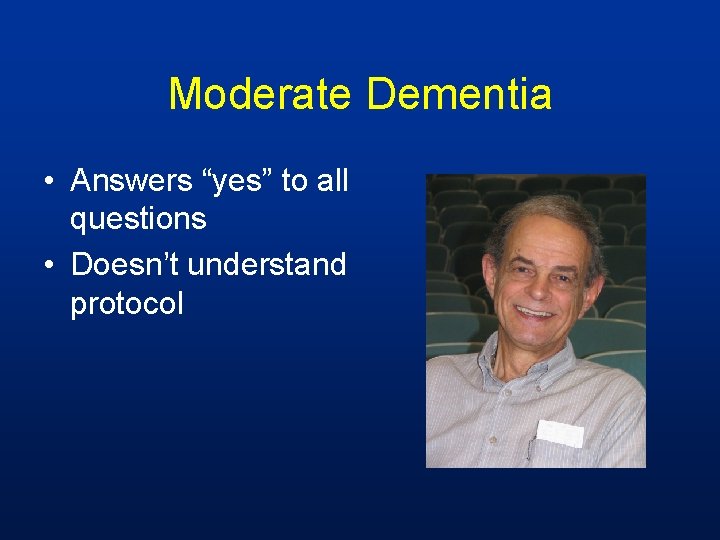
Moderate Dementia • Answers “yes” to all questions • Doesn’t understand protocol
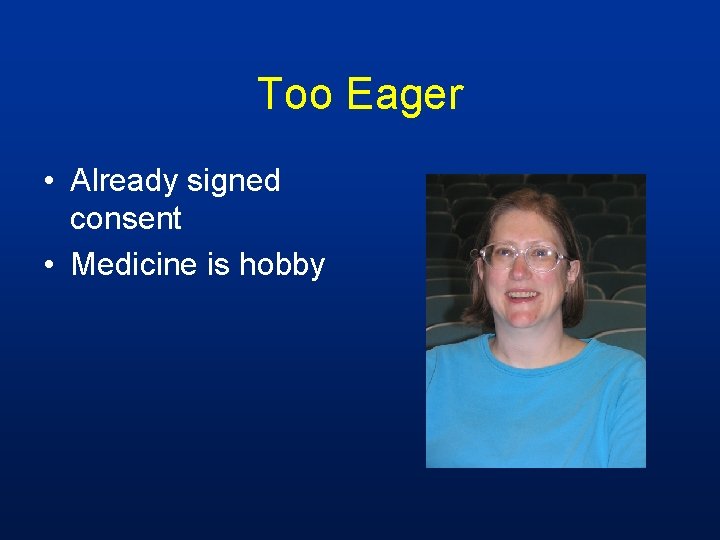
Too Eager • Already signed consent • Medicine is hobby
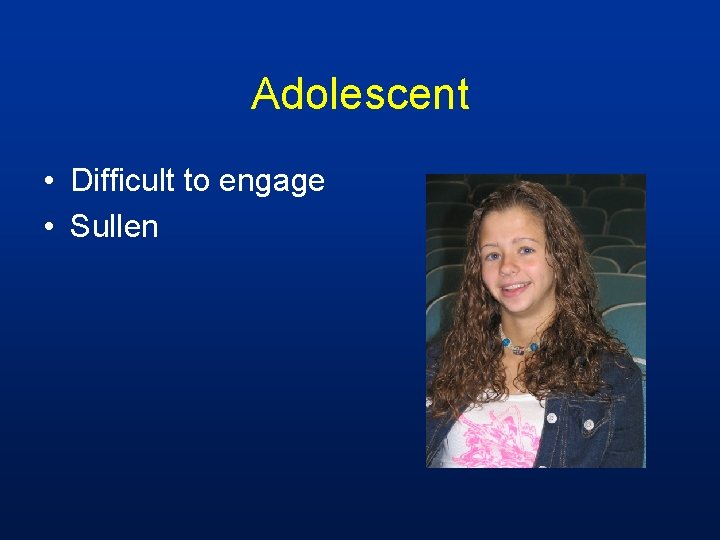
Adolescent • Difficult to engage • Sullen
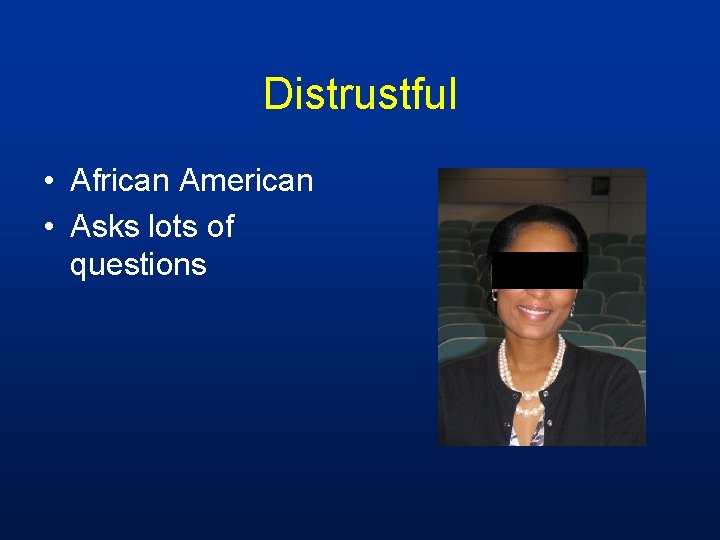
Distrustful • African American • Asks lots of questions
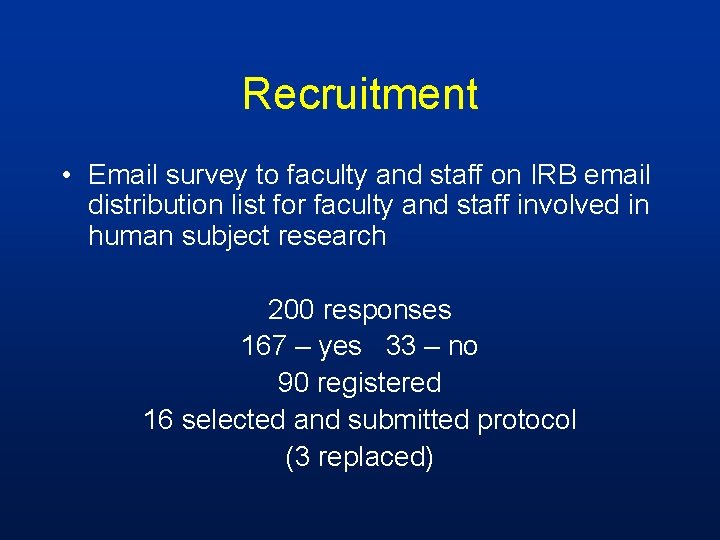
Recruitment • Email survey to faculty and staff on IRB email distribution list for faculty and staff involved in human subject research 200 responses 167 – yes 33 – no 90 registered 16 selected and submitted protocol (3 replaced)
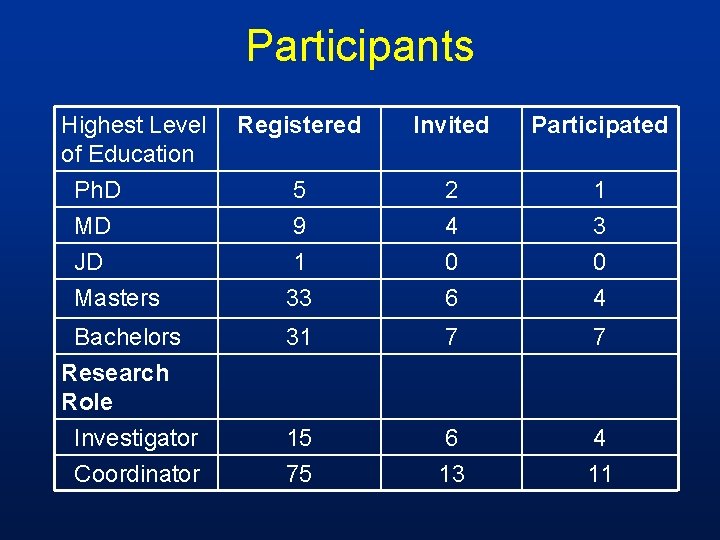
Participants Highest Level of Education Ph. D MD JD Masters Bachelors Research Role Investigator Coordinator Registered Invited Participated 5 9 2 4 1 33 0 6 0 4 31 7 7 15 75 6 13 4 11
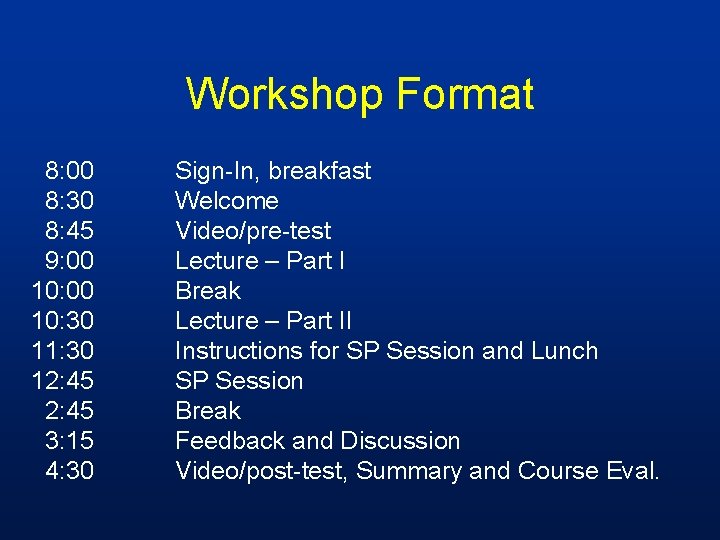
Workshop Format 8: 00 8: 30 8: 45 9: 00 10: 30 11: 30 12: 45 3: 15 4: 30 Sign-In, breakfast Welcome Video/pre-test Lecture – Part I Break Lecture – Part II Instructions for SP Session and Lunch SP Session Break Feedback and Discussion Video/post-test, Summary and Course Eval.
Interactive Session with Standardized Patients • 4 groups of participants • Rotated through SPs so each participant: – Presented their protocol to one SP of a given type – Observed the other three present protocols to the other three SPs – Gave feedback on the observed consents • SPs gave feedback based on their subject type and communications checklist
Results/Evaluation
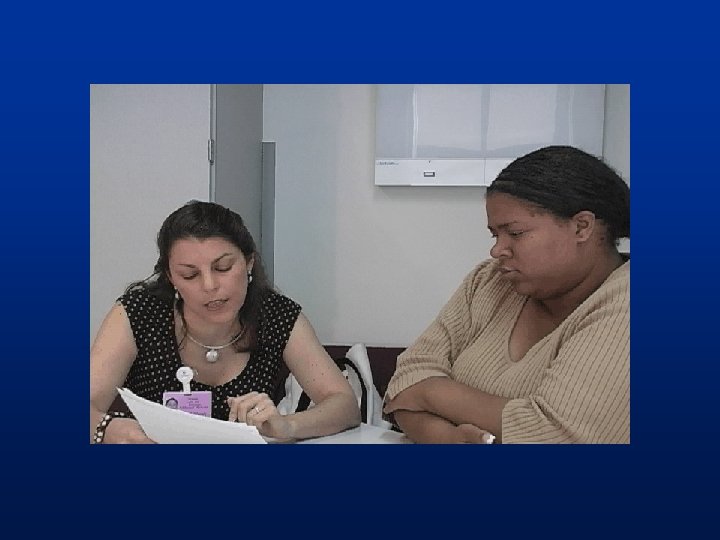
Pre-Post test • Script written to include positive and negative behaviors • 10 minute video consent developed using trained faculty member & SP • Used same actors as “gold standard” • Completed at beginning and end of workshop 1) Describe all the positive behaviors you observe 2) Describe all the behaviors which could be improved
Pre-Post Test • Separated written comments into individual behaviors or ideas • Qualitative methods to analyze comments • 26 categories
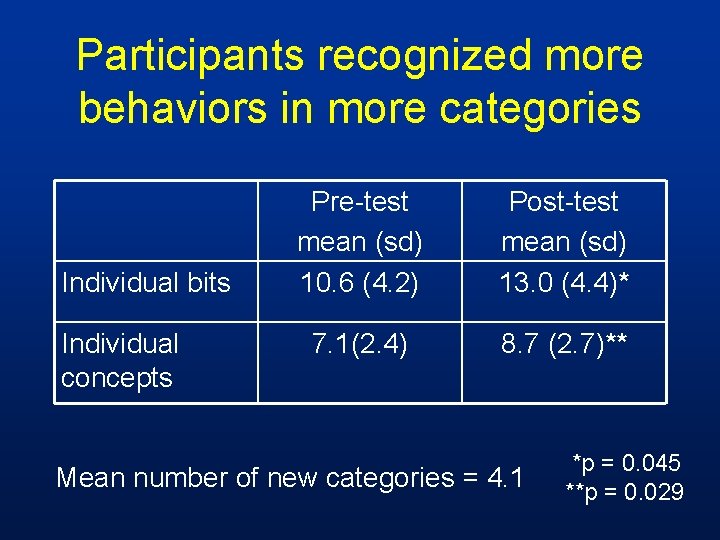
Participants recognized more behaviors in more categories Individual bits Individual concepts Pre-test mean (sd) 10. 6 (4. 2) Post-test mean (sd) 13. 0 (4. 4)* 7. 1(2. 4) 8. 7 (2. 7)** Mean number of new categories = 4. 1 *p = 0. 045 **p = 0. 029
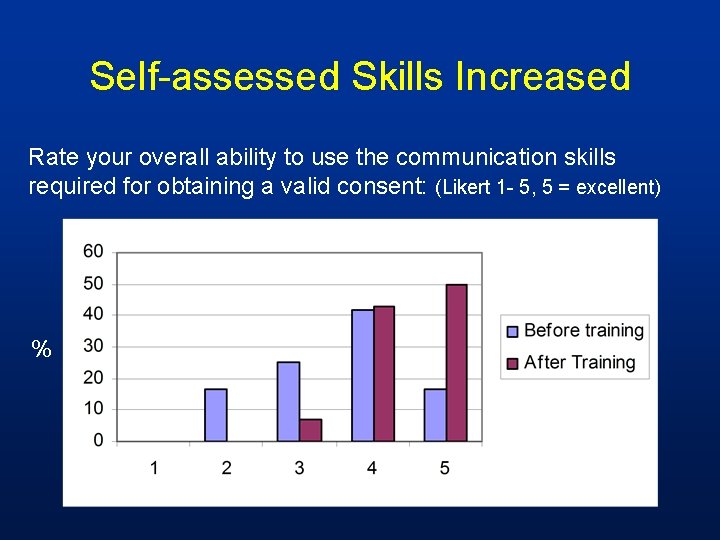
Self-assessed Skills Increased Rate your overall ability to use the communication skills required for obtaining a valid consent: (Likert 1 - 5, 5 = excellent) %
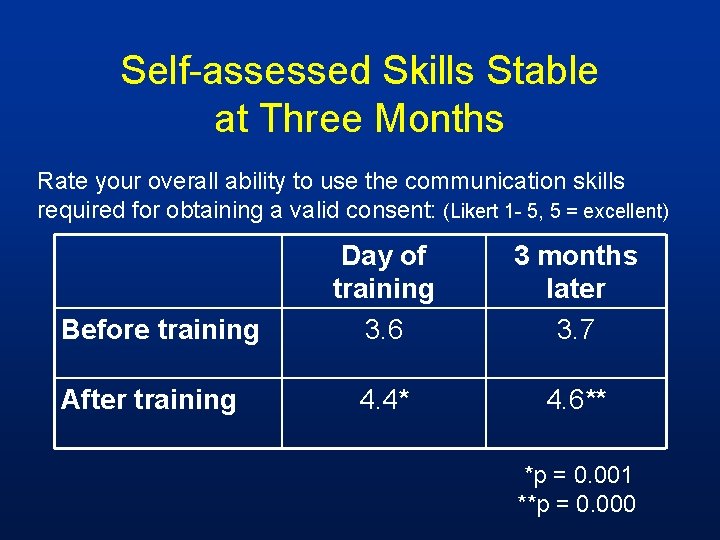
Self-assessed Skills Stable at Three Months Rate your overall ability to use the communication skills required for obtaining a valid consent: (Likert 1 - 5, 5 = excellent) Before training After training Day of training 3. 6 3 months later 3. 7 4. 4* 4. 6** *p = 0. 001 **p = 0. 000
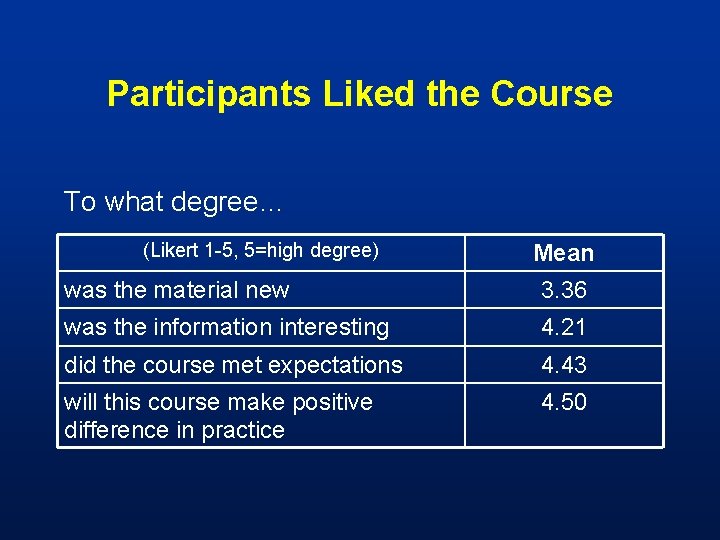
Participants Liked the Course To what degree… (Likert 1 -5, 5=high degree) Mean was the material new 3. 36 was the information interesting 4. 21 did the course met expectations 4. 43 will this course make positive difference in practice 4. 50
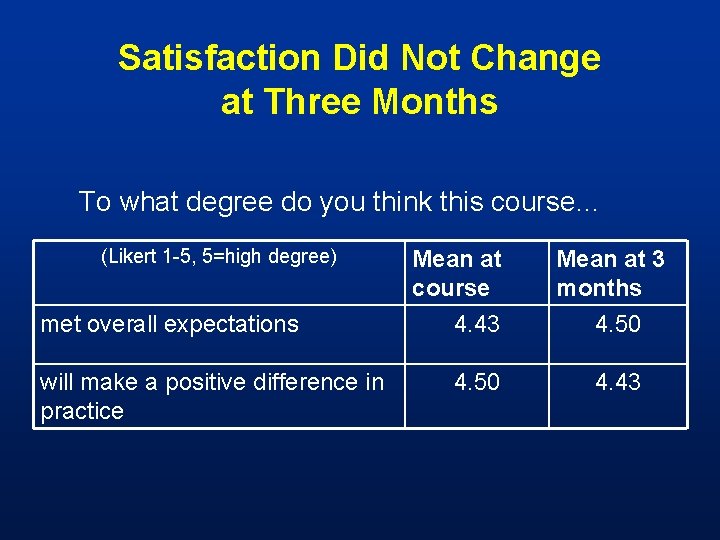
Satisfaction Did Not Change at Three Months To what degree do you think this course… (Likert 1 -5, 5=high degree) Mean at course Mean at 3 months met overall expectations 4. 43 4. 50 will make a positive difference in practice 4. 50 4. 43
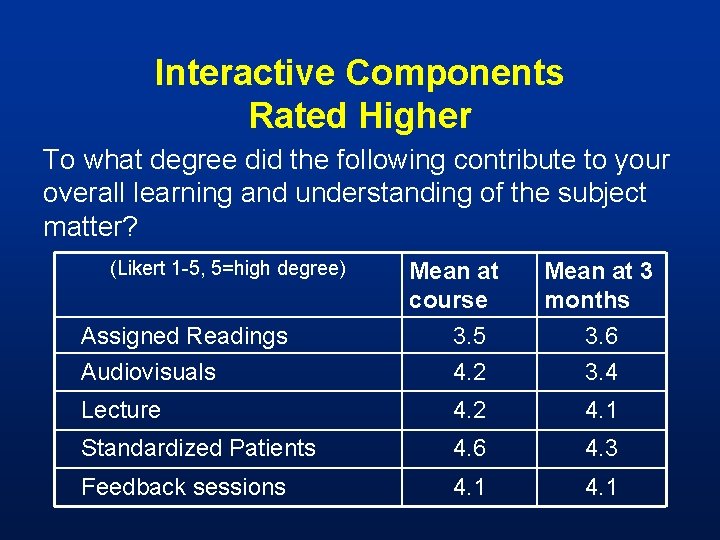
Interactive Components Rated Higher To what degree did the following contribute to your overall learning and understanding of the subject matter? (Likert 1 -5, 5=high degree) Mean at course Mean at 3 months Assigned Readings 3. 5 3. 6 Audiovisuals 4. 2 3. 4 Lecture 4. 2 4. 1 Standardized Patients 4. 6 4. 3 Feedback sessions 4. 1
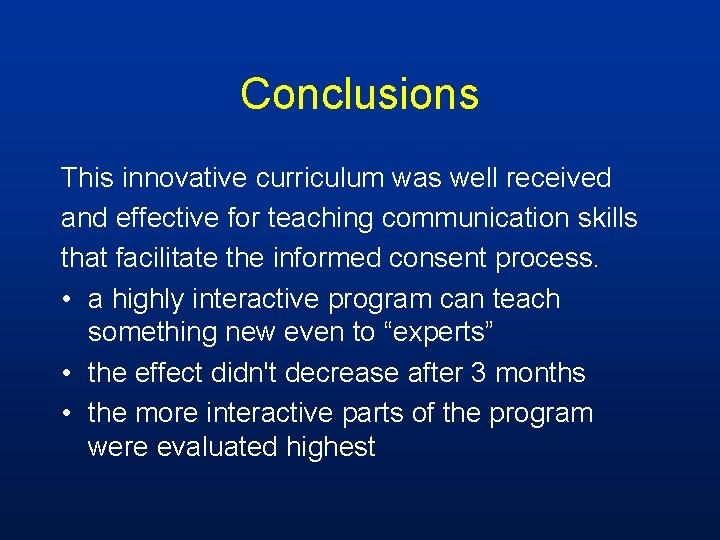
Conclusions This innovative curriculum was well received and effective for teaching communication skills that facilitate the informed consent process. • a highly interactive program can teach something new even to “experts” • the effect didn't decrease after 3 months • the more interactive parts of the program were evaluated highest