
APPLICATION OF ENVELOPE THEORY FOR 2 D FIRE
- Slides: 1
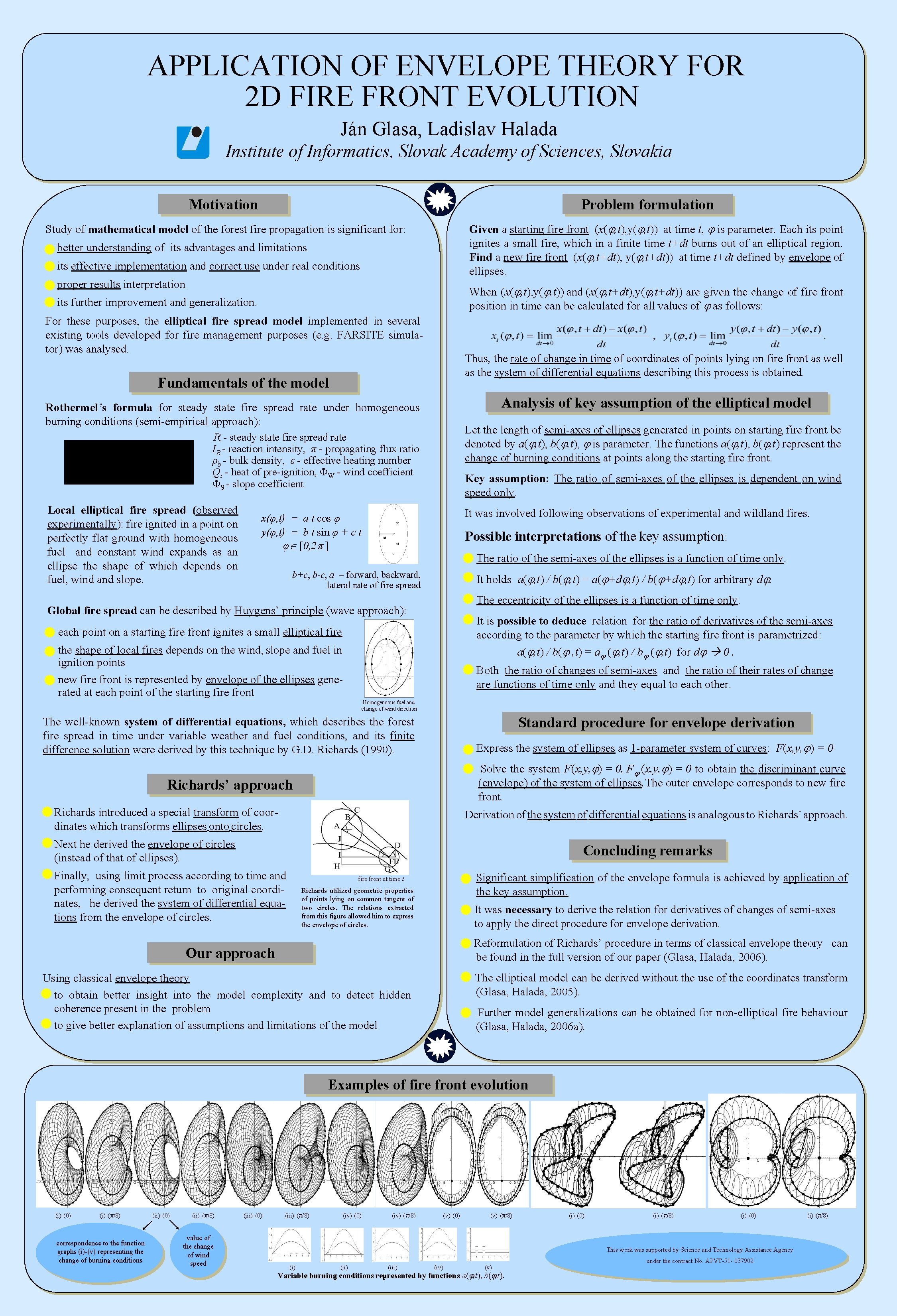
APPLICATION OF ENVELOPE THEORY FOR 2 D FIRE FRONT EVOLUTION Ján Glasa, Ladislav Halada Institute of Informatics, Slovak Academy of Sciences, Slovakia Motivation Problem formulation Given a starting fire front (x( , t), y( , t)) at time t, is parameter. Each its point ignites a small fire, which in a finite time t+dt burns out of an elliptical region. Find a new fire front (x( , t+dt), y( , t+dt)) at time t+dt defined by envelope of ellipses. Study of mathematical model of the forest fire propagation is significant for: better understanding of its advantages and limitations its effective implementation and correct use under real conditions proper results interpretation When (x( , t), y( , t)) and (x( , t+dt), y( , t+dt)) are given the change of fire front position in time can be calculated for all values of as follows: its further improvement and generalization. For these purposes, the elliptical fire spread model implemented in several existing tools developed for fire management purposes (e. g. FARSITE simulator) was analysed. Thus, the rate of change in time of coordinates of points lying on fire front as well as the system of differential equations describing this process is obtained. Fundamentals of the model Analysis of key assumption of the elliptical model Rothermel’s formula for steady state fire spread rate under homogeneous burning conditions (semi-empirical approach): Let the length of semi-axes of ellipses generated in points on starting fire front be denoted by a( , t), b( , t), is parameter. The functions a( , t), b( , t) represent the change of burning conditions at points along the starting fire front. R - steady state fire spread rate IR - reaction intensity, π - propagating flux ratio ρb - bulk density, ε - effective heating number Qi - heat of pre-ignition, ΦW - wind coefficient ΦS - slope coefficient Local elliptical fire spread (observed experimentally): fire ignited in a point on perfectly flat ground with homogeneous fuel and constant wind expands as an ellipse the shape of which depends on fuel, wind and slope. Key assumption: The ratio of semi-axes of the ellipses is dependent on wind speed only. It was involved following observations of experimental and wildland fires. x(φ, t) = a t cos φ y(φ, t) = b t sin φ + c t φ [0, 2 ] Possible interpretations of the key assumption: The ratio of the semi-axes of the ellipses is a function of time only. b+c, b-c, a – forward, backward, lateral rate of fire spread It holds a( , t) / b( , t) = a( +d , t) / b( +d , t) for arbitrary d. The eccentricity of the ellipses is a function of time only. Global fire spread can be described by Huygens’ principle (wave approach): It is possible to deduce relation for the ratio of derivatives of the semi-axes according to the parameter by which the starting fire front is parametrized: a( , t) / b( , t) = a ( , t) / b ( , t) for d 0. each point on a starting fire front ignites a small elliptical fire the shape of local fires depends on the wind, slope and fuel in ignition points new fire front is represented by envelope of the ellipses generated at each point of the starting fire front Both the ratio of changes of semi-axes and the ratio of their rates of change are functions of time only and they equal to each other. Homogenoous fuel and change of wind direction Standard procedure for envelope derivation The well-known system of differential equations, which describes the forest fire spread in time under variable weather and fuel conditions, and its finite difference solution were derived by this technique by G. D. Richards (1990). Express the system of ellipses as 1 -parameter system of curves: F(x, y, ) = 0 Solve the system F(x, y, ) = 0, F (x, y, ) = 0 to obtain the discriminant curve (envelope) of the system of ellipses. The outer envelope corresponds to new fire front. Richards’ approach Richards introduced a special transform of coordinates which transforms ellipses onto circles. Derivation of the system of differential equations is analogous to Richards’ approach. Next he derived the envelope of circles (instead of that of ellipses). Concluding remarks Finally, using limit process according to time and performing consequent return to original coordinates, he derived the system of differential equations from the envelope of circles. Significant simplification of the envelope formula is achieved by application of the key assumption. fire front at time t Richards utilized geometric properties of points lying on common tangent of two circles. The relations extracted from this figure allowed him to express the envelope of circles. It was necessary to derive the relation for derivatives of changes of semi-axes to apply the direct procedure for envelope derivation. Reformulation of Richards’ procedure in terms of classical envelope theory can be found in the full version of our paper (Glasa, Halada, 2006). Our approach The elliptical model can be derived without the use of the coordinates transform (Glasa, Halada, 2005). Using classical envelope theory to obtain better insight into the model complexity and to detect hidden coherence present in the problem to give better explanation of assumptions and limitations of the model Further model generalizations can be obtained for non-elliptical fire behaviour (Glasa, Halada, 2006 a). Examples of fire front evolution (i)-(0) (i)-( /8) correspondence to the function graphs (i)-(v) representing the change of burning conditions (ii)-(0) (ii)-( /8) value of the change of wind speed (iii)-(0) (iii)-( /8) (iv)-(0) (iv)-( /8) (v)-(0) (v)-( /8) (i)-(0) (i)-( /8) (i)-(0) This work was supported by Science and Technology Assistance Agency (i) (iii) (iv) (v) Variable burning conditions represented by functions a( , t), b( , t). under the contract No. APVT-51 - 037902. (i)-( /8)