
Application of dramatic elements Drama as a specific



- Slides: 50
◤ Application of dramatic elements Drama as a specific study
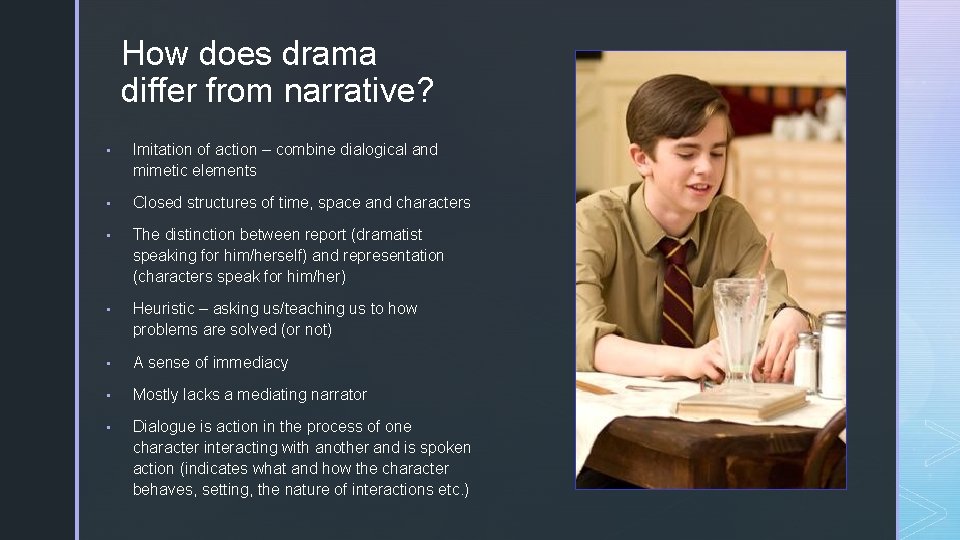
How◤does drama differ from narrative? ▪ Imitation of action – combine dialogical and mimetic elements ▪ Closed structures of time, space and characters ▪ The distinction between report (dramatist speaking for him/herself) and representation (characters speak for him/her) ▪ Heuristic – asking us/teaching us to how problems are solved (or not) ▪ A sense of immediacy ▪ Mostly lacks a mediating narrator ▪ Dialogue is action in the process of one character interacting with another and is spoken action (indicates what and how the character behaves, setting, the nature of interactions etc. )
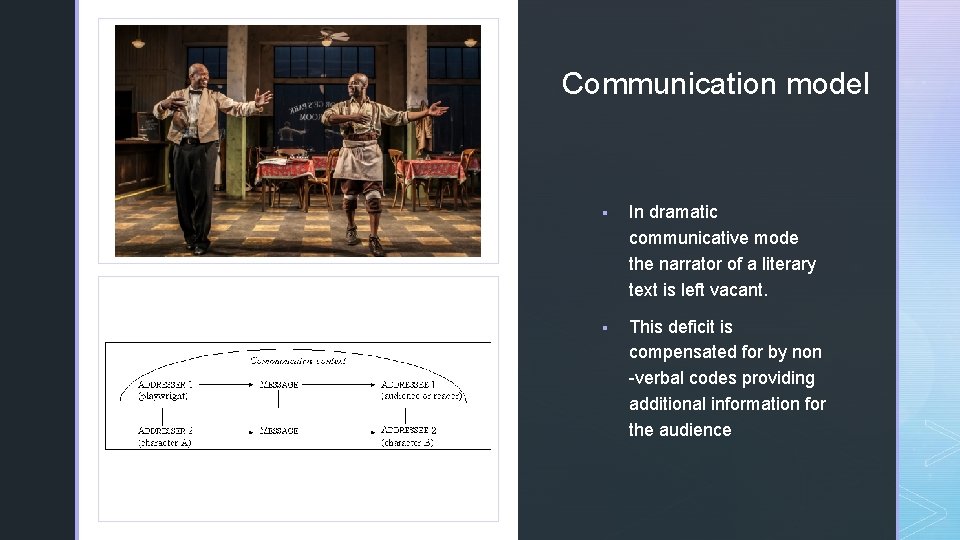
◤ Communication model ▪ In dramatic communicative mode the narrator of a literary text is left vacant. ▪ This deficit is compensated for by non -verbal codes providing additional information for the audience
◤ Dramatic figure (characterisation) ▪ The term “dramatic figure”, as opposed to characterisation, is a way of communicating the artifice and functionality and prevents us thinking of characters as real people. ▪ Dramatic figures cannot be separated from their context. Questions such as, What would Hally have done if Sam had hit him? are irrelevant. ▪ The set of information about a dramatic figure is finite and closed. Information about a real person may or may not be relevant to the action we observe, but each individual piece of information about a dramatic figure is specific and therefore of significance? ▪ Their name, age, physical appearance, ways of speaking, ways of dressing, reactions to others, evidence of personality type … anything the dramatist chooses to create
The dramatic figure: limitations in creating the dramatic figure ◤ Limitations – drama is… ▪ Shorter than the novel, so there is less time for character development ▪ Interiority is difficult as there is a lack of narration ▪ Less detailed and precise – the audience experiences the whole figure and not detailed understanding of parts of the individual ▪ Lack of omniscience - the dramatist reveals information to the audience but cannot comment on the situation as a whole ▪ Limited to what characters say ▪ More prone to tropes and types in characterisation
The dramatic figure: possibilities for the ◤ dramatic figure ▪ Multiple characters on stage create for the audience a polyperspectival (multiple perspectives as a response to single situation) through verbal and non-verbal communication. ▪ Superordinate figures can be part of the action but whose function is to provide something beyond the action: commentary, narrative transition. Their roles can be confirmed by the subordinate figures or undermined by them. They, however, provide a kind of cosmic perspective (Amadeus) ▪ The figure can be used to create a distorted perspective, so much so that the audience, using their experiences of other character perspectives or presentations recognises the distorted perspective as such. ▪ Onomastic codes – the semiotics of character names - can provide immediate understanding of characters in the text and in the figure interaction are often repeated – entries, exits, introductions.
Master Harold and the Boys questions ◤ ▪ What decisions has Fugard made in terms of sharing finite information in relation to the following characters? ▪ Sam ▪ Willie ▪ Hally’s mother ▪ Hally’s father ▪ How in combination do they become important? ▪ In what ways has Fugard created multiple perspectives on particular issues or events and why? ▪ Men of magnitude ▪ The dance competition ▪ The value of and transmission of education ▪ The kite flying incident ▪ The role of fathers ▪ Aesthetics, art, literature
Dramatis personae ◤ Dramatis Personae: The sum of all figures who appear on stage including minor figures ▪ Excludes persons referred to in the course of the dialogue and character interactions and who do not appear. Considerations include: ▪ ▪ Quantitative elements ▪ Size (the number of dramatic figures) ▪ Dominance (the amount of time a dramatic figure remains on stage) this can vary from act to act and scene to scene. A character can be central or peripheral based on their stage presence but their importance is not just defined by presence. A minor, or peripheral, figure may appear briefly but be significant in the plot or message of the playwright. Qualitative elements (suprahistorical contrasts) ▪ Male vs female – used to indicate power relationships, social mores and expectations ▪ Old vs young – generational shifts in attitude, proximity of death, responsibility ▪ Social class (Rich/Poor) - power and control, ambition, capitalism ▪ Nature and affectation - honesty and façade ▪ Black vs white - racism, cultural difference, power and control
◤ Configuration of dramatis personae Configuration refers to characters on stage at any point. This is not accidental and is manipulated by the playwright to emphasis similarities and differences, conflict, relationships and increasing tension. Some considerations: ▪ As dramatic figures are added to the stage the possibility for polylogue increases ▪ A single dramatic figure can be highlighted as different ▪ Groups or factions emerge ▪ Configural structures may increase the presence of fade away of a dramatic figure without them necessarily being ‘killed off’ ▪ The sequence in which dramatic figures are introduced and therefore highlight the suprahistorical elements
◤ The three dimensions of figure conception There are three ways to talk about the conception of a dramatic figure: ▪ Breadth: the number of possibilities a dramatic figure may present in the initial presentation to the audience. For example Is John going to recommence his affair with Abigail? The more ‘real’ and less ‘type’ a character is, the more the author raises questions for the audience. ▪ Length: the actual change and dynamism a dramatic figure undergoes in the play. This may or may not fulfil the possibilities initially presented by the playwright. ▪ Depth: the relationship between the external behaviour and our understanding of a dramatic figure’s inner life (giving voice to dilemmas, change of mind, interiority)
Activity -The Crucible ◤ In groups of 5 (one of 6) you will become the expert in the dramatic figure configuration in your act and for a specific dramatic figure. Within your group you will need to assign the following roles: 1. 2. 3. Identify the number of figures, their sequence, and the number and significance of entrances and exits in your given Act? Why? 4. Using the whole play and one central dramatic figure, examine the significance of breadth, length and depth for … Identify the significant suprahistorical elements in your Act and what is their significance? Identify the dominance of particular figures and their specific contributions in your Act (choose one central and one minor character) How long are they on stage and why? 1. 2. 3. 4. 5. Group 2 – Hale Group 3 – Elizabeth Group 4 - Abigail Using the whole play, and two minor/peripheral figures and examine the significance of breadth, length and depth for… 1. 2. 3. 4. 6. Group One – Proctor Group 1 – The Putnams Group 2 – Mary Warren Group 3 – Rebecca Nurse Group 4 – Tituba Group with 6 members: 6 th member to examine the significance of breadth, length and depth of Rev Parris Together you will make one or two summative statements about the importance of dramatic figures in the play, both specific to your Act and in the case of specific dramatic figures, across the four-act structure.
◤ What are the important elements of dramatic figure configurations in Act…. ? The important character configurations of Act … are:
◤ Sending and receiving information ▪ Verbal information
Verbal communication – the features of dramatic speech ◤ ▪ Dramatic speech deviates from, and is more complex than, real speech in a number of ways: ▪ The awareness of audience and their needs; The expressive nature of the dramatic figure; The author ▪ It is aesthetically functionalised; it is stylised ▪ Syntax, Rhetoric, Poetic, Diction – archaisms, coinage, repetition … ▪ It is polyfunctional ▪ Appellative – addressed to a particular person by use of name or pronoun (dialogical) ▪ Expressive – both the what and how of delivery tells us something about how the character feels (dialogical/monological) ▪ Referent – refers to something specific: action, event, character, relationship, place (dialogical/monological – diectic references) ▪ Phatic – maintains the dialogue between characters but doesn’t ‘say’ much ▪ Metalingual – where characters discuss or in the dialogue draw attention to ways of speaking ▪ Poetic – sits outside the communication process between characters but the audience is aware of author choices.
◤ Verbal communication Soliloquy and monologue ▪ ▪ Soliloquy – solo in a soliloquy the character speaks as if to him or herself. It can be attended but another character is not directly addressed ▪ Changes in direction inspired by the speaker alone. ▪ Provides commentary on past events or future possibilities ▪ Provides interiority: reflection, decision making, dilemma ▪ Can slow down action (pace) ▪ Artificial and unrealistic (audience must buy into the willing suspension of disbelief) ▪ Can give the impression of being premeditated (well formed ) or spontaneous Monologue ▪ Monologue – one speaker is distinguished by its length and relative completeness ▪ Unified direction, but characters refer to the listener by name or pronoun
◤ Verbal communication Asides ▪ Not always soliloquys or monological but resemble some aspects of the soliloquy because they diverge from the interaction of dialogue ▪ Can be long or short ▪ Monological asides can reflect on the action taking place and are self-addressed ▪ Break the laws of acoustics in that the other characters cannot hear what is said ▪ Can be addressed to a listener even though they cannot hear it – emphasises the difficulty of honest communication ▪ In the case of ad spectatores (to the audience) an aside breaks the internal communication system (“breaking the fourth wall”) ▪ When part of the flow of the dialogue can indicate conspiratorial or eavesdropping
Verbal communication ◤ Dialogue the interaction of two (dialogue) or more (polylogue) speakers can work in consensus, at cross-purposes or disrupted ways ▪ Changes in direction and semantics and fairly equal quantitatively, characters will often refer to each other by name or pronoun ▪ The frequency of interruption and equality of length helps dictate the closeness in the characters and increases the tempo of the exchanges ▪ The utterances are usually successive (they follow on from one another) when performed quickly they become stichomythia ▪ Simultaneous speech can occur in dialogue and is often comedic (Godot) ▪ Pauses and silences in dialogue interrupt the succession and create suspense, tension or allow time for the audience to react ▪ Monological structures can occur when two speakers speak their own chain of semantics which do not rely or concern themselves with the other character (Godot) ▪ A chorus in the Greek tradition summarises the action: several voices coming together to convey information
Master Harold and the Boys, The Crucible, Amadeus ◤ Compare the structures of speech notable in the three plays. Consider: 1. Who speaks and for how long and are there any significant ‘when’ moments? 2. Dialogue vs monologue and its influence on pace and perceptions of control? 3. The role of a mediating narrator? 4. How and when is the dialogue successive and who changes the direction? 5. Whether the dialogue feels realistic and at what points is it artifice in any way? 6. When are there silences and pauses, and why might these be significant? 7. The register (formality) and tone as a representation of power, context, relationship?
◤ The rhetoric of dialogue Logos, Ethos, Pathos Whilst traditionally associated with persuasive speaking, characters persuade us to their point of view through a number of means: Consider: Sam’s speech on page 57 – what does Fugard use to persuade the audience that Sam’s assessment is (in)correct? Hale’s speech on page 115 - What does Miller use to persuade the audience that Hale’s assessment is (in)correct? Danforth’s speech on page 90 and 92 – What does Miller use to persuade the audience that Danforth’s assessment is (in)correct?
◤ Advance information and audience expectations Consider the use of verbal foreshadowing in the three plays Which characters are we given verbal information in advance of their arrival ▪ Elizabeth ▪ Hale ▪ Salieri ▪ Mozart ▪ God Are our expectations confirmed or challenged?
◤ Audience awareness What does a standard audience bring in terms of awareness and what attitudes and perceptions does the author hope to exploit? ▪ Apartheid ▪ Ballroom dancing ▪ Salem witch trials ▪ Mc. Carthyism ▪ Mozart ▪ Music and composition
◤ Dramatic irony – internal and external communication systems in conflict Dramatic irony is the difference between what is known by all or some characters in the internal communication system and what is known by the audience. Dramatic irony does not occur in Master Harold; the information is revealed to us as it is revealed to the characters. Identify the key moments of dramatic irony in ▪ The Crucible ▪ Amadeus
◤ Non-verbal communication – sound and light ▪ Diegetic: source comes from the imaginary world of the fiction represented. The characters and the audience are exposed to the same ▪ Non-diegetic: source comes from outside the action and only the audience is subject to it. The characters remain unaware ▪ Internal-diegetic: where what is in a character’s head is heard by the audience ▪ Meta-diegetic – the source is diegetic but it is exaggerated, enhanced or distorted for dramatic effect. In your given play or act find as many examples as you can of light or sound that contribute to the action. Categorise them under the headings above. Comment on their literal and figurative contribution
◤ Lighting + sound Realism ▪ Meant to look like real: mimics lighting and sound in real life. ▪ Light can be total or partial ▪ Sound comes only from diegetic source and is not enhanced ▪ Deceptively difficult to achieve. Symbolism ▪ More interested in communicating an idea than real life ▪ Deliberately using certain colours for certain moments or spotlighting certain characters ▪ Deliberately Minimalism ▪ Use empty spaces ▪ relies on the actors to create the experience ▪ Location can be changed simply by changing the lighting state. ▪ Productions that use minimal costume and set often rely on complex lighting. Fantasy ▪ Allow the designer to create a new world ▪ A range of colours and special effects: strobe ▪ needs to maintain an internal logic
Structure ◤ To distinguish between story and plot in drama. ▪ ▪ ▪ Story addresses an assumed chronological sequence of event ▪ Plot refers to the way events are causally and logically connected. Aristotle is credited with the 3 unities of drama unity of plot, unity of place, and unity of time. Master Harold unity of place, time and plot Crucible no unity of place, not unity of time, unity of plot Amadeus not unity of place, not unity of time, unity of plot ▪ Closed structure: plays where the individual acts are tightly connected and logically built on one another, finally leading to a clear resolution of the plot ▪ Open structure: plays where scenes only loosely hang together and are even exchangeable at times and where the ending does not really bring about any conclusive solution or result
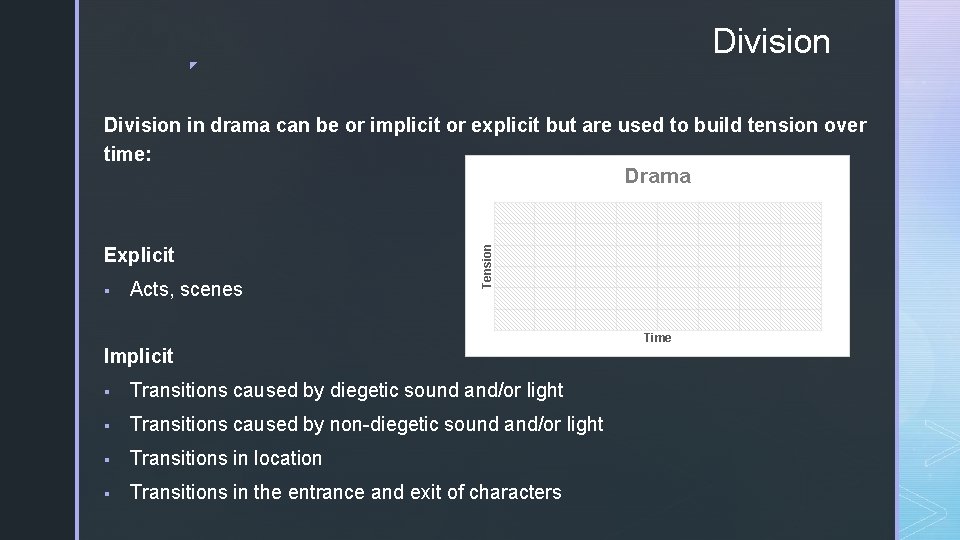
Division ◤ Division in drama can be or implicit or explicit but are used to build tension over time: Explicit ▪ Acts, scenes Tension Drama Time Implicit ▪ Transitions caused by diegetic sound and/or light ▪ Transitions caused by non-diegetic sound and/or light ▪ Transitions in location ▪ Transitions in the entrance and exit of characters
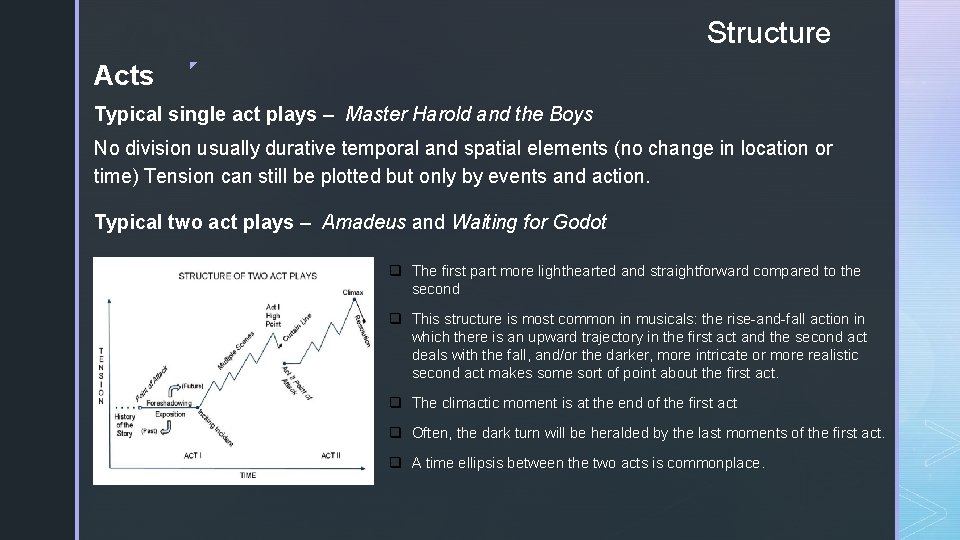
Structure Acts ◤ Typical single act plays – Master Harold and the Boys No division usually durative temporal and spatial elements (no change in location or time) Tension can still be plotted but only by events and action. Typical two act plays – Amadeus and Waiting for Godot q The first part more lighthearted and straightforward compared to the second q This structure is most common in musicals: the rise-and-fall action in which there is an upward trajectory in the first act and the second act deals with the fall, and/or the darker, more intricate or more realistic second act makes some sort of point about the first act. q The climactic moment is at the end of the first act q Often, the dark turn will be heralded by the last moments of the first act. q A time ellipsis between the two acts is commonplace.
◤ Structure Typical four act plays (a variant on the three act structure with the climax in Act 3. The Crucible ▪ ▪ ▪ Act 1, Act 2 a, Act 2 b and Act 3 The main story elements still apply – the inciting incident, the plot points, the pinch points, the midpoint, the dark night of the soul, the final battle, the denouement but they’re framed differently. Look for the five elements at act and whole play level: ▪ i) Status Quo ▪ ii) Incident ▪ iii) Initial Response ▪ iv) Escalation v) Decision Of particular note are the dramatic decisions/actions at the end of each act of The Crucible: ▪ End of Act 1 – Abigail decides to “open herself” this propels the action of Act 2 and the cause of the initial response ▪ End of Act 2 – Elizabeth is accused and John declares “God’s icy wind will blow” foreshadowing the action of Act 3 and the escalation ▪ End of Act 3 – Hale’s decision to “denounce these proceedings and “quit the court” delegitimises the court’s role in Act 4 and amplifies the tragic denouement. ▪
◤ Plot and plot points Whilst story is the chronology of people, place and time, plot contains important structural elements and is specifically related to causality. Story is made manageable by the representation of a story through its beginning, middle and end. Plot is caused by: ▪ Human: an action of a character. The action is deliberate and follows the following sequence: ▪ Situation ▪ Action of a character Successful change in the situation Spatial: a situation (a specific event /set of circumstances) ▪ ▪ Causes characters to act A combination of the two A lack of action – the reduction to only a series of events – is one of the most important structural transformations in 20 th Century drama (Waiting for Godot) The length of a story is not simply its duration, as the latter can be abbreviated or abridged. ▪ ▪
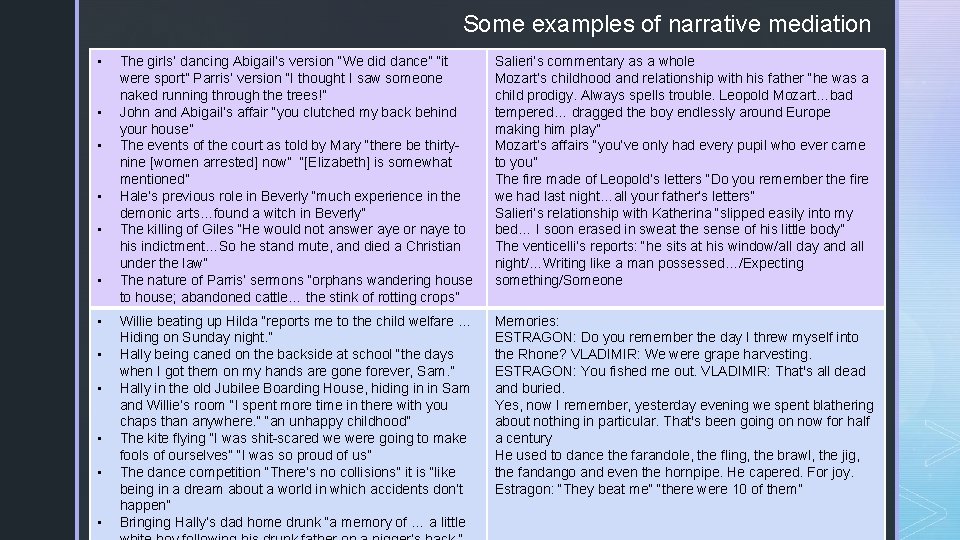
Mediated action Author’s use mediated action to bridge the difficulties of propriety, decency, or decorum. In contrast to novels (a ◤ solitary experiences) performance lowers the threshold of embarrassment; sometimes narrative mediation fills gaps that cannot or should not be performed. Where drama uses actions that breaks these social mores it is all the more vivid: ▪ ▪ Sam dropping his trousers and presenting his arse to the audience Hally spitting at Sam Mozart rolling around on the floor with Constanze and using scatological diction Lucky on the end of a rope Narrative mediation ▪ ▪ Fills in events that cannot be shown within the timeframe of the play ▪ Allows authors to emphasise phases of a story and keep others in the background (that background, however, is not unimportant and can provide context, change audiences’ judgement of the dramatic figure, give antecedents which help explain the current chain of events) ▪ ▪ ▪ Mediate in the anticipatory phase – foreshadowing and/or creating sense of anticipation Allows authors to remain spatially durative Filter events through human consciousness and therefore emotion and judgement Position events through specific dramatic figures and therefore create perspective – some of which maybe contradictory, given by different dramatic figures Mediate synchronously – scenic realisation of the action (simultaneous narration of action on stage = teichoscopy) Mediate retrospectively – recapitulates/ informs the audience.
Some examples of narrative mediation • • • The girls’ dancing Abigail’s version “We did dance” “it ◤ were sport” Parris’ version “I thought I saw someone naked running through the trees!” John and Abigail’s affair “you clutched my back behind your house” The events of the court as told by Mary “there be thirtynine [women arrested] now” “[Elizabeth] is somewhat mentioned” Hale’s previous role in Beverly “much experience in the demonic arts…found a witch in Beverly” The killing of Giles “He would not answer aye or naye to his indictment…So he stand mute, and died a Christian under the law” The nature of Parris’ sermons “orphans wandering house to house; abandoned cattle… the stink of rotting crops” Salieri’s commentary as a whole Mozart’s childhood and relationship with his father “he was a child prodigy. Always spells trouble. Leopold Mozart…bad tempered… dragged the boy endlessly around Europe making him play” Mozart’s affairs “you’ve only had every pupil who ever came to you” The fire made of Leopold’s letters “Do you remember the fire we had last night…all your father’s letters” Salieri’s relationship with Katherina “slipped easily into my bed… I soon erased in sweat the sense of his little body” The venticelli’s reports: “he sits at his window/all day and all night/…Writing like a man possessed…/Expecting something/Someone Willie beating up Hilda “reports me to the child welfare … Hiding on Sunday night. ” Hally being caned on the backside at school “the days when I got them on my hands are gone forever, Sam. ” Hally in the old Jubilee Boarding House, hiding in in Sam and Willie’s room “I spent more time in there with you chaps than anywhere. ” “an unhappy childhood” The kite flying “I was shit-scared we were going to make fools of ourselves” “I was so proud of us” The dance competition “There’s no collisions” it is “like being in a dream about a world in which accidents don’t happen” Bringing Hally’s dad home drunk “a memory of … a little Memories: ESTRAGON: Do you remember the day I threw myself into the Rhone? VLADIMIR: We were grape harvesting. ESTRAGON: You fished me out. VLADIMIR: That's all dead and buried. Yes, now I remember, yesterday evening we spent blathering about nothing in particular. That's been going on now for half a century He used to dance the farandole, the fling, the brawl, the jig, the fandango and even the hornpipe. He capered. For joy. Estragon: “They beat me” “there were 10 of them”
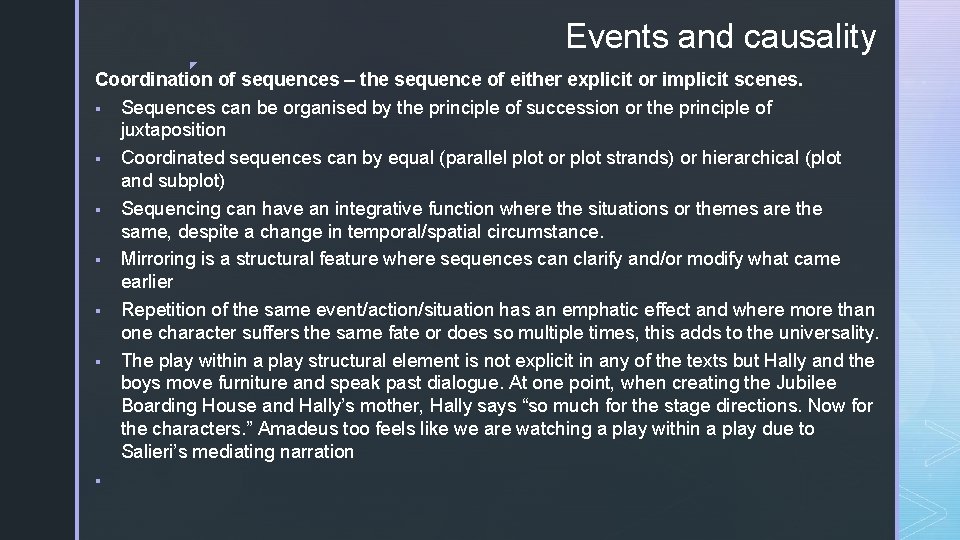
Events and causality ◤ Coordination of sequences – the sequence of either explicit or implicit scenes. ▪ Sequences can be organised by the principle of succession or the principle of juxtaposition ▪ Coordinated sequences can by equal (parallel plot or plot strands) or hierarchical (plot and subplot) ▪ Sequencing can have an integrative function where the situations or themes are the same, despite a change in temporal/spatial circumstance. ▪ Mirroring is a structural feature where sequences can clarify and/or modify what came earlier ▪ Repetition of the same event/action/situation has an emphatic effect and where more than one character suffers the same fate or does so multiple times, this adds to the universality. ▪ The play within a play structural element is not explicit in any of the texts but Hally and the boys move furniture and speak past dialogue. At one point, when creating the Jubilee Boarding House and Hally’s mother, Hally says “so much for the stage directions. Now for the characters. ” Amadeus too feels like we are watching a play within a play due to Salieri’s mediating narration ▪
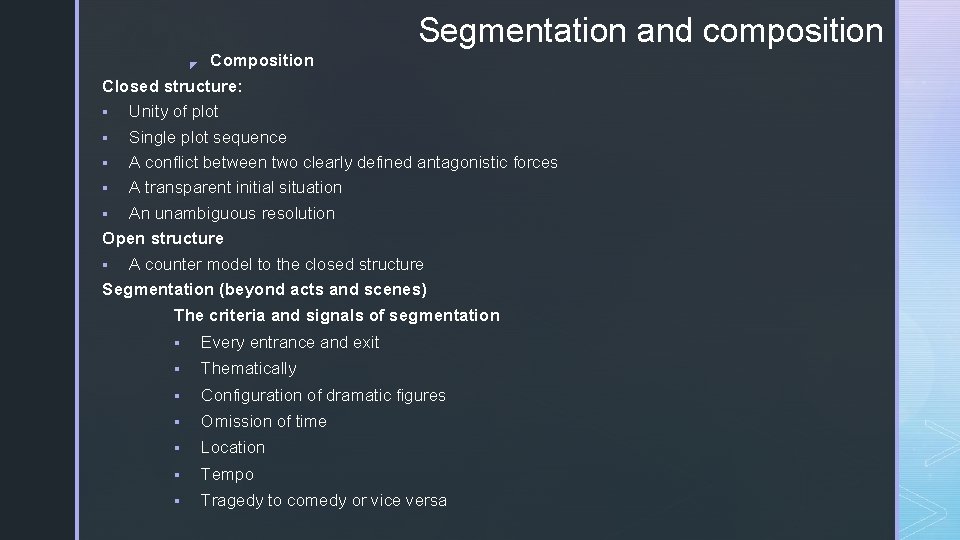
Segmentation and composition ◤ Composition Closed structure: ▪ Unity of plot ▪ Single plot sequence ▪ A conflict between two clearly defined antagonistic forces ▪ A transparent initial situation ▪ An unambiguous resolution Open structure ▪ A counter model to the closed structure Segmentation (beyond acts and scenes) The criteria and signals of segmentation ▪ Every entrance and exit ▪ Thematically ▪ Configuration of dramatic figures ▪ Omission of time ▪ Location ▪ Tempo ▪ Tragedy to comedy or vice versa
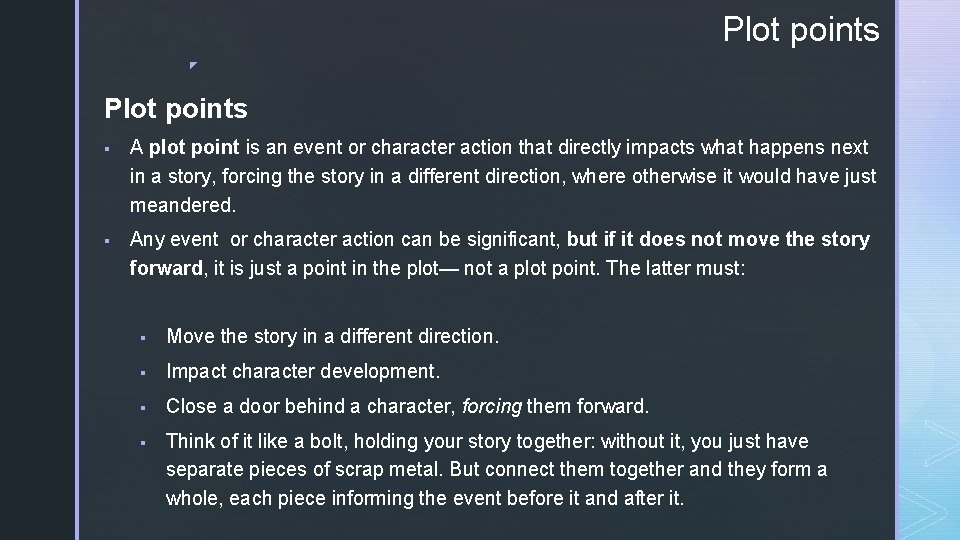
Plot points ◤ Plot points ▪ A plot point is an event or character action that directly impacts what happens next in a story, forcing the story in a different direction, where otherwise it would have just meandered. ▪ Any event or character action can be significant, but if it does not move the story forward, it is just a point in the plot— not a plot point. The latter must: ▪ Move the story in a different direction. ▪ Impact character development. ▪ Close a door behind a character, forcing them forward. ▪ Think of it like a bolt, holding your story together: without it, you just have separate pieces of scrap metal. But connect them together and they form a whole, each piece informing the event before it and after it.
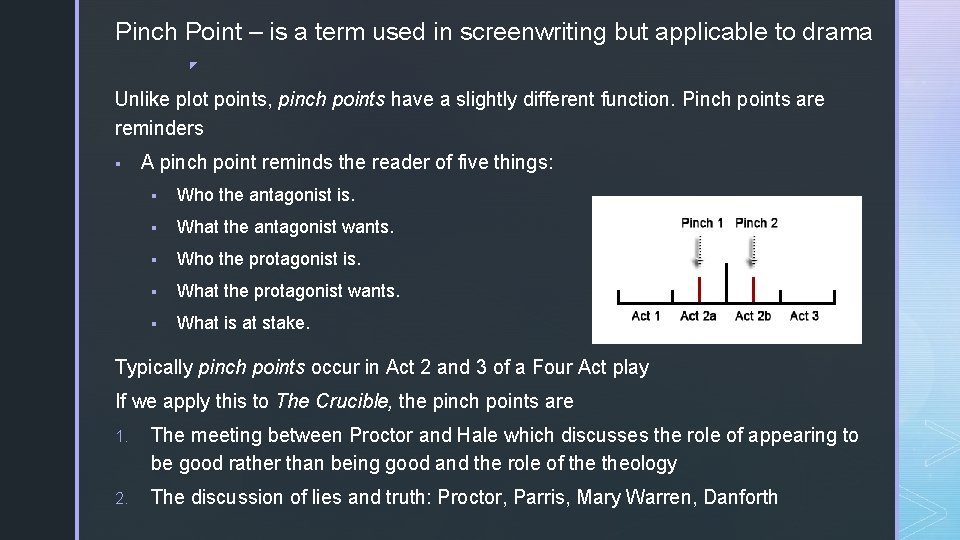
Pinch Point – is a term used in screenwriting but applicable to drama ◤ Unlike plot points, pinch points have a slightly different function. Pinch points are reminders ▪ A pinch point reminds the reader of five things: ▪ Who the antagonist is. ▪ What the antagonist wants. ▪ Who the protagonist is. ▪ What the protagonist wants. ▪ What is at stake. Typically pinch points occur in Act 2 and 3 of a Four Act play If we apply this to The Crucible, the pinch points are 1. The meeting between Proctor and Hale which discusses the role of appearing to be good rather than being good and the role of theology 2. The discussion of lies and truth: Proctor, Parris, Mary Warren, Danforth
Structures of time and space ◤ ▪ The multimediality of dramatic texts means that time and space can be clearly defined beyond the narration. ▪ Time – the played time - is specific and concrete but fictionalised through ellipsis and abridgement and differs from the playing time ▪ Space is the limitation of the stage and auditorium on the external level but the internal level is the fictional space in which the story unfolds. The actual stage corresponds to the fictional locale through the use of set and changes in set. ▪ Where the author breaks the fourth wall the audience becomes aware of the tension between real time and space and the fictional time and space. ▪ As a unit of segmentation each scene is a closed time-space continuum with each scene being marked by a change in locale or a rupture in time
◤ Closed structures of time and space (those which are durative) can be used thematically: ▪ Permanence – nothing changes. In MHATB we begin and end in the tea shop. Thematically this might imply that change is less likely. The suffocating nature of this world is significant as none of the characters can avoid facing the nature of their relationships. Hally’s departure could be viewed either optimistically or pessimistically ▪ The closed space has its roots in naturalism which attempts to bring fictional presentation as close as possible to reality – important to Fugard on a personal and political level ▪ Sudden changes in time or locale disrupt continuity and does not correspond to the way we perceive reality. MHATB is real, the political situation is real and the personal representation is real. Our perceptions of inequality, racism, power etc. are represented in real ways by real people in real time and space. ▪ The structure and plot therefore are instigated much more by action than event as (oddly enough, similarly but different to Godot) action (or in Godot’s case) inaction is in the anthropomorphic realm (people)
◤ Open structures of time and space ▪ Open structures of time and space allow the dramatist to become panoramic and to use the changes to create contrast or comparison ▪ As different people inhabit this space it also allows a layered understanding of the problem – consider how we see John Proctor in his different settings and how this deals with the idea of morality at a court, church, domestic setting. ▪ This relationship between different places also allows the audience to see a relationship between events in one place and their impact on another place ▪ Open time structures allow for dramatists to present lines of individual development – consider the young Salieri, the court Salieri, the old Salieri ▪ Time and space can be disrupted or undermined. In Godot the understanding of both time and space is ambiguous, due to repetition, contradiction, amnesia ▪ The relationship between stage and off stage applies to dramatic figures but also context: what is known about the world beyond the immediate locale. ▪ MHATB – 1950 s Port Elizabeth, South Africa, no season specified (wet and windy implies Winter) ▪ The Crucible – 1692, Salem, Massachusetts, Spring to Autumn ▪ Amadeus - 1823, Vienna, November and 1780 Vienna ▪ Godot – unknown. There is one reference to “back in the nineties” but that is deliberately ambiguous
The space (setting) and its semantic implications ◤ The stage set literally sets the scene for a play. In analysis we must ask what is the purpose and how does this correlate to the play ▪ Time: historical context, season, time of day, weather, ▪ Tone E. g. sorrow, mystery ▪ Detailed and precise ▪ Minimalist ▪ Natural, stylized, artificial ▪ a means of indirect characterisation ▪ Symbolic space: a representation of a key theme, mood, motif ▪ Provides focus ▪ Be durative or non-durative or something in between… ▪ The relationship and the events or characters found within it
Structure and presentation of time ◤ Tense and drama ▪ “A play is what takes place. A novel is what one person tells took place. ” (Wilder. T) The present tense dominates and there is an increased vitality conferred by the action that is now. ▪ The Crucible fits this description as the action takes place over several locations but is in the now ▪ MHAB also fits this description. Structure is given to the play by the recounts which transport us into the past but this is still completed in the now. ▪ Amadeus breaks with this convention through the mediating narrator. Salieri’s monologues/soliloquys give a structure to the play that corresponds to many of the explicit scene changes. Shaffer’s ad spectatores, however, works as a counterpoint and the vitality of the present is in the present tense address to the audience. Shaffer achieves two kinds of immediacy (the actions of the play and the direct ad spectatores) and distance in the mediating narrator.
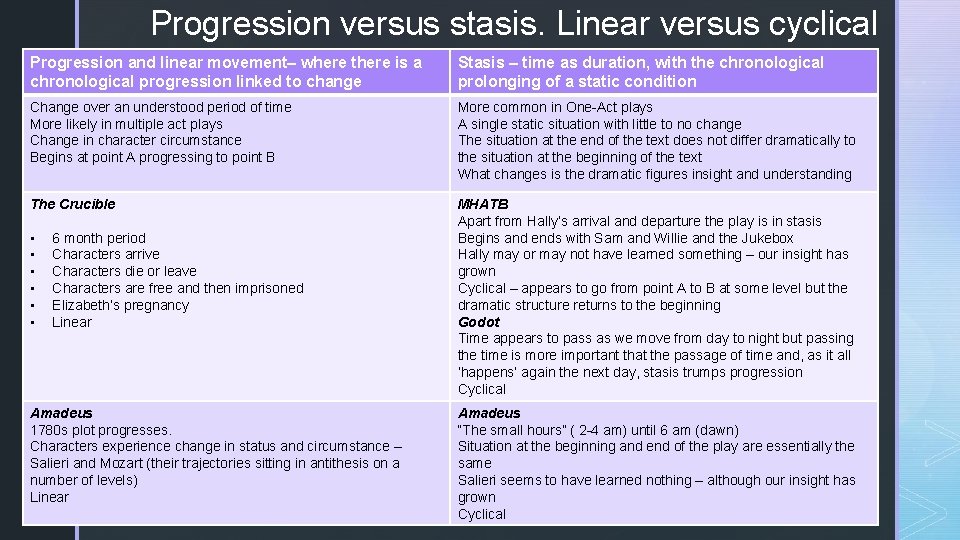
Progression versus stasis. Linear versus cyclical Progression and linear ◤ movement– where there is a chronological progression linked to change Stasis – time as duration, with the chronological prolonging of a static condition Change over an understood period of time More likely in multiple act plays Change in character circumstance Begins at point A progressing to point B More common in One-Act plays A single static situation with little to no change The situation at the end of the text does not differ dramatically to the situation at the beginning of the text What changes is the dramatic figures insight and understanding The Crucible MHATB Apart from Hally’s arrival and departure the play is in stasis Begins and ends with Sam and Willie and the Jukebox Hally may or may not have learned something – our insight has grown Cyclical – appears to go from point A to B at some level but the dramatic structure returns to the beginning Godot Time appears to pass as we move from day to night but passing the time is more important that the passage of time and, as it all ‘happens’ again the next day, stasis trumps progression Cyclical • • • 6 month period Characters arrive Characters die or leave Characters are free and then imprisoned Elizabeth’s pregnancy Linear Amadeus 1780 s plot progresses. Characters experience change in status and circumstance – Salieri and Mozart (their trajectories sitting in antithesis on a number of levels) Linear Amadeus “The small hours” ( 2 -4 am) until 6 am (dawn) Situation at the beginning and end of the play are essentially the same Salieri seems to have learned nothing – although our insight has grown Cyclical
Tempo/pace ◤ Tempo is a way of analysing the segmentation and structure of a play. Dramatic tempo/pace is the speed at which the action is presented and can provide a specific segmentation to the text. Interplay between fast and slow scenes provides interest and variety on a surface level. However, the text has a holistic tempo. The superficial tempo may indicate speed at some level, but the play as a whole is slow In most cases the tempo does not remain constant and can even be varied in a single dialogue Pace can increase the dramatic intensity of events To hold up or retard the pace allows for moments of reflection Classical tragedies move quickly in the case of the central peripeteia (reversal of fortune) Tempo can be measured by ▪ ▪ ▪ In the mimetic – movement, gesture, choreography Temporal - In the speed at one event is succeeded by another Dialogically – the speed in which one speaker succeeds another Characters - Changes in the configuration of dramatic figures Spatial – the frequency and succession of different locales
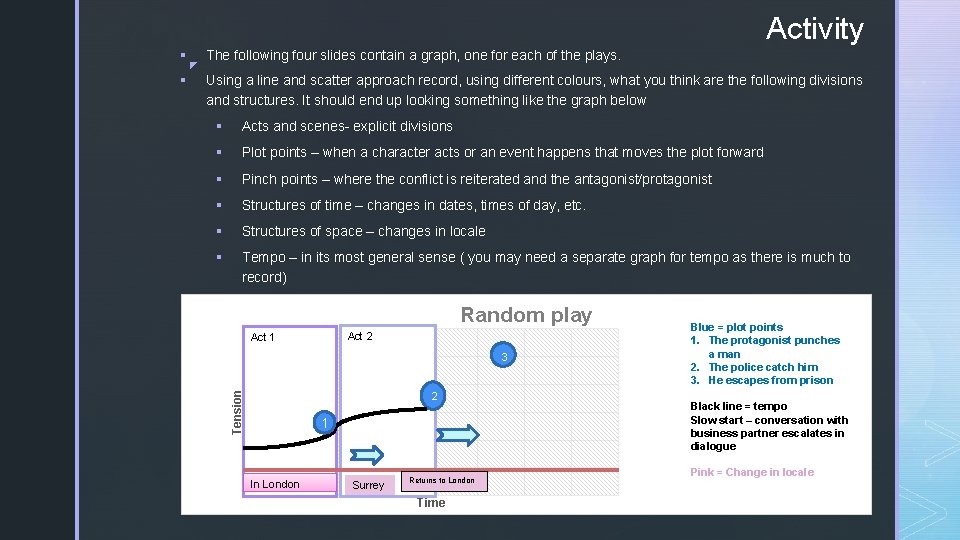
▪ ◤ The following four slides contain a graph, one for each of the plays. Using a line and scatter approach record, using different colours, what you think are the following divisions and structures. It should end up looking something like the graph below ▪ Acts and scenes- explicit divisions ▪ Plot points – when a character acts or an event happens that moves the plot forward ▪ Pinch points – where the conflict is reiterated and the antagonist/protagonist ▪ Structures of time – changes in dates, times of day, etc. ▪ Structures of space – changes in locale ▪ Tempo – in its most general sense ( you may need a separate graph for tempo as there is much to record) Random play Act 2 Act 1 3 Tension ▪ Activity 2 1 In London Surrey Returns to London Time Blue = plot points 1. The protagonist punches a man 2. The police catch him 3. He escapes from prison Black line = tempo Slow start – conversation with business partner escalates in dialogue Pink = Change in locale
Plotting ◤ Tension “Master Harold” … and the boys Time
Plotting ◤ Tension The Crucible Time
Plotting ◤ Tension Amadeus Time
Plotting ◤ Tension Waiting for Godot Time
◤ What the critics say: Master Harold… ▪ Athol Fugard’s plays during the apartheid era document not just the social and political effects of this national policy but also the insidious and sometimes subtle ways in which hate corrupts peoples’ psyches, souls, and relationships” (O’Neil p. 365). ▪ Fugard’s characters naturally display strengths and weaknesses which make them unable to fit into what society requires. However, Mair declares that: ▪ …whites like to address non- whites with orders and insults. ‘Normal’ mutual conversation between the white and non-white group does not exist. Apartheid rhetoric makes it impossible to describe reality outside of its discursively imposed frame, and language becomes subjected to manipulation” (Mair p. 308).
◤ Things to think about Despite the polyperspectivity of views in Master Harold and the Boys and The Crucible, Miller conveys a dominant message in the external communication through what and how?
◤ Sending and receiving information Confessional drama (Master Harold) Of all his plays, none is more personal than Master Harold and the Boys because it tells a boyhood episode which involved him and which preoccupied him for years until he tried to atone by writing this play in 1982. As Fugard said in an Interview: “The sense I have of myself is that of a ‘regional’ writer with themes, textures, acts of celebration, of defiance and outrage that go with the South African experience. These are the only things I have been able to write about. ( Notebooks: 1960 -1977).