
Application of Covariant Density Functional Theory to Nuclear
- Slides: 48
Application of Covariant Density Functional Theory to Nuclear Structure Studies Shakeb Ahmad International School of Nuclear Physics, ERICE 16 -24 September 2016
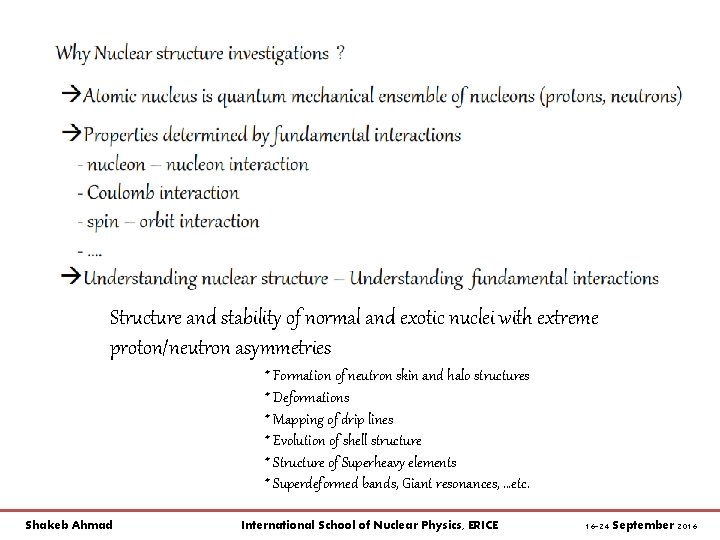
Structure and stability of normal and exotic nuclei with extreme proton/neutron asymmetries * Formation of neutron skin and halo structures * Deformations * Mapping of drip lines * Evolution of shell structure * Structure of Superheavy elements * Superdeformed bands, Giant resonances, …etc. Shakeb Ahmad International School of Nuclear Physics, ERICE 16 -24 September 2016
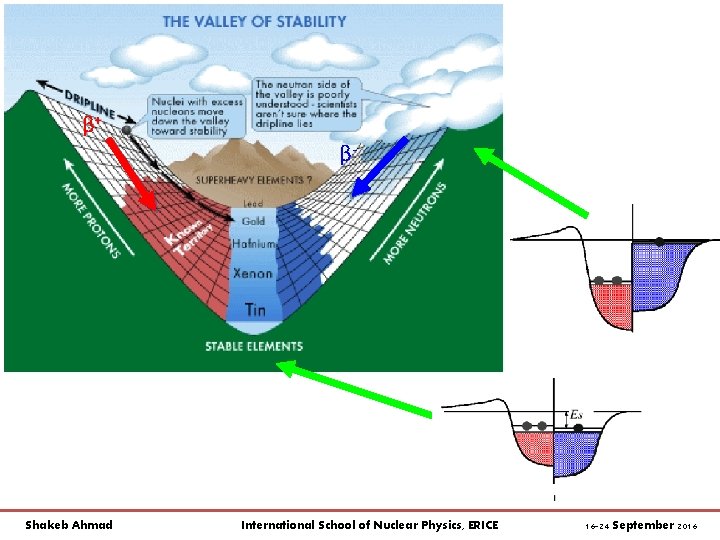
β+ Shakeb Ahmad β- International School of Nuclear Physics, ERICE 16 -24 September 2016
Shakeb Ahmad International School of Nuclear Physics, ERICE 16 -24 September 2016
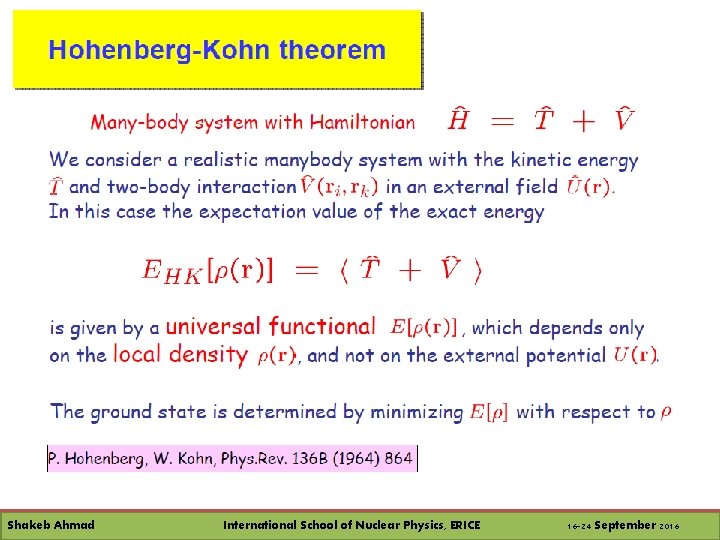
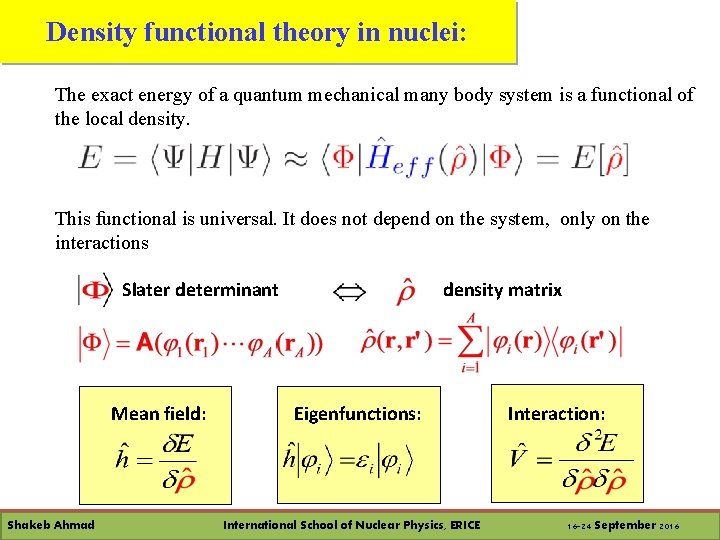
Density functional theory in nuclei: Density functional theory The exact energy of a quantum mechanical many body system is a functional of the local density. This functional is universal. It does not depend on the system, only on the interactions Slater determinant Mean field: Shakeb Ahmad density matrix Eigenfunctions: International School of Nuclear Physics, ERICE Interaction: 16 -24 September 2016
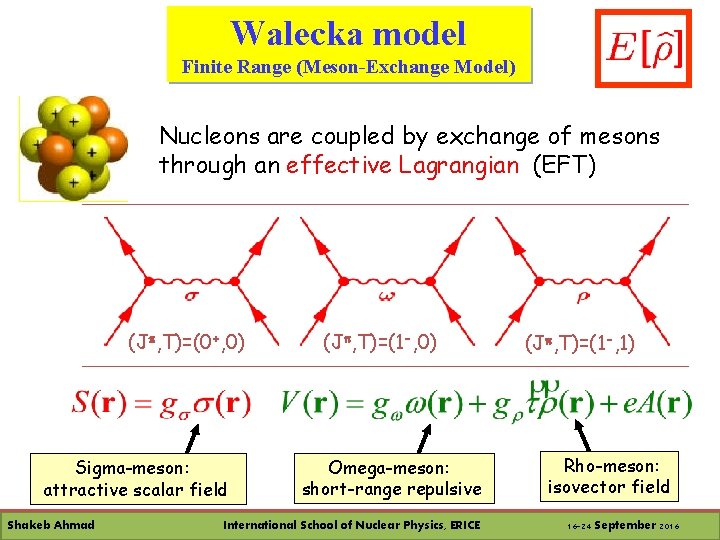
Walecka model Finite Range (Meson-Exchange Model) Nucleons are coupled by exchange of mesons through an effective Lagrangian (EFT) (J , T)=(0+, 0) Sigma-meson: attractive scalar field Shakeb Ahmad (J , T)=(1 -, 0) Omega-meson: short-range repulsive International School of Nuclear Physics, ERICE (J , T)=(1 -, 1) Rho-meson: isovector field 16 -24 September 2016
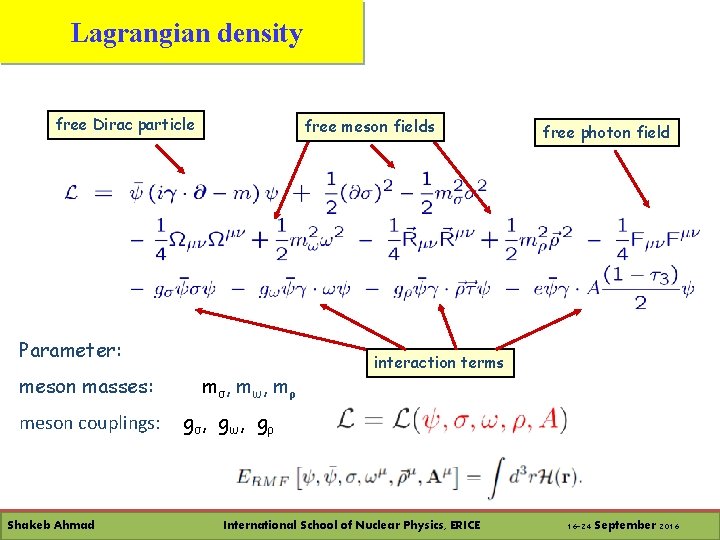
Lagrangian density free Dirac particle free meson fields Parameter: meson masses: mσ, mω, mρ free photon field interaction terms meson couplings: gσ, gω, gρ Shakeb Ahmad International School of Nuclear Physics, ERICE 16 -24 September 2016
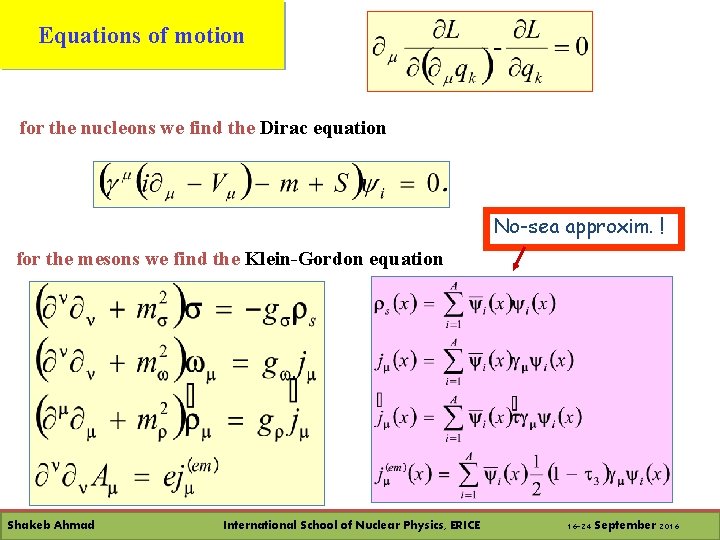
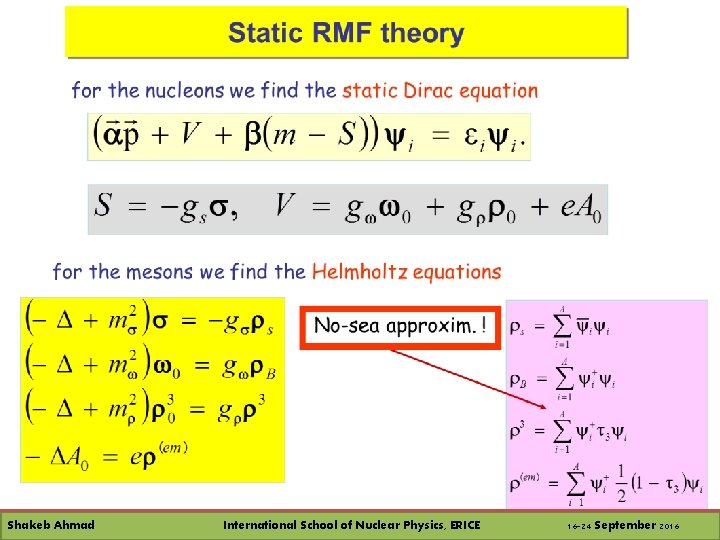
Equations of motion equations of motion for the nucleons we find the Dirac equation No-sea approxim. ! for the mesons we find the Klein-Gordon equation Shakeb Ahmad International School of Nuclear Physics, ERICE 16 -24 September 2016
Shakeb Ahmad International School of Nuclear Physics, ERICE 16 -24 September 2016
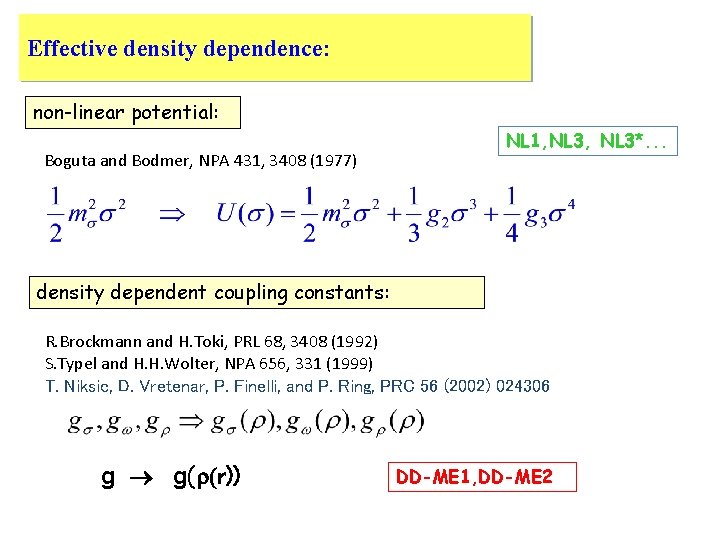
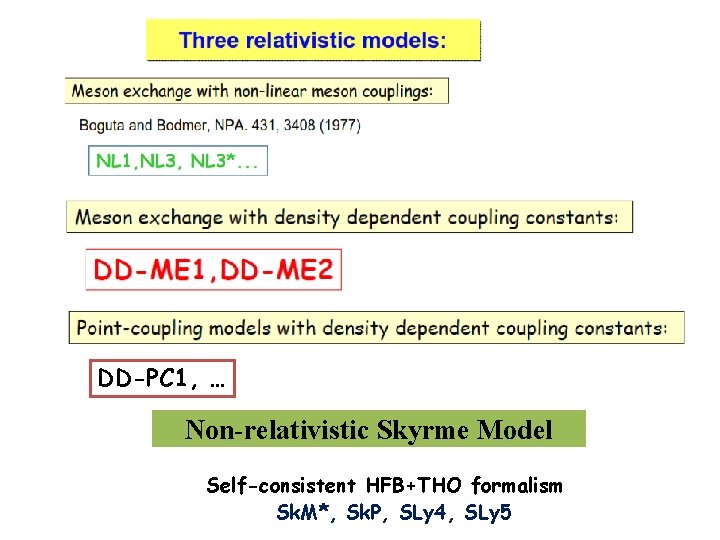
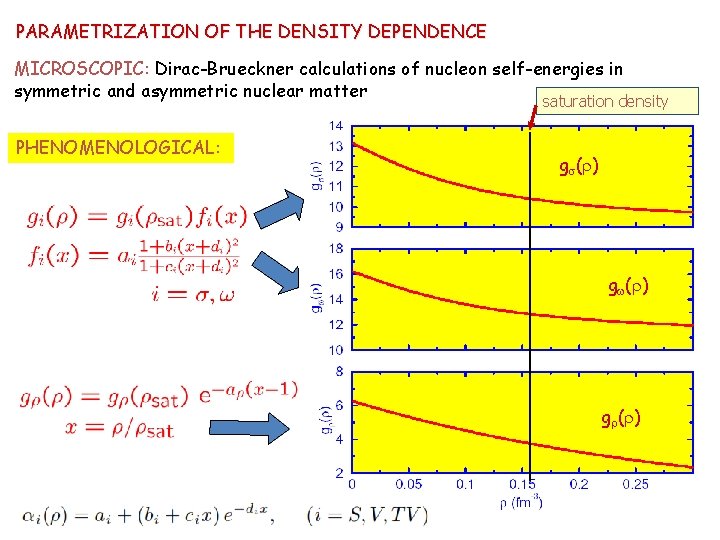
Density Effective density dependence: dependence non-linear potential: Boguta and Bodmer, NPA 431, 3408 (1977) NL 1, NL 3*. . . density dependent coupling constants: R. Brockmann and H. Toki, PRL 68, 3408 (1992) S. Typel and H. H. Wolter, NPA 656, 331 (1999) T. Niksic, D. Vretenar, P. Finelli, and P. Ring, PRC 56 (2002) 024306 g g(r(r)) DD-ME 1, DD-ME 2
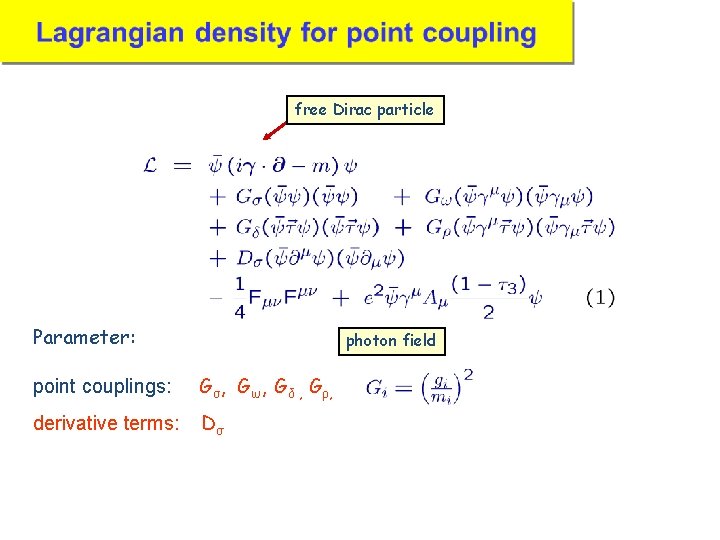
free Dirac particle interaction terms Parameter: photon field point couplings: Gσ, Gω, Gδ , Gρ, derivative terms: Dσ
DD-PC 1, … Non-relativistic Skyrme Model Self-consistent HFB+THO formalism Sk. M*, Sk. P, SLy 4, SLy 5
PARAMETRIZATION OF THE DENSITY DEPENDENCE MICROSCOPIC: Dirac-Brueckner calculations of nucleon self-energies in symmetric and asymmetric nuclear matter saturation density PHENOMENOLOGICAL: g ( )
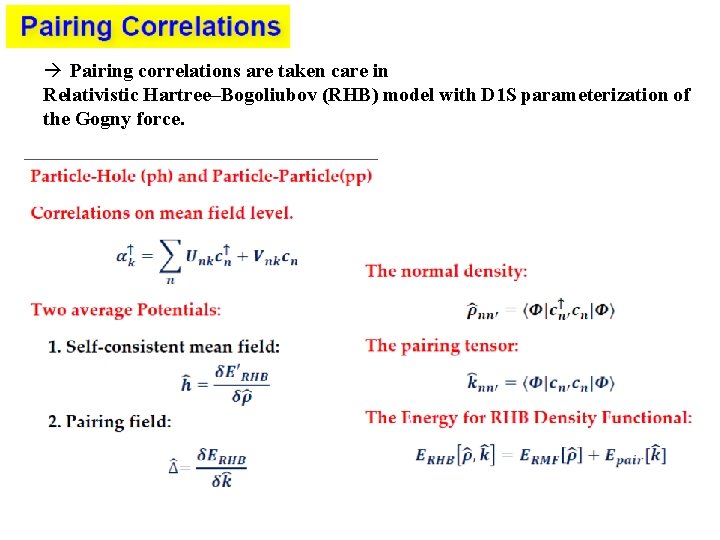
à Pairing correlations are taken care in Relativistic Hartree–Bogoliubov (RHB) model with D 1 S parameterization of the Gogny force.
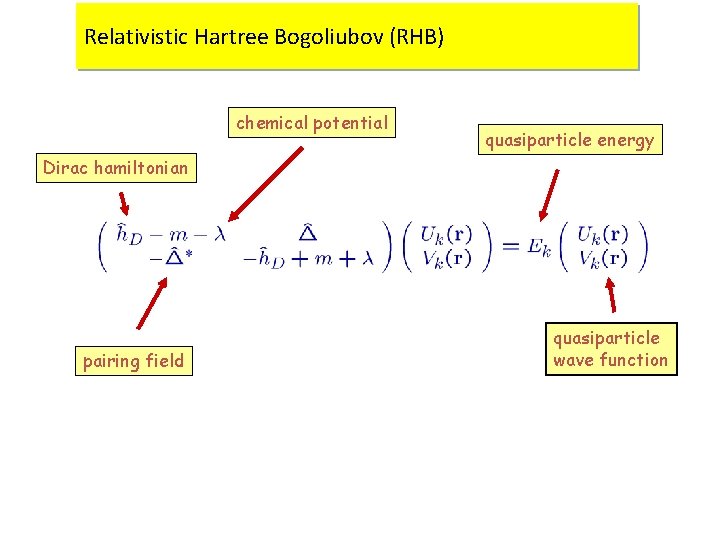
Relativistic Hartree Bogoliubov (RHB) chemical potential quasiparticle energy Dirac hamiltonian pairing field quasiparticle wave function
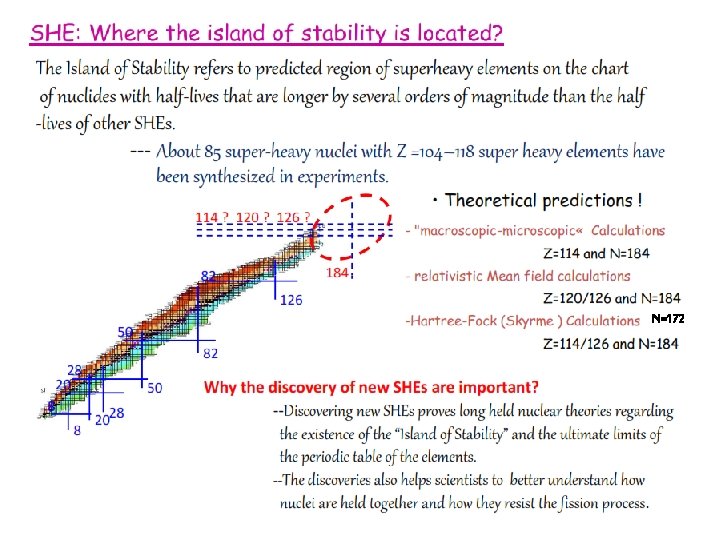
N=172
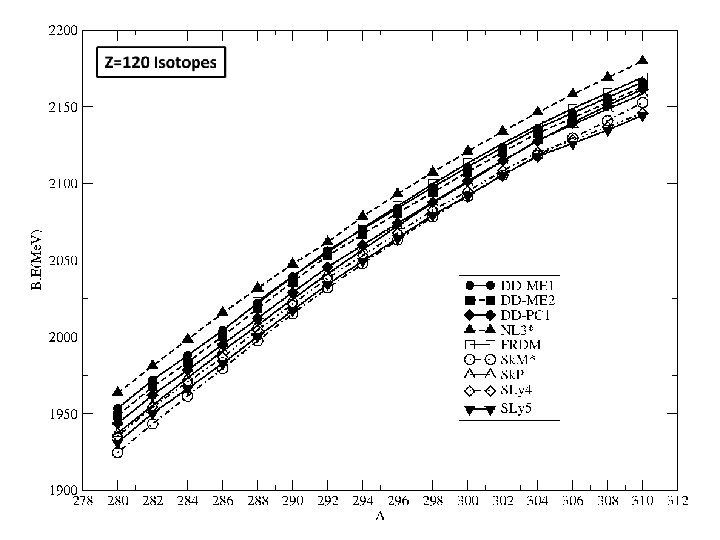
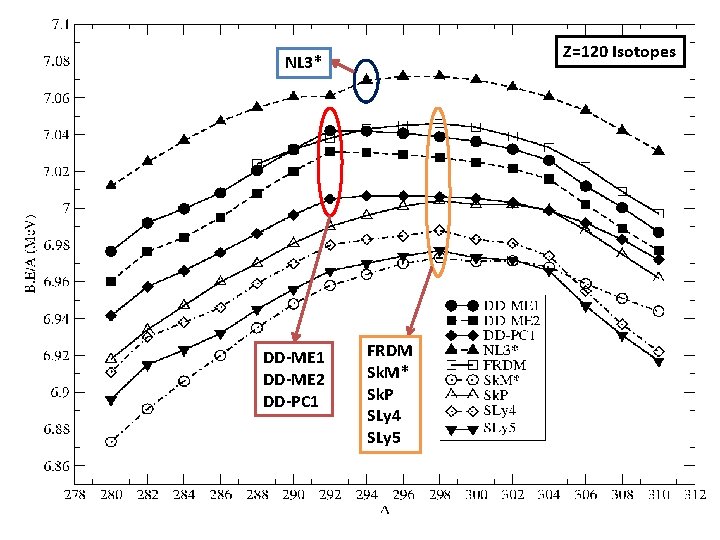
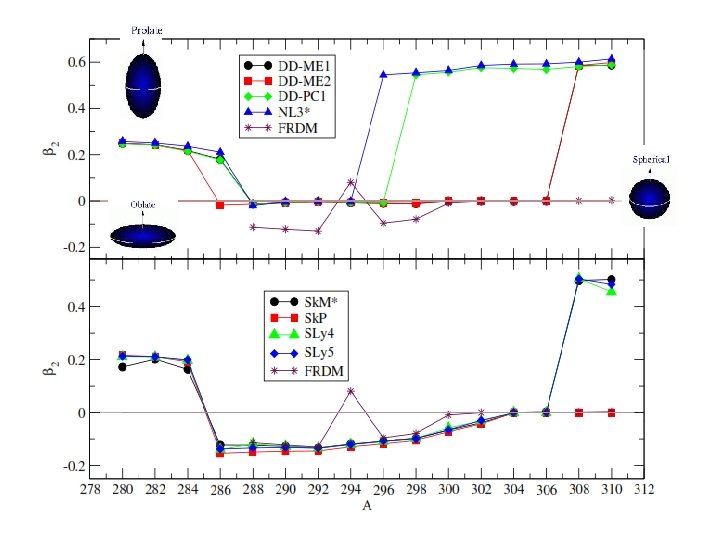
Z=120 Isotopes NL 3* DD-ME 1 DD-ME 2 DD-PC 1 FRDM Sk. M* Sk. P SLy 4 SLy 5
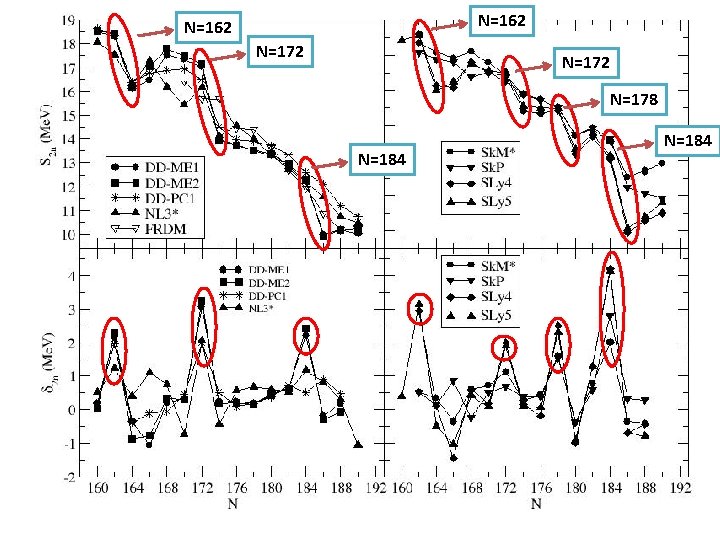
N=162 N=172 N=178 N=184
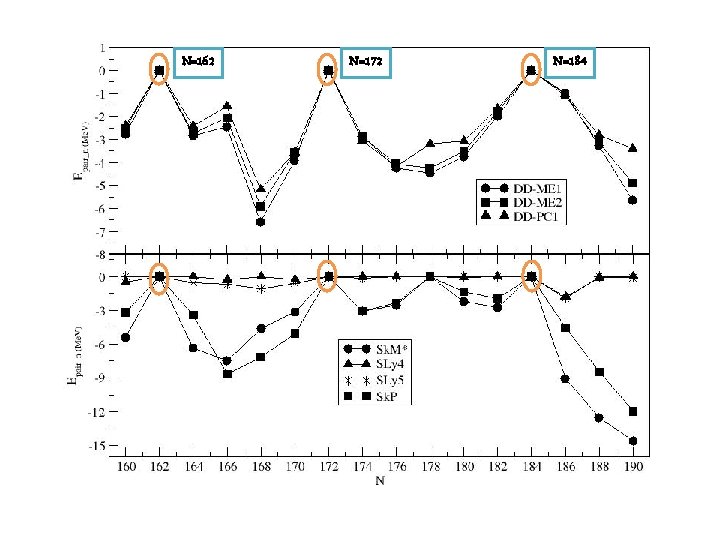
N=162 N=172 N=184
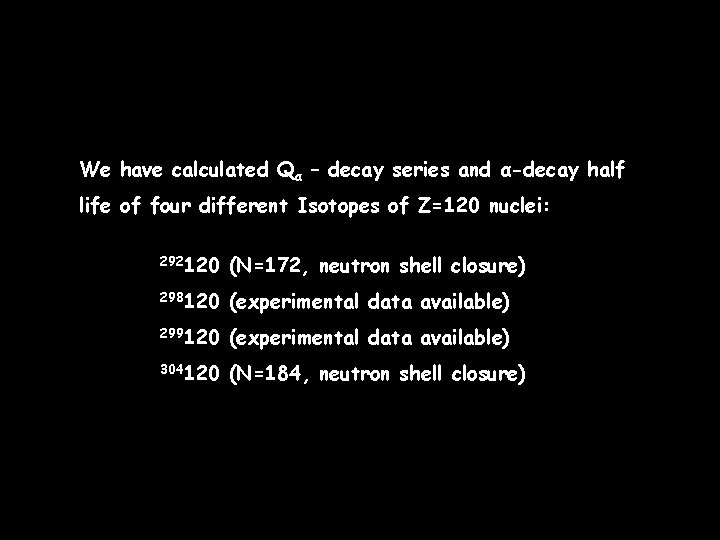
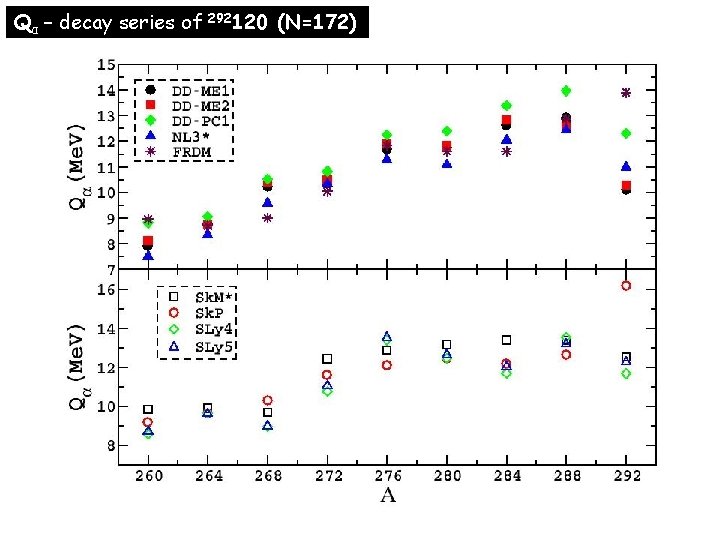
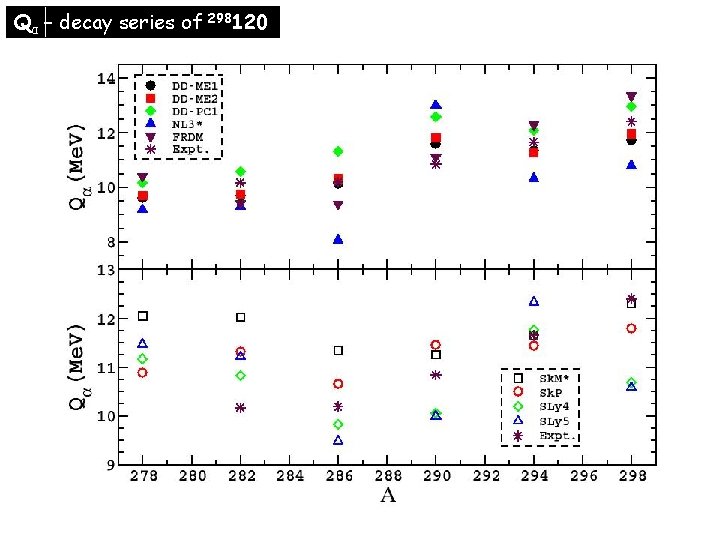
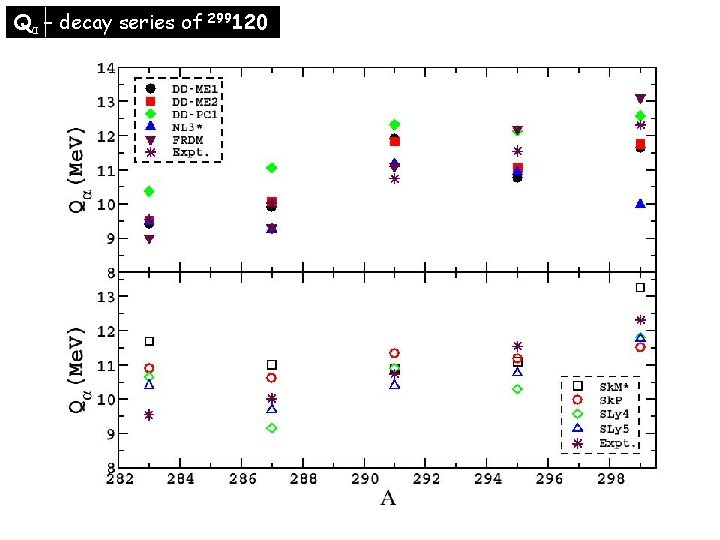
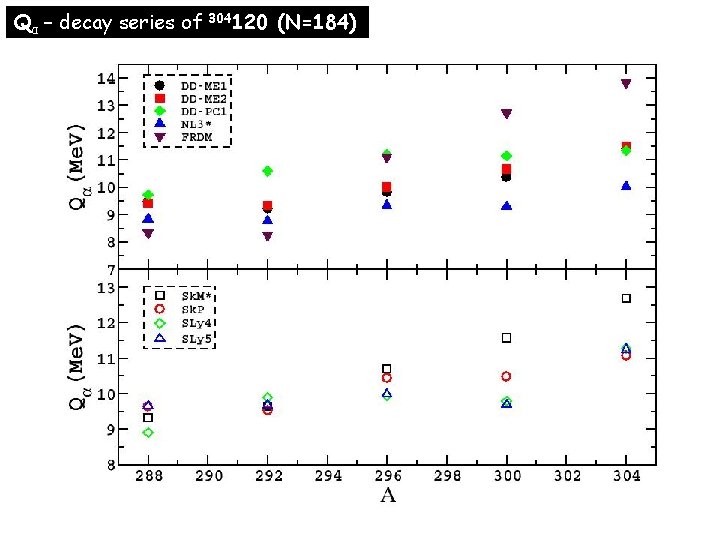
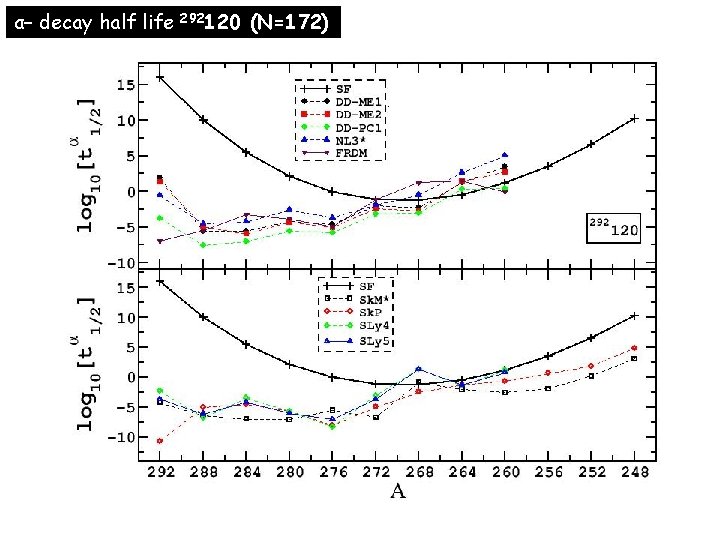
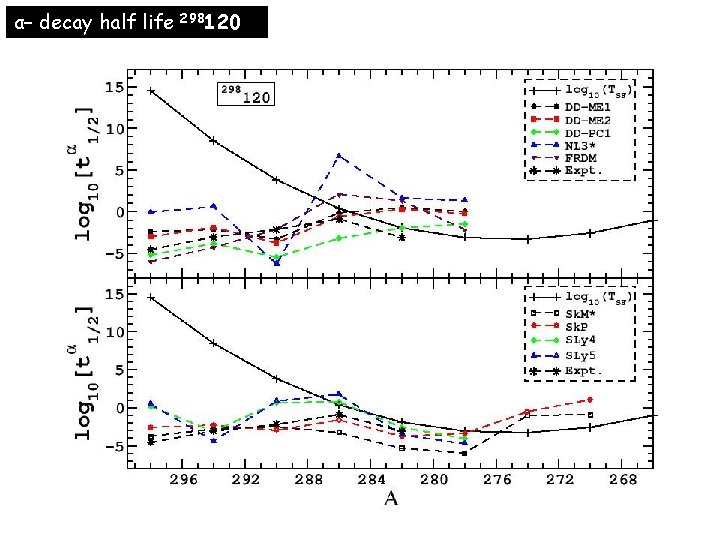
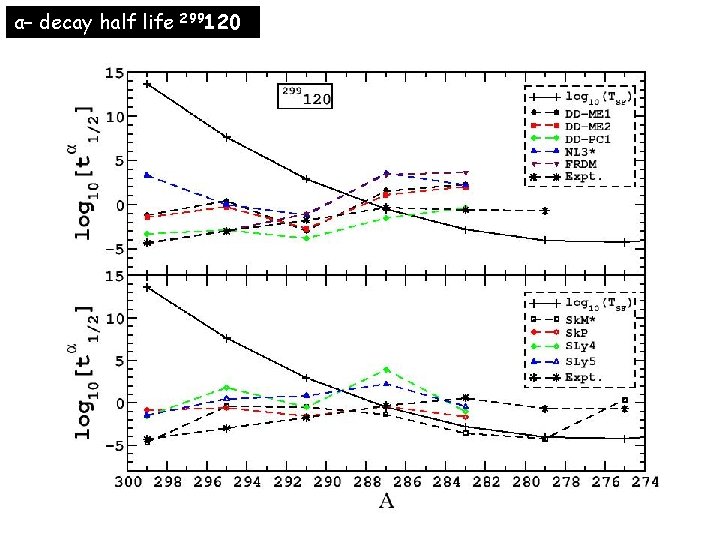
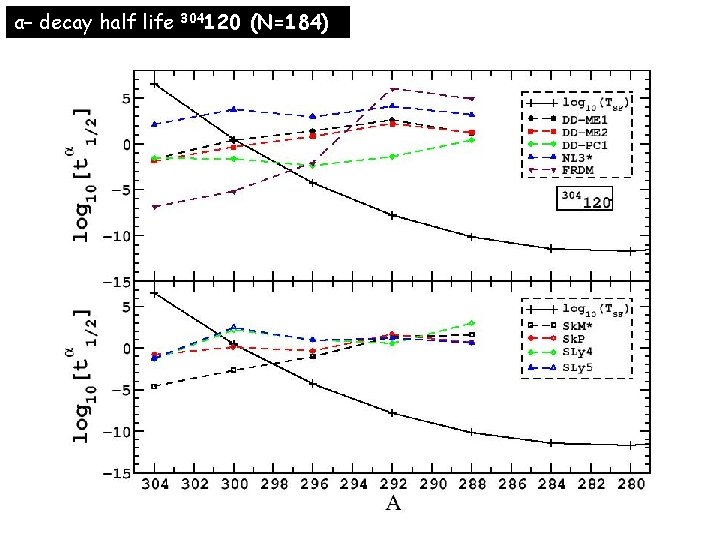
We have calculated Qα – decay series and α-decay half life of four different Isotopes of Z=120 nuclei: 292120 (N=172, neutron shell closure) 298120 (experimental data available) 299120 (experimental data available) 304120 (N=184, neutron shell closure)
Qα – decay series of 292120 (N=172)
Qα – decay series of 298120
Qα – decay series of 299120
Qα – decay series of 304120 (N=184)
α– decay half life 292120 (N=172)
α– decay half life 298120
α– decay half life 299120
α– decay half life 304120 (N=184)
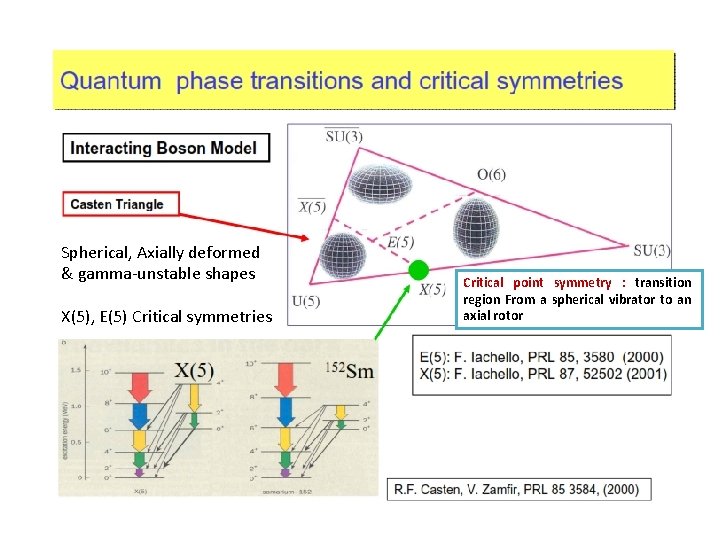
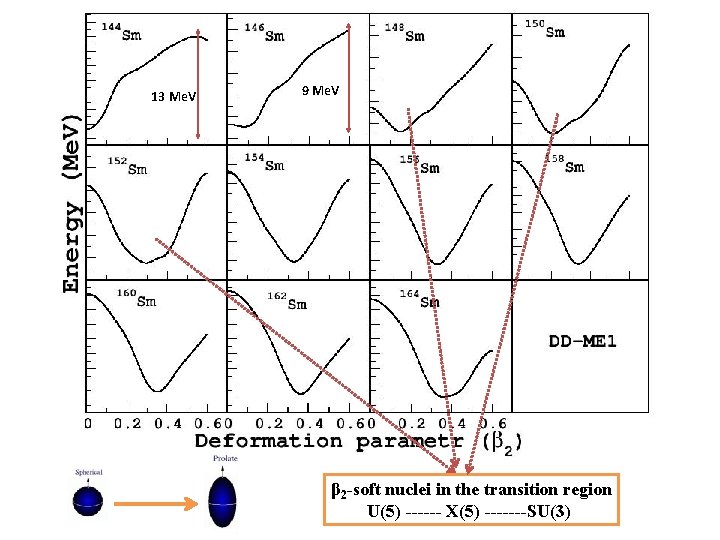
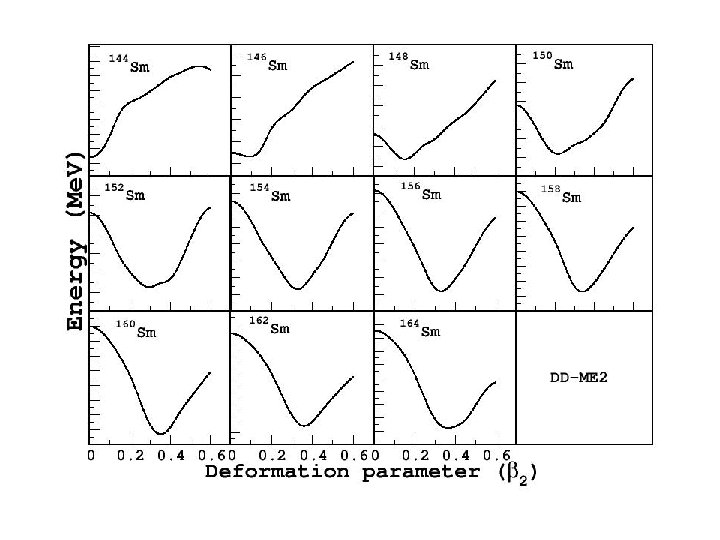
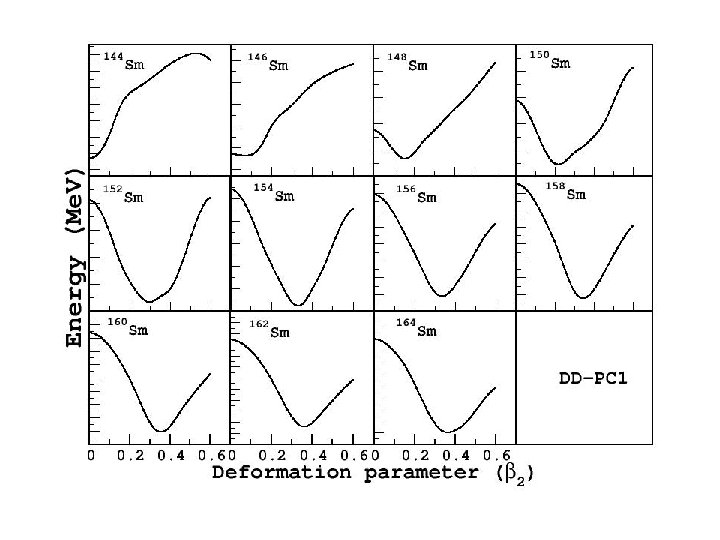
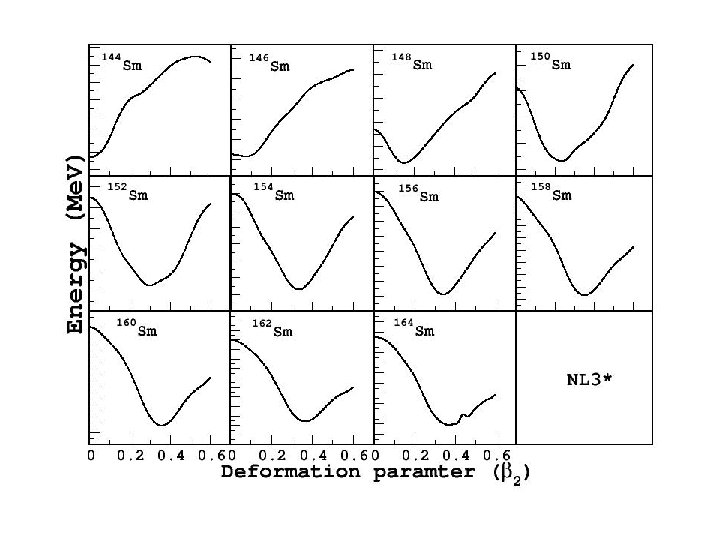
Spherical, Axially deformed & gamma-unstable shapes X(5), E(5) Critical symmetries Critical point symmetry : transition region From a spherical vibrator to an axial rotor
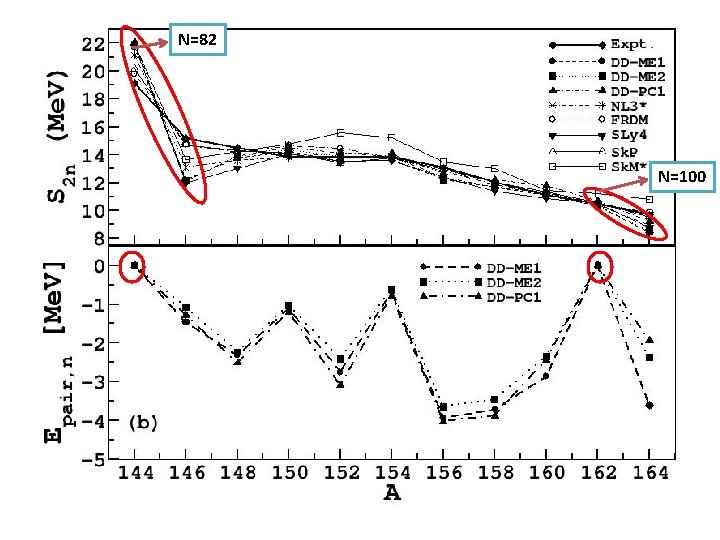
N=82 N=100
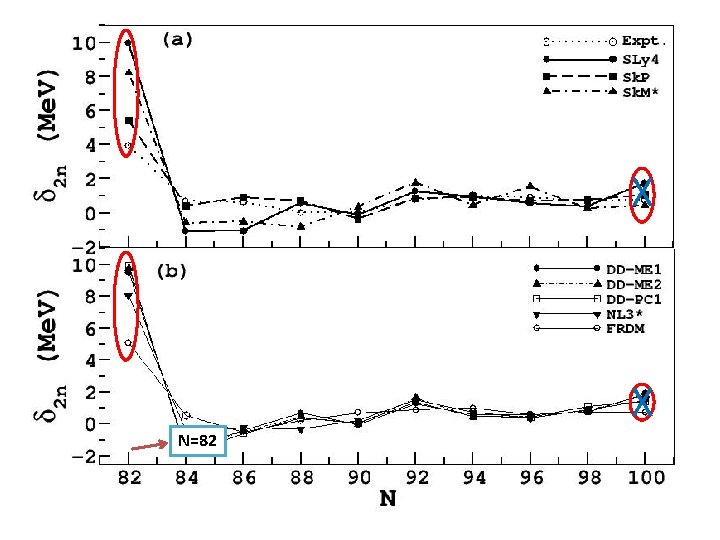
X X N=82
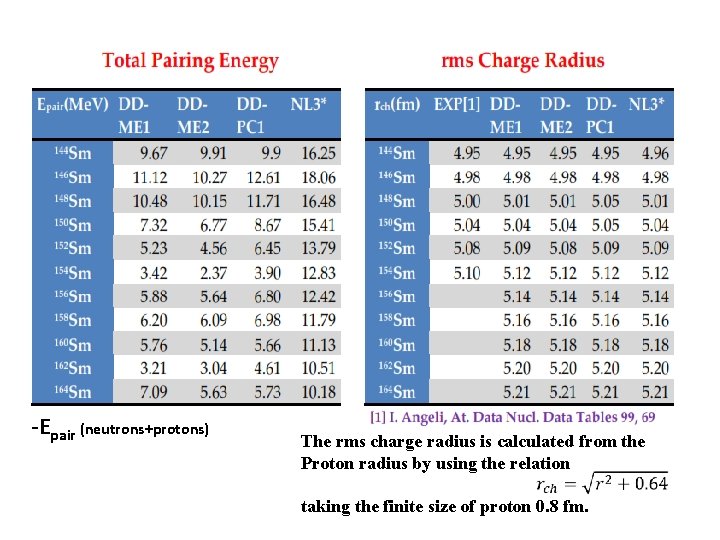
-Epair (neutrons+protons) The rms charge radius is calculated from the Proton radius by using the relation taking the finite size of proton 0. 8 fm.
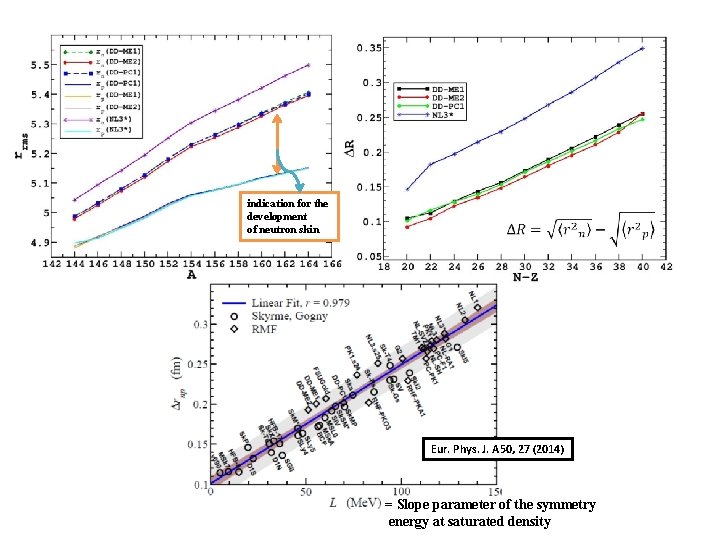
indication for the development of neutron skin Eur. Phys. J. A 50, 27 (2014) = Slope parameter of the symmetry energy at saturated density
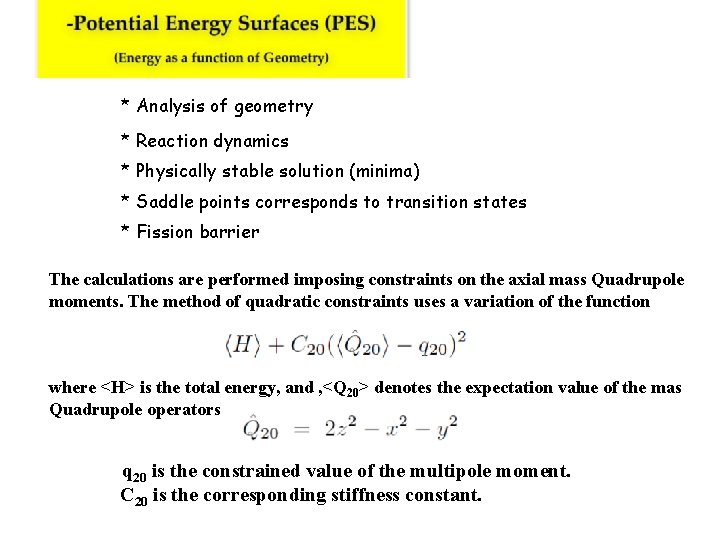
* Analysis of geometry * Reaction dynamics * Physically stable solution (minima) * Saddle points corresponds to transition states * Fission barrier The calculations are performed imposing constraints on the axial mass Quadrupole moments. The method of quadratic constraints uses a variation of the function where <H> is the total energy, and , <Q 20> denotes the expectation value of the mas Quadrupole operators q 20 is the constrained value of the multipole moment. C 20 is the corresponding stiffness constant.
13 Me. V 9 Me. V β 2 -soft nuclei in the transition region U(5) ------ X(5) -------SU(3)
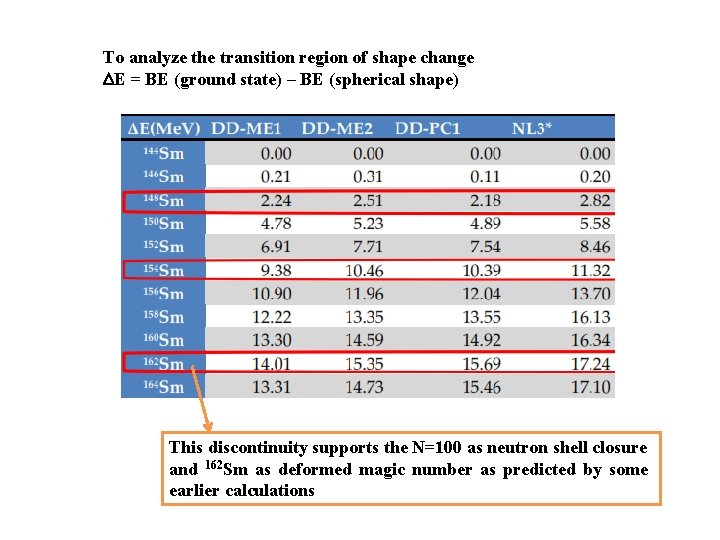
To analyze the transition region of shape change E = BE (ground state) – BE (spherical shape) This discontinuity supports the N=100 as neutron shell closure and 162 Sm as deformed magic number as predicted by some earlier calculations
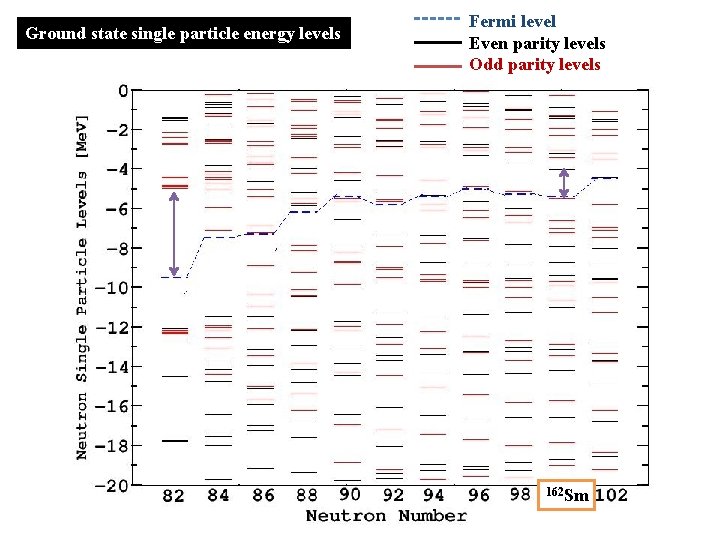
Ground state single particle energy levels Fermi level Even parity levels Odd parity levels 162 Sm
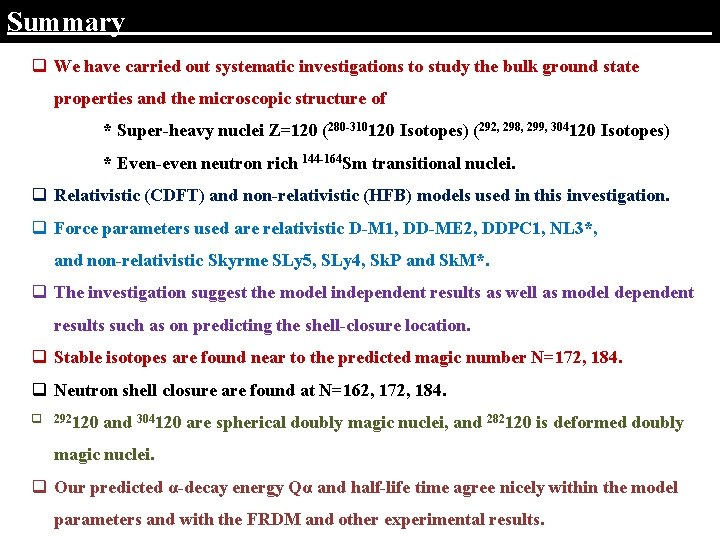
Summary q We have carried out systematic investigations to study the bulk ground state properties and the microscopic structure of * Super-heavy nuclei Z=120 (280 -310120 Isotopes) (292, 298, 299, 304 120 Isotopes) * Even-even neutron rich 144 -164 Sm transitional nuclei. q Relativistic (CDFT) and non-relativistic (HFB) models used in this investigation. q Force parameters used are relativistic D-M 1, DD-ME 2, DDPC 1, NL 3*, and non-relativistic Skyrme SLy 5, SLy 4, Sk. P and Sk. M*. q The investigation suggest the model independent results as well as model dependent results such as on predicting the shell-closure location. q Stable isotopes are found near to the predicted magic number N=172, 184. q Neutron shell closure are found at N=162, 172, 184. q 292120 and 304120 are spherical doubly magic nuclei, and 282120 is deformed doubly magic nuclei. q Our predicted α-decay energy Qα and half-life time agree nicely within the model parameters and with the FRDM and other experimental results.
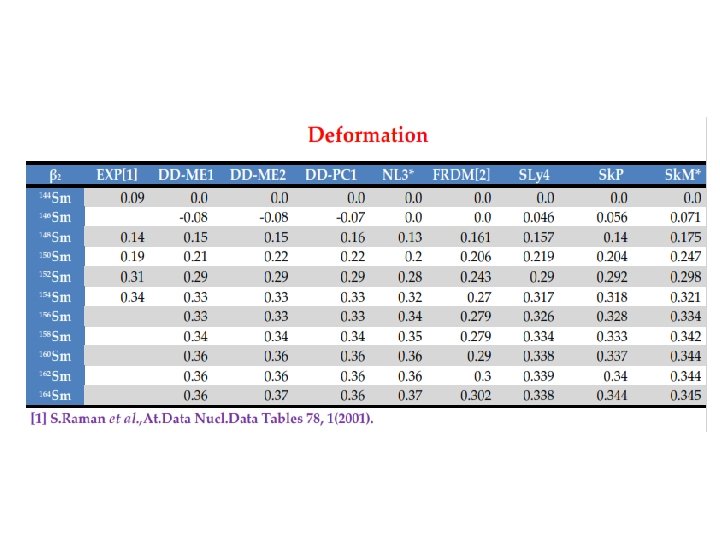
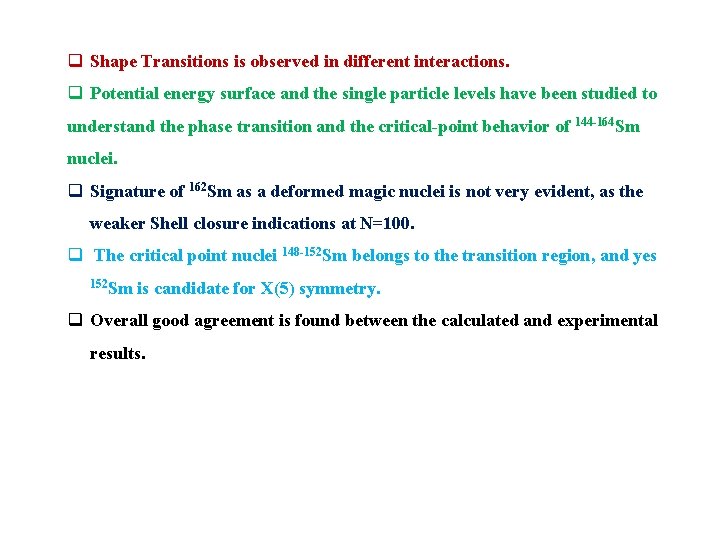
q Shape Transitions is observed in different interactions. q Potential energy surface and the single particle levels have been studied to understand the phase transition and the critical-point behavior of 144 -164 Sm nuclei. q Signature of 162 Sm as a deformed magic nuclei is not very evident, as the weaker Shell closure indications at N=100. q The critical point nuclei 148 -152 Sm belongs to the transition region, and yes 152 Sm is candidate for X(5) symmetry. q Overall good agreement is found between the calculated and experimental results.