
Application of Comprehensive TwoDimensional Gas Chromatography Mass Spectrometry












- Slides: 56
Application of Comprehensive Two-Dimensional Gas Chromatography - Mass Spectrometry to Forensic Science Investigations Glenn S. Frysinger Richard B. Gaines Department of Science U. S. Coast Guard Academy New London, Connecticut glenn. s. frysinger@uscg. mil
U. S. Coast Guard Academy U. S. Military Academy located in New London, Connecticut on the Thames River near Long Island Sound Cadets earn a B. S. degree in science, engineering, government, or management. The academic degree program & professional training prepares graduates to receive commissions in the U. S. Coast Guard Five year service commitment
Application of GC × GC/MS to Forensic Science Investigations 1. Oil Spill Fingerprinting 2. Fire Debris Analysis
Application of GC × GC/MS to Forensic Science Investigations GC × GC and GC × GC/MS methods are in competition with GC/MS standard methods (ASTM, EPA).
Oil Spill Fingerprinting – ASTM D 5739 1. Use GC/MS to compare the chemical composition of petroleum oil spills with suspected sources. 2. Use GC/MS to identify and compare specific classes of compounds that are both unique descriptors of oil and resistant to environmental degradation. 3. Chemical analysis supports a conclusion of similar, dissimilar, or inconclusive.
Oil Spill Fingerprinting – ASTM D 5739
Coast Guard Marine Safety Laboratory Case Oil Spill Fingerprinting Marine diesel fuel spill. Fuel from two suspect fishing vessels in the area sampled as potential sources. GC/MS TIC 5 10 Spill 15 20 25 30 35 (min) Source A 5 10 15 20 25 30 35 (min) Source B 5 10 15 20 Gaines et al. , Environ. Sci. & Technol. 33 (1999) 2106 -2112. 25 30 35 (min)
Oil Spill Fingerprinting GC/MS m/z 156 GC/MS m/z 170 C 2 -Naphthalenes C 3 -Naphthalenes Spill Source A Source B
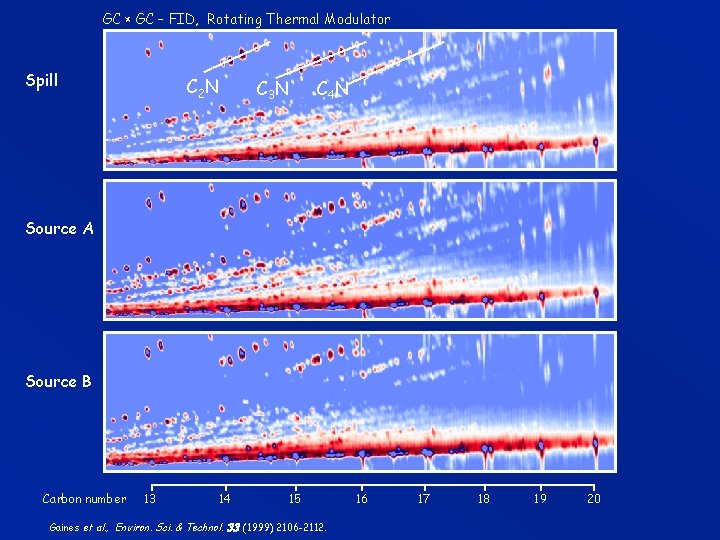
GC × GC – FID, Rotating Thermal Modulator Spill Source A Source B Carbon number 13 14 15 Gaines et al. , Environ. Sci. & Technol. 33 (1999) 2106 -2112. 16 17 18 19 20
GC × GC – FID, Rotating Thermal Modulator Spill C 2 N C 3 N C 4 N Source A Source B Carbon number 13 14 15 Gaines et al. , Environ. Sci. & Technol. 33 (1999) 2106 -2112. 16 17 18 19 20
Observations 1. The patterns in GC × GC images are equal to multiple GC/MS extracted ion chromatograms. 2. Visual analysis of GC × GC images enables rapid identification of similarities and differences between samples. 3. Integration of GC × GC images permits quantitative description of similarities and differences between samples.
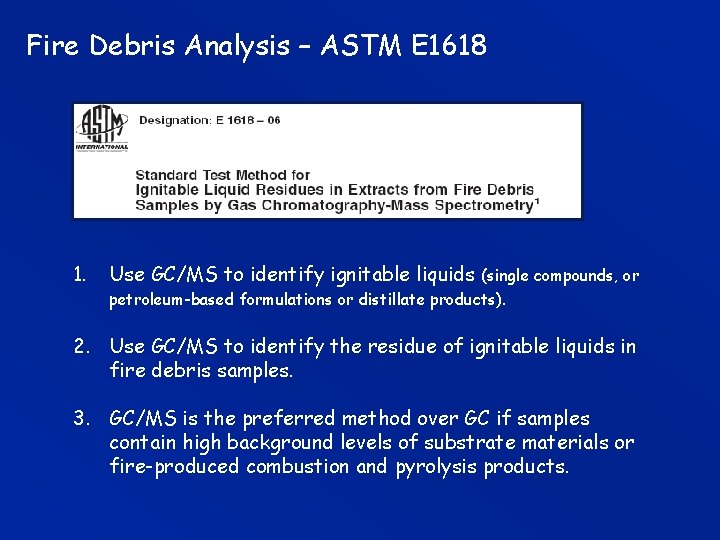
Fire Debris Analysis – ASTM E 1618 1. Use GC/MS to identify ignitable liquids (single compounds, or petroleum-based formulations or distillate products). 2. Use GC/MS to identify the residue of ignitable liquids in fire debris samples. 3. GC/MS is the preferred method over GC if samples contain high background levels of substrate materials or fire-produced combustion and pyrolysis products.
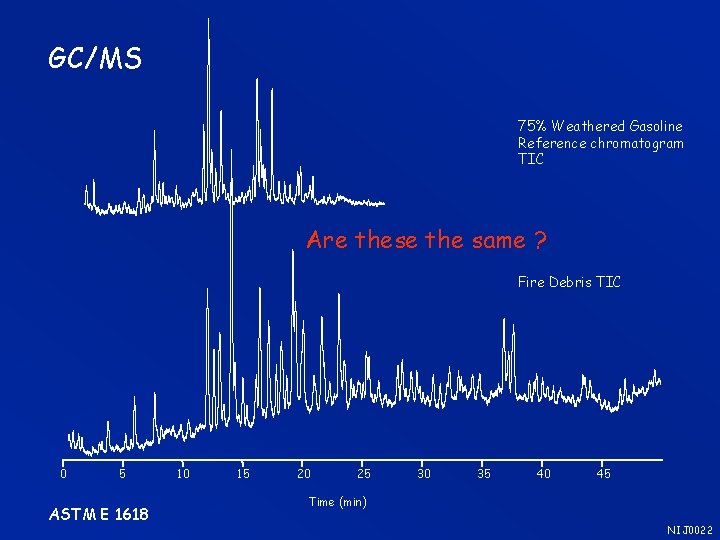
Fire Debris is a Complex Chemical Mixture Substrate material Pyrolysis products Combustion products Ignitable liquid ?
Fire Debris Analysis – ASTM E 1618
GC/MS 75% Weathered Gasoline Reference chromatogram TIC Are these the same ? Fire Debris TIC 0 5 ASTM E 1618 10 15 20 25 30 35 40 45 Time (min) NIJ 0022
Fire Debris Analysis – ASTM E 1618
m/z 106 GC/MS C 2 -Benzenes m/z 120 Fire Debris EICs C 3 -Benzenes m/z 134 C 4 -Benzenes Fire Debris TIC 0 5 ASTM E 1618 10 15 20 25 30 35 40 45 Time (min) NIJ 0022
GC/MS m/z 106 C 2 -Benzenes Gasoline m/z 120 Gasoline C 3 -Benzenes Debris 12 15 Debris 15 20 25 m/z 134 Gasoline C 4 -Benzenes Debris ASTM E 1618 20 25 30 NIJ 0022, NIJ 0023
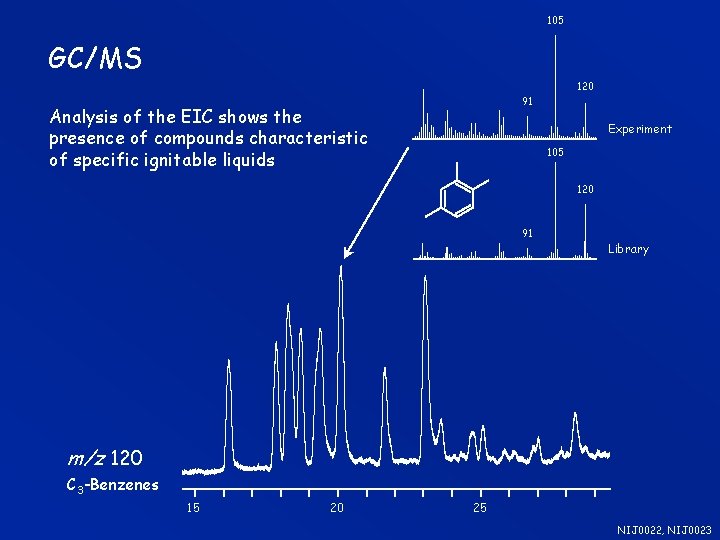
105 GC/MS 120 91 Analysis of the EIC shows the presence of compounds characteristic of specific ignitable liquids Experiment 105 120 91 Library m/z 120 C 3 -Benzenes 15 20 25 NIJ 0022, NIJ 0023
77 105 GC/MS 120 Analysis of the EIC shows the presence of compounds NOT characteristic of specific ignitable liquids Experiment 77 105 O 120 Library m/z 120 C 3 -Benzenes 15 20 25 NIJ 0022, NIJ 0023
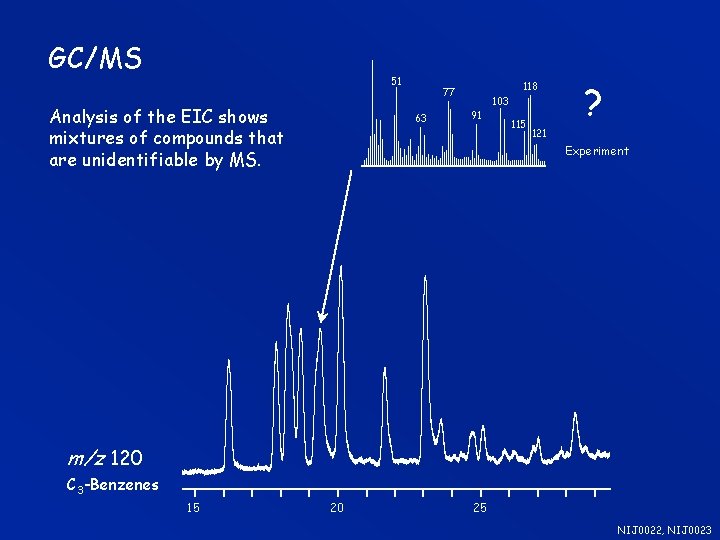
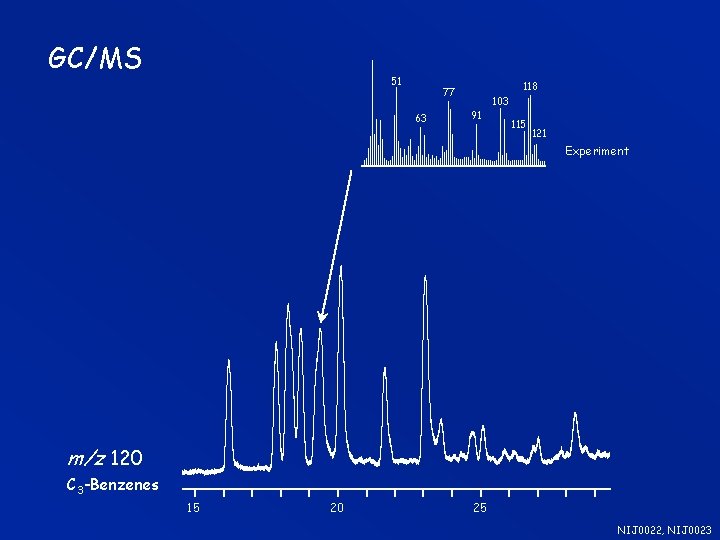
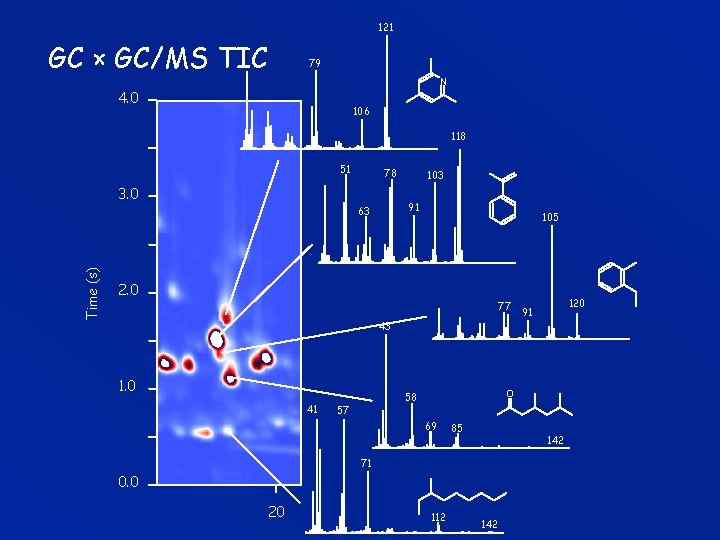
GC/MS 51 Analysis of the EIC shows mixtures of compounds that are unidentifiable by MS. 118 77 63 103 91 115 ? 121 Experiment m/z 120 C 3 -Benzenes 15 20 25 NIJ 0022, NIJ 0023
Problems with ASTM E 1618 1. The idea that “major ions are characteristic of each compound type” is false. Truly unique ions do not exist for any target class. 2. Matrix compounds unrelated to target compounds for a suspected ignitable liquid can contribute to the EIC. The EIC will contain extra peaks that may or may not coelute with the target compounds. 3. Matrix compounds are sometimes exactly the same as the target compounds from a suspected ignitable liquid. 4. Mass selectivity is an insufficient second dimension.
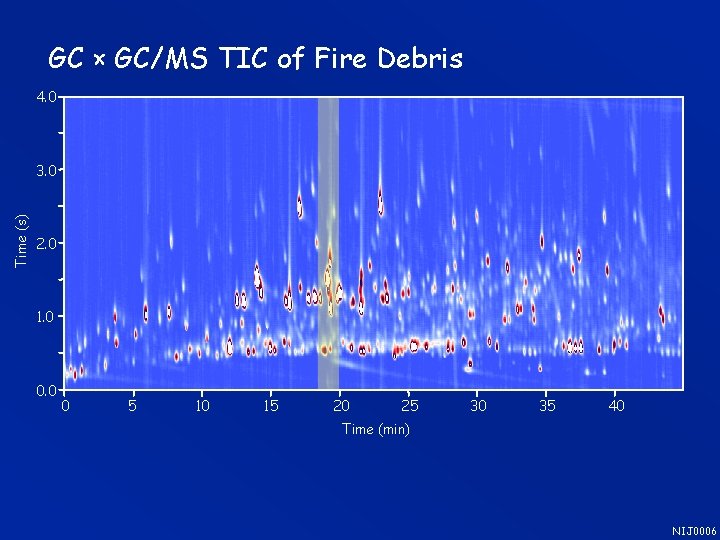
GC × GC/MS TIC of Fire Debris 4. 0 Time (s) 3. 0 2. 0 1. 0 0 5 10 15 20 25 30 35 40 Time (min) NIJ 0006
GC/MS 51 118 77 63 103 91 115 121 Experiment m/z 120 C 3 -Benzenes 15 20 25 NIJ 0022, NIJ 0023
GC × GC/MS TIC of Fire Debris 4. 0 Time (s) 3. 0 2. 0 1. 0 0 5 10 15 20 25 30 35 40 Time (min) NIJ 0006
121 GC × GC/MS TIC 79 N 4. 0 106 118 51 78 3. 0 91 63 Time (s) 103 105 2. 0 77 120 91 43 1. 0 41 O 58 57 69 85 142 71 0. 0 20 112 142
Fire Debris Analysis – ASTM E 1618
Gasoline – Target Compound Analysis 1, 3, 5 -trimethylbenzene 1, 2, 4 -trimethylbenzene 1, 2, 3 -trimethylbenzene indan 2 -methylindan 1, 2, 4, 5 -tetramethylbenzene 1, 2, 3, 5 -tetramethylbenzene 5 -methylindan 4 -methylindan tetrahydronaphthalene 2 -methylnaphthalene 1 -methylnaphthalene 2 -ethylnaphthalene 1, 3 -dimethylnaphthalene 2, 3 -dimethylnaphthalene C 3 Benzenes C 4 Benzenes C 1 Naphthalenes C 2 Naphthalenes Target compounds are often identified based on 1 D retention and ratios of molecular or fragment ions.
GCImage screen capture GC × GC of Fire Debris IS NIJ 0221
100 GC × GC/MS Mass Spectra 105 80 60 40 77 20 120 91 1, 3, 5 - trimethylbenzene 0 105 100 80 60 40 77 20 120 91 1, 2, 4 - trimethylbenzene 0 105 100 80 60 40 20 0 77 120 91 1, 2, 3 - trimethylbenzene
GCImage screen capture GC × GC/MS m/z 120 Extracted m/z 120 is the molecular ion for the C 3 benzene isomers
C 3 B Target Compound GC × GC/MS GCImage screen capture Extract the total ion signal at all places where m/z 105 is the base peak in the mass spectrum
C 3 B Target Compound GC × GC/MS GCImage screen capture Add the condition that m/z 120 abundance must be > 20% of the base peak
C 3 B Target Compound GC × GC/MS GCImage screen capture Add the condition that m/z 91 must be less than 20% of the base peak
C 3 B Target Compound GC × GC/MS GCImage screen capture
GC × GC/MS Mass Spectra 117 100 80 60 115 40 20 132 91 2 - methylindan 77 0 117 100 80 60 115 40 20 91 132 77 0 1 - methylindan 117 100 80 60 115 40 20 132 91 5 - methylindan 77 0 117 100 80 60 115 40 20 0 Peak Selection Rules 91 77 132 4 - methylindan 117 = base peak 115 = 2 nd most abundant 132 > 10% abundant
GCImage screen capture GC × GC/MS m/z 132 Extracted m/z 132 is the molecular ion for the methylindan isomers
GCImage screen capture GC × GC/MS m/z 117 Extracted m/z 117 is the base peak for the methylindan isomers
GCImage screen capture Methyindan Target Compound GC × GC/MS unknown peak
GC × GC/MS Mass Spectra 100 80 115 60 40 20 0 Peak Selection Rules 117 91 77 132 dimethylstyrene (tentative identification) 117 = base peak 115 = 2 nd most abundant 132 > 10% abundant
GC × GC/MS Mass Spectra 100 80 115 60 40 Peak Selection Rules 117 132 91 77 dimethylstyrene (tentative identification) 20 117 = base peak 115 = 2 nd most abundant 132 > 10% abundant 0 New Peak Selection Rules 117 100 80 60 115 40 20 0 91 77 132 2 - methylindan 117 = base peak 115 = 2 nd most abundant 115 < 60% abundant 132 > 10% abundant
GCImage screen capture Methyindan Target Compound GC × GC/MS
Gasoline – Target Compound Analysis 1, 3, 5 -trimethylbenzene 1, 2, 4 -trimethylbenzene 1, 2, 3 -trimethylbenzene indan 2 -methylindan 1, 2, 4, 5 -tetramethylbenzene 1, 2, 3, 5 -tetramethylbenzene 5 -methylindan 4 -methylindan tetrahydronaphthalene 2 -methylnaphthalene 1 -methylnaphthalene 2 -ethylnaphthalene 1, 3 -dimethylnaphthalene 2, 3 -dimethylnaphthalene C 3 Benzenes C 4 Benzenes C 1 Naphthalenes C 2 Naphthalenes
GC × GC/MS Total Ion Chromatogram GCImage screen capture IS ASTM Standard Compounds NIJ 0201 10 µg ASTM standard mix
GC × GC/MS Total Ion Chromatogram GCImage screen capture 1 ng each compound on column IS ASTM Standard Compounds NIJ 0201 10 µg ASTM standard mix
GC × GC/MS Total Ion Chromatogram GCImage screen capture IS 75% Weathered Gasoline NIJ 0220 100 µg 75% Wx gasoline
GC × GC/MS Template Results 75% Weathered Gasoline GCImage screen capture
GC × GC/MS Total Ion Chromatogram GCImage screen capture Fire Debris NIJ 0221 100 µg 75% Wx gasoline / nylon carpet matrix
GC × GC/MS Total Ion Chromatogram GCImage screen capture Nylon Matrix NIJ 0217 nylon carpet matrix
1 -methylnaphthalene Matrix 2 -methylnaphthalene Fire Debris = Gasoline + Matrix Gasoline IS dodecane tetrahydronaphthalene 4 -methylindan 5 -methylindan 1, 2, 3, 5 -tetramethylbenzene 1, 2, 4, 5 -tetramethylbenzene 1 -methylindan 2 -methyindan 1, 2, 3 -trimethylbenzene 1, 2, 4 -trimethylbenzene 1, 3, 5 -trimethylbenzene Peak Volume
GC × GC/MS Total Ion Chromatogram GCImage screen capture 56 Peak Aromatics Template 75% Weathered Gasoline NIJ 0220 100 µg 75% Wx gasoline
GC × GC/MS Total Ion Chromatogram GCImage screen capture 56 Peak Aromatics Template (46 of 56 matched) Fire Debris NIJ 0221 100 µg 75% Wx gasoline / nylon carpet matrix
GC × GC/MS Peak Deconvolution GCImage screen capture NIJ 0221 100 µg 75% Wx gasoline / nylon carpet matrix
Observations 1. GC × GC/MS offers solutions to problems inherent in the GC/MS analysis of complex fire debris samples. 2. Target compounds can be selected and identified in GC × GC/MS data with MS-based algorithms. 1. “Target Compound Chromatograms” 3. Target compounds can be selected and identified with templates matched by two-dimensional retention time position, and MS algorithm or MS probability.
What’s Next 1. Chemometric data analysis. 2. Chemometric analysis with peak tables produced from GC × GC chromatograms. 3. Chemometric analysis with GC × GC images. 4. LCDR Greg Hall, April 3, 2007 • • • Image alignment Image normalization PCA, PLS DA, PARAFAC
Acknowledgements National Institute of Justice U. S. Coast Guard Academy Leco GC Image This project was supported by Grant Number (2002 -RB-052) awarded by the National Institute of Justice, Office of Justice Programs, US Department of Justice. Points of view in this document are those of the author and do not necessarily represent the official position or policies of the US Department of Justice.