
Application of blind deconvolution to Adaptive Optics Imaging
Application of “blind” deconvolution to Adaptive Optics Imaging Julian C. Christou Center for Adaptive Optics
Adaptive Optics Imaging • Quality of compensation depends upon: – – – – Wavefront sensor Signal strength & signal stability Speckle noise (d / r 0) Duty cycle (t / t 0) Sensing & observing λ Wavefront reconstructor & geometry Object extent Anisoplanatism (off-axis)
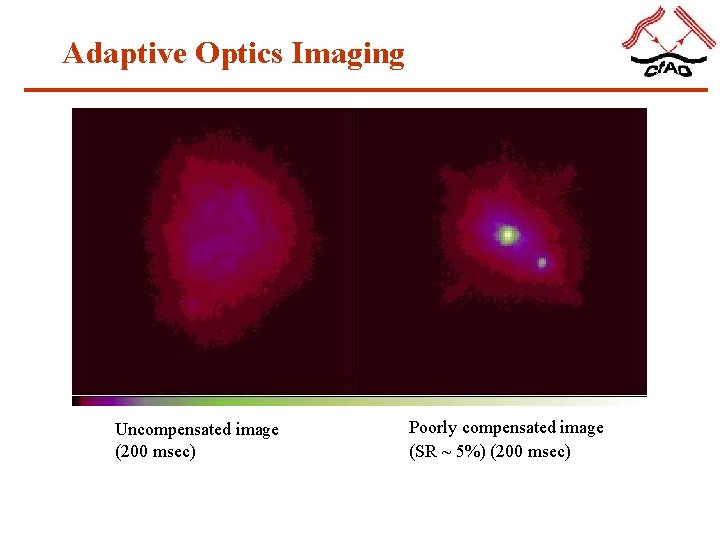
Adaptive Optics Imaging Uncompensated image (200 msec) Poorly compensated image (SR ~ 5%) (200 msec)
Adaptive Optics Point Spread Function Variability • Differences in Target & Reference compensation due to: • Temporal variability (changing r 0 & t 0). • Object dependency (extent and brightness) • full & sub-aperture tilt measurements • Spatial variability • Adaptive Optics PSFs are poorly determined.
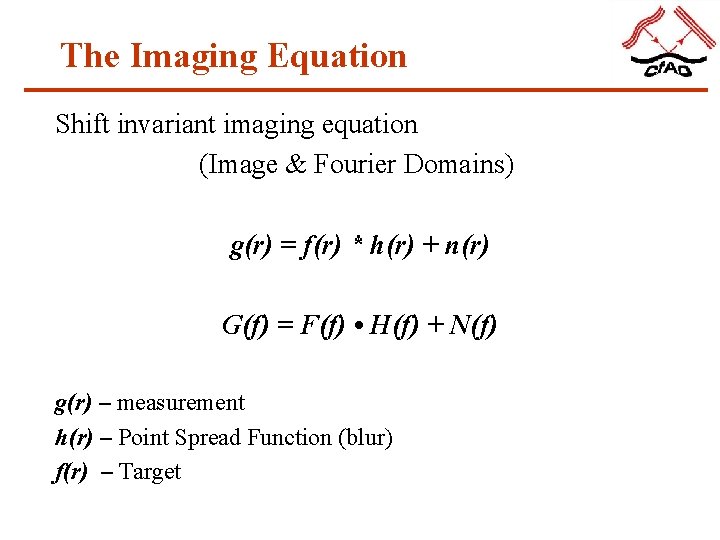
The Imaging Equation Shift invariant imaging equation (Image & Fourier Domains) g(r) = f(r) * h(r) + n(r) G(f) = F(f) • H(f) + N(f) g(r) – measurement h(r) – Point Spread Function (blur) f(r) – Target
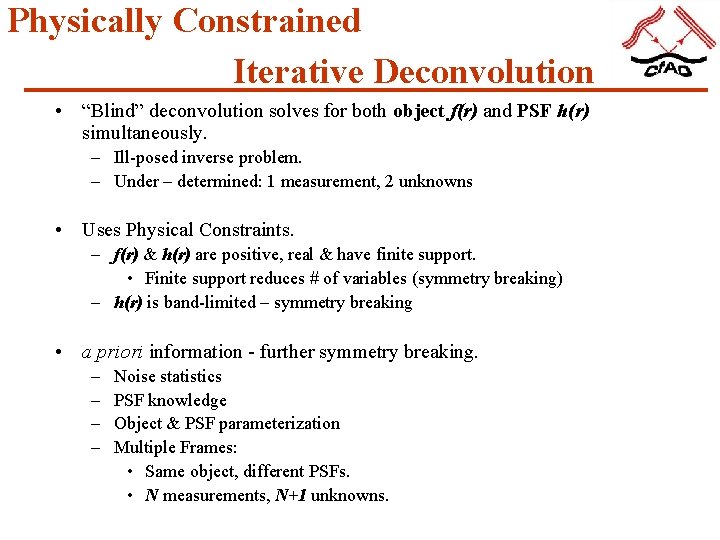
Physically Constrained Iterative Deconvolution • “Blind” deconvolution solves for both object f(r) and PSF h(r) simultaneously. – Ill-posed inverse problem. – Under – determined: 1 measurement, 2 unknowns • Uses Physical Constraints. – f(r) & h(r) are positive, real & have finite support. • Finite support reduces # of variables (symmetry breaking) – h(r) is band-limited – symmetry breaking • a priori information - further symmetry breaking. – – Noise statistics PSF knowledge Object & PSF parameterization Multiple Frames: • Same object, different PSFs. • N measurements, N+1 unknowns.
idac – iterative deconvolution algorithm in c • Developed at Steward Observatory – Authors – Keith Hege, Matt Chesalka – Collaborators - Stuart Jefferies & Julian Christou • Available to download from SO & Cf. AO – http: //babcock. ucsd. edu/cfao_ucsd/idac_package/idac_index. html – http: //bach. as. arizona. edu/~hege/docs/idac. html • “blind” and fixed PSF multi-frame deconvolution

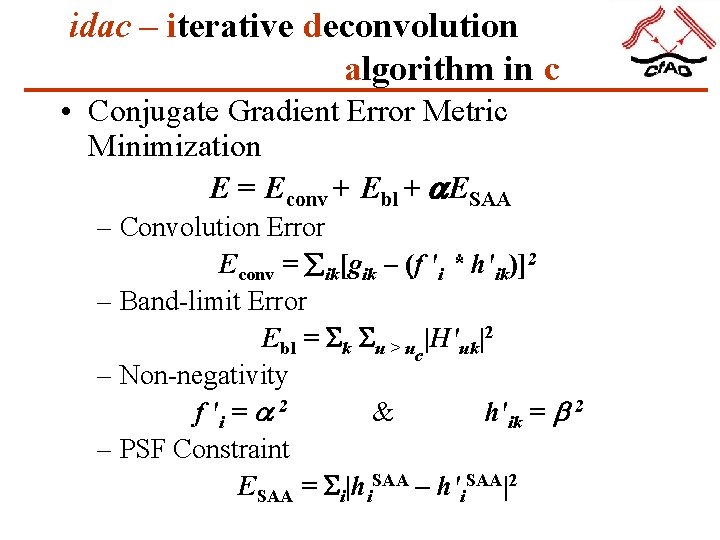
idac – iterative deconvolution algorithm in c • Conjugate Gradient Error Metric Minimization E = Econv + Ebl + ESAA – Convolution Error Econv = ik[gik – (f 'i * h'ik)]2 – Band-limit Error Ebl = k u > uc|H'uk|2 – Non-negativity f 'i = 2 & h'ik = 2 – PSF Constraint ESAA = i|hi. SAA – h'i. SAA|2
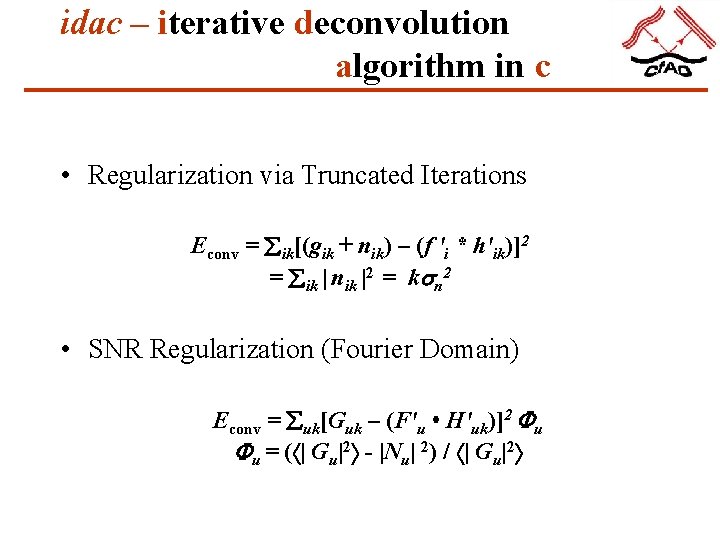
idac – iterative deconvolution algorithm in c • Regularization via Truncated Iterations Econv = ik[(gik + nik) – (f 'i * h'ik)]2 = ik | nik |2 = k n 2 • SNR Regularization (Fourier Domain) Econv = uk[Guk – (F'u • H'uk)]2 u u = ( | Gu|2 - |Nu| 2) / | Gu|2
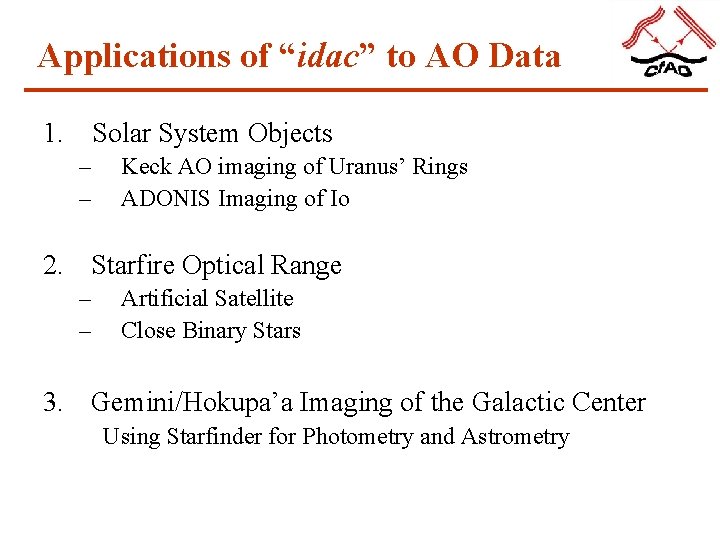
Applications of “idac” to AO Data 1. Solar System Objects – – Keck AO imaging of Uranus’ Rings ADONIS Imaging of Io 2. Starfire Optical Range – – Artificial Satellite Close Binary Stars 3. Gemini/Hokupa’a Imaging of the Galactic Center Using Starfinder for Photometry and Astrometry
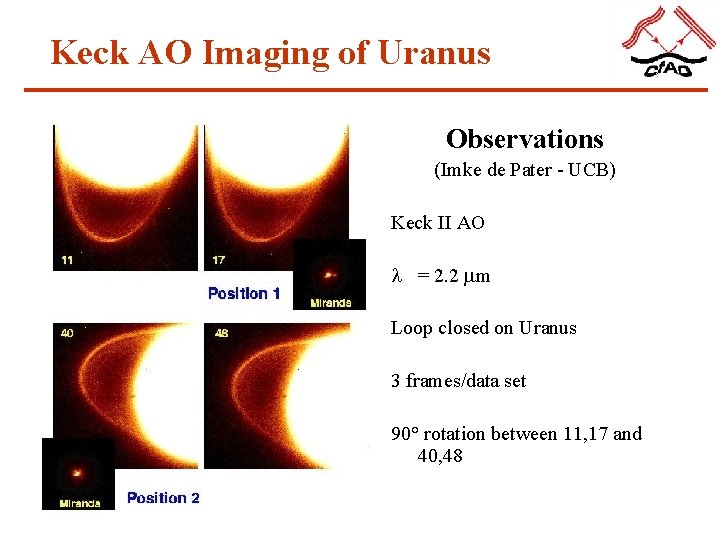
Keck AO Imaging of Uranus Observations (Imke de Pater - UCB) Keck II AO l = 2. 2 m Loop closed on Uranus 3 frames/data set 90° rotation between 11, 17 and 40, 48
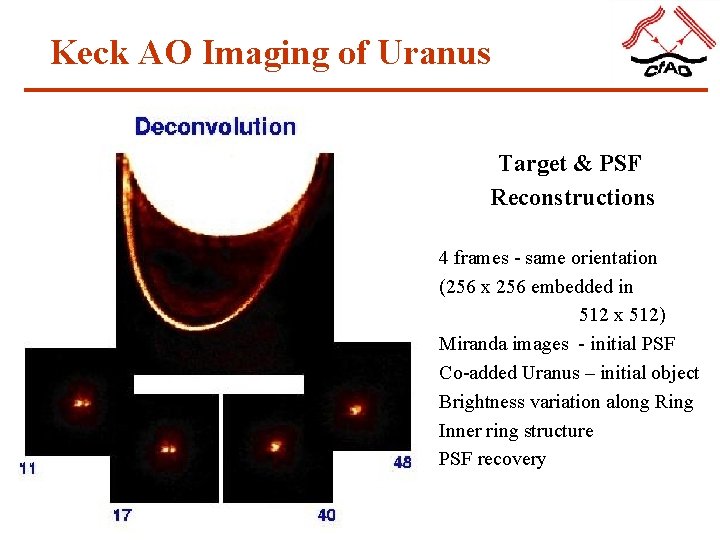
Keck AO Imaging of Uranus Target & PSF Reconstructions 4 frames - same orientation (256 x 256 embedded in 512 x 512) Miranda images - initial PSF Co-added Uranus – initial object Brightness variation along Ring Inner ring structure PSF recovery
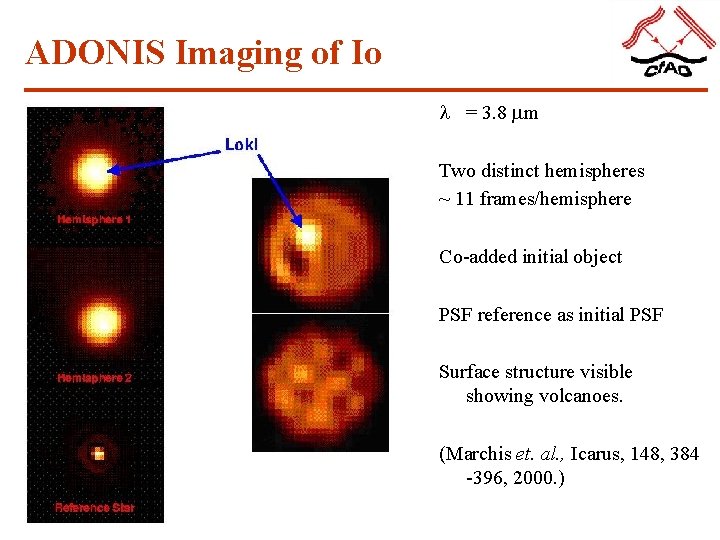
ADONIS Imaging of Io l = 3. 8 m Two distinct hemispheres ~ 11 frames/hemisphere Co-added initial object PSF reference as initial PSF Surface structure visible showing volcanoes. (Marchis et. al. , Icarus, 148, 384 -396, 2000. )
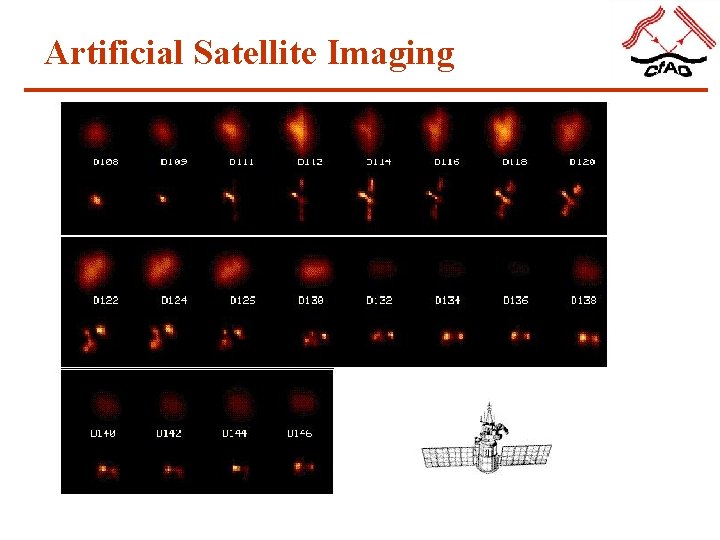
Artificial Satellite Imaging
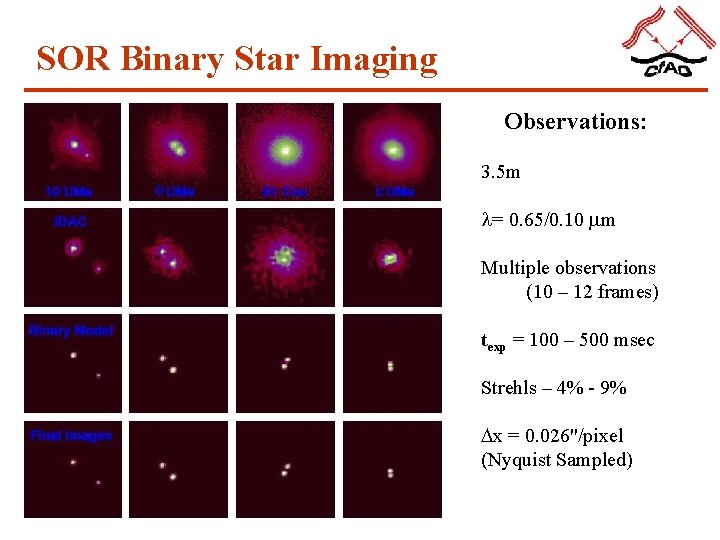
SOR Binary Star Imaging Observations: 3. 5 m l= 0. 65/0. 10 m Multiple observations (10 – 12 frames) texp = 100 – 500 msec Strehls – 4% - 9% x = 0. 026"/pixel (Nyquist Sampled)
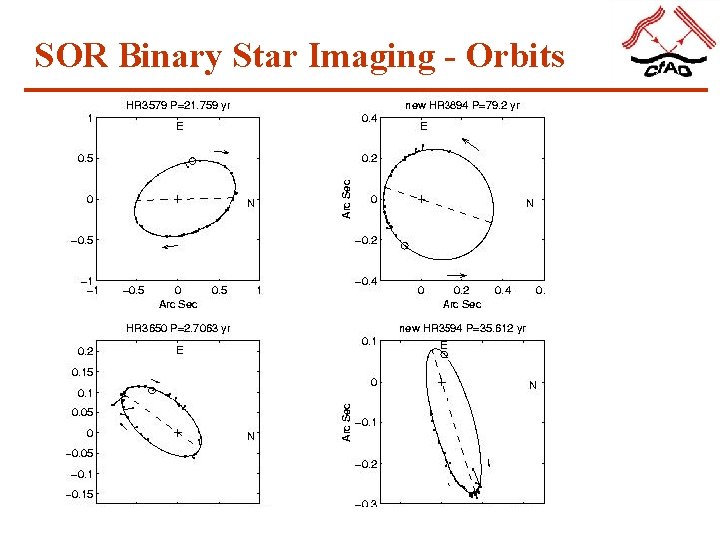
SOR Binary Star Imaging - Orbits
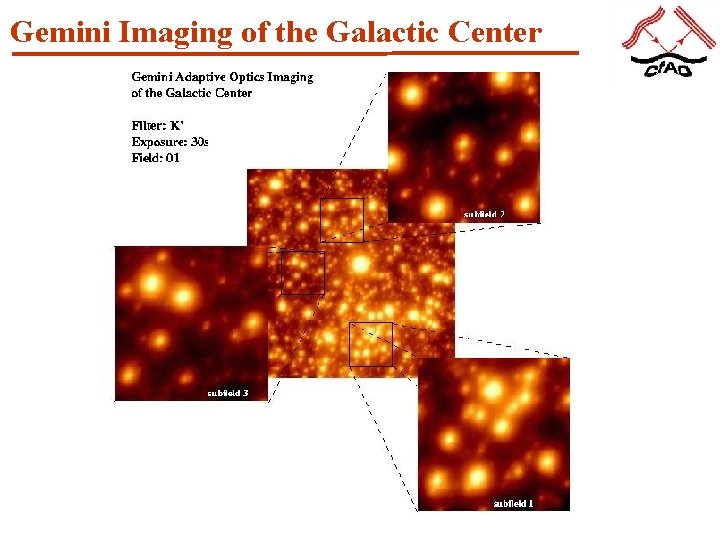
Gemini Imaging of the Galactic Center
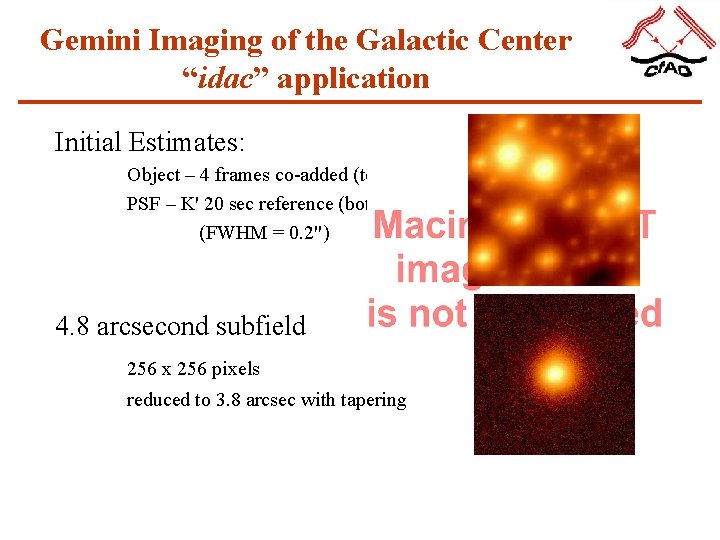
Gemini Imaging of the Galactic Center “idac” application Initial Estimates: Object – 4 frames co-added (top) PSF – K' 20 sec reference (bottom) (FWHM = 0. 2") 4. 8 arcsecond subfield 256 x 256 pixels reduced to 3. 8 arcsec with tapering
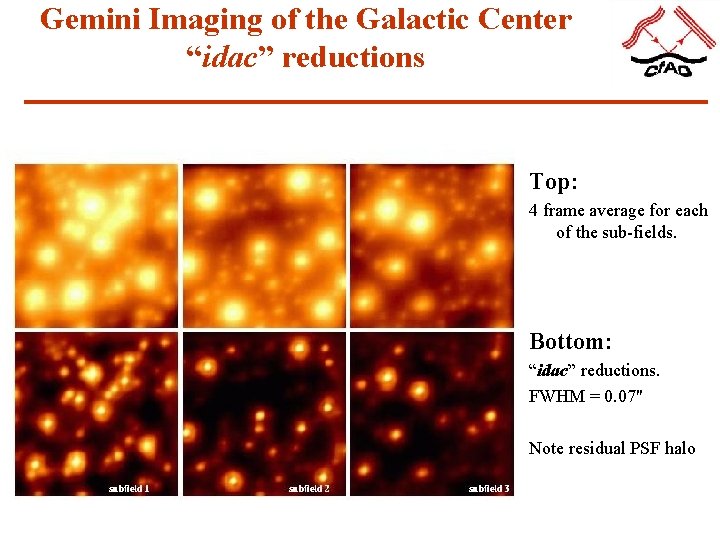
Gemini Imaging of the Galactic Center “idac” reductions Top: 4 frame average for each of the sub-fields. Bottom: “idac” reductions. FWHM = 0. 07" Note residual PSF halo
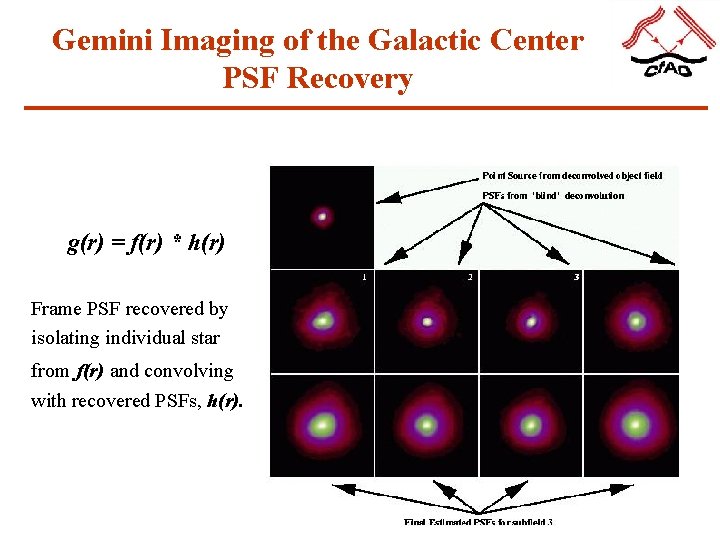
Gemini Imaging of the Galactic Center PSF Recovery g(r) = f(r) * h(r) Frame PSF recovered by isolating individual star from f(r) and convolving with recovered PSFs, h(r).
Gemini Imaging of the Galactic Center Further Object Recovery • Data Reduction Outline – “Blind” Deconvolution to obtain target & PSF – Estimate PSF from isolated star and h(r) – “Known” Deconvolution using estimated PSF – “Blind” Deconvolution to relax PSF estimates
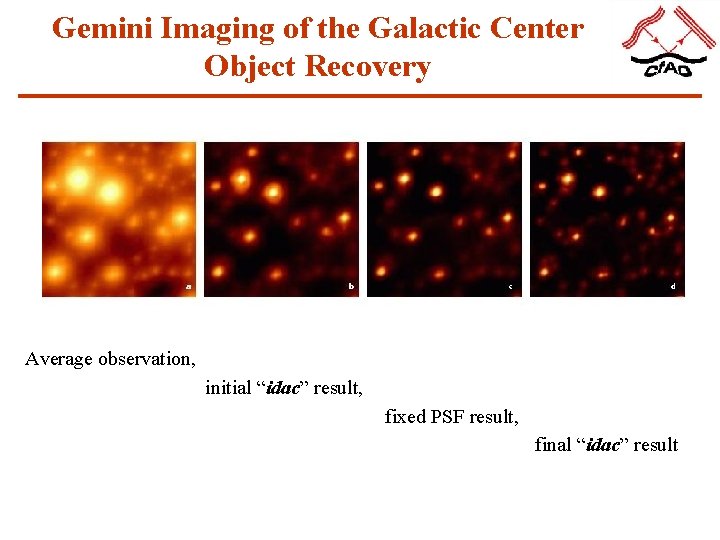
Gemini Imaging of the Galactic Center Object Recovery Average observation, initial “idac” result, fixed PSF result, final “idac” result
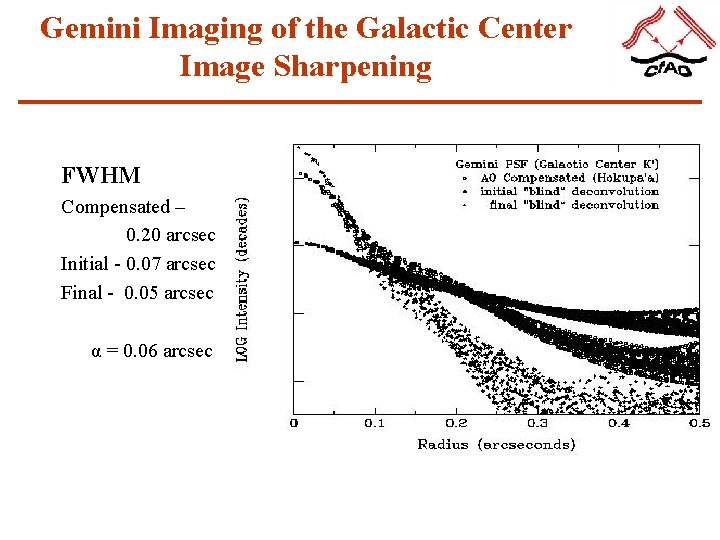
Gemini Imaging of the Galactic Center Image Sharpening FWHM Compensated – 0. 20 arcsec Initial - 0. 07 arcsec Final - 0. 05 arcsec α = 0. 06 arcsec
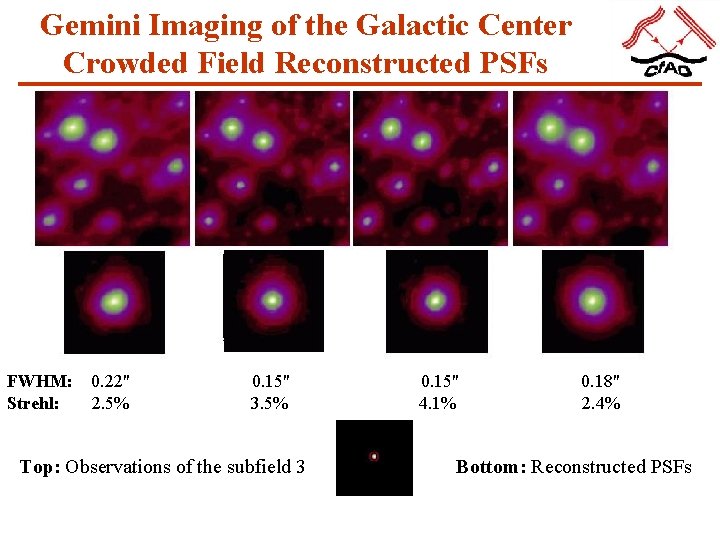
Gemini Imaging of the Galactic Center Crowded Field Reconstructed PSFs FWHM: Strehl: 0. 22" 2. 5% 0. 15" 3. 5% Top: Observations of the subfield 3 0. 15" 4. 1% 0. 18" 2. 4% Bottom: Reconstructed PSFs
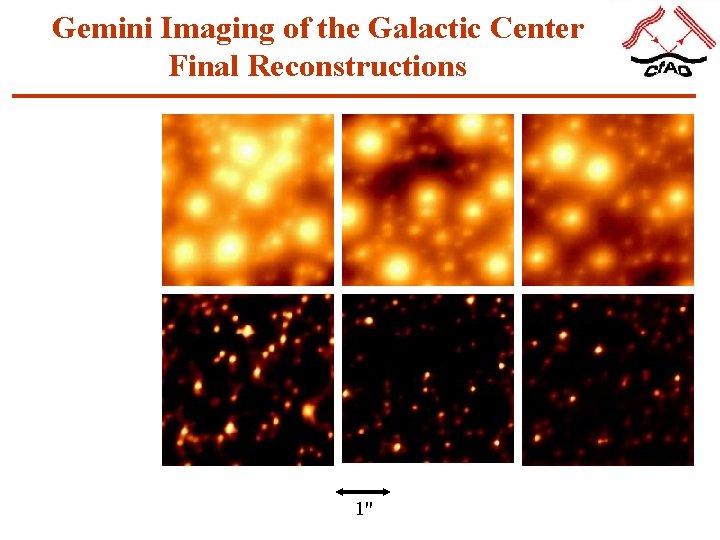
Gemini Imaging of the Galactic Center Final Reconstructions 1"
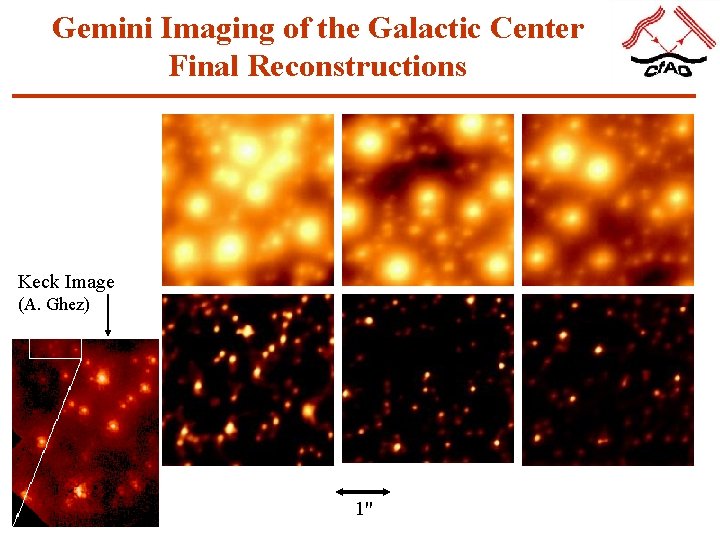
Gemini Imaging of the Galactic Center Final Reconstructions Keck Image (A. Ghez) 1"
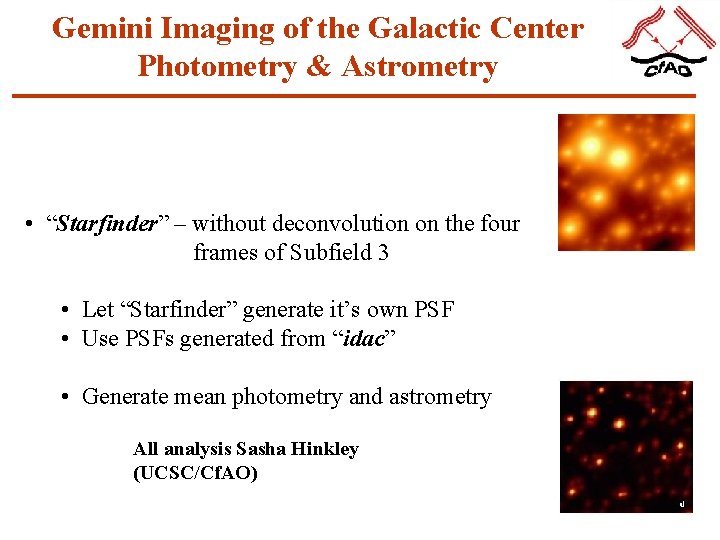
Gemini Imaging of the Galactic Center Photometry & Astrometry • “Starfinder” – without deconvolution on the four frames of Subfield 3 • Let “Starfinder” generate it’s own PSF • Use PSFs generated from “idac” • Generate mean photometry and astrometry All analysis Sasha Hinkley (UCSC/Cf. AO)
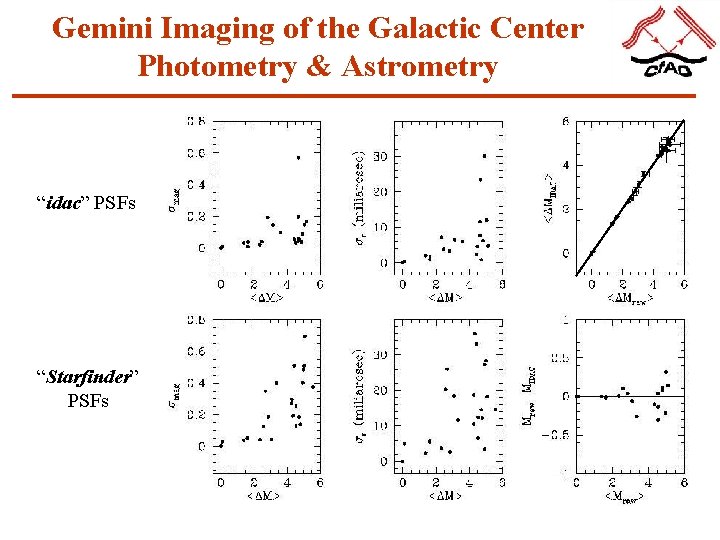
Gemini Imaging of the Galactic Center Photometry & Astrometry “idac” PSFs “Starfinder” PSFs
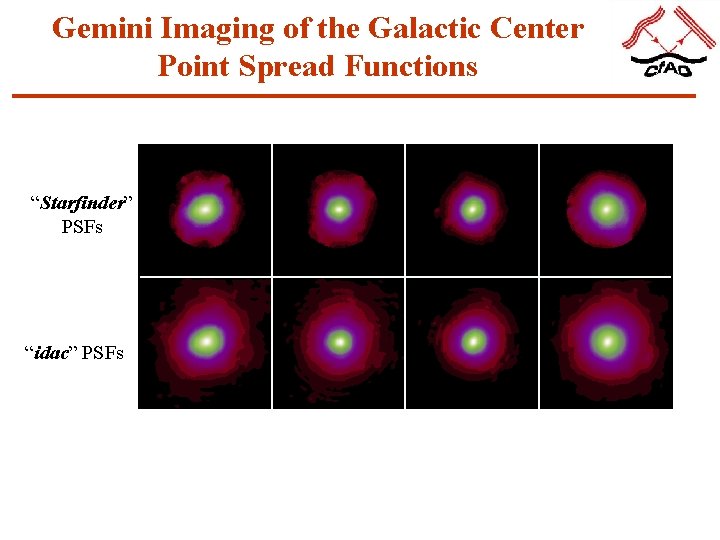
Gemini Imaging of the Galactic Center Point Spread Functions “Starfinder” PSFs “idac” PSFs
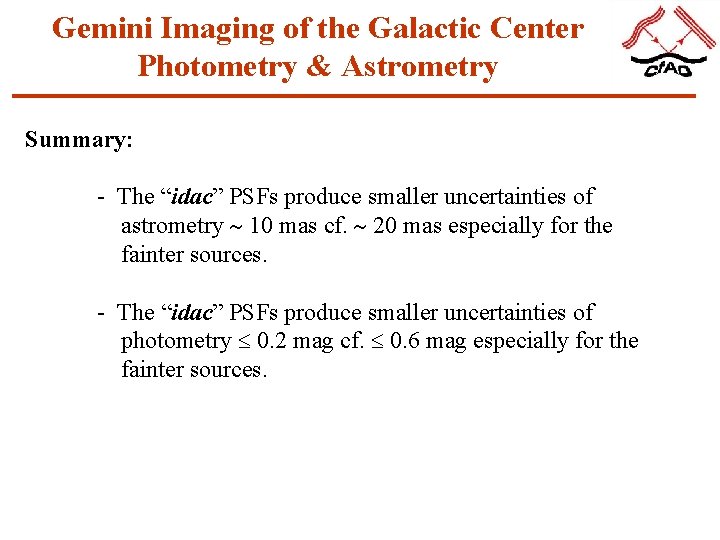
Gemini Imaging of the Galactic Center Photometry & Astrometry Summary: - The “idac” PSFs produce smaller uncertainties of astrometry 10 mas cf. 20 mas especially for the fainter sources. - The “idac” PSFs produce smaller uncertainties of photometry 0. 2 mag cf. 0. 6 mag especially for the fainter sources.
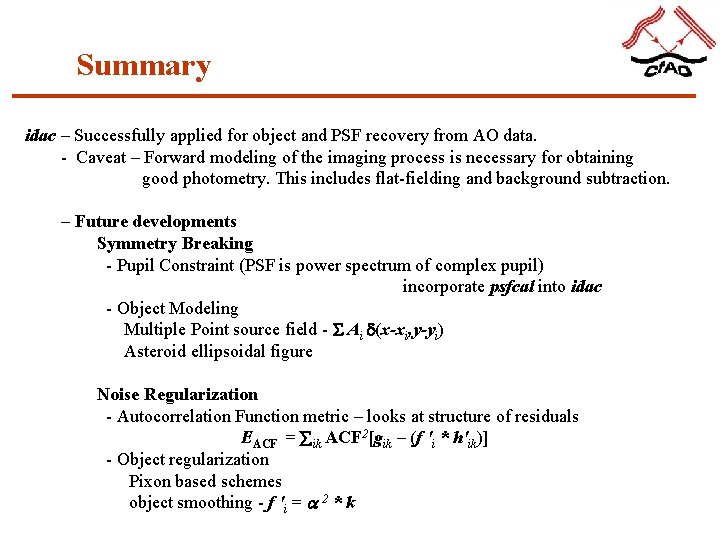
Summary idac – Successfully applied for object and PSF recovery from AO data. - Caveat – Forward modeling of the imaging process is necessary for obtaining good photometry. This includes flat-fielding and background subtraction. – Future developments Symmetry Breaking - Pupil Constraint (PSF is power spectrum of complex pupil) incorporate psfcal into idac - Object Modeling Multiple Point source field - Ai (x-xi, y-yi) Asteroid ellipsoidal figure Noise Regularization - Autocorrelation Function metric – looks at structure of residuals EACF = ik ACF 2[gik – (f 'i * h'ik)] - Object regularization Pixon based schemes object smoothing - f 'i = 2 * k
- Slides: 32