
Application of Apriori Algorithm to Derive Association Rules

- Slides: 16
Application of Apriori Algorithm to Derive Association Rules Over Finance Data Set Presented By Kallepalli Vijay Instructor: Dr. Ruppa Thulasiram
Agenda l l l Introduction Motivation Background Solution Results Conclusion and Future work
Introduction l Stock exchanges maintain a log of events – l l l rise in stock price, option value, number of stocks sold Investors predict the market trends based on available log information Stock market is highly unpredictable The values in the log change very drastically with time
Introduction (Con…) l If investors are given adequate information – l regarding stock market trends Investors can invest money accordingly – maximum profits.
Motivation l l l Data in the log is very huge Data contains hidden details Manually identifying the hidden details – l l cumbersome process Apply Apriori to retrieve hidden details Prior deriving large item data has to be classified
Background l l l Data mining: A process of extracting unknown patterns, facts and relations from large database Data mining means knowledge discovery from large databases Association rules in data mining involves in detecting which items tend to occur together in transactions
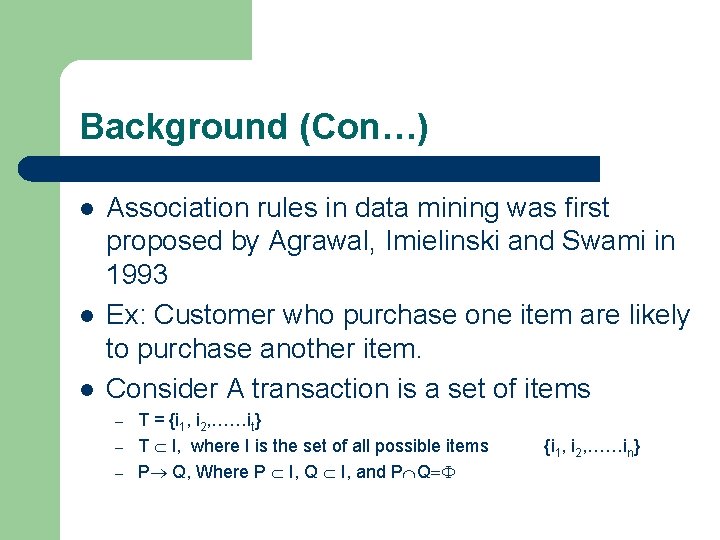
Background (Con…) l l l Association rules in data mining was first proposed by Agrawal, Imielinski and Swami in 1993 Ex: Customer who purchase one item are likely to purchase another item. Consider A transaction is a set of items – – – T = {i 1, i 2, ……it} T I, where I is the set of all possible items P Q, Where P I, Q I, and P Q {i 1, i 2, ……in}
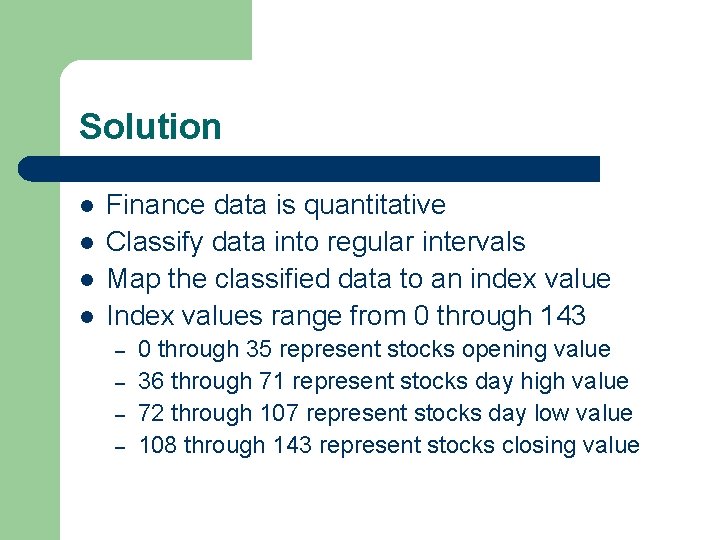
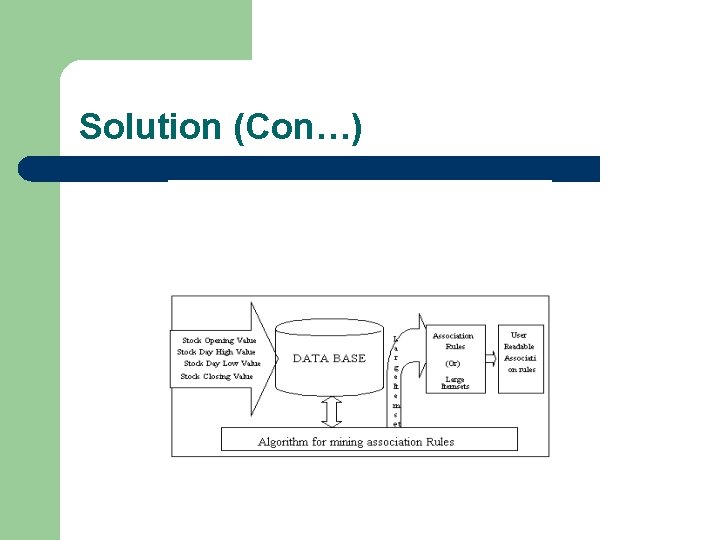
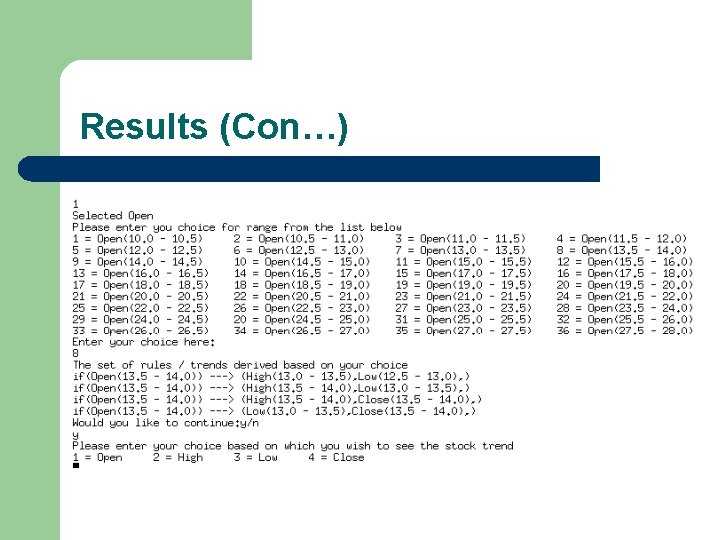
Solution l l Finance data is quantitative Classify data into regular intervals Map the classified data to an index value Index values range from 0 through 143 – – 0 through 35 represent stocks opening value 36 through 71 represent stocks day high value 72 through 107 represent stocks day low value 108 through 143 represent stocks closing value
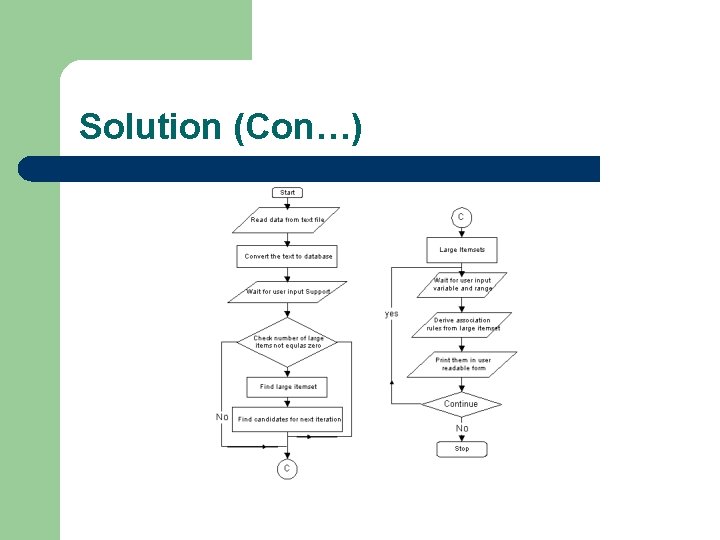
Solution (Con…) l l Finance data of the Apple Computers Inc is read from a text file Eg 1: Stock opening value ranging between 10. 0 and 10. 5 is mapped to an index value 0 Eg 2: Stock high value ranging between 10. 0 and 10. 5 is mapped to an index value 36 Apply Apriori algorithm on the mapped indices to derive association rules
Solution (Con…)
Solution (Con…)
Results
Results (Con…)
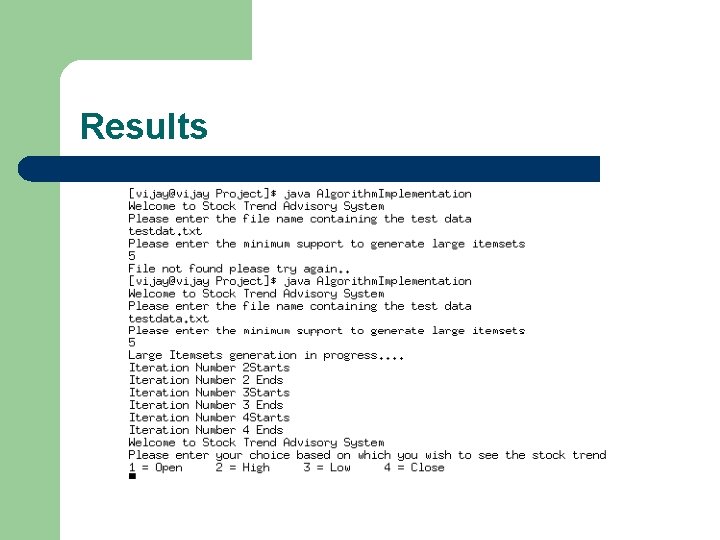
Conclusions & Future work l l Manually identifying hidden details is a tedious process Classified the collected data into regular intervals Applied apriori algorithm to derive large item sets Derived large item sets and projected to the user in user readable form
Conclusions & Future work (Con…) l l Classification of data plays important role Correctness of association rules depends on the classification of the data Selecting the length of the interval for classification is difficult Fuzzy logic can applied on the data for classification
Thanks!